
Introduction
The Australian Defence Force (ADF) must understand how new digital technologies enhance capability to safeguard against cognitive threats in the information environment.
The information environment (IE) is dynamic, interconnected, highly participatory and instantaneous.1 It is comprised of three dimensions: the physical, virtual and cognitive (see Figure 1).2
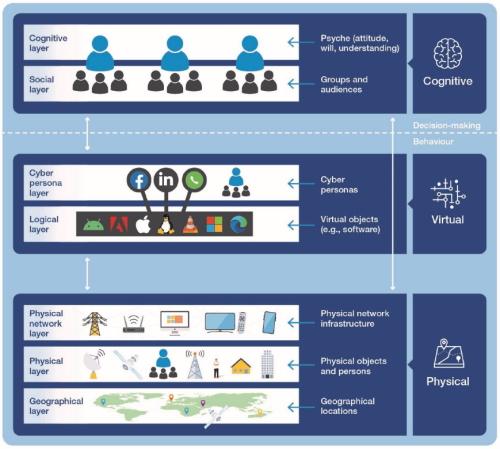
Mis/dis/ and malinformation3, unstable regional and global actors, and continual advancement of digital technologies shape the IE. Misinformation is the misleading and unintentional spread of information, while disinformation is the deliberate dissemination of fake or misleading information. Furthermore, malinformation is accurate information presented out of context to mislead or cause harm.
Smartphones, social media and algorithms have enabled the instant global spread of information, capable of directly reaching specific audiences. This constant, real-time flow enables actors to shape narratives, persuade and influence public opinion and disrupt military operations.
Operations in the Information Environment have been a consistent feature of warfare. From classical theory to modern-day warfare, actors have refined their operations, and regardless of where target audiences operate, threats will follow.4 As a result, battles now take place in not only the maritime, land and air domains but also within the space and cyber domains, where controlling the narrative can be as critical as controlling territory. In fact, it is capable of shaping cognition, deterring adversary actions and resolving misunderstandings, thereby preventing conflict escalation. In this hyper-connected world, digital technologies have expanded the aperture of war to include Operations in the Information Environment as essential to success.
Historical Perspective of Operations in the Information Environment
Military decision-makers have long recognised the utility of information as a tool for achieving decision, narrative and psychological superiority. They understand that conflict spans not only the physical environment but also the cognitive and informational environments.
Classic texts such as Sun Tzu’s Art of War and Thucydides’ History of the Peloponnesian War underscore the role of deception in warfare. They explain the value of information manipulation and the skilled use of narratives in affecting an adversary’s will to fight.
Operations in the Information Environment were common during WWI, WWII and the Cold War. Actors used narratives to persuade their target audience that success was imminent. At the same time, adversaries disseminated their ideology and sought to exploit internal contradictions within opposing societies.
During WWI, Britain and Germany employed information as a strategic tool using intelligence, propaganda and censorship to understand, shape and control the IE. Some historians view WWI as the beginning of modern information operations (IO), as all sides recognised the importance of controlling information in the conduct of war.
During WWII, military deception played a crucial role in shaping the war’s outcome. Operations such as FORTITUDE, MINCEMEAT, BODYGUARD and the ‘Ghost Army’ were all aimed at misleading the enemy about the location and timing of Allied attacks. The Political Warfare Executive and the Ministry of Information spearheaded Britain’s information and psychological operations. They sought to boost morale at home and weaken the enemy’s will to fight through propaganda, radio broadcasts and deception tactics.
Operations in the Information Environment matured during the Cold War, as nations engaged in psychological and ideological struggles to influence public opinion and undermine opposing narratives. The US used U-2 photographs to disrupt the narrative of the Union of Soviet Socialist Republics (USSR) regarding missiles in Cuba during proceedings at the United Nations. The US shifted towards covertly distributing banned books and periodicals to intellectuals in the USSR and Eastern Europe as a means of cultural penetration, aiming to counter Soviet influence and promote Western ideals.
The counterinsurgency focus of the past two decades has encouraged a shift towards understanding the need to defeat ideology, rather than forces. This requires winning ‘wars among the people’ by ‘winning hearts and minds’.5
Digital technologies amplify—and will continue to amplify—the speed, scale and reach of information sharing. As such, Information Advantage has become more relevant and important.
Information Advantage is a favourable condition relative to competing entities in the IE, achieved through orchestration of military power.
Therefore, the ADF must enhance its understanding and integration of Operations in the Information Environment to safeguard Australia and its national interests in an increasingly complex and contested landscape.
Digital Technology Factors Disrupting the Information Environment
With the rapid speed of technological change, long, rigid procurement processes are no longer fit for purpose in the information space.
Operations in the Information Environment are continuous and adaptive.6 They integrate information, cyberspace and electromagnetic spectrum operations with Defence strategic communication to achieve narrative, decision and psychological superiority.7 They use information to influence actors and systems, adapting to real-time changes in narratives, behaviours and technological conditions to achieve Information Advantage. Five key factors shape Operations in the Information Environment:
Connectivity. The highly connected IE creates conditions that reward actors for their actions.8 The side that can generate and disseminate credible information more effectively, and efficiently, to its target audience can achieve an Information Advantage. Connectivity is continuous and occurs at scale, which enhances the interconnectedness of actors. Rapidly available and increasingly inexpensive digital technologies are enabling greater participation.
Reach and engagement. Actors can disseminate information to target audiences faster than ever before, with enhanced precision and at a time of their choosing. Social media platforms use algorithms to analyse and shape human behaviour.9 Actors use these platforms to influence target audiences and to shape how those audiences share and engage with information. This can increase or decrease engagement, providing actors with broader power of influence.
Highly participatory. Smartphones and social media are highly participatory technologies that significantly influence how citizens engage with, and respond to, military events.10 Citizens actively share their opinions and beliefs using digital technologies that amplify the reach and effect of these expressions.11 This offers both an opportunity and a challenge. An opportunity is that it increases trust in institutions. However, this opportunity may also present a challenge, as adversaries can target those institutions with mis/dis/malinformation and fake news.
Instantaneous information. Digital technologies enable the instant sharing of information.12 Actors use digital technologies to propagate their narratives, which can undermine Australia’s national interests in near real time. This requires the ADF and the wider National Intelligence Community to process an overwhelming volume of information at the tactical, operational and strategic levels. The ADF must adapt its decision-making processes to the lowest possible level, enhance situational awareness, and plan for the effects of a dynamic IE on command manoeuvre.
Rapidly scalable and deployable digital technologies. Driven by public-private partnerships, the ADF must adopt scalable and rapidly deployable digital technologies for Operations in the Information Environment to achieve Information Advantage. The ADF must assess digital technologies against appropriate risk thresholds to ensure they are fit for purpose, operate with agility, and meet growth and demand requirements when needed.
Exercising Information Advantage
Today, technology development has created an information environment that is fundamentally different from the past.
As the information landscape becomes increasingly democratised through broad access to open-source and freely available information, it becomes more transparent. This occurs for two reasons.
The first is the loss of state monopoly on information gathering and dissemination. Ubiquitous smartphone and social media use permits forces and citizens to engage and transmit information globally. Commercial entities can now provide access to information previously accessible only through high-end, costly and monopolised technologies such as imagery satellites.
The second is that these types of technologies, raw data, and information are being analysed by a growing community of analysts and researchers.
The emergence of the open-source intelligence profession has eroded some of the state’s monopoly on intelligence collection and analysis. Previously, the state maintained control over the flow of information, with both technologies and actors subject to oversight rules. While Operations in the Information Environment have long been a component of state power, information was limited to the speed and reach of the means of transmission usually controlled by large institutions, such as governments or print media outlets. This is no longer the situation. As the speed and reach of information increases, it will impose enduring strategic implications for the ADF and the Australian Government.
The mass adoption of smartphones and social media has blurred territorial boundaries and legal responsibilities, enabling a wide range of actors to exploit the IE and erode the ability of governments to shape and influence the information space. Adversaries continue to target audiences to create division, disrupt social cohesion and undermine trust in government, often with anonymity. This takes advantage of an open global economy and democratic societies with their commitment to free speech. Efforts to counter foreign interference and deliberate disinformation can lead to further erosion of public trust in government.13
Modern Operations in the Information Environment
Modern Operations in the Information Environment require a new mindset (ie new ways to interpret and inference false information) in order to understand and counter disinformation campaigns and fake news. Highly trained and skilled operators must understand and adapt to the rapidly changing information environment in order to achieve Information Advantage.
While actors seek to shape the IE, they erode trust and confidence in legacy media and advance their own interests. The changing character of war in the IE has also enabled social media to become a critical source for legacy media. Once a narrative is established, it often provides actors (and adversaries in the spectrum of competition scenarios) to be better postured to promote their interests.
Western societies are more open to psychological and cognitive warfare because the openness of their media and social systems differs from those of authoritarian states. Vulnerability asymmetry is an important factor in achieving Information Advantage. Adversaries tasked with creating Information Advantage exploit these asymmetries. For example, information created or collected about ADF personnel enables adversaries to understand and target them, and to attempt to shape their cognition.
Authoritarian regimes tend to control media and public expression as a means of supporting their legitimacy. This also makes their population less vulnerable to broad-based information campaigns from external sources.
Western societies are generally reluctant to engage in information operations that target the civilian populations of other countries outside of wartime. This is due to ethical and moral reasons as well as to uphold democratic principles. For these reasons, authoritarian regimes view Information Advantage as a favourable asymmetry; highlighting the importance of Operations in the Information Environment to offset adversarial campaigns against ADF personnel and to protect them from the malign effects of foreign powers.
Conclusion
The ADF must adapt to the dynamic information environment by acting thoughtfully, adjusting quickly and responding effectively to achieve Information Advantage.
A key factor in battling mis/dis and malinformation is providing personnel with better situational awareness of the IE. When personnel can readily identify authentic information, they are better able to respond to and safeguard against cognitive threats
As smartphones, social media and algorithms continue to proliferate, more information will be generated and shared, and mis/dis and malinformation will inevitably continue. This paper has presented historical and modern day Operations in the Information Environment and digital technology factors disrupting the information landscape. This paper has also outlined the shift to a more synchronised and interconnected environment, changing how actors participate and engage. Therefore, the changing IE increases the interplay between the physical battlefield and virtual space, leading to non-kinetic effects having significant implications on the modern day battlefield.
1David Kolevski, ‘The invisible frontline: Why the next war will be won in your mind,’ The Forge, (2025) https://theforge.defence.gov.au/article/invisible-frontline-why-next-war-will-be-won-your-mind
2NATO Standard AJP-10.1 Allied Joint Doctrine for Information Operations, Ed. A Version 1, January (2023).
3Elena Broda and Jesper Stromback, ‘Misinformation, disinformation, and fake news: lessons from an interdisciplinary, systematic literature review,’ Annals of the International Communication Association 48, no. 2 (2024) https://doi.org/10.1080/23808985.2024.2323736
4‘Weaponization of the Information Environment: The Need for Cognitive Security,’ Information Professionals Association, (2025), https://information-professionals.org/weaponization-of-the-information-environment-the-need-for-cognitive-security/
5General Sir Rupert Smith, ‘The Utility of Force: The Art of War in the Modern World (2005), Penguin UK.
6The Online Information Environment: Understanding How the Internet Shapes People’s Engagement with Scientific Information, The Royal Society, (2022), 6 – 9 Carlton House Terrace London SW1Y 5AG: The Royal Society. https://royalsociety.org/-/media/policy/projects/online-information-environment/the-online-information-environment.pdf
7David Kolevski, ‘The invisible frontline: Why the next war will be won in your mind,’ The Forge, (2025). https://theforge.defence.gov.au/article/invisible-frontline-why-next-war-will-be-won-your-mind
8Abhijeet Satani et al, ‘Modern Day High: The Neurocognitive Impact of Social Media Usage,’ Cureus 17, no. 7 (2025): e87496, https://doi.org/10.7759/cureus.87496
9Tahereh Saheb, Mouwafac Sidaoui and Bill Schmarzo, ‘Convergence of Artificial Intelligence with Social Media: A Bibliometric & Qualitative Analysis,’ Telematics and Informatics Reports 14, no. 100146 (2024): 1 – 14, https://doi.org/10.1016/j.teler.2024.100146
10Matthew Ford, ‘From innovation to participation: connectivity and the conduct of contemporary warfare,’ International Affairs 100, no. 4 (2024): 1531 – 1549, https://doi.org/10.1093/ia/iiae061
11Dirk Helbing et al, ‘Democracy by Design: Perspectives for Digitally Assisted, Participatory Upgrades of Society,’ Journal of Computational Science 71 (2023): 102061, https://doi.org/10.1016/j.jocs.2023.102061
12Esma Aimeur, Sabrine Amri and Gilles Brassard, ‘Fake News, Disinformation and Misinformation in Social Media: A Review,’ Social Network Analysis and Mining 13, no. 1 (2023): 1 – 36, https://doi.org/10.1007/s13278-023-01028-5
13Lawrence Freedman, ‘Strategy: A History’ (2015) Oxford University Press.
Defence Mastery
Social Mastery

Biography
Dr David Kolevski
Information Environment Analyst, Information Advantage Centre of Excellence (IACOE)
Doctor
The IACOE was formally established within Joint Capabilities Group in 2024 to develop, prepare and generate ADF capability and capacity to conduct operations in the information environment as an essential element of Australia’s military power.
Weapons of the Mind: How Digital Tech is Undermining ADF Cognition and Advantage © 2026 by . This work is licensed under CC BY-NC-ND



Please let us know if you have discovered an issue with the content on this page.
Comments
Continue the conversation by sharing your thoughts! Please login to comment. If you don't yet have an account registration is quick and easy.




An informative paper (not analytical) forecasting capability enhancements in ADF's operations in the information environment.