Executive Summary
This paper opens with a proposition: protected vehicle survivability is not an armour problem. It is a systems problem.
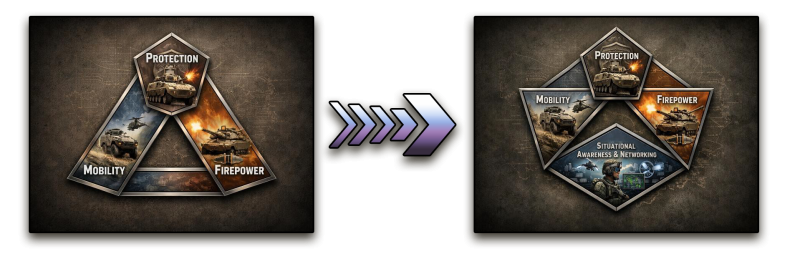
To make this explicit, a Survivability Matrix is presented at the outset. The matrix reframes survivability as a dynamic, mission-dependent outcome shaped by trade-offs between protection, mobility, firepower, and situational awareness. It challenges the enduring assumption that increased armour equates to increased combat effectiveness.
Survivability should be integrated throughout the layers of detection, avoidance, defeat, mitigation, and recovery, and carefully balanced with considerations for human performance, mobility, and sustainment requirements.
The iron triangle of armoured vehicle design—firepower, mobility, and protection—no longer captures operational reality. Contemporary conflict demonstrates that:
- More Protection = Less Mobility. Additional armour increases mass, reduces agility, increases fuel demand, stresses drivetrains, and degrades strategic deployability.
- More Firepower = Less Protection or Mobility. Larger turrets and heavier weapon systems demand structural reinforcement, increase centre of gravity, and force trade-offs in armour thickness or mobility margins.
- More Protection does not automatically equal more survivability. Over-armoured platforms can reduce visibility, increase crew fatigue, degrade situational awareness, and ultimately erode decision quality.
The battlefield has evolved faster than procurement habits. Platforms optimised for counter-IED operations in Iraq and Afghanistan now face peer and near-peer adversaries employing heavy machine guns, medium-calibre cannons, loitering munitions, electronic warfare, and persistent ISR networks. Survivability is no longer defined solely by underbody or ballistic resistance.
The lessons of contemporary war demand an update to the traditional triangle. This paper proposes a quad model: firepower, mobility, protection, and situational awareness and networking as a co-equal design pillar. A vehicle that cannot see, share, and decide quickly is vulnerable regardless of armour thickness.
The protected vehicle market now faces a structural mismatch between legacy design
philosophy and current operational demands. Survivability cannot be treated as a static armour specification written into a requirement line item. It must be understood as a system-level, mission-specific outcome shaped by:
- Architecture and weight management
- Human factors and cognitive load
- Modularity and mission reconfiguration
- Camouflage, concealment, and signature management
- Sustainment and production models
The Survivability Matrix presented in this paper visualises these interdependencies and exposes the false simplicity of armour-centric thinking. It provides a framework for balancing protection, mobility, firepower, and awareness in a way that enhances combat effectiveness rather than merely increasing mass.
In short: survivability is not how much armour you carry. It is how effectively you balance trade-offs in order to fight, move, see, adapt, and recover.
This paper explains why that balance must now drive vehicle architecture and procurement strategy.
1. Introduction
Contemporary protected vehicles emerged in response to a specific operational problem: the prevalence of underbody blast threats during counterinsurgency operations in Iraq and Afghanistan. Survivability was therefore defined primarily by a vehicle’s capacity to withstand vertical blast while preserving crew life. The resulting design logic, characterised by V-shaped hulls, elevated ride height, and blast-attenuating seating was coherent and demonstrably effective within that setting.
That operational context no longer dominates. Protected vehicles now confront adversaries equipped with heavy machine guns, medium-calibre autocannons, anti-tank mines, indirect fires, loitering munitions, electronic warfare, and persistent ISR networks. At the same time, platforms have evolved into networked combat nodes integrating sensors, effectors, communications, and electronic systems, increasing both their tactical utility and their detectability.
This paper is the first in a series examining the structural challenges facing the protected vehicle market as it adapts to contemporary and emerging conflict. It does not reject the probabilistic logic embedded in the traditional iron triangle of firepower, mobility, and protection. Rather, it argues that the triangle is no longer sufficient as a heuristic for modern design decisions. Survivability has always depended upon calibrated trade-offs relative to adversary capability. However, in an environment defined by persistent sensing, networked fires, loitering threats, and cognitive saturation, situational awareness and networking emerge as a fourth co-equal design variable.
Accordingly, this paper reframes survivability as a system-level, probabilistic outcome shaped not only by structural protection, but by architecture, tactical employment, human performance, signature management, and sustainment. The objective is not to replace the iron triangle, but to extend its explanatory power for a battlespace in which the ability to see, share, decide, and adapt is as determinative of survival as resistance to blast or ballistic threat.
2. Defining Survivability
The traditional iron triangle of firepower, mobility, and protection originated as an engineering optimisation problem. Within a finite size, weight, and power (SWaP) budget, designers balance structural mass, drivetrain performance, payload, and weapon integration to achieve acceptable operational performance. The triangle captures the tensions inherent in this constraint space. It does not, in itself, define survivability; rather, it governs the performance trade-offs from which survivability emerges.
Survivability is frequently treated in technical documentation as a binary attribute expressed through armour certification levels, such as STANAG 4569, or discrete blast and ballistic test outcomes. While such measures are necessary, they are insufficient. Survivability is probabilistic: the likelihood that a system continues to contribute to mission objectives when exposed to threat.
| Weapon | Ammunition | Distance | Angle | |
|---|---|---|---|---|
| Level-1 | Assault rifles: 7.62 and 5.56 mm | Ball | 30 m | Azimuth 360° Elevation 0-30° |
| Level-2 | Assault rifles, 7.62 mm | AP steel core | 30 m | Azimuth 360° Elevation 0-30° |
| Level-3 | Machine Gun and Sniper rifles, 7.62 mm | AP tungsten carbide and AP hard steel core | 30 m | Azimuth 360° Elevation 0-30° |
| Level-4 | Heavy Machine Gun, 14.5 mm | AP | 200 m | Azimuth 360° Elevation 0° |
| Level-5 | Automatic Cannon, 25 mm | APDS and APFSDS | 500 m | Frontal arc to centreline: ± 30° sides included Elevation 0° |
| Level-6 | Automatic Cannon, 30 mm | APFSDS and AP | 500 m | Frontal arc to centreline: ± 30° sides included Elevation 0° |
At the system level, survivability comprises four interrelated outcomes:
- Crew protection — reduce injury and preserve physical and cognitive performance
- Mission continuation — maintain mobility, command, and situational awareness
- Recovery — repair, tow, and return assets to service
- Sustainment — preserve fleet endurance across extended operations
A vehicle may prevent armour perforation yet lose mobility, communications or awareness and still represent mission failure. Survivability must therefore be assessed at the mission and fleet level, not solely at the component or event level.
The SWaP constraint that underpins the iron triangle remains fundamental. However, contemporary operational environments characterised by persistent sensing, networked fires, electronic attack, and cognitive saturation require that network integration and situational awareness be treated as co-equal performance parameters within that constraint space. Survivability is thus not redefined, but recalibrated to reflect an expanded set of determinants within the same finite engineering envelope.
3. Blast Protection in the Modern Battlespace
Blast protection remains a foundational survivability requirement. While the character of conflict has evolved, blast threats have not disappeared but rather diversified. Underbody blast from mines and buried IEDs continues to feature in contemporary conflict. Roads, choke points, and urban approaches remain predictable terrain features that adversaries can exploit.
As of 2025–26, Ukraine is widely considered the most heavily mined country in the world, having surpassed previous top contenders like Afghanistan, Syria, and Cambodia. Following the full-scale Russian invasion in 2022, a significant portion of the country is contaminated with landmines, cluster munitions, and unexploded ordnance.
Contemporary conflicts also demonstrate increased use of lateral and complex blast mechanisms, including off-route charges, explosively formed projectiles, and secondary effects
from artillery and loitering munitions. These threats expose sidewalls, doors, and roof
structures to significant impulse loads, often in environments where vehicles cannot rely on speed or manoeuvre to avoid engagement.
The real issue is not whether blast protection is needed, but whether vehicles are being designed to defeat the threats they are most likely to face in combat, or merely those that are easiest to certify under current test standards.
4. Ballistic Threat Growth and Trade-Offs
Ballistic threats have expanded rapidly in both calibre and availability. Weapons in the 12.7mm and 14.5mm class are increasingly prevalent across conflict zones, shifting customer expectations and recalibrating baseline survivability requirements. The prevailing market response has been linear: increased threat drives increased armour.
The global availability of heavy sniper and anti-materiel rifles, including the Barrett M82 (12.7mm) and modern 14.5mm systems, enables infantry to disable light armoured vehicles from distances exceeding 1,500 metres. Their effectiveness has been demonstrated in Ukraine, where both sides have employed anti-materiel rifles to target vehicles, equipment, and fortified positions at range. Reports from Gaza similarly indicate use in counter-mobility and counter-material roles, reinforcing their tactical relevance in both peer and asymmetric contexts.
While the logic of adding armour is intuitive, it is not neutral. Increased ballistic protection drives mass growth, reduces payload and growth margin, elevates centre of gravity, and constrains both strategic and tactical mobility. Over time, cumulative weight accretion erodes a platform’s capacity to integrate new systems, accommodate mission reconfiguration, or adapt to evolving threat environments. The linear armour response therefore narrows future design options even as it seeks to improve present survivability.
At the same time, exposure to ballistic threat is no longer predictable by vehicle role. Cheap ISR, long-range weapons, and loitering munitions have compressed the battlespace. The old divide between ‘front line’ and ‘rear area’ is less clear. Logistics, medical, reconnaissance, and combat vehicles can all face sudden high-intensity threat depending on location and timing.
Applying the same protection level across all missions can therefore be inefficient. Over-armouring some vehicles reduces mobility and increases sustainment burden without clear benefit. Survivability design should instead be based on likely exposure and mission task, not simply on vehicle type or traditional battlefield assumptions.
5. Survivability Beyond Armour Penetration
A persistent weakness in survivability discussions is the tendency to equate success solely with the absence of armour penetration. However, operational evidence from Ukraine demonstrates a more complex reality. Analysis of battlefield kill vectors reveals that loitering drones account for 34% of vehicle losses, followed by ATGMs at 26%, mines and IEDs at 20%, and traditional artillery at 12%. Yet, beyond catastrophic penetration, vehicles are often neutralised through mobility kills, power distribution failures, sensor damage, or communications loss. In armoured assaults, over 50% of losses are now attributed to FPV drones or mines dropped from UAVs, incidents which frequently leave the armour intact but render the vehicle combat-ineffective through mission kills.
From a capability perspective, survivability must be framed as the ability to maintain combat effectiveness. This requires protecting not only personnel, but also the performance of mobility systems, mission architectures, and crew decision-making under adverse conditions.
Accordingly, a key acquisition question emerges: are protected vehicles designed to meet certification standards, or to remain operational after repeated damage and system degradation in real-world operations? Understanding that certification standards are the technical expression of the operational requirement, do they need to be changed to meet current and future operational requirements?
6. Architecture, Modularity, and Scalable Survivability
Scalable survivability is the architectural capacity of a protected mobility vehicle to vary protection levels without altering the base platform. It enables calculated trade-offs between blast and ballistic protection, mass, mobility and payload through modular armour and mission configurations while preserving fleet commonality and cost discipline. Well-designed platforms allow protection levels, internal layouts, and mission systems to be adjusted without fundamental redesign. This flexibility is essential as threats evolve faster than platform life cycles.
Scalability operates across two dimensions. The first is protection scaling through modular appliqué armour, roof kits, and subsystem shielding, enabling survivability to be tailored to mission risk without permanent fleet-wide weight penalties. The second is mission reconfiguration through adaptable internal fit-outs supporting roles such as troop transport, command and control, medical evacuation, or specialist payloads.
This approach relies on producing vehicles as common base platforms that can be configured later with mission-specific protection packages and systems as required. By separating production from final configuration, fleets can tailor capability to operational need without locking in unnecessary weight or cost across all vehicles. This enables tighter cost control, supports incremental upgrades, and preserves flexibility for long-term fleet planning as threats evolve. Crucially, survivability cannot be separated from crew performance. Protection design directly affects ergonomics, fatigue, visibility, acoustic conditions, and cognitive load. Excessive armour can degrade situational awareness and decision-making even as it increases physical protection, ultimately reducing, rather than enhancing, combat effectiveness.
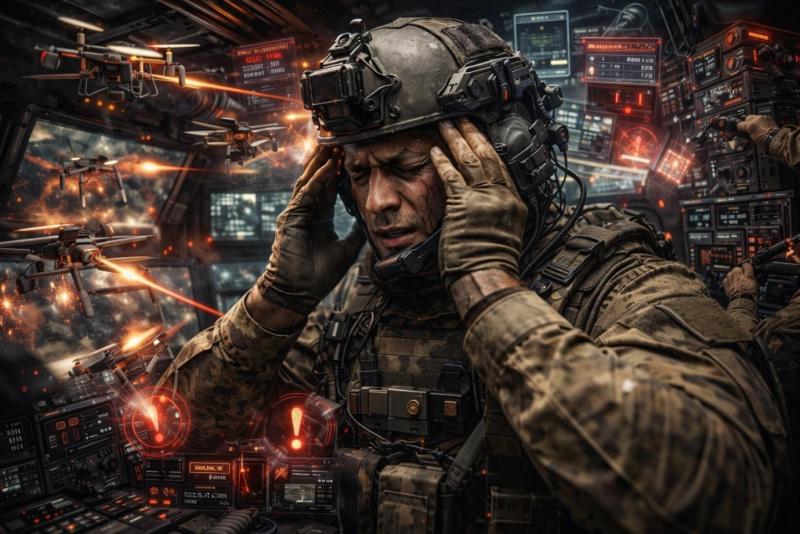
Behavioural effects are equally significant. High levels of visible protection can generate false confidence, altering crew behaviour and increasing exposure to threat. Additionally, poor internal configuration can significantly increase crew cognitive load, reducing their ability to focus on the fight outside the vehicle as they struggle to manage the vehicle itself. As such, survivability design must also account for how humans interact with protection systems, not merely how protection performs in isolation.
7. Weapon Systems, APS, and Escalation Dynamics
As protected vehicles integrate heavier weapon systems, layered sensors, active protection systems, and electronic warfare suites, they are evolving from protected mobility assets into high-value nodes within the tactical network. This transformation increases their operational utility but also elevates their target priority and alters escalation dynamics in contested environments.
Active and soft-kill systems provide important survivability advantages, yet their performance is context-dependent and vulnerable to saturation, countermeasures, and spectrum denial.
Survivability therefore cannot rest solely on intercepting incoming threats. It must also account for how the platform is detected, tracked, and targeted in the first place.
Signature management, deception, spectrum resilience, and data integrity are critical to survivability because they reduce the chance of being detected and targeted in the first place. If a vehicle is not seen or accurately tracked, armour and intercept systems may never need to be used.
Survivability does not increase in a straight line with more firepower or thicker armour. After a certain point, adding more protection or weapons delivers less benefit than improving tactics, combined-arms integration, network strength, and the ability to adapt in operations.
8. A Survivability Matrix for Protected Vehicles
A survivability matrix is proposed to clarify these trade-offs by mapping threat mechanisms against survivability responses and design consequences. The matrix shown below illustrates the concept, highlighting where survivability investments deliver meaningful operational benefit and where they impose disproportionate penalties, rather than simply ranking platforms by nominal protection levels.
Threat Mechanisms vs Layered Survivability Responses
| Survivability Response Layers | |||||
|---|---|---|---|---|---|
| Threat Mechanism | Detect | Avoid | Defeat (Limited)* | Mitigate (Core) | Recover / Fight-Through |
| Underbody Blast (Mine / IED) | Route intelligence | Route choice, spacing | External disruption chain | V-hull, energy management, blast seats | Redundant steering, run-flat tyres |
| Side Blast (IED) | EO/IR cues | Standoff geometry | Limited electronic warfare | Modular side armour, spall liners | Limp-home mobility, replaceable armour |
| Ballistic / AP | Shot detection | Cover and manoeuvre | Passive armour | Armour oriented to threat, spall liners | Redundant power, and communications |
| Fragments / Indirect Fire | ISR cues | Dispersion, mov. | System-level defeat | Roof armour, liners, stowage control | Crew drills, mission continuation |
| EFP / Shaped Charge | ISR cues | Route variation | System-level defeat | Advanced side kits, stowage control | Damage isolation, extraction |
| Top-Attack / Loitering Threats | Air & electro-optical | Camouflage, deception | External defeat chain | Roof payload options, signature management | Rapid relocation |
| Fire / Secondary Effects | Thermal detection | Thermal spacing | Auto-initiation systems | Fire suppression, protected fuel systems | Isolate, repair, continue |
| Mobility Damage | Health monitoring | Terrain selection | Terrain selection | Underbody and wheel-well protection | Recovery, limp-home capability |
| Spectrum awareness | Spectrum awareness | Concealment and timing | Electronic warfare systems | Signature reduction | Recovery, limp-home capability |
| Signature Targeting (IR / RF / Visual) | Spectrum awareness | Concealment and timing | Electronic warfare systems | Signature reduction | Reposition, degrade gracefully |
* Vehicle-level defeat is limited for most threat mechanisms and is typically achieved at the system-of-systems level.
9. Conclusion
The future of the protected vehicle market will be determined not by maximum armour
thickness but by the capacity to treat survivability as a dynamic, mission-tailored outcome rather than a static specification.
Blast and ballistic threats remain operationally relevant, but armour-centric design logic, reinforced by test protocols and procurement thresholds, delivers diminishing returns. This assertion will form the context of the next paper. Survivability must be reframed at the requirements level, not retrofitted during platform development.
The central question is not whether protected vehicles can survive the next threat, but whether they are designed to adapt to subsequent threats.
Defence Mastery
Social Mastery

Reframing Survivability beyond Armour thickness in the Protected Vehicles © 2026 by . All Rights Reserved. Published under license.
Please let us know if you have discovered an issue with the content on this page.
Comments
Start the conversation by sharing your thoughts! Please login to comment. If you don't yet have an account registration is quick and easy.