
The invisible frontline: Why the next war will be won in your mind
Introduction
The Australian Defence Force (ADF) must adapt, develop and enhance its own capabilities to be able to fight and win in a contested Information Environment.
The Information Environment is not static: it is constantly evolving. The rules-based global order is under threat and the Information Environment is in a turbulent state of play. This is characterised by malign regional and global actors, untrustworthy information, and advancement in digital technologies.
The Information Environment is the primary sphere for decision-making in which humans and automated systems interact, integrate, process, task, decide and act on data, information and knowledge.[1] It is a layered battlespace comprised of three dimensions: the physical, virtual and cognitive.
The physical dimension is comprised of geographic areas, where physical objects and infrastructure exist, and audiences reside. It is where physical activities take place, societies and cultures interact, and raw data transmission occurs.
The virtual dimension is the virtual space where personas of audiences as online profiles can interact through digital technologies. An audience can have multiple personas, which can interact through multiple digital technologies.
The cognitive dimension is a critical dimension. This is where thought processes occur, including how people think, perceive and process information. It is where narratives and cultures shape behaviour and decision-making.
The utility of Information Advantage is to influence behaviour and cognitive processes of our adversaries and competitors, while safeguarding our own and those of our allies and partners. Information Advantage is a favourable condition, relative to competing entities in the Information Environment, achieved through orchestration of Military Power. Achieving Information Advantage protects freedom of action in order to support national objectives. It must be coordinated through a whole-of-government (WofG) approach, including Defence and other government agencies.
Information as an Instrument of National Power
Information is an important resource. It must be possessed, controlled and used. The reach of information has dramatically expanded. Digital and advanced technologies provide greater access to even the most remote communities, enabling targeted influence operations at a far greater scale. In this context, the power and utility of information must be integral to orchestrating Military Power.
The change in information power structures is transformative and accelerating. This change enables understanding that the collective of all information generates increasing and accessible knowledge. The shift in information power and utility shapes trust and social cohesion in society. Furthermore, information has influence on actions and decision-making processes of individuals in all aspects of military, civilian and political life. This has led to the recognition of the informational instrument as being crucial to National Power.[2]
The Informational instrument, alongside the Diplomatic, Military, and Economic instruments, make up the fundamental elements of National Power (referred to as DIME). The Informational instrument[3] affects, informs and influences all other instruments. DIME is an important integrated approach for a national strategy. The Diplomatic, Military and Economic instruments alone cannot achieve their strategic objective without the Informational instrument (see Figure 1).
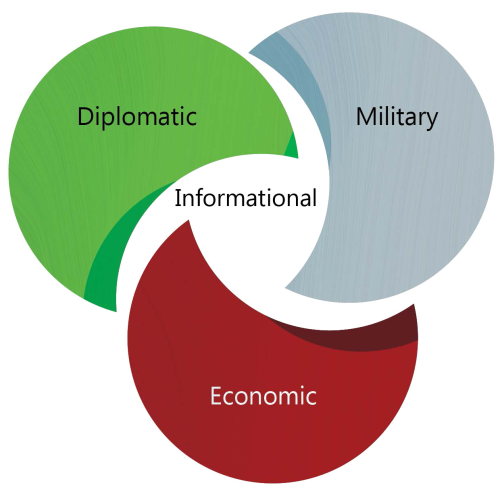
- Diplomatic – Cannot be effective without an understanding of Australia’s and other state and non-state actors’ interests, resources and cultural frameworks.
- Informational – Understand, shape and influence perceptions, attitudes and opinions of both domestic and international actors.
- Military – To defend Australia and its national interest in order to advance Australia’s security and prosperity.
- Economic – Decisions based on the knowledge of markets and conditions, and of future market forecasts, to shape and influence economic elements of National Power.
- Information Operations (IO) (human-centred) – primarily focuses on achieving and sustaining psychological superiority.
- Cyberspace Operations and Electromagnetic Spectrum Operations – primarily focuses on achieving and sustaining decision superiority.
- Strategic communication – focuses on the ADF contribution to narrative superiority to enhance the Australian Government’s communication objectives.
Together, these lenses form the basis of the ADF’s ability to shape, influence and exploit the Information Environment, and protect against adversaries seeking to do the same. This enhances the ADF to amplify national strength in support of achieving asymmetric advantage.
Importance and Role of Information Advantage
Information Advantage serves dual military benefits of weakening the psychological resolve of adversaries while defending the resolve, resilience and social cohesion of our own force and those of our allies and partners.
Information Advantage is a crucial line of effort (LOE) to protect against malign activities of other actors that affect the cognition of ADF personnel, allies and partners. These activities focus on attempts to influence military operations, the operating environment and Australian democratic processes. Therefore, Information Advantage enables the ADF to operate where kinetic military action is not possible, ethical or lawful.
The evolving nature of the Information Environment creates a complex domain that requires constant assessment and agility of response. The often short-timescale and broad reach of events in the Information Environment require attention and commitment to adaptation (such as refreshed proactive approaches and more rapid reactive responses). The growing interconnectedness, access and manipulability of the Information Environment has led to a more contested information landscape. These natural developments—combined with maturing adversary disinformation campaigns to influence the Information Environment for strategic effect—have created a situation in which the Information Environment is likely no longer able to be dominated (at least internationally) by any one actor.
Information Advantage provides a temporal edge on cognitive and territorial space. This may occur through localised Information Advantage rather than general information dominance. To achieve Information Advantage, operations in the Information Environment target critical nodes that underpin the strength of an adversary’s position or their cognitive frame. This aligns strength (such as a particular operation, narrative, or LOE) on weakness (weak points in an adversary’s narrative, or particular insecurities) to create cognitive effects.
While creating an Information Advantage wherever possible is a desirable goal, it is far more important and feasible to pursue Information Advantage at critical moments or points to maximise strategic effect. Using resources on operations or LOE that achieve strategic or operational value with limited resource outlay is far more pragmatic and efficient.
Information Advantage, when achieved at key moments or in key regions, can be crucial for strategic effect. Therefore, the Information Environment must be continually analysed for the most accurate picture (the role of intelligence) for situational awareness and cognitive threats. As domination of the environment is likely not possible, Information Advantage should be targeted along aligned efforts to support national goals in discreet periods and audiences.
A focus on pursuing Information Advantage requires significant agility. It is vital to adapt to changing Information Environment conditions in order to operate effectively. This requires a keen knowledge of the environment and emerging changes within it, as well as national strategic objectives in order to discover, understand, and act on developments and opportunities. This needs a combination of elements:
- a broad range of expertise and experience
- long-term planning
- a commitment to creativity
- an understanding of the limits of authority
- national policy and strategy
Achieving Information Advantage contributes to achieving asymmetric (Military Power) advantage as part of an integrated campaigning (National Power) approach. In a Defence context, attaining an Information Advantage for operational benefit requires an integrated planning process which understands the second-order effects in the Information Environment and maximises (not hinders) strategic objectives. Objectives of military operations must feed and flow into the strategic campaign.
Information Advantage as an Enabler of Military Power
The contest for Information Advantage is a constituent element of warfare, providing the basis for commanders to make quality decisions. This includes influencing aspects of military operations in and through the Information Environment, therefore making understanding the environment a core requirement of all military operations. Together with an intelligence-informed force, Information Advantage enables superior planning processes to ultimately fight and win.
The gathering, understanding and dissemination of intelligence to commanders is as old as war itself.[4] This includes planners’ appropriate use of intelligence to provide decision superiority over an adversary’s situational awareness of the Information Environment. This has also led militaries and intelligence agencies to gather and interpret relevant information to make threat-informed decisions, while protecting their own information content and channels.
Military deception (MILDEC) is used alongside other lenses to achieve Information Advantage. MILDEC is the deliberate act of manipulating information that is available to the adversary. This creates advantage by causing the adversary to believe a state of affairs that differs from reality, and therefore to manoeuvre in ways that are unfavourable to them. MILDEC operations can range from simple battlefield manoeuvres such as feigned retreat, to highly complex deception campaigns such as Operations Mincemeat and Fortitude.
Whether through MILDEC or other Information capabilities, working towards an Information Advantage enables the ADF to shape the perceptions, attitudes and beliefs of others in the battlespace, in support of wider military objectives.
Conclusion
The character of warfare has changed significantly in the Information Environment.
Enabling the ADF to achieve Information Advantage is a key capability to deter adversary aggression and defend Australia’s national interests from influence at home and in the region, as part of an integrated force, within a WofG strategy.
Changes in technology, the behaviours of actors and the deterioration of the rules-based order contribute to the dynamic Information Environment. The ADF must integrate and orchestrate Information Advantage throughout the five domains, and with our allies and partners, to achieve strategic effect. By adapting to the Information Environment, the ADF can achieve Information Advantage where it is suited for tactical, operational and strategic effect. Allies and partners have already considered and outlined responses to elements of operations in the Information Environment.
Adversaries seek to shape the Information Environment. They do not observe international rules and norms. Adversaries have shown a clear willingness to engage in a struggle for Information Advantage. They have confidence in their capability to exploit asymmetric vulnerabilities below the threshold of conflict, and over a prolonged period.
1 NATO Standard AJP-10.1 Allied Joint Doctrine for Information Operations, Ed. A Version 1, January 2023
2 ADF Capstone Doctrine (ADF-C-0), Australian Military Power ed. 2 (Commonwealth of Australia, 2024)
3 All instruments of national power have a degree of interrelatedness.
4 Christopher Andrew 2019, The Secret World: A History of Intelligence, Penguin Press
Defence Mastery
Social Mastery

Biography
Dr David Kolevski
Information Environment Analyst, Information Advantage Centre of Excellence (IACOE)
Doctor
The IACOE was formally established within Joint Capabilities Group in 2024 to develop, prepare and generate ADF capability and capacity to conduct operations in the information environment as an essential element of Australia’s military power.
The invisible frontline: Why the next war will be won in your mind © 2025 by . This work is licensed under CC BY-NC-ND



Please let us know if you have discovered an issue with the content on this page.
Comments
Start the conversation by sharing your thoughts! Please login to comment. If you don't yet have an account registration is quick and easy.