Acknowledgments
I am grateful for the contributions of several advisors and mentors. These include:
Dr. David Kilcullen for his advice on strategic context; and Emeritus Professor John Aquilla and those of his colleagues at the US Naval Post-Graduate School Dr John Willingham and Dr Tim Jones for their insights on applicability to policy making. Also Dr. Pichamon Yeophantong for her invaluable guidance in shaping the exploratory nature of this thesis; Dr. Claire Yorke; and Colonel Nicholas Bosio, PhD for his advice on academic rigour. I am indebted to Professor Nicholas Trongale, RAN for his mentoring, friendship, and insistence on the proper use of commas. Most importantly my wife, Natalee, for endless patience and encouragement while managing three children, a full-time job and an absent spouse.
Abstract
This thesis explores the critical concept of strategic surprise, with particular regard for the challenge of implementing Australia’s National Defence Strategy, which highlights the diminishing window for strategic warning. Similar concerns are echoed by the US and UK, emphasizing the growing risk of unforeseen events. While intelligence and policy efforts focus on anticipating specific threats, history and theory suggest that predictions will often be wrong, underscoring the inevitability of surprise. This thesis examines traditional theories of strategic surprise, integrates insights from cognitive science and psychology, and proposes a framework to classify surprise events across four dimensions: temporal, informational, schematic disruption, and strategic impact. By developing a clearer ontology of strategic surprise, this research aims to enhance preparedness planning, laying the groundwork for future research. As an exploratory thesis it lays an ontological foundation for a comprehensive typology and analysis to be developed in the Author’s pending PhD studies on enhanced civil-military preparedness for surprise.
Introduction
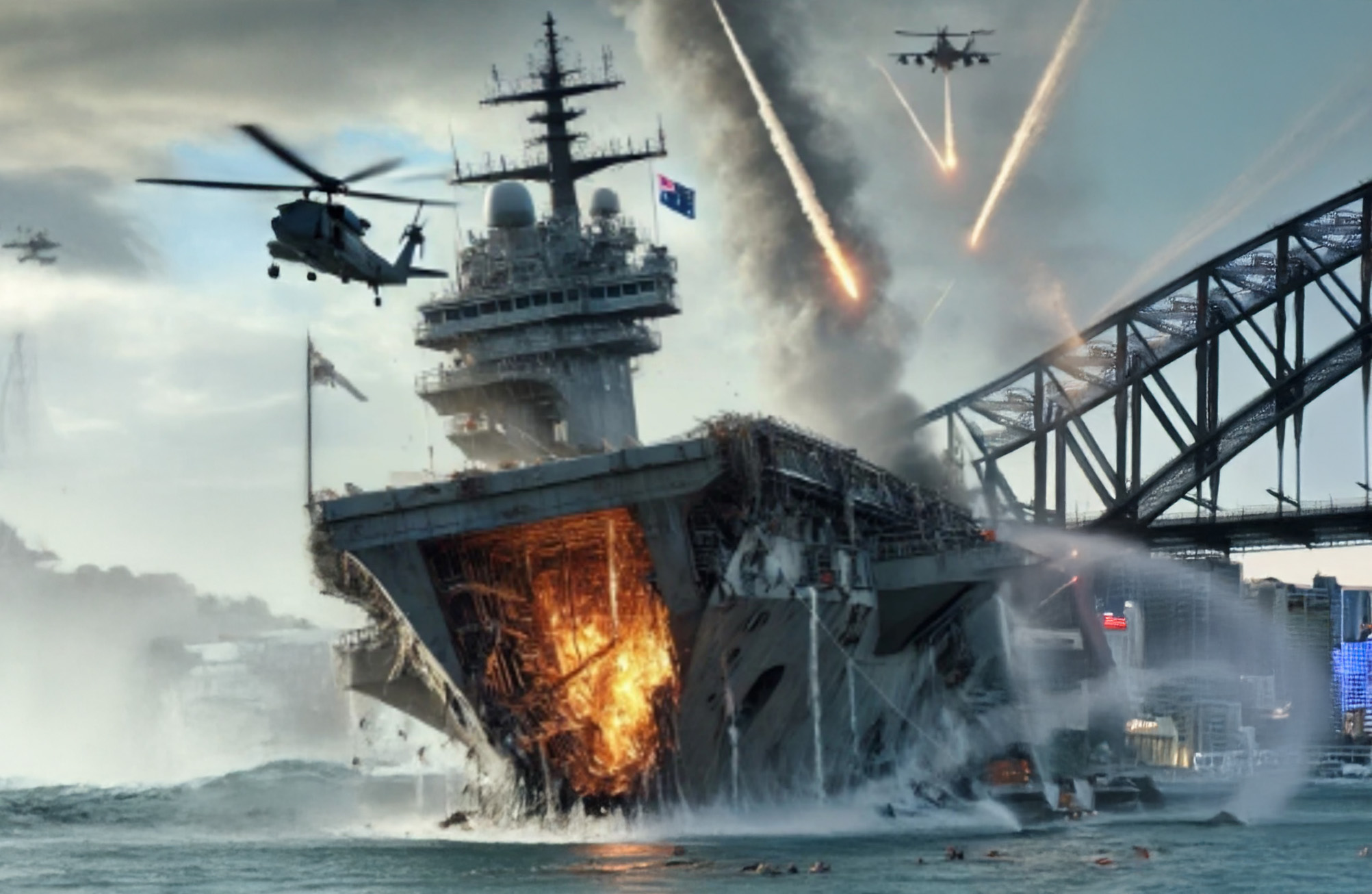
The dead were unloaded after dark. The wounded - evacuated at sea - were now in hospitals across Australia. Although the battered helicopter carrier had been able to limp into port beyond the media’s glare, the sight of her scarred and listing hull would not shock a public who had witnessed the looping footage of her sister ship’s final moments. The unforgettable images had displaced the financial collapse and energy grid failures that dominated the news cycle and had occupied the government’s attention for weeks. In the months that followed the enormous explosion that claimed a thousand lives and marked the first day of the conflict, there would be outrage, resignations, even a royal commission, to ask: ‘how did we not see this coming’ and ‘why were we not better prepared’? However, the questions that occupied the government on that day were: ‘what happened?’, ‘what does it mean?’, and ‘what do we do now?’
This grim vignette offers two lessons for policymakers. First the self-evident observation that strategic surprise can have dire consequences. Since World War II, numerous devastating surprises, from the Cuban Missile Crisis; 9/11; and the recent invasion of Ukraine to name but a few; have not only inflicted enormous human and security costs they have changed the fate of nations. Strategic surprise is of critical interest to policy makers. The second is captured in Mike Tyson’s pithy philosophy of pugilism ‘everybody has a plan until they get punched in the face’. Strategic surprise represents the critical juncture where strategic plans collide with unforeseen events – the ‘punch in the face’ when plans confront the disruption and disorder of reality.
When Australia’s National Defence Strategy (NDS) cautions a ‘loss of warning time’, with government cautioning ‘Australia no longer has the luxury of a ten-year window of strategic warning time’, it is describing the need to prepare for strategic surprise.2 Similar sentiments are shared by the US National Defense Commission and British Government who also conclude that the risk of some unforeseen event is increasing.3 All three nations’ peak security documents describe an urgent need to enhance preparedness and readiness. Much effort on the part of the intelligence community and policy makers already goes into predicting, in detail, what it is we are preparing for. But their predictions will most likely be wrong as Betts observed ‘the only thing less probable than war itself is that it would start in the way we expect.’4 Tyson’s insight is that deliberate plans never fully prepare a nation for the experience of being surprised. It is almost inevitable that whatever we expected, will not transpire when, where and how we anticipate. We should expect to be surprised. But to prepare to survive the blow requires a clear understanding of what strategic surprise is.
This exploratory thesis addresses a divide between ‘deliberate strategic planning’ and dynamic ‘strategy making’ in government.5 The former is vital for building long-term capabilities and alliances; the latter acknowledges the need for contingency and adaptation in response to unpredictable technological, geopolitical, and environmental changes. The dissonance between them is a form of ‘contingency theory’ - organizations must balance adaptation to external environments with the internal integration of resources.6 Tyson’s observation highlights how disruptive the transition between them can be, with strategic surprise acting as the fulcrum upon which they interact. National preparedness, therefore, requires an understanding of strategic surprise in order to define what we are preparing for. I found however, that while there is a large corpus of literature on averting surprise, there is a lacuna in the form of an ontology of the experience of surprise. This exploratory thesis approaches this gap in three stages.
First, it surveys traditional thinking about strategic surprise, examining four key themes: classical theories; case studies of major surprise events; orthodox scholarship; and revisionist approaches. To address the gaps that emerge, the thesis expands our current thinking about strategic surprise by integrating insights from fields such as cognitive science and psychology. Finally, it develops differentiating criteria to analyse surprise, focusing on four dimensions: temporal; informational; schematic; and the scale of impact before identifying priorities for future research.
Traditional thinking begins with ‘the classics’, from de Saxe, through Clausewitz, Mahan and Liddle-Hart to Cold War nuclear theorists. Most of them describe surprise as a characteristic of battle, what modern practitioners would describe as the tactical or operational level of war. While traditional scholarship recognises that surprise has a fundamentally temporal aspect, it is largely treated as a binary event with a before and after, but little attention to the in-between experience of surprise. Some authors, such as Clausewitz, Boyd and Luttwak, began to recognize there is a cognitive dimension to surprise offering an initial step towards an ontology.
After World War II, the study of strategic-level surprise gave rise to numerous case studies where authors like Wohlstetter and Lanir began to explore the role of information entropy in impeding prediction and preparation. By comparing different case studies of strategic surprise, it also becomes clear that the temporal domain is more nuanced than a simple binary of before and after surprise, offering a more textured understanding of its unfolding.
Towards the end of the Cold War numerous scholars began to study strategic surprise as a phenomenon in its own right, cleaving to two schools: orthodox and revisionist. The former, advocated by Betts, Wirtz, Handel and many others, argues that surprise is an inherent feature of a stochastic international system. Rather than seeking the impossible task of preventing surprise, the orthodox view suggests improving our anticipation to navigate through it. Revisionists, beginning with Levite, instead argue that instances of strategic surprise inevitably result from intelligence failures or policy lapses. Although these schools enhance our understanding of the causes of surprise, through failures to foresee and prepare, they leave a gap around the dimensions of the experience of surprise.
The second chapter seeks to expand our thinking on surprise by integrating insights from other disciplines—particularly cognitive science and psychology. The former approaches surprise from two schools of thought: the probabilistic school, which shares traditional thinking’s desire to avert; and the sense-making or ‘cognitive evolutionary model’, which directly addresses the experience of surprise. This latter school explores how novelty and unexpectedness disrupt established mental frameworks, ‘schemas’, offering a way to describe the dimensions of surprise. Psychology, meanwhile, identifies factors like arousal and valence that allow us to describe the scale and significance of surprise.
The final chapter integrates traditional approaches with insights from cognitive science and psychology to develop differentiating criteria (specifically temporal, informational, schematic and impact) that enable more precise description and classification of surprise events. Building on the classics and case studies, the temporal criterion adds depth by considering not only speed of onset but distinguishing between short- and long-duration surprise events, as well as whether they are persistent or punctuated. Expanding the use of information theory, particularly the concept of information entropy, allows insights into the quality of information during the event itself, assessing the signal’s reliability and the level of distortion in communication channels. Schematic disruption, drawn from cognitive science, offers a framework and qualitative scale to measure how surprises disrupt mental models and organizational schemas. Finally, impact adapts psychological insights on arousal and valence to assess the magnitude of a surprise's strategic effect, helping to understand its broader influence on decision-making and strategy. This framework offers policymakers a clear language to describe and analyse strategic surprise, providing differentiating criteria that enhance preparedness planning to better anticipate, assess, and respond to a range of potential surprises.
Having a means to better describe and communicate surprise is an important foundation to enhancing our ability to plan and prepare to adapt, which is crucial to addressing the tension between strategic surprise and strategic plans at the core of this research. If we can describe different types of surprise, it follows that they may also require different types of preparation. This raises key questions: What is common across all surprises? What varies between different cases? And how can we optimize our responses? As an exploratory thesis this is only the beginning of an enhanced understanding of strategic surprise. Answering these questions will require further research to create a typology, develop a theory and test its validity. But it is the necessary first step.
The Research Puzzle
The genesis of this thesis emerged from my experience rewriting the Australian Strategy Framework in 2017. While trying to describe how Australia undertook strategy it became apparent to me that various parts of Defence, and Government, inhabited two different universes. One was the prudential world of strategic plans, necessary for the development of sophisticated capabilities and the curation of long-term relationships, treaties and alliances. The other, the dynamic world of operations, contingency and adaptation in the face of technological, geopolitical and environmental turbulence – Clausewitz’s demand that ‘planning must maintain infinite flexibility’.7 I had encountered what Jermy described when he wrote, ‘a strategic-planning process is not the same as a strategy-making one’8.
The intellectual friction between these two worlds—one governed by order and predictability, the other by chaos and unpredictability—was palpable: one sought the clarity of a clockwork universe, the other contended with a ‘clockwork orange’.9 This tension is an example of contingency theory - organisations need to achieve both ‘differentiation (adapting to different external environments)’ and ‘integration (coordination of internal activities)’.10
Tyson’s observation in the title of this thesis leads us to surprise. The transition between these two worlds occurs at the point of the blow, where we encounter ‘discontinuity’, or strategic surprise.11 To understand how to mediate and integrate these ‘two hemispheres of the ‘strategic brain requires an understanding of the manifestation of discontinuity – strategic surprise.12
Consequently, the original intent of this thesis was to find ways to enhance preparedness using existing strategic surprise theories as a starting point. However, the available literature is heavily prognostic i.e. focussed on predicting or preventing unexpected events. On the one hand, this makes eminent sense, an ounce of prevention is worth a pound of cure, especially when the consequences of strategic surprise can be so dire. However, Professor John Arquilla helped shape the question at the heart of this thesis by suggesting that, if the scholarship is focussed on averting surprise, then there is a lacuna in describing the nature of being surprised.13 There is significant analysis on the causes of surprise, with scholarly debate on how to predict or prepare for surprise, and another corpus on adaptation after the instantiation of surprise. But there is limited inquiry into the essence of being surprised, that in-between period, evoked by T.S. Eliot when he wrote:
And the reality
Between the motion
And the act
Falls the Shadow
This thesis seeks to better inform our mental model of national preparedness, developing a way of thinking about the experience of surprise, offering consistent language to describe it, and criteria to diagnose it, in doing so casting light upon Eliot’s shadow.
Methodology
This exploratory thesis establishes an ontology of strategic surprise across three main components as a foundation for subsequent, PhD level, research.
First, by examining the current canon on strategic surprise through a narrative literature review addressing four thematic areas: classic works; case study approaches; orthodox; and revisionist schools of thought. This review synthesises existing knowledge and identifies gaps in understanding. Second, expanding our thinking about surprise by integrating relevant insights from an interdisciplinary literature exploration incorporating cognitive science, psychology, management science, and organisational behaviour. This approach aligns with calls for greater integration across disciplines in studying complex phenomena like strategic surprise15
The differentiating criteria for this typology were then developed through a process of literature review and synthesis, combining insights from multiple disciplines. These criteria represent a mix of quantitative and qualitative measures, reflecting the complex nature of strategic surprise, using Ragin's fuzzy set qualitative comparative analysis (fsQCA).16 Some criteria are more quantitative in nature, such as the temporal dimension, while others are more qualitative, such as the level of schematic disruption. This is a feature of fsQCA and allows for nuanced non-binary classifications. The criteria were iteratively refined through application to historical case studies to ensure relevance.17 By synthesizing existing literature, incorporating interdisciplinary perspectives, and applying fsQCA, this methodology seeks to develop a robust ontology that can inform future research and theory development.
Scope and Limitations
This study acknowledges several important considerations that are beyond its current scope and are recommended for future research. These include:
Strategic Level Focus: Surprise can manifest at various levels—tactical, operational, and strategic, there is a substantial sub-set of the literature in the field which is primarily concerned with tactical and operational aspects of surprise. This thesis is specifically concerned with the highest tier of surprise, where strategic and policy considerations intersect with civil-military decision-making processes.
Simplification of Decision-Making Dynamics: In order to build a tractable framework, this thesis deliberately avoids the complex organizational, structural, and political dynamics that influence decision-making. The myriad human factors, including insights from political science, organizational behaviour, and psychology, are acknowledged as critical for further development. An exceptional study, such as Goodwin's Team of Rivals, exemplifies the depth of understanding that can be achieved by exploring these factors, but this thesis is limited to analysing surprise within a single decision-making entity.18 Future research could expand this to include distinctions between different types of governance structures, e.g. states with collective decision-making processes may experience surprise differently than centralized regimes, such as dictatorships, due to fewer decision-makers and decreased dissent. Additionally, this thesis focuses on unilateral surprise, meaning the experience of a single nation state. However, future work is also needed to explore multilateral surprise, such as the differing experiences of allies, treaty partners, or coalition members during the same event. This would address how strategic surprise impacts multiple actors in different ways, further complicating decision-making and response.
Contemporary Cases: There are numerous contemporary, indeed ongoing, strategic surprise events available today including the war in Ukraine and the conflict sparked by the October 07 attacks in Southern Israel. However the scholarly literature and data to fully analyse these events are still emerging, making them both a priority for future research and a valuable opportunity to apply and further develop the ontology of strategic surprise.
Chapter 1 Thinking about Surprise: A Review of the Literature
Surprise has long fascinated scholars of conflict, strategy, and politics, forming a foundational element in the study of statecraft and warfare since antiquity. This chapter explores the evolution of thinking about strategic surprise, revealing several trends through a narrative review of four aspects of the literature: classical works; case studies; and the orthodox and revisionist schools.
Traditional war and conflict studies, collectively forming ‘the classics,’ from the pre-enlightenment era to the early Cold War, primarily associate surprise with battles or campaigns, emphasizing its temporal nature. By treating surprise as an event with a clear before and after they offer limited insight into the experience itself and our ability to describe the dimensions of strategic surprise. This view reaches its apogee in nuclear strategic theory, where the entire course of war could unfold in minutes, allowing little depth to explore the experience of surprise. After World War II, large-scale strategic surprises led to the rise of analytic case studies, introducing key concepts like the role of information theory in creating surprise. However, these were predominantly forensic, asking how surprises could have been predicted or prevented. In the late Cold War, scholars like Betts began to think of surprise as a distinct phenomenon, leading to the development of the orthodox school. They argued that surprise is an inevitable outcome of a stochastic environment, seeking to understand how to reduce its impact by improving anticipation. However, orthodox theory triggered the rise of an opposing revisionist school, which argued that strategic surprises result from intelligence or policy failure. These approaches all offer significant insights into the sources, mechanisms, and failures that lead to surprise, improving our understanding of how it can be averted (or created) or at least mitigated. However, they leave gaps in our understanding of the experience of surprise as it unfolds during the event.
Classical theory
Historically, surprise was primarily understood in the context of campaigns and battles - the instruments of surprise after all, moved at the speed with which an army marched or a fleet sailed. Consequently, our earliest thinking about surprise was defined by its temporal aspects. Early modern writers, such as Machiavelli and De Saxe, typically framed surprise as a battlefield phenomenon, what modern practitioners would recognise as the operational level of war, seeking tactical advantage for strategic effect.19 This battlefield-focused view of surprise persisted through the 19th and into the 20th century. Jomini emphasized ‘taking the enemy by surprise as a means to gain superiority,’ while his contemporaries, drawing from Napoleon's campaigns, saw surprise as a tactical manoeuvre—such as flanking an enemy to turn a battle and potentially influence the war.20 This conception of surprise as a battle-tactic was echoed by strategists like Mahan, who argued that ‘the essence of strategy is to bring about the battle…by surprise,’ and Liddell-Hart, who stated that ‘surprise in battle is the master-key of war’. 21
In the wake of the Second World War, both Western and Soviet military theorists continued to emphasise the role of surprise as a battle phenomenon through the prism of operational theory.22 Russian military doctrine described surprise as an effect which is generated and dissipated over time,23 while the US military evinced a similar philosophy, proposing surprise could be calculated almost formulaically as a function of ‘time and risk’.24 In all these instances, while surprise is fundamentally temporal—rooted in the superior speed of thought and action over an adversary—it remains conceptually limited. Theorists and practitioners alike tend to describe surprise as a discrete event with a clear before and after, focusing on the moment when it occurs and post-surprise effects. This approach overlooks the depth of the experience itself, including how surprise is processed cognitively and collectively in real-time. Treating surprise as a linear sequence risks reducing it to a two-dimensional concept, emphasising the build-up and aftermath but neglecting the nuances in how it impacts decision-making in the moment.
This paradigm of surprise reaches its apogee in early nuclear theory.
Figures like Kahn, Kissinger and Schelling, envisioned the possibility of a ‘30-minute war’, vividly described by Kahn as an ‘orgiastic spasm of destruction’.25 The sheer destructive power of thermonuclear weapons, combined with the ability to launch them with less than an hour’s warning, elevated surprise to a truly strategic scale. However, this presents a paradox. The concept of a ‘spasm war’ is inherently bound by time—its brevity defines it. This leaves little capacity for analysis of the shadow that falls between the exchange and the response. In nuclear theory, there is no state of being surprised, only immediate annihilation. The corollary is that prediction, prior planning and prevention were paramount since, once the surprise occurred, there would be no opportunity for adaptation or recovery.26 The resultant ‘reciprocal fear of surprise attack’ saw an emphasis on warning, 27 readiness and prepared plans, reflected in the first-strike doctrine on both sides of the Cold War.28
However, throughout the 20th and 21st centuries, even at the height of nuclear risk, a variety of strategic surprises would occur—none of them resembling a ‘spasm war’. From the 1967 ‘Six-Day War’, to the 1971 Indio-Pakistani War, and the 1973 Arab-Israeli War, surprise remained a recurring feature. Even in cases where nuclear weapons were involved, such as the Cuban Missile Crisis, there was a distinct passage of time during which the experience of surprise unfolded. During the 13 days of the crisis policymakers on both sides engaged in information gathering and sense-making - as Allison would come to suggest nearly 40 years later – a demonstration of the extended experience of surprise, even in nuclear contexts.29
Among classical theorists, Clausewitz was one of the first to consider the cognitive aspects of surprise moving beyond a view of surprise as a mere battle-tactic, recognizing its psychological and cognitive dimensions. Clausewitz saw surprise as a phenomenon in its own right stating, ‘surprise therefore becomes the means to gain superiority, but because of its psychological effect, it should also be considered as an independent element’.30 His ideas were built on by theorists such as Fuller, who suggested ‘the real target in war is the mind of the enemy commander, not the bodies of his troops.’31 The logical corollary of this notion was that surprise may not be homogenous, but may have different forms. Fuller began to consider that surprise may have variations in form, seeking to distinguish between ‘moral’ and ‘material surprise’.32 In Fuller’s thinking moral surprise refers to the psychological impact of unexpected actions or events on an enemy's mindset, morale, and decision-making processes. This form of surprise targets the mental and emotional state of the adversary, potentially causing confusion, fear, or paralysis in their command structure.33 Material surprise, on the other hand, relates to the physical or tangible aspects of unexpected military actions creating a tactical advantage through unexpected deployment or application of military assets. Material surprise occurs in the realms of time and space, while moral surprise exists within the mind of the object. Several theorists developed this idea: Boyd distinguished between 'surprise' and 'shock'; while Luttwak reinforced this binary distinction, differentiating between 'routine' surprise on the battlefield and the kind that could 'render the victim unhinged.’34 This binary thinking has, overtime, influenced western operational thought.35 While this approach acknowledges the cognitive aspect of surprise, it doesn't provide a framework to assess its dimensions, degree, or impact.
The classics reveal that surprise has an inherently temporal aspect. Paradoxically, however, theorists often view it in a simplistic, two-dimensional way, as a clear-cut event with a distinct 'before' and 'after'—as if surprise simply happens. Yet, even in early thought, there was a nascent understanding of its cognitive dimension, gradually leading to the recognition that surprise can take different forms and be experienced in different ways.
Analytic Case Study
Following World War II, the scale, scope, and strategic impact of surprise led to specific cases being studied in their own right, rather than merely as features of battles or campaigns. Advances in technology, such as combustion engines, aviation, and nuclear weapons, fundamentally reshaped the dynamics of conflict and heightened the potential consequences of strategic surprise. Combat was no longer constrained by the speed of armies or fleets; it could now occur over vast distances with unprecedented destructive force. From the early 1960s onward, numerous case studies emerged, examining these new forms of strategic surprise.36
In her landmark case study of the Japanese attack on Pearl Harbor, Wohlstetter introduced a crucial perspective: surprise is not only something inflicted on an adversary but also something experienced by one's own side.37 This initiated a trend of case studies focused on exploring why strategic surprises occurred and how nations, along with their policy and intelligence apparatuses, failed to foresee, adequately deter, or prepare for such events. These studies sought explanatory factors in the shortcomings in intelligence processing, decision-making, and strategic planning that allowed surprises to happen despite available warnings or signals.
Importantly, Wohlstetter’s analysis of Pearl Harbor introduced the role of information (what would later be understood as information entropy theory), particularly the idea of distinguishing the ‘signal’ from the ‘noise’.38 She highlighted the challenge of identifying critical intelligence signals amidst overwhelming background information, a concept that has become central to understanding the complexities of anticipating strategic surprise. This concept was further developed by scholars like Allison and Lanir, however, much of their work, like their contemporaries, is forensic in nature, focused on understanding failures of foresight.39 The emphasis tends to be on how information theory can help predict and anticipate surprise events, rather than on the role of information in understanding how surprise unfolds in real-time.
Many case studies in this era developed a nuanced understanding of the temporal dimensions of surprise. Comparing the short, sharp attack on Pearl Harbor with the prolonged 'penetrating attack' of the 1973 Arab-Israeli War, it becomes clear that surprise can take different forms.40 Lanir’s major study of the latter highlights how the ongoing, persistent nature of the attack shifted from 'situational (or material) surprise' to one of 'comprehension,' illustrating Fuller’s distinction between ‘material’ and ‘moral’ surprise. 41 This comparison underscores that surprise is not a uniform experience but can evolve over time, affecting both the physical and cognitive realms of decision-making. Wohlstetter herself would go on to note that different strategic surprises could have a rapid or slower onset and could even, absent an act of violence, would only be apparent retrospectively.42
Case studies of strategic surprises in the 20th century offer insights into the anticipatory challenges of surprise, in particular how time and information can increase or decrease its likelihood. However, this approach has two key limitations. First, it tends to focus solely on successful surprises, neglecting Finegar’s paradox, which suggests that successful intelligence (and by extension, policy) may have correctly anticipated and averted a potential surprise.43 As a result, policymakers may mistakenly assume that the anticipated threat was never going to create a real surprise. Second, while individual events are studied in great depth, they often lack comparative context. For instance, how did Pearl Harbor differ from the 1971 India-Pakistan conflict or 1973 Arab-Israeli War? How did pre-event actions, inactions, and mental models shape the experience of surprise? The danger lies in applying lessons from one case study to another type of surprise.
Returning to the research puzzle, while the US intelligence and policy system was shaped by the lessons of Pearl Harbor, did these lessons prepare it for other forms of surprise, or leave it optimised for a certain type of surprise? 44 When Australia’s NDS proposes a lack of warning time, what type of surprise are we preparing for and how should we think about different potential surprise types in those preparations? This raises the need for an ontology that accounts for multiple types of surprise, better equipping us for a range of potential scenarios.
The Orthodox School45
Recognising surprise as a phenomenon worthy of study, Betts laid the foundation of what would come to be described as the orthodox school in the 1980s.46 Broadly, this school suggests that, due to a stochastic external environment, the nature of conflict and of human contest, it is impossible to completely avert surprise. As Gray wrote ‘uncertainty is not a flaw in our understanding; rather is it an essential feature’.47
Betts highlights a key paradox: that accurate signals often exist before a failure but despite this, failures remain unavoidable. He develops Wohlstetter’s work on the challenge of distinguishing critical signals from background noise by linking it to bureaucratic and organisational factors that form ‘pathologies in processing warnings’.48 While reform can improve intelligence analysis, Betts argues that the core issues are political and psychological, making them difficult to resolve through structural changes alone. He also notes that we tend to focus on high-profile failures, overlooking routine successes, and that analysts’ preconceived notions can hinder accurate assessments. Schelling captured the essence of the orthodox view observing, ‘one thing a person cannot do, no matter how rigorous his analysis or heroic his imagination, is to draw up a list of things that would surprise him.’49
The orthodox school doesn't propose nihilism or despair; key authors such as Cancian, Dahl, and even Wohlstetter seek to learn lessons and identify surprise events as early as possible in an effort to prepare where possible and adapt where necessary.50 Although surprise may be inevitable, orthodox theorists focus on aversion and anticipation by continuously adapting preparations up to the point of surprise, aiming to mitigate its impact rather than prevent it entirely. As Betts notes,
Orthodox pessimism emerges from cases… which appear to reveal a prevalence of warning indicators prior to attack... While many sources of surprise lie in the attacker's skill in deception and operational innovation, orthodox studies emphasize the victim's mistakes—how interactions of organisation, psychology, and inherent ambiguity of information create pathologies in processing and reacting to warning indicators.
One important contribution of the orthodox school is the introduction of concepts from cognitive science, such as those by Wirtz who argues that cognitive limitations are the root cause of the problem of anticipation the orthodox school identifies.52 These include biases such as overconfidence, confirmation bias, and the tendency to rely on existing analytical frameworks, even when they are outdated or inadequate.53 He concludes ‘surprise is not a structural or systemic phenomenon – it is about human cognition (existing) in the mind of the victim.’.54 The emerging insights from cognitive science are explored further in Chapter Two of this thesis. Once again however, the majority of analysis focuses on pre-surprise cognitive limitations, not the impact of cognitive factors post-event.
When the NDS highlights a lack of warning time, what kind of surprise are we preparing for? The orthodox school highlights the importance of anticipating the unexpected, but it raises key questions about how decision-makers will respond when truly surprised. Tyson’s insight, that deliberate plans often misalign with reality, suggests the need for frameworks that better capture how we might experience and interpret different types of surprise.
The Revisionist School55
Levite was one of the first to challenge the orthodox perspective, suggesting that surprise was inevitably the product of avoidable failures within intelligence or policy-making apparatus.56 This led to a prolonged, contentious academic debate which played out through the end of the Cold War and into the War on Terror. It was Levite who would coin the appellation ‘orthodox school’ to describe Betts and fellow thinkers. Betts would respond by labelling Levite and others who expressed similar views ‘revisionists’.57 The orthodox criticism of the revisionists is that they were utopian, seeking a world where strategic surprise could be averted. However, this is simplistic and reductionist, rather, proponents of such thinking, including Kent, Zegart and Johnson, propose that each case of strategic surprise was the result of one or more, specific and avoidable failures.58 They would not argue that states could prevent all failures all the time, rather, that by learning from failure, states could do better next time. Most who might be described as revisionists, such as Knorr and Handel, would use the word ‘mitigate’, rather than ‘avert’ making the differences between the schools more philosophic rather than practical.59
A key focus of the revisionist school is enhancing intelligence systems' ability to better warn of impending surprises, emphasizing the link between intelligence failures and organisational behaviour, particularly ‘bureaucratic structures.’ 60 Revisionists often refer to case studies like Pearl Harbor, the Cuban Missile Crisis, and the 1973 Arab-Israeli War, arguing that these surprises were preventable with better foresight and action.61 They aim to distinguish between the lead-up to different surprises, highlighting how improved processes could have mitigated or averted such events. But both orthodox and revisionist schools continue the tradition of studying the before-surprise experience.
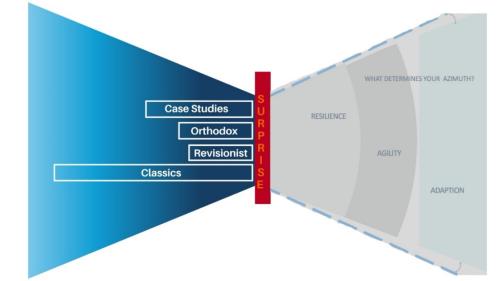
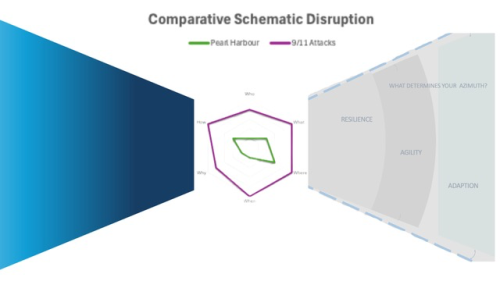
This approach can be visualised in a bow-tie diagram such as at Figure 1.62 This tool, used to analyse risk scenarios, shows the causes leading to an event (left) and the consequences or responses that follow (right), with the surprise event represented at the centre, or ‘knot’. Traditional approaches focus heavily on aversion by examining factors that lead to surprise, but they provide limited depth in exploring the experience of surprise, the shadow that Eliot described in The Hollow men.63 To address the central question of the research puzzle—how surprise influences and transforms strategic plans into dynamic strategies—a richer understanding of surprise is essential. This requires moving beyond the simplistic ‘before and after’ framework and adding dimension to the ‘shadow’. Cognitive scientists Moore and Schatz elucidate their field’s perspective, stating ‘surprises should not be taken as dichotomous on/off phenomena but rather should be considered as a variable’ with depth and variety.64 By deepening our understanding of surprise, we can better grasp how it unfolds, varies, and inflects strategic decisions in real time, ultimately shaping our preparation.
Chapter 2 Expanding Our Approaches to Surprise: Integrating Inter-Disciplinary Literature
The previous chapter explored how traditional approaches often present a two-dimensional view of the temporal aspects of surprise, focussing on aversion, but also introduce the role of information in causation along with the potential contribution of cognitive science. This chapter aims to address some of the identified gaps by incorporating insights from other disciplines—specifically cognitive science and psychology—which have examined surprise for over a century. Cognitive science contains two schools of thought: the probabilistic school, which aligns with traditional strategic surprise thinking; and the sense-making or ‘cognitive evolutionary’ school which directly addresses the experience of surprise. The latter explores how novelty and unexpectedness disrupt established mental frameworks (schemas) offering the potential to describe the dimensions of surprise. Psychology, meanwhile, identifies factors like arousal and valence that influence the impact of surprise. While these fields predominantly study individual-level surprise, they provide important frameworks which may be scaled and adapted to enhance our understanding of strategic surprise.
Cognitive science – why are some surprises so surprising?
Cognitive science approaches surprise through at least two prominent schools of thought: the probabilistic; and the cognitive or sense-making. 66 Unlike the tension between orthodox and revisionist schools in strategic studies, these are harmonious, differing in focus rather than intent. Indeed, cognitive sciences recognise that these two schools can build a more complete picture of surprise phenomena by describing both anticipation and actuation of surprise. The probabilistic approach emphasizes the role of uncertainty and probability in reasoning and decision-making, examining how individuals assess likelihood to make judgments.67 This perspective builds an understanding how people anticipate surprise and seek to avert or prepare for it, and is finding renewed interest in the fields of computer science and Ai.68 This school enhances insights of traditional approaches, notably the orthodox and revisionist schools, into prediction of discontinuities. This is likely why, when leading thinkers have sought to introduce insights from cognitive science, they have predominantly done so in relation to prediction and aversion.
Authors such as Wirtz, Finkel, Handel, and Knorr were some of the first to introduce cognitive science into the study of strategic surprise, drawing predominantly on the probabilistic school.69 Finkel, for example explores how cognitive limitations can lead to biases or ‘blind spots’ that hinder accurate predictions.70 Wirtz and Handel further explore the role of faulty schema and assumptions in hampering prediction.71 This school makes an important contribution, providing explanatory tools for intelligence failures like Pearl Harbour that Wohlstetter identified (before the concept had a formal name), today they are understood courtesy of cognitive science as an example of ‘mirror imaging bias,’.72 Similarly, the failure of MacArthur and the United Nations Command to anticipate China’s entry into the Korean War in 1950 is often cited as an example of bias, with US intelligence predictions skewed by ‘optimism’ and ‘selective attention’ biases.73 Indeed the study of bias is a core element of western intelligence training models.74
The unrealised contribution of cognitive science to an ontology of strategic surprise, however, is to be found in the cognitive, sense-making school. More formally described as the ‘cognitive evolutionary model of surprise (CEMS)’, it describes how surprise is experienced, focussing on how individuals interpret and create meaning, especially in ambiguous or unexpected situations.75 This school explores the cognitive processes involved in recognizing, interpreting, and responding to novel or surprising information.76
An important contribution from this school is the concept of schematic disruption which suggests that surprise occurs when incoming information conflicts with existing mental schemas, leading to ‘cognitive dissonance’.77 The CEMS proposes that surprise is the result of unexpected (schema-discrepant) events, and its intensity is determined by the degree of schema-discrepancy.78 In other words, the degree to which an event is surprising, and the impact it has, is linked to how far outside our conceptions the event is.79
Several theorists propose that schematic disruption is a product of novelty, either instead of, or in addition to, unexpectedness.80 Unexpected events are defined as those disconfirming expectations, while novel events are those not represented in a person's schema (mental model) for the current situation.81 The degree of novelty can be quantified as the dissimilarity of an event to relevant schemas.82 While unexpected events can be novel or familiar, evidence suggests that more novel events are usually more surprising.83 Schematic disruption can be thought of as describing the difference between the unexpected and the unimaginable. This might cause us to ask how far from a pre-strategic surprise mental model were the events that unfolded? Was a Japanese attack on Pearl Harbour as divergent from the mental models of US political leaders as the terror attacks of 9/11? An aerial attack on Pearl Harbour was unexpected but not overly novel, an attack on the World Trade Centre using hijacked civilian airliners was both unexpected and extremely novel. The former may have been unexpected, but to most the latter was unimaginable - in the strict sense that Schelling had meant – they simply had not formed a part of policy makers’ pre-attack mental model. Schematic disruption provides a clue that the experience of surprise becomes a vital consideration in preparedness, evident in comparing the reaction of decision-makers in the US and the USSR on their entry to World War Two.
The attack on Pearl Harbor, while clearly unexpected as evidenced in the inadequate preparations by the US, was not unimaginable for U.S. military planners. As early as 1924, U.S. war games had simulated a potential Japanese carrier-based air attack on Hawaii, indicating that such a scenario was within the conceptual framework of American military thinking. 84 While Pearl Harbour is a famous study in intelligence and policy failures before the attack, when the surprise occurred there is broad consensus that the US civil and military leadership reacted swiftly, calmy and rationally to the initial attack.85 In contrast, the German invasion of Russia in ‘Operation Barbarossa’ was a complete departure from Stalin's mental model of the geopolitical situation.86 Stalin had convinced himself that Hitler would not attack the Soviet Union while still at war with Britain, and he stubbornly dismissed multiple warnings of the impending invasion, including intelligence from his own spies.87 For days after the event, in a paralysis that likely cost territory, thousands of Soviet lives and military advantage, Stalin famously hid in his Dacha unable or unwilling to make a decision or provide direction. 88 What role did schematic disruption, and the pre-existing mental models, play in the very different reaction that Stalin displayed to his counterparts in Washington. While orthodox and revisionist writers have embraced the significance of cognitive science in anticipating surprise, there is a gap that the CEMS’ schematic disruption may help address in how to better prepare for the experience of surprise.
Psychology – measuring impact: how big was the surprise
Psychology offers another potential dimension to our understanding of surprise by describing how and why some surprises are greater than others due to perception, researchers proposing 'the perception of surprise is a matter of impact'. 89 This perspective complements the CEMS discussed above. While the cognitive model speaks to the novelty of surprise through disruption to mental models, psychology’s study of surprise addresses the scale of surprise. The CEMS helps understand the mechanisms by which surprise manifests, focusing on the discrepancy between expected and actual events. In contrast, the psychological impact literature provides a framework for measuring the intensity of the surprise experience. How, then, is impact measured? Psychologists have identified two primary dimensions for assessing the impact of surprise: arousal and valence.90
Arousal refers to the degree of physiological and psychological activation experienced during a surprising event. High arousal surprises tend to be more memorable and impactful. In psychology arousal is usually studied through the physiological response triggered by surprising events, which can be influenced by personal proximity to the situation as well as the perceived intensity. Most typically this is measured along certain physiological markers as well as phenomenologically (i.e. self-reporting by the subject).91 The latter is difficult to scale, the former almost impossible, as noted by Cunha et al. ‘a systematic and integrative typology of (large scale) surprises, however, is still missing.’92 But it may be possible to adapt arousal to the strategic scale in two ways. First, decision makers’ personal proximity (either physically or direct personal connection with the events at the centre of surprise), and second the systemic impact.93
Proximity considers how closely involved or affected the decision-maker is by the surprise event. The closer the proximity, the higher the potential for arousal and emotional engagement. Proximity can be ‘physical, temporal, or psychological’, and may influence the decision-maker's ‘perception of urgency’ and personal stake in the situation.94 Research suggests decision-makers who are more proximate to a crisis event tend to exhibit higher levels of stress making intuitive rather than analytical decisions more likely, however to date this has not been adapted as a measure of the impact of surprise. 95
Perceived systemic impact, what we might describe as the intensity of the surprise, assesses the extent to which the surprise event affects the broader system or organization.96 A higher degree of systemic impact implies more far-reaching consequences, potentially leading to greater arousal and perceived importance of the event. The relationship between strategic surprise and systemic impact is often characterized by amplification and cascading consequences. Strategic surprises can amplify systemic impacts, leading to more profound and far-reaching consequences than initially anticipated. A case made by Kasperson et al. in their seminal paper on ‘social amplification’, they argue that amplification occurs when ‘events interact with social, and cultural processes in ways that can heighten or attenuate public perceptions of risk and related risk behaviour’.97 The 9/11 terrorist attacks in 2001 serve as a prime example of strategic surprise with significant amplification effects. The attacks not only caused immediate devastation but also led to far-reaching consequences that amplified the initial impact. The amplification of the initial surprise attack resulted in transformative effects on international relations, military strategy, and societal norms that persisted for decades. This exemplifies ‘cascading effects’ - a surprise event in one area can trigger a chain reaction of impacts across multiple systems and stakeholders. Pescaroli defines ‘cascading effects’ of disasters, ‘where an initial impact can trigger a sequence of events with progressive consequences over time, leading to non-linear impacts across different systems’.98 Amplification and cascading non-linearity are proxy metrics for systemic impact. Therefore, the psychological concept of ‘arousal’ can be applied to strategic surprise through the twin lenses of decision makers’ proximity; and the level of impact based on the degree of amplification and cascading consequence across the strategic system.
Valence refers to the emotional quality of a surprise, capturing whether the event is perceived as positive or negative and describes how much the surprising event aligns with or contradicts an individual's values, expectations, or desires. 99 Positive valence surprises, which align with values, may lead to quicker acceptance and integration of new information, increased motivation, and engagement. Negative valence surprises, which contradict values, often trigger denial or resistance, paralysis in decision-making, or lead to more cautious and defensive strategies. The fall of the Berlin Wall in 1989 offers an illustration of how valence can influence responses to strategic surprise. For East German authorities, this was a negative valence surprise that contradicted their values and expectations, consequently their initial response was characterized by confusion and paralysis in decision-making. 100 In contrast for West German authorities, and many citizens, it was a positive valence surprise, aligning with their hopes and leading to rapid acceptance and proactive engagement. ‘While East German leaders hesitated and debated, West German Chancellor Helmut Kohl quickly grasped the historic opportunity, presenting a …Plan for German Unity just weeks after the Wall's opening’101
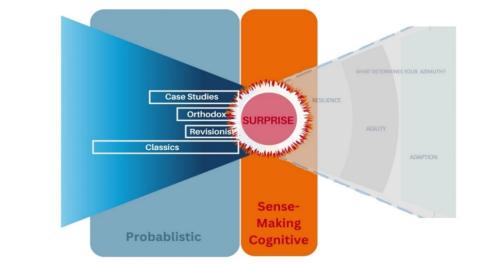
Cognitive science and psychology’s insights into the cognitive processes involved in responding to unexpected events complement traditional approaches to strategic surprise. Traditional approaches align with, and occasionally draw upon, the probabilistic school of cognitive science, with their focus on anticipation. The sense-making school with its CEMS, helps address this gap. Similarly, psychological concepts like arousal and valence are essential for informing strategic thinking, as they help to understand how emotional responses influence decision-making and adaptability at the highest levels of leadership. The relationship between the traditional schools, and those discussed in this chapter can be visualised on a revised bow-tie diagram (vide Figure 2). Traditional approaches, and the probabilistic school, seek to forecast and avert surprise – they are fundamentally prognostic in nature. But we also need to be able to diagnose different types of strategic surprise, as Ghandi suggested, ‘A correct diagnosis is three-fourths the remedy’.102
Chapter 3 Qualifying Surprise: Developing Dimensions
Integrating traditional approaches explored in Chapter One, with insights from cognitive science and psychology in Chapter Two allows us to develop a richer understanding of surprise, directly addressing the research puzzle. To then develop an integrated ontology, however, requires a more precise description and classification of surprise events, which in turn necessitates differentiating criteria. These criteria serve multiple purposes: they allow for a more systematic analysis of surprise; facilitate comparison across different cases; and they provide a foundation for future research and theory development.103 Of the four criteria detailed below (temporal, informational, schematic and systemic impact) some are more quantitative in nature, such as the temporal dimension while others are more qualitative, such as schematic disruption. This is a feature of fsQCA and allows for nuanced categorization beyond simple binary classifications throughout the four criteria.
The first criteria builds on the classics and insights from case studies to add depth to the temporal aspect of surprise by considering speed of onset as well as distinguishing between short- and long-duration surprise, and the persistence of the event. Second, expanding on the use of information theory in case studies, particularly the concept of information entropy, we consider the quality of information during the event itself, not just leading up to it. Two key dimensions are inferred: the quality of the signal (similar to the intelligence scale of reliability and authority) and the level of distortion in the communication channel.104 Leveraging insights from cognitive science, schematic disruption incorporates a framework and qualitative scale to measure the extent to which surprises disrupt existing mental models and organizational schemas, and how this may affect responses. Finally adapting psychological insights on arousal (proximity and systemic intensity) and valence to the strategic environment, allows assessment of the magnitude of a surprise's effect at the strategic level. By exploring these four dimensions, we aim to develop a more robust framework for understanding, anticipating, and responding to strategic surprises in an increasingly complex global environment.
Temporal
Time is the most obvious and commonly discussed aspect of strategic surprise, being the easiest to observe and quantify. The temporal aspect however can be analysed in at least three sub-dimensions: speed of onset, persistence, and duration. Speed of onset refers to how quickly the surprise unfolds, while persistence distinguishes between surprises that endure and those that are brief or punctuated. Duration captures the overall timespan of the surprise's impact, from its initial occurrence to the point where a new equilibrium is reached.
Speed of onset
The speed of onset is a critical sub-dimension of strategic surprise, shaping how events unfold and are perceived. While revisionists assert that warnings are always present but are often overlooked due to cognitive or systemic failures, most revisionists concede that true ‘bolt from the blue’ surprises can still occur. Yet, many strategic surprises, while disruptive, often have a protracted onset, allowing the unexpected to gradually reveal itself over time suggesting that the speed of onset is an important discriminator.
Traditional approaches, in seeking to understand errors in intelligence and preparedness, would measure the speed of onset from the perpetrator's perspective, however, measuring onset from the victim's perspective, more accurately reflects the experience of surprise. This is apparent when comparing the aerial attacks on Pearl Harbor; the Israeli strike on Arab armies in 1967; and the 9/11 attacks. The Japanese fleet departed Japan on November 26, 1941, and attacked on December 7, providing an 11-day window from the first tangible action of the strategic surprise to its denouement.105 The Israeli attack, occurring during a period of heightened tensions replete with false-alerts and continual military activity in each country, took just 185 minutes from activation to conclusion of the strike.106 By contrast, Al-Qaeda transitioned from planning to a tangible execution phase as early as 1999 when ‘the Hamburg cell’ became involved and hijackers were selected seeing around 18-24 months of detectable activity preceding the attacks.107 However, from the victim’s perspective, from the first engagement (i.e. the moment somebody on the victims side had a tangible experience of the surprise was occurring) to the final at Pearl Harbour was precisely 185 minutes – the exact same duration as the surprise air attack that started the 1967 war.108 On September 11, the gap between the first and second attacks was only 17 minutes.109 The speed of onset, and how we measure it, can inform our perception of a strategic surprise and potentially reveal that seemingly dissimilar events may be more alike than expected, while seemingly similar events may differ in important ways.
Surprise can also unfold slowly, lacking the clear punctuation of rapid-onset events. For example, while the protests sparked by Mohammed Bouazizi's self-immolation in Tunisia in December 2010 initially caught observers off-guard, the full impact wasn’t immediately apparent.110 Only as protests spread to Egypt and across the Arab world did the magnitude of the ‘Arab Spring’ as a strategic surprise become clear. Unlike sudden events like Pearl Harbor or 9/11, where there was an evident transition from start point to the surprise, the Arab Spring's significance emerged gradually, illustrating how slow-onset surprises can present different challenges. Context matters, while 9/11 was a bolt from the blue, the 1967 Israeli strike came after months of heightened tensions, hostile actions, and false alerts. However, once the surprise crystallizes, the speed of onset becomes an important dimension in describing it.
Duration and Persistence
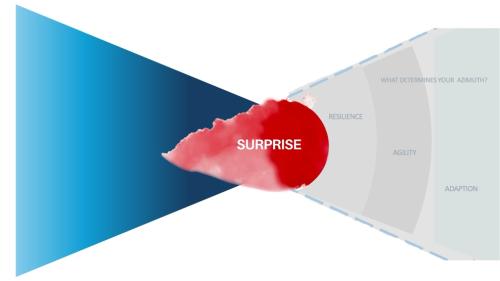
Strategic surprises can be further distinguished by their duration and persistence, factors that significantly impact the experience of strategic surprise. This distinction is crucial because brief events often allow only for post-mortem sense-making, while longer, persistent surprises require both sense-making and action in real-time. For example, although 9/11 was traumatic it soon became apparent there were no follow up attacks demanding a further, immediate, response. In contrast, the French government faced urgent, concurrent demands for both decision-making and sense-making during the German invasions of 1940, just as the Israeli government did in 1973. In the case of Pearl Harbor, the punctuated nature of the attacks allowed political leaders some breathing room; the situation didn’t demand an immediate response. However, in the cases of France and Israel, leaders faced calamitous consequences as enemy forces rapidly advanced toward their capitals, forcing immediate decisions under immense pressure. In the latter cases, leaders had to gather information, rebuild mental models, and gauge the impact while responding immediately to the unfolding crisis. As Gray has observed, the urgency of the situation and the presence of ongoing events to react to will significantly impact decision quality. 111 Brief, self-terminating, events allow for a more measured response and retrospective analysis before major actions are taken, while extended and persistent events will often create pressure for immediate decisions in a fluid situation. This difference in duration and persistence thus plays a critical role in shaping the nature of the response, the quality of decision-making, and ultimately, the outcome of the strategic surprise.
In studying a number of (admittedly tactical) cases, Finkel concluded that a common feature of successful responses was how readily the policy establishment ‘resolved pre-surprise debates’.112 Might a rapid onset surprise, though traumatic, offer a ‘clean break’ between strategic plans and the subsequent response where the catalysing shock creates a clear imperative for change? Creeping surprises offer their own challenges as the gradual nature of change can make it difficult to identify a clear transition point and build consensus for a new approach. When the Australian NDS (and its allied equivalents) express concerns about a 'lack of strategic warning time,' it is crucial to question the temporal dimension of the surprise they anticipate. Are we preparing for rapid, bolt-from-the-blue surprises, or for longer, unfolding crises? Different types of surprises, distinguished by their temporal characteristics, may require distinct preparations and responses. Understanding these differences is important when considering how to prepare military and political leadership for strategic surprise.
Informational
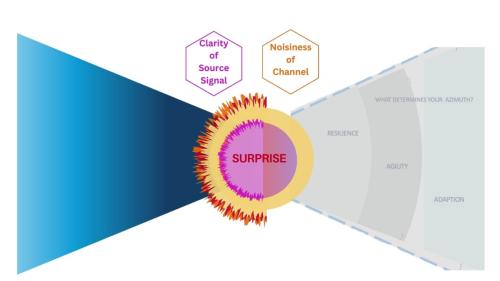
Wohlstetter was perhaps the first major author to introduce the concept of noise in detecting impending surprise, primarily in the context of predicting or anticipating such events. However, noise is equally important once a surprise begins to unfold. To fully grasp the role of information entropy in strategic surprise, we must first consider Shannon's ‘fundamental problem of communication,’ which defines a data communication system as having three elements: ‘a source of data, a communication channel, and a receiver’.113 The central challenge, according to Shannon, is not just transmitting data, but ensuring the receiver can accurately interpret the information based on the signal received through the channel. In the context of strategic surprise, two variables shape how events are understood in real time: the clarity of the signal and the level of noise or distortion in the channel, sharply contrasted in two surprise attacks on American soil - Pearl Harbor and 9/11.
Both the clarity and lack of distortion in the transmission of information during the initial attack on Pearl Harbor are noteworthy. Within 17 minutes of the first strike, Pearl Harbor's command issued a clear alert ‘air raid on Pearl Harbor X this is not a drill’. 114 This message was transmitted across the Pacific to Washington D.C. in minutes meaning key decision-makers, including the Secretary of the Navy and President Roosevelt, were briefed within two hours of the attack.115 The information source was both reliable and authoritative with messages transmitted by professional staff using pre-formatted, templated communications. They were clear, succinct, and informed by multiple data sources, including ship reports, ground observers, naval air stations, and various electronic means. Moreover, all the significant reporting during as well as after the attack was transmitted in highly structured and organised military reports, allowing it to be clearly understood and interpreted at the other end, leaving little doubt as to the relevant facts at hand. Admittedly, the information was incomplete – the exact number of aircraft took time to confirm, as did the battle damage sustained. However, information entropy was further reduced with the messages travelling through secure, uncontested military channels, including both low-frequency and high-frequency encrypted radio channels as well as submarine telegraph cables, ensuring low noise in the channel.116
The information quality and transmission during the 9/11 attacks stand in stark contrast. Unlike the clear, professional communications following the Pearl Harbor raid, the attacks were characterized by a lack of authoritative intelligence sources and an absence of systematic reporting. 117 In the immediate aftermath of the first plane striking the World Trade Centre, there was no single, credible source providing a clear picture of events. Instead, information came from a multitude of uncoordinated channels, including civilian eyewitnesses, local law enforcement, and media reports.118 This lack of a centralized, authoritative source made it challenging for decision-makers to quickly assess the situation and respond effectively. This was exacerbated by the noise in the channel.
Television networks broadcast live footage of the unfolding events, but much of the initial reporting was speculative and often contradictory. The volume of 911 calls overwhelmed emergency response systems, with dispatchers struggling to manage the influx of information from panicked callers.119 These calls ranged from eyewitness accounts of the plane impacts to reports of people trapped in the towers, creating a chaotic information environment that was difficult to parse for actionable intelligence. Furthermore, the unprecedented nature of the attacks meant that there were no pre-formatted templates or established protocols for communicating this type of threat.120 Unlike the military channels used in Pearl Harbor, the 9/11 communications relied heavily on civilian infrastructure, which quickly became overloaded with information that was often unconfirmed from sources of varying reliability, and sometimes appeared conflicting in nature. This made it extremely challenging for key decision-makers to quickly grasp the full scope and nature of the attacks, delaying effective response measures. The 9/11 Commission Report later highlighted these communication failures, noting the lack of information sharing between intelligence agencies and domestic law enforcement as a critical factor that contributed to the success of the attacks.
The NDS anticipates strategic surprise, but how well does it anticipate the effects of informational entropy? Modern preparedness must account for the informational dimension of surprise, ensuring that leaders receive timely, clear, and reliable intelligence. In the information domain a critical question arises, how will decision-makers form a complete picture? Sense-making relies heavily on the quality and confidence of the information provided, which will determine how quickly and effectively leaders can respond to emerging threats. Modern preparedness must consider the role of information entropy in sense-making amid strategic surprise.
Novelty and Schemata
Applying insights from cognitive science, particularly the importance of novelty, allows us to create a measure of surprise. Schematic disruption refers to the breakdown of established mental models in the face of unexpected events. The CEMS, emphasizes how greater cognitive demands lead to higher levels of surprise. Emerging literature suggests that the more explanations needed to make sense of a surprising event, the greater the level of surprise experienced.121 However, a gap exists in the literature regarding the application of schematic disruption to large-scale, organizational surprises. This thesis addresses this through two approaches: first, using interrogatives (what, where, when, who, how and why) to develop differentiating criteria; and second, employing a radar plot as a means to visualize and analyse surprise. Comparative scenario analysis is used to illustrate how these tools enhance understanding of surprise at an organizational level.
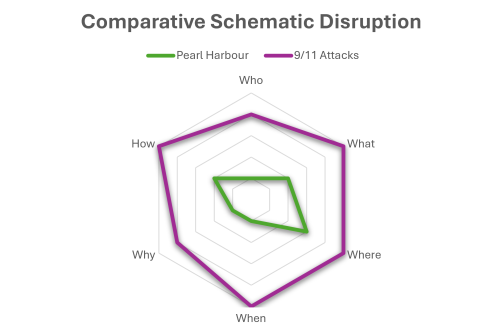
At the individual level, it's easier to ask a person to describe how novel a surprise event felt (phenomenology) compared to assessing this for an organization. The CEMS emphasizes that surprise is triggered by schema-discrepant events, with the intensity of surprise determined by the degree of discrepancy between the event and existing mental models.122 One approach to scaling the schematic disruption model is through estimated interrogatives, combining qualitative content analysis123 —systematically coding and identifying themes—with Weick’s sense-making theory, which explores how people assign meaning to experiences of uncertainty or change. 124 This qualitative method doesn't provide precise measurements but offers an assessment of high or low schematic impact. Developing a more formal metric for such assessments should be considered in future research. Using a ‘radar plot’ then allows us to visualize the surface area of schematic disruption. ‘Radar charts (vide Figure 5 A radar plot allows the visualisation of multiple variables, such as schema disruptors, and comparison between events for multivariate data visualization.’ 125 By analysing the surface area of these plots, we can approximate the relative size of schematic disruption across two or more strategic surprises. 126
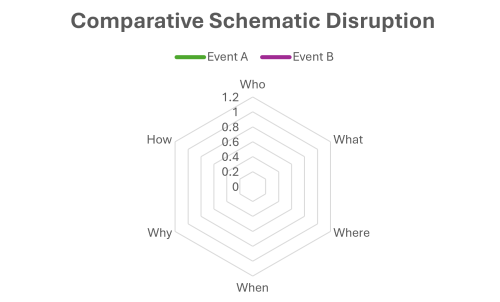
The variation can be seen comparing Roosevelt (and his cabinet’s) schematic disruption with those of his successor 60 years later. In terms of ‘who’, the Japanese attack was not entirely surprising given the tensions between Japan and the US. However, the specific timing and scale were unexpected.128 Similarly the ‘what’ and the ‘how, i.e. an aerial attack on the US Pacific Fleet using aircraft carriers operating at extended range, were not entirely unforeseeable. While innovative, it occurred over a year after the British Royal Navy's successful carrier-based attack on the Italian fleet at Taranto in November 1940, an event that Roosevelt and his cabinet were familiar with.129 Likewise ‘when’ had low schematic disruption coming in the second year of a global conflagration, with an expectation of potential conflict in the weeks leading up to Pearl Harbor.130 This understanding in turn rested on the clear rationale for Japanese hostility, biting US economic sanctions and trade embargoes; and it was evident to both sides that the US Pacific Fleet was the most significant threat to Japan’s expansionist plans in Southeast Asia. What was outside of existing planning and mental models, was the ‘where’. US planners had anticipated possible attacks in the Philippines or Malay-peninsular, however, had discounted the possibility of Japanese fleet carriers being able to reach the Hawaiian Islands.
Compare this to the schematic disruption experienced by President George W. Bush and his cabinet on September 11, 2001 where almost all interrogatives were significantly outside of any existing mental schema. In terms of ‘who’, Al-Qaeda was a known entity, having previously attacked the World Trade Centre in 1993, however they were not seen as an imminent threat, and few anticipated such a large-scale attack from them on American soil.131 ‘How’ the attack had been conducted and ‘what’ means were used were also highly disruptive - coordinated hijackings of commercial airliners used as weapons against civilian and military targets was an unprecedented and transformative escalation in the nature of terrorism.132 Likewise, there was little anticipation of the timing, a seemingly random Autumn’s day, during a period of relative peace for the US mainland. The suddenness of the attack shattered the perception of security that had existed since the end of the Cold War. Likewise, the rationale, the ‘why’ is still a subject of ongoing inquiry, though Bin Laden and Al-Qaeda cited opposition to US foreign policy and the American presence in the Middle East as primary motivations. And in terms of ‘where’ an attack on the continental United States, especially after the Cold War, was completely outside most policy makers’ schema.133
In this case, there was significant disruption across multiple dimensions, particularly the 'what' (unprecedented use of hijacked planes as weapons), 'when' (a sudden attack in peacetime), and 'where' (the US mainland, which was considered safe from such large-scale attacks). Unlike Pearl Harbor, where the main surprise was geographical, September 11 disrupted expectations in nearly every aspect, making it a much more comprehensive and multifaceted shock. The contrast between the two is illustrated on the radar plot in Figure 6.
Schematic disruption is, perhaps one of the most challenging dimensions of surprise in the context of preparedness. To paraphrase Schelling: how do you prepare for what you cannot imagine? Cognitive surprise—instances where the response to any putative scenario is ‘they simply wouldn’t do that’—is a rich area for exploration, and understanding what makes states more capable of overcoming schematic disruption is critical. The lack of strategic warning is a significant challenge, but this is where developing a typology of surprise can assist strategic planners and policymakers. While we can't predict the unimaginable, creating a typology based on key criteria allows us to forecast the ways we might be surprised. Although not exhaustive, such a framework can help identify relevant factors and improve preparedness, ensuring that at least some aspects of potential surprises have been considered in advance.
Equally important is examining how cognitive surprise interacts with other factors. For example, does a rapid speed of onset amplify the impact of schematic disruption? Or, if Finkel is correct that recovering from surprise requires the rapid resolution of pre-surprise debates, are there cases where a fast, persistent surprise forces resolution and definitive acclimation to a new reality? How does the informational dimension shape and influence this? Answering these research questions may enhance preparedness for strategic surprise.
Impact
Applying psychological insights into arousal and valence allows us to develop a fourth and final criterion for understanding strategic surprise: impact. Arousal refers to both the emotional and physiological response of decision-makers and the systemic impact, while valence captures the positive or negative emotional quality of that response. At the strategic level, the proximity of decision-makers to the event—whether physical or emotional—can significantly influence their arousal state, directly affecting their cognitive processes and decision-making capabilities.
The personal proximity of leaders to a surprise event is crucial, as individual ‘windows of tolerance’ for emotional arousal shape their ability to make effective decisions.134 High arousal states, whether positive or negative, can lead to more impulsive or less reasoned responses. For example, during the Pearl Harbor attack, President Roosevelt was in the White House and received updates from his cabinet in real-time, allowing him to remain physically close to key decision-makers. His relatively stable proximity to the centre of power may have contributed to more measured responses.
In contrast, during the 9/11 attacks, President Bush was at an elementary school in Florida when the events unfolded. He was quickly removed from the scene and boarded Air Force One, creating a physical and emotional dislocation from his key advisors. Secretary of Defense Donald Rumsfeld was at the Pentagon, experiencing the attack firsthand and assisting first responders. The difference in physical proximity between Bush and Rumsfeld highlights the potential impact of location on decision-making in moments of strategic surprise. The emotional and physical dislocation of decision-making collectives is an area that warrants further analysis in understanding the role of arousal and proximity in shaping strategic responses to surprise events. Equally, much has been discussed about how the events of September 11 influenced U.S. foreign policy, particularly the decision to invade Iraq in 2003—a decision in which Rumsfeld played a key role.135 While it is speculative to link his (and Bush’s) personal experiences directly to these decisions, a scaled model of arousal and valence raises important questions about the potential influence of such factors.
Proximity, whether physical or emotional, plays a significant role in shaping the decision-making process during a surprise event. For instance, while being physically remote on Air Force One, the emotional experience of separation can still have a profound impact. The physical dislocation of policy-making collectives is an area worthy of further analysis. Though it is beyond the scope of this thesis to fully explore, important questions arise about how these criteria—such as temporal factors and proximity—may combine. By examining case studies where proximity was high or low, we can assess the quality of decision-making during surprise events. What was the impact of proximity when combined with the temporal nature of the event? Or with schematic disruption? For example, could an event with low schematic disruption (i.e., an anticipated event that had been planned for) still lead to suboptimal outcomes if proximity heightened emotional arousal? Understanding these dynamics is key to improving strategic responses to surprise.
The systemic impact of surprise refers to the broader, state-wide arousal resulting from the amplification and cascading consequences of a surprise event, affecting multiple domains of state functioning and leading to significant disruption of normal operations. This concept captures how systemic arousal, 136 influenced by the scale of the event and the extent of schema disruption, interacts with individual decision-makers' emotional responses, collectively shaping national decision-making and resource allocation in times of strategic surprise. 137 Understanding this dynamic offers a critical framework for analysing state responses to unexpected crises and the broader implications for strategic planning.
The interaction between these two levels of arousal can significantly influence strategic decision-making in the face of surprise events. Personal arousal of key decision-makers may be amplified or moderated by the systemic intensity of the surprise, and vice versa. Understanding this dual-level arousal framework can provide insights into how states respond to strategic surprises and why certain decisions are made under such circumstances.
Arousal is positively correlated with valence - a surprise which fundamentally confronts our values system is likely to elicit a stronger response than one which is not so discordant. The concept of valence in surprise is a subject of ongoing enquiry in emotion research. While some scholars argue that surprise is valence-neutral, others, such as Noordewier and Breugelmans, contend that surprise has inherent valence, stating that ‘surprise is indeed valenced’ and can be experienced as either positive or negative depending on the context. The unexpected Japanese attack on Pearl Harbor was, obviously, strongly negative for Americans, causing immediate shock, fear, and anger. There is, however, further research needed to quantify whether the galvanising effect outweighed the initial shock and emotion that it engendered. Returning to the example of the Fall of the Berlin Wall, those who had a positive view of events (i.e. the West German State) have been judged as better able to respond to the surprise than those who had the oppositive valence.138
To again consider the implications of the loss of warning foreshadowed in the NDS, it would seem a comprehensive framework is needed to better anticipate not just the types of surprises that may arise but also the systemic impacts they may trigger. This involves developing tools and processes to observe, anticipate, and mitigate the amplification and cascading consequences that often follow unexpected events. Additionally, thinking about how valence may shape not only decision makers, but the broader public, should be a part of prudent preparedness.
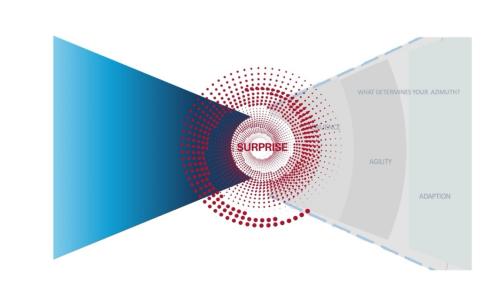
Conclusions and Future Research
Having examined traditional thinking on strategic surprise, including classical theories, case studies of major events, and both orthodox and revisionist approaches, this thesis identified key gaps—namely the two-dimensional treatment of surprise and the focus on pre-surprise aversion. To address these gaps, it integrated insights from cognitive science and psychology, broadening our understanding of how surprise unfolds. CEMS provided insights into novelty and schematic disruption, while psychology contributed to understanding systemic impact and valence. These insights informed the development of a framework for analysing surprise across four key dimensions: temporal, informational, schematic disruption, and impact.
Having integrated traditional thinking about surprise with new fields to create differentiating criteria, each criterion offers new insights into, and questions for, preparedness. It is also apparent that these criteria are only a first step in addressing important questions that arise, demanding a more comprehensive typological framework to account for multiple types of surprise, equipping us to respond to a range of scenarios. In doing so numerous questions remain to be explored.
Regarding the temporal dimension, a rapid onset surprise, though traumatic, may offer a ‘clean break’ between strategic plans and dynamic responses, creating a clear imperative for change. In contrast, creeping surprises pose their own challenges, as the gradual nature of change makes it difficult to identify a transition point and build consensus for a new approach. When the Australian NDS and its allied equivalents express concern about a 'lack of strategic warning time,' it is essential to consider the temporal characteristics of the surprise they anticipate. Are we preparing for rapid, bolt-from-the-blue events or for longer, unfolding crises? Each type demands distinct preparations and responses.
And how well have Australian and allied policy makers accounted for the effects of informational entropy? Preparedness must ensure that leaders receive clear, timely, and reliable intelligence, placing a demand on our preparedness framework to consider how decision-makers form a complete picture in the midst of surprise. Moreover, schematic disruption appears to be perhaps the most challenging dimension of surprise for preparedness. As Schelling’s insight suggests, how do you prepare for what you cannot imagine? Understanding how states overcome schematic disruption is essential for future research - creating a typology of surprise may help planners foresee how we might be surprised, even if we cannot predict the exact event. A lack of strategic warning is a significant challenge, but, while we can't predict the unimaginable, creating a typology based on key criteria allows us to forecast the ways we might be surprised.
The systemic impact of a surprise also requires attention, such as the prosaic but important procedural aspects of decision-making – understanding potential personal and collective dislocation, as well as the personal, emotional, and physical relationships that may compromise decision-makers’ objectivity. Finally, we need tools and processes to observe, anticipate, and mitigate the systemic impacts surprise may trigger, including amplification and cascading consequences. This includes considering how valence influences both decision-makers and the broader public should be part of prudent preparedness planning.
Equally important is examining how these dimensions interact with each other. Does a rapid onset amplify the impact of schematic disruption, or clarify pre-surprise debates? And how might informational entropy accentuate or attenuate this dynamic? If strong information entropy worsens schematic disruption, are there certain circumstances, where a lack of information could reduce the cognitive load on decision-makers. While the criteria in this thesis move us closer to an ontology of strategic surprise, these questions suggest the need for a more comprehensive framework to provide meaningful and structured answers to these and other questions. This thesis seeks to provide policymakers with a clearer language to classify and prepare for different types of strategic surprise, offering a foundation for improved preparedness and response strategies. But it will need further research, the development of a typology of ideal types and fsQCA case study analysis as a foundation for essential research into national preparedness for strategic surprise.
The invasion of Ukraine in 2022, the attack on Israel in 2023, and potential flashpoints looming in 2025, are reminders that strategic surprise remains both relevant and seemingly inevitable. Intelligence and threat aversion are core responsibilities for any government, but we must also prepare for the inevitable shift from making predictions to diagnosing strategic surprises in real time. As Mike Tyson might say, we may have a plan, even a National Defence Strategy, but are we truly ready to be punched in the face?
Abel, Jonathan. Guibert: Father of Napoleon's Grande Armée. Norman: University of Oklahoma Press, 2016.
Allison, Graham T., and Philip Zelikow. Essence of Decision: Explaining the Cuban Missile Crisis. 2nd ed. New York: Longman, 1999.
Arquilla, John, conversation with author, 20 April 2024, discussing Arquilla's work Bitskrieg
Baldi, Pierre, and Laurent Itti. "Of Bits and Wows: A Bayesian Theory of Surprise with Applications to Attention." Neural Networks 23, no. 5 (2010): 649-666.
Barto, Andrew G., Marco Mirolli, and Gianluca Baldassarre. "Novelty or Surprise?" Frontiers in Psychology 4 (2013): 907.
Berlyne, D.E. Conflict, Arousal, and Curiosity. New York: McGraw-Hill, 1960.
Betts, Richard K. "Analysis, War, and Decision: Why Intelligence Failures Are Inevitable." World Politics 31, no. 1 (1978): 61-89.
Betts, Richard K. "Surprise Despite Warning: Why Sudden Attacks Succeed." Political Science Quarterly 95, no. 4 (1980-1981): 551-572.
Betts, Richard K. Surprise Attack: Lessons for Defense Planning. Washington, D.C.: Brookings Institution, 1982.
Betts, Richard K. "Surprise, Scholasticism, and Strategy: Review of Ariel Levite's Intelligence and Strategic Surprise." International Studies Quarterly 33, no. 3 (1989): 329-343.
Bonn, Ingrid, and Sharyn Rundle-Thiele. "Do or Die—Strategic Decision-Making Following a Shock Event." Tourism Management 29, no. 2 (2008): 387-396.
Borch, Frederic L., and Daniel Martinez. "Kimmel, Short, and Pearl Harbor: The Final Report Revealed." Naval History Magazine 19, no. 5 (October 2005).
Boyd, John R. A Discourse on Winning and Losing. Edited by Grant T. Hammond. Maxwell AFB, AL: Air University Press, 2018.
Brownlee, Jason, Tarek Masoud, and Andrew Reynolds. "Theorizing the Arab Spring." In The Arab Spring: Pathways of Repression and Reform. Oxford: Oxford University Press, 2015.
Butow, Robert J. "How Roosevelt Attacked Japan at Pearl Harbor." Prologue Magazine 28, no. 3 (Fall 1996).
Cancian, Mark F. Avoiding Coping with Surprise in Great Power Conflicts. Center for Strategic and International Studies (CSIS), 2018.
Chater, Nick, and George Loewenstein. "The Under-Appreciated Drive for Sense-Making." Journal of Economic Behavior & Organization 126 (2016): 137-154.
Clausewitz, Carl von. On War. Princeton: Princeton University Press, 1984.
Corrado, Jonathan. "Biases Blind Us to the Risk of Chinese Military Intervention in Korea." Atlantic Council, August 16, 2023. https://www.atlanticcouncil.org/in-depth-research-reports/issue-brief/biases-blind-us-to-the-risk-of-chinese-military-intervention-in-korea/.
Cunha, Miguel Pina e, Stewart R. Clegg, and Ken Kamoche. "Surprises in Management and Organization: Concept, Sources and A Typology." British Journal of Management 17, no. 4 (2006): 317-329.
Dahl, Erik J. Intelligence and Surprise Attack: Failure and Success from Pearl Harbor to 9/11 and Beyond. Washington, DC: Georgetown University Press, 2013.
Darman, P. Surprise Attack. New York: Barnes & Noble Books, 2004.
Department of Defence. National Defence: Defence Strategic Review 2023. 2023.
DePuy, Trevor N. Elusive Victory: The Arab Israeli Wars, 1947-1974. New York, NY: Harper & Row, 1978.
Dibb, Paul. "Kissinger's role in avoiding nuclear war, and the key part Australia played." The Strategist, Australian Strategic Policy Institute, December 4, 2023.
Dimitrov, K. "Edgar Schein's model of organizational culture levels as a hologram." Economic Studies 22, no. 4 (2013): 3-36.
Eliot, T.S. "The Hollow Men." In Collected Poems, 1909-1962, 79-82. New York: Harcourt Brace Jovanovich, 1963.
Finkel, Meir. Military Agility: Ensuring Rapid and Effective Transition From Peace to War. AUSA Books - Foreign Military Studies. Lexington, Kentucky: The University Press of Kentucky, 2020.
Finkel, Meir. On Flexibility: Recovery From Technological and Doctrinal Surprise on the Battlefield. Stanford, California: Stanford Security Studies, 2011.
Fingar, Thomas. Reducing Uncertainty: Intelligence Analysis and National Security. Stanford: Stanford University Press, 2011.
Fiss, P. C. "Building better causal theories: A fuzzy set approach to typologies in organization research." Academy of Management Journal 54, no. 2 (2011): 393-420.
Frank, Adam. About Time: From Sun Dials to Quantum Clocks, How the Cosmos Shapes Our Lives. Oxford: Oneworld Publications, 2012.
Frank, Richard B. "The Path to Pearl Harbor." The National WWII Museum. Accessed October 3, 2024. https://www.nationalww2museum.org/war/articles/path-pearl-harbor.
Frijda, Nico H. "Surprise." In The Oxford Companion to Emotion and the Affective Sciences, edited by David Sander and Klaus R. Scherer, 386-387. Oxford: Oxford University Press, 2009.
"From Hope to Agony, What's Left of the Arab Spring?" The Economic Times, December 13, 2020. https://economictimes.indiatimes.com/news/international/uae/from-hope-to-agony-whats-left-of-the-arab-spring/articleshow/79775111.cms.
Fuller, J.F.C. The Foundations of the Science of War. London: Hutchinson & Co, 1926.
Gani, Jasmine K. "From Discourse to Practice: Orientalism, Western Policy and the Arab Uprisings." International Affairs 98, no. 1 (January 2022): 45–61.
Goertz, Gary. "Fuzzy Sets and Qualitative Comparative Analysis: A Review and Update." European Journal of Political Research 60, no. 3 (2021): 564-581.
Goodwin, Doris Kearns. Team of Rivals: The Political Genius of Abraham Lincoln. New York: Simon & Schuster, 2005.
Gorodetsky, Gabriel. Grand Delusion: Stalin and the German Invasion of Russia. New Haven: Yale University Press, 1999.
Gray, Colin S. "The Implications of Strategic Surprise." In Strategy and History: Essays on Theory and Practice. Newport, RI: Naval War College Press, 2013.
Gray, Colin S. "The Strategy Bridge: Theory for Practice." In Strategy Matters: Essays in Honor of Colin S. Gray, edited by Donovan C. Chau and Thomas G. Mahnken. Maxwell Air Force Base, AL: Air University Press, 2020.
Gray, Colin S. "Transformation and Strategic Surprise." Article, Transformation & Strategic Surprise, April 1, 2005.
Grix, J. The Role of the Masses in the Collapse of the GDR. Palgrave Macmillan, 2000.
Hama, Larry. Surprise Attack! Battle of Shiloh. New York: Aladdin, 2006.
Hancock, Larry. Surprise Attack: From Pearl Harbor to 9/11 to Benghazi. Berkeley, CA: Counterpoint, 2015.
Handel, Michael. Masters of War: Classical Strategic Thought. London: Taylor & Francis, 2001.
Herbig, Katherine L. Strategic Military Deception. New York: Pergamon Press, 1982.
Heuer Jr., Richards J. Psychology of Intelligence Analysis. Washington, D.C.: Center for the Study of Intelligence, 1999.
Hoffman, David E. The Dead Hand: The Untold Story of the Cold War Arms Race and Its Dangerous Legacy. New York: Doubleday, 2009.
Hutchison, William A Systemic View of Surprise Attacks: Why It Matters," Journal of Information Warfare 22, no. 4, accessed October 6, 2024,
Jermy, Steven. Strategy for Action: Using Force Wisely in the 21st Century. London: Knightstone Publishing, 2011.
Jervis, Robert. "The Logic of Images in International Relations." In "Remembering Robert Jervis." Texas National Security Review. Accessed October 4, 2024. https://tnsr.org/roundtable/remembering-robert-jervis/.
Jervis, Robert. "Thomas C. Schelling: A Reminiscence." War on the Rocks, December 15, 2016. https://warontherocks.com/2016/12/thomas-c-schelling-a-reminiscence/.
Jervis, Robert. "Why Intelligence and Policymakers Clash." Political Science Quarterly 125, no. 2 (Summer 2010): 185-204.
Johnson, Loch. "Bricks and Mortar for a Theory of Intelligence." Comparative Strategy 22, no. 1 (2003): 1-28.
Jomini, Antoine-Henri. Treatise on Grand Military Operations: Or, A Critical and Military History of the Wars of Frederick the Great. Translated by Samuel B. Holabird. New York: D. Van Nostrand, 1865.
Kahn, Herman. On Thermonuclear War. Princeton, NJ: Princeton University Press, 1960.
Kahn, Herman. Thinking about the unthinkable. New York: Horizon Press, 1962.
Kam, Ephraim. Surprise Attack: The Victim's Perspective. Cambridge, MA: Harvard University Press, 1988.
Kasperson, R. E., O. Renn, P. Slovic, H. S. Brown, J. Emel, R. Goble, J. X. Kasperson, and S. Ratick. "The Social Amplification of Risk: A Conceptual Framework." Risk Analysis 8, no. 2 (1988): 177-187.
Keane, Mark T. "Why Some Surprises Are More Surprising Than Others: Surprise as a Metacognitive Sense of Explanatory Difficulty." Cognition 144 (November 2015): 53-62.
Kean, Thomas H., and Lee H. Hamilton. Without Precedent: The Inside Story of the 9/11 Commission. New York: Alfred A. Knopf, 2006.
Kent, Sherman. Strategic Intelligence for American World Policy. Princeton: Princeton University Press, 1966.
Klein, Gary, and Nader Jalaeian. "The Plausibility Transition Model for Sensemaking." Semantic Scholar. Accessed October 5, 2024. https://www.semanticscholar.org/paper/The-plausibility-transition-model-for-sensemaking-Klein-Jalaeian/fba934840232de676ebb5af278e46750a89f26c6.
Knorr, Klaus, and Patrick Morgan, eds. Strategic Military Surprise: Incentives and Opportunities. New Brunswick, NJ: Transaction Books, 1983.
Lake, Brenden M., Ruslan Salakhutdinov, and Joshua B. Tenenbaum. "Human-Level Concept Learning through Probabilistic Program Induction." Science 350, no. 6266 (2015): 1332-1338.
Lanir, Zvi. Fundamental Surprises. Tel Aviv, Israel: Center for Strategic Studies, 1983.
Lawrence, P. R., and J. W. Lorsch. "Differentiation and Integration in Complex Organizations." Administrative Science Quarterly 12, no. 1 (1967): 1-47.
Leffler, Melvyn P. "9/11 and Iraq: The Making of a Tragedy." Brookings Institution, September 7, 2021. https://www.brookings.edu/articles/9-11-and-iraq-the-making-of-a-tragedy/.
Levite, Ariel. "Intelligence and Strategic Surprises Revisited: A Response to Richard K. Betts's "Surprise, Scholasticism, and Strategy"." International Studies Quarterly 33, no. 3 (1989): 345-349.
Liddell Hart, B.H. Strategy. 2nd rev. ed. New York, NY: Frederick A. Praeger Publishers, 1967.
Luttwak, Edward. Strategy: The Logic of War and Peace. Cambridge: Harvard University Press, 1987.
Machiavelli, Niccolò. The Art of War. Translated by Christopher Lynch. Chicago: University of Chicago Press, 2003.
Mahan, Alfred Thayer. The Influence of Sea Power upon History, 1660–1783. Boston: Little, Brown and Company, 1890.
Maurice de Saxe, Reveries on the Art of War, trans. Thomas R. Phillips (Mineola, NY: Dover Publications, 2007).
MKGandhi.org. "Gandhi Quotes | Epigrams from Gandhiji." Accessed August 19, 2024. https://www.mkgandhi.org/epigrams/d.php.
McKinsey & Company. "Increasing FDNY's Preparedness." New York: Fire Department of New York, 2002.
Marles, Richard "Launch of the National Defence Strategy and Integrated Investment Program." April 17, 2024.
Mohammadi, Zahra, Mohsen Kiani, and Hamid Aghajan. "Spatiotemporal Signatures of Surprise Captured by Magnetoencephalography." Frontiers in Systems Neuroscience 16 (2022): 865453.
Moore, Don A., and Derek Schatz. "Overprecision Increases Subsequent Surprise." PLOS ONE 15, no. 7 (July 8, 2020): e0227084. https://doi.org/10.1371/journal.pone.0227084.
Murphy, David E. What Stalin Knew: The Enigma of Barbarossa. Yale University Press, 2005.
Nafrada, Caesar, and Joseph Caddell. "'Never Thought They Could Pull Off Such an Attack': Prejudice and Pearl Harbor." War on the Rocks, December 7, 2021. https://warontherocks.com/2021/12/never-thought-they-could-pull-off-such-an-attack-prejudice-and-pearl-harbor/.
National Commission on Terrorist Attacks upon the United States. The 9/11 Commission Report: Final Report of the National Commission on Terrorist Attacks Upon the United States. Washington, DC: Government Printing Office, 2004.
Noordewier, Marret K., and Seger M. Breugelmans. "On the Valence of Surprise." Cognition and Emotion 27, no. 7 (2013): 1326-1334.
O'Leary, Jeffrey. "Surprise and Intelligence: Towards a Clearer Understanding." Air War College, Maxwell Air Force Base, 1994.
Oren, Michael B. Six Days of War: June 1967 and the Making of the Modern Middle East. New York: Oxford University Press, 2002.
Pauly, Reid B. C., and Rose McDermott. "The Psychology of Nuclear Brinkmanship." International Security 47, no. 3 (Winter 2022/23): 9–51.
Pescaroli, G., and D. Alexander. "A definition of cascading disasters and cascading effects: Going beyond the "toppling dominos" metaphor." Planet@Risk 3, no. 1 (2015): 58-67.
Police Executive Research Forum. "The Revolution in Emergency Communications." Washington, DC: Police Executive Research Forum, 2017.
Prange, Gordon W., Donald M. Goldstein, and Katherine V. Dillon. Pearl Harbor: The Verdict of History. New York: McGraw-Hill, 1986.
Prange, Gordon W., Donald M. Goldstein, and Katherine V. Dillon. At Dawn We Slept: The Untold Story of Pearl Harbor. New York: Penguin Books, 1991.
Prange, Gordon W., Donald M. Goldstein, and Katherine V. Dillon. At Dawn We Slept: The Untold Story of Pearl Harbor. 60th anniversary ed. New York: Penguin Books, 2001.
Quinn, Mark T., and Mark T. Keane. "Factors Affecting 'Expectations of the Unexpected': A Computational Model of Surprise." Cognitive Science 47, no. 1 (2023).
Ragin, Charles. Fuzzy-Set Social Science. Chicago: University of Chicago Press, 2000.
Ragin, Charles. The Comparative Method: Moving Beyond Qualitative and Quantitative Strategies. University of California Press, 1987.
Reisenzein, Rainer, Wulf-Uwe Meyer, and Michael Niepel. "Surprise." In Encyclopedia of Human Behavior, 2nd ed. Accessed October 6, 2024
Reisenzein, Rainer, Gernot Horstmann, and Achim Schützwohl. "The Cognitive‐Evolutionary Model of Surprise: A Review of the Evidence." Topics in Cognitive Science 11, no. 1 (January 2019): 50-74.
Rovner, Joshua. "Why Did the United States Invade Iraq? The Debate at 20 Years." Texas National Security Review 6, no. 3 (Summer 2023).
Saary, M. Joan. "Radar plots: a useful way for presenting multivariate health care data." Journal of Clinical Epidemiology 60, no. 3 (2008): 311-317.
Sarotte, M. E. The Collapse: The Accidental Opening of the Berlin Wall. Basic Books, 2014.
Schelling, Thomas C. "The Role of War Games and Exercises." In Managing Nuclear Operations, edited by Ashton B. Carter, John D. Steinbruner, and Charles A. Zraket, 426-444, 478. Washington, D.C.: Brookings Institution Press, 1987.
Scherer, Klaus R. "Appraisal Considered as a Process of Multilevel Sequential Checking." In Appraisal Processes in Emotion: Theory, Methods, Research, edited by Klaus R. Scherer, Angela Schorr, and Tom Johnstone, 92-120. New York: Oxford University Press, 2001.
Schreier, Margrit. Qualitative Content Analysis in Practice. London: SAGE Publications, 2012.
Shannon, Claude E. "A Mathematical Theory of Communication." The Bell System Technical Journal 27, no. 3 (1948): 379-423.
Shrivastava, Paul. "Crisis Theory/Practice: Towards a Sustainable Future." Industrial & Environmental Crisis Quarterly 7, no. 1 (March 1993): 23-42.
Simpkin, Richard E. Race to the Swift: Thoughts on Twenty-First Century Warfare (London: Brassey's Defense Publishers, 1985).
Smart, C., and I. Vertinsky. "Designs for Crisis Decision Units." Administrative Science Quarterly 22, no. 4 (1977): 640-657.
Stanley, Elizabeth A., and Kelsey L. Larsen. "The Neurobiological Window of Tolerance: How Leaders' Self-Regulatory Capacity Shapes Strategic Decision-Making." Frontiers in Psychology 12 2021). https://www.frontiersin.org/journals/psychology/articles/10.3389/fpsyg.2021.749715/full.
Teigen, Karl Halvor, and Gideon Keren. "Against Expectations: Surprising and Not Surprising Events." Cognition 87, no. 1 (2003): 33-51.
Tyson, Mike, quoted in "Everybody Has a Plan Until They Get Punched in the Mouth - How Did the Famous Mike Tyson Quote Originate?" Sportskeeda, accessed August 19, 2024, https://www.sportskeeda.com/mma/news-everybody-plan-get-punched-mouth-how-famous-mike-tyson-quote-originate.
UK Government. Integrated Review Refresh 2023: Responding to a More Contested and Volatile World. GOV.UK, March 13, 2023.
U.S. Congress, Senate Committee on Armed Services, Commission on the National Defense Strategy for the United States. "Providing for the Common Defense: The Assessment and Recommendations of the National Defense Strategy Commission." 115th Cong., 2d sess., 2018.
U.S. Joint Chiefs of Staff. "Joint Publication 3-0: Joint Operations." Washington, DC: U.S. Joint Chiefs of Staff, 2017.
US Department of the Army, Field Manual 3-0: Operations. (Washington, DC: Government Printing Office, 2008).
Vachon, François, Robert W. Hughes, and Dylan M. Jones. "Broken Expectations: Violation of Expectancies, Not Novelty, Captures Auditory Attention." Journal of Experimental Psychology: Learning, Memory, and Cognition 38, no. 1 (2012): 164-177.
Vandepeer, Charles B., James L. Regens, and Matthew R.H. Uttley. "Surprise and Shock in Warfare: An Enduring Challenge." The Strategy Bridge, October 27, 2020. https://thestrategybridge.org/the-bridge/2020/10/27/surprise-and-shock-in-warfare-an-enduring-challenge.
Viner, D. Accident Analysis and Risk Control. Melbourne: VRJ Delphi, 1991.
Weick, Karl E. Sensemaking in Organizations. Thousand Oaks, CA: Sage Publications, 1995.
"What is the Admiralty Scale?" SRM Asset Management, February 11, 2021. https://www.srmam.com/post/what-is-the-admiralty-scale.
Whitesmith, M "Cognitive Bias in Intelligence Analysis" (Edinburgh: Edinburgh University Press, 2020).
Wilensky, Harold L. "The Professionalization of Everyone?" American Journal of Sociology 70, no. 2 (1964): 137-158.
Wirtz, James J. "The Intelligence Paradigm." Intelligence and National Security 4, no. 4 (October 1989): 829-837.
Wirtz, James J. "Understanding Intelligence Failure: Warning, Response and Deterrence." In Understanding Intelligence Failure: Warning, Response and Deterrence, edited by James J. Wirtz. London: Routledge, 2017.
Wohlstetter, Roberta. "Cuba and Pearl Harbor: Hindsight and Foresight." Foreign Affairs 43, no. 4 (1965): 691-707.
Wohlstetter, Roberta. Pearl Harbor: Warning and Decision. Stanford, CA: Stanford University Press, 1962.
Zegart, Amy B. "September 11 and the Adaptation Failure of U.S. Intelligence Agencies." International Security 29, no. 4 (2005): 78-111.
Zimm, Alan. "Taranto: The Raid, the Observer, and the Aftermath." Naval War College Review 65, no. 4 (2012): 110-125.
1 Mike Tyson, quoted in "Everybody Has a Plan Until They Get Punched in the Mouth - How Did the Famous Mike Tyson Quote Originate?" Sportskeeda, accessed August 19, 2024,.
2 Richard Marles, Minister for Defence. (2024, April 17). Launch of the National Defence Strategy and Integrated Investment Program; and Department of Defence. (2023). National Defence: Defence Strategic Review 2023, 24
3 The U.S. National Defense Strategy Commission describes the need to keep pace ‘with a worsening situation’ (see U.S. Congress, Senate Committee on Armed Services, Commission on the National Defense Strategy for the United States, Providing for the Common Defense: The Assessment and Recommendations of the National Defense Strategy Commission, 115th Congress., 2nd session., 2018, 7) and the British Integrated Review (see UK Government. Integrated Review Refresh 2023: Responding to a More Contested and Volatile World, March 13, 2023, 2).
4 Richard K.Betts, Surprise Attack: Lessons for Defense Planning (Washington, D.C.: The Brookings Institution, 1982), p. 177.
5 Steven Jermy, Strategy for Action: Using Force Wisely in the 21st Century (London: 2011), 118-19.
6 Lawrence, P. R., & Lorsch, J. W. (1967). Differentiation and Integration in Complex Organizations. Administrative Science Quarterly, 12(1), 1-47. 4, 6
7 Carl von Clausewitz, On War, book 1, chapter 3 (Princeton: Princeton University Press, 1984), 102
8 Jermy (2011), 118-19.
9 Although often attributed to Newton, he resiled from the metaphor ‘clockwork universe’ which actually originated with Bishop Nicole d'Oresme (1330-1382), see Adam Frank, About Time: From Sun Dials to Quantum Clocks, How the Cosmos Shapes Our Lives (Oxford: Oneworld Publications, 2012), 54.
10 Lawrence, P. R., & Lorsch, J. W. (1967). “Differentiation and Integration in Complex Organizations.” Administrative Science Quarterly, 12(1), 1-47. 4, 6
11 Dimitrov, K. (2013). Edgar Schein's model of organizational culture levels as a hologram. Economic Studies, 22(4), 3-36.
12 Schein in Dimitrov, 6.
13 Conversation with author, 20 April 2024 discussing Aquilla’s work Bitskrieg.
14 T.S. Eliot, ‘The Hollow Men,’ in Collected Poems, 1909-1962, New York: Harcourt Brace Jovanovich, 1963, 79-82.
15 Robert Jervis, ‘The Logic of Images in International Relations,’ in ‘Remembering Robert Jervis,’ Texas National Security Review, accessed October 4, 2024, https://tnsr.org/roundtable/remembering-robert-jervis/.
Richard Heuer Jr., ‘Psychology of Intelligence Analysis’ (Washington, D.C.: Center for the Study of Intelligence, 1999).
16 Ragin first proposed synthesising quantitative and qualitative methods (see chapter two for ‘fuzzy set theory’) in Charles Ragin The Comparative Method: Moving Beyond Qualitative and Quantitative Strategies. University of California Press, 1987 Chapter 2: ‘The Set-Theoretic Method’. A more rigorous approach, which informs this thesis, is set out in chapter three of Charles Ragin Fuzzy-Set Social Science. Chicago: University of Chicago Press, 2000. Chapter 3, ‘Methodological Innovations,’ 45-67.
Goertz sets out the core principles that this thesis applies in Gary Goertz. ‘Fuzzy Sets and Qualitative Comparative Analysis: A Review and Update.’ European Journal of Political Research 60, no. 3 (2021): 564-581. P 565-567
17 This method of criteria development follows Fiss's recommendation for building better causal theories in organizational research using fuzzy set approaches see Fiss, P. C. "Building better causal theories: A fuzzy set approach to typologies in organization research." Academy of Management Journal 54, no. 2 (2011): 393-420.
18 Doris Goodwin, Team of Rivals: The Political Genius of Abraham Lincoln (New York: Simon & Schuster, 2005)
19 Niccolò Machiavelli, The Art of War, trans. Christopher Lynch (Chicago: University of Chicago Press, 2003), 102. And Maurice de Saxe, Reveries on the Art of War, trans. Thomas R. Phillips (Mineola, NY: Dover Publications, 2007), 19. See also Pierre-Joseph de Bourcet in Jonathan Abel, Guibert: Father of Napoleon's Grande Armée (Norman: University of Oklahoma Press, 2016). ‘The operational level of war is the level of command that connects tactical actions to strategic objectives by planning and conducting campaigns and major operations within a theatre of war or theatre of operations’ see U.S. Joint Chiefs of Staff. "Joint Publication 3-0: Joint Operations." Washington, DC: U.S. Joint Chiefs of Staff, 2017.
20 Antoine-Henri Jomini, Treatise on Grand Military Operations: Or, A Critical and Military History of the Wars of Frederick the Great, trans. Samuel B. Holabird (New York: D. Van Nostrand, 1865), 277.
21 Alfred Thayer Mahan, The Influence of Sea Power upon History, 1660–1783 (Boston: Little, Brown and Company, 1890), p17 and B.H. Liddell Hart, Strategy, 2nd rev. ed. (New York, NY: Frederick A. Praeger Publishers, 1967), 357.
22 Richard E. Simpkin, Race to the Swift: Thoughts on Twenty-First Century Warfare (London: Brassey’s Defense Publishers, 1985), 182
23 Donald C. Daniel and Katherine L. Herbig, eds., Strategic Military Deception (New York: Pergamon Press, 1982), 347
24 US Department of the Army, Field Manual 3-0: Operations. (Washington, DC: Government
Printing Office, 2008), 3-5.
25 A version of this was quoted in Herman Kahn, On Thermonuclear War (Princeton, NJ: Princeton University Press, 1960).p651. For discussion of Schelling’s views see Reid B.C. Pauly, "The Psychology of Nuclear Brinkmanship," International Security 47, no. 3 (Winter 2022/23): 9-49,
Paul Dibb essays Kissinger’s similar views in ‘Kissinger's role in avoiding nuclear war, and the key part Australia played,’ The Strategist, Australian Strategic Policy Institute, December 4, 2023.
26 This paraphrases Pauly and McDermott’s argument in Reid Pauly (2023), P11
27 Robert Jervis, "Thomas C. Schelling: A Reminiscence," War on the Rocks, December 15, 2016, https://warontherocks.com/2016/12/thomas-c-schelling-a-reminiscence/.
28 See Herman Kahn. " Thinking about the unthinkable." Horizon Press.(1962), 59 for western first strike dogma however as Hoffman aruges ‘The Russians came closest to building an automatic retaliation system’.
See David E. Hoffman, The Dead Hand: The Untold Story of the Cold War Arms Race and Its Dangerous Legacy (New York: Doubleday, 2009)
29 Graham T. Allison and Philip Zelikow, Essence of Decision: Explaining the Cuban Missile Crisis, 2nd ed. (New York: Longman, 1999).
30 Clausewitz, p198.
31 J.F.C. Fuller, The Foundations of the Science of War (London: Hutchinson & Co, 1926), p 121
32 Fuller (1926), 272-277
33 Jeffry O'Leary, Surprise and Intelligence: Towards a Clearer Understanding Air War College, Maxwell Air Force Base, 1994.
34 John R. Boyd, A Discourse on Winning and Losing, ed. Dr. Grant T. Hammond (Maxwell AFB, AL: Air University Press, 2018), slide 30.
Edward Luttwak, Strategy: The Logic of War and Peace (Cambridge: Harvard University Press, 1987), p. 8.
35 Charles B. Vandepeer, James L. Regens, and Matthew R.H. Uttley, "Surprise and Shock in Warfare: An Enduring Challenge," The Strategy Bridge, October 27, 2020,
36 In the course of researching this thesis there are over half a dozen books alone whose main title is ‘Surprise Attack’ Richard K. Betts, Surprise Attack: Lessons for Defense Planning (Washington, D.C.: Brookings Institution, 1982); Ephraim Kam, Surprise Attack: The Victim's Perspective (Cambridge, MA: Harvard University Press, 1988); P. Darman, Surprise Attack (New York: Barnes & Noble Books, 2004); Larry Hancock, Surprise Attack: From Pearl Harbor to 9/11 to Benghazi (Berkeley, CA: Counterpoint, 2015); and Larry Hama, Surprise Attack! Battle of Shiloh (New York: Aladdin, 2006).
37 Roberta Wohlstetter, Pearl Harbor: Warning and Decision. Stanford, CA: Stanford University Press, 1962.
38 Wohlstetter seems never to have used the term ‘signal through the noise’ although it is often attributed to her, having famously introduced the concept of noise in intelligence. Informational entropy is widely credited to Claude Shannon who was among the first to quantify the unpredictability and disorder in a set of messages or signals, which provides the quantitative basis for Wohlstetter's observations about the difficulty of distinguishing crucial intelligence from background noise see Claude E. Shannon, "A Mathematical Theory of Communication," The Bell System Technical Journal 27, no. 3 (1948): 379-423
39 Allison and Zelikow. (1999) and Zvi Lanir, Fundamental Surprises (Tel Aviv, Israel: Centre for Strategic Studies, 1983).
40 Colonel Trevor N. DePuy, Elusive Victory: The Arab Israeli Wars, 1947-1974 (New York, NY:Harper & Row, 1978), 596
41 Zvi Lanir (1983), 3
42 Roberta Wohlstetter, ‘Cuba and Pearl Harbor: Hindsight and Foresight.’ Foreign Affairs 43, no. 4 (1965): 691-707.
43 See Thomas Fingar, Reducing Uncertainty: Intelligence Analysis and National Security (Stanford: Stanford University Press, 2011), 192. This description adapts a classic paradox of deterrence theory to the relationship between intelligence and political leadership.
44 See Chapter 2 of Erik J. Dahl, Intelligence and Surprise Attack: Failure and Success from Pearl Harbor to 9/11 and Beyond (Washington, DC: Georgetown University Press, 2013) for an exposition of how the US policy and intelligence community reorganised itself to be ready for another Pearl Harbour attack during and after World War Two. Dahl posits that many of the institutional measures introduced to prevent another Pearl Harbour contributed to the failure to foresee the 9/11 terror attacks.
45 Orthodox school is used here to describe the school however it was an appellation first used by its critics and would not necessarily be used by leading theorists to describe themselves.
46 Richard K. Betts, "Analysis, War, and Decision: Why Intelligence Failures Are Inevitable," World Politics 31, no. 1 (1978): 61-89.
47 Colin Gray, "The Strategy Bridge: Theory for Practice," in Strategy Matters: Essays in Honor of Colin S. Gray, ed. Donovan C. Chau and Thomas G. Mahnken (Maxwell Air Force Base, AL: Air University Press, 2020), 25.
See also chapter 1 of Colin S. Gray, "Transformation and Strategic Surprise," Article, Transformation & Strategic Surprise (04//4/1/2005 2005) and Richard K. Betts, "Surprise Despite Warning: Why Sudden Attacks Succeed," Article, Political Science Quarterly (Academy of Political Science) 95, no. 4 (//Winter80-81 Winter80-81 1980),
48 Richard K. Betts, "Surprise Despite Warning: Why Sudden Attacks Succeed," Political Science Quarterly 95, no. 4 (1980-1981): 551-572.
49 Thomas C. Schelling, The Role of War Games and Exercises, in Managing Nuclear Operations, ed. Ashton B. Carter, John D. Steinbruner, and Charles A. Zraket (Washington, D.C.: Brookings Institution Press, 1987), 426-444, 478
50 Mark F. Cancian, Avoiding Coping with Surprise in Great Power Conflicts, Center for Strategic and International Studies (CSIS) (2018).;
Erik Dahl, Intelligence and Surprise Attack: Failure and Success from Pearl Harbor to 9/11 and Beyond (2013); Roberta Wohlstetter, Pearl Harbor : warning and decision (Stanford, California: Stanford University Press, 1962).
51 Richard K. Betts, "Surprise, Scholasticism, and Strategy: Review of Ariel Levite's Intelligence and Strategic Surprise," International Studies Quarterly 33, no. 3 (1989): 330-331
52 Wirtz, James J. "Understanding Intelligence Failure: Warning, Response and Deterrence." In Understanding Intelligence Failure: Warning, Response and Deterrence, edited by James J. Wirtz. London: Routledge, 2017.
53 Wirtz, James J. (2017) specifically Chapter 3
54 James J. Wirtz, “The Intelligence Paradigm,” Intelligence and National Security Vol. 4, No. 4 (October 1989), pp. 829-837. P 830
55 ‘Revisionist school’ is used here to describe the school however it was an appellation first used by its critics and would not necessarily be used by leading theorists to describe themselves.
56 Ariel Levite, "Intelligence and Strategic Surprises Revisited: A Response to Richard K. Betts's "Surprise, Scholasticism, and Strategy"," International Studies Quarterly 33, no. 3 (1989).
57 Richard K. Betts, 'Surprise, Scholasticism, and Strategy: A Review of Ariel Levite's Intelligence and Strategic Surprises,' International Studies Quarterly 33, no. 3 (September 1989): 329-343, P 330 and 333. See Levite’s riposte in Ariel Levite, "Intelligence and Strategic Surprises Revisited: A Response to Richard K. Betts's 'Surprise, Scholasticism, and Strategy,'" International Studies Quarterly 33, no. 3 (September 1989): 345-349.
58 Amy B. Zegart, "September 11 and the Adaptation Failure of U.S. Intelligence Agencies," International Security 29, no. 4 (2005); Loch Johnson, "Bricks and Mortar for a Theory of Intelligence*," Comparative Strategy 22, no. 1 (2003/01/01 2003).
Sherman Kent, Strategic Intelligence for American World Policy (Princeton: Princeton University Press, 1966).
59 Knorr, Klaus, and Patrick Morgan, eds. Strategic Military Surprise: Incentives and Opportunities. New Brunswick, NJ: Transaction Books, 1983. For Handel’s theories on intelligence failure refer to Michael Handel Masters of War: Classical Strategic Thought. London: Taylor & Francis, 2001, Ch 4.
60 Robert Jervis, "Why Intelligence and Policymakers Clash," Political Science Quarterly 125, no. 2 (Summer 2010): 185.
61 For the role of organisational behaviour in intelligence failure see Wilensky’s argument in, Harold L. Wilensky "The Professionalization of Everyone?" American Journal of Sociology 70, no. 2 (1964): 137-158.
62 One way of visualising them is to consider a bow tie diagrams are more formally known as Generalized Time Sequence Models (GTSM) and provide a framework to analyse surprise events, combining elements of fault tree and event tree analysis in a simplified, linear representation (Zahra Mohammadi, Mohsen Kiani, and Hamid Aghajan, "Spatiotemporal Signatures of Surprise Captured by Magnetoencephalography," Frontiers in Systems Neuroscience 16 (2022), 2). This model positions initiating mechanisms on the left side of a central surprise event, with outcomes and consequences on the right, creating a time-based flow from causes to effects D. Viner, Accident Analysis and Risk Control (Melbourne: VRJ Delphi, 1991). Viner developed the original bow-tie model in earlier chemical sciences work in the 1960s)
63 There is another corpus that deals with response and adaptation post-surprise which, for the sake of brevity, must sit outside this thesis.
64 Don A. Moore and Derek Schatz, "Over precision Increases Subsequent Surprise," PLOS ONE 15, no. 7 (July 8, 2020):
65 (NB – post-surprise scholarship on topics such as adaptation is expansive but beyond the scope of this thesis)
66 Nick Chater and George Loewenstein, "The Under-Appreciated Drive for Sense-Making," Journal of Economic Behavior & Organization 126 (2016): 137-154,
67 Pierre Baldi and Laurent Itti, "Of Bits and Wows: A Bayesian Theory of Surprise with Applications to Attention," Neural Networks 23, no. 5 (2010): 649-666.
68 Brenden M. Lake, Ruslan Salakhutdinov, and Joshua B. Tenenbaum, "Human-Level Concept Learning through Probabilistic Program Induction," Science 350, no. 6266 (2015): 1332-1338
69 Michael Handel, Masters of War: Classical Strategic Thought (London: Taylor & Francis, 2001).;
Knorr, Klaus, and Patrick Morgan, eds. Strategic Military Surprise: Incentives and Opportunities. New Brunswick, NJ: Transaction Books, 1983; and James Wirtz (2017)
70 Meir Finkel, On Flexibility : Recovery From Technological and Doctrinal Surprise on the Battlefield (Stanford, California: Stanford Security Studies, 2011). Meir Finkel, Military Agility : Ensuring Rapid and Effective Transition From Peace to War, AUSA Books - Foreign Military Studies, (Lexington, Kentucky: The University Press of Kentucky, 2020).
71 James Wirtz (2017)
72 Richards J. Heuer Jr., Psychology of Intelligence Analysis (Washington, D.C.: Center for the Study of Intelligence, 1999), 111-113
73 Jonathan Corrado, "Biases Blind Us to the Risk of Chinese Military Intervention in Korea," Atlantic Council, August 16, 2023, https://www.atlanticcouncil.org/in-depth-research-reports/issue-brief/biases-blind-us-to-the-risk-of-chinese-military-intervention-in-korea/.
74 See Martha Whitesmith, Cognitive Bias in Intelligence Analysis (Edinburgh: Edinburgh University Press, 2020); and also Erik J. Dahl, Intelligence and Surprise Attack: Failure and Success from Pearl Harbor to 9/11 and Beyond (Washington, DC: Georgetown University Press, 2013).
75 The full title is often the ‘Cognitive-Evolutionary Sensemaking model of surprise’. In the interest of brevity this thesis will refer to it as the cognitive or sense-making school
76 Sensemaking as a function Gary Klein and Nader Jalaeian, "The Plausibility Transition Model for Sensemaking," Semantic Scholar, accessed October 5, 2024,
77 Klein, 2024.
78 Reisenzein, Rainer, Gernot Horstmann, and Achim Schützwohl. "The Cognitive‐Evolutionary Model of Surprise: A Review of the Evidence." Topics in Cognitive Science 11, no. 1 (January 2019): 50-74
79 Reisenzein, Horstmann, and Schützwohl. (2019): 50-74
80 Karl Halvor Teigen and Gideon Keren, "Against Expectations: Surprising and Not Surprising Events," Cognition 87, no. 1 (2003): 33-51.
81 Teigen and Keren (2003), 34
82 Andrew G. Barto, Marco Mirolli, and Gianluca Baldassarre, "Novelty or Surprise?" Frontiers in Psychology 4 (2013): 907.
83 François Vachon, Robert W. Hughes, and Dylan M. Jones, "Broken Expectations: Violation of Expectancies, Not Novelty, Captures Auditory Attention," Journal of Experimental Psychology: Learning, Memory, and Cognition 38, no. 1 (2012): 164-177.
84 Caesar Nafrada and Joseph Caddell, "'Never Thought They Could Pull Off Such an Attack': Prejudice and Pearl Harbor," War on the Rocks, December 7, 2021,
85 See Butow for a detailed analysis of the executive and cabinet responses in the opening stages of Japan’s war on the US in Robert J. Butow. "How Roosevelt Attacked Japan at Pearl Harbor." Prologue Magazine 28, no. 3 (Fall 1996). Accessed October 5, 2024. See also the last chapter of Gordon W. Prange, Donald M. Goldstein, and Katherine V. Dillon, Pearl Harbor: The Verdict of History (New York: McGraw-Hill, 1986).
86 Gabriel Gorodetsky, Grand Delusion: Stalin and the German Invasion of Russia (New Haven: Yale University Press, 1999), viii.
87 This argument is explored comprehensively in in David E. Murphy, What Stalin Knew: The Enigma of Barbarossa (Yale University Press, 2005). His firm belief in the Molotov-Ribbentrop Pact's ability to prevent war with Germany; his misunderstanding of Hitler's strategic goals; and his fear of provoking Germany into war by taking defensive measures.
88 "Did Stalin Suffer a Nervous Breakdown After Germany Invaded?" War History Online, accessed October 2, 2024.
89 Paul Shrivastava, "Crisis Theory/Practice: Towards a Sustainable Future," Industrial & Environmental Crisis Quarterly 7, no. 1 (March 1993): 23-42,
90 Nico H. Frijda, "Surprise," in The Oxford Companion to Emotion and the Affective Sciences, ed. David Sander and Klaus R. Scherer (Oxford: Oxford University Press, 2009), 386-387.
91 D.E. Berlyne, Conflict, Arousal, and Curiosity (New York: McGraw-Hill, 1960).
Klaus R. Scherer, "Appraisal Considered as a Process of Multilevel Sequential Checking," in Appraisal Processes in Emotion: Theory, Methods, Research, ed. Klaus R. Scherer, Angela Schorr, and Tom Johnstone (New York: Oxford University Press, 2001), 92-120.
92 Cunha, Miguel Pina e, Stewart R. Clegg, and Ken Kamoche. "Surprises in Management and Organization: Concept, Sources and A Typology." British Journal of Management 17, no. 4 (2006): 317-329, 317.
93 Nico H. Frijda, "Surprise," in The Oxford Companion to Emotion and the Affective Sciences, ed. David Sander and Klaus R. Scherer (Oxford: Oxford University Press, 2009), 386-387, 386
94 Ingrid Bonn and Sharyn Rundle-Thiele, "Do or Die—Strategic Decision-Making Following a Shock Event," Tourism Management 29, no. 2 (2008): 387-396, 388.
95 C. Smart and I. Vertinsky, "Designs for Crisis Decision Units," Administrative Science Quarterly 22, no. 4 (1977): 640-657.
96 Marret K. Noordewier and Seger M. Breugelmans, "On the Valence of Surprise," Cognition and Emotion 27, no. 7 (2013): 1326-1334., 1327.
97 R. E. Kasperson et al., "The Social Amplification of Risk: A Conceptual Framework," Risk Analysis 8, no. 2 (1988): 177-187.
98 G. Pescaroli and D. Alexander, "A definition of cascading disasters and cascading effects: Going beyond the 'toppling dominos' metaphor," Planet@Risk 3, no. 1 (2015): 58-67.
99 The impact of valence Mark T. Quinn and Mark T. Keane, "Factors Affecting 'Expectations of the Unexpected': A Computational Model of Surprise," Cognitive Science 47, no. 1 (2023),
100 M. E. Sarotte, The Collapse: The Accidental Opening of the Berlin Wall (New York: Basic Books, 2014)., p. 5.
101 J. Grix, The Role of the Masses in the Collapse of the GDR (London: Palgrave Macmillan, 2000). p. 143
102 Mahatma Gandhi, quoted in "Gandhi Quotes | Epigrams from Gandhiji," MKGandhi.org, accessed August 19, 2024, https://www.mkgandhi.org/epigrams/d.php.
103 P. C. Fiss, "Building better causal theories: A fuzzy set approach to typologies in organization research," Academy of Management Journal 54, no. 2 (2011): 393-420, 394.
104 "What is the Admiralty Scale?," SRM Asset Management, February 11, 2021,
105 Richard B. Frank, The Path to Pearl Harbor, The National WWII Museum, accessed October 3, 2024.
106 Michael B. Oren, "The Six-Day War," in Six Days of War: June 1967 and the Making of the Modern Middle East (New York: Oxford University Press, 2002), 170-171.
107 National Commission on Terrorist Attacks upon the United States, The 9/11 Commission Report: Final Report of the National Commission on Terrorist Attacks Upon the United States (Washington, DC: Government Printing Office, 2004), 7-8.
108 The first action at Pearl Harbour was not the famous mistaken radar sighting at Opana Radar Site at 0702 hours, but an attack by USS Ward on a Japanese submarine at approximately 06:37 on the morning of December 7, 1941. Richard B. Frank, "The Path to Pearl Harbor," The National WWII Museum, accessed October 3, 2024,
109 The 9/11 Commission Report (2004), 8.
110 A variety of scholars and journalists suggests that the west was: 'taking a case-by-case basis’ (Jason Brownlee, Tarek Masoud, and Andrew Reynolds, "Theorizing the Arab Spring," in The Arab Spring: Pathways of Repression and Reform (Oxford: Oxford University Press, 2015)); and that Jasmine K. Gani, "From Discourse to Practice: Orientalism, Western Policy and the Arab Uprisings," International Affairs 98, no. 1 (January 2022): 45.); and ‘the west, led by the US administration of Barack Obama, ‘failed to see the Arab revolts coming,’ From Hope to Agony, What's Left of the Arab Spring?" The Economic Times, December 13, 2020.
111 Colin S. Gray, "The Implications of Strategic Surprise" in Strategy and History: Essays on Theory and Practice (Newport, RI: Naval War College Press, 2013).58
112 Finkel (2011), iii
113 Shannon, Claude E. "A Mathematical Theory of Communication." The Bell System Technical Journal 27, no. 3 (1948): 379-423, 380.
114 Prange et al. (1991), 539.
115 ibid
116 Prange et al (1991), 540.
117 Thomas H. Kean and Lee H. Hamilton, Without Precedent: The Inside Story of the 9/11 Commission (New York: Alfred A. Knopf, 2006).54-55.
118 ibid
119 The near collapse of the emergency communications systems was studied by McKinsey & Company, "Increasing FDNY's Preparedness" (New York: Fire Department of New York, 2002) refer pages 10-11 and also referenced in Police Executive Research Forum, "The Revolution in Emergency Communications" (Washington, DC: Police Executive Research Forum, 2017).
120 Amy Zegart "September 11 and the Adaptation Failure of U.S. Intelligence Agencies." International Security 29, no. 4 (2005): 78-111., 78 and 80.
121 Mark T. Keane, "Why Some Surprises Are More Surprising Than Others: Surprise as a Metacognitive Sense of Explanatory Difficulty," Cognition 144 (November 2015): 53-62, 53
122 Meyer, Reisenzein, and Schützwohl,
123 Margrit Schreier. Qualitative Content Analysis in Practice. London: SAGE Publications, 2012.
124 Karl Weick Sensemaking in Organizations Thousand Oaks, CA: Sage Publications, 1995, iv-v
125 Analyzing the Advantages of Using Radar Charts for Data Visualization," International Journal of Research, October 5, 2023,
126 M. Joan Saary, "Radar plots: a useful way for presenting multivariate health care data," Journal of Clinical Epidemiology 60, no. 3 (2008): 311-317, 312.
127 While this method provides a useful qualitative comparison, it is not a strictly quantitative metric.
128 ‘U.S. civil and military intelligence had good information suggesting additional Japanese aggression throughout the summer and fall before the attack’ but ‘At the time, however, no reports specifically indicated an attack against Pearl Harbor.’ Gordon W. Prange, Donald M. Goldstein, and Katherine V. Dillon, At Dawn We Slept: The Untold Story of Pearl Harbor, 60th anniversary ed. (New York: Penguin Books, 2001) 12, 77.
129 Ironically it was the US who had studied the British attack on Taranto, and contrary to opinions that the Japanese had also studied the raid, there is seemingly little evidence they did. Alan Zimm, "Taranto: The Raid, the Observer, and the Aftermath," Naval War College Review 65, no. 4 (2012): 110-125, 114.
130 Frederic L. Borch and Daniel Martinez, "Kimmel, Short, and Pearl Harbor: The Final Report Revealed," Naval History Magazine 19, no. 5 (October 2005).
131 National Commission on Terrorist Attacks upon the United States. The 9/11 Commission Report: Final Report of the National Commission on Terrorist Attacks
132 ibid
133 Thomas H. Kean and Lee H. Hamilton, Without Precedent: The Inside Story of the 9/11 Commission (New York: Alfred A. Knopf, 2006).
134 Elizabeth A. Stanley and Kelsey L. Larsen, "The Neurobiological Window of Tolerance: How Leaders' Self-Regulatory Capacity Shapes Strategic Decision-Making," Frontiers in Psychology 12 (2021),
135 For the arguments linking the September 11 attacks and the decision to invade Iraq so Melvyn P. Leffler, 9/11 and Iraq: The Making of a Tragedy, Brookings Institution, September 7, 2021. For an examination of the role that Rumsfeld, and others with personal proximity to the events of the attacks, played in the decision to go to war in 2003 see Joshua Rovner, "Why Did the United States Invade Iraq? The Debate at 20 Years," Texas National Security Review 6, no. 3 (Summer 2023)
136 William Hutchison “A Systemic View of Surprise Attacks: Why It Matters," Journal of Information Warfare 22, no. 4, accessed October 6, 2024,
137 Rainer Reisenzein, Wulf-Uwe Meyer, and Michael Niepel, "Surprise," in Encyclopedia of Human Behavior, 2nd ed., accessed October 6, 2024
138 Grix (2000), p. 143
Defence Mastery
Social Mastery

Colonel Andrew Kirby assumed his current role as Director of the Australian Command and Staff Course (Part Time) after completing the 2024 Defence Strategic Studies Course (DSSC). He has previously served in a variety of strategic, joint, and command appointments. Privileged to have served over a decade in command roles, he most recently led domestic operations in Queensland as Deputy Commander Joint Task Group 629.3 (2021–22).
Punched in the Face: Towards an Ontology of Strategic Surprise © 2026 by . This work is licensed under CC BY-NC-ND



Please let us know if you have discovered an issue with the content on this page.
Comments
Start the conversation by sharing your thoughts! Please login to comment. If you don't yet have an account registration is quick and easy.