Summary
This paper argues that for Australia to defend the ‘rules-based order’, but, most critically, to convince others to do so, it is essential to have clarity about what the ‘rules-based order’ is and how it is perceived. This paper addresses two principal questions. First, what is the ‘rules-based international order’ frequently invoked by Australia and other States? Second, does Australia’s use of ‘rules-based order’ terminology support Australia’s foreign policy interests? To answer these questions, this paper will consider and examine: the emergence of ‘rules-based order’ terminology; the intersection between the ‘rules-based order’ and other frameworks, such as the ‘liberal international order’ and international law; the narratives regarding the order’s content, its emergence, and attacks on the order; and who is employing ‘rules based-order’ terminology. This paper will demonstrate that this term is unfit for use as a tool by Australia to mobilise international action, particularly in the Indo-Pacific, in line with Australia’s foreign and security policy interests. This paper offers recommendations for how Australia should seek to characterise how a ‘rules-based order’, or an international ‘rule of law’, should operate to support Australia’s international interests. It concludes with a summary of the paper’s findings and ideas for possible future research.
Introduction
References to the ‘international rules-based order’ have become a ubiquitous feature of Australia’s foreign and security policy over the last fifteen years. These references have often been accompanied by assertions that this order is a critical national interest, it is under threat and that Australia and other States must defend it.
For instance, the 2023 Defence Strategic Review found that working with partners to defend the “global rules-based order” ranked alongside the “defen[ce] of Australia” as one of the Defence Force’s five top priorities.1 In July 2016, Australia’s Foreign Minister, Julie Bishop, emphasised that all South China Sea claimants “[had] benefited enormously from the rules-based international order.”2 Two years later, Bishop told a La Trobe University gathering that “the test of our generation” was whether “we defended and strengthened [the] rules-based order”.3 Australia’s Prime Minister, Anthony Albanese, said in October 2023 that it was the “responsibility of every nation that has benefitted from the stability and prosperity of the international rules-based order to work together and protect it”.4
While Australia and other States clearly imbue this ‘order’ with considerable importance, it is less clear precisely how it functions and what its rules are. In a lengthy study, Sellars observed that “the more we discuss [the rules-based order], the more elusive it becomes.”5 Chalmers remarked that “[UK] official documents and speeches rarely define what [the order is] as if it is widely recognised.”6 For Porter, describing it is akin to “wrestling with fog.”7 Two years after characterising the order’s defence as the acid test of a generation, Bishop conceded that the concept was, in fact, something of a “semantic innovation”.8
Some, such as Singapore’s Kausikan, insist that a lack of definitional clarity is immaterial. The term is a harmless bromide, or ‘Rashōmon term’, with its value rooted in its ambiguity.9 Others contest that perspective and view the term as politicised. China’s Ambassador told the UN Security Council in 2023 that the term was an “ambiguous formulation”, distinct from international law, which served as a “back door to double standards and exceptionalism.”10
This paper argues that for Australia to defend the ‘rules-based order’, but, most critically, to convince others to do so, it is essential to have clarity about what the ‘rules-based order’ is and how it is perceived. This paper, therefore, addresses two principal questions. First, what is the ‘rules-based international order’ so frequently invoked by Australia and others? Second, does Australia’s use of ‘rules-based order’ terminology support Australia’s foreign policy interests?
To answer these questions, this paper will consider the emergence, use and academic and political narratives surrounding the ‘rules-based international order’11 to demonstrate that this term is unfit for use as a tool by Australia to mobilise international action, particularly in the Indo-Pacific, in line with Australia’s foreign and security policy interests.
This paper will show that while users of ‘rules-based international order’ terminology typically describe an order with roots in the international institutions and architecture developed in the immediate aftermath of the Second World War, the term itself, or synonyms thereof, were not used by the Australian Government until the late 2000s. Further, its initial usage at the political level in Australia was in the context of an alleged breach of the ‘order’ by Australia itself, weakening the credibility of Australia’s purported fidelity to the order (Chapter One). The ‘rules-based international order’ is treated, particularly in the US and Australia, as synonymous with the ‘liberal international order’. This latter concept has a longer history, with consistent usage dating back to the 1970s. The core tenets of this order include the promotion of ‘liberal’ values, including liberal democracy, human rights, and the hegemony of the United States (‘US’). This risks the perception that when Australia invokes ‘rules-based order’ terminology, it argues for the right to promote liberal democracy, a privileged role for liberal democracies within the order and the US’ right to hegemony (Chapter Two).
Conceptions of the ‘order’s’ content, scope, operation, and temporal emergence are varying and often irreconcilable, weakening the coherence and appeal of the terminology (Chapter Three). In contrast, the narrative of the order’s fraying reveals an emphasis, by Australia and others, on liberal conceptions of the order, such as US hegemony and liberal democracy promotion that are unlikely to resonate globally (Chapter Four). An exploration of the relationship between international law and the ‘order’ highlights that an overemphasis on references to alleged breaches of the order, as opposed to international law, politicises such claims and may be perceived as designed to mask the shortcomings of accusing States in adhering to international law (Chapter Five). In contrast, an exploration of the States that are using the ‘rules-based order’ terminology supports the conclusion that the term is viewed in political terms and is of less appeal to States beyond the West (Chapter Six). This paper concludes with recommendations for how Australia should seek to characterise how a ‘rules-based order’, or an international ‘rule of law’, should operate to support Australia’s international interests (Chapter Seven) and a summary of the paper’s findings and ideas for possible future research (Conclusion).
Research for this paper has been limited to English-language official and academic sources. As a result, while this paper’s assessment of the reception of ‘rules-based order’ terminology in non-English speaking States does draw on some perspectives of individuals from these countries, this has been limited to authors who have published in English. As a result, this paper places greater emphasis on the likely perception of the use of this terminology.
Chapter 1: The emergence of ‘rules-based international order’ terminology
This Chapter will demonstrate that ‘rules-based order’ terminology emerged internationally in the 1990s and was first used by the Australian Government fifteen years ago. Its emergence at the political level in Australia was in the context of allegations that Australia was contributing to the order’s destruction. These factors impact Australia’s credibility, particularly when it seeks to rally others to defend the ‘order’.
The study of, and attempts to define, ‘international order’ has long been a pursuit of scholars. As with many terms, its meaning is contested. Through a synthesis of the common features of definitions advanced by Brands and Ikenberry, ‘international order’ can be viewed as a set of commonly understood ‘rules, norms, principles, and institutions’ that govern relations between States on the international plane.12 In World Order, Kissinger defined ‘international order’ as ‘a set of commonly accepted rules that define the limits of permissible action and a balance of power that enforces restraint when rules break down, preventing one political unit from subjugating all others.’ In this regard, ‘rules’, in one form or another, are envisaged as at the core of any international order.13
Emergence of the term globally
The term ‘the rules-based international order’, however, has a shorter history. While many academic and official accounts identify the intensive international institution building that followed the Second World War as the origin point of the rules and institutions at the 'rules-based order’s’ core, the term itself only began to gain traction within academic and public policy discourse in the 1990s. In one example of an early reference, Sarty, writing in 1993 in Foreign Affairs, referred to Canada’s “promotion since 1945 of an open, stable, rules-based international order”, thus situating post-war institutions at the order’s core.14 Similarly, in 1994, Wang queried what the UN Security Council’s failure to resolve the Iraq-Iraq conflict of the 1980s would portend for the “prospects for a rules-based international order.”15
Governments’ consistent usage of the term can also be traced to the mid-1990s. Canada’s 1995 ‘Canada in the World’ foreign policy statement observed that international institutions are “crucial to … a rules-based global governance system”.16 At the 1995 Nuclear Non-Proliferation Treaty conference, Ireland observed that “a rules-based international order and strong international institutions [are] of fundamental importance”.17
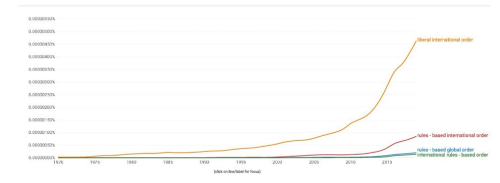
Google Ngram18 searches for the use of the term, and minor variations thereof, provide support for the above conclusions regarding the terminology’s emergence.
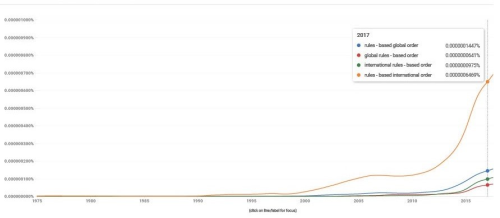
As Figure 2 indicates, consistent usage of the ‘rules-based international order’ began in the 1990s, with usage increasing exponentially from the late 1990s. Inflection points of usage are identifiable in the early 2000s and from approximately 2011/12 onwards.
Figure 3 (below) shows that the term ‘liberal international order’ – which Chapter 2 demonstrates is largely employed as a synonym for the ‘rules-based international order’ in Australia and the US – began to gain prominence almost three decades earlier. The use of the ‘liberal international order’ and the ‘rules-based international order’ have increased in tandem. However, the former term, which enjoys greater prominence in official policy and academic literature in the US, is used more frequently, and its usage is increasing at a greater exponential rate than the ‘rules-based order’.
Emergence in Australia
In Australia, the ‘rules-based international order’ terminology experienced an unorthodox rise for a concept considered by both major parties to be at the core of Australia’s contemporary foreign policy interests. In 2003, when setting out the core tenets of the opposition’s foreign policy, then foreign affairs spokesperson, Kevin Rudd, outlined that “an international rules-based system based on the [UN]” represented one of three pillars of Labor’s foreign policy, alongside the US alliance and engagement with Asia.19
In contrast, Rudd charged that the Howard Government had “effectively junk[ed]” the rules-based order in place “for more than half a century” through its participation in the 2003 US-led invasion of Iraq. Rudd’s approach mirrored a similar rhetorical pattern in the US, with Democrats charging that the Bush Administration had breached a core rule of this ‘order’, the prohibition on aggressive war enshrined in Article 2(4) of the UN Charter, by invading Iraq.20 While in opposition, Rudd consistently employed ‘rules-based order’ terminology, including in international engagements in China and elsewhere.21
In 2008, then-Prime Minister Rudd told the Brookings Institution that global harmony would depend on China “[participating] and acting in accordance with the rules of that … global and regional rules-based order”.22 This was the first identifiable occasion of an Australian Government official using the term. Similarly, the 2009 Defence White Paper was the first official high-level policy document to refer to the ‘order’ that could be identified.23 This document and the 2013 White Paper that followed it accorded the term significant prominence, describing it as one of Australia’s primary ‘strategic interests’.24 25
Australia’s 2016 Defence White Paper, which made 56 references to the ‘rules-based global order’, claimed that this order’s stability was “essential for Australia’s security and prosperity”.26 However, the term or similar could not be identified in any Defence White Papers before 2009.27
References to ‘order’ and ‘rules’ in official material prior to 2009 provides no sense of a broader ‘rules-based order’ concept. For instance, the 2000 White Paper referred to a ‘global security order’, which the US played a ‘major role’ in maintaining.28 Australia’s 2017 Foreign Policy White Paper insisted that “determined diplomacy and strong partnerships” were required to “strengthen the rules-based international order”, alongside 15 other references.29 In contrast, Australia’s 2003 Foreign Policy White Paper, the most immediate previous iteration, contained no references to the term nor any conceivable synonyms. Its references to ‘order’, for instance, included an assertion that States would need to organise “military coalitions” to deal swiftly and decisively with threats to “international order”, an apparent and problematic reference to Iraq.30 The thirty-two references to ‘rules’ emphasised the importance of specific international legal rules, including on trade and non-proliferation.
The 1997 Foreign Policy White Paper, which preceded the 2003 version, did not employ the term ‘international rules-based order’ either. The document made 13 references to ‘rules’, all of which related to specific international trade rules.31 The two references to ‘order’ referred to ASEAN’s role in the “emerging regional order” and Japan’s anticipated use of its diplomatic influence to “underpin the regional and global order”.32 A similar pattern is evident in the US and UK's foreign policy and strategic literature. While the US’ 2010 National Security Strategy, released under President Obama, mentioned the term,33 strategies released in 1994 and 2000 did not refer to the ‘rules-based order’ or similar formulations. In the UK, the term first appeared to gain traction in the 2008 National Security Strategy.34
This analysis reveals two fundamental challenges for Australia. First, it is challenging to reconcile the importance of the order in contemporary Australian official statements and policy with the reality that the term has only entered the Government’s lexicon in the last fifteen years. Further, as an exploration of Foreign Policy and Defence White Papers, statements and documents released before 2009 has demonstrated, no synonymous terms are used. Rather, references to ‘rules’ tend to relate to specific and technical rules of international law. In contrast, references to ‘order’ tend to emphasise the leadership or hegemonic role of the US, seemingly independent of any broader international rules or architecture. It is challenging, therefore, for Australia to convince States in the Indo-Pacific, or indeed States generally, that the ‘rules-based order’, purportedly created in the ashes of the Second World War, is critical to all States' national interests when Australia has only been articulating its importance over the last few decades.
The emergence of the term in the Australian political lexicon in the context of allegations that the Australian Government ‘junked’ the order through its participation in the US’ 2003 invasion of Iraq reinforces a perception that despite Australia’s (recent) promotion of the ‘rules-based order’ its track record in adhering to this order, as Australia itself defines it, is far from exemplary. As a result, Australia’s credibility is reduced when it seeks to rally support to defend or promote the ‘order’ or when it seeks to assert that other States, as later Chapters will explore, are seeking to overturn or erode the order, including by acting in violation of its core norms.
Chapter 2: The ‘rules-based international order’ v. the ‘liberal international order’
While the ‘rules-based international order’ term emerged in the academic and official lexicon in the 1990s, a separate term, ‘the liberal international order’, had been used for many decades.35 This Chapter will analyse the core elements of the ‘liberal international order’ and demonstrate that it and the ‘rules-based international order’ are effectively synonyms in Australia and the US. Accordingly, concepts such as US hegemony and the promotion of liberal democracy, which make up the liberal order and are explored in the first subsection of this Chapter, are imported into ‘rules-based order’ terminology, reducing its broader international appeal.
What is the ‘liberal international order?’
Deudney and Ikenberry, two prominent academic authors on the ‘liberal international order’, explain that, at its heart, the ‘post-war liberal order’ is “aimed at ‘making safe’ liberal democracy in a world riven by tyranny, brutality, and intolerance”.36 This liberal order, they assert, has several essential features and norms.37 The first is ‘security co-binding’ between liberal States and the US, as hegemon. This is epitomised by mutual defence arrangements, such as the North Atlantic Treaty Organization (‘NATO’), which ties certain regions and States to the US.38 Chalmers incorporates a similar perspective, describing the ‘Western system’, embodied by security and integrative mechanisms, such as NATO, bilateral security agreements (such as ANZUS39), the European Union and the Five Eyes intelligence-sharing arrangement, as a vital component of the order.40
The second key feature of the liberal order, for Ikenberry, is the ‘penetrated hegemony’ of the US. Ikenberry outlines that the ‘liberal international order’ or ‘the American-centred Western order’ (Ikenberry uses these terms interchangeably) differs from traditional hegemonic relations based on superordinate-subordinate relations. In contrast, the liberal order vests overall control with the US, while allowing Western states scope to contribute to “policymaking for the overall system”. In this way, the order is an “empire by invitation.”41 The US, as hegemon, is considered the “first citizen” of this order “providing hegemonic leadership—anchoring the alliances, stabilising the world economy, fostering cooperation and championing ‘free world’ values.”42
Similarly, Ho conceives of the ‘liberal order’ as one in which liberal, democratic States, especially the US, occupy positions of privilege. Non-liberal democracies like Vietnam may work within the liberal system, but only if they accept US primacy. Ho argues that during the Cold War, the liberal international order (comprising the US and its liberal democratic allies) operated in opposition to a communist-led order championed by the Soviet Union (‘USSR’) and China.43 Within this paradigm, the USSR’s collapse and the Cold War’s culmination in 1991 represented the victory of the liberal international order over a communist order,44 a line of reasoning that shares parallels with Fukuyama’s ‘end of history’ thesis regarding the triumph of Western liberalism.45
Sloss also views a hegemon as essential to the ‘liberal international order’, noting that its rules are “difficult to enforce without a dominant hegemon … willing and able to exert its power to maintain a rules-based order.”46 Participants at a Chatham House conference in 2015 on ‘challenges to the international rules-based order’ adopted an equivalent position, agreeing that the rules-based international order was both embodied by Western liberal values and “enforced by the most powerful nations.”47
Western primacy or predominance also emerges as another core feature of the liberal order in other Australian and US narratives. Bisley has observed a growing sense in Canberra that diminished US and Western “primacy” has reduced the ability to enforce ‘Western rules’.48 Porter argued that the ‘liberal democratic order’ was naturally Western-led and that it was inherently resilient as “capitalist democracies” retained the “majority of global power”. In contrast, rising powers would “never align into a cohesive, counter-hegemonic bloc.”49
Ikenberry suggested that the third key component of liberal order is ‘civic identity’. This covers norms and principles such as “political democracy, constitutional government, individual rights [and] private property-based economic systems.”50 Mazzar, in a US Government-sponsored study seeking to define the ‘rule-based order’,51 noted that the liberal elements of the order, such as democracy, are so firmly ingrained that “reducing the emphasis” on these elements could “unravel” the order itself. In addition, the “liberal character” of the order “implies … a positive duty to defend other members of the liberal community” and to free people from “intolerable oppression” even if, it is implied, that might be in breach of principles of international law, such as state sovereignty. The US invasion of Iraq in 2003 and efforts to impose a democratic system, under this paradigm, were “not an insult to the liberal order” but rather the highest point in its development.52 Mazzar envisaged conflict and tension within this system, conceding that it was predictable that “illiberal states”, such as Russia and China, would take a stand against critical elements of the rules-based order, including liberal values, US alliances and hegemony.53
‘Liberal international order’ and the ‘rules-based international order’ – separate or synonymous?
In government policy and academic literature in Australia and the US, the ‘liberal international order’ and the ‘rules-based international order’ are treated as broadly synonymous and interchangeable. Bilahari Kausikan, former head of Singapore’s foreign ministry, claims that for the vast majority of States, including those in the Indo-Pacific, the rules-based international order means the liberal international order, an order ‘led’ by the US.54 Strating observes that the West tends to use the ‘rules-based international order’ as a “rhetorical proxy” for the maintenance of US hegemony under a ‘liberal international order’.55 For Price, when Australian officials refer to the ‘rules-based order’, this is code for the “post-1945 Liberal International Order”, as described by Ikenberry.56
Reinforcing this point, Bisley and Schreer assert that the Australian Government’s contemporary preference for the use of the ‘rules-based international order’ is not because it views this term as divergent from the ‘liberal international order’. On the contrary, this is because the ‘rules-based order’ formulation has greater appeal to the non-democratic, non-liberal States of the Indo-Pacific, such as Singapore and Vietnam, with which Australia seeks to enhance security and foreign policy cooperation.57
In a recent study of US official and academic thinking concerning the content and scope of the ‘rules-based international order’, Ho found that most camps saw this order in liberal terms – that is, as a vehicle for the promotion of liberal economic and governance values and US hegemony. Ho concluded that thinking fell into three ‘schools’: idealists, internationalists, and instrumentalists. 58 Idealists viewed the order as being animated by the promotion of liberal values, such as democracy and human rights. The US was the sine qua non for the order and its exemplar. Instrumentalists viewed the order principally as focused on preserving Washington’s power and hegemony. Alternatively, internationalists considered the order was primarily about maximising international cooperation and stability. Ho found no overwhelming partisan alignment to any of these schools.
In terms of official narratives, the US, a regular invoker of ‘rules-based order’ terminology,59 often refers to international order in a way that appears to confirm that it views its hegemony and primacy in rule-setting as a central principle. For example, in the 2016 State of the Union address, President Obama stated that “China does not set the rules [in the Indo-Pacific], we do.”60 Similarly, the US’ 2018 Strategic Framework for the Indo-Pacific describes the maintenance of US “strategic primacy” as a key US regional objective.61 In an essay in Foreign Affairs in 2020, then-candidate Biden emphasised the role of US leadership in “forging the agreements, and animating the institutions” that bring global order.62
In the Australian context, official documents and statements confirm, or at least create the perception, that Australia views the rules-based and liberal order concepts as synonymous, thus effectively incorporating liberal order norms into Australia’s interpretation of the order. For example, in the 2017 Fullerton lecture in Singapore, Foreign Minister Bishop used the terms ‘liberal international order’ and ‘rules-based international order’ interchangeably. Further, Bishop noted that US democracy and political values “reflect the liberal rules-based order … we seek to preserve and defend.”63 Australia’s 2017 Foreign Policy White Paper confirmed that Australia strongly supports “US global leadership” in the international system. Without US support, the Paper suggests, both the “effectiveness and the liberal character of the rules-based order will decline.”64 Australia’s former Prime Minister Scott Morrison used both terms interchangeably, and, on occasion, combined the two, referring to the “liberal, rules-based order”.65
Australia’s 2013 National Security Strategy described the US as the “critical underpinning” to the rules-based order.66 In 2014, Prime Minister Abbot went further, describing Australia’s conception of the US as a guarantor whose role was to “keep the peace and enforce the rules”.67 For Foreign Minister Bishop, the liberal elements of what was an order in which the West enjoyed primacy were critical. While non-democracies, like China, could “thrive” in the present order, “an essential pillar of our preferred order is a democratic community.” Emphasising this point, Bishop suggested that only liberal democracies could be true ‘citizens’ of the rules-based international order and outlined that “domestic democratic habits” were essential to the resolving of disagreements according to international law and to allow States to achieve their full economic potential, citing the ‘middle-income trap’ thesis.68
The perception that liberal democratic States, such as Australia, view the ‘rules-based’ and ‘liberal’ order as identical was reinforced by a 2017 Strategy Paper released by the ‘D-10’ forum of democracies.69 This paper used the terms ‘international rules-based order’, ‘rules-based democratic order’ and ‘liberal international order’ interchangeably, describing this order as based on democratic governance and the protection of individual rights.70
From the perspective of Australia’s foreign policy, fundamental challenges for Australia’s use of ‘rules-based order’ language as a tool to catalyse regional action arise from the perception that Australia views the ‘rules-based’ and ‘liberal’ international orders as synonymous. If a ‘rules-based order’ requires the promotion of liberal, democratic values as a guiding philosophy, or if ‘true membership’ requires that a State be a liberal democracy, this automatically excludes many States in the Indo-Pacific that are not liberal democracies or even basic democracies. In a ‘liberal democracy index’ prepared by Our World in Data, aside from Australia, New Zealand, and the US, only South Korea, Japan, Taiwan, and Vanuatu score above fifty per cent in the Indo-Pacific.71 Singapore has expressly rejected liberal democracy,72 while China and Vietnam are one-party, authoritarian states. Thailand is emerging from (another) period of military dictatorship. Indonesia, Bangladesh, and India are rated as only ‘partly free’ by Freedom House and Cambodia, Myanmar, and Laos are considered ‘not free’.73 As Milner and Smith observe, ASEAN members, with their divergent governance practices, do not wish to discriminate with respect to political systems and are wary of language that suggests order must be brought by a partnership of democracies.74
Further, if the ‘rules-based order’, as Mazarr has suggested, justifies the use of force against countries in the service of efforts to bring liberal democracy, such as in Iraq in 2003, this approach is antithetical to the perspectives of the vast majority of States in the Indo-Pacific region. The notion that the ‘rules-based order’ justifies efforts to spread liberal democracy, not just via proselytisation but also, where necessary, by force, has parallels with the ‘civilising mission’, an intellectual trend that took root in the nineteenth century and purported to justify European colonialism on the basis that “backward lands” would be ‘civilised’ in return for the exploitation of their economies.75 To support this conclusion, we only need to look at the reaction of States in the Indo-Pacific region to the US’ 2003 invasion of Iraq and the fact that Australia and the US were the only States in the Indo-Pacific that participated in the invasion. India opposed the US invasion of Iraq, maintaining that UN Security Council authorisation was required and that any move to change the regime in Baghdad “must come from within” and “not be imposed from outside.”76 China, Indonesia, Malaysia (speaking for the Non-Aligned Movement), New Zealand, Vietnam, and Bangladesh took similar positions.77
Finally, the centrality of US hegemony to the ‘liberal’ and ‘rules-based’ orders establishes, at least in the Indo-Pacific, a binary between the US and China and could reasonably imply that support for this order requires support for US regional hegemony. This runs contrary to the position of many States in the region. As Singapore’s Kausikan writes, the ‘political-security’ aspects of the ‘rules-based order’ effectively incorporate the norm of US primacy and, subsequently, the “hard containment” of China, something that ASEAN members do not support.78 Further, as Singapore’s Prime Minister underlined in 2022, countries in Southeast Asia – most of which are more economically reliant on trade with China than the US – do not wish to be forced to ‘choose’ between the US and China and believe that security is enhanced where these superpowers enjoy “overlapping circles of friends.”79
Anwar, an adviser to Indonesia’s Vice President, underscores that the emphasis on ‘rules-based international order’ terminology by the US, Australia and others is perceived by China as “exclusive rather than inclusive” and a component of a “strategy to contain China”. ASEAN countries are at the coalface of US-China strategic competition and, Anwar highlights, have “no desire” to be driven to “take side[s]” and be divided by the superpowers, as occurred during the Cold War.80
In addition, if US hegemony or primacy in the Indo-Pacific constitutes a part of the fabric of the rules-based order, the perception could be that support for this order equates to a willingness to back the US – militarily if necessary – should its primacy be challenged in the Indo-Pacific, or elsewhere. The resulting implications dampen the appeal of ‘rules-based order’ terminology. As Anwar and others outline, ASEAN states have been clear that they do not wish to ‘choose’, and the idea of backing the US militarily in a conflict with China, not least over ‘primacy’, appears inconceivable for many regional States.

Chapter 3: When was the ‘international rules-based order’ created, and what does it comprise?
This Chapter will demonstrate that the official and academic narrative regarding the creation of the rules-based order is incoherent; there is no consensus on what the rules and institutions that make up the ‘rules-based order’ are, or even whether the order exists or is merely aspirational. Individual accounts of the rules and institutions that comprise the order are also, in some instances, incoherent or internally contradictory. As a result, it is challenging for Australia to convince other States, in the region and beyond, to value the order and to act in its defence.
Emergence of the rules and institutions of the order
In temporal terms, the bulk of the official and academic literature suggests that the order was established in the aftermath of the Second World War and comprises, at its core, the UN and the Bretton Woods Institutions (i.e., the International Monetary Fund (‘IMF’) and the World Bank).81 However, some trace the origins of an international rules-based order to the Kellogg-Briand Pact of 192882, a treaty that sought to outlaw aggressive war and served as a forerunner to Article 2(4) of the UN Charter, or even to the 1648 Treaty of Westphalia.83
Australia’s 2016 Defence White Paper described the rules-based order as underpinned by “international governance … developed since the end of the Second World War", including the UN and international treaties.84 Similarly, Australia’s 2017 Foreign Policy White Paper emphasised that the creation of “international institutions and rules to … support economic growth, global security and human development” was one of the key features of the post-Second World War era.85
However, the rules-based order is considered aspirational in some official and academic quarters. This perspective is informed by liberal conceptions of the order, suggesting that there can be no genuinely global ‘rules-based order’ until all, or perhaps the majority, of States are liberal democracies or accept liberal democracy’s hegemony. For example, Sloss argues that in the post-Cold War period, the US “attempted to create a rules-based order that was both liberal and global”. This order was typified by “military adventurism”, leveraging US military power to spread human rights and democracy internationally.86 Mazarr submits that while a rules-based order was established in the aftermath of the Second World War, membership was limited to the democratic West. Once the Soviet Union collapsed, the opportunity to participate in the order was extended more broadly, allowing States that accepted the order's core norms – US hegemony, democracy, and liberal values – to join.87
Statements at the official level appear to confirm that similar perspectives are held by the US and Australian governments. In 2011 at APEC, then-Secretary of State, Hillary Clinton, noted that a “rules-based order” needed to be created to promote and protect freedom, openness and fairness.88 In 2019, Australia’s Defence Minister Reynolds articulated the need to establish a rules-based order that is “fit-for-purpose in the twenty-first century” and which can deliver “regional and global peace and also prosperity” as a “collective challenge”.89 While Reynolds’ statement is seemingly at odds with Government White Papers, at best it reduces the perceived coherence of Australia’s conception of the ‘rules-based order’, negatively affecting the strength of Australia’s case when it seeks to rally other States to defend the order. Further, there is a risk that Reynold’s statement could be perceived as reinforcing liberal elements in Australia’s conception of the order’s operation, such as a privileged role for liberal democracies. As Chapter 2 has demonstrated, many States in the Indo-Pacific are not liberal democracies, rendering it less likely that Australia could convince these States to value and defend an order that Australia suggests they are not part – or are second-class citizens – of.
Content of the order
Official and academic efforts to capture the rules-based order's content, limits and core features diverge significantly, while individual conceptions often lack internal coherence. For instance, Hall and Heazle claim that the post-war rules-based order is, at its core, about global economic rules, maritime rules, and human rights standards. The principle of the ‘freedom of [maritime] navigation’ is portrayed as a key element of the order, though Hall and Heazle’s work does not reconcile the fact that this international norm is enshrined in a treaty – the United Nations Convention on the Law of the Sea (‘UNCLOS’) – which the order’s most powerful member, the US, is not a party to.90 UNCLOS’ deep sea-bed mining regime, popular in the developing world, is viewed by the US as inimical to its liberal, free market interests.91
Patrick maintains instead that the post-war order’s guiding principles are openness, economic liberalism and de-colonisation and that fundamental norms of the order include self-determination, freedom of navigation, the use of force in self-defence, non-proliferation, human rights, and climate change.92 The UN is widely credited as playing a pivotal role in catalysing and supporting the de-colonisation/self-determination process. The 1960 Declaration on the Granting of Independence to Colonial Countries and Peoples (‘the Declaration’) was the decision that initiated the UN’s involvement in the de-colonisation process. Only nine States in the UN General Assembly did not support this Declaration, including Australia, the US, and the UK.93 The Declaration itself was put forward by the Soviet Union. The Soviet leadership of this initiative and the lack of US support make it challenging to reconcile Patrick’s conclusion that the order is a “post-1945 Western Order” that incorporates US “hegemony” with his separate finding that “self-determination” is one of the order’s guiding principles.94
While Patrick claims that non-proliferation norms are ‘fundamental’ to the post-war order, it is unclear how this can be reconciled with the fact that the most critical non-proliferation norms are contained in treaties that did not become binding for some decades after the Second World War. For instance, the Nuclear Non-Proliferation Treaty entered into force in 197095, whereas the Chemical Weapons Convention, prohibiting the possession of chemical weapons, entered into force only in 1997.96
As explored in Chapter Two, official, and academic literature in the West often blurs or merges references to a rules-based international order with references to what Ikenberry and others have characterised as the liberal international order. Many of the narratives explored in this paper suggest that the ‘rules-based order’ is a Western order created in competition with a Soviet order. A widely cited 2016 RAND study, commissioned by the US Government, describes the order, at a structural level, as a post-war liberal order, established by the US, which includes “international economic institutions, bilateral” and “regional security organizations” (meaning US alliance structures) and “liberal political norms”.97 Citing, Ikenberry, Patrick and others, this study suggests that this rules-based order was “not global at first”; instead, it was incubated “within the global democratic community in competition with the Soviet bloc”. Once the Soviet Union collapsed, the order was “extended globally”, allowing States to participate, on the condition of adherence to the order’s liberal norms and values. Ho also draws a similar distinction between a Western ‘rules-based order’ and a ‘Soviet order’, though the structures and rules of these orders and whether, or how, they overlap are given limited attention.98 According to Mazarr, the order’s core elements include “US power and sponsorship” and “a set of legitimate global institutions”, such as the UN and the World Trade Organization (‘WTO’), and “international legal conventions”, such as arms control regimes.99
These norms and institutions were created to advance “core principles”, including “economic stability”, “nonaggression”, and “the advance of liberal values”.100 The rules-based order was built around “two architectures”, reflecting key ideological points of consensus. The first is the liberal trade and investment regime – encompassing the Bretton Woods Institutions and the General Agreement on Tariffs and Trade (later WTO). This regime was developed by a “core set of democratic trading states” that were so large that prosperity for other states required trade with them, and thus participation in the liberal order.
The second is the security architecture, designed to “obstruct large-scale aggression [and] also to shape the use of force.” In addition, the order “came to embrace goals of democratization and the protection of human rights”, such that these are “embedded” in the “global vision” for the order.101 From the perspective of the RAND study, it is unclear how the concept of a Western rules-based order competing with a Soviet order can be reconciled with the idea of the UN system and key global conventions, such as those on arms control, sitting within the ‘Western rules-based system’. After all, both the US and the USSR played an integral role in drafting the UN Charter. Indeed, it was the USSR that insisted on the inclusion of the veto power for permanent members of the UN Security Council, which included the USSR, as the price of its agreement to the Charter.102 It is also unclear precisely whether membership of this order, which includes, according to the RAND study and other authors, the UN, requires that a State be a liberal democracy. After all, this would not be consistent with the fact that many States that have been members of the UN since its inception,103 including two-fifths of the permanent membership of the UN Security Council, are non-democracies, let alone liberal democracies. 104
Chalmers, adding further to the incoherence of the narrative surrounding the content of the order, claims that instead of thinking about a single ‘rules-based order’, it is necessary to conceive of the order as consisting of multiple orders with varying memberships, organised not geographically but thematically. These thematic orders include the ‘Universal Security System’, the ‘Western System’, the ‘Universal Economic System’, and ‘Major Power Relations’.105 The former is governed by the principles of “self-determination and non-aggression”, under the UN system, and norms related to the use of nuclear and other weapons of mass destruction. The Western System enjoys the exclusive membership of “developed market democracies” in North America, Europe and the Asia-Pacific through security, integrative and cooperative mechanisms, such as the EU, NATO, bilateral security agreements, the G7, the OECD and the Five Eyes intelligence sharing arrangements. The Universal Economic System captures the international trade and investment architecture established by the IMF, the World Bank, and the WTO. The Major Power System includes the bloc structure and the division of Europe into mutually agreed spheres of influence and bilateral arms control agreements between the superpowers, such as the START treaty.106
In terms of the content of the ‘rules-based order’, Australia’s official documents and statements tend towards the general over the specific. The 2016 Defence White Paper described the order as encompassing the UN system, a “shared commitment” to abide by international law and regional security architectures.107 Prime Minister Morrison also reinforced the UN’s centrality, describing it in 2019 as the “prime custodian” of the order, adding that the “UN and its norms” were key to a cooperative rules-based approach to global challenges. In a 2018 speech by Australia’s Foreign Minister Bishop and in Australia’s 2016 Defence White Paper, the UN architecture and “regional security architectures” – including bilateral mutual defence agreements, such as ANZUS, as well as ASEAN and other regional fora, such as the European Union – were described as core components of the ‘rules-based order’.108
As this analysis reveals, academic and official views diverge significantly with respect to the content and contours of the ‘rules-based order’. As was explored in Chapter Two, many accounts emphasise liberal conceptions of the order, such as US hegemony and the promotion of liberal values, though they ignore the agency of non-Western actors in shaping key norms that regulate interaction between States, the temporal period in which norms were generated and the record of some Western States in terms of submitting themselves to treaties which many States consider contain norms critical to global order. Australia’s narrative regarding the order is equally inconsistent. In one instance, the order is a post-war creation; in another, it is yet to be realised. In one case, the UN is at the very core of the order, then Australia speaks of the US setting and enforcing the rules and, in a move that suggests a profound lack of confidence in the UN, conducts an ‘audit’ of its multilateral institutions. Accordingly, this inability to paint a straightforward narrative leaves the neutral observer to conclude that ‘liberal’ norms are genuinely at the core of the rules-based order as these are the only elements clearly and consistently referenced across competing narratives. Beyond these liberal norms, it is hard to paint a clear and consistent picture of the order’s norms, making it challenging for Australia to rally international efforts to maintain and defend the order.
Chapter 4: The rules-based international order is ‘under strain’
The suggestion that the rules-based order is in crisis, “disintegrating”, or even in its “death throes”,109 is another central theme in academic and official discourse, including in Australia. Indeed, as Chapter One demonstrated, some of the earliest references at the political level in Australia to the ‘rules-based order’ were to characterise it as in jeopardy, in that instance because of Australia’s conduct.110 An exploration of the narratives related to the ‘strain’ on the order assists in illuminating how those who utilise this description view the norms and operation of the ‘rules-based order’. This Chapter will demonstrate that the narratives regarding the ‘stresses’ on the order, which are predominantly found among Western sources, are focused largely on the geopolitical challenges generated by Russia’s and China’s more assertive international posture. These narratives further reinforce that ‘liberal’ norms – such as US hegemony, the privileged status of the West as rule maker and enforcer, and the promotion of liberal democracy globally, including by force – sit at the very core of the mainstream conception of the ‘rules-based order’. As a result, the rallying and coordinating power of ‘rules-based order’ terminology is diminished.
A fraying order?
The narrative that the ‘rules-based international order’ is currently facing unprecedented pressure and challenge, particularly from China and Russia, is dominant in both Australian academic and official sources. For Tyler, the concept that some States are “uniquely or fundamentally challenging [it]” is a central theme of the order itself.111 Maude, a former senior official in Australia’s foreign ministry, noted that we must “recognise the significance of the strains on the rules-based order” and that it is changing, with its liberal character weakening.112 Australia’s 2017 Foreign Policy White Paper paints a similarly gloomy picture, emphasising that the order is “under significant challenge” with “forces of change … buffeting this system”, citing “geo-political competition”, power shifts between states and globalisation as the primary centrifugal forces.113 Australia’s 2016 Defence White Paper described an order that was showing “signs of fragility” and was being contested by “competition between countries and major powers trying to promote their interests outside of the established rules [created over 70 years ago]”.114
Similar perspectives can be found elsewhere. In reference to Russia’s invasion of Ukraine, German Foreign Minister, Heiko Maas, observed that some States were engaging in “power politics”, undermining the order based on rules in favour of an order based on strength.115 Similarly, for Paikin, Russia’s invasion of Ukraine has left the rules-based order “in crisis” and has “destroyed the European security architecture”.116
Why and how is it fraying?
While a consistent theme in official and academic narratives centres on the pressures and strains on this order, accounts of how and why it is fraying differ markedly. Often, the ‘fraying’ narrative is underpinned by liberal conceptions of the order, with challenges coming from non-liberal States or even purely because of the failure of the ‘liberal agenda’ to gain traction internationally. As a pointed example, Mead cites the failures of US ‘democracy building’ interventions in Libya, under Obama, and in Iraq, under George W. Bush, as examples of the failure of liberal internationalism at the very core of the rules-based order.117
Another dominant theme in the ‘fragility’ narrative focuses less on the notion that the order’s integrity is at risk due to breaches of fundamental tenets of its international legal norms, such as Russia’s breach of the prohibition on aggression enshrined in Article 2(4) of the UN Charter through its invasion of Ukraine. Instead, the sources of ‘disorder’ are threats to US hegemony and dominance that arise because of rising powers rejecting the premise of US primacy. For example, Haass, former President of the US Council on Foreign Relations, stresses that the current “disorder” in the rules-based system is a result of States and other actors acting with greater autonomy and “paying less heed to US interests and preferences”.118
Similarly, for Mazarr, one of the critical risks to the order is that rising States perceive that elements of it are “designed to constrain their power and perpetuate U.S. hegemony.”119 Bisley concludes that there is a growing sense among decision-making elites in Canberra that the post-war rules-based order is in ‘disarray’ since “Western primacy and the ability to enforce Western rules [which make up the ‘Western rules-based order’] are declining.” The critical question, for Bisley, is whether the US is willing to “act as the principal guarantor” for these rules.
For Bisley, ‘rules-based order’ terminology is a subtle code for the desire of the US to retain ‘primacy’ in East Asia, which has been the “fundamental ordering principle in East Asia”. Usage of the rules-based order formulation – which Bisley observes is largely by US allies – is a means for Canberra to “signal Australia’s growing security alignment with Washington and its other Asian partners”. Calling out China for breaches of the rules-based order is merely a subtle way to criticise China’s “strategic actions” while minimising the risk of damage to the bilateral relationship.120
Bisley’s narrative is that China poses a threat to this ‘Western rules-based order’ on the basis that it has rejected overtures and socialisation efforts from the West to become a liberal democratic state. 121 Under this paradigm, China challenges this order by building its own regional institutions – such as the Shanghai Cooperation Organization and the Asian Infrastructure Investment Bank. In addition, however, China’s challenge to the order can also be seen in its “comprehensive military build-up … designed to negate US naval supremacy in the Western Pacific.” Thus, from Bisley’s perspective, or at least the perception the reader is left with, US military supremacy in East Asia itself is a crucial component or norm of the ‘rules-based order’.122
As a corollary, China’s challenge to the order and its desire, as Bisley puts it, to ‘rewrite’ the order, at least in East Asia, is not framed as China’s desire to rewrite extant rules of international law, but rather to build the military power necessary to displace the US as East Asia’s hegemon. According to Bisley, Australia must champion a coalition against China’s ‘revisionism’ to resist this. Necessarily, this will require the involvement of democratic and non-democratic States. Accordingly, it will be necessary for Canberra to steer clear of the use of ‘liberal international order’ language (favouring instead the ‘rules-based order’), so it is appealing to non-democratic States in Asia.
The concept that liberal democracies occupy a position of privilege also appears consistently in the ‘fraying’ narrative. Ikenberry acknowledges the threats to the rules-based order but is more sanguine about its prospects for survival. The order, Ikenberry contends, is a “liberal leviathan”, reinforcing the centrality and supremacy of liberal democracies. Ikenberry argues that capitalist democracies retain the bulk of global power, and their ‘first-mover advantage’ means they have created a global order that is “easy to join” but “hard to overturn”.123 In Ikenberry’s view, it is unlikely that rising powers would coalesce into a coherent “counter-hegemonic” bloc, given their differences in interests, histories, and political systems. In this regard, it is clear to Ikenberry that the rules-based order is designed to benefit capitalist democracies and has facilitated a period of hegemony for these States. Mazarr shares this view, noting that liberal democracies “ha[ve] always constituted the core of the modern order.”124
Sloss touches on some similar themes. For Sloss, the rise of China, ‘democratic decline’ globally, and the weakening of the US’ power and leadership are among the order’s principal threats. For Sloss, the latter threat is acute because the US plays a critical role in both maintaining and enforcing the order’s “rules affecting peace, prosperity, and human rights”.125
Like others, Sloss links the integrity of the rules-based order to the health of democracy internationally. Sloss suggests that wise politicians in the West may be able to “exploit widespread fear of China” to reinvigorate liberal democracy, both domestically and globally. If this fails, the resulting “erosion of liberal democracy” will undermine the protection of human rights, a fundamental pillar, Sloss claims, of the rules-based order. 126 Sloss emphasises the idea that liberal values are both at the heart of the rules-based order, but also that liberal democracies enjoy a form of exceptional standing within the rules-based order, or even that parts of this order are not genuinely universal but apply only to, or privilege, liberal democracies.
The challenge this narrative creates is two-fold. First, it underscores the perception that the rules-based order is being used as a synonym for the liberal international order and that concepts such as the promotion of liberal democracy, US hegemony and a privileged role for liberal democracies sit at the core of this order. The narrative that the rise of powers that are not liberal democracies threaten the order is unlikely to increase the attractive pull of the rules-based order for many States in Australia’s region, given the number of countries in the Indo-Pacific that are not democracies (see Chapter 2). Second, it promotes the idea that US hegemony or primacy in the Indo-Pacific forms a pillar of the rule-based order. As Chapter 2 canvassed in detail, many States in the Indo-Pacific have been clear that they do not wish to be forced to choose between China and the US and do not support the concept of any State occupying a position of hegemony in the region.
Chapter 5: What is the distinction between the ‘order’ and international law?
In April 2020, Russia’s Foreign Minister, Sergey Lavrov, observed that there is a trend in the West to:
new expression, a rules-based order.
International law comprises rules of a legally binding character that set out the “responsibilities of States in their conduct with each other, and their treatment of individuals within States boundaries.”128 As such, international law – as a set of legally binding rules applicable to States – may be expected to have considerable prominence within an order that is ‘rules-based’. In practice, as this Chapter will demonstrate, official and academic narratives on the ‘rules-based order’ in Australia and the US de-emphasise international law and its centrality as part of this order. This Chapter will argue that this de-emphasis weakens the appeal of ‘rules-based order’ terminology as rhetorical attacks against Russia and China for breaches of the ‘rules-based order’ risk being perceived as overly geopolitically motivated, particularly considering the track record of adherence to international law of accusing States.
From the perspective of some conceptions of the ‘rules-based order’, the reason for the distinction between ‘international law’ and the order is that the latter captures the full breadth of international rules, including those of a legally binding character and those that might best be described as political commitments. Germany, for example, advocates this approach. It considers that the order includes international law and “non-binding norms, standards and procedures in various international fora and negotiating processes.” After all, a significant portion of the norms and rules that govern relations between States are non-legally binding. These include the 1948 Universal Declaration of Human Rights,129 which was a hortatory resolution of the UN General Assembly,130 the 1993 Rio Declaration on the Environment and Development,131 and the 1960 UN General Assembly resolution on the Declaration on the Granting of Independence to Colonial Countries and Peoples (Resolution 1514).132
However, Australia’s emphasis on other norms, such as US security alliances and the US’ unique role in the order, makes it clear that Australia’s position diverges from Germany’s. Australia’s 2016 Defence White Paper claimed that the ‘rules-based order’ entails a common commitment between States to act in line with “agreed rules which evolve over time”. It lists ‘international law’ as but one example of ‘agreed rules’ in an open list that includes “regional security arrangements”. This is a notable juxtaposition, given that the bulk of regional security arrangements, such as the agreements that underpin NATO, ANZUS and the Five Power Defence Arrangements, are enshrined in treaties, meaning that the rules of these security arrangements are international law.133 This juxtaposition reinforces the impression that Australia’s conception of a rules-based international order includes the security frameworks that such agreements generate or acknowledge, including the concept of US primacy in the Indo-Pacific.
Australia’s 2017 Foreign Policy White Paper reinforces this perception. It characterises ‘international law’ and the ‘rules-based order’ as distinct frameworks, noting that Australia’s response to cyber-attacks will be consistent with “our support for the rules-based international order and our obligations under international law.” In a paragraph exploring the core principles of the rules-based order that support Australia’s interests and values, the White Paper identified “international law”, “the articulation of universal rights and freedoms”, and “US leadership [and] network of [alliances]” as well as the US military presence in Asia and Europe.134
There is, therefore, a risk of the perception that the de-emphasis on international law, in favour of an emphasis on the ‘rules-based order’, is because users of the ‘rules-based order’ terminology wish to import a range of concepts as norms of this order – such as the hegemony of the US and liberal democracies – which are not enshrined in international law.
In addition, the emphasis on breaches of the ‘rules-based order’, an undefined concept, over specific rules of international law, has given rise to the perception that it allows certain States, principally the US but also Australia, to attack States with which they are in geopolitical competition while avoiding criticism of their own record of adherence to international legal standards.135
An overwhelming majority of States consider Russia’s 2022 invasion of Ukraine to be a fundamental breach of one of the most critical post-war norms of international law and one of the central pillars of the UN Charter – the legal prohibition on aggressive war enshrined in Article 2(4) of the UN Charter. On 2 March 2022, the UN General Assembly adopted resolution A/Res/ES-11/1, which “deplore[d] in the strongest terms the aggression by the Russian Federation against Ukraine in violation of Article 2(4) of the Charter”.136 Nearly eighty per cent of States voted in favour of this resolution, with only North Korea, Syria, Belarus, Eritrea, and Russia voting against it. While this resolution was replete with references to the violation of international law, it contained no references to the ‘rules-based order’. Singapore’s Foreign Minister, in a statement in February 2022, condemned Russia’s invasion of Ukraine as a breach of “fundamental norms of international law and the UN Charter that prohibit the use of force and acts of aggression against another sovereign State.”137 Again, no reference was made to the ‘rules-based order’.
In contrast, in response to the same event, statements by the US and Australia are replete with references to the rules-based order. In March 2022, US President Biden labelled Russia’s invasion of Ukraine a “direct challenge to the [post-war] rule-based international order”.138 In a New York Times op-ed in June 2022, Biden declared that Putin’s aggression could spell the end for the ‘rules-based international order’ and “open the door” to aggression elsewhere.139 At a NATO summit in June of that year, Biden, making a notable reference to the role of democracies, claimed that he told Putin that its invasion of Ukraine would “see democracies in the world stand up and oppose his aggression and defend the rules-based order.”140 Similarly, Australia’s Foreign Minister labelled Russia’s actions a breach of “bedrock principles … of the rules-based order.”141
Twenty years ago, however, another military intervention by a Permanent Member of the UN Security Council in another sovereign State prompted similar allegations from many quarters of a breach of Article 2(4) of the UN Charter – the US invasion of Iraq. It is here that one of the fundamental weaknesses of the emphasis on breaches of the ‘rules-based order’ over ‘international law’ lies in that the emphasis on claims that certain actions by Russia and China ‘challenge’ or ‘destroy’ this order exposes the proponents of this term, chiefly the US but also Australia, to charges of inconsistency or even hypocrisy.
As Professor Murphy, a former international lawyer in the US State Department, highlights, the US itself has a track record of violating Article 2(4) of the UN Charter through the illegal use of force in Kosovo (alongside other NATO members) and against Iraq in 2003.142 Australia was also a participant in the US ‘coalition of the willing’, an action for which, as observed previously, the Howard Government was treated to allegations from Kevin Rudd that it was ‘junking’ the rules-based order. Considering this, it can be difficult to unpack the logic behind assertions that Russia’s actions in Ukraine – an unquestionably flagrant violation of perhaps the UN Charter’s most critical obligation – pose an existential challenge to the ‘rules-based order’ whereas breaches of that same norm by the US and its like-minded partners do not. Indeed, Henry Kissinger, in the context of the Kosovo conflict, reflected that "the abrupt abandonment of the concept of national sovereignty" by the West risked grave consequences for global order.143 In the context of Iraq, in addition to Rudd’s critique explored in Chapter One, Elizabeth Wilmshurst, a long-serving UK Foreign Office lawyer, resigned in response to the UK’s decision to invade in 2003 on the basis that the action was a “crime of aggression … so detrimental to international order and the rule of law”.144
A similar dynamic is evident with respect to China. In 2016, US President Obama told China that the Arbitral Tribunal’s ruling, which found China’s nine-dash-line was not valid legally, was “binding” and that China should comply in order to “maintain the rules-based international order”.145 The US’ record in terms of adherence to binding international judicial decisions has not been exemplary. In 1986, the International Court of Justice (‘ICJ’) – the UN’s principal judicial body – found that the US’ arming of the contra rebels and the mining of Nicaragua’s harbours amounted to an illegal use of force and a violation of Nicaragua’s sovereignty.146 The US refused to accept the Court’s ruling, which included calls for reparations for Nicaragua. The then US Ambassador to the UN claimed the Court was a “semi-legal” entity that “nations sometimes accept and sometimes don’t.” In fact, under Article 59 of the ICJ’s Statute, ICJ rulings are binding on the parties to the dispute.147 US attempts to withdraw from its recognition of the ICJ’s jurisdiction in disputes brought against the US (‘compulsory jurisdiction’) in 1985 were found by the Court not to be applicable to the Nicaragua case.148 The US had recognised the Court’s compulsory jurisdiction since 1946.149
In addition to instances where international law has been violated, the US has refused to subject itself to the very international standards that it demands others adhere to. For instance, and as discussed in Chapter Three, while the US, Australia and others criticise China for its failure to act consistent with its obligations under UNCLOS, the US remains one of the small number of States, most of which are developing, landlocked States, that are not party to UNCLOS.150 US concerns that portions of UNCLOS related to deep sea-bed mining represent a form of socialism only serve to reinforce perceptions of US exceptionalism when it comes to being bound by international law.151
Murphy argues that the US struggles with the constraining effect of international law due to the US’ “triumphalism” and “exceptionalism”, as well as its “distrust of centralized power”. As a result, the US prefers international institutions, such as the UN Security Council and the World Bank, where it enjoys substantial influence and control.152 Australia has echoed similar sentiments. Just weeks after describing the UN as the “prime custodian of the rules-based order”, Prime Minister Morrison railed against ‘negative globalism’, the impositions of the ‘borderless global community’ and an ‘unaccountable internationalist bureaucracy’.153 In a demonstration of limited faith in the multilateral bodies he had just anointed the custodians of the ‘rules-based order’, Morrison announced a “comprehensive audit of global institutions and rule-making processes.”154
The emphasis on allegations of the breach of the ‘rules-based order’, as opposed to international law, risks further diminishing the appeal of ‘rules-based order’ terminology for three key reasons. First, there is a risk that the use of the term – which is used primarily by the US and its allies – is viewed by others as an insincere or cynical effort to simultaneously brand certain actors as malign, sometimes while avoiding specific charges, while masking past failures of the accusing State to act consistent with international rules. As Singapore’s Mahbubani has pointed out in the context of the US invasion of Iraq, “how can the violators of UN principles also be their enforcers?”155 Second, the characterisation of some States’ breaches of international law as posing jeopardy to the ‘rules-based order’ itself, even in the context of similar past breaches by accusing States, risks highlighting a perception that some Western States consider themselves ‘exceptional’ or above the constraining effect of international law as a result of their hegemonic or privileged status within the ‘rules-based order’.
Third, there is a risk that an overemphasis on breaches of the rules-based order can, in practice, dilute support for the criticism of flagrant violations of international law because of a perceived politicisation of the issue and importation of geopolitical and ‘bloc’ dynamics. This can already be seen in the context of the situation in Ukraine at the United Nations, where resolutions that call on Russia to withdraw its military forces from Crimea and end its occupation attracted predominantly Western support, with only 62 out of 193 UN members voting in favour.156 The following Chapter explores this issue further.
Chapter 6: Who is using ‘rules-based order’ terminology? Who is not?
This Chapter reinforces this paper’s conclusion that the ‘rules-based order’ terminology is of limited appeal beyond the West by demonstrating that while it is in favour in the West, and principally, in Australia, the US and the UK, it is explicitly rejected as a geopolitical construct by China and Russia and not typically utilised by other States in the Indo-Pacific. While Germany, as canvassed previously, Austria and others also use the formulation, these States tend to ascribe to it a more technical definition, focused on international law, norms of a non-legal character and norm-generating multilateral institutions, such as the UN and its dispute resolution tribunals and bodies.
For many Europeans, the rules-based order is more closely intertwined with international law and legal structures, such as the UN system, and less with power dynamics. As explored previously, for Germany, the order covers international law, but also “non-binding norms, standards and procedures in various international fora and negotiating processes.”157 Austria defines the ‘rules-based order’ as largely analogous to international law, describing it as “a system comprising international law, treaties, customary law as well as general principles of law as outlined in the Statute of the International Court of Justice (ICJ).” The order also required the “settlement of disputes by peaceful means”, including through international judicial processes.158
In contrast, Russia and China maintain that the ‘rules-based order’ formulation serves as a stalking horse for US and Western hegemony. Russia objects to the perceived lack of clarity regarding the order’s content. Lavrov has stated that the West “shies away from spelling out the ‘rules’ it purports to follow” and accuses any State that acts against “the will of the West” of being a “rule breaker”.159 Lavrov criticises the West’s claims to the universality and the inevitably of its liberal values and its democratic political systems, observing that there is more than simply one civilisation in the world.160
Similarly, China considers it an ‘ambiguous formulation’ not found in the UN Charter or the UN’s resolutions.161 It views the formulation as a vehicle to “impose [Western] standards and will on others” and as a “back door to double standards and exceptionalism.” In 2022, Russia and China issued a joint statement that implicitly rejected the order in favour of an ‘international law-based world order’.162
Beyond the US and its allies in Western Europe and East Asia, the use of the ‘rules-based order’ formulation is more limited. While Australia’s former Prime Minister Morrison dubbed the UN the “prime custodian” of the rules-based order,163 the international organisation which enjoys the greatest universality and international legitimacy as a forum for international cooperation has largely eschewed the ‘rules-based order’ formulation in its statements and decisions.
While the US and others suggest that Russia’s invasion of Ukraine threatened to shatter the very foundations of the ‘rules-based order’, the UN General Assembly’s resolution in response to Russia’s invasion contained no references to this formulation or to ‘order’, its eight references to ‘rules’ were to specific international legal rules.164 On 21 September 2020, the UN General Assembly adopted a resolution to celebrate the 75th anniversary of the 1945 UN Charter, a treaty establishing an institution that is a core component of most conceptions of the ‘rules-based order’. This resolution contained no references to the ‘rules-based order’. In a 2023 UN Security Council open debate on the ‘rule of law in the maintenance of international peace and security’, the US and UK statements emphasised the importance of the ‘rules-based order’. In contrast, Russia and China criticised the formulation in familiar terms. Malta was the only other State that employed the term. Malta’s statement described this order as “enshrined in the UN Charter”, an approach more in line with Germany’s or Austria’s characterisation.165
Turning to the Indo-Pacific, the ‘rules-based order’ formulation is not typically employed in the language used by its regional institutions. The 2019 ASEAN ‘Outlook on the Indo-Pacific’ statement does not employ the phrase.166 In contrast, the formulation receives significant prominence in statements and strategies on the Indo-Pacific from the US, Australia, and others. While it is common for the statements from Western liberal democracies to be replete with references to the rules-based order, statements from the last four ASEAN Leaders Summits contain only a single reference to ‘rules-based order’, which in that instance referred explicitly to legal cooperation between ASEAN members on an extradition treaty.167
While ASEAN member states have not articulated a common position on the formulation, for some key thinkers in the region, it is evident that the ‘rules-based order’ formulation is perceived as intertwined with ‘liberal and internationalist beliefs shared among political elites in Western countries’ and is considered designed to ‘counter assumed challenges’ from non-Western States and blocs. 168 For others, it is seen as code for a ‘US-led Western order’, in which the core norms include the promotion of liberal democracy, free trade and universal human rights standards.169
There is a perception in the region that the ‘rules-based order’ is an inherently political term, closely aligned with the US and its democratic system of government. Alignment with and use of this terminology could be viewed as being at odds with a strong desire in the region not to “discriminate against any political system” nor to choose between the US and China.170 This may well explain why the rules-based order formulation enjoys limited prominence in the Indo-Pacific region, and where it is employed, it is typically not used in ways that align with Western conceptions of the term.
Images: Department of Defence
Chapter 7: Implications for Australia’s foreign policy
As Australia’s Foreign Minister, Penny Wong, has articulated, Australia’s vision is for a region that “operates by rules … where a larger country does not determine the fate of a smaller country”.171 As this paper has demonstrated, there is a risk that the ‘rules-based order’ formulation is perceived as being at odds with Wong’s statement, given the perception that Australia sees this order as encompassing US hegemony and a privileged role for liberal democracies.
This paper argues that Australia must articulate more clearly how it sees rules, rulemaking, and rule-adjudicating processes contributing to prosperity, order, and stability in the Indo-Pacific and beyond. Such a statement would benefit from the inclusion of the following five elements.
First, Australia should emphasise the importance of States, big and small, allies and competitors, adhering to international law. Recognising that States can only be bound by international law to which they consent, certain critical international agreements, including but not limited to the UN Charter, UNCLOS and the NPT, are critical guarantors of stability in the Indo-Pacific. Australia should articulate this point and strongly encourage all States to be party to these treaties. While adherence to all international legal obligations is important, it must be recognised that some international law norms are foundational and critical to regional order and stability and are deserving of greater emphasis, such as the obligations of States to refrain from the use of force, save in self-defence, and the obligation of non-interference and respect for the sovereignty of other States, norms which are enshrined in Article 2 of the UN Charter.
Second, Australia should emphasise the importance of States committing to the peaceful resolution of disputes, a core legal norm found also in Article 2 of the UN Charter. States should demonstrate this commitment by undertaking to resolve all disputes peacefully and in accordance with international law. Where disputes cannot be resolved bilaterally, these should be submitted to relevant global judicial and arbitral processes. In line with this, States should submit to the compulsory jurisdiction of the International Court of Justice, as Australia has done.172
Third, acknowledging that rules, not power, should regulate interactions between States, States in the Indo-Pacific should make a joint commitment to negotiate new rules where it is necessary to deal with challenges requiring collective action or in situations where there is a particular risk of tension, such as in the context of border, territorial, or maritime disputes. Such rules may be global, regional, or even bilateral. Ideally, such rules would be legally binding, but in some instances, that may not be achievable, and instead, rules may be non-legally binding (sometimes referred to as ‘less than treaty status instruments’).173
Fourth, appreciating that existing rules and norms that States have agreed can be changed, but that this should be done within the existing frameworks for the amendment of those rules, or by creating, in some instances, new rules. In the process of rulemaking or amending, no States or exclusive collective of States have a unilateral right – unless they have been expressly granted such rights – to make, remove or enforce the rules. Fifth, the States in the Indo-Pacific must commit to open and regular dialogue between all States in the region as an essential pillar of their international relations and as a mechanism for building understanding and solving common problems.
Conclusion
As this paper has acknowledged, research has been limited to English-language sources. Thus, in drawing conclusions about the reaction of States in the Indo-Pacific to ‘rules-based order’ terminology, greater emphasis has been placed on the role of perception. Further research in this space could explore in more detail non-English sources to establish first-hand regional and international perspectives on the use of ‘rules-based order’ terminology. Additional research could also focus on the origins of the blending of the ‘rules-based order’ concept with the more overtly ideological ‘liberal international order’ terminology. The working hypothesis of this paper is that the ‘rules-based order’ first originated as a term designed to intertwine global order more closely with international law and law-making and enforcing multilateral institutions, as was demonstrated in its early usage including in the context of the 2003 Iraq war. Though, ultimately, the ‘rules-based order’ terminology began to be infused rhetorically, at least in Australia and the US, with the norms of the ‘liberal international order’. In recent decades, the term ‘the rules-based international order’ has assumed a central position in Australia’s foreign and security policy. While Australia places considerable stock in this order, it also claims that all States in the Indo-Pacific – friends, competitors, and foes alike – have benefited from this framework and have a stake in its defence. Given the criticality that Australia ascribes to this order, both for itself and for the region and beyond, and given the absence of any concrete and substantive definitions for this ‘order,’ this paper has sought to explore how the rules-based order is defined and whether it is a suitable term to employ as a central principle of Australia’s foreign and security policy.
This paper finds that while the ‘rules-based order’ itself is typically said to have been created post World War Two, the term itself only entered the political lexicon in Australia in the last twenty years. The term is primarily spoken about in Australia, the US and elsewhere as being synonymous with the ‘liberal international order’, sending the signal that Australia and others view US hegemony and the ‘civilising mission’ of overseas democracy promotion, sometimes, as Mead suggested in the context of the Iraq invasion in 2003, via the barrel of a gun as core ideals of the order. While the norms of the ‘liberal international order’ bring some coherence to the concept of a rules-based order, broader efforts to encapsulate the content and even the origins of the order tend to be disparate and incoherent.
Contemporary use of ‘rules-based order’ language by Australia and the US, particularly given the ‘liberal’ elements these States have imported to the term, risk framing attacks on significant violators of international law – such as Russia’s invasion of Ukraine – through the lens of strategic competition where there is an implicit request to ‘choose sides’. Further, the use of ‘rules-based order’ terminology can be perceived as a cynical effort to mask or downplay past violations, or rejection, of international law by user States, including based on claims to exceptionalism. Accordingly, this paper concludes that Australia's use of ‘rules-based order’ terminology to rally international action in support of Australia’s interests should be rethought.
As this paper has acknowledged, research has been limited to English-language sources. Thus, in drawing conclusions about the reaction of States in the Indo-Pacific to ‘rules-based order’ terminology, greater emphasis has been placed on the role of perception. Further research in this space could explore in more detail non-English sources to establish first-hand regional and international perspectives on the use of ‘rules-based order’ terminology. Additional research could also focus on the origins of the blending of the ‘rules-based order’ concept with the more overtly ideological ‘liberal international order’ terminology. The working hypothesis of this paper is that the ‘rules-based order’ first originated as a term designed to intertwine global order more closely with international law and law-making and enforcing multilateral institutions, as was demonstrated in its early usage including in the context of the 2003 Iraq war. Though, ultimately, the ‘rules-based order’ terminology began to be infused rhetorically, at least in Australia and the US, with the norms of the ‘liberal international order’.
Anwar, Dewi Fortuna. ‘A Rules-Based Order in the Indo-Pacific: A view from Jakarta’, Journal of Indo-Pacific Affairs, 2020, 42-47, page 46.
Association of Southeast Asian Nations - Secretariat. ‘ASEAN Outlook on the Indo-Pacific’. Accessed 27 October 2023. https://asean.org/speechandstatement/asean-outlook-on-the-indo-pacific/.
Association of Southeast Asian Nations - Secretariat. ‘Statements Archives’. Accessed 27 October 2023. https://asean.org/category/statements-meetings/.
Commonwealth of Australia, Department of Defence. ‘Defence White Paper’. Accessed 19 September 2023. https://www.defence.gov.au/about/strategic-planning/defence-white-paper.
Commonwealth of Australia, Department of Defence. ‘National Defence: Defence Strategic Review 2023’. Accessed 14 June 2023. https://www.defence.gov.au/about/reviews-inquiries/defence-strategic-review.
Australian Government, Department of Foreign Affairs and Trade. ‘Australia Supports Peaceful Dispute Resolution in the South China Sea’. Last modified 12 July 2016. https://www.foreignminister.gov.au/minister/julie-bishop/media-release/australia-supports-peaceful-dispute-resolution-south-china-sea.
Australian Government, Department of Foreign Affairs and Trade. ‘La Trobe University Lecture and Conversation’. Last modified 11 April 2018. https://www.foreignminister.gov.au/minister/julie-bishop/speech/la-trobe-university-lecture-and-conversation.
Australian Government, Department of Foreign Affairs and Trade. ‘National Press Club Address, Australian Interests in a Regional Balance of Power’. Last modified 17 April 2023. https://www.foreignminister.gov.au/minister/penny-wong/speech/national-press-club-address-australian-interests-regional-balance-power.
Australian Government, Department of Foreign Affairs and Trade. ‘Statement on Russia’s Invasion of Ukraine’. Last modified 24 February 2022. https://www.foreignminister.gov.au/minister/marise-payne/media-release/statement-russias-invasion-ukraine.
Barrett, Chris. "We Don’t Want to Pick Sides: The View from South-East Asia as China Woos Pacific." The Sydney Morning Herald, 26 May 2022. https://www.smh.com.au/world/asia/we-don-t-want-to-pick-sides-the-view-from-south-east-asia-as-china-woos-pacific-20220526-p5aosj.html.
‘South China Sea: Obama Urges Beijing to Abide by Ruling’. BBC News. Last modified 3 September 2016, https://www.bbc.com/news/world-asia-china-37267372.
Beinart, Peter. ‘The Vacuous Phrase at the Core of Biden’s Foreign Policy’. The New York Times, 22 June 2021. https://www.nytimes.com/2021/06/22/opinion/biden-foreign-policy.html.
Biden, Joseph R. ‘Why America Must Lead Again’. Foreign Affairs. Last modified 23 January 2020. https://www.foreignaffairs.com/articles/united-states/2020-01-23/why-america-must-lead-again.
Bisley, Nick, and Schreer, Benjamin. "Australia and the Rules-Based Order in Asia". Asian Survey 58, no. 2 (April 2018): 302–19.
The Brookings Institution. ‘A Conversation with the Prime Minister of Australia, the Hon. Kevin Rudd MP’. Accessed 19 September 2023. https://www.brookings.edu/events/a-conversation-with-the-prime-minister-of-australia-the-hon-kevin-rudd-mp/.
Bosco, David L. Five to Rule Them All. Oxford University Press, 2009.
Bull, Hedley. The Anarchical Society: A Study of Order in World Politics. New York: Palgrave, 1977.
Chalmers, Malcolm. ‘Which Rules? Why There Is No Single “Rules-Based International System”’. Accessed 21 July 2023. https://www.rusi.org.
Chatham House. “Challenges to the Rules-based international order”, accessed 3 September 2023,https://www.chathamhouse.org/sites/default/files/London%20Conference%202015%20-%20Background%20Papers.pdf.
China Daily. ‘Rules-Based Order: Hypocrisy Masquerading as Principle’. Accessed 24 April 2023. https://s.chinadailyhk.com/mUF3Af.
Embassy of the People's Republic of China, Australia. ‘Australia and China: A Strong and Stable Partnership for the 21st Century’. Last modified 6 January 2005. https://web.archive.org/web/20050126165251/http://au.china-embassy.org/eng/zagx/t142076.htm.
United Nations. ‘Declaration of the United Nations Conference on the Human Environment’. Accessed 11 October 2023. https://legal.un.org/avl/ha/dunche/dunche.html.
United Nations. ‘Declaration on the Granting of Independence to Colonial Countries and Peoples’. Accessed 25 October 2023. https://legal.un.org/avl/ha/dicc/dicc.html.
International Court of Justice. ‘Declarations Recognizing the Jurisdiction of the Court as Compulsory’. Accessed 27 October 2023. https://www.icj-cij.org/declarations/au.
Dugard, John. ‘The Choice before Us: International Law or a “Rules-Based International Order”?’ Leiden Journal of International Law, 21 February 2023, 1–10. https://doi.org/10.1017/S0922156523000043.
Falk, Richard A., “Kosovo, World Order, and the Future of International Law.” The American Journal of International Law, No. 4 (Oct., 1999), pp. 847-85.
Ern Ho, Benjamin Tze. ‘A Finely Fractured Consensus: American Motivations for Rules-Based Order’. The Washington Quarterly 45, no. 4 (2 October 2022): 61–76. https://doi.org/10.1080/0163660X.2022.2148506.
United Nations. ‘General Assembly Adopts 51 Resolutions, 13 Decisions Forwarded by Fourth, Sixth Committees | UN Press’. Accessed 7 October 2023. https://press.un.org/en/2021/ga12394.doc.htm.
Haass, Richard N. ‘The Unraveling: How to Respond to a Disordered World’. Foreign Affairs 93, no. 6 (2014): 70–79.
Harvard International Review. ‘Hypocri-Sea: The United States’ Failure to Join the UN Convention on the Law of the Sea’. Last modified 31 October 2019. https://hir.harvard.edu/hypocri-sea-the-united-states-failure-to-join-the-un-convention-on-the-law-of-the-sea-2/.
The White House. ‘Remarks by President Biden on the United Efforts of the Free World to Support the People of Ukraine’. Last modified 26 March 2022. https://www.whitehouse.gov/briefing-room/speeches-remarks/2022/03/26/remarks-by-president-biden-on-the-united-efforts-of-the-free-world-to-support-the-people-of-ukraine/.
Ikenberry, G. John. ‘Reflections on After Victory’. The British Journal of Politics and International Relations 21, no. 1 (2019): 5–19.
Ikenberry, G. John. ‘The End of Liberal International Order?’ International Affairs 94, no. 1 (1 January 2018): 7–23. https://doi.org/10.1093/ia/iix241.
Ikenberry, G. John, and Daniel Deudney. ‘The Nature and Sources of Liberal International Order’. Review of International Studies 25, no. 2 (April 1999): 179–96.
Jorgensen, Malcolm. ‘The German National Security Strategy and International Legal Order’s Contested Political Framing’. EJIL: Talk! (blog). Accessed 5 July 2023. https://www.ejiltalk.org/international-legal-orders-contested-political-framing/.
Kagan, Robert. "America's Crisis of Legitimacy," Foreign Affairs 83, no. 2 (March/April 2004): 65-87
Karp, Paul. ‘Scott Morrison Gave “Negative Globalism” Speeches without Consulting DFAT’. The Guardian. Last modified 24 October 2019. https://www.theguardian.com/australia-news/2019/oct/25/scott-morrison-gave-negative-globalism-speeches-without-consulting-dfat.
Kausikan, Bilahari. ‘Perspectives: What (and Whose) Rules-Based Order (RBO)?’ Asialink. Last modified 17 August 2021. https://asialink.unimelb.edu.au/insights/what-and-whose-rules-based-order-rbo.
Australian Government, Department of Defence. ‘Keynote Address, Hudson Institute, Washington DC’. Last modified 2 November 2019. https://www.minister.defence.gov.au/speeches/2019-11-02/keynote-address-hudson-institute-washington-dc.
Kiernan, V.G. The Lords of Human Kind : European Attitudes to Other Cultures in the Imperial Age. Serif, 1995.
United Nations, Dag Hammarskjöld Library. ‘Research Guides: UN General Assembly Resolutions Tables: Emergency Special Sessions’. Accessed 26 September 2023. https://research.un.org/en/docs/ga/quick/emergency.
United Nations. ‘Research Guides: UN Security Council Meetings & Outcomes Tables: 2023 (S/RES/2672- )’. Accessed 26 October 2023. https://research.un.org/en/docs/sc/quick/meetings/2023.
Latham, Andrew. ‘The Rules-Based International Order Is Ending. What Will Replace It?’. Accessed 14 June 2023. https://thehill.com/opinion/national-security/3736389-the-rules-based-international-order-is-ending-what-will-replace-it/.
Loh, Dylan M. H. ‘Singapore’s Conception of the Liberal International Order as a Small State’, International Affairs 99, no. 4 (3 July 2023): 1499–1518, https://doi.org/10.1093/ia/iiad161.
Lowy Institute. ‘Rules Based Order - Lowy Institute’. Accessed 18 September 2023. https://interactives.lowyinstitute.org/features/rules-based-order/.
Lowy Institute. ‘Rules-Based Order: What’s in a Name?’ Accessed 29 September 2023. https://www.lowyinstitute.org/the-interpreter/rules-based-order-what-s-name.
Mahbubani, Kishore. "The Case against the West - America and Europe in the Asian
Century," Foreign Affairs 87, no. 3 (May/June 2008): 111-125
Mazarr, Michael J., Miranda Priebe, Andrew Radin, and Astrid Stuth Cevallos. ‘Understanding the Current International Order’. RAND Corporation. Last modified 19 October 2016. https://www.rand.org/pubs/research_reports/RR1598.html.
Mead, Walter Russell. ‘The End of the Wilsonian Era: Why Liberal Internationalism Failed’,. Foreign Affairs 100, no. 1 (February 2021): 123–37.
Singapore, Ministry of Foreign Affairs. ‘Minister for Foreign Affairs Dr Vivian Balakrishnan’s Ministerial Statement on the Situation in Ukraine and Its Implications’. Accessed 26 September 2023. http://www.mfa.gov.sg/Newsroom/Press-Statements-Transcripts-and-Photos/2022/02/20220228-Ministerial-Statement.
Murphy, John F. The United States and the Rule of Law in International Affairs. Cambridge: Cambridge University Press, 2004.
Norton-Taylor, Richard. “War resignation letter censored”, The Guardian, 25 March 2005,https://www.theguardian.com/politics/2005/mar/24/uk.iraq.
United Nations. ‘Universal Declaration of Human Rights’. Accessed 11 October 2023. https://www.un.org/en/about-us/universal-declaration-of-human-rights.
United Nations. ‘Uphold International Law’. Accessed 10 October 2023. https://www.un.org/en/our-work/uphold-international-law.
International Court of Justice. 'Military and Paramilitary Activities in and against Nicaragua (Nicaragua v. United States of America)'. Accessed 27 October 2023. https://www.icj-cij.org/case/70/judgments.
Organisation for the Prohibition of Chemical Weapons. ‘History’. Accessed 3 October 2023. https://www.opcw.org/about-us/history.
Our World in Data. ‘Liberal Democracy Index’. Accessed 2 October 2023. https://ourworldindata.org/grapher/liberal-democracy-index.
Department of Foreign Affairs and Trade, Australian Government. 'Foreign Policy White Paper - 2017'. Last modified 24 April 2020. https://www.dfat.gov.au/sites/default/files/minisite/static/4ca0813c-585e-4fe1-86eb-de665e65001a/fpwhitepaper/index.html.
Parliament House, Commonwealth of Australia. ‘ParlInfo - Change and Uncertainty in the IndoPacific: Strategic Challenges and Opportunities: Speech to the 28th IISS Fullerton Lecture, Singapore’. Accessed 21 September 2023.
Parliament House, Commonwealth of Australia. “Strong and Secure – A Strategy for Australia’s National Security”, accessed 25 June 2023, https://parlinfo.aph.gov.au/parlInfo/search/display/display.w3p;query=Id:%22library/lcatalog/00500351%22.
Australian Labor Party. ‘Kevin Rudd - The Three Pillars Of Labor’s National Security Policy’. Bibliothek der Friedrich-Ebert-Stiftung. Last modified 15 October 2003. https://library.fes.de/aussies/2003/1003/20006086.html.
Patrick, Stewart, “World Order: What, Exactly, are the Rules?”, The Washington Quarterly, 39:1, 7-27, DOI: 10.1080/0163660X.2016.1170477
Porter, Patrick. ‘Sorry, Folks. There Is No Rules-Based World Order.’ The Center for the National Interest. 28 August 2016. https://nationalinterest.org/blog/the-skeptics/sorry-folks-there-no-rules-based-world-order-17497.
Porter, Patrick. ‘Wrestling with Fog: On the Elusiveness of Liberal Order’. War on the Rocks. Last modified 15 July 2020. http://warontherocks.com/2020/07/wrestling-with-fog-on-the-elusiveness-of-liberal-order/.
Price, Megan. ‘Norm Erosion and Australia’s Challenge to the Rules-Based Order’. Australian Journal of International Affairs 75, no. 2, January 2021: 161–77. https://doi.org/10.1080/10357718.2021.1875983.
US-China Institute. ‘Russia-China Joint Statement on International Relations, February 4, 2022'. Accessed 25 October 2023. https://china.usc.edu/russia-china-joint-statement-international-relations-february-4-2022.
United Nations. 'Security Council holds first debate on Iraq since start of military action; speakers call for halt to aggression, immediate withdrawal’. Accessed 25 October 2023. https://press.un.org/en/2003/sc7705.doc.htm.
Sloss, David. Is the International Legal Order Unraveling? Oxford University Press, 2022.
The White House. ‘Statement from National Security Advisor Robert C. O’Brien – The White House’. Accessed 21 September 2023. https://trumpwhitehouse.archives.gov/briefings-statements/statement-national-security-advisor-robert-c-obrien-011221/.
Government of India, Ministry of External Affairs. ‘Statement on the Current Situation Related to Iraq’. Accessed 11 October 2023. https://www.mea.gov.in/press-releases.htm?dtl/9209/Statement_on_the_current_situation_related_to_Iraq.
Talmon, Stefan. ‘Notable Statements on International Law during March 2020’. German Practice in International Law. Last modified 12 May 2020. https://gpil.jura.uni-bonn.de/2020/05/notable-statements-on-international-law-during-march-2020/.
‘The Liberal Order of the Past 70 Years Is under Threat’. The Economist. Accessed 29 September 2023. https://www.economist.com/books-and-arts/2017/09/21/the-liberal-order-of-the-past-70-years-is-under-threat?giftId=9ee2a2a5-2e4c-4024-8a72-2c031f304e83.
The Institute for Peace and Diplomacy. ‘Canada’s Dilemma: China and the “Rules-Based International Order”’. Last modified 14 June 2022. https://peacediplomacy.org/2022/06/14/canadas-dilemma-china-and-the-rules-based-international-order/.
‘The Rules-Based International Order Is Ending. What Will Replace It?'. The Hill. Accessed 14 June 2023. https://thehill.com/opinion/national-security/3736389-the-rules-based-international-order-is-ending-what-will-replace-it/.
United Nations. ‘Treaty on the Non-Proliferation of Nuclear Weapons (NPT)’. Accessed 3 October 2023. https://disarmament.unoda.org/wmd/nuclear/npt/.
United Nations. ‘UN General Assembly - Legal - Sixth Committee’. Accessed 7 October 2023. https://www.un.org/en/ga/sixth/76/rule_of_law.shtml.
United Nations. ‘United Nations Treaty Collection’. Accessed 1 October 2023. https://treaties.un.org/Pages/ViewDetailsIII.aspx?src=TREATY&mtdsg_no=XXI-6&chapter=21&Temp=mtdsg3&clang=_en.
U.S. Department of Defense. ‘Biden Says NATO Meets Challenges of Today, Prepares to Counter Threats of Tomorrow’. Accessed 26 September 2023. https://www.defense.gov/News/News-Stories/Article/Article/3080993/biden-says-nato-meets-challenges-of-today-prepares-to-counter-threats-of-tomorr/https%3A%2F%2Fwww.defense.gov%2FNews%2FNews-Stories%2FArticle%2FArticle%2F3080993%2Fbiden-says-nato-meets-challenges-of-today-prepares-to-counter-threats-of-tomorr%2F.
U.S. Department of State. ‘America’s Pacific Century’. Accessed 16 June 2023. //2009-2017.state.gov/secretary/20092013clinton/rm/2011/11/176999.htm.
Tyler, Melissa Conley, Allan Gyngell and Bryce Wakefield. ‘Australia and the Rules-Based International Order’. Australian Institute of International Affairs. Accessed 27 July 2023. https://www.internationalaffairs.org.au/publication/australia-and-the-rules-based-international-order/.
Strating, Dr Bec. ‘Perspectives: Preserving the “Rules-Based Order”’. Asialink. Last modified 17 August 2021. https://asialink.unimelb.edu.au/insights/perspectives-preserving-the-rules-based-order.
Smith, Ric and Tony Milner. ‘Rules-Based Order: What Does the Region Think?’ Asialink. Last modified 17 August 2021. https://asialink.unimelb.edu.au/insights/rules-based-order-what-does-the-region-think.
Van Severen, Sebastiaan. ‘Lavrov’s Lament: A Russian Take on the Rules-Based Global Order’. EJIL: Talk! Last modified 16 July 2021. https://www.ejiltalk.org/lavrovs-lament-a-russian-take-on-the-rules-based-global-order/.
Vylegzhanin, Alexander, and Magomedova, Olga. ‘The Term “Rules-Based International Order” in International Legal Discourses’. Moscow Journal of International Law, July 2021, 35–60. https://doi.org/DOI: 10.24833/0869-0049-2021-2-35-60.
Warnault, Romain. ‘Strategy of “Constrainment”’. Atlantic Council, 16 March 2017. https://www.atlanticcouncil.org/in-depth-research-reports/report/strategy-of-constrainment/.
United Nations. ‘What Is the Universal Declaration on Human Rights?’. Last modified 31 December 2007. https://humanrights.gov.au/our-work/projects/what-universal-declaration-human-rights.
The White House. ‘Remarks by the Vice President at the US-Japan-South Korea Trilateral Meeting’. Last modified 14 July 2016. https://obamawhitehouse.archives.gov/the-press-office/2016/07/14/remarks-vice-president-us-japan-south-korea-trilateral-meeting.
The White House. ‘Remarks of President Barack Obama – State of the Union Address As Delivered’. Last modified 13 January 2016. https://obamawhitehouse.archives.gov/the-press-office/2016/01/12/remarks-president-barack-obama-%E2%80%93-prepared-delivery-state-union-address.
Zakaria, Fareed. ‘Putin Is Invading Ukraine Because It’s a Liberal Democracy’. The Washington Post. Accessed 14 June 2023. https://www.washingtonpost.com/opinions/2022/02/24/putin-invasion-ukraine-shows-why-liberal-democracy-worth-defending/.
1'National Defence: Defence Strategic Review 2023', Department of Defence, page 6, accessed 2 June 2023, www.defence.gov.au/about/reviews-inquiries/defence-strategic-review.
2“Australia Supports Peaceful Dispute Resolution in the South China Sea", Australian Government Department of Foreign Affairs and Trade, last modified 12 July 2016, https://www.foreignminister.gov.au/minister/julie-bishop/media-release/australia-supports-peaceful-dispute-resolution-south-china-sea.
3"La Trobe University Lecture and Conversation", Australian Government Department of Foreign Affairs and Trade, last modified 11 April 2018, https://www.foreignminister.gov.au/minister/julie-bishop/speech/la-trobe-university-lecture-and-conversation.
4Prime Minister, Anthony Albanese (@albomp), Instagram photo, 28 October 2023.
5‘Australia and the Rules-Based International Order’, Australian Institute of International Affairs, Tyler, Gyngell and Wakefield, page 9, accessed 27 July 2023, https://www.internationalaffairs.org.au/publication/australia-and-the-rules-based-international-order/.
6‘Which Rules? Why There Is No Single “Rules-Based International System”’, Royal United Services Institute, Malcolm Chalmers, accessed 12 August 2023, 1, www.rusi.org/explore-our-research/publications/occasional-papers/which-rules-why-there-no-single-rules-based-international-system.
7‘Wrestling with Fog: On the Elusiveness of Liberal Order’, War on the Rocks, Patrick Porter, last modified 15 July 2020, http://warontherocks.com/2020/07/wrestling-with-fog-on-the-elusiveness-of-liberal-order/.
8‘Rules-Based Order - Lowy Institute’, Lowy Institute, 18 September 2023, https://interactives.lowyinstitute.org/features/rules-based-order/.
9‘Perspectives: What (and Whose) Rules Based Order (RBO)?’, Asialink, University of Melbourne, Bilahari Kausikan, last modified 17 August 2021, https://asialink.unimelb.edu.au/insights/what-and-whose-rules-based-order-rbo.
10‘Research Guides: UN Security Council Meetings & Outcomes Tables: 2023 (S/RES/2672- )’, United Nations. Dag Hammarskjöld Library, accessed 26 August 2023, https://research.un.org/en/docs/sc/quick/meetings/2023.
11There are several key synonyms for this term, including: the ‘global rules-based order’, the ‘rules-based global order’ and the ‘rules-based international order. These are captured in Table 1.
12‘Understanding the Current International Order’, RAND Corporation, Michael J. Mazarr et al, last modified 19 October 2016, 7, www.rand.org/pubs/research_reports/RR1598.html.
13Henry Kissinger, World Order, (Penguin Books, 2014), page 9.
14Leigh Sarty, "Sunset Boulevard Revisited - Canadian Internationalism after the Cold War," International Journal 48, no. 4 (Autumn 1993): 749-777.
15Erik B. Wang, "The Iran-Iraq War Revisited: Some Reflections on the Role of International Law," Canadian Yearbook of International Law 32 (1994): 83-110.
16‘Canada in the World: Canadian Foreign Policy Review 1995’, Canadian Government, Department of Foreign Affairs and International Trade, accessed 17 July 2023, http://www.dfait-maeci.gc.ca/foreign_policy/cnd-world/menu-en.asp
17Vylegzhanin, Alexander and Magomedova, Olga, ‘The Term “Rules-Based International Order” in International Legal Discourses’, Moscow Journal of International Law, July 2021, 40, https://doi.org/DOI: 10.24833/0869-0049-2021-2-35-60.
18Google Ngram is a search function that displays a graph showing how specific phrases have occurred in a corpus of books over selected years. Further information is available at: https://books.google.com/ngrams/info
19Australian Labor Party, ‘Kevin Rudd - The Three Pillars of Labor’s National Security Policy’, Bibliothek der Friedrich-Ebert-Stiftung, 15 October 2003, https://library.fes.de/aussies/2003/1003/20006086.html.
20Peter Beinart, ‘The Vacuous Phrase at the Core of Biden’s Foreign Policy’, The New York Times, 22 June 2021, https://www.nytimes.com/2021/06/22/opinion/biden-foreign-policy.html.
21‘Australia and China: A Strong and Stable Partnership for the 21st Century’, Embassy of the Republic of China in Australia, 26 January 2005, https://web.archive.org/web/20050126165251/http://au.china-embassy.org/eng/zagx/t142076.htm.
22‘A Conversation with the Prime Minister of Australia, the Hon. Kevin Rudd MP’, The Brookings Institution, accessed 19 September 2023, https://www.brookings.edu/events/a-conversation-with-the-prime-minister-of-australia-the-hon-kevin-rudd-mp/.
23This conclusion is supported by research conducted by the Australian Institute for International Affairs and the Australian Committee of the Council for Security Cooperation in the Asia Pacific. See page 22, ‘Australia and the Rules-Based International Order’, Australian Institute of International Affairs, Tyler, Gyngell and Wakefield, accessed 27 July 2023, www.internationalaffairs.org.au/publication/australia-and-the-rules-based-international-order/.
24"Defence White Paper", Australian Government, Department of Defence, accessed 15 September 2023, https://www.defence.gov.au/about/strategic-planning/defence-white-paper.
25Department of Defence, “Defence White Paper”.
26Department of Defence, “Defence White Paper”.
27Department of Defence, “Defence White Paper”.
28Department of Defence, “Defence White Paper”.
29‘2017 Foreign Policy White Paper' Australian Government, Department of Foreign Affairs and Trade, last modified 24 April 2020, page 2, www.dfat.gov.au/sites/default/files/minisite/static/4ca0813c-585e-4fe1-86eb-de665e65001a/fpwhitepaper/index.html.
30‘Advancing the National Interest: Australia’s Foreign Policy and Trade White Paper 2003’, Department of Foreign Affairs and Trade, Australia, accessed on 17 July 2023, page 46, https://catalogue.nla.gov.au/catalog/2324418
31‘Advancing the National Interest: Australia’s Foreign Policy and Trade White Paper 1997’, Department of Foreign Affairs and Trade, Australia, accessed on 17 July 2023, https://catalogue.nla.gov.au/catalog/2324418
32‘Advancing the National Interest: Australia’s Foreign Policy and Trade White Paper 1997’, Department of Foreign Affairs and Trade, Australia, accessed on 17 July 2023, pages 29 and 66, https://catalogue.nla.gov.au/catalog/2324418
33‘National Security Strategy – May 2010’, The White House, Washington, accessed on 1 September 2023, https://obamawhitehouse.archives.gov/sites/default/files/rss_viewer/national_security_strategy.pdf
34‘The National Security of the United Kingdom – Security in an interdependent world’, UK Cabinet Office, accessed 1 September 2023, https://assets.publishing.service.gov.uk/media/5a7c68abed915d696ccfc92a/7291.pdf
35Refer to Table 2.
36G.J Ikenberry, A World Safe for Democracy: Liberal Internationalism and the Crises of Global Order (New Haven, CT: Yale University Press, 2020), xii-xiii.
37G. John Ikenberry and Daniel Deudney, ‘The Nature and Sources of Liberal International Order’, Review of International Studies 25, no. 2 (April 1999): 176.
38Ikenberry and Deudney, ‘The Nature and Sources of Liberal International Order’, page 177.
39‘ANZUS’ refers to the ‘Australia, New Zealand and United States Security Treaty’, which was agreed in 1951.
40Chalmers, Malcolm, ‘Which Rules?’, 4.
41Ikenberry and Deudney, ‘The Nature and Sources of Liberal International Order’, page 185
42G. John Ikenberry, ‘The End of Liberal International Order?’, International Affairs 94, page 7, no. 1 (1 January 2018): 7–23, https://doi.org/10.1093/ia/iix241.
43Benjamin Tze Ern Ho, ‘A Finely Fractured Consensus: American Motivations for Rules-Based Order’, The Washington Quarterly 45, no. 4 (2 October 2022): 61, https://doi.org/10.1080/0163660X.2022.2148506.
44Ho, 'A Finely Fractured Consensus', page 61.
45Fukuyama, Francis. “The End of History?” The National Interest, no. 16 (1989): 3–18. http://www.jstor.org/stable/24027184.
46Sloss, David, Is the International Legal Order Unraveling? (Oxford University Press, 2022), 19.
47“Challenges to the Rules-based international order”, Chatham House, accessed 3 September 2023, https://www.chathamhouse.org/sites/default/files/London%20Conference%202015%20-%20Background%20Papers.pdf.
48Australian Institute of International Affairs, ‘Australia and the Rules-Based International Order', page 308.
49Patrick Porter, ‘Sorry, Folks. There Is No Rules-Based World Order.’ The National Interest, 28 August 2016, 5, https://nationalinterest.org/blog/the-skeptics/sorry-folks-there-no-rules-based-world-order-17497.
50Ikenberry and Deudney, ‘The Nature and Sources of Liberal International Order’, page 192.
51‘Understanding the Current International Order’, RAND Corporation, page xiii.
52‘Understanding the Current International Order’, RAND Corporation, page 33.
53‘Understanding the Current International Order’, RAND Corporation, page 33.
54Bilahari Kausikan, ‘Perspectives’, 17 August 2021.
55Dr. Bec Strating, ‘Perspectives: Preserving the “Rules-Based Order”’, Asialink, 17 August 2021, 1, https://asialink.unimelb.edu.au/insights/perspectives-preserving-the-rules-based-order.
56Price, Megan, ‘Norm Erosion and Australia’s Challenge to the Rules-Based Order’, Australian Journal of International Affairs 75, no. 2 (n.d.): 163, https://doi.org/10.1080/10357718.2021.1875983.
57Bisley, Nick and Schreer, Benjamin, ‘Australia and the Rules-Based Order in Asia’, Asian Survey 58, no. 2 (April 2018): 312.
58Ern Ho, ‘A Finely Fractured Consensus’.
59Beinart, ‘The Vacuous Phrase at the Core of Biden’s Foreign Policy’.
60‘Remarks of President Barack Obama – State of the Union Address as Delivered’, White House, 13 January 2016, https://obamawhitehouse.archives.gov/the-press-office/2016/01/12/remarks-president-barack-obama-%E2%80%93-prepared-delivery-state-union-address.
61‘Statement from National Security Advisor Robert C. O’Brien', The White House, accessed 21 September 2023, https://trumpwhitehouse.archives.gov/briefings-statements/statement-national-security-advisor-robert-c-obrien-011221/.
62Joseph R. Biden and Jr, ‘Why America Must Lead Again’, Foreign Affairs, 23 January 2020, https://www.foreignaffairs.com/articles/united-states/2020-01-23/why-america-must-lead-again.
63‘Change and Uncertainty in the Indo-Pacific: Strategic Challenges and Opportunities: Speech to the 28th IISS Fullerton Lecture, Singapore’, accessed 21 September 2023, https://parlinfo.aph.gov.au/parlInfo/search/display/display.w3p;query=Id:%22media/pressrel/5160178%22.
64‘2017 Foreign Policy White Paper' Australian Government, Department of Foreign Affairs and Trade, last modified 24 April 2020, page 7, www.dfat.gov.au/sites/default/files/minisite/static/4ca0813c-585e-4fe1-86eb-de665e65001a/fpwhitepaper/index.html.
65‘Rules-Based Order: What’s in a Name?’, Lowy Institute, accessed 29 September 2023, https://www.lowyinstitute.org/the-interpreter/rules-based-order-what-s-name.
66“Strong and Secure – A Strategy for Australia’s National Security”, Parliament House of Australia, accessed 25 June 2023, page 22, https://parlinfo.aph.gov.au/parlInfo/search/display/display.w3p;query=Id:%22library/lcatalog/00500351%22.
67‘Rules-Based Order: What’s in a Name?’ Lowy Institute.
68‘Change and Uncertainty in the Indo-Pacific: Strategic Challenges and Opportunities: Speech to the 28th IISS Fullerton Lecture, Singapore’.
69The “Democracies 10” or “D-10” comprise Australia, Canada, France, Germany, Italy, Japan, South Korea, the UK, the US and the EU. www.atlanticcouncil.org/programs/scowcroft-center-for-strategy-and-security/global-strategy-initiative/democratic-order-initiative/d-10-strategy-forum/
70Romain Warnault, ‘Strategy of “Constrainment”’, Atlantic Council (blog), 16 March 2017, 4, https://www.atlanticcouncil.org/in-depth-research-reports/report/strategy-of-constrainment/.
71‘Liberal Democracy Index’, Our World in Data, accessed 27 October 2023, https://ourworldindata.org/grapher/liberal-democracy-index.
72Dylan M H Loh, ‘Singapore’s Conception of the Liberal International Order as a Small State’, International Affairs 99, no. 4 (3 July 2023): 1499–1518, https://doi.org/10.1093/ia/iiad161.
73‘Countries and Territories – Freedom in the World Dataset’, Freedom House, accessed 6 October 2023, https://freedomhouse.org/countries/freedom-world/scores.
74Tony Milner and Ric Smith, ‘Rules-Based Order: What Does the Region Think?’, Asialink, 17 August 2021, 3, https://asialink.unimelb.edu.au/insights/rules-based-order-what-does-the-region-think.
75Kiernan, V.G., The Lords of Human Kind: European Attitudes to Other Cultures in the Imperial Age (Serif, 1995), 24.
76‘Statement on the Current Situation Related to Iraq’, Ministry of External Affairs, India, accessed 11 October 2023, https://www.mea.gov.in/press-releases.htm?dtl/9209/Statement_on_the_current_situation_related_to_Iraq.
77See country statements recorded at: ‘Security Council holds first debate on Iraq since start of military action: speakers call for halt to aggression, immediate withdrawal’, UN Press, accessed 21 July 2023, https://press.un.org/en/2003/sc7705.doc.htm.
78Bilahari Kausikan, ‘Perspectives’, 17 August 2021, page 2.
79Chris Barrett, ‘We Don’t Want to Pick Sides: The View from South-East Asia as China Woos Pacific’, The Sydney Morning Herald, 26 May 2022, www.smh.com.au/world/asia/we-don-t-want-to-pick-sides-the-view-from-south-east-asia-as-china-woos-pacific-20220526-p5aosj.html.
80Dewi Fortuna Anwar, ‘A Rules-Based Order in the Indo-Pacific: A view from Jakarta’, Journal of Indo-Pacific Affairs, 2020, 42-47, page 46.
81See, for example, Department of Defence, “Defence White Paper”, page 21 and ‘2017 Foreign Policy White Paper' Australian Government, Department of Foreign Affairs and Trade, last modified 24 April 2020, page 79, www.dfat.gov.au/sites/default/files/minisite/static/4ca0813c-585e-4fe1-86eb-de665e65001a/fpwhitepaper/index.html and other sources explored in this Chapter.
82‘The Liberal Order of the Past 70 Years Is under Threat’, The Economist, accessed 29 September 2023, https://www.economist.com/books-and-arts/2017/09/21/the-liberal-order-of-the-past-70-years-is-under-threat?giftId=9ee2a2a5-2e4c-4024-8a72-2c031f304e83
83‘Australia and the Rules-Based International Order’, Australian Institute of International Affairs, Tyler, Gyngell and Wakefield, page 17, accessed 27 July 2023, https://www.internationalaffairs.org.au/publication/australia-and-the-rules-based-international-order/.
84Department of Defence, “Defence White Paper”, page 21.
85‘2017 Foreign Policy White Paper' Australian Government, Department of Foreign Affairs and Trade, last modified 24 April 2020, page 79, www.dfat.gov.au/sites/default/files/minisite/static/4ca0813c-585e-4fe1-86eb-de665e65001a/fpwhitepaper/index.html.
86Sloss, David, Is the International Legal Order Unravelling?, page 22.
87‘Understanding the Current International Order’, RAND Corporation, Michael J. Mazarr et al, last modified 19 October 2016, 32, www.rand.org/pubs/research_reports/RR1598.html.
88‘America’s Pacific Century’, remarks delivered at APEC 2011, U.S. Department of State, accessed 16 June 2023, //2009-2017.state.gov/secretary/20092013clinton/rm/2011/11/176999.htm.
89‘Keynote Address, Hudson Institute, Washington DC’ Department of Defence, Australia, 2 November 2019, https://www.minister.defence.gov.au/speeches/2019-11-02/keynote-address-hudson-institute-washington-dc.
90‘United Nations Treaty Collection’, accessed 27 October 2023, https://treaties.un.org/Pages/ViewDetailsIII.aspx?src=TREATY&mtdsg_no=XXI-6&chapter=21&Temp=mtdsg3&clang=_en.
91‘Statement on United States Actions Concerning the Conference on the Law of the Sea’, Ronald Reagan Presidential Library, accessed 19 September 2023, www.reaganlibrary.gov/archives/speech/statement-united-states-actions-concerning-conference-law-sea
92Stewart Patrick, ‘World Order: What, Exactly, are the Rules?’, The Washington Quarterly, 39:1, 2016, 7-27, page 11, DOI: 10.1080/0163660X.2016.1170477
93‘Declaration on the Granting of Independence to Colonial Countries and Peoples’, United Nations Audiovisual Library, accessed 25 September 2023, https://legal.un.org/avl/ha/dicc/dicc.html.
94Stewart Patrick, World Order: What, Exactly, are the Rules?, The Washington Quarterly, 2016, 39:1, 7-27, page 12, DOI: 10.1080/0163660X.2016.1170477
95‘Treaty on the Non-Proliferation of Nuclear Weapons (NPT)’, UN Office of Disarmament Affairs, accessed 3 October 2023, https://disarmament.unoda.org/wmd/nuclear/npt/.
96‘History’, Organisation for the Prohibition of Chemical Weapons, accessed 3 October 2023, https://www.opcw.org/about-us/history.
97Mazarr et al., ‘Understanding the Current International Order’, 3.
98Ho, 'A Finely Fractured Consensus', page 61.
99Mazarr et al., ‘Understanding the Current International Order’, 12.
100Mazarr et al., ‘Understanding the Current International Order’, 13.
101Mazarr et al., ‘Understanding the Current International Order’, 15.
102David L. Bosco, Five to Rule Them All, (Oxford University Press, 2009).
103Founding members of the United Nations included: Russia, China, Poland, Belarus, Venezuela, Iraq, Ethiopia, and South Africa. These States were not recognised as democracies at the point the UN was founded. https://research.un.org/en/unmembers/founders#:~:text=Founding%20Member%20States,51%20Founding%20Members%20in%201945.
104The UN Security Council has five permanent members. This includes Russia and China, which are widely recognised as non-democratic States.
105Chalmers, Malcolm, ‘Which Rules?’, 4.
106‘Strategic Arms Reduction Treaty’; Chalmers, Malcolm, ‘Which Rules?’, 4.
107Department of Defence, “Defence White Paper”.
108Department of Defence, “Defence White Paper”, page 45; and “La Trobe University Lecture and Conversation”, Department of Foreign Affairs and Trade, Australia, accessed on 5 October 2023, https://www.foreignminister.gov.au/minister/julie-bishop/speech/la-trobe-university-lecture-and-conversation.
109‘The Rules-Based International Order Is Ending. What Will Replace It?', The Hill, accessed 14 June 2023, https://thehill.com/opinion/national-security/3736389-the-rules-based-international-order-is-ending-what-will-replace-it/.
110Mazarr et al., ‘Understanding the Current International Order’, 2.
111‘Australia and the Rules-Based International Order’, Australian Institute of International Affairs, Tyler, Gyngell and Wakefield, page 9, accessed 27 July 2023, https://www.internationalaffairs.org.au/publication/australia-and-the-rules-based-international-order/.
112‘Australia and the Rules-Based International Order’, Australian Institute of International Affairs, Tyler, Gyngell and Wakefield, page 45, accessed 27 July 2023, https://www.internationalaffairs.org.au/publication/australia-and-the-rules-based-international-order/.
113‘2017 Foreign Policy White Paper' Australian Government, Department of Foreign Affairs and Trade, last modified 24 April 2020, page 79, www.dfat.gov.au/sites/default/files/minisite/static/4ca0813c-585e-4fe1-86eb-de665e65001a/fpwhitepaper/index.html.
114Department of Defence, “Defence White Paper”.
115Malcolm Jorgensen, ‘The German National Security Strategy and International Legal Order’s Contested Political Framing’, EJIL: Talk! (blog), 5 July 2023, page 23, https://www.ejiltalk.org/international-legal-orders-contested-political-framing/.
116‘Canada’s Dilemma: China and the “Rules-Based International Order”’, The Institute for Peace and Diplomacy - l’Institut Pour La Paix et La Diplomatie, 14 June 2022, page 1, https://peacediplomacy.org/2022/06/14/canadas-dilemma-china-and-the-rules-based-international-order/.
117Walter Russell Mead, ‘The End of the Wilsonian Era: Why Liberal Internationalism Failed’, Foreign Affairs 100, no. 1 (February 2021): 136.
118Richard N. Haass, ‘The Unraveling: How to Respond to a Disordered World’, Foreign Affairs 93, no. 6 (2014): 70.
119Mazarr et al., ‘Understanding the Current International Order’, 3.
120Bisley, Nick and Schreer, Benjamin, ‘Australia and the Rules-Based Order in Asia’, Asian Survey 58, no. 2 (April 2018): 311.
121Bisley, Nick and Schreer, Benjamin, 312.
122Bisley, Nick and Schreer, Benjamin, ‘Australia and the Rules-Based Order in Asia’, Asian Survey 58, no. 2 (April 2018): 313.
123G. John Ikenberry, ‘Reflections on After Victory’, The British Journal of Politics and International Relations 21, no. 1 (2019): 16.
124Mazarr et al., 3.
125Sloss, David, Is the International Legal Order Unravelling?, page 21.
126Sloss, David, Is the International Legal Order Unravelling?, page 34.
127‘Excerpts from Russian Foreign Minister Sergey Lavrov’s Remarks at a Roundtable Discussion with the Participants of the Gorchakov Public Diplomacy Fund’, Permanent Mission of the Russian Federation to the European Union, last modified 22 April 2020, https://russiaeu.ru/en/news/excerpts-russian-foreign-minister-sergey-lavrovs-remarks-roundtable-discussion-participants>;, archived at <https://perma.cc/799K-M629. See generally Sergei V Lavrov, ‘On Law, Rights and Rules’ (2021) 19(3) Russia in Global Affairs 228.
128‘Uphold International Law’, United Nations, accessed 10 October 2023, https://www.un.org/en/our-work/uphold-international-law.
129‘Universal Declaration of Human Rights’, United Nations, accessed 27 October 2023, https://www.un.org/en/about-us/universal-declaration-of-human-rights.
130‘What Is the Universal Declaration on Human Rights?’, Australian Human Rights Commission, 31 December 2007, https://humanrights.gov.au/our-work/projects/what-universal-declaration-human-rights.
131‘Declaration of the United Nations Conference on the Human Environment’, United Nations, accessed 27 October 2023, https://legal.un.org/avl/ha/dunche/dunche.html.
132‘Declaration on the Granting of Independence to Colonial Countries and Peoples’.
133The sources of international law are authoritatively set out in Article 38 of the Statute of the International Court of Justice, which forms part of the Charter of the United Nations. Article 38(1)(a) outlines that international treaties and conventions between States are considered international law.
134‘2017 Foreign Policy White Paper' Australian Government, Department of Foreign Affairs and Trade, last modified 24 April 2020, page 21, www.dfat.gov.au/sites/default/files/minisite/static/4ca0813c-585e-4fe1-86eb-de665e65001a/fpwhitepaper/index.html.
135John Dugard, ‘The Choice before Us: International Law or a “Rules-Based International Order”?’, Leiden Journal of International Law, 21 February 2023, 5, https://doi.org/10.1017/S0922156523000043.
136‘Research Guides: UN General Assembly Resolutions Tables: Emergency Special Sessions’, United Nations, Dag Hammarskjöld Library), accessed 26 September 2023, https://research.un.org/en/docs/ga/quick/emergency.
137‘Minister for Foreign Affairs Dr Vivian Balakrishnan’s Ministerial Statement on the Situation in Ukraine and Its Implications’, Singapore Ministry of Foreign Affairs, accessed 26 September 2023, http://www.mfa.gov.sg/Newsroom/Press-Statements-Transcripts-and-Photos/2022/02/20220228-Ministerial-Statement.
138The White House, ‘Remarks by President Biden on the United Efforts of the Free World to Support the People of Ukraine’, The White House, 26 March 2022, https://www.whitehouse.gov/briefing-room/speeches-remarks/2022/03/26/remarks-by-president-biden-on-the-united-efforts-of-the-free-world-to-support-the-people-of-ukraine/.
139Dugard, ‘The Choice before Us’, 1.
140‘Biden Says NATO Meets Challenges of Today, Prepares to Counter Threats of Tomorrow’, U.S. Department of Defense, accessed 26 September 2023, https://www.defense.gov/News/News-Stories/Article/Article/3080993/biden-says-nato-meets-challenges-of-today-prepares-to-counter-threats-of-tomorr/https%3A%2F%2Fwww.defense.gov%2FNews%2FNews-Stories%2FArticle%2FArticle%2F3080993%2Fbiden-says-nato-meets-challenges-of-today-prepares-to-counter-threats-of-tomorr%2F.
141‘Statement on Russia’s Invasion of Ukraine’, Australian Government Department of Foreign Affairs and Trade, 24 February 2022, https://www.foreignminister.gov.au/minister/marise-payne/media-release/statement-russias-invasion-ukraine.
142Murphy, John F., The United States and the Rule of Law in International Affairs (Cambridge: Cambridge University Press, 2004), 350.
143Robert Kagan, "America's Crisis of Legitimacy," Foreign Affairs 83, no. 2 (March/April 2004): 65-87, page 75.
144Richard Norton-Taylor, “War resignation letter censored”, The Guardian, 25 March 2005, https://www.theguardian.com/politics/2005/mar/24/uk.iraq.
145‘South China Sea: Obama Urges Beijing to Abide by Ruling’, BBC News, 3 September 2016, https://www.bbc.com/news/world-asia-china-37267372.
146‘Military and Paramilitary Activities in and against Nicaragua (Nicaragua v. United States of America)’, International Court of Justice, accessed 27 October 2023, https://www.icj-cij.org/case/70/judgments.
147‘How the Court works’, International Court of Justice, accessed 27 September 2023, https://www.icj-cij.org/how-the-court-works#:~:text=The%20judgment%20is%20final%2C%20binding,an%20opinion%20to%20the%20judgment.
148‘Military and Paramilitary Activities in and against Nicaragua (Nicaragua v. United States of America)’, International Court of Justice, accessed 27 October 2023, https://www.icj-cij.org/case/70/judgments.
149“Foreign relations of the United States, 1946”, US State Department, accessed 25 October 2023, https://history.state.gov/historicaldocuments/frus1946v01/d34#:~:text=The%20Declaration%20by%20the%20United,of%20August%2016%20by%20the
150‘United Nations Treaty Collection’, accessed 27 October 2023, https://treaties.un.org/Pages/ViewDetailsIII.aspx?src=TREATY&mtdsg_no=XXI-6&chapter=21&Temp=mtdsg3&clang=_en.
151‘Hypocri-Sea: The United States’ Failure to Join the UN Convention on the Law of the Sea’, Harvard International Review, 31 October 2019, https://hir.harvard.edu/hypocri-sea-the-united-states-failure-to-join-the-un-convention-on-the-law-of-the-sea-2/.
152Murphy, The United States and the Rule of Law in International Affairs, 354.
153Paul Karp, ‘Scott Morrison Gave “negative Globalism” Speeches without Consulting Dfat’, The Guardian, 24 October 2019, https://www.theguardian.com/australia-news/2019/oct/25/scott-morrison-gave-negative-globalism-speeches-without-consulting-dfat.
154Paul Karp, ‘Scott Morrison Gave “negative Globalism” Speeches without Consulting Dfat’, The Guardian, 24 October 2019, https://www.theguardian.com/australia-news/2019/oct/25/scott-morrison-gave-negative-globalism-speeches-without-consulting-dfat.
155Kishore Mahbubani, "The Case against the West - America and Europe in the Asian Century," Foreign Affairs 87, no. 3 (May/June 2008): 111-125, page 114.
156‘General Assembly Adopts 51 Resolutions, 13 Decisions Forwarded by Fourth, Sixth Committees’, United Nations Press, accessed 25 August 2023, https://press.un.org/en/2021/ga12394.doc.htm.
157Stefan Talmon, ‘Notable Statements on International Law during March 2020’, German Practice in International Law, 12 May 2020, https://gpil.jura.uni-bonn.de/2020/05/notable-statements-on-international-law-during-march-2020/.
158‘UN General Assembly - Legal - Sixth Committee’, United Nations, accessed 27 October 2023, https://www.un.org/en/ga/sixth/76/rule_of_law.shtml.
159Sebastiaan Van Severen, ‘Lavrov’s Lament: A Russian Take on the Rules-Based Global Order’, EJIL: Talk! (blog), 16 July 2021, 1, https://www.ejiltalk.org/lavrovs-lament-a-russian-take-on-the-rules-based-global-order/.
160Van Severen, 1.
161‘Research Guides: UN Security Council Meetings & Outcomes Tables: 2023 (S/RES/2672- )’, United Nations. Dag Hammarskjöld Library, accessed 26 August 2023, https://research.un.org/en/docs/sc/quick/meetings/2023.
162‘Russia-China Joint Statement on International Relations, February 4, 2022', US China Institute, accessed 1 October 2023, https://china.usc.edu/russia-china-joint-statement-international-relations-february-4-2022.
163Lowy Institute, ‘Rules Based Order’.
164‘A/RES/ES-11/1 : UN Documents : Security Council Report’, accessed 27 October 2023, https://www.securitycouncilreport.org/un-documents/document/a-res-es-11-1.php.
165‘Research Guides: UN Security Council Meetings & Outcomes Tables: 2023 (S/RES/2672- )’, United Nations. Dag Hammarskjöld Library, accessed 26 August 2023, https://research.un.org/en/docs/sc/quick/meetings/2023.
166‘ASEAN Outlook on the Indo-Pacific’, ASEAN Main Portal, accessed 27 October 2023, https://asean.org/speechandstatement/asean-outlook-on-the-indo-pacific/.
167‘Statements Archives’, ASEAN Main Portal, accessed 27 October 2023, https://asean.org/category/statements-meetings/.
168‘Rules-Based Order: What Does the Region Think?’, Asialink, University of Melbourne, Ric Smith and Tony Milner, 17 August 2021, 3, https://asialink.unimelb.edu.au/insights/rules-based-order-what-does-the-region-think.
169‘Rules-Based Order: What Does the Region Think?’, Asialink, University of Melbourne, Ric Smith and Tony Milner, 17 August 2021, 3, https://asialink.unimelb.edu.au/insights/rules-based-order-what-does-the-region-think.
170‘Rules-Based Order: What Does the Region Think?’, Asialink, University of Melbourne, Ric Smith and Tony Milner, 17 August 2021, 3, https://asialink.unimelb.edu.au/insights/rules-based-order-what-does-the-region-think.
171‘National Press Club Address, Australian Interests in a Regional Balance of Power’, Australian Government, Department of Foreign Affairs and Trade, last modified 17 April 2023, https://www.foreignminister.gov.au/minister/penny-wong/speech/national-press-club-address-australian-interests-regional-balance-power.
172‘Declarations Recognizing the Jurisdiction of the Court as Compulsory' International Court of Justice, accessed 27 October 2023, https://www.icj-cij.org/declarations/au.
173“Australia’s practice for concluding less-than-treaty status instruments”, Department of Foreign Affairs and Trade, Australian Government, accessed 11 October 2023, https://www.dfat.gov.au/international-relations/treaties/australias-practice-concluding-less-than-treaty-status-instruments.
Defence Mastery
Social Mastery

Mr Cary Scott-Kemmis has almost two decades of experience across multiple Commonwealth portfolios. In 2023, he was selected to attend the Defence and Strategic Studies Course (DSSC) at the Australian War College—an appointment reserved for leaders assessed as having the potential to influence defence and national security policy both domestically and at the international level. During the course, Cary focused on strategic risk, Indo‑Pacific security dynamics, and whole‑of‑government approaches to complex crises.
What is the ‘International Rules-based Order’? © 2025 by . This work is licensed under CC BY-NC-ND



Please let us know if you have discovered an issue with the content on this page.
Comments
Start the conversation by sharing your thoughts! Please login to comment. If you don't yet have an account registration is quick and easy.