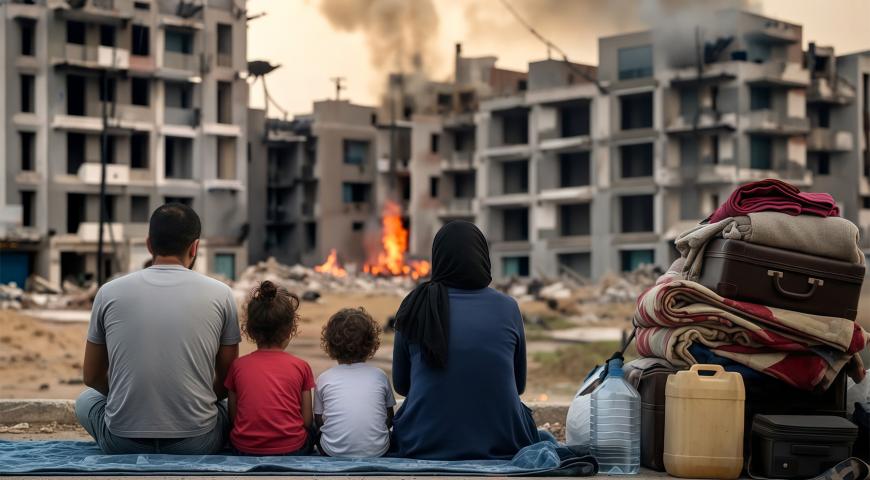
ADF Chaplaincy already serves members from diverse religious and non-religious backgrounds. It also supports ethical leadership and connects Defence with the wider Australian society.
Defence continues to face public scrutiny over religion, especially Christianity, allegedly maintaining a disproportionately privileged position in the organisation. It was reported in January 2026 that Si Gladman, Executive Director of the Rationalist Society of Australia (RSA), questioned Chief of Personnel, Lieutenant General Natasha Fox, the month prior over deep concerns about Defence’s apparent failure to meet the wellbeing needs of its majority non-religious workforce.1 According to Australian Defence Force (ADF) Census 2023, 61% of Permanent Defence members have no religious affiliation, up from 56% in 2019, with the most common religious affiliation, Christianity, at 34%, down from 40% in 2019.2 It is on this basis that the RSA have been running a campaign for the three Services to rapidly transition to a ‘modern wellbeing support capability’, to better support the mental health of Defence personnel.3
It appears that at the core of the campaign is the concern that the current ADF pastoral care model is predominantly religious-based. It points to the Defence Force Remuneration Tribunal report-back in 2024 that whilst Navy’s relatively new non-religious Maritime Spiritual Wellbeing Officer (MSWOs) workforce is ‘small in number, demand for MSWO support is strong’.4 The RSA has been critical of Army and Air Force not following suit yet.
The temptation to wholesale implement the RSA’s campaign is seemingly logical and understandable, however, this article argues that the issue should not be reduced to a simple contest between ADF Chaplaincy and explicitly non-religious wellbeing support capability. Rather, the ADF’s changing religious profile is a civil-military workforce issue.
Defence life is not ordinary employment, for Defence members accept unlimited liability and may have to confront moral injury, if not death. Naturally, they may have to make difficult ethical decisions, in pursuit of the national interest. Formal religious affiliation may be declining, but the need to understand the meaning and purpose of service remains.
The beliefs system discrepancy between the ADF Permanent and Reserve also complicates the debate. The Reserve’s religious profile is closer to that of Australian society. This may reflect the greater amount of time Reserve members spend in civilian workplaces and communities, whereas Permanent service can involve frequent relocation and some separation from the communities that help form a person’s identity and beliefs.
This article considers why the religious profiles of the Permanent and Reserve may differ, and what this means from a workforce analysis perspective. It argues that Defence should not move to a wholly secular wellbeing model simply because ‘No religion’ is now the largest Census category for ADF Permanent. Instead, the ADF needs a spiritual wellbeing capability that serves religious and non-religious members, supports ethical leadership and ultimately keeps Defence connected with Australian society.
The Changing Religious Profile of the ADF
ADF Census 2023 contrasted the ADF Reserve (SERCAT 5, 4 and 3) with the Permanent5 on religion: only 46% of Reserve Defence members indicated no religious affiliation, up from 40% in 2019, and 48% of Reserve Defence members identified as Christian, down from 56% in 2019.6 The RSA’s focus on the ADF Permanent is defensible in the sense that at Census, the total Permanent headcount was 58,015, versus Reserve at 20,852,7 which is a perspective that looks inwards. But looking outwards, two years earlier in 2021, the top two religions in Australia were Christianity at 44%, and ‘No religion’ at 39%.8
On this basis, the ADF Reserve’s overall religious affiliation is more reflective of Australian society than ADF Permanent, which is unsurprising given that the Reserve composition is Defence members who undertake at least one day of paid service in a financial year.9 Reserve service allowed for 70% of Reserve members to be employed outside the ADF at the time of Census,10 with 54% of Reserve members having joined the Reserve Force through direct entry.11 Such circumstances allow Reserve members to spend more time in societal environments outside of the ADF, and in this sense, be more reflective of society.
On a side note, the ‘No religion’ category should not be treated as a proxy for absences of spirituality, moral conviction, or need for meaning-based support.
Unpacking the ADF Religious Affiliation Contrast
Firstly, most new ADF recruits have been recruited from the target demographic of 17-24-year-old Australians.12 Indeed, in 2021 the top two religions for Generation Z (10-24 year olds) were ‘No religion’ at 44%, and Christianity at 39%.13 But there is some early anecdotal evidence in recent times to suggest that young Australians may be slowing turning back to organised religion.14 Australians, especially younger generations, are still particularly interested in spirituality in general, an interest likely to be bolstered by immigration in recent times.15 It is not obvious that the typical recruiting demographic will continue to have a permeating impact on ‘No religion’ in the ADF Permanent.
Secondly, a requirement of ADF Permanent service for most members is to be posted to a new role every 2-3 years, which often means relocation.16 Frequent relocation can disrupt social connections and create instability in social support networks, which can, for example, make it difficult for a member to make and/or maintain a connection with a place of worship.
Building on the previous two paragraphs, the modern ADF recruit (more so the Permanent than the Reserve recruit) enters a manufactured institutionalising culture in Defence, isolating him17 from a constant civilian community, thereby potentially diminishing the recruit’s personal culture. This is partly because the Defence member’s domain has been predominantly outside of Australia, his warfighting is an instrument of Government, and he is not as present in the community as he once was.18
His presence, to whatever degree, provokes fundamental questions of human existence, such as: what is justice? Is anything worth the ultimate sacrifice of life? What or whom shall I serve? Is killing ever permitted? For he is, by extension, an instrument of the civilian community’s politics and public debate.19
Religion and belief systems, such a ‘No religion’, in the West often sit at the intersection of other attributes that may pigeonhole an individual as conservative or progressive, or leaning left or right in political ideology20. It is not clear to what extent that there are ‘No religion’ Defence members who have replaced religion with (veteran) politics.21 Nor is it clear in this sense if the RSA (or anyone else for that matter), in its push for the ADF (Chaplaincy) to transition to a non-religious wellbeing support capability, presumably without duplicating other member support services already in place, have the full civil-military picture.
Defence’s institutional culture has been manufactured for security, safety in training, and indoctrination, so how is humanity bred in such an environment? On the surface, Defence has institutionalised personnel diversity and inclusion.22 But this does not necessarily mean that the arc of dissent has broadened over time.
Assuming the arc of dissent, whether implied or otherwise, remains narrow in today’s Defence bases, this may hamper Defence member character development. The Defence member must ultimately be prepared to sacrifice his life, but without a coherent moral and spiritual account of service and sacrifice — whether religious or non-religious — the professional warfighter risks being formed more by institutional utility than by civic obligation.23
The 2025 Final Report of Public Attitudes towards the Australian Defence Force found that the ADF was highly regarded by survey respondents. Yet knowledge of Australian operations as part of the War in Afghanistan and associated (ethical) issues was comparatively low, as was public awareness of veterans’ issues.24
Not only is religious affiliation across the ADF Service Categories inconsistent, but so is public existential attitudes towards the ADF. This disjointedness may be due to an insular, manufactured culture, revealing only sombre, media-driven existential glimpses of the Defence member to the civilian community, such as natural disaster responses, ramp ceremonies, ANZAC day events, and alleged war crimes.25 Here, there is a risk that Defence members are losing their collective humanity over time.
A Civil-Military Relations Explanation for (the State of) Religion in Defence
A contemporary straightforward definition of civil-military relations (CMR) is ‘the control and direction of the military by the highest civilian authorities in nation states’26, that is, government-military relations. But in Australia, defence policy has been formulated through a formal diarchy between public servants and ADF officers, supervised by elected parliamentarians, meaning that Defence and society likely becomes ‘tangled up in each other’s business’.27 Further, the previous Chief of Army articulated that Army exists only in the context of Australians,28 for Defence draws its members and its legitimacy wholly from the society Defence serves. This has been the case since the emergence of the ‘digger’.
The digger was originally the citizen soldier answering the call of King (or Queen) and country, but well embedded in the community, starting off as a butcher or a farmer at Gallipoli.29 He evolved into the modern ‘corporate culture’ professional post-Vietnam War, niche-marketed, highly skilled,30 and more insulated from society. Who spiritually and morally guards the guardians in the institution, if not society?
ADF Chaplains (of all denominations and faith) and MSWOs support Defence members of any or no faith, due in part to ADF geographic spread and tempo.31 So even if Spiritual Wellbeing Officers (SWOs) overtake the Chaplaincy workforce in numbers, it would remain unlikely that every denomination/faith and non-faith group can be represented in every location. As for the current situation, in 2021 a survey of 2 783 Defence members revealed that:
Of those military participants answering the question on religious status (n = 1 116), a total of 71.6% (n = 799) of respondents identified as non-religious while 28.4% (n = 317) identified as holding a religious affiliation. Approximately 44.2% (n = 1 230) of participants had sought support from a chaplain, of which 85.3% (n = 1 049) found chaplaincy care to be satisfactory or very satisfactory.32
Of note, the data suggests there is a lack of clarity around the multiple roles undertaken by ADF Chaplaincy, which may have contributed to the rise of ‘No religion’ in the ADF. Either way, those surveyed were just as likely to prefer chaplaincy support as they were to seek non-chaplaincy support such as a non-ADF counsellor, their workplace supervisor, or a psychologist.33 For workforce planners, this means the beliefs system profile of the ADF should be read not only as a measure of formal affiliation, but as an indicator of social connection (or lack thereof), institutionalisation and spiritual support needs.
One reason that religious-based ADF chaplaincy remains a valued ‘guardian’ of choice for holistic ADF member health and well-being ‘guardianship’ might be the natural alignment of faith traditions with Defence Values. Drawing on their rich and deep religious heritage, ADF chaplains of the Buddhist, Christian, Hindu, Islamic, Jewish, Sikh faiths have been able to justify the overall religious alignment from different perspectives.34 This demonstrates that the various faith teachings and sacred writings, which come from society, can act as a spiritual and moral capability multiplier for Defence members.
MSWOs were also introduced in 2021, where Navy were reportedly recruiting from the non-chaplaincy support fields of psychology, social work, nursing, counselling, occupational therapy and similar others.35 If this is still the case, then there may still be a lack of clarity around the role of chaplaincy and spiritual wellbeing in the ADF. It would be helpful here to review the first principles of ADF (spiritual) wellbeing.
Defence has publicly stated that the ADF accepts that “a person’s religious and spiritual belief system is a significant factor in their overall wellbeing”.36 This has been affirmed by the Defence and Veteran Family Wellbeing Strategy 2025-2030 which makes clear that ‘meaning and spirituality’, that is, a sense of inner peace, purpose, and connection to something greater than oneself (without specifying say, God),37 is a wellbeing factor for Defence members, veterans and their families.38
The clarity issue is not whether ADF Chaplains or SWOs should prevail, but whether both roles can be coherently defined for spiritual wellbeing and ethical readiness requirements. The first and foremost role of the ADF Chaplain and MSWO is to encourage Defence members to identify and foster that which gives them meaning and purpose. Especially given that warfighting involves matters of life and death, and therefore values and ethics, trauma and struggle.39 With a well-developed worldview and spiritual lived experience, Chaplains and MSWOs assist others in making sense of their own beliefs, values and behaviours. History has demonstrated that:
Providing warriors with the most powerful munitions platforms, weapon systems, and technology is often not enough to win wars. They must also have the strength of spirit (and will power) to accomplish their duties with honor, which will help them not only succeed in these military endeavors but also avoid the devastating inner conflicts that might otherwise result.40
If MSWOs are being recruited from the non-chaplaincy support fields of psychology, social work, nursing, counselling, occupational therapy and similar other, then it is not necessarily clear what rich and deep heritage from society MSWOs are drawing from. The RSA’s campaign appears to rely on, amongst other things, a 2021 article published on The Forge titled ‘Losing Our Religion: The ADF’s Chaplaincy Dilemma’. The seemingly pluralist article argued for a modern wellbeing support capability that is inclusive of all religions and beliefs in the ADF, as it would ‘provide the greatest benefit and capability outcome for Defence’.41 This argument may not align with the ADF Philosophical Doctrine on Military Ethics.
Guarding Ethical Leadership in the ADF
Ethical leadership is the single most important factor in ensuring the societal legitimacy of ADF operations, for the ADF ethos is derived from that of Australian society.42 Especially considering that unlimited liability requires Defence members to have the highest standards of behaviour, ethical reasoning and self-restraint.43 Ethical theory has been developed and studied for centuries in society, due in part to conflicting perspectives and schools of thought. But the three ethical theories that underpin Military Ethics are just war and natural law theory, duty ethics and virtue ethics.44
Of particular note, virtue ethics in the ADF sense is acting in accordance with (faith traditions-based) Defence Values, and providing ethical leadership in Defence is a demonstration of virtue ethics.45 Here, there is a potential subjectivity risk associated with virtue ethics, because the accepted virtues of organisations and societies can change over time, which is why the ADF endorses all three ethical theories together. The foundations of just war and natural law theory rely heavily on the Christian traditions of Augustine of Hippo and Thomas Aquinas,46 whilst duty ethics relies more on the Enlightenment tradition of Immanuel Kant.47
Military Ethics also makes clear that consequentialist ethics, ethical relativism and subjectivism do not align well with the ADF’s approach to ethics. Consequentialist ethics is driven by the greatest good for the greatest number of people being the ‘right’ thing, which is not ethics appropriate for applying in complex, high-stress military environments.48 Similarly, ethical relativism is the belief that there is no objective ‘right’ thing to do because each individual has their own set of truths, and subjectivism asserts that there is no objective moral truth at all.
It is not clear to what extent the RSA and/or the 2021 article published on The Forge is advocating for a modern wellbeing support capability aligned with Military Ethics. What is clearer is that ADF Chaplaincy’s inherent role is to guide and guard ethical leadership for all Defence members, veterans and their families, and that it would not be unreasonable for currently serving MSWOs to be expected to execute the same critical role to meet the perennial spiritual challenge all in society face. In the words of Chief of Defence Force in September 2021, ‘The risk of moral injury increases if you are not well prepared and practised in ethical decision-making.’49
Again, for workforce planners, this means that the beliefs system profile of the ADF should be read not only as a measure of formal affiliation, but as an indicator of social connection (or lack thereof), institutionalisation and spiritual support needs.
The Anzac Tradition: Australia’s Civil-Military Religion
It has been observed that in the 1960s the Anzac tradition seemed destined for decline like the Christian traditions, but the 1990s saw the metamorphosis of the Anzac tradition via stoic ceremonies of the first diggers (presumably majority Christian), blended with hymns and readings into the rites of a ‘civil religion’.50 This media-driven existential glimpse of the (modern ‘corporate culture’) digger, to this day, offers a kind of transcendence for a pluralist Australian society. It would explain why the publicised arrest of Ben Roberts-Smith in the lead-up to Anzac Day 2026 struck at the heart and divided the Australian psyche.51
Naturally, the RSA’s campaign includes pushing for fully secularised Anzac Day Dawn Services. But it is worth noting that recent Dawn Services have included Welcome to Country, which includes a spiritual dimension,52 the booing of which have led to widespread condemnation.53 National religion therefore ‘remains powerful in memory, but also as a kind of reserve fund of spiritual force or consolation’.54 And in the words of Major Cate Carter:
Let us allow and enable the soldier to live in the community, in some cases in the neighbourhood which raised him. The more he sees of his neighbours, and the more they see of him, will make the human aspects of his job easier. It may also strengthen his purpose. Let him train with real people of different ages, creeds and emotions.55
In their full actualisation, ADF Chaplains and MSWOs connect the civil (society) with the military in transcendentally important ways.
Towards 2026 Census Results and ADF Census 2027
Belief systems in the ADF is about more than the chaplaincy headcount or the percentage of members who select ‘No religion’ on a census form. It is also about how Defence prepares its members for the moral demands of service.
Defence should not assume that declining religious affiliation means declining demand for moral, spiritual or existential support. Nor should it treat Chaplains and MSWOs as competing workforces. Both should be able to help members deal with questions of meaning, sacrifice, and moral injury.
Beliefs system discrepancy between ADF Permanent and Reserve deserves closer attention. Reserve members remain more integrated in society, with their religious profile closer to the national population. By contrast, Permanent service can separate members from civilian communities through posting cycles, other social disruption, and the pressures of Defence life. This may help explain the discrepancy.
The pending 2026 Census Results and the 2027 ADF Census will provide an opportunity to test these trends, examining whether the gaps between Permanent members, Reserve members and the wider community continue to grow. It should avoid treating ‘No religion’ as evidence that members have no spiritual life or need for meaning-based support.
The answer is not a transition to a wholly secular model. Defence needs to maintain a capability that recognises religious and non-religious worldviews, and supports the ethical readiness of the workforce. Defence members may be losing their formal religion, but they still need to answer the deeper questions of service: what is worth defending, what limits should govern military force, and what kind of person the profession of arms requires?
Australian Bureau of Statistics. “Religious affiliation in Australia.” Released July 4, 2022. https://www.abs.gov.au/articles/religious-affiliation-australia/.
Best, Megan C., Leach, Katie Tunks, Layson, Mark, and Carey, Lindsay B. “Military Perspectives on the Provision of Spiritual Care in the Australian Defence Force: A Cross-Sectional Study.” Journal of Religion and Health 63, no. 1 (2024): 289-308. https://doi.org/10.1007/s10943-023-01985-3.
Britannica. “Natural law.” Updated July 15, 2026. https://www.britannica.com/topic/natural-law.
Carter, Cate. “Citizen Soldier.” Australian Army Journal 7, no. 1 (2010): 109-120. https://researchcentre.army.gov.au/sites/default/files/aaj_2010_1.pdf.
Carter, Cate. “The new citizen soldier.” The Interpreter, August 25, 2021. https://www.lowyinstitute.org/the-interpreter/new-citizen-soldier.
Carter, Cate. “Australian civil-military relations: Who guards the guardians?” The Interpreter, November 25, 2019. https://www.lowyinstitute.org/the-interpreter/australian-civil-military-relations-who-guards-guardians.
Cohen, Eliot. “Civil-military relations in a disrupted world.” Australian Journal of Defence and Strategic Studies 1, no. 1 (2019): 11-21. https://www.defence.gov.au/sites/default/files/research-publication/2019/Full.pdf.
Cronshaw, Darren. “The Chaplain in a Pluralist Military.” Australian Army Chaplaincy Journal (2024): 85-106. https://www.army.gov.au/sites/default/files/2024-10/Australian%20Army%20Chaplaincy%20Journal%202024_1.pdf.
Davison, Graeme. “Ken Inglis: Threads of Influence.” History Australia 14, no. 4 (2017): 516-529. https://doi.org/10.1080/14490854.2017.1381065.
Department of Defence. Defence and Veteran Family Wellbeing Strategy 2025–2030. Commonwealth of Australia, 2024. https://www.dva.gov.au/sites/default/files/2024-12/def-vet-family-wellbeing-strategy-2025-30_1.pdf.
Dunley, Richard, Tristan Moss, Nicole Townsend, Miranda Booth, Rhys Crawley, Margaret Hutchison, and Tom Richardson. Public Attitudes towards the Australian Defence Force: Final Report June 2025. UNSW Canberra, 2025. https://www.unsw.edu.au/content/dam/pdfs/unsw-canberra/hass/Public%20Attitudes%20Towards%20the%20ADF%20Report%20-V3.pdf.
Estherby, Ralph. “RACS Responses to the Defence Values.” Australian Army Chaplaincy Journal (2021): 56-64. https://www.army.gov.au/sites/default/files/2023-06/RAACHD-Journal-2021.pdf.
Gladman, Si. “RSA questions Defence Force chief over absence of secular and non-religious frontline wellbeing support.” Rationalist Society of Australia, January 6, 2026. https://rationalist.com.au/rsa-questions-defence-force-chief-over-absence-of-secular-and-non-religious-frontline-wellbeing-support/.
Grant, Stan. “The young Australians turning to religion.” The Saturday Paper, November 8, 2025. https://www.thesaturdaypaper.com.au/comment/topic/2025/11/08/the-young-australians-turning-religion.
Hoglin, Phillip. “A Deep Dive into Our Tiny Recruitment Pool.” The Forge, April 15, 2025. https://theforge.defence.gov.au/article/deep-dive-our-tiny-recruitment-pool.
Hoglin, Phillip. “Losing Our Religion: The ADF’s Chaplaincy Dilemma.” The Forge, January 28, 2021. https://theforge.defence.gov.au/publications/losing-our-religion-adfs-chaplaincy-dilemma.
Hoglin, Phillip. “Who Do We Think We Are? Demographic Changes in the Australian Defence Force and Implications for Social Legitimacy.” In The New Australian Military Sociology: Antipodean Perspectives, edited by Brad West and Cate Carter. Berghahn Books, 2024.
Koenig, Harold G., Carey, Lindsay B., and Al Zaben, Faten. Spiritual Readiness: Essentials for Military Leaders and Chaplains. Amazon Books, 2022.
Lessons and Doctrine Directorate (LDD). ADF-P-0 ADF Leadership Edition 3. Directorate of Information, Graphics and eResources, 2021. https://theforge.defence.gov.au/sites/default/files/2024-02/ADF-P-0%20ADF%20Leadership%20Ed3.pdf.
LDD. ADF-P-0 Military Ethics Edition 1. Directorate of Information, Graphics and eResources, 2021. https://theforge.defence.gov.au/sites/default/files/2021-12/ADF-P-0%20Military%20Ethics%20Ed%201_0.pdf.
O’Neill, B. and Fogarty, G. Statement – Matter 16 of 2024 – Maritime Spiritual Wellbeing Officer – Report Back. Defence Force Remuneration Tribunal, 2024. https://www.dfrt.gov.au/sites/default/files/2024-11/Statement%20-%20MSWO%20Report%20Back.pdf.
Other, A. N. “The Changing Role of Naval Chaplaincy.” Naval Historical Review, June 2022. https://navyhistory.au/the-changing-role-of-naval-chaplaincy/.
Rationalist Society of Australia. “Religion in the military.” Rationalist Society of Australia, April 29, 2026. https://rationalist.com.au/campaigns/religion-in-the-military/.
Royal Australian Air Force. “Cultural and religious diversity.” Accessed August 11, 2026. https://www.airforce.gov.au/about-us/overview/religious-and-ethnic-diversity.
Royal Commission into Defence and Veteran Suicide. Final Report Volume 2: Serving the nation, and Defence culture and leadership. Commonwealth of Australia, 2024. https://defenceveteransuicide.royalcommission.gov.au/system/files/2024-09/final-report-volume-2.pdf.
Ryan, Mick. “Welcoming Remarks.” In Civil-Military Relations in Australia: Past, Present and Future, Profession of Arms Seminar Series—Proceedings. Australian Defence College Weston Creek, 2021.
Shepherd, Tory. “ADF Has 108 Evangelical Chaplains with Each Representing Just 15 Members.” The Guardian, July 30, 2023. https://www.theguardian.com/australia-news/2023/jul/30/adf-has-108-evangelical-chaplains-with-each-representing-just-15-members.
Silva, Kristian. “Neo-Nazi Hecklers Found Guilty over Anzac Day Booing during Welcome to Country.” ABC News, June 4, 2026. https://www.abc.net.au/news/2026-06-04/anzac-day-welcome-to-country-booing-neo-nazis-found-guilty/106757584.
Smee, Ben. “Arrest of National War Hero Ben Roberts-Smith Cuts Deeply to Core of Australian Psyche.” The Guardian, April 11, 2026. https://www.theguardian.com/australia-news/2026/apr/11/ben-roberts-smith-arrest-war-hero-australian-psyche-ntwnfb.
Stanford Encyclopedia of Philosophy. “Deontological Ethics.” Revised December 11, 2024. https://plato.stanford.edu/entries/ethics-deontological/.
Stuart, Simon. “Chief of Army Symposium 2025 Keynote Speech: ‘A Brief History of National Conversations’.” Australian Army News, August 26, 2025. https://www.army.gov.au/news-and-events/speeches-and-transcripts/2025-08-26/chief-army-symposium-keynote-speech-brief-history-national-conversations.
Taylor, Charles. A Secular Age. Harvard University Press, 2007.
The Australian Institute of Aboriginal and Torres Strait Islander Studies. “Welcome to Country.” Updated October 13, 2025. https://aiatsis.gov.au/explore/welcome-country.
Workforce Strategy Branch. Australian Defence Force Census 2023 Public Report. Defence People Group, 2024. https://www.defence.gov.au/sites/default/files/2024-12/ADFCensus2023.pdf.
1 Si Gladman, “RSA questions Defence Force chief over absence of secular and non-religious frontline wellbeing support,” Rationalist Society of Australia, January 6, 2026, https://rationalist.com.au/rsa-questions-defence-force-chief-over-absence-of-secular-and-non-religious-frontline-wellbeing-support/.
2 Workforce Strategy Branch (WSB), Australian Defence Force Census 2023 Public Report (Defence People Group, 2024), 11, https://www.defence.gov.au/sites/default/files/2024-12/ADFCensus2023.pdf.
3 Rationalist Society of Australia, “Religion in the military,” Rationalist Society of Australia, April 29, 2026, https://rationalist.com.au/campaigns/religion-in-the-military/.
4 B. O’Neill and G. Fogarty, Statement – Matter 16 of 2024 – Maritime Spiritual Wellbeing Officer – Report Back (Defence Force Remuneration Tribunal, 2024), 3, https://www.dfrt.gov.au/sites/default/files/2024-11/Statement%20-%20MSWO%20Report%20Back.pdf.
5 Permanent (SERCAT 7 and 6) ADF members. SERCAT refers to Service Category, part of the ADF Total Workforce System. SERCATs group members together, according to their approved service arrangements, conditions of service and obligation to serve.
6 WSB, Australian Defence Force Census 2023 Public Report, 12.
7 WSB, ADF Census 2023 Public Report, 2.
8 “Religious affiliation in Australia,” Australian Bureau of Statistics, released July 4, 2022, https://www.abs.gov.au/articles/religious-affiliation-australia/.
9 WSB, ADF Census 2023 Public Report, 2.
10 WSB, ADF Census 2023 Public Report, 47.
11 WSB, ADF Census 2023 Public Report, 40.
12 Phillip Hoglin, “A Deep Dive Into Our Tiny Recruitment Pool,” The Forge, April 15, 2025, https://theforge.defence.gov.au/article/deep-dive-our-tiny-recruitment-pool.
13 “Religious affiliation in Australia.”
14 Stan Grant, “The young Australians turning to religion,” The Saturday Paper, November 8, 2025, https://www.thesaturdaypaper.com.au/comment/topic/2025/11/08/the-young-australians-turning-religion.
15 Darren Cronshaw, “The Chaplain in a Pluralist Military,” Australian Army Chaplaincy Journal (2024): 89, https://www.army.gov.au/sites/default/files/2024-10/Australian%20Army%20Chaplaincy%20Journal%202024_1.pdf.
16 Royal Commission into Defence and Veteran Suicide, Final Report Volume 2: Serving the nation, and Defence culture and leadership (Commonwealth of Australia, 2024), 79, https://defenceveteransuicide.royalcommission.gov.au/system/files/2024-09/final-report-volume-2.pdf.
17 Male pronouns are used throughout the text for reading flow, and to reflect the male-dominated ADF. This by no means omits the wider ADF demographic from being affected by my arguments and conclusions.
18 Cate Carter, “Citizen Soldier,” Australian Army Journal 7, no. 1 (2010): 116, https://researchcentre.army.gov.au/sites/default/files/aaj_2010_1.pdf.
19 Carter, “Citizen Soldier,” 116.
20 Phillip Hoglin, “Who Do We Think We Are? Demographic Changes in the Australian Defence Force and Implications for Social Legitimacy,” in The New Australian Military Sociology: Antipodean Perspectives, ed. Brad West and Cate Carter (Berghahn Books, 2024), 45.
21 Cate Carter, “The new citizen soldier,” The Interpreter, August 25, 2021, https://www.lowyinstitute.org/the-interpreter/new-citizen-soldier.
22 “Cultural and religious diversity,” Royal Australian Air Force, accessed August 11, 2026, https://www.airforce.gov.au/about-us/overview/religious-and-ethnic-diversity.
23 Carter, “Citizen Soldier,” 117.
24 Richard Dunley, Tristan Moss, Nicole Townsend, Miranda Booth, Rhys Crawley, Margaret Hutchison, and Tom Richardson, Public Attitudes towards the Australian Defence Force Final Report June 2025 (UNSW Canberra, 2025), 1, https://www.unsw.edu.au/content/dam/pdfs/unsw-canberra/hass/Public%20Attitudes%20Towards%20the%20ADF%20Report%20-V3.pdf.
25 Carter, “Citizen Soldier,” 117.
26 Mick Ryan, “Welcoming Remarks,” in Civil-Military Relations in Australia: Past, Present and Future, Profession of Arms Seminar Series—Proceedings (Australian Defence College Weston Creek, 2021), 3.
27 Eliot Cohen, “Civil-military relations in a disrupted world,” Australian Journal of Defence and Strategic Studies 1, no. 1 (2019): 13, https://www.defence.gov.au/sites/default/files/research-publication/2019/Full.pdf.
28 Simon Stuart, “Chief of Army Symposium 2025 Keynote Speech: ‘A Brief History of National Conversations’,” Australian Army News, August 26, 2025, https://www.army.gov.au/news-and-events/speeches-and-transcripts/2025-08-26/chief-army-symposium-keynote-speech-brief-history-national-conversations.
29 Cate Carter, “Australian civil-military relations: Who guards the guardians?” The Interpreter, November 25, 2019, https://www.lowyinstitute.org/the-interpreter/australian-civil-military-relations-who-guards-guardians.
30 Cate Carter, “The new citizen soldier.”
31 Cronshaw, “The Chaplain in a Pluralist Military,” 87.
32 Megan C. Best, Katie Tunks Leach, Mark Layson, and Lindsay B. Carey, “Military Perspectives on the Provision of Spiritual Care in the Australian Defence Force: A Cross‑Sectional Study,” Journal of Religion and Health 63, no. 1 (2024): 289, https://doi.org/10.1007/s10943-023-01985-3.
33 Best et al, “Military Perspectives on the Provision of Spiritual Care in the Australian Defence Force: A Cross‑Sectional Study,” 289.
34 Ralph Estherby, “RACS Responses to the Defence Values,” Australian Army Chaplaincy Journal (2021): 56-64, https://www.army.gov.au/sites/default/files/2023-06/RAACHD-Journal-2021.pdf.
35 A.N. Other, “The Changing Role of Naval Chaplaincy,” Naval Historical Review, June 2022, https://navyhistory.au/the-changing-role-of-naval-chaplaincy/.
36 Tory Shepherd, “ADF has 108 evangelical chaplains with each representing just 15 members,” The Guardian, July 30, 2023, https://www.theguardian.com/australia-news/2023/jul/30/adf-has-108-evangelical-chaplains-with-each-representing-just-15-members.
37 Cronshaw, “The Chaplain in a Pluralist Military,” 88.
38 Department of Defence, Defence and Veteran Family Wellbeing Strategy 2025-2030 (Commonwealth of Australia, 2024), 5, https://www.dva.gov.au/sites/default/files/2024-12/def-vet-family-wellbeing-strategy-2025-30_1.pdf.
39 Cronshaw, “The Chaplain in a Pluralist Military,” 89.
40 Harold G. Koenig, Lindsay B. Carey, and Faten Al Zaben, Spiritual Readiness: Essentials for Military Leaders and Chaplains (Amazon Books, 2022), 231.
41 Phillip Hoglin, “Losing Our Religion: The ADF’s Chaplaincy Dilemma,” The Forge, January 28, 2021, https://theforge.defence.gov.au/publications/losing-our-religion-adfs-chaplaincy-dilemma.
42 Lessons and Doctrine Directorate (LDD), ADF-P-0 ADF Leadership Edition 3 (Directorate of Information, Graphics and eResources, 2021), 2, 7, https://theforge.defence.gov.au/sites/default/files/2024-02/ADF-P-0%20ADF%20Leadership%20Ed3.pdf.
43 LDD, ADF-P-0 Military Ethics Edition 1 (Directorate of Information, Graphics and eResources, 2021), 4, https://theforge.defence.gov.au/sites/default/files/2021-12/ADF-P-0%20Military%20Ethics%20Ed%201_0.pdf.
44 LDD, ADF-P-0 Military Ethics, 14-15.
45 LDD, ADF-P-0 Military Ethics, 17.
46 “Natural law,” Britannica, updated July 15, 2026, https://www.britannica.com/topic/natural-law.
47 “Deontological Ethics,” Stanford Encyclopedia of Philosophy, revised December 11, 2024, https://plato.stanford.edu/entries/ethics-deontological/.
48 LDD, ADF-P-0 Military Ethics, 18.
49 LDD, ADF-P-0 Military Ethics, iv.
50 Graeme Davison, “Ken Inglis: threads of influence,” History Australia 14, no. 4 (2017): 528, https://doi.org/10.1080/14490854.2017.1381065.
51 Ben Smee, “Arrest of national war hero Ben Roberts-Smith cuts deeply to core of Australian psyche,” The Guardian, April 11, 2026, https://www.theguardian.com/australia-news/2026/apr/11/ben-roberts-smith-arrest-war-hero-australian-psyche-ntwnfb.
52 “Welcome to Country,” The Australian Institute of Aboriginal and Torres Strait Islander Studies, updated October 13, 2025, https://aiatsis.gov.au/explore/welcome-country.
53 Kristian Silva, “Neo-Nazi hecklers found guilty over Anzac Day booing during Welcome to Country,” ABC News, June 4, 2026, https://www.abc.net.au/news/2026-06-04/anzac-day-welcome-to-country-booing-neo-nazis-found-guilty/106757584.
54 Charles Taylor, A Secular Age (Harvard University Press, 2007), 522.
55 Carter, “Citizen Soldier,” 118.
Defence Mastery
Technical Mastery
Social Mastery

Flight Lieutenant Dana Pham is a Personnel Capability Officer in the Royal Australian Air Force. She will graduate from her Master of Liberal Arts at the University of Notre Dame Australia in 2027. Her Master’s Supervised Dissertation is titled “Catholic bioethics for sex change”. She is also currently studying her Graduate Certificate in Workforce Planning at UNSW Canberra.
Losing our religion? It’s civil-military complicated © 2026 by . This work is licensed under CC BY-NC-ND



Please let us know if you have discovered an issue with the content on this page.
Comments
Start the conversation by sharing your thoughts! Please login to comment. If you don't yet have an account registration is quick and easy.