Introduction
In the mid-1980s, when one of the authors was a junior officer at an ADF training establishment, the unit was experiencing disciplinary issues with a couple of foreign NCO students - not under the jurisdiction of the DFDA. The unit requested an officer from their nation counsel them about their responsibilities. In the process of this ‘counselling,’ the officer became visibly angry and slapped and yelled at the NCOs while the Australian Commanding Officer (CO), Warrant Officer Discipline and the author looked on, dumbfounded. This incident was both culturally and ethically confusing and the Australians present were poorly trained for either.
In discussions after the event they wondered if they had been complicit in the ‘assault’ on the two NCOs; who, by the way, were unhurt (other than pride) by the mild slaps of their officer. Or was the dignity and authority of the officer, whom they had invited to fix the problem, the higher priority? At the end of the dressing down, the international officer instantly returned to his calmer self and simply apologised for the behaviour of his countrymen, and assured the CO similar problems with the NCOs would not happen again.
Was doing nothing in this instance actually the right thing to do? Or should one of the ADF members in the room diplomatically intervened? Back in the 1980s we did not have the benefit of ethics or culture education to help guide this kind of decision making, let alone doctrine on the subject. Even so, it would have been difficult to determine the precise balance between cultural appropriateness and ethical reasoning in this scenario. Fortunately, it is unlikely a similar situation would occur in 2026. Most international exchange officers are now provided cultural awareness training about Australian cultural norms, making such behaviour in an Australian context very unlikely, and ADF doctrine education and training offers tools for Defence members navigating this kind of complexity.
This paper is about doing the right thing when you are under pressure from your team, circumstances, or expectations, and the potential cost of not doing the right thing.
Now that the ADF does have explicit statements on behaviour, standards, and decision-making, how useful are they in providing guidance in discharging our duties on a daily basis? This paper considers the utility of philosophical doctrine ADF-P-0 - Military Ethics, published in 2021 and ADF-P-0- Culture in the Profession of Arms, published in 2024, to ADF personnel in garrison and operational settings. During deployed operations, ADF members confront ethical and cultural dilemmas on an almost daily basis. It is in these situations that the theory of military ethics and the reality of working with other nation’s military/police forces come together, sometimes in confronting ways. Even so, the ethical standards that apply in garrison should be no different to those that apply on deployment, hence why they are blended together in this paper.
To enable clearer understanding, the paper begins with brief explanations of the concepts to be discussed. It should be noted, we define ethical decisions as any decision where there is a clear risk of harm to oneself or others. An ethical dilemma is a decision where any path taken will have negative consequences for others.1 A test of integrity is where there is no doubt about what is the ‘right’ thing to do, but making the decision may have negative consequences for oneself.
Cognitive Dissonance
In order to understand the pressure inherent in dealing with an ethical dilemma, it is helpful to understand the theory of cognitive dissonance2 Cognitive dissonance is what we experience when faced with inconsistent information on an issue of importance – it is literally the anxiety of not knowing what to do. In a high stakes situation, making any decision can reduce anxiety and this can sometimes override other considerations (e.g., doing the right thing). Leon Festinger3, who first coined the term cognitive dissonance, argued that people reduce this anxiety via the following steps:
Make a definitive choice – no option to turn back
Avoid information that suggests the choice was wrong – e.g., confirmation bias – only attending to information that conforms with an already formed opinion
Seek information (and social support) that reinforces the choice made – e.g., herd bias – befriending people who all believe the same thing
Reduce the value of the unchosen alternative – e.g., moral disengagement (see below), diminish, blame, dehumanise
Raise the value of the choice made – e.g., moral disengagement (see below), zealotry, call to ‘rights’, seek praise4.
Cognitive dissonance is more likely to occur when we find ourselves in culturally unfamiliar situations where it is not clear what the correct course of action is. This does not necessarily need to be in foreign lands. Our Culture doctrine explicitly recognises that Services, Groups, units etc. have their own distinctive cultures which means that ADF personnel are going to encounter cultural differences in their own domain. Culturally unfamiliar situations create uncertainty about what is right to do, and this uncertainty is deeply uncomfortable. In order to reduce this discomfort, people are vulnerable to making choices that can diminish the value of doing the right thing. This is the slippery slope towards moral disengagement.
Moral Disengagement
A particular threat to maintaining our personal and institutional values in a culturally complex situation is to become morally disengaged from the situation and the people involved. Albert Bandura5 highlighted eight cognitive processes that increase the likelihood of becoming detached from one’s personal moral compass and doing something one would never do otherwise:
- Moral justification: Minimising purposeful harm done to others on the grounds it is morally justifiable – e.g., for the greater good or for their own good
- Euphemistic language: Using morally neutral language (e.g., ‘domestic violence’, ‘collateral damage’, ‘enhanced interrogation’, ‘water-boarding’, ‘freedom fighter’) to disguise reprehensible conduct
- Advantageous Comparison: Comparing one’s own unethical behaviour to even more harmful behaviour by others to make one’s own behaviour appear more acceptable
- Diffusion of Responsibility: Individual responsibility for immoral behaviour diffused between a collective
- Distorting Consequences: Downplaying the effects of unethical behaviour to make it appear less harmful
- Displacement of Responsibility: Arguing one’s behaviour was the direct result of authoritative dictates
- Dehumanisation: Emphasising an us versus them mentality by using demeaning stereotypes or language
- Attribution of blame: Exonerating oneself by placing the blame for unethical behaviour on the target of the behaviour6.
A person does not have to use all of these processes to become morally disengaged; just one could create the moral justification for doing the wrong thing or doing nothing.
Normalised Deviance
In response to the crash of the Challenger Space Shuttle in 1986, Diane Vaughan identified a related phenomenon to moral disengagement in corporate culture; she labelled this 'normalised deviance.'7 Normalised deviance refers to the general acceptance of small deviations from normal procedures, which, if not corrected, may eventually result in a disaster. While normalisation of deviance can be a cause of accidents in the workplace, it differs from moral disengagement in terms of intent, the people making slight deviations from the norm do not intend to harm anyone in the process. By contrast, mechanisms of moral disengagement are used to justify purposeful harm. Nevertheless, knowingly allowing normalised deviance to continue would be an example of an ‘intentional’ risk of harm.
Common Ethical Dilemmas
Chapter 6 of ADF-P-0 Military Ethics recognises there are many risks to maintaining one’s ethical compass in war, with moral disengagement and the normalisation of deviance mentioned specifically. The question is, how do we prepare ourselves for the ethical challenges of war? As our doctrine tells us, it is the capacity for restraint, compassion and above all ethical reasoning that distinguishes a ‘just’ military.8 Consequently, every ‘just’ military has an obligation to educate its personnel, especially leaders, in the importance of ethical decision-making in military operations.
In our experience9, the issues listed below are common scenarios that have occurred within the ADF; both while on deployment or in barracks. Discussing each in terms of mechanisms of moral disengagement is a useful way of highlighting for readers how these processes work, and how we can prevent ethical drift and ethical failure from happening.
- Misuse of official resources
- Attitude to ‘troop discipline’ – AKA bastardization
- Cultural biases revealed in terms of race, gender, colour, etc
- Support of regimes that demonstrate questionable ethical standards
- Attitudes to bribery as a way of conducting business
- Lack of common standards or the enforcement of them including work ethic and operational discipline
- Attitudes to the wellbeing of subordinate personnel
- Attitudes to managing complaints.
Misuse of official resources and Moral Justification
Being a witness to the misuse of official resources is less of an ethical dilemma for a person in authority. Authority provides the institutional power to intervene and hold someone accountable for the misuse, or to redefine the parameters of use and misuse via command authorisation. This is very different for a subordinate who witnesses such behaviour, especially by a superior. It can be even more difficult for newcomers, perhaps on an exchange posting or posted into a new unit, who are confronted by unethical practices, apparently condoned. People in these challenging situations face an ethical dilemma between loyalty to, or fear of, the superior (or peers, unit, institution) and doing the right thing. This dilemma creates a contest between ‘letting it go’ and doing nothing, or taking action to stop what is happening and risking a backlash. Arguably, this is a much harder dilemma to manage while deployed.
Most people are afraid of ‘rocking the boat’, and often believe making a complaint will cause more harm than good. This becomes a moral justification for doing nothing, with arguments like it is ‘for the greater good’ of our mission/unit/Service/ADF. But the strongest justification for an individual to turn a blind eye is self-interest, e.g., ‘it is none of my business.’ Bringing wrongdoing to light is a high-risk activity, which is why Defence supports a Public Interest Disclosure Act. There is a risk people could make false, or malicious accusations, but this is the lesser of two evils in this situation. An innocent person has less reason to worry about an investigation than someone doing the wrong thing.
Just because we can find a way to justify doing the wrong thing or doing nothing, especially while deployed, does not make the harm of the wrong any less. Not doing the right thing because of fear is moral cowardice – it is also evidence of a morally weak organisation.
Attitude to troop discipline AKA Bastardization and ‘Euphemistic Language’
Bearing witness to the mistreatment of a junior colleague under the guise of ‘troop discipline,’ can be extremely troubling for both the victim and also for bystanders. Sometimes, observers are enlisted by lead perpetrators to take part in this abuse, even when they know it is wrong and want no part of it. Leaving aside the obvious damage to the victim, this will create enormous dissonance for an unwilling bystander. This is why perpetrators often diminish the cruelty of their behaviour with the use of euphemistic language, e.g., “it’s just a bit of fun,” “we were only letting off steam”, or the behaviour is “corrective discipline.” By sanitising the intent to harm, cruel behaviour can seem less damaging and even okay, removing the guilt associated with being involved.
Euphemistic language is a convenient device for masking reprehensible activities, such as torturing prisoners in the guise of ‘enhanced interrogation,’ or political kidnapping being called ‘extraordinary rendition’ and may even confer a respectable status on this conduct.’10 Euphemistic language should be called out for what it is, just as torturing a junior subordinate or peer for fun should be called torture and punished as such.
Racial or Gender Biases – ‘Advantageous Comparison’ and ‘Dehumanisation’
There are occasions when ADF personnel have done the wrong thing while deployed. Most of us will be aware of the Afghanistan Inquiry, but this is not the only case where Australians have committed unethical acts while overseas. However, in considering the need to hold our own people accountable, it is not uncommon to hear the excuse that our adversaries did worse things, which may be true but is also irrelevant. This is the moral disengagement mechanism of advantageous comparison. It is sometimes combined with attribution bias11, e.g., ascribing more negative intentions or characteristics to those we regard as different to ourselves. When attribution bias is in play, the moral disengagement processes that follow are dehumanisation and blaming the victim.
By contrasting an evil act with an even more evil act, we are actively attempting to diminish the seriousness of doing purposeful harm ourselves. ‘The more outrageous the contrasted actions, the more likely it is that one’s own destructive conduct will appear trifling or even benevolent.’12 Absolving ourselves of responsibility for purposeful harm does not diminish our guilt, it only diminishes our right to say we are good.
A more prevalent challenge for ADF personnel working in culturally diverse environments is dealing with attitudes towards the role of women. In some cases, ADF gender norms and local expectations do not align. Female ADF members attempting to be ‘heard’ in these contexts may face serious cultural and ethical dilemmas. The ADF does not tolerate discrimination on any grounds, but this is not the case in every context where we deploy. In order to be culturally respectful we may feel forced into treating our members in a discriminatory fashion, by denying them the opportunity to participate in an equivalent way to their peers. While this problem requires careful reflection and deep sensitivity, it should also be understood that seeing women in powerful roles being treated respectfully by their male colleagues is important in achieving Australia’s goals in any environment we operate in.
Support of unethical regimes – ‘Displacement’ and ‘Diffusion of Responsibility’
There is probably no more difficult moral dilemma for ADF personnel than working with foreign governments, warlords or militaries where ethically questionable behaviour is normalised. And yet, given the nature of conflict and war, this is more likely to be the situation than the reverse. While our own ethics doctrine makes it clear that we have a responsibility to act in accordance with Australian values and ethical principles, the difficulty is making this happen without becoming morally disengaged. Familiarity with ADF-P-0 Culture in the Profession of Arms13 (see Ch, 3, pp. 17-25) will assist readers in maintaining an openness to cultural differences. Even so, every ADF member needs to be forewarned and forearmed for the personal risk of moral disengagement in these settings.
There are at least three moral disengagement mechanisms that prevent taking action in this situation. One mechanism is termed displacement of responsibility, where ‘people view their actions as springing from the dictates of authorities rather than from their own personal responsibility.’’14 If we can convince ourselves that as the Australian Government, and our Defence hierarchy, approved of the operation, then we might also convince ourselves the occurrence of the ethically questionable behaviour is sanctioned and/or not our problem. Similarly, if we convince ourselves that as the behaviour is more common in the country we are operating in, we might also believe the behaviour isn’t, in fact, unethical, which diffuses our responsibility. Both of these mechanisms are moral justifications for doing nothing, and yet neither absolves us from the responsibility to try and do something.
By behaving in accordance with our own values and ethical standards we can at least avoid becoming complicit in the unethical behaviour of those around us. Moreover, recording and reporting behaviour that breaches our ethical standards helps keep our government informed of the situation on the ground. Any sanctioning of unethical acts by a partner military or host country could be grounds to end ADF involvement in a coalition arrangement. The reporting of such behaviour is important, both for the reputation of Australia and the moral and mental wellbeing of ADF personnel.
Attitudes to bribery and ‘Distorting Consequences’
Another common challenge working with foreign militaries and/or on deployment is the issue of bribery. Bribery is a relatively prevalent behaviour in many parts of the world, and often starts with the paying of small sums of money to ‘grease the wheel’ to make things easier. It can be a simple matter to distort the consequences of such behaviour when it appears that this is the way things are done around here. However, where there is pressure to achieve a mission in a short timeframe (‘can do’ attitude) bribery can result in a murky slide into corruption and abuse, with all manner of gifts and ‘services’ being provided, e.g., to get the ship refuelled quicker so as to pursue the mission. Bribery may seem harmless in the beginning, but engaging in it only makes us vulnerable to exploitation and moral drift.
As Bandura argues, ‘As long as the detrimental results of one’s conduct are ignored, minimized, distorted, or disbelieved, there is little reason for self-censure to be activated.’15 Further, the exchange of gifts is often viewed as a common aspect of developing and maintaining relationships16.
The ADF does not allow bribery, but does actively engage in programs for locals that support communities and build trusting relationships. These programs are not bribes, but they also ‘grease the wheel’ by providing valued assistance. ADF personnel are strongly encouraged to support these programs, and show a generosity of spirit towards local people as part of our overall mission. Building connections and trust is a more productive and equitable means of gaining the support of local people, and military partners, and does not require us to compromise our values.
Lack of common standards and ‘Displacement of Responsibility’
Issues associated with double standards and the abuse of power are common complaints raised by people on deployment. However, this problem often causes more angst between ADF units, where there is a belief that everyone should be treated the same, than between Australian and international contingents, and can involve almost any issue, including the wearing of uniform, work hours, the availability of alcohol, and different rules applying to different groups in apparently unfair ways. Because junior personnel are rarely privy to the reasons for double standards, it is often this group who feels most victimised by them.
Because authority is needed to permit a double standard, the moral disengagement process is not always clear to see. Perhaps there is a displacement of responsibility, a belief that because the unfairness has been sanctioned it is no longer an issue. However, the real issue in this scenario is not taking responsibility for an apparent injustice of a situation where people suffer as a result of higher level direction that is not challenged.
It is beyond this paper to attempt to address the hierarchical structure of the military itself, where rank and prestige do confer privileges unavailable to junior personnel. It is up to leaders of all ranks to ensure that double standards and abuse of power are minimised in all settings, to ensure ADF members, and especially junior personnel, do not feel mistreated and abused. We cannot harp on about low recruitment and high wastage if we create morally unsafe and unfair working environments.
Attitudes to subordinate wellbeing and ‘Dehumanisation’
As noted above, dehumanisation can be a mechanism used to justify inequality in the wellbeing of subordinate personnel. The idea that a subordinate is less entitled to our consideration and respect because they do a particular job, or have a certain status in our organisation is unacceptable under ADF values. Although there are different statuses conferred on different groups in Australia, in international contexts differences in status can be stark where there can sometimes be cruel behaviour directed at subordinates by superiors.
Before we judge others, it is important to remember Australia has its own terrible history in this regard. The treatment of junior Air Force personnel during the F-111 Deseal-Reseal program must always remind us of the importance of care as an ethical principle in the military. For 20 years, young men were knowingly17 exposed to toxic jet fuel and cancer causing sealants in their role as F-111 deseal-resealers, leading to long-term health problems and many premature deaths. While one might argue that the mission required it, it was the dehumanisation18 of this group of RAAF personnel that allowed it to continue.
It should also be recalled that the Royal Commission into Defence and Veteran Suicide19 considered aspects of dehumanisation through ab initio training processes where recruits are ‘broken down’ to ‘build you up again’.
Attitudes to managing complaints and ‘Attribution of Blame’
It is fair to say the military has not always treated people who bring forward complaints, especially about abuse, unfairness or mistreatment, with much kindness. Complaining tends to be viewed as both disloyal and a sign of weakness, both of which go directly against the unspoken culture of the military. It was not uncommon in the past for people who complained to find themselves in a worse predicament than if they had said nothing at all.
Over the past 20 years, the military has worked hard to change this culture, and to encourage people to come forward about abusive behaviour in an effort to stop it. However, the tendency to blame the victim for their own mistreatment is still a common attitude. In situations where people have raised such complaints a number of moral disengagement mechanisms can operate at once. The abuse will be morally justified as just a normal part of military life, boys will be boys, the victim was lazy/selfish/overly sensitive, the perpetrators are good people, the abuse wasn’t all that bad, they are making a mountain out of a molehill, they behaved in some provocative way, and ultimately, they brought it on themselves.
Blaming the victim for their own abuse is about as unethical as it is possible to get, but it is common across society. The reality is, not all people who complain are perfect souls who gain immediate sympathy. Nevertheless, every person has a right to be treated with respect and an open mind, especially when they believe they have been abused. To rise above the avalanche of moral disengagement, people receiving complaints must imagine themselves in the shoes of the victim and practice empathy and sincerity. It is often the experience of callous disregard by those one expects will ‘care’ that entrenches the deepest wounds in the hearts of people who genuinely have been abused.20
Avoiding Ethical Failures
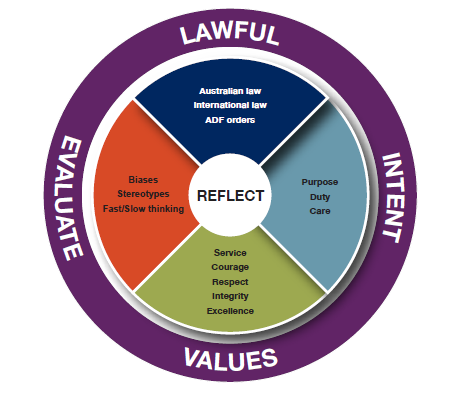
The first step in avoiding the corrosive effects of moral disengagement is awareness. Just taking the time to read this paper will increase your awareness and provide a basis for disarming people who engage in unethical behaviour or turn a blind eye to it. Unlike those of us who joined the military a long time ago, ADF members now have access to the Ethos of the Profession of Arms doctrine, including, but not limited to, ADF-P-0 Military Ethics, and the Australian Defence Force Ethical Decision-making Framework (ADF EDM). 21 Moreover, ADF members are encouraged to discuss their views on ethical issues with peers, superiors and subordinates to check how they feel about ethically confusing situations. It only takes one person to raise an issue to create an environment for positive ethical change.
When making ethical decisions, most people rely on personal experience and general knowledge of a situation to decide what to do. While some people are good at looking at problems with objectivity and emotional detachment, some are not. Having a framework that prompts us to consider ethical risks acts as a bulwark against moral disengagement. The ADF EDM asks us to stop and reflect on the ethically challenging decision we are making. Just slowing down your thinking is an important step towards making the right decision. Slow thinking allows us to consider if we are responding to the situation or something we believe about the situation. Checking our thoughts and opinions for bias, or elements of moral disengagement also helps prevent ethical failure. Indeed, while the model provides individual guidance there is nothing to prevent decision-makers from discussing their concerns with mentors, subordinates, peers and superiors to enhance their perspective. The best solutions may stem from the hive brain where collaborative solutions are found.
Making Ethical Decisions when Deployed
Serving in Coalition environments presents numerous challenges, not least accommodating different cultural practices. Not all nation’s militaries treat their people the same way as we do here in Australia, and as discussed earlier in this paper, this can be very troubling for ADF personnel. The most important point to take away is, regardless of the differences we observe, we have an obligation to stand by our own ethical standards and not turn a blind eye or adopt practices that lower those standards – as per the following quote from ADF-P-0 Military Ethics:
Conclusion
The Australian public expect the ADF to operate in a manner which aligns with Australian values, including the ethical, legal, and strategic considerations of the Profession of Arms. Where members of the ADF behave contrary to our doctrine it reduces the credibility of the ADF as a ‘just’ military and a ‘force for good’. This demands more than just adhering to international humanitarian law, it requires us to set a high standard of ethical conduct in every engagement we undertake. There will be times when ADF personnel are faced with challenging circumstances that test our ability to remain ethically grounded, nevertheless, there is no excuse for allowing our standards to slip.
This paper set out to consider the utility of philosophical doctrine, in particular ADF-P-0 Military Ethics, for ADF personnel on deployed operations and to highlight the danger in becoming morally disengaged from the situation or the people. By looking more deeply at moral disengagement as a specific risk for ethical drift and failure, it is hoped readers will feel forewarned and forearmed in operational situations, and in garrison. The authors acknowledge, there are no easy answers when it comes to ethical dilemmas, and making ethical decisions, especially under the pressure of operational demands, is not a simple task. However, by taking steps to slow down your thinking, checking yourself for bias and moral disengagement, considering your own personal values and the values of the ADF, and checking in with the ADF EDM; it may be easier to make decisions you can live with.
1 ADF-P-0 Military Ethics, p. 19 Pages - ADF Doctrine Library
2 Festinger, L. (1957). A Theory of Cognitive Dissonance. Stanford University Press, Stanford: California.
3 ibid.
4 Ibid p. 83.
5 Bandura, A. (1990). Selective activation and disengagement of moral control. Journal of Social Issues, 40/1, 27-46.
6 Bandura, Albert. 1990. Selective Activation and Disengagement of Moral Control. in Journal of Social Issues, Vol. 46 No. 1. 1990. pp. 27-46
7 Normalised deviance is the gradual process through which unacceptable practice or standards become acceptable. Vaughan, D. (1997). The Challenger Launch Decision. University of Chicago Press. Chicago.
8 ADF-P-0 Military Ethics, p. 40 ADF Philosophical Doctrine - Military Ethics | Future Forge
9 The authors of this paper collectively hold over 60 years experience serving full-time in the ADF. It is this experience which informs our work at the Centre for Defence Leadership and Ethics where we often hear stories from current ADF members of ethical challenges they have faced.
10 Bandura, p 31
11 To learn more about unconscious cognitive processes and bias see Kahneman, D. (2011). Thinking Fast and Slow. Allen Lane, Penguin Books, Australia
12 Ibid. pp 32-33
13 ADF-P-0 Culture in the Profession of Arms, p. 17-25 ADF Philosophical Doctrine - Military Ethics | Future Forge
14 Bandura, Albert. 1990. Selective Activation and Disengagement of Moral Control. in Journal of Social Issues, Vol. 46 No. 1. 1990. pp. 27-46 p. 34 - note that Bandura uses the term displaced rather than diffused in this article.
15 Ibid. p. 37
16 Ibid. p. 49 paragraphs 5.52 – 5.54 indicates how judgement is required in giving and receiving gifts.
17 The dangerousness of contact with petroleum based fuels was known and reported from as far back as the 1920s – see Huff, J. (2007). Benzene-induced cancers: Abridged history and occupational health impact. International Journal of Occupational Environmental Health, 13/2, 213-221.
18 RAAF personnel who worked on the program were called ‘the goop troop’ and were shunned by others due to the offensive odour of chemicals on their overalls.
19 Royal Commission into Defence and Veteran Suicide – Final Report, accessed at: https://www.aph.gov.au/Parliamentary_Business/Tabled_Documents/7262 on 27 Aug 2025 para 214.
20 Ibid. p. 41
21 Ibid. p. 27
22 Ibid. p. 19
Social Mastery

Anne Goyne the Senior Psychologist and Deputy Director Research at the Centre for Defence Leadership and Ethics (CDLE) at the Australian Defence College (ADC)
GPCAPT Brown is a now a Reserve officer who serves in the Centre for Defence Leadership and Ethics at the Australian Defence College. Numerous postings throughout his career in the Permanent Air Force have necessitated the supervision and management of contracts. His interests are organisational culture, human behaviours, leadership, and ethics.
Applied Ethics – Considerations for ADF Personnel © 2026 by . This work is licensed under CC BY-NC-ND



Please let us know if you have discovered an issue with the content on this page.
Comments
Start the conversation by sharing your thoughts! Please login to comment. If you don't yet have an account registration is quick and easy.