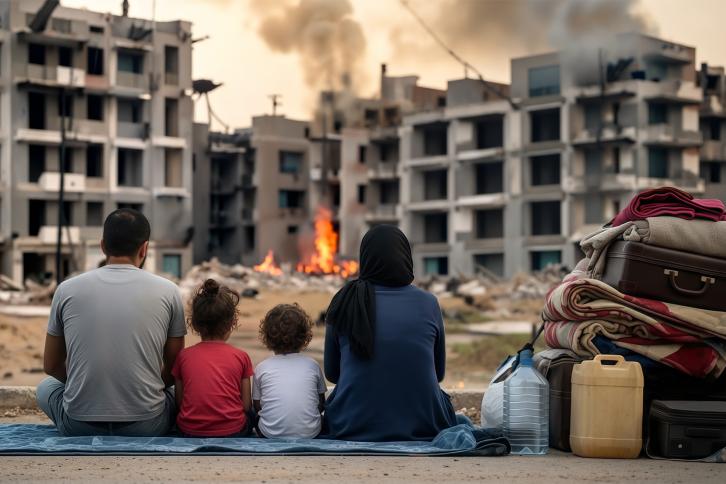
asymmetric conflicts, i.e. those that may be limited in scope and scale
but tend to be protracted. But as global conflict dynamics evolve, there
is the potential for a resurgence of large-scale conventional warfare.
Should this happen, the humanitarian consequences of urban operations
could be much more severe.1
Preamble
The obligation for military forces to consider the Protection of Civilians (POC) in Large Scale Combat Operations (LSCO) is under increasing global scrutiny. Recent conflicts in Ukraine, Gaza and Iran have highlighted the persistent risk of harm to civilians and civilian infrastructure, whether incidental or deliberate. In this context, a review of the ADF’s legal, policy and doctrinal framework is both timely and necessary. As the ADF focuses on preparing for LSCO, integrating civilian protection considerations into planning and execution is more important than ever, given the consequences of failing to do so. This paper seeks to contribute to that effort.
Background
Large Scale Combat Operations (LSCO) in littoral environments are a key priority for the ADF’s training cycle. The 1st (Australian) Division is the Army’s unit of action for LSCO, and Exercise TALISMAN SABRE 2025 demonstrated the complexity of conducting high-end warfighting as part of a combined joint force—Task Force Hamel.
During the exercise, divisional and brigade headquarters grappled with planning offensive operations against adversary forces embedded in populated areas. Two scenarios in particular uncovered shortfalls in how planners understand and apply the ADF’s obligations under international humanitarian law (IHL) and the Laws of Armed Conflict (LOAC), as well as whole-of-government policy on the protection of civilians (POC) in high-end warfighting. Those scenarios were the clearance of a large regional coastal city and the clearance of a smaller rural town. The planning for those scenarios highlighted the importance of specialist advice—including from legal officers and civil–military interaction (CMI) staff—when planning manoeuvre operations in urban environments.
This paper reviews the CMI planning aspects of the large coastal city through three specific lenses: the requirements of IHL/LOAC, the Australian Government’s policy approach, and ADF civil–military doctrine. It offers recommendations to ensure commanders and staff at divisional and brigade level integrate POC into their planning and execution of LSCO.
The Tactical Problem
The objective was a principal regional centre on the eastern coast of a large island. The city has a population in the order of two-hundred thousand with a broad urban footprint concentrated around a busy sea point of disembarkation (SPOD) and central business district (CBD) that hugs the waterfront and port precincts.
The air point of disembarkation (APOD) lies approximately 5 kilometres north of the CBD on the northern edge of the city, with the principal logistics nodes (depot areas, rail sidings and freight yards) formed along the corridor between the APOD and the port. Residential suburbs and light industrial zones extend west and south from the CBD across a relatively flat coastal plain that gives way to a range complex to the west.
The island is connected internally by primary ground lines of communication running north–south and east–west: a sealed coastal highway links the city to smaller coastal towns to the north and south; a secondary inland highway and rail line run west into the hinterland.
Remaining enemy forces had consolidated to an estimated size of a battalion detachment (BDET) defence anchored on the CBD, with company-size positions on the western side of the city and a recon screen further inland.
The broad scheme of manoeuvre saw the objective isolated and then a brigade seizure of the APOD and SPOD via an air mobile operation and amphibious assault followed by a second brigade clearance of the urban terrain to the south-west of the CBD.
IHL/LOAC Considerations
IHL and LOAC provide the framework for protecting civilians during armed conflict. For commanders, these obligations are not abstract—they directly affect how operations are planned and conducted in urban terrain2.
Precautions against the Effects of Attack: Offensive (and besieging) forces must, to the maximum extent feasible, endeavour to remove the civilian population, individual civilians, and civilian objects under their control from the vicinity of military objectives3.
- This is subject to the prohibition of mass transfers from occupied territory.
- Humanitarian relief personnel are, to the fullest extent practicable, to be assisted to carry out their relief mission. The activities or movement of humanitarian relief personnel may only be restricted in cases of imperative military necessity.4
Voluntariness. Civilians may need to be moved for their own safety, but displacement must remain voluntary, proportionate, and limited in duration. Forced removal is prohibited unless absolutely required for security or imperative military reasons.
The Law of Occupation (Belligerent Occupation): The law of occupation only applies in an International Armed Conflict (IAC). Territory is considered occupied when it is 1) actually placed 2) under the authority of the 3) hostile forces5. The Australian Government will decide Australia’s position on whether Australia is an occupying power and consequently the legal regime applicable to ADF operations.6
- ‘Actually Placed’: This prong refers to the effectiveness of the occupation and requires organised resistance to the occupying power to have been overcome and the occupying power taking measures to establish its authority. An example measures taken to establish authority include making regulations for the conduct of a temporary government.
- ‘Under Authority’: This prong refers to the suspension and substitution of governmental authority. The territorial state must be rendered incapable of publicly exercising its authority in the territory.
- ‘of the Hostile Forces’: This prong refers to the requirement that occupation only occurs in enemy territory. The law of belligerent occupation would not apply to the liberation of friendly territory that was previously occupied by the enemy.
Warnings and precautions. Unless circumstances do not permit, effective advance warning must be given of attacks that will affect the civilian population.7 .
Corridors and safe passage. Humanitarian corridors and demilitarised zones, while not necessarily a legal requirement, are often a good mechanism for the protection of civilians in conflict, especially during the siege of an urban area. Humanitarian corridors and demilitarised zones should be clearly identified, mutually agreed with adversaries or neutral intermediaries, and monitored to ensure safe movement.8
IHL/LOAC Application
As the enemy BDET had been isolated within the CBD, Task Force Hamel was technically a besieging force and therefore had an obligation to endeavour to remove the civilian population, individual civilians, and civilian objects under its control from the vicinity of military objectives.
Evacuation/safe spaces. Given the city was orders of magnitude larger than any nearby rural town it was not feasible to encourage the population to leave the town in entirety. Instead, humanitarian movement corridors and safe spaces within the city would be required to meet IHL obligations. Experience indicates that this may require operational pauses to allow such mechanisms to be negotiated and facilitated through the host nation authorities and the Department of Foreign Affairs and Trade (DFAT), potentially via third party intermediaries9.
Critical civil infrastructure. Detailed analysis of civil infrastructure was undertaken to identify critical infrastructure required to maintain a functioning civil society. This included food, health, water and sanitation, power and communications, as well as maintaining civil access to this infrastructure.
Warnings. Communication vectors were planned to allow warnings of impending attacks to be given, where feasible, to allow civilian evacuation to safe areas within the city. Information Operations (IO) messaging was planned to prepare the populace to be self-sufficient for up to three days and shelter safely.
The IHL/LOAC considerations translate into real planning requirements: intelligence staff must understand civilian patterns of life; operations staff must wargame evacuation routes and timings; and commanders must balance operational tempo with their obligation to minimise civilian harm.
Australian Government Policy Considerations
Australia’s policy framework on Protection of Civilians (POC) is set out in The Australian Guidelines on the Protection of Civilians10 and represents Australia’s commitment to enhancing POC across all international operations and engagements in which Australia is involved.
Australia has identified three focal areas11 that guide the approach:
- Protection through dialogue and engagement. This includes dialogue with perpetrator/potential perpetrators, conflict resolution and mediation between parties to the conflict, persuading the civil authorities and other relevant actors to intervene to protect civilians, and other initiatives that seek to protect civilians through public information, dialogue and direct engagement.
- Provision of physical protection. This encompasses those activities by police and military elements to prevent, deter, pre-empt and respond to situations in which civilians are under threat of physical violence. Those actions are informed by and implemented in close coordination with substantive civilian sections
- Establishment of a protective environment. This focuses on establishing an environment that enhances the safety of civilians by supporting legal, social and political conditions that safeguard civilians in the longer term. It promotes legal protections; facilitates the provision of humanitarian assistance; builds national institution capacity and includes disarmament, demobilisation and reintegration (DDR).
These focus areas align with the three-tiered approach to protecting civilians in armed conflict detailed in the UN DPKO/DFS Policy on the Protection of Civilians in United Nations Peacekeeping (2015)12. Across all operations, several principles apply13:
- POC is integral to Australia’s contribution to international peace and security, not an optional extra. Strategies must reflect IHL, human rights, refugee law, and international criminal law.
- Where host states are unable or unwilling to protect civilians, or are themselves a threat, Australia may act.
- Planning should involve civil society and local communities to ensure sustainability.
- Vulnerable groups—women, children, the frail and wounded, displaced persons, and medical staff—require specific attention.
- Agencies must coordinate with all protection actors and ensure military activity does not undermine existing protection efforts.
For commanders, this policy perspective reinforces that civilian protection is not only a legal requirement but also a strategic necessity, shaping Australia’s international reputation and coalition relationships.
Australian Government Policy Application
The Protection of Civilians policy provided guidance beyond that contained in IHL/LOAC. While there was not a strict legal requirement to seek to ensure civilian safety in areas Task Force Hamel did control, nevertheless, the POC obligations (as well as the strategic aim of liberating the city and restoring host nation governance) made civilian welfare a key planning consideration.
Maintenance of civilian logistics. The securing of the SPOD in order to resume civilian logistic supply was a key priority as the assessment as any interruption of basic supply needs beyond seven days would risk a humanitarian crisis.
Post-evacuation obligations. The POC guidelines entail command responsibilities that extend beyond the evacuation itself: if civilians must be displaced, all possible measures should be taken to ensure shelter, medical care, dignity, family unity, and eventual right of return. This should be facilitated through engagement with local authorities, international organisations (IOs) and non-government organisations (NGOs). Screening processes must respect both IHL and human rights norms.
Facilitation of humanitarian assistance. A population of 200,000 meant any post-kinetic action population support was beyond the capacity of the TF without significant additional augmentation from higher echelon. Thus establishment of a protective environment to allow civil actors access to provide that support was a key planning priority to ensure the Task Force did not create any ongoing obligations for populations support.
Civil–Military Interaction Doctrine
ADF joint doctrine ADF-I-3 Civil–Military Interaction and Army’s LP 3.0.14 Civil-Military Cooperation provide specific guidance for how commanders should approach POC in LSCO. Key elements include:
- Defence is just one component of a whole-of-government effect. Australian Defence Force will interact with government departments and their response capabilities at respective operational levels to apply POC policy. This requires Civil Military Interaction (CMI) based on operational context to ensure a high degree of civil-military alignment of national objectives. Relationships should be built at all levels in preparation for and during operations.14
- Readiness to work with civilian actors. Effective CMI is enabled by preparation—including education, training and exercising—prior to an operational response. The ADF needs to consciously manage its relationships with all civilian actors to ensure the protection of civilians and reduce the impact of disasters or complex emergencies on civilians.15
- Civilian interaction mechanisms and response mechanisms will already exist. Civilian actors, including host nation authorities, Australian government departments and the humanitarian community, will activate or have in place coordination and response mechanisms based on the nature of an operation. Planning must involve host nation authorities and humanitarian partners.16
- Primary responsibility for civilian wellbeing. The primary responsibility rests with lawful governments or de facto authorities but if those authorities fail an occupying force commander has legal obligations to provide governance and life-saving assistance.17
- Displaced persons and refugees. Humanitarian actors normally manage displaced persons and refugee camps and the ADF will only provide Immediate Life Sustaining Aid (ILSA) only in extremis.18 When delivering ILSA, the commander’s priority is to stabilise the situation until responsibility can transition to civil actors. Monitoring displaced populations and their movement corridors helps tactical commanders avoid or protect them during manoeuvre.19
- The Sphere Handbook20 is the universal minimum standard for the delivery of a quality humanitarian response. It should guide any military provision of ILSA.
- Implement a transition and exit strategy. The conditions necessary for transition should be established with relevant civilian actors at the start of the operation as part of an integrated whole-of-government approach. Understanding civilian and humanitarian actors' objectives and end states enables the ADF to plan and conduct activities that support or de-conflict with humanitarian actors based on operational requirements.21
CMI Lessons for LSCO Planning
The scenarios played out in Exercise TALISMAN SABRE 2025 underline that POC considerations can—and must—shape manoeuvre plans. Several lessons stand out:
- Legal compliance requires operational integration. Civilian protection cannot be treated as an afterthought. Policy, Legal and CMI advisors must be part of targeting, COA analysis, and rehearsals.
- Urban operations require anticipation of civilian effects. Reverberating impacts—loss of water, power, sanitation etc—can have more severe consequences than the initial strike. These must be factored into proportionality and precaution assessments.
- Evacuation and humanitarian corridors must be planned, not improvised. Commanders must coordinate with international organisations, civil authorities and NGO to support secure routes and reception areas.
- Training should replicate civilian complexity. Exercises must integrate role players, humanitarian organisations, and civilian infrastructure to make POC dilemmas realistic for commanders and staff.
Conclusion
Civilian protection during kinetic operations in LSCO is both a legal obligation and an operational necessity. The inevitable interaction between the military and civilians in urban environments, and the intermingling of military objectives and civilian objects present significant challenges in complying with IHL/LOAC. Commanders who integrate IHL, Australian policy, and ADF doctrine into their planning will preserve legitimacy, maintain freedom of manoeuvre, and support broader strategic WOG objectives.
Recommendations
- Embed POC in orders. Operational orders and rehearsals must explicitly address POC obligations.
- Use specialist advice early. Policy Advisors, Legal Officers and CIMIC staff should be engaged at the start of planning, not during execution.
- Train realistically. Include proportionality and precaution dilemmas in staff exercises and field training.
- Coordinate civilian movements. Establish mechanisms for evacuation, screening, and humanitarian corridors in the planning phase.
- Monitor and adapt. Track displaced populations to reduce risk, inform manoeuvre, and adjust operations dynamically.
The ICRC’s publication, Civilian Harm in Urban Warfare: A Commander’s Handbook 202122 provides excellent guidance for the main applicable frameworks IHL in urban settings and assembles additional recommendations for commanders in training, planning and conduct of urban operations.
1 ICRC. 2021. Civilian Harm in Urban Warfare: A Commander’s Handbook. 2021. https://shop.icrc.org/download/ebook?sku=4569/002-ebook
2 ADF-I-0 Law of Armed Conflict para. 2.3
3 ADF-I-0 Law of Armed Conflict para. 4.70
4 ADF-I-0 Law of Armed Conflict para. 6.43, 6.44
5 ADF-I-0 Law of Armed Conflict para. 1.10
6 ADF-I-0 Law of Armed Conflict para. 1.11
7 ADF-I-0 Law of Armed Conflict para. 4.69(e)
8 ADF-I-0 Law of Armed Conflict para.4.61 – 4.63
9 Center for Civilians in Conflict (CIVIC) & InterAction 2017, Protection of Civilians in Mosul: Identifying Lessons for Contingency Planning, roundtable outcome report, 17 October. <https://civiliansinconflict.org/wp-content/uploads/2017/10/civic-interaction-protection-of-civilians-in-mosul-october-2017_final.pdf> [Accessed 19 Aug. 2025]
10 Australian Civil-Military Centre 2015, Australian Guidelines for the Protection of Civilians, Australian Civil-Military Centre, viewed 26 September 2025, <https://www.acmc.gov.au/sites/default/files/2018-08/Australian_Guidelines_for_the_Protection_of_Civilians.pdf>[Accessed 5 Aug. 2025]
11 Ibid.
12 United Nations, Department of Peacekeeping Operations/Department of Field Support. The Protection of Civilians in United Nations Peacekeeping. April 1, 2015.
13 Australian Civil-Military Centre 2015, Australian Guidelines for the Protection of Civilians. Op cit.
14 ADF-I-3 Civil–Military Interaction, para 4.1
15 ADF-I-3 Civil–Military Interaction, para 3.4
16 ADF-I-3 Civil–Military Interaction, para 4.6
17 LP 3.0.14 Civil-Military Cooperation, p69
18 LP 3.0.14 Civil-Military Cooperation, p70
19 LP 3.0.14 Civil-Military Cooperation, p32
20 Sphere 2018.The Sphere Handbook: Humanitarian Charter and Minimum Standards in Humanitarian Response, https://spherestandards.org/wp-content/uploads/Sphere-Handbook-2018-EN.pdf
21 ADF-I-3 Civil–Military Interaction, para 3.16
22 ICRC. Civilian Harm in Urban Warfare: A Commander’s Handbook, 2021. https://shop.icrc.org/download/ebook?sku=4569/002-ebook
Defence Mastery
Technical Mastery
Social Mastery

LTCOL Michael Thomas is a SERCAT 5 Infantry Corps officer. He is currently serving as the G9 CIMIC at the 1st (Australian) Division. He has served in a variety of regimental positions, including Commanding Officer of the 25th/49th Battalion, the Royal Queensland Regiment. He has served in a number of CIMIC positions at 1 (AS) DIV and completed the NATO CIMIC Centre of Excellence’s Higher Command Course.

MAJ Cora Allen is a Major in the United States Army Judge Advocate General’s (JAG) Corps and has served in a variety of National Security Law positions over the past 8 years. She is currently serving as an exchange legal officer at the 1st (Australian) Division, and is posting to the Judge Advocate General’s Legal Center and School to pursue a Master of Laws degree in Military Law in August 2026. Cora holds a Bachelor of Science from Spring Hill College in Mobile Alabama and a Juris Doctor from Northern Kentucky University.
Civil–Military Interaction in Large Scale Combat Operations (LCSO) © 2026 by . This work is licensed under CC BY-NC-ND



Please let us know if you have discovered an issue with the content on this page.
Comments
Start the conversation by sharing your thoughts! Please login to comment. If you don't yet have an account registration is quick and easy.