Introduction
The 2023 Defence Strategic Review (DSR) recommended that the Australian Defence Force (ADF) “maximise the deterrence, denial, and response options for government.”1 In response, the National Defence Strategy (NDS) adopted a deterrence-by-denial strategy for Australia’s northern approaches.2 Yet, as Gregory MacCallion and Courtney Stewart note, the NDS is unclear on how land power will contribute.3 This essay argues that the 1st (Australian) Division, as the Australian Army’s unit of action, contributes to Australia’s deterrence-by-denial strategy chiefly through communication. As a forward, operational-level headquarters, it functions as a ‘thick tripwire’, a small, robust forward presence that secures access and rehearses theatre throughput, making coalition reinforcement predictable and visible to an adversary.4 Its deterrent effect, however, is contingent on the perceived automaticity of an allied response, primarily from the United States, given the Division’s limits in mass and depth.
Firstly, this essay examines the theory of deterrence-by-denial and its application in Australia, with a focus on the centrality of collective deterrence. Next, it defines the division and examines the factors that drove the Australian Army’s return to this structure as its unit of action. This shift stems from the complexity of modern warfare and the need for coalition integration, a requisite for Australia’s denial strategy. It also asserts that the 1st Division, as the sole deployable combat division, is an operational-level headquarters capable of joint and coalition integration. Lastly, the essay assesses the Division’s contribution by applying the ‘three Cs’ of deterrence: communication, capability, and credibility. The communication analysis asserts the Division’s primary contribution is its signaling effect as a forward-deployed force. The capability analysis reveals that the Division's benefits as a joint integrator are outweighed by deficiencies in strategic depth, concurrency, and its inability to deter grey-zone activities. Finally, the credibility assessment argues the Division’s deterrent effect is contingent on an adversary’s belief in an automatic coalition response to any attack.
Deterrence-by-Denial: The Australian Way
Australia’s strategic position as a middle power facing great powers necessitates a deterrence posture based on denial, offering a more credible foundation than the threat of punishment. Deterrence is simply persuading an opponent that the costs/risks outweigh the benefits.5 A state achieves deterrence through punishment, which threatens retaliation after an act, or denial, which aims to convince an adversary that they will fail before they even begin.6 For non-nuclear scenarios, the literature generally judges denial as more reliable: tangible, observable capabilities are more credible than the more abstract threat of post-hoc retaliation.7 This is the case for a non-nuclear middle power like Australia. Great powers such as China hold ‘escalation dominance’ over it, maintaining a deterrence advantage because they can escalate beyond Australia’s capacity to match.8 This mismatch lays the basis for a coalition-centred approach to resisting Chinese hegemony in the Indo-Pacific.
The prevalence of states resisting Chinese hegemony in the Indo-Pacific renders a regional strategy of denial, underpinned by a US-led coalition, the most viable approach. The People’s Republic of China (PRC) presents as the only peer competitor to the US, demonstrating both the intent and capacity to reshape the international order.9 Decades of force modernisation have significantly improved the People’s Liberation Army (PLA) power-projection capabilities, which it employs to coerce its neighbours through aggressive diplomacy, grey-zone tactics, and territorial expansion in the South China Sea.10 Elbridge Colby argues that punishment is far less credible in this environment: China’s potential regional gains, such as the seizure of Taiwan, would outweigh any costs imposed elsewhere, and the risk of vertical escalation would stiffen Chinese resolve.11 China’s objective is to subordinate neighbouring states. Therefore, the coalition’s measure of success is to preserve the independence and alignment of those states, sustaining the regional balance of power.12
Australia operationalises this coalition-denial strategy through what Andrew Carr calls “archipelagic deterrence,” a posture that uses the northern approaches and surrounding island chains to complicate Chinese power projection.13 Within this collective strategy, Australia’s primary contribution is to act as a “secure southern bastion,” a resilient base from which a coalition can project power forward into the contested archipelagos.14 The 2024 National Defence Strategy (NDS) codifies this approach, reorienting the ADF from a balanced force to one focused on deterring any attempt to project force through our northern maritime approaches. This has prioritised the acquisition of capabilities heavily weighted toward air and maritime power, including long-range strike, a sovereign guided weapons enterprise, and integrated domain awareness, all underpinned by deep integration with the United States.15 This is most evident in the expansion of the United States Force Posture Initiatives (USFPI), which increases rotational access for high-end American bombers, fighters, and nuclear-powered submarines.16 The clear strategic intent is to create a layered and lethal anti-access/area denial (A2/AD) network across Australia's northern maritime approaches. The NDS states that the ADF will achieve this through ‘integrated deterrence.’17 This US concept integrates instruments of power across domains, theatres, and, most critically, with allies and partners. As Michael Mazarr notes, this integration with allies is the central pillar of the concept, designed to convince adversaries “that the costs of their hostile activities outweigh their benefits”.18 Yet the NDS privileges maritime, air and long-range strike. This raises a critical question: within this denial construct, what role does land power, specifically the 1st Division, play?
The Return of the Division: The Australian Army’s Unit of Action
In 2023, the Australian Army's return to the division as its unit of action re-established a formation with a specific and doctrinally defined scale and purpose. In ADF doctrinal terms, the unit of action is the “organised command level that controls the application of land power”. The division is a “tactical combined-arms formation, commanded by a two-star headquarters that can conduct independent and sustained operations”.19 The 1st (Australian) Division concentrates the majority of the Army’s combat power in one formation, including its three combat brigades,20 the 17th Sustainment Brigade,21 and the 10th Fires Brigade,22 as well as other niche enablers.
The complexity of modern war, in part, drove the Army’s return to the divisional structure. Most Western armies had been division-based forces since the First World War. However, in 2003, the US Army transitioned to a modular, brigade-based force to better contend with the operational tempo and distributed operations of the Iraq and Afghanistan Wars.23 These wars revealed that modular brigades, though effective for distributed operations, lacked the capacity to synchronise the broader functions of modern campaigns: information activities, partner-force development, coalition coordination, political engagement, and long-term sustainment. Contemporary operations also demand command and control across large distances and in emerging domains, including space, cyber, and cognitive. Anthony King argues that these demands drove Western armies back to the division as a “collective command” with the necessary capacity at the two-star level.24 Australian Chief of Army, Lieutenant General Simon Stewart, has explicitly stated that the Army reorganised most of its combat power under the 1st Division to “better command and control operations and establish permanent command relationships with the brigades they’ll fight with.”25 This improved command function of the Division directly contributes to deterrence through enhanced capacity.
The need to preserve interoperability with the US provided an external driver for returning to a divisional organisation, as it is the most appropriate echelon for integrating into US campaigns. The 2024 NDS places interoperability with the US at the centre of Australia's strategy, stating our reliance on the US will “drive interoperability and interchangeability in the development of ADF’s force structure to enable Australian access to US systems and capabilities.”26 In 2016, partly in response to Russia’s annexation of Crimea and increasingly aggressive actions by China, Iran and North Korea, General Mark Milley, the US Army Chief of Staff, refocused the US Army from counterinsurgency operations to defeating peer enemies in large-scale combat operations (LSCO).27 This resulted in the US returning to the division as the primary fighting formation because it is the lowest viable formation capable of managing the tempo, complexity and risk of LSCO.28 The UK followed suit, despite lacking many of the enablers to deploy and fight an entire division, a decision that only makes sense within an alliance context where interoperability29 requirements often dictate force structure.30 Indeed, the Army’s stated rationale for returning to the division follows suit; LTGEN Stewart noted that it “better enables the employment of Australian divisions within partner and coalition environments.”31
Military doctrine generally considers the division a tactical formation, but this essay argues that it resides at the operational level, given the contemporary complexity, planning horizons, and, in Australia’s case, scale. US joint doctrine holds that the levels of war are perspectives rather than fixed echelons and that purpose depends on the task and mission.32 In large armies, such as the US Army, multiple echelons above the division (corps, field army, and theatre army) carry out campaign design, employing divisions as large tactical manoeuvre headquarters. Yet, as King argues, the modern division’s “collective command” plans and synchronises over vast areas, integrates fires with air and maritime schemes, manages information and cyber activity, and runs a Future Plans function over time horizons extending into weeks and months, which are operational tasks in substance.33 Further, the Australian Army fields only one combat division. With no intervening land command echelon between the 1st Division and Joint Operations Command, which serves as ADF’s theatre command headquarters, the 1st Division plans and executes land campaigns integrated with joint and whole-of-government effects. It is therefore reasonable to treat the 1st Division not merely as a tactical unit but as the Army’s principal expression of the operational level of war, capable of planning and synchronising joint effects across campaigns.
The Three Cs of Deterrence: Assessing the 1st (Australian) Division’s Contribution
The three core components of effective deterrence are known as the '3Cs': capability, credibility, and communication.34 Capability refers to the ability or technical capacity to carry out plausible deterrence measures; in military terms, it is the materiel and skills within a force to execute military threats. Credibility is the visible intent and resolve to implement those measures. As Thomas Schelling’s work highlights, this is a fundamentally psychological challenge. Credibility is not the will itself, but the adversary’s belief in that will,35 a perception reinforced by tangible factors such as organisational structure, the ability to command in complex environments, and power-projection capability.36 Communication is the process of conveying capability and credible intent, which relates to the adversary’s perceptions.37 Robert Jervis’s work on perception highlights the central challenge of communication: it is a complex two-way process where signals sent are not always the signals received.38 This section argues that the Division’s primary contribution is communicative because its limited standalone capability means its credibility must be guaranteed by a coalition response.
Communication: The Division as a ‘Thick Tripwire’
The 1st (Australian) Division’s primary contribution to deterrence is communicative: it makes resolve visible. Colin Gray argues that land forces are uniquely ‘politically entangling’ in a way that air and maritime rotations are not.39 Their comparatively limited mobility implies persistence, which gives weight to signaling political commitment and regional presence.40 This is particularly relevant in the Indo-Pacific, where armies are the largest service in most resident countries, giving land forces unmatched influence in combined operational planning.41 Mälksoo argues that such ritualised presence works on allies as much as on adversaries.42 These repeated, scheduled engagements within the region are designed to build the trust and solidarity needed to translate partnerships into formalised access. Formalised access is the “permission to use another country’s territory or airspace for military operations.”43 Such access can help host nations withstand coercion44 and shape perceptions of the ADF’s capabilities and, ultimately, Australia’s political intent.45
The Division’s enduring relationships in the region exemplify how this 'ritualised presence' translates into a tangible signal of regional commitment. Brown argues that these long-standing regional engagements are among the most significant contributions to the ADF’s deterrence effectiveness provided by the Australian Army.46 For example, the Australian Army’s enduring relationship with Papua New Guinea (PNG), now managed by the 1st Division, is a prime example of a ‘ritualised presence’, built over decades of shared history through recurring operations and exercises, such as Wantok Warrior, Olga Warrior, and Pukpuk.47 This has contributed to formal operational access to PNG. On 6 October 2025, the Papua New Guinea – Australia Mutual Defence Treaty (Pukpuk Treaty) was signed by the Prime Ministers of PNG and Australia,48 overcoming significant last-minute political opposition and suspected Chinese interference.49 Pending formal ratification by both parliaments, it will elevate the relationship to an alliance, joining only the US and New Zealand. It contains agreements on mutual defence, expansion of defence cooperation, “enhanced capability, interoperability and integration.”50 Specifically regarding access, the Treaty enables the ADF to use PNG defence facilities for various defence activities, including the staging and deployment of forces, as well as the pre-positioning of equipment and supplies.51 Ultimately, land forces like the Division, “operating beyond Australia’s shores demonstrate a tangible message of resolve, maintaining their presence for extended periods in support of the integrated force,”52 contributing to the denial of access and influence.
The 1st Division achieves effective strategic communication not through political statements but by demonstrating operational access, which turns theoretical permissions into rehearsed capabilities. The recent consolidation of theatre support within the division, particularly the transfer of the 17th Sustainment Brigade as of November 2024,53 strengthens this signal by co-locating the logistics, health, policing, and engineering services that enable access. The 17th Sustainment Brigade is the Division’s theatre-opening and sustainment arm, transforming access permissions into lift, storage, distribution, and support at the point of need. For example, during Talisman Sabre 2025, the Division’s theatre enablers in the 17th Sustainment Brigade formed a Force Support Group, operating sustainment nodes in both urban and field environments.54 10th Force Support Battalion cleared littoral access lanes and recovered heavy vehicles along the shore while cargo specialists ran port and airfield throughput with forklifts, cranes and movement control teams. The exercise’s PNG phase, culminating at Lae, demonstrated that access now extends beyond Australia’s coastline.55 This is how theoretical permissions become measurable capability: through the visible sequence of opening ports, handling aircraft, lifting containers, and sustaining forward elements. When these enablers perform on schedule in public view, the message to an opponent is that permissions are rehearsed, not theoretical. Ultimately, this demonstrated capacity to open and sustain a theatre is not just a signal of Australian resolve, but the essential, practical guarantee that makes the promise of a follow-on coalition response credible.
The Division’s posture as a thick tripwire is its most critical communicative act. Strategic practice offers three forward deterrence postures: thin tripwires, thick tripwires, and forward defence.56 For a middle power like Australia, a heavy forward defence is unsustainable, while a thin tripwire lacks credibility. Therefore, the thick tripwire—a small, robust force that prompts a shift from grey-zone pressure to overt attack—is the most logical choice. Similar to the US Army’s Multi-Domain Task Forces, a key wartime function of such a force is to set the theatre: hold key terrain and provide command and control (C2) so follow-on forces can enter and project power.57 As Dayton McCarthy argues, the primary function of land forces in a strategy of denial is to secure the air and seaports of entry (APOE/SPOE) to “hold the door open” for arriving coalition forces and to project multi-domain fires.58 This signals that ‘reinforcement will arrive on time,’ undermining hopes of a quick fait accompli. In effect, by establishing a regional forward presence, the Division assumes what Andrew Carr and Stephen Frühling call the “primary responsibility for signaling Australia’s political intent.”59
A division-centric posture is a blunt instrument in the grey zone; it is built for decisive war, not the persistent ambiguity below that threshold. Grey-zone activities coerce while avoiding overt conflict.60 China’s “Three Warfares” (psychological, public opinion and legal warfare) is an “integrated campaign to achieve political objectives while remaining below the threshold of outright warfare,”61 aimed at the permissions and narratives that underwrite access. They are calibrated to sit below the point at which a conventional division is a proportionate response. While Australian doctrine demands integrated planning across the spectrum of competition,62 the suitability of the 1st Division in this environment is questionable. As Michael Mazarr and colleagues argue, grey-zone deterrence relies on small, persistent, and proportionate tools, such as training, advising, security assistance, and local partner exercises, where specialforces and ISR platforms add the most value by illuminating and attributing coercive acts.63 Making land power credible here would require enduring task groups focused on partnered operations to build the access that renders grey-zone activity visible.64 The result is diminished deterrence credibility for the 1st Division, as it cannot deliver a timely, proportionate, and persistent presence in the very space where coercion actually occurs.
Even so, recent scholarship and operational practice indicate the Division can play a role in recognising and responding to these tactics. China’s campaign in the Solomon Islands exemplifies the “Three Warfares” strategy, which involves utilising state-owned companies to secure long-term leases on strategic islands, signing a security pact, and providing police equipment to build influence and secure access.65 The US uses ‘campaigning’ to counter such actions, defined as “peacetime military activities that limit, frustrate and disrupt competitor activities.”66 Within this approach, the 1st Division deepens partnerships through security-force assistance and rehearsed access, and develops proportionate combined response options with the United States and regional partners.67 Countering grey-zone interference means making access resilient and establishing routine response pathways; the 1st Division’s role is to embed, rehearse, and demonstrate these pathways with allies and regional partners. As a forward operational HQ, the 1st (Australian) Division contributes through communication, transforming relationships into permissions and rehearsed throughput. This approach reads as a thick tripwire, but only where access instruments and authorities are approved and allied readiness is visible.
Capability: A Potent Integrator Lacking Strategic Depth
1st (Australian) Division’s distinctive value is as a forward, survivable integrated force enabler that coordinates coalition multi-domain effects, and synchronises joint fires where high-value platforms cannot safely persist.68 Integration fuses maritime and air sensors into land strike via networked targeting.69 This shifts signature-heavy strike to dispersed land nodes, reducing exposure for irreplaceable assets, such as strike aircraft and surface combatants. Former commanding general of the US Army Pacific has highlighted land forces’ unique value proposition: the “arsenal of the Chinese have designed is primarily designed to defeat our air and maritime capabilities. It is not designed to find, fix and target—attack—distributed, mobile,  Division contribute to Australia’s deterrence-by-denial strategy\Media/media/image2.jpeg) reloadable and networked land forces.”70
reloadable and networked land forces.”70
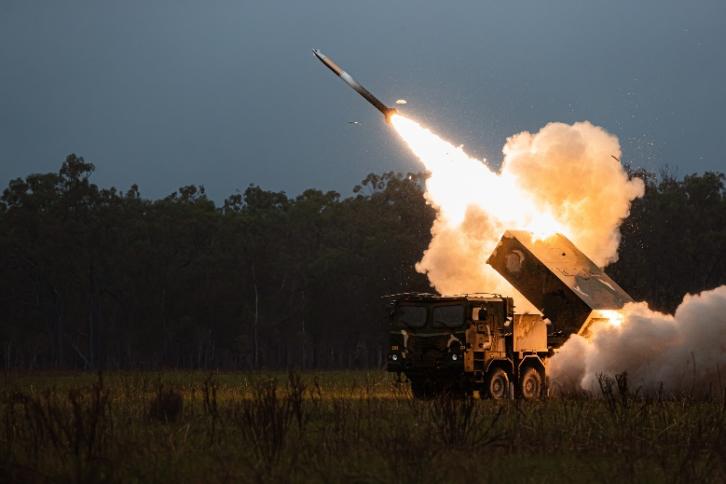
The Division’s expanding ground-based long-range strike capability is an essential contributor to the ADF’s multi-domain strike system, but it will have a limited deterrent effect. The Army has procured the High Mobility Artillery Rocket System (HIMARS), the Army Tactical Missile System (ATACMS), and the Precision Strike Missile (PrSM), all of which will be assigned to the 10th Brigade, under the command of the 1st Division.71 These assets will enhance the ADF’s long-range strike system and, critically, have the potential for close interoperability with the US. However, MacCallion and Stewart argue that they do not achieve credible deterrence on their own; they are deficient in range, mass, and mobility to be sufficiently threatening to alter an adversary’s risk calculus.72 For example, HIMARS has a range of only 500 kilometres (with PrSM), rendering it strategically ineffective unless it is forward-deployed in the region, which carries its own security and escalation risks.73 Regarding mass, the 10th Brigade will acquire only 42 launchers, which is insufficient to create credible denial effects on a large scale.74 For mobility, the Division has yet to develop company-sized deployable units capable of operating HIMARS in a dispersed posture. Additionally, it lacks organic targeting and firing capabilities, which risks ‘firing blind’.75 These limitations mean that the Division’s strike capability is not a credible standalone deterrent, reinforcing its coalition dependency.
The Division’s demonstrated competence in coordinating joint fires creates a proven and credible blocking capacity that complicates an adversary’s calculus. In 2021, the Australian and US Armies successfully shared joint fires targeting data through the Advanced Field Artillery Tactical Data System (AFATDS),76 representing a vital interoperability milestone and signal to adversaries. In 2025, 10th Brigade supported a US Army land-based SM-6 launch at Talisman Sabre that sank a target at sea,77 highlighting growing integrated strike capability. The principal risks to integration are delays resulting from classification frictions78 and contested communications, as well as the exposure that comes with firing signatures. Credibility, therefore, depends on rehearsed authorities, low-signature workflows, and dispersion/deception to keep the kill chain moving under pressure. Taken together, these proven, combined kill chains signal a credible and resilient blocking capacity resident within the Division, complicating an adversary’s calculus and strengthening coalition deterrence.
However, there is brittleness in the Division’s deterrent posture, which is a direct consequence of its lack of strategic depth: a single combat division cannot absorb shocks, manage concurrency, or regenerate quickly, creating a hard ceiling on its endurance. Dr Richard Brabin-Smith argues that during times of compressed warning time, a military needs to increase its core force and its expansion base, or institute rapid mobilisation pathways, to enable responses to military contingencies.79 The Australian Contribution to the National Defence Strategy 2024 states that the 2nd (AS) Div will provide a force expansion base for the Australian Army.80 However, Ross Babbage contends that, in its current form, it is incapable of achieving this for war in our immediate region because it is configured for expeditionary operations and has its own strategic task of homeland defence.81 This leaves the 1st Division as the sole land power force capable of providing a forward deterrence posture, bringing the Australian Army’s lack of strategic depth and mobilisation mechanisms into stark relief. The gap between the ADF’s integrated campaign doctrine, which defines mobilisation as expansion, adaptation, and endurance,82 and the reality of a single deployable division creates a critical vulnerability that an adversary will consider in their strategic calculus, thereby undermining Australia’s denial strategy.
The challenge of concurrent operations highlights the unsustainability of a force structure centred on a single combat division. RAND modelling shows that continuous brigade deployments typically require a 1:2 deployment-to-dwell cycle, meaning that for any time spent deployed, twice that is needed at home for recovery, training, and reset.83 In practice, this means that maintaining one brigade continuously forward requires a pool of three comparable brigades: one deployed, one preparing, and one recovering. Applying this model to the Army’s 1st Division of three combat brigades demonstrates the fragility of the posture; a single continuous forward deployment consumes the entire available force, leaving no capacity for a second contingency or a surge. This is further complicated by the Army’s decision to shift back toward a focused force, in which brigades have specialisation and are not immediately interchangeable.84 Carr and Frühling assess that rotational forces “will require outsized resources for force generation that limit the feasibility of such a posture for smaller nations in particular.”85
This sustainability challenge is more acute for the 1st Division’s enablers, which are the first to culminate. High-demand, low-density units, such as signals, ISR, aviation, engineers, and theatre sustainment (17th Brigade), are required for every deployment. As the hypothetical rotation in Table 1 demonstrates, the sustainable 1:2 dwell time for combat brigades becomes a compressed and unsustainable 1:1 tempo for the 17th Brigade’s only two supporting Force Support Battalions responsible for theatre logistics.86 If there are concurrent operations, their dwell time plummets further because there are fewer units to rotate. The pressure becomes more acute as the number of units decreases for any given capability. The cost of lowering dwell to meet operational tempo leads to personnel retention issues, maintenance backlogs and training debts, which negatively impact future readiness.87 A deterrent that stays forward only by accumulating readiness debt advertises its own limited endurance, making the division's deterrence signal credible in the short term but unsustainable over time. An adversary will observe this and use concurrency to coerce: by generating overlapping tasks, they can force the Division to culminate. These inherent limitations in the Division’s warfighting capability mean its deterrent value is found not in its capacity to win a fight alone, but in the credibility of the coalition response it guarantees. The Division’s capability contribution is coalition kill-chain integration and theatre opening, which constrains adversary freedom of action. This is effective only if intelligence and targeting data can be shared, C2 is resilient, munitions stocks, and integrated air and missile defence (IAMD) depth are adequate, and enabler rotations can sustain concurrency.
| Month 1-4 | Month 5-8 | Month 9-12 | ||
|---|---|---|---|---|
| 1st Brigade (Dismounted) | Deploy | Reset | Readying | |
| 3rd Brigade (Armoured) | Readying | Deploy | Reset | |
| 7th Brigade (Motorised) | Reset | Readying | Deploy | |
| 17th Sustainment Brigade | 9 FSB | Deploy | Reset | Deploy |
| 10 FSB | Reset | Deploy | Reset | |
Credibility: Contingent on Coalition Response
The 1st (Australian) Division’s credibility rests less on mass than on the believability of rapid US-led reinforcement, a problem rooted in alliance politics. What an adversary must believe is that this chain holds under friction. Nations manage alliance politics by mitigating two competing risks: abandonment, the fear that agreed-upon support will not materialise, and entrapment, the fear that a state will be drawn into an unwanted conflict.89 Asymmetric military dependence between partners exacerbates these fears. Snyder argues that if one ally is militarily dependent on another, any reduction in mutual interest will, in turn, reduce the credibility of the alliance to an adversary.90 While abandonment is typically more salient for Canberra and entrapment for Washington, both risks are mutually held and vary by contingency; either ally can worry about the other’s over- or under-commitment, known as an alliance dilemma.91 In a Taiwan contingency, Canberra may fear entrapment in a high-intensity war, while Washington worries about allied free-riding and having to act largely alone. In a defence of Australia scenario, the salience reverses: Canberra’s abandonment concerns rise while Washington’s entrapment concerns dominate. Because measures to insure against abandonment often heighten entrapment fears for the other party, the strategic task is to balance the two.92 The 1st Division’s posture as a thick tripwire seeks that balance by raising the political cost of abandonment, making a follow-on US response more believable to an adversary. It also signals burden-sharing, which recent US policy expects from allies,93 thereby easing US entrapment concerns.
The Division is deficient in decisive mass to materially shift the military balance of power in the region. The NDS outlines Australia’s “primary area of military interest (PAMI), the immediate region encompassing the Northeast Indian Ocean through maritime Southeast Asia into the Pacific” as the area where the ADF must “possess sufficient capability to credibly hold at risk forces that could attempt to project power.”94 Reiter and Poast contend that tripwire forces often have a limited deterrence effect because they lack the resident capability to carry through with military threats.95 On this test, the Division, capable of sustaining one brigade forward, is unlikely by itself to change the local balance across Australia’s PAMI. The division’s credibility, then, is a function of how integrated and automatic allied reinforcement appears.
The Division’s ability to remain in the fight depends on allied enablers and permissions. The 2024 NDS explicitly focuses on force design to enhance interoperability and interchangeability with the US,96 a prudent strategic decision that imposes operational constraints. In practice, a forward brigade from the 1st Division cannot sustain operational tempo without coalition support in strategic lift, high-end ISR and targeting networks, protected satellite communications and space capabilities, integrated air and missile defence, and munitions supply chains. This dependency is most acute in targeting. Although the Division provides the ‘shooter,’ the long-range ISR to find, fix, and track targets is largely US-owned, creating a vulnerability at the heart of the kill chain.97 These deep enabler dependencies are the specific mechanisms that make the Division's endurance inherently coalition-dependent.
The credibility of a thick tripwire is not a function of its own military power, but of the perceived automaticity of the coalition response it is designed to trigger. The empirical record on small forward deployments is mixed to sceptical. Reiter and Poast, for example, argue that tripwires fail when an attacker can achieve a rapid fait accompli before a larger response can be mounted, citing historical cases such as North Korea’s invasion in 1950 and Germany's invasion of Belgium in 1914.98 Similarly, Musgrave and Ward’s research, supported by historical events like the 1983 Beirut barracks bombing, finds that public demands for escalation after troop losses are often too modest to guarantee a response.99 However, these critiques are primarily drawn from contexts aimed at deterring a land invasion or assume a lack of public resolve, whereas the 1st Division’s tripwire function differs: to secure maritime access points within a pre-existing alliance framework. The more conditional view holds that deterrence improves only when forward presence is paired with explicit guarantees and rehearsed response plans. These signal a high likelihood of rapid coalition action in the event of an attack.100 Such responses are only believable, though, when underwritten by sustained, combined training and rehearsals with allies that mirror the ADF’s own internal training cycle, rather than intermittent exchanges.101 In 2022, the Defence Minister stated that the division’s amphibious forces would deepen interoperability with the US Marines, moving from interoperability to interchangeability, which signals substantial progress toward shared C2.102
However, integration with partners is a decisive credibility function provided by the 1st Division because Indo-Pacific denial ultimately hinges on coalition strength and regional partners rather than the capabilities of individual nations. The 2024 NDS explicitly highlights regional partnerships and the US alliance as core inputs to deterrence and force design.103 Colby convincingly argues that the US, as the “cornerstone external balancer”, will likely constitute the decisive factor in any immediate conflict and in the broader success of an anti-hegemonic coalition in general.104 The Australian Army’s response to the NDS highlights the importance of collective security, for which the 1st Division, as the primary deployable land power, provides the engagement spine for relationships with the US and regional partners.105 It is the mechanism by which Australia gains credibility by transitioning from being a ‘deterrence taker’, a state that only receives the benefits of deterrence, to a ‘deterrence maker’. 106
Accordingly, the Division contributes to the alliance precisely through its deep regional relational capital. MacCallion and Stewart posit that the US military “cannot replicate the social and cultural connections the Army has built with Indo-Pacific militaries, and those ties matter most when permissions and consent are contested.”107 Furthermore, to maintain credibility with the US, the Division must convert these engagements into operational access, which comes with no guarantees. While Australia’s 'ritualised presence' fosters peacetime relationships, analysis by Pettyjohn and Kavanagh reveals that this does not guarantee a host nation will grant access during a crisis, rendering credibility a constant and context-specific challenge.108 In summary, the 1st Division’s contribution to deterrence is enhanced when the thick tripwire reliably triggers predictable allied reinforcement, so an attack on the Division is an attack on the coalition. This holds only under the conditions of perceived US commitment, secured access and lift, and exercised timelines.
Conclusion
As Nick Brown said, “Historically, the Australian Army has been precluded from a role in deterrence.”109 This essay has argued that, as the Army’s single deployable combat division, the 1st (Australian) Division plays an important role. Its contribution to Australia’s deterrence-by-denial strategy is essentially one of communication; its ability to posture forward within the region and maintain a strong, extensive relationship network with regional partners signals Australia’s commitment and political intent. This contribution, however, is tempered by its dependence on coalition support, particularly that of the US. Furthermore, the anticipated coalition response to an attack on its forward presence underwrites its credibility, as the Division lacks the required combat or logistics mass.
Within a coalition context, Australia’s denial strategy provides a secure regional base for an “archipelagic deterrence” posture alongside the United States. Within this framework, the need for an operational-level headquarters capable of managing the complexity of modern war and integrating with partners drove the Army’s return to a divisional structure. The subsequent analysis using the 3Cs showed that the Division’s primary contribution is not independent combat power, but a communicative posture that makes reinforcement predictable, and a capability contribution that integrates land-based fires into the coalition kill chain and opens the theatre. This works when access agreements and approvals are in place, lift and sustainment are scheduled, and allies have rehearsed the timelines. It is effective only if intelligence and targeting data can be shared, C2 is resilient, munitions stocks and integrated air and missile defence have depth, and enabler rotations can sustain concurrency. Its credibility rests not on the Division’s ability to win a fight, but on an adversary’s belief that any attack would trigger an automatic and overwhelming US-led response. Under those conditions, an attack on the Division is understood as an attack on the coalition. The Division’s contribution to denial is therefore less about repelling invasion by itself and more about making a wider conflict certain and prompt. Ultimately, its modern purpose is not to win a war alone, but to signal the strength of the alliance so effectively that a war never begins.
2024 National Defence Strategy. Department of Defence, 2024. https://www.defence.gov.au/about/strategic-planning/2024-national-defence-strategy-2024-integrated-investment-program.
ADF Capstone Concept APEX: Integrated Campaigning for Deterrence. Australian Defence Force, 2025.
ADF Land Power Ed 1. ADF-I-3. 3 Series - Operations. Australian Defence Force, 2024.
Army Multi-Domain Transformation: Ready to Win in Competition and Conflict. Chief of Staff Paper #1: Unclassified Version. Headquarters, Department of the Army, 2021. https://api.army.mil/e2/c/downloads/2021/03/23/eeac3d01/20210319-csa-paper-1-signed-print-version.pdf.
Arthur, Gordon. “Army Bullseyes Maritime Target with Portable Launcher.” USNI News, July 17, 2025. https://news.usni.org/2025/07/17/army-bullseyes-maritime-target-with-sm-6-fired-from-portable-launcher.
Australian Army. “Chief of Army Mid-Year Message 2023.” YouTube video. July 7, 2023. 6:43. https://www.youtube.com/watch?v=qVU4bGmxQDA.
Australian Military Power. ADF-C-0. ADF Capstone Doctrine. Australian Defence Force, 2024. https://acmc.gov.au/sites/default/files/2024-10/ADF-C-0%20Australian%20Military%20Power-compressed.pdf.
Babbage, Ross. “The ADF Reserve System Is Obsolete. We Need a Dramatically Expanded Force.” The Strategist, March 20, 2025. https://www.aspistrategist.org.au/the-adf-reserve-system-is-obsolete-we-need-a-dramatically-expanded-force/.
Brabin-Smith, Richard. Contingencies and Warning Time. No. 12. The Centre of Gravity Series. ANU Strategic & Defence Studies Centre, 2013.
Bree, Max. “Right on Target.” Department of Defence, August 18, 2021. https://www.defence.gov.au/news-events/news/2021-08-18/right-target.
Brown, Nick. “Riding Shotgun: Army’s Move to the Strategic Front Seat.” Australian Army Journal 16, no. 2 (2020): 5–24.
Burket, Dennis S. “Chapter 1: The Evolution of the Division Formation.” In Large-Scale Combat Operations: The Division Fight, 1st edition, edited by Dennis S. Burket. The Art of Tactics, volume 1. Army University Press, 2019. https://www.armyupress.army.mil/Portals/7/combat-studies-institute/csi-books/lsco-the-division-fight.pdf.
Carr, Andrew. “Australia’s Archipelagic Deterrence.” Survival 65, no. 4 (2023): 79–99. https://doi.org/10.1080/00396338.2023.2239058.
Carr, Andrew, and Stephan Frühling. Forward Presence for Deterrence: Implications for the Australian Army. Australian Army Occasional Paper No. 15. Australian Army Research Centre, 2023.
Clarke, Michael. “Australia’s Alliance Dilemma Sharpens.” East Asia Forum, September 12, 2025. https://eastasiaforum.org/2025/09/12/australias-alliance-dilemma-sharpens/.
Colby, Elbridge. The Strategy of Denial: American Defense in an Age of Great Power Conflict. Yale University Press, 2021.
Collingburn, Ashley. “Welcoming the 10th Brigade to the 1st (Australian) Division.” LinkedIn, November 2024. https://www.linkedin.com/posts/ashley-collingburn-am-dsm-b3ba14197_i-look-forward-to-welcoming-the-10th-brigade-activity-7253074326906707970-aW6O.
Dean, Peter J., Stephan Frühling, and Andrew O’Neil. “Australia and the US Nuclear Umbrella: From Deterrence Taker to Deterrence Maker.” Australian Journal of International Affairs 78, no. 1 (2024): 22–39. https://doi.org/10.1080/10357718.2024.2302589.
Defence Australia. “ADF | Exercise Puk Puk - Brothers in Arms and Construction in PNG.” YouTube video. July 8, 2025. 1:20. https://www.youtube.com/watch?v=3VRMuTumTgo.
Defence Minister. “Government Delivers First Australian HIMARS.” Department of Defence, March 24, 2025. https://www.minister.defence.gov.au/media-releases/2025-03-24/government-delivers-first-australian-himars.
Department of Defence. “Major changes to Army announced.” September 28, 2023. https://www.defence.gov.au/news-events/news/2023-09-28/major-changes-army-announced.
Department of Foreign Affairs and Trade. “Joint Statement Australia-US Ministerial Consultations (AUSMIN) 2021.” 2021. https://www.dfat.gov.au/geo/united-states-of-america/ausmin/joint-statement-australia-us-ministerial-consultations-ausmin-2021.
Doll, Abby, Yvonne K. Crane, Gian Gentile, et al. The Backbone of US Joint Operations: Army Roles in the Indo-Pacific. Research. RAND Corporation, 2023. https://www.rand.org/pubs/research_reports/RRA1784-1.html.
Dziedzic, Stephen. “‘Our Nearest Neighbour Is Our Newest Ally’: Albanese, Marape Sign New Defence Treaty.” Foreign Affairs. ABC News, October 6, 2025. https://www.abc.net.au/news/2025-10-06/australia-png-sign-defence-treaty-of-mutual-alliance/105858244.
Evans, Brittany. “Ex Wantok Warrior taken up a notch.” Department of Defence, December 9, 2024. https://www.defence.gov.au/news-events/news/2024-12-09/ex-wantok-warrior-taken-up-notch.
Exercise Talisman Sabre 2025 concludes. Media release. Department of Defence, 2025. https://www.defence.gov.au/news-events/releases/2025-08-04/exercise-talisman-sabre-2025-concludes.
Freedman, Lawrence. “General Deterrence and the Balance of Power.” Review of International Studies, Special Issue on the Balance of Power, vol. 15, no. 2 (1989): 199–210.
Gray, Colin S. Modern Strategy. Oxford University Press, 1999.
Haffa, Robert P. “The Future of Conventional Deterrence: Strategies for Great Power Competition.” Strategic Studies Quarterly 12, no. 4 (2018): 94–115.
Jackson, John C., Lisa M. Harrington, Jeffrey S. Brown, et al. Assessment of Deployment- and Mobilization-to-Dwell Policies for Active and Reserve Component Forces: An Examination of Current Policy Using Select US Joint Force Elements. RAND Corporation, 2023. https://www.rand.org/pubs/research_reports/RRA670-1.html.
Jervis, Robert. The Logic of Images in International Relations. Reprint. Columbia University Press, 1989.
Kaye, Thomas. “Developing Skills for International Exercise.” Department of Defence, July 6, 2023. https://www.defence.gov.au/news-events/news/2023-07-06/developing-skills-international-exercise.
King, Anthony. Command: The Twenty-First-Century General. Cambridge University Press, 2019.
Leca, Joanne. “Big changes for 17th Sustainment Brigade.” Department of Defence, December 5, 2024. https://www.defence.gov.au/news-events/news/2024-12-05/big-changes-17th-sustainment-brigade.
Leca, Joanne. “Soldiers Project Force from the Sea.” Department of Defence, April 30, 2024. https://www.defence.gov.au/news-events/news/2024-04-30/soldiers-project-force-from-sea.
Leca, Joanne. “Special visit with vital mission enablers.” Department of Defence, July 22, 2025. https://www.defence.gov.au/news-events/news/2025-07-22/special-visit-vital-mission-enablers.
Leiter, Samuel, and Samuel Gerstle. “Do Tripwires Deter? Reassessing Their Role in US Extended Deterrence.” SSRN Scholarly Paper No. 5175680. Social Science Research Network, February 15, 2025. https://doi.org/10.2139/ssrn.5175680.
Lonergan, Thomas. Ambitiously Grey: Pursuing an Active Australian Military Approach in the Grey-Zone. Policy Brief. United States Studies Centre, 2024. https://www.ussc.edu.au/pursuing-an-active-australian-military-approach-in-the-grey-zone.
Lynch, Evan. “US Army Uses New Path To Bypass Data Sharing Barriers.” Signal, October 23, 2024. https://www.afcea.org/signal-media/us-army-uses-new-path-bypass-data-sharing-barriers.
MacCallion, Gregory, and Courtney Stewart. “Australian Deterrence: Land Power’s Contribution to the Integrated Force.” Australian Army Journal 20, no. 2 (2024): 48–76.
Mälksoo, Maria. “A Ritual Approach to Deterrence: I Am, Therefore I Deter.” European Journal of International Relations 27, no. 1 (2021): 53–78. https://doi.org/10.1177/1354066120966039.
Mankowski, Mark. “Putting the Band Back Together – Part One.” Australian Army Research Centre, February 6, 2024. https://researchcentre.army.gov.au/library/land-power-forum/putting-band-back-together-part-one.
Marles, Richard. “Address: Center for Strategic and International Studies (CSIS).” Address. Defence Ministers, July 12, 2022. https://www.minister.defence.gov.au/speeches/2022-07-12/address-center-strategic-international-studies-csis.
Mazarr, Michael J. Understanding Deterrence. RAND Corporation, 2018. https://www.rand.org/pubs/perspectives/PE295.html.
Mazarr, Michael J., Jeffrey W. Hornung, and Stephanie Pezard. What Deters and Why: Applying a Framework to Assess Deterrence of Gray Zone Aggression. RAND Corporation, 2021. https://doi.org/10.7249/RR3142.
Mazarr, Michael J., and Ivana Ke. Integrated Deterrence as a Defense Planning Concept. Perspective. RAND Corporation, 2024. https://www.rand.org/pubs/perspectives/PEA2263-1.html.
McCarthy, Dayton. “‘Holding the Door Open’: Securing a Point of Entry to Facilitate Littoral Manoeuvre in the Near Region—Part Two.” Land Power Forum, July 14, 2023. https://researchcentre.army.gov.au/library/land-power-forum/holding-door-open-securing-point-entry-facilitate-littoral-manoeuvre-near-region-part-two.
McGrath-Cohen, Emma. “PNG Cabinet Approves Australia Defence Treaty.” Politics. Australian Financial Review, October 2, 2025. https://www.afr.com/politics/federal/png-cabinet-green-lights-australia-defence-treaty-20251002-p5mzla.
Miles, Aaron. “Escalation Dominance in America’s Oldest New Nuclear Strategy.” War on the Rocks, September 12, 2018. https://warontherocks.com/2018/09/escalation-dominance-in-americas-oldest-new-nuclear-strategy/.
Molesworth, Daniel. “Australian Army’s Long-Range Strike Capability Could Be Firing Blind.” The Strategist, November 30, 2022. https://www.aspistrategist.org.au/australian-armys-long-range-strike-capability-could-be-firing-blind/.
Monaghan, Sean. Deterring Hybrid Threats: Towards a Fifth Wave of Deterrence Theory and Practice. No. 12. Hybrid COE Paper. The European Centre of Excellence for Countering Hybrid Threats, 2022. https://www.hybridcoe.fi/wp-content/uploads/2022/03/20220331-Hybrid-CoE-Paper-12-Fifth-wave-of-deterrence-WEB.pdf.
Musgrave, Paul, and Steven Ward. “The Tripwire Effect: Experimental Evidence Regarding US Public Opinion.” Foreign Policy Analysis 19, no. 4 (2023): orad017. https://doi.org/10.1093/fpa/orad017.
Nelson, Olivia. “Stop the World: Armies Key to Indo-Pacific Deterrence, Says Former US General.” The Strategist, September 23, 2025. https://www.aspistrategist.org.au/stop-the-world-armies-key-to-indo-pacific-deterrence-says-former-us-general/.
Papua New Guinea – Australia Mutual Defence Treaty. Treaty. Department of Foreign Affairs and Trade, 2025. https://www.dfat.gov.au/sites/default/files/png-australia-mutual-defence-treaty.pdf.
Pettyjohn, Stacie. Aiming Higher: Accelerating US-Australia Cooperation on Precision-Guided Weapons. United States Studies Centre, 2024. https://www.ussc.edu.au/accelerating-us-australia-cooperation-on-precision-guided-weapons.
Pettyjohn, Stacie. More than the Sum of Its Parts: Developing a Coordinated US-Australian Response to Potential Chinese Aggression. Carnegie Endowment for International Peace, 2024. https://carnegieendowment.org/research/2024/11/more-than-the-sum-of-its-parts-developing-a-coordinated-us-australian-response-to-potential-chinese-aggression?lang=en.
Pettyjohn, Stacie, and Jennifer Kavanagh. Access Granted: Political Challenges to the US Overseas Military Presence, 1945–2014. RAND Corporation, 2016. https://doi.org/10.7249/RR1339.
Prime Minister of Australia: The Hon Anthony Albanese MP. “Joint Communiqué - Papua New Guinea and Australia on a Mutual Defence Treaty.” September 16, 2025. https://www.pm.gov.au/media/joint-communique-papua-new-guinea-and-australia-mutual-defence-treaty.
Reiter, Dan, and Paul Poast. “The Truth About Tripwires: Why Small Force Deployments Do Not Deter Aggression.” Texas National Security Review 4, no. 3 (2021): 34–53. https://doi.org/10.1086/711716.
Ryan, Evita. “Lowering the Flag on 6th Brigade.” Department of Defence, December 2, 2024. https://www.defence.gov.au/news-events/news/2024-12-02/lowering-flag-6th-brigade.
Schelling, Thomas C. Arms and Influence. Yale University Press, 2020.
Schultz, Marcus. US Land Power in the Indo-Pacific: Opportunities for the Australian Army. Special Report. Australian Strategic Policy Institute, 2023. https://www.aspi.org.au/report/us-land-power-indo-pacific-opportunities-australian-army/.
Sinodinos, Arthur. “Allied Burden-Sharing Must Reshape Australia’s Defence Priorities.” Lowy Institute. The Interpreter, July 2025. https://www.lowyinstitute.org/the-interpreter/allied-burden-sharing-must-reshape-australia-s-defence-priorities.
Smith, Stephen, and Angus Houston. National Defence: Defence Strategic Review. Department of Defence, 2023.
Snyder, Glenn H. Alliance Politics. Cornell University Press, 1997.
Snyder, Glenn H. Deterrence and Defense. Princeton University Press, 1961.
Snyder, Glenn H. “The Security Dilemma in Alliance Politics.” World Politics 36, no. 4 (1984): 461–95. https://doi.org/10.2307/2010183.
Stahl, Albert C. “Chapter 17 - Interoperability in Large-Scale Combat Operations.” In Large-Scale Combat Operations: The Division Fight, 1st edition, edited by Dennis S. Burket. The Art of Tactics, volume 1. Army University Press, 2019. https://www.armyupress.army.mil/Portals/7/combat-studies-institute/csi-books/lsco-the-division-fight.pdf.
The Australian Army Contribution to the National Defence Strategy 2024. Australian Army, 2024. https://www.army.gov.au/our-work/strategy/australian-army-contribution-national-defence-strategy-2024.
US Department of Defense. Military and Security Developments Involving the People’s Republic of China 2024. Annual Report to Congress. 2024. https://media.defense.gov/2024/Dec/18/2003615520/-1/-1/0/MILITARY-AND-SECURITY-DEVELOPMENTS-INVOLVING-THE-PEOPLES-REPUBLIC-OF-CHINA-2024.PDF.
US Joint Chiefs of Staff. Joint Operations. Joint Publication 3-0. 2017. https://irp.fas.org/doddir/dod/jp3_0.pdf.
Wilner, Alex, and Andreas Wenger. “Introduction: Deterrence by Denial.” In Deterrence by Denial: Theory and Practice, edited by Alex S. Wilner and Andreas Wenger. Cambria Press, 2021. https://research.ebsco.com/linkprocessor/plink?id=242c1a36-4ff9-3c7b-b7aa-be7d4975d044.
Wuthnow, Joel, and Phillip C. Saunders. China’s Quest for Military Supremacy. Polity Press, 2025.
176 The Australian War College – Geddes Papers
1Stephen Smith and Angus Houston, National Defence: Defence Strategic Review (Department of Defence, 2023), 19.
22024 National Defence Strategy (Department of Defence, 2024), 23, https://www.defence.gov.au/about/strategic-planning/2024-national-defence-strategy-2024-integrated-investment-program.
3Gregory MacCallion and Courtney Stewart, “Australian Deterrence: Land Power’s Contribution to the Integrated Force,” Australian Army Journal 20, no. 2 (2024): 48.
4Andrew Carr and Stephan Frühling, Forward Presence for Deterrence: Implications for the Australian Army, Australian Army Occasional Paper No. 15 (Australian Army Research Centre, 2023), 16.
5Lawrence Freedman, “General Deterrence and the Balance of Power,” Review of International Studies, Special Issue on the Balance of Power, vol. 15, no. 2 (1989): 200; Glenn H. Snyder, Deterrence and Defense (Princeton University Press, 1961), 3.
6Alex Wilner and Andreas Wenger, “Introduction: Deterrence by Denial,” in Deterrence by Denial: Theory and Practice, ed. Alex S. Wilner and Andreas Wenger (Cambria Press, 2021), 7, https://research.ebsco.com/linkprocessor/plink?id=242c1a36-4ff9-3c7b-b7aa-be7d4975d044; Snyder, Deterrence and Defense, 15.
7Michael J. Mazarr, Understanding Deterrence (RAND Corporation, 2018), 2, https://www.rand.org/pubs/perspectives/PE295.html.
8Aaron Miles, “Escalation Dominance in America’s Oldest New Nuclear Strategy,” War on the Rocks, September 12, 2018, https://warontherocks.com/2018/09/escalation-dominance-in-americas-oldest-new-nuclear-strategy/.
9US Department of Defense, Military and Security Developments Involving the People’s Republic of China 2024, Annual Report to Congress (2024), V, https://media.defense.gov/2024/Dec/18/2003615520/-1/-1/0/MILITARY-AND-SECURITY-DEVELOPMENTS-INVOLVING-THE-PEOPLES-REPUBLIC-OF-CHINA-2024.PDF.
10Joel Wuthnow and Phillip C. Saunders, China’s Quest for Military Supremacy (Polity Press, 2025), 133.
11Elbridge Colby, The Strategy of Denial: American Defense in an Age of Great Power Conflict (Yale University Press, 2021), 149–50.
12Colby, The Strategy of Denial, 151.
13Andrew Carr, “Australia’s Archipelagic Deterrence,” Survival 65, no. 4 (2023): 79, https://doi.org/10.1080/00396338.2023.2239058.
14Carr, “Australia’s Archipelagic Deterrence,” 79.
15NDS, 38–41.
16“Joint Statement Australia-US Ministerial Consultations (AUSMIN) 2021,” Department of Foreign Affairs and Trade, 2021, https://www.dfat.gov.au/geo/united-states-of-america/ausmin/joint-statement-australia-us-ministerial-consultations-ausmin-2021.
17MacCallion and Stewart, “Australian Deterrence,” 50.
18Michael J. Mazarr and Ivana Ke, Integrated Deterrence as a Defense Planning Concept, Perspective (RAND Corporation, 2024), 1, https://www.rand.org/pubs/perspectives/PEA2263-1.html.
19A division consists of two or more brigades plus specialised battalions, about 7,000 to 22,000 troops, commanded by a major general, and includes all arms and services needed to conduct independent operations. ADF Land Power Ed 1, ADF-I-3, 3 Series - Operations (Australian Defence Force, 2024), 23.
20An unclassified order of battle for the 1st (Australian) Division does not exist. Any order of battle or direct command relationship discussed in this essay has been deduced from open-source material. Australian Army, “Chief of Army Mid-Year Message 2023,” YouTube video, July 7, 2023, 6:43, https://www.youtube.com/watch?v=qVU4bGmxQDA.
21Joanne Leca, “Big changes for 17th Sustainment Brigade,” Department of Defence, December 5, 2024, https://www.defence.gov.au/news-events/news/2024-12-05/big-changes-17th-sustainment-brigade.
22Ashley Collingburn, “Welcoming the 10th Brigade to the 1st (Australian) Division,” LinkedIn, November 2024, https://www.linkedin.com/posts/ashley-collingburn-am-dsm-b3ba14197_i-look-forward-to-welcoming-the-10th-brigade-activity-7253074326906707970-aW6O; Evita Ryan, “Lowering the Flag on 6th Brigade,” Department of Defence, December 2, 2024, https://www.defence.gov.au/news-events/news/2024-12-02/lowering-flag-6th-brigade.
23Dennis S. Burket, “Chapter 1: The Evolution of the Division Formation,” in Large-Scale Combat Operations: The Division Fight, 1st edition, ed. Dennis S. Burket, The Art of Tactics, volume 1 (Army University Press, 2019), 11, https://www.armyupress.army.mil/Portals/7/combat-studies-institute/csi-books/lsco-the-division-fight.pdf.
24Anthony King, Command: The Twenty-First-Century General (Cambridge University Press, 2019), 37.
25Australian Army, “Chief of Army Mid-Year Message 2023.”
26NDS, 46.
27Burket, “Chapter 1: The Evolution of the Division Formation,” 12.
28Mark Mankowski, “Putting the Band Back Together – Part One,” Australian Army Research Centre, February 6, 2024, https://researchcentre.army.gov.au/library/land-power-forum/putting-band-back-together-part-one.
29Interoperability is defined as the “ability to routinely act together coherently, effectively, and efficiently to achieve tactical, operational, and strategic objectives.” Albert C. Stahl, “Chapter 17 - Interoperability in Large-Scale Combat Operations,” in Large-Scale Combat Operations: The Division Fight, 1st edition, ed. Dennis S. Burket, The Art of Tactics, volume 1 (Army University Press, 2019), 263, https://www.armyupress.army.mil/Portals/7/combat-studies-institute/csi-books/lsco-the-division-fight.pdf.
30King, Command, 34.
31Australian Army, “Chief of Army Mid-Year Message 2023.”
32US Joint Chiefs of Staff, Joint Operations, Joint Publication 3-0 (2017), I–12, https://irp.fas.org/doddir/dod/jp3_0.pdf.
33King, Command, 306.
34Robert P. Haffa, “The Future of Conventional Deterrence: Strategies for Great Power Competition,” Strategic Studies Quarterly 12, no. 4 (2018): 96–97.
35Thomas C. Schelling, Arms and Influence (Yale University Press, 2020), 35–36.
36MacCallion and Stewart, “Australian Deterrence,” 51.
37Sean Monaghan, Deterring Hybrid Threats: Towards a Fifth Wave of Deterrence Theory and Practice, no. 12, Hybrid COE Paper (The European Centre of Excellence for Countering Hybrid Threats, 2022), 16, https://www.hybridcoe.fi/wp-content/uploads/2022/03/20220331-Hybrid-CoE-Paper-12-Fifth-wave-of-deterrence-WEB.pdf.
38Robert Jervis, The Logic of Images in International Relations, Reprint (Columbia University Press, 1989), 18–40.
39Colin S. Gray, Modern Strategy (Oxford University Press, 1999), 213.
40Carr and Frühling, Forward Presence for Deterrence: Implications for the Australian Army, 3.
41Abby Doll et al., The Backbone of US Joint Operations: Army Roles in the Indo-Pacific, Research (RAND Corporation, 2023), 11, https://www.rand.org/pubs/research_reports/RRA1784-1.html.
42Maria Mälksoo, “A Ritual Approach to Deterrence: I Am, Therefore I Deter,” European Journal of International Relations 27, no. 1 (2021): 6, https://doi.org/10.1177/1354066120966039.
43Stacie Pettyjohn and Jennifer Kavanagh, Access Granted: Political Challenges to the US Overseas Military Presence, 1945–2014 (RAND Corporation, 2016), 3, https://doi.org/10.7249/RR1339.
44Pettyjohn and Kavanagh, Access Granted, 147.
45MacCallion and Stewart, “Australian Deterrence,” 61.
46Nick Brown, “Riding Shotgun: Army’s Move to the Strategic Front Seat,” Australian Army Journal 16, no. 2 (2020): 15–16.
47Brittany Evans, “Ex Wantok Warrior taken up a notch,” Department of Defence, December 9, 2024, https://www.defence.gov.au/news-events/news/2024-12-09/ex-wantok-warrior-taken-up-notch; Defence Australia, “ADF | Exercise Puk - Brothers in Arms and Construction in PNG,” YouTube video, July 8, 2025, 1:20, https://www.youtube.com/watch?v=3VRMuTumTgo.
48Stephen Dziedzic, “‘Our Nearest Neighbour Is Our Newest Ally’: Albanese, Marape Sign New Defence Treaty,” Foreign Affairs, ABC News, October 6, 2025, https://www.abc.net.au/news/2025-10-06/australia-png-sign-defence-treaty-of-mutual-alliance/105858244.
49Emma McGrath-Cohen, “PNG Cabinet Approves Australia Defence Treaty,” Politics, Australian Financial Review, October 2, 2025, https://www.afr.com/politics/federal/png-cabinet-green-lights-australia-defence-treaty-20251002-p5mzla.
50“Joint Communiqué - Papua New Guinea and Australia on a Mutual Defence Treaty,” Prime Minister of Australia: The Hon Anthony Albanese MP, September 16, 2025, https://www.pm.gov.au/media/joint-communique-papua-new-guinea-and-australia-mutual-defence-treaty.
51Papua New Guinea – Australia Mutual Defence Treaty, Treaty, Department of Foreign Affairs and Trade, 2025, 22, https://www.dfat.gov.au/sites/default/files/png-australia-mutual-defence-treaty.pdf.
52MacCallion and Stewart, “Australian Deterrence,” 62.
53Leca, “Big changes for 17th Sustainment Brigade.”
54Joanne Leca, “Special visit with vital mission enablers,” Department of Defence, July 22, 2025, https://www.defence.gov.au/news-events/news/2025-07-22/special-visit-vital-mission-enablers.
55Exercise Talisman Sabre 2025 concludes, Media release (Department of Defence, 2025), https://www.defence.gov.au/news-events/releases/2025-08-04/exercise-talisman-sabre-2025-concludes.
56Thin tripwires rely on symbolic sacrifice to bind political commitment to military response; thick tripwires that are small but robust enough to force a shift by the adversary from grey-zone pressure to overt attack; and forward defence, a heavy and permanent capability-in-being that aims to deny locally. Carr and Frühling, Forward Presence for Deterrence: Implications for the Australian Army, 16.
57Army Multi-Domain Transformation: Ready to Win in Competition and Conflict, Chief of Staff Paper #1: Unclassified Version (Headquarters, Department of the Army, 2021), 18, https://api.army.mil/e2/c/downloads/2021/03/23/eeac3d01/20210319-csa-paper-1-signed-print-version.pdf.
58Dayton McCarthy, “‘Holding the Door Open’: Securing a Point of Entry to Facilitate Littoral Manoeuvre in the Near Region—Part Two,” Land Power Forum, July 14, 2023, https://researchcentre.army.gov.au/library/land-power-forum/holding-door-open-securing-point-entry-facilitate-littoral-manoeuvre-near-region-part-two.
59Carr and Frühling, Forward Presence for Deterrence: Implications for the Australian Army, 2.
60Thomas Lonergan, Ambitiously Grey: Pursuing an Active Australian Military Approach in the Grey-Zone, Policy Brief (United States Studies Centre, 2024), 7, https://www.ussc.edu.au/pursuing-an-active-australian-military-approach-in-the-grey-zone.
61Michael J. Mazarr et al., What Deters and Why: Applying a Framework to Assess Deterrence of Gray Zone Aggression (RAND Corporation, 2021), ix, https://doi.org/10.7249/RR3142.
62Australian Military Power, ADF-C-0, ADF Capstone Doctrine (Australian Defence Force, 2024), 27, https://acmc.gov.au/sites/default/files/2024-10/ADF-C-0%20Australian%20Military%20Power-compressed.pdf.
63Mazarr et al., What Deters and Why, 90–91.
64Carr, “Australia’s Archipelagic Deterrence,” 87.
65Lonergan, Ambitiously Grey: Pursuing an Active Australian Military Approach in the Grey-Zone, 4–11.
66Marcus Schultz, US Land Power in the Indo-Pacific: Opportunities for the Australian Army, Special Report (Australian Strategic Policy Institute, 2023), 12, https://www.aspi.org.au/report/us-land-power-indo-pacific-opportunities-australian-army/.
67Stacie Pettyjohn, More than the Sum of Its Parts: Developing a Coordinated US-Australian Response to Potential Chinese Aggression (Carnegie Endowment for International Peace, 2024), https://carnegieendowment.org/research/2024/11/more-than-the-sum-of-its-parts-developing-a-coordinated-us-australian-response-to-potential-chinese-aggression?lang=en; Lonergan, Ambitiously Grey: Pursuing an Active Australian Military Approach in the Grey-Zone, 15–19.
68MacCallion and Stewart, “Australian Deterrence,” 68.
69Brown, “Riding Shotgun,” 12.
70Olivia Nelson, “Stop the World: Armies Key to Indo-Pacific Deterrence, Says Former US General,” The Strategist, September 23, 2025, https://www.aspistrategist.org.au/stop-the-world-armies-key-to-indo-pacific-deterrence-says-former-us-general/.
71Defence Minister, “Government Delivers First Australian HIMARS,” Department of Defence, March 24, 2025, https://www.minister.defence.gov.au/media-releases/2025-03-24/government-delivers-first-australian-himars.
72MacCallion and Stewart, “Australian Deterrence,” 66.
73MacCallion and Stewart, “Australian Deterrence,” 67.
74MacCallion and Stewart, “Australian Deterrence,” 67.
75Daniel Molesworth, “Australian Army’s Long-Range Strike Capability Could Be Firing Blind,” The Strategist, November 30, 2022, https://www.aspistrategist.org.au/australian-armys-long-range-strike-capability-could-be-firing-blind/.
76Max Bree, “Right on Target,” Department of Defence, August 18, 2021, https://www.defence.gov.au/news-events/news/2021-08-18/right-target.
77Gordon Arthur, “Army Bullseyes Maritime Target with Portable Launcher,” USNI News, July 17, 2025, https://news.usni.org/2025/07/17/army-bullseyes-maritime-target-with-sm-6-fired-from-portable-launcher.
78Classification frictions refer to the technical and policy barriers that delay or prevent the real-time sharing of sensitive information between allies operating on separate national networks. Evan Lynch, “US Army Uses New Path to Bypass Data Sharing Barriers,” Signal, October 23, 2024, https://www.afcea.org/signal-media/us-army-uses-new-path-bypass-data-sharing-barriers.
79Richard Brabin-Smith, Contingencies and Warning Time, no. 12, The Centre of Gravity Series (ANU Strategic & Defence Studies Centre, 2013), 3.
80The Australian Army Contribution to the National Defence Strategy 2024 (Australian Army, 2024), 16, https://www.army.gov.au/our-work/strategy/australian-army-contribution-national-defence-strategy-2024.
81Ross Babbage, “The ADF Reserve System Is Obsolete. We Need a Dramatically Expanded Force,” The Strategist, March 20, 2025, https://www.aspistrategist.org.au/the-adf-reserve-system-is-obsolete-we-need-a-dramatically-expanded-force/.
82ADF Capstone Concept APEX: Integrated Campaigning for Deterrence (Australian Defence Force, 2025), 23.
83John C. Jackson et al., Assessment of Deployment- and Mobilization-to-Dwell Policies for Active and Reserve Component Forces: An Examination of Current Policy Using Select US Joint Force Elements (RAND Corporation, 2023), 5, https://www.rand.org/pubs/research_reports/RRA670-1.html.
84The 1st Brigade in Darwin is a light (dismounted) combat brigade; the 3rd Brigade in Townsville is an armoured combat brigade; and the 7th Brigade is a motorised combat brigade. “Major changes to Army announced,” Department of Defence, September 28, 2023, https://www.defence.gov.au/news-events/news/2023-09-28/major-changes-army-announced.
85Carr and Frühling, Forward Presence for Deterrence: Implications for the Australian Army, 24.
86Joanne Leca, “Soldiers Project Force from the Sea,” Department of Defence, April 30, 2024, https://www.defence.gov.au/news-events/news/2024-04-30/soldiers-project-force-from-sea; Thomas Kaye, “Developing Skills for International Exercise,” Department of Defence, July 6, 2023, https://www.defence.gov.au/news-events/news/2023-07-06/developing-skills-international-exercise.
87Stacie Pettyjohn, Aiming Higher: Accelerating US-Australia Cooperation on Precision-Guided Weapons (United States Studies Centre, 2024), 14, https://www.ussc.edu.au/accelerating-us-australia-cooperation-on-precision-guided-weapons.
88The table's purpose is not to detail the complex force packaging of enablers, but to simply illustrate the severe impact on the operational tempo of enabler units, even in a simple rotation.
89Glenn H. Snyder, “The Security Dilemma in Alliance Politics,” World Politics 36, no. 4 (1984): 90, https://doi.org/10.2307/2010183; Snyder, “The Security Dilemma in Alliance Politics,” 466.
90Glenn H. Snyder, Alliance Politics (Cornell University Press, 1997), 32.
91Michael Clarke, “Australia’s Alliance Dilemma Sharpens,” East Asia Forum, September 12, 2025, https://eastasiaforum.org/2025/09/12/australias-alliance-dilemma-sharpens/.
92Snyder, Alliance Politics, 181–82.
93Arthur Sinodinos, “Allied Burden-Sharing Must Reshape Australia’s Defence Priorities,” Lowy Institute, The Interpreter, July 2025, https://www.lowyinstitute.org/the-interpreter/allied-burden-sharing-must-reshape-australia-s-defence-priorities.
94NDS, 21–24.
95Dan Reiter and Paul Poast, “The Truth about Tripwires: Why Small Force Deployments Do Not Deter Aggression,” Texas National Security Review 4, no. 3 (2021): 41, https://doi.org/10.1086/711716.
96NDS, 46.
97Molesworth, “Australian Army’s Long-Range Strike Capability Could Be Firing Blind.”
98A fait accompli is the rapid conquest of territory and defeat of tripwire forces before reinforcements can arrive. Reiter and Poast, “The Truth about Tripwires,” 39–40.
99Paul Musgrave and Steven Ward, “The Tripwire Effect: Experimental Evidence Regarding US Public Opinion,” Foreign Policy Analysis 19, no. 4 (2023): 20, https://doi.org/10.1093/fpa/orad017.
100Samuel Leiter and Samuel Gerstle, “Do Tripwires Deter? Reassessing Their Role in US Extended Deterrence,” SSRN Scholarly Paper no. 5175680 (Social Science Research Network, February 15, 2025), 14, https://doi.org/10.2139/ssrn.5175680.
101MacCallion and Stewart, “Australian Deterrence,” 63.
102Richard Marles, “Address: Center for Strategic and International Studies (CSIS),” Address, Defence Ministers, July 12, 2022, https://www.minister.defence.gov.au/speeches/2022-07-12/address-center-strategic-international-studies-csis.
103NDS, 46–52.
104Colby, The Strategy of Denial, 152.
105The Australian Army Contribution to the National Defence Strategy 2024, 27–28.
106Peter J. Dean et al., “Australia and the US Nuclear Umbrella: From Deterrence Taker to Deterrence Maker.,” Australian Journal of International Affairs 78, no. 1 (2024): 22–39, https://doi.org/10.1080/10357718.2024.2302589.
107TMacCallion and Stewart, “Australian Deterrence,” 64.
108Pettyjohn and Kavanagh, Access Granted, 7–10.
109Brown, “Riding Shotgun,” 7.
Defence Mastery
Technical Mastery
Social Mastery

Major Christian Johnston is an infantry officer and a graduate of the ACSC class of 2025. He is currently posted to ADFHQ as the Staff Officer to the Vice Chief of the Defence Force
Holding the Door Open: The 1st Division and Deterrence © 2026 by . This work is licensed under CC BY-NC-ND



Please let us know if you have discovered an issue with the content on this page.
Comments
Start the conversation by sharing your thoughts! Please login to comment. If you don't yet have an account registration is quick and easy.