Introduction
Amid rising strategic competition in the Indo-Pacific, Australia has reoriented its defence policy around deterrence by denial as the core of its military posture. Articulated most recently in the 2024 National Defence Strategy (NDS) and supported by the Integrated Investment Program (IIP), this shift reflects a growing recognition that Australia's geography, while once a protective buffer, no longer guarantees security in the face of long-range missile threats, grey-zone coercion, and regional instability.
As stated in the NDS, this approach “aims to deter any conflict before it begins, prevent any potential adversary from succeeding in coercing Australia through force, support regional security and prosperity and uphold a favourable regional strategic balance”.1 Glenn Snyder first highlighted that denying an adversary access to territory or success in battle can serve as a powerful deterrent.2 Building on this foundation, Zilincik and Sweijs have proposed a contemporary framework of four operational logics of denial: capability elimination, operational paralysis, tactical performance degradation, and strategic effect reduction.3 These logics operate across physical and temporal dimensions, offering a robust framework for assessing the effectiveness of force structure.
This essay evaluates how well the 2024 NDS and IIP develop a force structure suitable for a strategy of deterrence by denial. It applies the four-logics framework to analyse whether Australia’s emerging capabilities meet the demands of modern conflict across the spectrum, from conventional warfare to grey-zone threats. It argues that while the NDS and IIP demonstrate significant progress toward enabling denial in conventional scenarios, especially through investments in long-range strike, undersea warfare, and base defensive improvements, gaps remain in resourcing and preparedness for grey-zone operations. Ultimately, this analysis finds that the force structure reflects a credible shift toward deterrence by denial, but its effectiveness will depend on sustained investment, regional access, and the ability to operationalise these capabilities promptly.
Deterrence by Denial: Concept and Framework
The 2024 National Defence Strategy (NDS) builds on the 2020 Defence Strategic Update (DSU) by elevating deterrence, particularly deterrence by denial, as the central pillar of Australia’s defence posture. Deterrence by denial aims to reduce an adversary’s chances of success, or at minimum, alter their perception of it enough to discourage them from taking action.4 This highlights the importance of undermining not just military means, but confidence in their outcomes. However, as Snyder observes, denial is ineffective if the deterring state lacks the tactical capacity to physically block or disrupt an adversary’s objectives.5 Building on this foundation, Zilincik and Sweijs refine the concept by offering a practical framework to evaluate denial strategies, particularly in relation to force structure planning under the NDS and IIP. They identify four operational logics of denial: capability elimination, operational paralysis, tactical performance degradation, and strategic effect reduction.6 Operating across space and time, these logics combine to create layered barriers that reinforce deterrence.
The first logic of denial is capability elimination, which involves preventing an adversary from deploying or utilising key military assets by striking them before they can be effectively brought to bear. This form of denial typically occurs beyond the defender’s immediate territory and often precedes the formal outbreak of hostilities.7 The core of this strategy lies not only in physically neutralising an adversary’s capabilities, as seen in traditional defensive approaches, but also in signalling that pursuing such objectives would be prohibitively costly and unlikely to succeed.8 Historical and contemporary examples illustrate how states have employed this logic. For instance, Japan’s attack on Pearl Harbor in 1941 sought to neutralise the United States Pacific Fleet, thereby preventing interference while Japan consolidated its victories across Southeast Asia.9 In a more recent context, the Stuxnet cyber-attack allegedly conducted by the United States and Israel, targeted Iran’s nuclear enrichment capabilities, aiming to delay or prevent the development of a nuclear weapons program without initiating open conflict.10 These cases demonstrate how capability elimination can shape adversary calculations by pre-emptively undermining their critical systems and platforms.
While capability elimination seeks to prevent an adversary from fielding key military assets, operational paralysis focuses on disrupting those assets once deployed, denying them the ability to achieve their intended objectives.11 As Snyder argues, denying an adversary access to territory or obstructing their ability to effect an attack can be a highly effective form of deterrence.12 Achieving operational paralysis typically requires the use of offensive capabilities by the defender,13 which serve to signal that any act of aggression would be prohibitively costly and unlikely to succeed, making the investment of resources unjustifiable.14 A notable historical example of operational paralysis is the use of the Dowding system during the Battle of Britain, which integrated early warning radar with coordinated fighter command and control. This enabled the Royal Air Force (RAF) to optimise its limited resources in effectively intercepting and repelling German air raids.15 Other examples include using air power and submarines to disrupt enemy supply lines, significantly degrading an adversary’s ability to manoeuvre and sustain operations.16 Ultimately, these examples show how operational paralysis can serve as a powerful deterrent by raising the costs of aggression and undermining the adversary’s ability to sustain offensive operations.
The next logic of denial is Tactical Performance Degradation, which focuses on reducing the effectiveness of an adversary’s forces once an attack is underway. As Zilincik and Sweijs explain, its primary aim is “to make it more difficult for the adversary’s attack to inflict damage on the target once the adversary’s attack reaches the target”.17 The deterrent value of denial forces lies predominantly in their effectiveness at defending territory.18 Tactical performance degradation can be implemented through passive measures, which are primarily defensive, or active measures, which incorporate offensive action to disrupt or neutralise enemy attacks.19 Passive approaches include fortifications, camouflage, and defensive obstacles, while active measures encompass air defence systems, forward screening elements, and rapid reaction forces. Historical examples include the French-constructed Maginot Line as a passive denial measure, and Israel’s Iron Dome as a modern example of an active defence system.20 Together, these measures demonstrate how degrading an adversary’s tactical effectiveness at the point of contact can serve as a powerful deterrent by reducing the likelihood of operational success and increasing the cost of aggression.
The final denial logic is Strategic effect reduction, which aims to deny an adversary any meaningful gain from their attack, even if it achieves tactical success.21 This logic is inherently defensive, focused on preserving the status quo rather than achieving conquest, and typically comes into effect on the home front after an attack has occurred.22 It is often understood through the lens of resilience, defined as a system’s ability to maintain functionality despite disruption or attack.23 A resilient force can quickly recover and re-establish combat effectiveness, even in the face of tactical setbacks. A recent example is the Ukrainian military in its ongoing conflict with Russia: despite suffering battlefield losses, Ukraine has leveraged Western military aid, adapted its tactics, and employed innovative technologies to blunt the strategic impact of Russian aggression. Zilincik and Sweijs also identify logistics and redundancy as key enablers of strategic effect reduction.24 Sustained resupply and support operations maintain morale and ensure the flow of essential equipment and ordnance, allowing continued resistance and increasing the cost of adversary gains. Similarly, redundancy in command, control, and communications blunts the effectiveness of strikes aimed at severing leadership from frontline forces, reducing the strategic utility of such attacks. Strategic effect reduction thus strengthens deterrence by demonstrating that even successful attacks will fail to achieve decisive results, undermining adversary confidence and disincentivising aggression. The following sections evaluate how well the NDS and IIP develop capabilities aligned with each of the four denial logics.
Applying the Four Logics of Denial to the NDS and IIP
Capability Elimination
The NDS and IIP include significant investment in capabilities that may contribute to capability elimination. Undersea warfare receives 17% of the decade's funding, focused on nuclear-powered submarines and autonomous underwater systems.25 These platforms create uncertainty for adversaries by threatening high-value assets, limiting their confidence in success.26 Similarly, investments in long-range guided weapons and explosive ordnance27 aim to strike critical nodes in adversary combat systems and potentially home bases at ranges up to 5000 to 8000 kilometres.28 Furthermore, investment in offensive cyber capabilities29 extends Australia’s operational reach into emerging domains, enhancing its ability to disrupt adversaries beyond the physical battlespace. These investments reinforce Australia’s capacity for impactful projection, ensuring that adversary forces are held at risk from greater ranges.
While the NDS and IIP demonstrate Australia’s commitment to enhancing its cyber, long-range strike, and undersea warfare capabilities, it remains uncertain whether these investments are designed, or appropriate for the logic of capability elimination. For example, Australia’s investment in cyber capabilities30 lacks clarity on whether they will serve offensive, pre-emptive roles. Similarly, the planned acquisition of SSN-AUKUS submarines will enhance Australia’s ability to project force and threaten high-value adversary targets, including those located deep within hostile territory,31 while long-range precision missile systems are expected to place critical adversary infrastructure within striking range.32 Even if intended for capability elimination, their practical application is constrained by serious operational and strategic challenges.
These constraints raise critical questions about the real-world effectiveness of Australia’s emerging capabilities in a pre-emptive context. While such missions might offer tactical advantages or delay adversary operations, they also carry a high risk of escalation and political and military backlash. Pre-emptive strikes risk portraying Australia as the aggressor,33 damaging its legitimacy and straining alliances. This is especially dangerous when confronting a militarily superior adversary such as China, where miscalculation could provoke broader conflict.34 Moreover, operating within China’s sophisticated anti-access/area denial (A2/AD) environment, particularly in contested regions like the South China Sea, raises significant doubts about the survivability of Australia’s relatively small submarine fleet and the effectiveness of offensive missile strikes in high-risk, pre-emptive operations. Finally, these factors suggest that while Australia is investing in relevant capabilities, it is not yet positioned to realise capability elimination as a credible or timely denial strategy. Delays in delivering SSN-AUKUS submarines and long-range missiles weaken the urgency outlined in the NDS. As Dowse notes, the slow pace of modernisation risks opening a strategic window during which adversaries may act with reduced fear of deterrence.35
Operational Paralysis
The NDS and IIP reflect Australia’s commitment to deterrence by denial, particularly through investments that support the logic of operational paralysis. Central to this approach is the implicit threat that Australia’s strike capabilities will alter an aggressor’s risk and cost calculus, thereby deterring hostile actions.36 This intent is evident in the prioritisation of long-range offensive strike capabilities, integrated theatre command and control systems,37 electronic warfare systems,38 joint targeting enterprises,39 and enhancements to intelligence, surveillance, and reconnaissance (ISR) capabilities.40 Collectively, these capabilities are designed to disrupt an adversary’s ability to coordinate, manoeuvre, and adapt during operations, particularly in contested environments beyond Australia’s immediate territory. For instance, the integration of persistent surveillance through uncrewed aerial and space-based platforms enables rapid target identification and coordination with long-range precision strike assets, effectively denying adversaries freedom of action across Australia’s northern approaches. In a complementary role, future SSN-AUKUS submarines and long-range missile systems may be used to disrupt adversary logistics and command structures in depth, degrading operational momentum and stalling further advances. The Army’s shift to a mobile littoral force41 improves deployment of land-based strike systems across the northern archipelago, enabling a more agile forward posture.
However, by its nature, operational paralysis can only be employed as a logic of denial in response to an adversary actively threatening or initiating conventional attack. This presents a challenge when confronting threats that remain below the threshold of overt aggression. For instance, China frequently employs state-sponsored irregular forces, such as the People’s Armed Forces Maritime Militia (PAFMM), to assert its maritime claims in contested areas.42 These grey-zone tactics are deliberately designed to stay beneath established thresholds for escalation or armed conflict,43 thereby complicating the applicability of denial logics such as operational paralysis. Maintaining operational access in the region is also critical for enabling forward defence and achieving operational paralysis.44 However, such access is contingent on sustained regional cooperation and cannot be taken for granted.
Tactical Performance Degradation
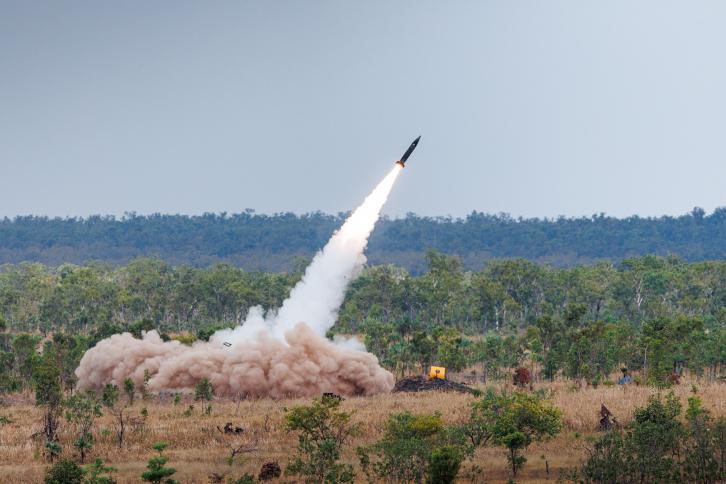
The NDS and IIP outline a range of capabilities and commitments that enhance Australia’s ability to implement tactical performance degradation. Australia’s traditional geographic advantage has been rapidly eroded by the reach of modern missile systems,45 prompting the need for urgent strategic adaptation as highlighted in the Defence Strategic Review.46 Key active defensive measures include investment in Integrated Air and Missile Defence (IAMD), which incorporates advanced missile systems, diverse delivery platforms, and improved battlespace awareness through enhanced command and control networks, extending also to defence against small autonomous aerial systems.47 The Army’s acquisition of High Mobility Artillery Rocket Systems (HIMARS) will further strengthen land and maritime strike capabilities, enhancing the ability to deny adversary access to key operational areas.48 These assets are complemented by other capabilities, including submarines, naval surface strike platforms, and autonomous systems operating in protective and screening roles.
The NDS and IIP also outline several passive defensive measures that support tactical performance degradation. A central initiative is the planned $14–18 billion investment in northern military infrastructure, intended to enhance base survivability and reduce the effectiveness of adversary strikes.49 However, the plan lacks detail on how these facilities will be hardened to withstand modern precision attacks. Additionally, the Army’s transition to a littoral manoeuvre force50 enables the dispersion of offensive support assets across Australia’s northern approaches, complicating adversary targeting and increasing the survivability of key capabilities during conflict.
But the effectiveness of these capabilities is further challenged by Australia’s vast geography. MacCallion and Stewart contend that while HIMARS could play a valuable role in a regional conflict if deterrence fails, its deterrent value is limited by the small number of launchers and uncertainty regarding basing.51 Similarly, Dowse argues that Australia remains poorly prepared to deter long-range missile threats.52 Given the breadth of Australia’s strategic interests, it is neither necessary nor feasible to defend all territory equally. Instead, air defence efforts should prioritise the protection of critical northern military infrastructure from emerging threats such as hypersonic weapons and autonomous aerial systems, rather than pursuing an unrealistic and prohibitively expensive nationwide missile shield.53 More broadly, protecting critical national infrastructure, including undersea communication cables that connect Australia to allies and trading partners, presents additional challenges. Defending such infrastructure against grey-zone threats involves complex legal and operational considerations54 and risks diverting limited defence resources from other high-priority missions.
Strategic Effect Reduction
To support the logic of strategic effect reduction, the NDS and IIP take important steps toward ensuring the ADF can sustain operations and remain combat-effective following an attack. Central to the concept of resilience is the proposed increase in protection of northern bases.55 Funding has been directed toward hardening defence infrastructure in northern Australia and strengthening cybersecurity capabilities,56 both essential for withstanding and recovering from disruption. Fortified bases improve the survivability of support infrastructure and enable combat operations to continue despite adversary strikes.
In addition, the NDS and IIP prioritise enhancing cyber resilience and ensuring communications redundancy. The NDS notes that “malign actors, both state and non-state, are improving their cyber capabilities, increasing the risk of disruptions to Australia’s critical systems, infrastructure and networks”.57 In response, the IIP allocates between $15 and $20 billion to strengthen Australia’s cyber capabilities, aiming to safeguard military and civilian systems from emerging digital threats.58 Similarly, the NDS articulates “an uplift to Defence’s communications networks, providing greater network efficiency, resilience and redundancy”,59 supported by IIP investments in sovereign space communications infrastructure.60 These measures are vital to maintaining command, control, and operational continuity in increasingly contested cyber, information, and electromagnetic domains, thereby diminishing the impact of both conventional and grey-zone attacks and reinforcing the broader logic of deterrence by denial.
In terms of logistical resilience, investments in air mobility and the development of the Army’s littoral manoeuvre capabilities will support the recovery, resupply, and reinforcement of forward combat elements from a network of resilient northern airbases,61 reducing the risk that tactical setbacks translate into strategic defeat. More broadly, the NDS also articulates improvements to national infrastructure, such as roads, railways, ports, and telecommunications,62 which are critical for reconstituting degraded capabilities and maintaining operational continuity in protracted conflicts. Furthermore, the NDS consistently emphasises the importance of embedding resilience into critical combat support systems, through measures such as increasing fuel and munitions stockpiles, expanding sovereign shipbuilding capacity, and establishing a domestic guided weapons manufacturing capability.
However, workforce shortages continue to constrain Australia’s defence ambitions, and initiatives such as increased remuneration or relaxed entry requirements63 are unlikely to achieve the necessary recruitment outcomes.64 If the ADF cannot meet personnel targets to adequately staff critical denial capabilities, the attrition sustained during initial combat phases could lead to a rapid depletion of essential skills, ultimately undermining the effectiveness of strategic effect reduction.
Conclusion
The 2024 NDS and IIP represent a deliberate shift in Australia’s defence force structure toward deterrence by denial. Through the lens of Zilincik and Sweijs’ four-logics framework, it is evident that the force structure investments outlined in both documents are aligned with the requirements of a denial strategy, particularly against conventional threats. Capability elimination is supported by planned investments in long-range strike, offensive cyber and undersea warfare capabilities; operational paralysis is enabled by the development of ISR, joint targeting, and command systems; tactical degradation is reinforced by investments in air defence, long range strike, and base hardening; and cyber resilience, logistics, and infrastructure upgrades support strategic effect reduction.
However, several critical limitations remain. The effectiveness of a denial strategy is limited by workforce and resource shortages, restricted regional access, and delays in delivering essential capabilities such as SSN-AUKUS submarines, air defence systems, and guided weapons. Political constraints, survivability concerns, and escalation risks, especially against stronger adversaries, limit the ADF’s pre-emptive capability elimination. Additionally, the NDS appears focused on defeating aggression near Australia’s northern approaches, offering limited deterrence against gradual territorial gains through grey-zone activities.65 This is where deterrence by denial is most difficult to implement and continues to challenge Australia’s capacity to respond effectively below the threshold of armed conflict.
Ultimately, the NDS and IIP have made significant progress in aligning Australia’s force structure with the requirements of deterrence by denial, particularly in the context of conventional and regional military threats. However, to ensure the strategy’s effectiveness against both conventional and grey-zone challenges, these structural advancements must be supported by sustained political commitment, reliable funding, integrated national resilience, and enhanced coordination across Defence, industry, and diplomacy. Only through these measures can Australia credibly deny adversaries confidence in the success of coercion, conventional or otherwise.
Bibliography
Australian Government – Department of Defence. Defence Strategic Review. Canberra, ACT: 2023. https://www.defence.gov.au/about/reviews-inquiries/defence-strategic-review
Australian Government – Department of Defence. Integrated Investment Program. Canberra, ACT: 2024. https://www.defence.gov.au/about/strategic-planning/2024-national-defence-strategy-2024-integrated-investment-program
Australian Government – Department of Defence. National Defence Strategy. Canberra, ACT: 2024. https://www.defence.gov.au/about/strategic-planning/2024-national-defence-strategy-2024-integrated-investment-program
Davis, Malcom. “Building integrated air and missile defence for Australia.” 2023. https://www.aspistrategist.org.au/building-integrated-air-and-missile-defence-for-australia/
Dowse, Andrew. “Australia’s Defense Strategy.” Journal of Indo-Pacific Affairs 7, no. 6 (September 1, 2024): 1–13. https://research.ebsco.com/linkprocessor/plink?id=8348d33b-712a-3d78-95d2-2871f6ad6596.
Imperial War Museum. “How Radar Gave Britain The Edge In The Battle Of Britain” 2025. https://www.iwm.org.uk/history/how-radar-gave-britain-the-edge-in-the-battle-of-britain
Goldsmith, Sam. “Achieving ‘deterrence by denial’ will be a major challenge for Australia.” 2022. https://www.aspistrategist.org.au/achieving-deterrence-by-denial-will-be-a-major-challenge-for-australia/
Gompert, David C., Hans Binnendijk, and Bonny Lin. “Japan’s Attack on Pearl Harbor, 1941.” In Blinders, Blunders, and Wars: What America and China Can Learn, 93–106. RAND Corporation, 2014. http://www.jstor.org/stable/10.7249/j.ctt1287m9t.15.
Gosling, Luke. “Deterring at a distance: The strategic logic of AUKUS.” Lowy Institute. 2024. https://www.lowyinstitute.org/publications/deterring-distance-strategic-logic-aukus
Lindsay, JonR. 2013. “Stuxnet and the Limits of Cyber Warfare.” Security Studies 22 (3): 365–404. doi:10.1080/09636412.2013.816122.
Lupovici, Amir. “Deterrence through Inflicting Costs: Between Deterrence by Punishment and Deterrence by Denial.” International Studies Review 25, no. 3 (September 1, 2023): 1–21. doi:10.1093/isr/viad036.
MacCallion, Gregory, and Courtney Stewart. “Australian Deterrence: Land Power’s Contribution to the Integrated Force.” Australian Army Journal 20, no. 2 (December 1, 2024): 48–76. https://research.ebsco.com/linkprocessor/plink?id=a3b8aa9d-ba71-300c-8656-fa2379aa38db.
Patton, Susannah. “Australia must take Southeast Asian reactions to AUKUS seriously.” 2021. https://www.aspistrategist.org.au/australia-must-take-southeast-asian-reactions-to-aukus-seriously/
Rahman, Chris, and Prakash Gopal. “The Role of Deterrence in Australian Strategic Thought: Implications for ANZUS.” Journal of Indo-Pacific Affairs 7, no. 6 (September 1, 2024): 84–100. https://research.ebsco.com/linkprocessor/plink?id=bd10e6c5-48ee-3ba0-8a4a-5a81c4f9cfe1.
Runde, Daniel F., Murphy, Erin L. and Bryja, Thomas. “Safeguarding Subsea Cables: Protecting Cyber Infrastructure amid Great Power Competition.” 2024. https://www.csis.org/analysis/safeguarding-subsea-cables-protecting-cyber-infrastructure-amid-great-power-competition
Smith, Cameron. “Countering China’s Grey-Zone Diplomacy.” 2022. https://www.internationalaffairs.org.au/australianoutlook/countering-chinas-grey-zone-diplomacy/
Snyder, Glenn H. “Deterrence and Defense toward a Theory of National Security.” Princeton University Press, 1961. https://research.ebsco.com/linkprocessor/plink?id=5bd036b2-3de4-340b-80f3-96b7e11d2605.
Snyder, Glenn, “Deterrence by denial and punishment.” Princeton University Press, 1959. #5 - Deterrence by denial and punishment / by Glenn H. ... no.1. - Full View | HathiTrust Digital Library
Nouwens, Veerle. “Above the Law: Holding China to Account in the South China Sea.” 2021. https://www.orfonline.org/research/above-the-law-holding-china-to-account-in-the-south-china-sea#_edn29
Zilincik, Samuel, and Sweijs, Tim. “Beyond Deterrence: Reconceptualizing Denial Strategies and Rethinking Their Emotional Effects.” Contemporary Security Policy 44, no. 2 (April 1, 2023): 248–75. doi:10.1080/13523260.2023.2185970.
176 The Australian War College – Geddes Papers
1 Department of Defence, National Defence Strategy, Canberra, ACT, 2024: 7, https://www.defence.gov.au/about/strategic-planning/2024-national-defence-strategy-2024-integrated-investment-program
2 Glenn H Snyder. Deterrence and Defense toward a Theory of National Security. Princeton University Press, 1961. https://research.ebsco.com/linkprocessor/plink?id=5bd036b2-3de4-340b-80f3-96b7e11d2605.
3 Samual Zilincik, and Tim Sweijs, (2023) “Beyond Deterrence: Reconceptualizing Denial Strategies and Rethinking Their Emotional Effects.” Contemporary Security Policy 44, no. 2 (2023): 248–75. doi:10.1080/13523260.2023.2185970.
4 Chris Rahman and Prakash Gopal. “The Role of Deterrence in Australian Strategic Thought: Implications for ANZUS.” Journal of Indo-Pacific Affairs 7, no. 6 (2024):87. https://research.ebsco.com/linkprocessor/plink?id=bd10e6c5-48ee-3ba0-8a4a-5a81c4f9cfe1.
5 Snyder. Deterrence and Defense toward a Theory of National Security, Princeton University Press, 16
6 Zilincik and Sweijs, “Beyond Deterrence: Reconceptualizing Denial Strategies and Rethinking Their Emotional Effects,” 252
7 Ibid.
8 Amir Lupovici. “Deterrence through Inflicting Costs: Between Deterrence by Punishment and Deterrence by Denial.” International Studies Review 25, no. 3 (2023): 7. doi:10.1093/isr/viad036.
9 David Gompert, Hans Binnendijk, and Bonny Lin. “Japan’s Attack on Pearl Harbor, 1941.” In Blinders, Blunders, and Wars: What America and China Can Learn, 93. RAND Corporation, 2014. http://www.jstor.org/stable/10.7249/j.ctt1287m9t.15.
10 David Sanger, “Obama Order Sped Up Wave of Cyberattacks Against Iran,” cited in Jon Lindsay. “Stuxnet and the Limits of Cyber Warfare.” Security Studies 22 no. 3 (2013): 369. doi:10.1080/09636412.2013.816122.
11 Zilincik and Sweijs, “Beyond Deterrence: Reconceptualizing Denial Strategies and Rethinking Their Emotional Effects,” 254
12 Snyder. Deterrence and Defense toward a Theory of National Security. Princeton University Press, 9
13 Zilincik and Sweijs, “Beyond Deterrence: Reconceptualizing Denial Strategies and Rethinking Their Emotional Effects,” 254
14 Lupovici. “Deterrence through Inflicting Costs: Between Deterrence by Punishment and Deterrence by Denial.”, 13
15 Imperial War Museum, “How Radar Gave Britain The Edge In The Battle Of Britain,” https://www.iwm.org.uk/history/how-radar-gave-britain-the-edge-in-the-battle-of-britain
16 Zilincik and Sweijs, “Beyond Deterrence: Reconceptualizing Denial Strategies and Rethinking Their Emotional Effects,” 255
17 Ibid., 256
18 Glenn Snyder, “Deterrence by denial and punishment.” Princeton University Press, 1959. #5 - Deterrence by denial and punishment / by Glenn H. ... no.1. - Full View | HathiTrust Digital Library, 2
19 Zilincik and Sweijs, “Beyond Deterrence: Reconceptualizing Denial Strategies and Rethinking Their Emotional Effects,” 256
20 Ibid.
21 Ibid., 258
22 Ibid.
23 Ibid., 259
24 Zilincik and Sweijs, “Beyond Deterrence: Reconceptualizing Denial Strategies and Rethinking Their Emotional Effects,” 259
25 Department of Defence, Integrated Investment Program, Canberra, ACT: 2023, 10, https://www.defence.gov.au/about/strategic-planning/2024-national-defence-strategy-2024-integrated-investment-program
26 Luke Gosling. “Deterring at a distance: The strategic logic of AUKUS.” Lowy Institute. 2024. https://www.lowyinstitute.org/publications/deterring-distance-strategic-logic-aukus
27 Department of Defence, Integrated Investment Program, 81
28 Sam Goldsmith. “Achieving ‘deterrence by denial’ will be a major challenge for Australia.” 2022. https://www.aspistrategist.org.au/achieving-deterrence-by-denial-will-be-a-major-challenge-for-australia/
29 Department of Defence, Integrated Investment Program, 48
30 Ibid., 48
31 Gosling. “Deterring at a distance: The strategic logic of AUKUS.”
32 Goldsmith. “Achieving ‘deterrence by denial’ will be a major challenge for Australia.”
33 Gosling. “Deterring at a distance: The strategic logic of AUKUS.”
34 Snyder. Deterrence and Defense toward a Theory of National Security. Princeton University Press, 134
35 Andrew Dowse. “Australia’s Defense Strategy.” Journal of Indo-Pacific Affairs 7, no. 6 (2024): 12. https://research.ebsco.com/linkprocessor/plink?id=8348d33b-712a-3d78-95d2-2871f6ad6596.
36 Ibid., 5
37 Department of Defence, Integrated Investment Program, 77
38 Ibid., 51
39 Ibid., 43
40 Ibid., 62
41 Ibid., 53–54
42 Veerle Nouwens. “Above the Law: Holding China to Account in the South China Sea.” 2021. https://www.orfonline.org/research/above-the-law-holding-china-to-account-in-the-south-china-sea#_edn29
43 Cameron Smith. “Countering China’s Grey-Zone Diplomacy.” 2022. https://www.internationalaffairs.org.au/australianoutlook/countering-chinas-grey-zone-diplomacy/
44 Susannah Patton. “Australia must take Southeast Asian reactions to AUKUS seriously.” 2021. https://www.aspistrategist.org.au/australia-must-take-southeast-asian-reactions-to-aukus-seriously/
45 Department of Defence, Defence Strategic Review, Canberra, ACT: 2023, 25, https://www.defence.gov.au/about/reviews-inquiries/defence-strategic-review
46 Malcom Davis. “Building integrated air and missile defence for Australia.” 2023. https://www.aspistrategist.org.au/building-integrated-air-and-missile-defence-for-australia/
47 Department of Defence, Integrated Investment Program, 67–68
48 Ibid., 44
49 Ibid., 85
50 Department of Defence, National Defence Strategy, 37
51 Gregory MacCallion and Stewart Courtney. “Australian Deterrence: Land Power’s Contribution to the Integrated Force.” Australian Army Journal 20, no. 2 (2024): 48–76. https://research.ebsco.com/linkprocessor/plink?id=a3b8aa9d-ba71-300c-8656-fa2379aa38db.
52 Dowse, “Australia’s Defense Strategy,” 5
53 Davis. “Building integrated air and missile defence for Australia.”
54 Daniel Runde, Erin Murphy and Thomas Bryja. “Safeguarding Subsea Cables: Protecting Cyber Infrastructure amid Great Power Competition.” 2024. https://www.csis.org/analysis/safeguarding-subsea-cables-protecting-cyber-infrastructure-amid-great-power-competition
55 Department of Defence, National Defence Strategy, 29
56 Dowse, “Australia’s Defense Strategy,” 6
57 Department of Defence, National Defence Strategy, 15
58 Department of Defence, Integrated Investment Program, 48
59 Department of Defence, National Defence Strategy, 41
60 Department of Defence, Integrated Investment Program, 47
61 Department of Defence, Integrated Investment Program, 61
62 Department of Defence, National Defence Strategy, 18
63 Ibid., 33
64 Dowse, “Australia’s Defense Strategy,” 12
65 Ibid., 5
Defence Mastery
Technical Mastery
Social Mastery

MAJ David Rees is an Aviation Officer and a graduate of the ACSC(MA)-PT class of 2025. He is currently posted to Aviation Command Headquarters, contributing to training and operational airworthiness for Army’s UH60M Blackhawk helicopter fleet.
Case Study 3 - Building a Force for Denial: Evaluating Strategy and Investment Alignment © 2026 by . This work is licensed under CC BY-NC-ND



Please let us know if you have discovered an issue with the content on this page.
Comments
Start the conversation by sharing your thoughts! Please login to comment. If you don't yet have an account registration is quick and easy.