Introduction
Modern military planning must reconcile structured processes with the unpredictable dynamics of war. This essay compares the Australian Defence Force’s (ADF) Decision‑Making and Planning Processes (DMPP) and the United States Joint Planning Process (JPP) through a complexity‑informed design lens to assess how each framework enables or constrains adaptation, interoperability, and decision‑making in a combined joint task force (C‑JTF). While both doctrines acknowledge war’s nonlinear, emergent character, they encode different grammars of work: DMPP more fully embeds iterative design and reframing across the planning continuum, whereas JPP nests design within a standardised sequence whose strengths in scale and product discipline can also harden early assumptions. The essay proceeds by setting a complexity lens, comparing DMPP and JPP across framing, mission analysis, COA/wargaming, and assessment then deriving CJTF implications. The comparison concludes that DMPP better institutionalises reframing while JPP better institutionalises large‑scale interoperability; coalitions should deliberately fuse these virtues to avoid cognitive drift or procedural rigidity.
A Theoretical Lens for Planning in Complexity
Clausewitz’s timeless observations on the fog and friction of war anticipated today’s complexity science.1 Far from being a predictable duel governed by mechanistic laws, war is an open, dynamic struggle rife with chance and uncertainty. Clausewitz described war as a “paradoxical trinity” of primordial violence, chance, and reason – a system of opposing forces and interactions so variable that outcomes can never be fully foreseen.2 As Beyerchen notes, On War grapples with war’s complexity more realistically than perhaps any other work of theory, precisely because Clausewitz acknowledged that war does not conform to neat linear models of cause and effect.3 In contrast to contemporaries who sought deterministic scientific laws of victory, Clausewitz rejected any approach “made like an automaton by rigid formations…like a piece of clockwork,”4 insisting that war is a constant state of reciprocal action between thinking adversaries.5
This nonlinear nature of war aligns with modern science’s distinction between complicated and complex systems. A complicated problem can be broken into parts and solved sequentially, assuming proportional cause and effect.6 A complex problem involves interactive, adaptive agents and emergent behaviour that cannot be reduced to simple components.7 Complexity science models war as a complex adaptive system: myriad independent agents (units, leaders, populations) interact and adapt, producing higher-order emergent behaviour not reducible to the sum of parts.8 War’s complex, self-organising nature means it contains both order and chaos simultaneously – it shows recurring patterns yet remains irregular and ever-changing.9 Crucially, war involves purposeful, interactive forces on all sides, not just random chaos; each belligerent is an adaptive opponent who reacts to the other’s moves, further complicating prediction.10 Thus, linear cause-and-effect models are inadequate. War’s nonlinear nature means that deterministic, Newtonian predictability is elusive – outcomes emerge from a tangle of interactions, chance, and friction.11 Accordingly, the epistemic posture of planners in complexity should prioritise hypothesis and learning over prediction and control, with leadership expectations calibrated to what can be known and changed under time pressure.12 In this paradigm, coherent action is the continuous orchestration of sensemaking, decision, and adaptation across a living system rather than the stepwise execution of a frozen design.13
Planning for these conditions is notoriously difficult – as Rittel and Webber’s notion of “wicked problems” suggests, one never fully solves such a problem, but stops planning when time or resources run out and says, “that’s good enough”.14 Planning in a complex environment faces inherent limits to foresight: seemingly sound plans can generate unexpected second- and third-order effects, while adversaries learn and adapt in real-time.15 It is not possible to identify – let alone understand – all possible effects of one’s actions in advance.16 This does not imply that planning is futile, but rather that planning must be approached with humility, flexibility, and an eye to continuous adaptation. Given this reality, military planners have increasingly recognised that traditional linear planning paradigms – however methodical – risk failure when confronted with nonlinear warfare. Beyerchen observes that Western military thought, rooted in a cultural bias equating truth with order and simplicity, has tended to treat nonlinearity as an abnormal inconvenience.17 Yet in warfare, the realities of instability and complexity are the norm, not the exception. Traditional military planning has been linear and analytical, breaking problems into parts, relying on detailed staff estimates, sequential decision gates, and a prescriptive ordering of steps.18 As Zweibelson describes, this classical approach is grounded in metrics, categories, and objective scientific tenets, aiming to quantify and compartmentalise warfare into a controllable process.19 Such linear planning methods provide structure and rigour, but risk imposing a false sense of order on what is inherently a complex reality.
Accordingly, contemporary doctrine and scholarship are replete with calls for planning approaches that acknowledge emergence, encourage adaptation, and leverage creative thinking over rigid procedure.20 In practice, this has given rise to the concept of operational design – a cognitive approach that precedes and underpins detailed planning by framing ill-structured problems and conceiving broad approaches suited for complex challenges.21 Over the past two decades, Western militaries have wrestled with integrating design philosophy into traditional planning doctrine. Commanders are urged to blend analytical planning with intuitive judgment, creativity, and continuous learning – essentially to become adaptive “complexity thinkers” as much as meticulous organisers. Within such conditions, “operational art” becomes the commander’s evolving theory of success that links political purpose to military action through framing, experimentation, and assessment, rather than a checklist of stock concepts.22 Reilly stresses that artistry lies in reasoning about tensions and possibilities and in the disciplined willingness to re-author aims and approaches as meanings shift in contact.23 Design theory was conceived as a way to operationalise that artistry by foregrounding problem framing, system mapping, and narrative construction before and during planning, challenging the legacy separation that relegated design to a pre-planning ritual.24 The design movement argues that ill-structured problems cannot be reduced to stable requirement lists; instead, teams must iterate abductively – generating plausible frames, testing them against feedback, and updating the commander’s narrative as evidence accumulates.25 In practice, this means treating design as a disciplined conversation that makes assumptions and causal stories explicit, establishes reframing triggers and decision rights, and legitimises changing direction without bureaucratic crisis.26 Against this theoretical backdrop, we now examine how DMPP and JPP meet the challenges of complexity and how this affects coalition interoperability.
DMPP vs. JPP
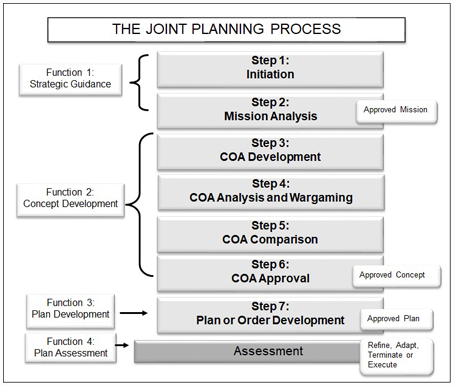
The DMPP and JPP pursue the same aim: turning political intent into coherent action. Both doctrines descend from the same Western operational-art lineage, yet their architectures reveal contrasting assumptions about how best to guide action in a complex world. DMPP foregrounds adaptation by structuring its deliberate component – Deliberate Military Appreciation Process – around three broad but porous activities that commanders may overlap, revisit, or truncate, thereby announcing from the outset that planning and execution are inseparable conversations rather than tidy phases.27 DMPP presents decision-making as a continuum that integrates appreciation, design-led framing, planning, execution, and assessment, signaling that understanding and action co-evolve rather than proceed in gated steps. JPP, by contrast, organises thought into seven numbered steps that flow logically from initiation to plan development, a design that provides unmatched procedural discipline but can seduce inexperienced staff into mistaking the map for the terrain.28 Each doctrine proclaims itself iterative, yet they advertise that claim with different visual grammars that subtly mould organisational reflex.29 DMPP draws feedback loops directly on the page, invites steps to merge, and tells commanders to “skip what adds no value,” thereby licensing improvisation.30 JP 5-0, by contrast, prints a tidy seven-box flowchart and buries the caveat – “steps may be truncated or run concurrently” – in subordinate text, which means most students first encounter JPP as a checklist and only later discover its latent elasticity.31 Thus, DMPP hard-codes nonlinearity, hoping to immunise users against procedural dogma, while JPP assumes experienced leaders will inject nonlinearity when circumstances demand it, an assumption that sometimes fails when staff are inexperienced or crises unfold faster than authority can react.32 That divergence matters in a CJTF because visual grammar shapes the default when multinational staff are tired and tempo is high: DMPP reduces the cognitive cost of deviation, while JPP often relies on senior leaders to authorise deviation, which can slow adaptation when authority is distant or fragmented across nations. Complexity theory warns that any architecture that relegates design to a pre‑planning ritual risks premature closure. In contrast, architectures that keep framing alive across the campaign preserve the option to change course when feedback contradicts early models, which is especially important when interoperability requires consensus to move.33
The contrast is most visible at the opening of each process, where creativity either flourishes or withers. DMPP begins with “scoping and framing,” a formal design workshop charged with constructing an environmental frame, a problem frame, and a provisional operational approach before any tasks are dissected, ensuring the headquarters is solving the correct puzzle rather than the most obvious one.34 JPP certainly mandates design thinking, but places it outside the numbered steps, meaning that a hurried staff may treat design as a pre-amble to “real planning” rather than a mindset that must saturate every product.35 The difference is subtle yet significant: DMPP’s framing canonises divergent thinking at the moment energy and curiosity are highest, while JPP leaves the same discipline to local commander emphasis, which history shows is uneven under operational tempo.36 The result is that Australian teams normally put design artefacts—such as causal loop maps and narrative statements – into the battle rhythm, whereas American teams may condense framing into a single slide inside the mission-analysis brief if the commander prefers to “get on with COAs”.37 Because initial framing shapes every analytic lens that follows, the Australian rule secures conceptual depth. At the same time, the American option preserves flexibility at the cost of occasional superficiality and early product convergence.38
Mission analysis further exposes contrasting logics of control and emergence that directly touch interoperability. DMPP treats mission analysis as an extension of framing, blending contextual insight with functional decomposition to generate a restated mission, updated operational approach, and draft concept sketch, thereby fusing art and science before the headquarters invests scarce effort in multiple fully formed courses of action.39 JPP instead segregates concept development; mission analysis feeds a commander’s planning guidance, after which staffs develop three or more discrete COAs, each destined for full wargaming regardless of its ultimate viability, a practice that preserves analytical rigour but can burn precious hours when the problem is time compressed and parameters are still shifting.40 DMPP, therefore, privileges exploratory depth early, whereas JPP emphasises option breadth later, which means a combined staff must reconcile whether to prune concepts fast or keep them alive for comparison, lest national components accuse each other of either premature convergence or analytical indulgence.41 Complexity research sides with time‑boxed exploration followed by provisional commitment, because small probes generate disconfirming evidence faster than elaborate comparisons built on an untested frame, which rewards coalitions that create authority and routines to pivot quickly when a hypothesis fails.
The divergence amplifies in COA development and analysis. DMPP merges development, wargaming, and analysis in an iterative loop that kills weak ideas quickly and evolves promising ones in real time under commander dialogue, accepting provisional risk to gain decision tempo.42 JPP, conversely, produces fully elaborated COAs, conducts formal red-blue wargames, then evaluates alternatives against weighted criteria, a sequence that surfaces logistic constraints brilliantly but can turn imaginative concepts into brittle artefacts by the time they reach the comparison board. Australian teams, therefore, exit COA deliberations with a single, heavily iterated design that already carries commander fingerprints, whereas U.S. teams present a menu for decision, preserving strategic choice at the cost of longer staff cycles, a trade-off that must be negotiated explicitly when both nations share a joint task force. In a CJTF, the consequence is a predictable friction: DMPP‑accustomed teams arrive at COA boards with a single, heavily iterated design that already bears commander fingerprints, while JPP‑accustomed teams expect a menu of options, each matured for a fair comparison across allies, which must be harmonised explicitly to avoid accusations of railroading or analysis paralysis. A pragmatic synthesis is to use a DMPP‑style narrative of hypotheses to drive JPP‑style wargames, and then to treat wargame results as evidence that may update the framing narrative in the same cycle so partners see change as a decision, not as whim. That synthesis keeps the meaning‑making loop tightly coupled to the resource loop, which is the practical condition for interoperability in complexity.
Because war evolves faster than any plan, the real test of design is how each doctrine handles emergence once orders are published, and here again the DMPP embeds adaptation more explicitly than the JPP. DMPP pairs the Immediate Decision-Making Process – a rapid loop that never stops – with the slower deliberate cycle, so commanders issue fragmentary orders the moment partial clarity appears, even while the main staff keeps analysing deeper questions.43 The doctrine also mandates “reframing triggers” in every plan and exhorts planners to restart framing whenever assumptions bend, thus turning redesign from a scandal into standard practice.44 JPP handles the same need through a separate assessment appendix, assigning future-plans cells to monitor indicators and recommend branches or sequels when metrics drift, an arrangement that safeguards analytical rigour and traceability across large coalitions but can create a lag between observation and redesign if stovepipes proliferate.45 Both doctrines anticipate branches and lines of effort shifts, yet DMPP’s shorter wiring means a battalion may receive new intent hours sooner, an advantage in volatile contests where tempo itself is a weapon. American mission command philosophy aspires to equal agility, but its planning machinery is heavier, so success depends more on commander discipline and pre-delegated authorities than on the default process map.
Underlying these procedural nuances are divergent cognitive cultures. The DMPP overtly warns against linear bias and exhorts planners to “seek to disprove conjecture,”46 institutionalising red team challenge as a professional duty rather than a discretionary tool. The JPP encourages critical thinking but couches dissent in the softer language of “staff-wide dialogue with the commander.”47 A formulation that may unintentionally reinforce consensus culture when steep rank gradients inhibit frank vertical critique. Consequently, DMPP educates officers to expect reframing as a normal outcome of learning, whereas JPP educates officers to respect the sanctity of the approved COA until the commander declares otherwise, subtle teachings that surface when coalition partners debate whether a sudden change in enemy behaviour justifies wholesale redesign or a conservative adjustment. Linear bias persists not because doctrine fails to mention complexity but because institutions relapse to comfortable habits, and each manual fights that relapse differently.48 ADF-I-5 was rebuilt from scratch in 2024 expressly to fuse design and planning, so the document never draws a bright line where design stops and detailed work begins; instead, it treats mission analysis as the bridge and merges COA development with wargaming into a single creative sprint that prunes weak ideas early. JP 5-0 still separates design conceptually, then invites staffs to “enter” JPP, a layout that critics argue encourages reverse-engineering design elements to justify pre-selected COAs rather than generating them.49
Critiques of both systems converge on execution gaps rather than theoretical flaws. Australian staff can certainly tick framing questions mechanically, just as U.S. staff can run perfunctory design sprints before defaulting to attritional templates, proving that no process – however enlightened – survives bureaucratic inertia unaided.50 The decisive variable is leadership that prioritises learning over certainty: commanders must treat every plan as a hypothesis, reward rapid sense-making, while also protecting and cultivating organisational mavericks so dissenting evidence is not smothered by institutional inertia, behaviours celebrated in both manuals but realised only through command climate.51 Neither system is categorically superior; each reflects a judicious trade-off between creativity and conformity shaped by the parent nation’s size, alliance posture, and historical experience with command tempo. Effectiveness depends on organisational culture and leadership that can balance innovation with established protocols and foreground divergent problem-framing – rather than defaulting to reductionist procedure – when complexity bites.52 Creativity research likewise shows cognitively diverse teams outperform on reframing, but only when leaders signal that changing a plan is evidence of learning rather than failure – vital in coalitions where rank gradients and national caveats otherwise suppress dissent.53 Practically, within a CJTF, this leadership task means time‑boxing exploration, demanding explicit hypotheses, and linking assessment to potential frame changes instead of grading task output alone. CJTFs should codify reframing authorities and thresholds so that adaptive change is seen as a decision, not a breach of discipline, reducing the social cost of pivoting when evidence demands it.
Zweibelson and other detractors criticise linear staff routines not because synchronisation is trivial, but because check-listed progress tempts organisations to confuse product completion with understanding and to defend early frames after the environment has shifted.54 Their remedy is to keep artefacts minimum‑viable – joint narratives, simple system sketches, and decision logs – so updating a shared story is cheap, fast, and politically frictionless across national seams.55 Assessment, therefore, must be a learning engine that updates the commander’s theory of success, privileging leading indicators, anomalies, and pattern shifts over retrospective scoreboard metrics – especially when evidence is dispersed across allies.56 In complex systems, measures of performance can glow green while the problem mutates, so indicator decks should test the narrative’s claims, not merely count completed tasks, enabling multinational staffs to pivot together when assumptions fail. Wargaming and red‑teaming thus serve a dual role: validating feasibility and deliberately attacking the coalition narrative to surface brittle assumptions and unseen stakeholders before they surprise the force.57 “Frame wargames” make this explicit: moves include re‑describing the problem or editing the theory of success, with changes recorded in a decision log and accompanied by clear authority for implementation so updates propagate through multinational orders without re‑litigating meaning. The payoff is not clairvoyance but shorter loops from signal to authorised change – decisive in turbulence and decisive for interoperability.
When refracted through complexity and design theory, DMPP and JPP are complementary tools rather than rival creeds. DMPP excels at swift contextual sense-making, early operational synthesis, and routine reframing – qualities vital for seizing transient advantage before an adaptive adversary can adjust – while JPP excels at exhaustive cross-functional analysis, assumption management, and scalable coordination across vast coalitions – qualities indispensable for protracted campaigns in politically congested theatres. The coalition craft is to orchestrate both grammars: empowering a binational design cell within the Joint Planning Group to call reframing huddles without waiting on separate national chains; publish a CJTF design annex with shared terms, reframing triggers, and minimal common artefacts; mandate frame-level wargaming each assessment cycle; and empower design-literate liaison officers as translators across national seams. Doing so compresses the time between anomaly detection and authorised change – the decisive interoperability metric in turbulence – while preserving the auditability and resource discipline large coalitions require. Commanders should therefore treat design literacy as an interoperability requirement, staff their assessment rooms with “complexity thinkers,” and make narrative changes as visible and routine as tasking orders, so the coalition learns in cadence with events rather than after them.
Conclusion
Viewed through a complexity-informed design lens, DMPP and JPP represent distinct processes for organising understanding and action: DMPP embeds design throughout and normalises reframing, while JPP embeds design within a standardised sequence optimised for scale and product interoperability. Both acknowledge uncertainty and friction, yet their structural emphases shape coalition behaviour: DMPP accelerates meaning-making and theory revision; JPP accelerates initial integration and synchronisation, with each strength implying a complementary weakness in tension. In CJTFs, cognitive interoperability becomes decisive, and commanders should explicitly fuse DMPP’s reframing cadence with JPP’s artefactual discipline through a published design annex, protected design forums, frame-level wargaming, and trained liaison officers. The aim is a coalition that can both think together and move together – able to re-author its story at the speed of events while maintaining the procedural coherence necessary for multinational action.
Antoine Bousquet. The Scientific Way of Warfare: Order and Chaos on the Battlefields of Modernity. Columbia Univ. Press, 2009. https://s3.amazonaws.com/arena-attachments/346222/181bf6dddc4e78eb4908f3fa62aae61d.pdf.
Australian Defence Force. ADF-I-5: Decision-Making and Planning Processes. 1st ed. Department of Defence, 2024.
Beyerchen, Alan. “2 Clausewitz and the Non-Linear Nature of Warfare: Systems of Organized Complexity.” In Clausewitz in the Twenty-First Century, edited by Hew Strachan and Andreas Herberg-Rothe. Oxford University Press, 2007. https://doi.org/10.1093/acprof:oso/9780199232024.003.0003.
Beyerchen, Alan. “Clausewitz, Nonlinearity, and the Unpredictability of War.” International Security 17, no. 3 (1992): 59–90. edsjsr.10.2307.2539130.
https://doi.org/10.2307/2539130.
Clausewitz, Carl von. On War. Edited by Michael Eliot Howard and Peter Paret. Princeton University Press, 2008. https://doi.org/10.1515/9781400837403.
Crabb, Andrew L. “Toward Military Design: Six Ways the JP 5-0’s Operational Design Falls Short.” Joint Force Quarterly, no. 105 (April 2022): 99–105. edsgcl.701933273.
Friedman, B. A. “War Is the Storm: Clausewitz, Chaos, and Complex War Studies.” Naval War College Review 75, no. 2 (2022): 37–65. edsjsr.48732037.
Joint Chiefs of Staff. Joint Publication 5-0: Joint Planning. Joint Chiefs of Staff, 2020. Kem, Jack D. Planning for Action: Campaign Concepts and Tools. U.S. Army Combined
Arms Center, 2012. https://apps.dtic.mil/sti/tr/pdf/ADA564371.pdf.
Mann, Steven R. “Chaos Theory and Strategic Art.” The US Army War College Quarterly: Parameters 22, no. 1 (1992): 54–68. https://doi.org/10.55540/0031-1723.1634.
Reilly, Jeffrey M. Operational Design: Distilling Clarity from Complexity for Decisive Action. Air Force Research Institute, Air University Press, 2012.
Rittel, Horst W. J., and Melvin M. Webber. “Dilemmas in a General Theory of Planning.”
Policy Sciences 4, no. 2 (1973): 155–69.
Smith, C. R. Design and Planning of Campaigns and Operations in the Twenty-First Century. Study Paper / Land Warfare Studies Centre 320. Land Warfare Studies Centre, 2011.
Wrigley, Cara, author, and Murray Simons. Creativity in Military Complexity: Design, Disruptors and Defence Forces. Routledge, 2025. deakin.b5681749. https://research.ebsco.com/linkprocessor/plink?id=8d4ad73d-5ef7-394b-9856-73a1328aa24f.
Zweibelson, Ben. “An Awkward Tango: Pairing Traditional Military Planning to Design and Why It Currently Fails to Work.” Journal of Military & Strategic Studies 16, no. 1 (2015): 11–41. 101794119.
Zweibelson, Ben. Beyond the Pale: Designing Military Decision-Making Anew. Air University Press, 2023.
Zweibelson, Ben. “One Piece at a Time: Why Linear Planning and Institutionalisms Promote Military Campaign Failures.” Defence Studies 15, no. 4 (2015): 360–74. 111592736. https://doi.org/10.1080/14702436.2015.1113667.
Zweibelson, Ben. “Seven Design Theory Considerations: An Approach to Ill-Structured Problems.” Military Review 92, no. 6 (2012): 80–90. edsgcl.310149752.
Zweibelson, Ben. “Three Design Concepts Introduced for Strategic and Operational Applications.” PRISM 4, no. 2 (2013): 87–104. edsjsr.26469813.
1 Carl von Clausewitz, On War, ed. Michael Eliot Howard and Peter Paret (Princeton University Press, 2008), 119, https://doi.org/10.1515/9781400837403.
2 von Clausewitz, On War, 89
3 Alan Beyerchen, “Clausewitz, Nonlinearity, and the Unpredictability of War,” International Security 17, no. 3 (1992): 59–61, edsjsr.10.2307.2539130, https://doi.org/10.2307/2539130.
4 Von Clausewitz, On War, 133.
5 Antoine Bousquet, The Scientific Way of Warfare: Order and Chaos on the Battlefields of Modernity (Columbia Univ. Press, 2009), 87, https://s3.amazonaws.com/arena-attachments/346222/181bf6dddc4e78eb4908f3fa62aae61d.pdf.
6 Cara Wrigley author. and Murray Simons, Creativity in Military Complexity: Design, Disruptors and Defence Forces (Routledge, 2025), 6–8, deakin.b5681749, https://research.ebsco.com/linkprocessor/plink?id=8d4ad73d-5ef7-394b-9856-73.
7 Wrigley and Simons, Creativity in Military Complexity, 6–8.
8 B. A. Friedman, “War Is the Storm: Clausewitz, Chaos, and Complex War Studies,” Naval War College Review 75, no. 2 (2022): 45, edsjsr.48732037.
9 Friedman, “WAR IS THE STORM,” 53–55.
10 Steven R. Mann, “Chaos Theory and Strategic Art,” The US Army War College Quarterly: Parameters 22, no. 1 (1992): 57, https://doi.org/10.55540/0031-1723.1634.
11 Mann, “Chaos Theory and Strategic Art,” 55.
12 Antoine Bousquet, The Scientific Way of Warfare: Order and Chaos on the Battlefields of Modernity, 181–82; Beyerchen, “Clausewitz, Nonlinearity, and the Unpredictability of War,” 87.
13 Friedman, “WAR IS THE STORM,” 45; Beyerchen, “2 Clausewitz and the Non-Linear Nature of Warfare,” 54.
14 Horst W. J. Rittel and Melvin M. Webber, “Dilemmas in a General Theory of Planning,” Policy Sciences 4, no. 2 (1973): 162.
15 Jeffrey M. Reilly, Operational Design: Distilling Clarity from Complexity for Decisive Action (Air Force Research Institute, Air University Press, 2012), 14; Beyerchen, “Clausewitz, Nonlinearity, and the Unpredictability of War,” 60–64
16 Australian Defence Force, ADF-I-5: Decision-Making and Planning Processes, 1st ed. (Department of Defence, 2024), 19–21.
17 Beyerchen, “Clausewitz, Nonlinearity, and the Unpredictability of War,” 61–66.
18 Ben Zweibelson, “One Piece at a Time: Why Linear Planning and Institutionalisms Promote Military Campaign Failures.,” Defence Studies 15, no. 4 (2015): 361–63, 111592736, https://doi.org/10.1080/14702436.2015.1113667.
19 Zweibelson, “One Piece at a Time,” 362
20 Ben Zweibelson, “Seven Design Theory Considerations: An Approach to Ill-Structured Problems,” Military Review 92, no. 6 (2012): 80–90, edsgcl.310149752; Ben Zweibelson, “Three Design Concepts Introduced for Strategic and Operational Applications,” PRISM 4, no. 2 (2013): 87–104, edsjsr.26469813; Ben Zweibelson, “An Awkward Tango: Pairing Traditional Military Planning to Design and Why It Currently Fails to Work.,” Journal of Military & Strategic Studies 16, no. 1 (2015): 11–41, 101794119; C. R. Smith, Design and Planning of Campaigns and Operations in the Twenty-First Century, Study Paper / Land Warfare Studies Centre 320 (Land Warfare Studies Centre, 2011); Wrigley and Simons, Creativity in Military Complexity.
21 Wrigley and Simons, Creativity in Military Complexity, 42–43.
22 Reilly, Operational Design, chap. 2; Smith, Design and Planning of Campaigns and Operations in the Twenty-First Century, 38–50.
23 Reilly, Operational Design, 14–15.
24 Zweibelson, “An Awkward Tango,” 11–15.
25 Zweibelson, “Seven Design Theory Considerations,” 88; Zweibelson, Ben, Beyond the Pale: Designing Military Decision-Making Anew (Air University Press, 2023), 158.
26 Zweibelson, “Three Design Concepts Introduced for Strategic and Operational Applications,” 88–91; Jack D Kem, Planning for Action: Campaign Concepts and Tools (U.S. Army Combined Arms Center, 2012), 95–99, https://apps.dtic.mil/sti/tr/pdf/ADA564371.pdf.
27 Australian Defence Force, ADF-I-5: Decision-Making and Planning Processes, 10–11.
28 Joint Chiefs of Staff, Joint Publication 5-0: Joint Planning (Joint Chiefs of Staff, 2020), fig. III–4.
29 Smith, Design and Planning of Campaigns and Operations in the Twenty-First Century, 66.
30 Australian Defence Force, ADF-I-5: Decision-Making and Planning Processes, fig. 1.2
31 Joint Chiefs of Staff, Joint Publication 5-0: Joint Planning, III–11.
32 Zweibelson, “One Piece at a Time,” 365, 371.
33 Mann, “Chaos Theory and Strategic Art,” 57; Beyerchen, “Clausewitz, Nonlinearity, and the Unpredictability of War,” 65.
34 Australian Defence Force, ADF-I-5: Decision-Making and Planning Processes, chap. 5.
35 Joint Chiefs of Staff, Joint Publication 5-0: Joint Planning, IV.
36 Andrew L. Crabb, “Toward Military Design: Six Ways the JP 5-0’s Operational Design Falls Short,” Joint Force Quarterly, no. 105 (April 2022): 99–105, edsgcl.701933273.
37 Crabb, “Toward Military Design,” 101.
38 Zweibelson, “An Awkward Tango,” 39.
39 Australian Defence Force, ADF-I-5: Decision-Making and Planning Processes, chap. 6.
40 Joint Chiefs of Staff, Joint Publication 5-0: Joint Planning, III–32.
41 Wrigley and Simons, Creativity in Military Complexity, 28.
42 Australian Defence Force, ADF-I-5: Decision-Making and Planning Processes, 11.
43 Australian Defence Force, ADF-I-5: Decision-Making and Planning Processes, chap. 3.
44 Australian Defence Force, ADF-I-5: Decision-Making and Planning Processes, 75–76.
45 Joint Chiefs of Staff, Joint Publication 5-0: Joint Planning, app. K.
46 Smith, Design and Planning of Campaigns and Operations in the Twenty-First Century, 73.
47 Joint Chiefs of Staff, Joint Publication 5-0: Joint Planning, app. K
48 Zweibelson, “Seven Design Theory Considerations,” 82–83.
49 Crabb, “Toward Military Design,” 101–3.
50 Zweibelson, “An Awkward Tango,” 14–15.
51 Smith, Design and Planning of Campaigns and Operations in the Twenty-First Century, 73–74; Wrigley and Simons, Creativity in Military Complexity, 65–66.
52 Wrigley and Simons, Creativity in Military Complexity, 42–44, 53–54.
53 Wrigley and Simons, Creativity in Military Complexity, 116, 136; Australian Defence Force, ADF-I-5: Decision-Making and Planning Processes, 35.
54 Zweibelson, Ben, Beyond the Pale: Designing Military Decision-Making Anew, chap. 2; Zweibelson, “An Awkward Tango.”
55 Smith, Design and Planning of Campaigns and Operations in the Twenty-First Century, 72–73.
56 Australian Defence Force, ADF-I-5: Decision-Making and Planning Processes, 13–14; Joint Chiefs of Staff,
Joint Publication 5-0: Joint Planning, VI; Reilly, Operational Design, chap. 4.
57 Reilly, Operational Design, 67–68, 70.
Defence Mastery
Social Mastery

Major Andrew Evans is an officer in the Royal Regiment of Australian Artillery and graduate of the ACSC(MA) class of 2025. He is currently posted to the Land Warfare Centre – Officer Training Wing as the Senior Instructor for the Foundation Major Course (FMC).
Compare the DMPP with an operational planning process from another military (USA) © 2026 by . This work is licensed under CC BY-NC-ND



Please let us know if you have discovered an issue with the content on this page.
Comments
Start the conversation by sharing your thoughts! Please login to comment. If you don't yet have an account registration is quick and easy.