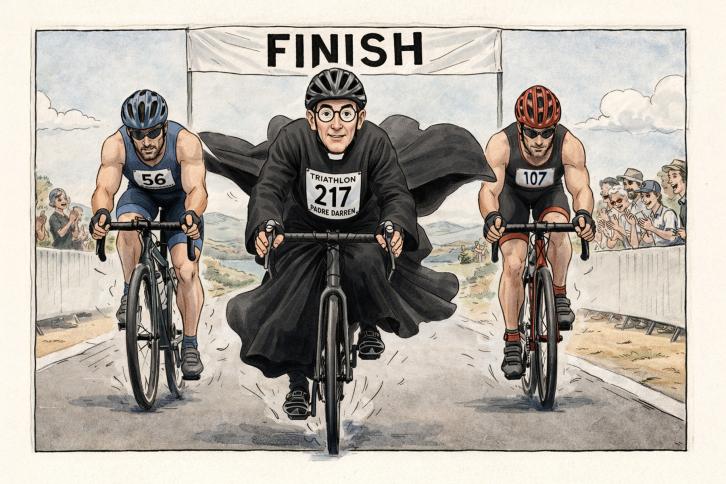
Sport stretches our physical capacity but also teaches life lessons that extend beyond the competitive sports field. Against the trend of declining youth sport participation, I believe the more sports, including team sports, that recruits do before they join, the better. I am a keen advocate for ADF Sport and Defence members doing civilian sport. Here are six lessons I am learning from doing the sport I love most. The lessons help me personally and inform my character training as a chaplain.
I have revisited these lessons recently because, first and foremost, I want to stay sharp and continue getting faster and stronger as a triathlete (though getting older makes that hill harder). Secondly, for the greater interest of Forge readers, at a professional chaplaincy level, I am passionate about thinking through how best to foster mental and spiritual conditioning in others. Optimising spiritual fitness is core business for us as chaplains. Defence is seeking to embed mental and spiritual conditioning across our entire training continuum – not just through standalone courses, but also integrated throughout the workplace and training centres. This includes the whole area of Spiritual Readiness alongside other elements, similar to the American Army’s Holistic Health and Fitness (H2F) program.
This kind of training is critically important in the context of two realities. Firstly, the Royal Commission into Defence and Veteran Suicide has highlighted the tragedy of suicide among our community, and this has not yet started to decline. We need fresh tools to foster purpose and values, grit, and the capacity to hang on to life through tough challenges. Secondly, as the Army Training Manual asserts, we need to prepare soldiers “to cope with the pressures and realities of war service and life”. We need resilience conditioning to build survivable, winning teams.
Nobody learns character in the classroom. We don’t get mental and spiritual conditioning by reading. None of us can rely just on the resilience of others in their stories. Yet I suggest there is value in evaluating where each of us learns resilience – here are some of my lessons as a pedalling Padre.
Triathlons are my hobby, but also my classroom for conditioning and resilience.
The Commanders’ Guide to Resilience defines resilience as the “capacity of individuals, teams and organisations to adapt, recover and thrive in situations of risk, challenge, danger, complexity and adversity”. The assumption is that stressful challenges will come our way, but resilience is the elastic band that lets us recover to normal wellbeing and performance. This grows in different ways for different people, but for me, I have learned it best through triathlons.
No military plan survives with certainty beyond first contact, and no race plans are guaranteed after the start. I have had waves dunk me and panic take my breath, goggles break and swimmers kicking me, flat tyres and broken gear, stomach cramps and blood blisters, freezing rain and blistering heat. Determination to bounce back and do the best I can with what is in front of me has helped me come back from behind in races. It also gives me practice in facing life difficulties and dealing with them calmly.
I love triathlons as a hobby, but they are also my conditioning context and resilience classroom.
I enter as an individual, but triathlons are really a team sport.
Triathlons are mostly individual entries, but I have learned that triathlon performance at its best is a team sport.
Firstly, I train best with a team. I rarely swim the same pace or distance as when I get to swim squad. I reached my peak cycling power when training regularly on the Velodrome with mates. I strive to maintain a strong tempo on solo runs, and find it easier with friends running alongside and out in front. Strava data worldwide shows we exercise more often and go longer and faster with others.
Secondly, I race with the ADF Triathlon Club and local triathlon clubs. Together, we enjoy the challenge of pushing our bodies to the limits of what they can do. At my personal best triathlon in Busselton in 2018, my mate Jarrod beat me by 30 seconds (over 9.5 hours!) But I was elated and so thankful – he beat me, but I would not have done as well against my age group without his pacing.
Thirdly, although competing with and against others, those whom I swim, ride or run alongside help carry me along. When prone to panic in a mass swim start, I use positive self-talk to tell myself I am swimming with friends who pull me in their draft. Bikes that pass mine are good motivation to keep pushing. The run is often the hardest leg not to slow down, but the energy of a slap or encouragement from another runner lifts my energy. It is the team that helps me stay resilient and keep the bounce in my step.
I used to think I could go it alone in life. I have tried going it alone in sport. But I have learned in life and sport I need my mates. A favourite book on the topic, The Resilience Shield, helps remind me of the importance of social strengths alongside building the body (and the foundational importance of grit and the mind and professional layer). I reflected elsewhere on my need for friends in The Tyranny of Distance: Where Have All My Friends Gone? I need supportive social connections alongside physical striving. Any worthwhile performance is ultimately a team sport.
There is always more to learn about my multiple strengths and weaknesses.
Six months after joining my triathlon club, I naively asked the coach, Steve, what he thought I needed to improve – my swim, cycle or run? “All of them”, he replied. Later, I asked what one thing I could do to improve each discipline. He said, instead of one thing, make a list of ten to work on – strengths and weaknesses.
I cannot do a hundred things at once to improve. But I need to maximise multiple strengths and address multiple weaknesses. This involves measuring performance and growth.
In my triathlon resilience classroom, the bike is my strongest leg and my comfort zone. Yet I do not want to be comfortable there, but push the boundaries of my limits and excel. The swim is my weakest leg and a challenge zone. If I am going to panic or lose a race, I will do it in the swim. A hero of mine, triathlon coach Matt Dixon, said philosophically about Swim Success:
Facing my swim weaknesses has taught me so much about facing the fear and doing it anyway.
Growth comes from challenge and recovery.
To go faster in a race than I have before, I need to train harder and faster. It is futile to tell myself I will race at a certain pace if I have not challenged myself to consistently achieve strong and regular intervals at that speed in training. So when doing a fast interval and I feel like slowing, I imagine myself speeding up when it matters in a race. As I learned from the podcast “Mental Hack for Marginal Mental Gains with Dr Jim Taylor”, I say to myself with pride, “I’m stretching my limits”. The challenge of pushing the pace or distance envelope gets me fit to do it in races.
Yet it is also no use trying to hit those speeds every day. I need rest and recovery. In fact, my muscles and aerobic capacity build not on the days I go hard, but on the days I go easy and recover the days after. I’m learning from coaches like Kelly & Juliett Starrett’s Built to Move, the importance of strength and mobility alongside aerobic exercise. I’ve learned I cannot afford habits of poor nutrition and sleep if I want to stay healthy and thrive in sport – a fact underlined in the Commanders’ Guide to Resilience
Todd Snowden, in Resilience, helpfully illustrates the need for downtime away from stressors. Jason Moriarty, in Leadership in Focus, underlined the potential of physical and adventure training in building resilience, but also notes the need for post-deployment decompression. Resilience builds as we practice it in responding to challenges. Yet we need to avoid overexposure to stress just as I need to avoid the tendency to overtrain as a triathlete.
Success comes from focus on process, not outcome.
It is tempting to be preoccupied with a race result during a race or even in training. Yet the best thing I can do in training is focus on the process of doing that session with the best of my skill and effort. The best thing I can do in a race is focus on the most efficient and smooth form I can achieve there and then. It becomes about performing optimally in the next 2 minutes, not the next 2 hours or beyond. This is an exercise of mindfulness. I can control the present process. The future outcome is beyond my control.
The New Zealand-based Balance is Better youth sport movement has helped me appreciate this. Neuroscience trainer Kathryn Berkett explains that Resiliency in children through sport comes from teamwork, relationship skills, knowing how to succeed and win, and how to keep at it when losing, as well as how to manage stress and emotions and then let them go. Coach Reed Maltbie comments on Developing Warriors, Not Winners that it can be too easy to care only about trophies; to be so fixed on outcomes that we neglect the virtue of true development:
This addresses youth in sport, but the wisdom of a process-focused approach applies equally to me as an age-group triathlete and to broader Defence resilience.
Pursue what gives you life, and hours feel like minutes.
Eric Liddell is quoted as saying, “When I run, I feel God’s pleasure.” Tapping into things we can be good at and enjoy will give us life and energy. That is when we may enter a state of optimal performance, or “flow,” in which time flies and hours feel like minutes. That is helpful for multi-hour endurance events!
Fifteen years ago, I decided I did not want to be a workaholic for the rest of my life. I needed a sport. So I joined my friend’s indoor cricket club at a local Anglican church. But I was hopeless at it and did not enjoy it. Yet I had a hunch I might enjoy triathlons and marathons. So I joined my local Hawthorn Triathlon Club, pursued that which gave me life and what I grew to love. At times, in training or events, hours do feel like minutes. At other times, hours feel like long days in the saddle and on my feet – but that’s the conditioning classroom in itself.
Notes:
An earlier version of this article was originally published as Resilience Lessons from a Pedalling Padre in the Cove.
Social Mastery
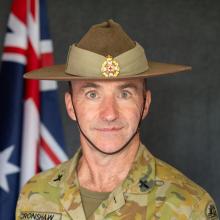
Darren Cronshaw is Chaplain at 6th Battalion, Royal Australian Regiment. He has previously served in Training Establishments at Army School of Transport, 1st Recruit Training Battalion and Defence Force School of Signals. He is also a Defence Linguist (Indonesian) and in the civilian world Professor of Practical and Intercultural Theology with Australian College of Ministries (Australian University College of Divinity). His hobby is pushing the boundaries of resilience in Ironman triathlons.
Conditioning Lessons from a Pedalling Padre © 2026 by . This work is licensed under CC BY-NC-ND



Please let us know if you have discovered an issue with the content on this page.
Comments
Start the conversation by sharing your thoughts! Please login to comment. If you don't yet have an account registration is quick and easy.