Only one who attempts the absurd is capable of achieving the impossible
2035. The Senkaku Islands. The air hums, not with jet engines, but with the electric whir of autonomous drone swarms. Thousands of Artificial Intelligence (AI)-enabled autonomous hunters are executing maneuvers that no human pilot could ever replicate. Below, China's hypersonic missiles strike with inhuman precision, their trajectories recalculated in real-time by predictive algorithms. Japan's command networks, crippled by AI-orchestrated cyber attacks, flicker between confusion and collapse. Soldiers don't fight this war; it's a clash of algorithms, where the side with the fastest, most adaptive AI doesn't just win, it erases the competition before they can react.
From Canberra, the view is even grimmer.
Australia, caught in the last warfare paradigm, clings to evolutionary upgrades, while its adversaries revolutionise the battlefield into something barely recognisable. The ethical debates about AI in warfare? A luxury Australia can no longer afford. No longer is the question whether we should integrate AI, but how we should counter an adversary whose AI is already out-thinking us. China, the U.S. and Russia are not just investing in AI; they are rewriting the rules of warfare.
This essay is not about catching up in the international AI arms race. It is about choosing where and how to fight. It begins with a brief introduction to the fundamentals of AI, then dissects the AI revolution in warfare, exploring how Machine Learning (ML) and Deep Learning (DL) are turning speed and precision into decisive weapons. It then confronts Australia's strategic dilemma: we are outspent, outscaled and outpaced. Our funding is a fraction of international investment; our industrial base lacks the depth to compete symmetrically, and our ethical frameworks have become bottlenecks that stifle innovation and development. However, herein lies an opportunity. While superpowers vie for dominance in AI-enabled warfare, Australia can carve out a niche in hybrid counter-AI, leading the way in undermining AI's distinct advantages.
However, delivering a viable counter-AI strategy will take time. To address this gap, this essay introduces two novel and immediately actionable counter-AI concepts: Data Deserts and Inverse Logic, designed to exploit AI's dependencies on data and predictability.
| Artificial Intelligence (AI) | ||
|---|---|---|
| Machine Learning (ML) | Deep Learning (DL) | |
| 
| |
| Subset of AI; learns from data using statistical techniques | Definition | Advanced subset of ML; uses artificial neural networks to mimic human cognition |
| Key Features |
|
| Military Applications |
|
Fundamentally, this essay argues that the future of Australian defence is not about building the best or the most AI, but about breaking the adversaries. The window to act is closing. We must no longer ask if we can adapt, but how quickly we can convert the absurd into advantage, before the impossible becomes a reality.
The Fundamentals of Artificial Intelligence
To effectively counter or leverage AI, we must first grasp its foundational principles: what AI is, how it functions and its operational applications. At its core, AI is a field of computer science dedicated to developing systems that perform tasks traditionally requiring human intelligence, including reasoning, learning, decision-making and perception.2 The power of AI lies in its ability to process vast datasets, identify patterns and make autonomous decisions, often without human oversight. These capabilities are not theoretical; they are currently reshaping modern warfare, where the lack of familiarity with AI risks becoming a strategic liability.
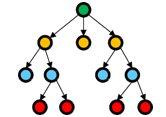
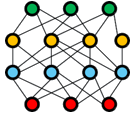
Two subfields, ML and DL, primarily drive modern AI. ML enables systems to improve performance by learning from data, rather than following rigid pre-programmed rules.3 It employs three broad approaches: supervised learning (using labelled data to map known inputs), unsupervised learning (identifying hidden patterns in unlabelled data) and reinforcement learning (training agents through rewards and penalties).4 DL, a more advanced subset of ML, utilises artificial neural networks (layered structures inspired by the human brain) to process data in ways that mimic human cognition, excelling in tasks such as image and speech recognition.5 Figure 1 summarises the definitions, key features, and military applications of ML and DL.6
Three key developments have accelerated AI's exponential growth: the availability of massive, curated datasets (e.g. through platforms like Scale AI), the proliferation of high-performance computing infrastructure Graphics Processing Units (GPUs) and Tensor Processing Units (TPUs)7, and breakthroughs in algorithms like Convolutional Neural Networks (CNNs)8 for image analysis and transformer models for Natural Language Processing (NLP).9 These advancements have enabled AI systems to transition from theoretical constructs to practical tools, particularly in military contexts where real-time data analysis is critical. AI development generally follows the Machine Learning Operations (MLOps) cycle. Figure 210 summarises this process.
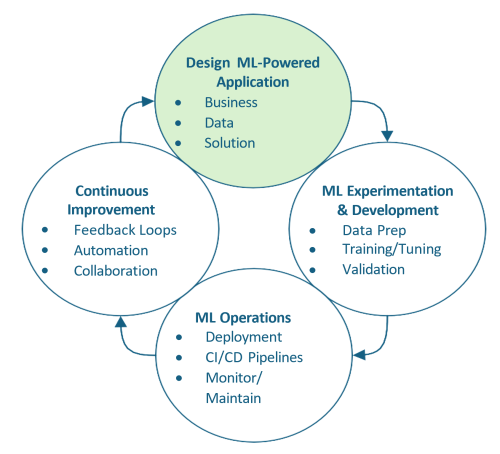
ML-powered application lifecycle
- Design ML-powered application
- Business
- Data
- Solution
- ML experimentation and development
- Data preparation
- Training and tuning
- Validation
- ML operations
- Deployment
- CI/CD pipelines
- Monitor and maintain
- Continuous improvement
- Feedback loops
- Automation
- Collaboration
The arrows indicate that the process is cyclical: each stage feeds into the next, with continuous improvement feeding back into design.
AI systems function through three phases: data input, model training and inference.11 In the training phase, developers expose models to data (labelled or unlabeled) depending on the preferred approach.12 For instance, supervised learning utilises datasets with predefined outputs to train models to associate inputs with correct responses, while unsupervised learning prompts models to discover latent structures in data independently. 13Once trained, models enter the inference phase, where they apply learned patterns to new, unseen data. A DL model trained on thousands of labelled images, for example, can classify novel images with high accuracy, provided the training data is robust and the computational resources are sufficient.14 Figure 3 summarises this process.15
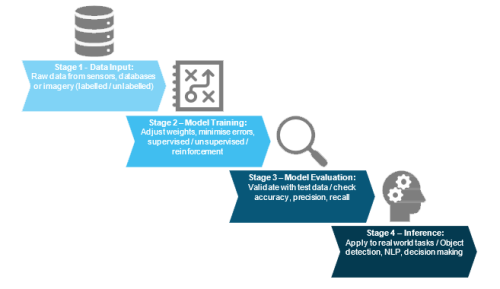
Summarised AI functions
- Stage 1 — Data input: Raw data from sensors, databases or imagery, labelled or unlabelled.
- Stage 2 — Model training: Adjust weights, minimise errors, and use supervised or unsupervised reinforcement.
- Stage 3 — Model evaluation: Validate with test data and check accuracy, precision and recall.
- Stage 4 — Inference: Apply the model to real-world tasks, including object detection, natural language processing and decision-making.
In practice, AI's military utility stems from its layered computational architectures. A CNN, for instance, processes visual data hierarchically: early layers detect simple features such as edges, while deeper layers combine these to recognise complex objects, such as vehicles in satellite imagery or anomalies in radar signals.16 Similarly, Recurrent Neural Networks (RNNs)17 and transformer models handle sequential data (text, speech, video), making them ideal for tasks such as language translation or generating human-like responses.18 However, these models demand extensive training data and computational power. Training a model like ChatGPT, for example, requires processing terabytes of text using thousands of GPUs or TPUs.19 While recent open-source models, such as China's DeepSeek, challenge this paradigm, resource-intensive models still generally outperform their lighter counterparts.20 Figure 4 visually summarises hierarchical feature extraction in a CNN.21
![Diagram showing simplified hierarchical feature extraction in a convolutional neural network using a dog image. The process begins with a raw input image, then moves through convolutional layers that detect edges, shapes and complex objects, with pooling layers used for down sampling. Extracted features such as colour, fur, hair, head, mouth, muzzle and eyes are combined by a fully connected layer to produce an output classification: “This is a [type] of dog.”](/sites/default/files/styles/content_image/public/2026-06/image7a.png?itok=ESTbnjZv)
Simplified hierarchical feature extraction for a CNN
The diagram shows how a convolutional neural network processes a raw image of a dog through several layers to produce a classification output.
- Input layer: Raw image.
- Convolutional Layer 1: Detects edges.
- Pooling Layer 1: Down sampling.
- Convolutional Layer 2: Detects shapes.
- Pooling Layer 2: Further down sampling.
- Convolutional Layer 3: Detects complex objects.
- Fully connected layer: Combines features.
- Output layer: Predicted class or classification.
The example feature maps separate visible characteristics of the dog, including muzzle, eyes, head, mouth, colour and hair. These extracted features contribute to the final output: “This is a [type] of dog.”
Globally, the growing reliance on AI for military use cases underscores its transformative potential in surveillance, targeting, logistics, and autonomous systems.22 However, Australia has adopted a partner-led, human-centric, data-driven, capability multiplier approach, rather than an adversary-led, tech-centric, emergence-based one.23 This limited investment in AI reflects a broader gap in understanding and exposure to the technology. Bridging this gap is essential to ensuring operational readiness in an era where AI-driven capabilities are increasingly decisive.
AI Integration in Modern Militaries: The Strategic Imperative
AI is no longer a futuristic concept; it is actively reshaping military operations across intelligence, autonomous systems and cybersecurity. Leading militaries are already leveraging AI to fuse and analyse sensor data from drones, satellites, and ground-based systems, creating a real-time, comprehensive situational awareness picture.24 The U.S. Department of Defence's (DoD) Project Maven, for example, uses AI to analyse full-motion video from Unmanned Aerial Vehicles (UAVs), automating the detection and tracking of targets such as vehicles or personnel.25 Projects like Maven reduce cognitive load on analysts and accelerate decision-making, demonstrating AI's capacity to enhance both speed and precision in high-stakes environments.
Similarly, human-machine teaming is becoming standard practice.26 Australia's Ghost Bat program showcases AI-enabled loyal wingman drones that assist crewed aircraft by processing sensor data and suggesting tactical maneuvers.27 These systems exemplify how AI augments human operators, enabling faster, more informed responses to dynamic threats. AI's adaptability is perhaps most evident in reinforcement learning, where systems refine their strategies through iterative trial and error. The U.S. Defence Advanced Research Projects Agency's (DARPA's) AlphaDogfight competition highlighted this potential, with an AI agent defeating a human F-16 pilot in simulated combat after training on millions of virtual dogfights.28 This particular example underscores AI's ability to outperform humans in complex, rapidly evolving scenarios, provided robust data pipelines and continuous training are maintained.
Globally, AI is being integrated into Intelligence, Surveillance, and Reconnaissance (ISR) to automate data analysis and reduce the fog of war.29 The U.S. Joint All-Domain Command and Control (JADC2) initiative and China's 'Intelligentised' warfare strategy both prioritise AI-driven decision superiority, utilising machine learning to sift through terabytes of sensor data, detect threats, and even predict adversary movements.30 Autonomous systems extend the reach of AI into physical domains. Australia's Unmanned Ground System (UGS), the M113 Optionally Crewed Combat Vehicle (OCCV), and Bluebottle Unmanned Surface Vessels (USV) demonstrate AI's role in land and maritime operations, including obstacle avoidance, persistent long-range ISR, and threat detection and engagement.31 In cybersecurity, AI tools like CyberSecurity (CS) Toolkit or IBM's QRadar monitor networks in real-time, detecting and mitigating threats.32 Meanwhile, offensive AI automates cyber operations and generates adversarial data to deceive enemy systems.33
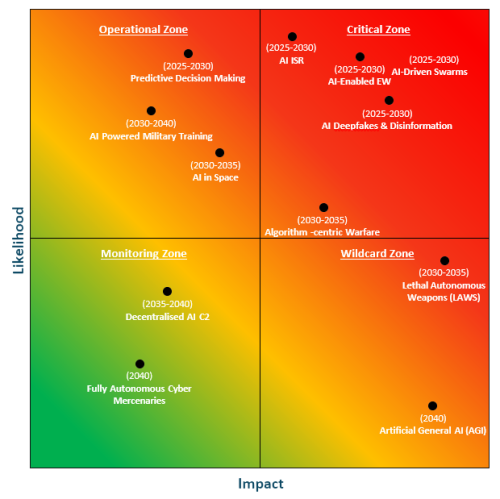
While Australia has achieved isolated success, its evolutionary approach to AI integration risks leaving it irreparably behind. The U.S., China, and other advanced militaries do not debate whether to integrate AI; instead, they debate how quickly they can scale its adoption. These nations are already deploying AI across ISR and cyber operations, turning theoretical advantages into operational reality. The U.S. uses AI-driven predictive maintenance to forecast equipment failures and optimise logistics, ensuring operational readiness and cost efficiency.34 China's Intelligentised warfare strategy automates decision-making, aiming to outpace adversaries' decision cycles.35 Australia's hesitation, rooted in risk aversion rather than disruptive innovation, does nothing to close the widening capability gap. In a paradigm where AI is already reshaping warfare, the cost of delay is not just technological obsolescence, but strategic irrelevance. The question is no longer whether AI will dominate future conflict, but how militaries will adapt to its inevitable evolution. AI requires a dedicated focus and a compromise of current practices to achieve speed-to-capability. Figure 5 forecasts future integration trends in military AI, assessing their likelihood and potential impact, highlighting the trends Australia is likely to contend with in the near to distant future.36
Three Rising Trends in Military AI
- Autonomous and Swarm-based Warfare: This trend represents the militarisation of AI-driven autonomy, where machines operate in coordinated groups or independently to overwhelm adversaries through speed, mass and adaptability. Swarms leverage distributed intelligence to saturate defences, while LAWS like Israel’s Harpy Drone remove human decision-making from the kill chain, enabling machine-speed engagements. China’s investments in swarm intelligence and the U.S. Replicator Initiative highlight a shift towards algorithmic combat where the side with the most adaptive, resilient AI gains a decisive edge. The proliferation of these systems lowers the barrier to mass strikes, making them a force multiplier for both state and non-state actors.
- Cognitive and Information Warfare: AI is transforming information as a weapon, enabling militaries to manipulate perceptions, degrade decision making and control the electromagnetic spectrum. AI-enabled EW systems disrupt communications and sensors, while AI-generated disinformation targets public opinion and command structures. Algorithm-centric warfare (Mosaic) takes this further, using AI to predict, adapt, and exploit adversary behaviours in real-time. The battlefield has extended to cognitive warfare and the side that controls the data and narratives dominates.
- AI-Augmented Decision-Making and Training: AI is enhancing human-machine teaming, enabling faster, more precise decision making and immersive training. Predictive analytics allow commanders to anticipate adversary moves, while AI-driven satellites provide real-time space domain awareness and sabotage operations. Training systems use AI to create adaptive, personalised simulations, reducing costs and improving readiness. These trends are less about replacing humans and more about augmenting their capabilities, making forces smarter, faster and more resilient.
Military AI Integration Trends Matrix
The matrix plots military AI technologies according to likelihood (vertical axis) and operational impact (horizontal axis). Likelihood increases from bottom to top. Impact increases from left to right.
Operational Zone
Technologies assessed as relatively likely and operationally useful.
- AI-Powered Military Training (2030–2040)
- AI in Space (2030–2035)
- Predictive Decision Making (2025–2030)
Monitoring Zone
Technologies requiring observation but assessed as lower impact or lower likelihood.
- Decentralised AI C2 (2035–2040)
- Fully Autonomous Cyber Mercenaries (2040)
Wildcard Zone
Technologies with potentially high impact but greater uncertainty.
- Lethal Autonomous Weapons (LAWS) (2030–2035)
- Artificial General AI (AGI) (2040)
Critical Zone
Technologies assessed as both highly likely and highly impactful.
- AI ISR (2025–2030)
- AI-Enabled Electronic Warfare (2025–2030)
- AI-Driven Swarms (2025–2030)
- AI Deepfakes and Disinformation (2025–2030)
- Algorithm-Centric Warfare (2030–2035)
Key observations
- AI ISR is positioned in the upper-right portion of the Critical Zone, indicating high likelihood and high impact.
- AI-Enabled Electronic Warfare, AI-Driven Swarms and AI Deepfakes and Disinformation cluster closely together in the Critical Zone.
- Artificial General AI is shown as the furthest-right item, indicating the highest potential impact, but with lower likelihood than technologies in the Critical Zone.
- Fully Autonomous Cyber Mercenaries are positioned in the lower-left region of the matrix, indicating lower likelihood and lower impact compared with other trends.
Australia's Military AI: Strategic Lag and the Counter-AI Opportunity
So how does Australia match up? Australia's approach to military AI is cautious, ad-hoc, unfocused, and ultimately ineffective. Australia is prioritising incremental integration over the disruptive innovation pursued by other nations.37 This restraint is not by design but by constraint: limited funding, industrial capacity and a risk-averse policy framework have left Australia trailing international standards.38 For example, in 2022, the U.S. spent and allocated around $875 billion on AI, while China spent an estimated $242 billion and pledged $148.6 billion by 2030 as part of its New Generation Artificial Intelligence Development Plan, which aims to cultivate an AI industry worth $1.6 trillion in related industries.39 Figure 6 illustrates the disparity in AI/ML investment, with China and the U.S. dominating investment, while European countries lag due to lower budgets, transparency issues, and coordination challenges.
| National defence spending and pledged AI/ML defence expenditure in China, France, Germany, the UK and the US* | |||
|---|---|---|---|
| Country | 2022 defence spending (USDbn, current) | 2022 defence R&D spending (USDbn, current) | Pledged annual defence R&D spending on AI/ML, 2018–22 (USDbn, current) |
| China** | 242.4 | N/A | e0.3–1.6 |
| France | 54.4 | 6.6 | 0.1 |
| Germany | 53.4 | 1.7 | 0.2 |
| UK*** | 71.4 | 2.2 | e0.4–0.5 |
| US**** | 766.6 | 114.7 | 0.8–e2.5 |
*Data for China’s 2022 defence R&D spending on AI/ML is not available; estimated expenditure reflects 2020 data presented in Ryan Fedasiuk, Jennifer Melot and Ben Murphy, ‘Harnessed Lightning: How the Chinese Military Is Adopting Artificial Intelligence’, Center for Security and Emerging Technology, October 2021. The defence AI/ML expenditure of all other case-study countries is from 2022, the latest available defence data.
**China’s R&D defence expenditure is not public and cannot be estimated with confidence. Data on Chinese defence AI/ML spending for 2022 is not available.
***The UK MoD has not made any public pledges for defence AI/ML spending. The figure in the table is an estimate based on defence R&D AI projects, Defence Digital annual spending and investments from other innovation funds.
****Estimated US expenditure calculated based on Office of the Under Secretary of Defense (Comptroller), ‘RDT&E Programs (R-1)’, April 2022.
Note: e = estimated figure.
Source: IISS, 2023
In contrast, Australia's Next Generation Technologies Fund commits just $0.5 billion over a decade, a fraction of the investments made by other nations.41 The 2024 Integrated Investment Program further highlights this investment gap, treating AI as a supporting technology that is often overshadowed by other emerging technologies, such as quantum, hypersonics, and electronic warfare.42 This distinct lack of investment does not position AI as a disruptive or game-changing capability, but rather as a tool to augment and sustain current and planned forces.
China's Military-Civil Fusion Strategy (C-MF) exemplifies an alternative approach: a comprehensive, whole-of-nation effort to leverage AI-driven warfare, encompassing swarm intelligence and autonomous decision-making.43 Australia's modest projects pale in comparison, lacking the scale and ambition of adversarial programs. Even Australia's tactical strengths in human-machine teaming remain limited, overshadowed by initiatives such as the U.S. Navy's Sea Hunter or China's AI-powered underwater drones, both designed for full-spectrum operations.44 In operational AI, Australia's Athena AI Project (now under Sightline Applications) offers a compliance-focused targeting tool; however, it lacks the global reach of the U.S. Project Maven or the autonomy of China's proposed system versus system operations.45
Australia's cyber AI capabilities are similarly underdeveloped. While the Australian Signals Directorate (ASD) has begun integrating machine learning for threat detection under Project Redspice, it lacks the dedicated large-scale offensive cyber AI tools deployed by DARPA under U.S. Cyber Command or China's Information Support Force (ISF), which use AI to automate hacking, conduct influence operations, and counter adversarial AI.46 The result is a growing vulnerability to technological surprise, compounded by a sovereign industrial base that relies on U.S. and UK supply chains for advanced components.47 This dependency risks operational paralysis in contested environments where allied support may falter. China has effectively avoided this problem with its C-MF strategy, ensuring that its AI development is entirely indigenous and reducing its exposure to supply chain disruptions or export controls.48
Government and Defence policy further exacerbates these gaps. Despite the impending release of a new National AI Capability Plan (December 2025), the website's language continues to echo that of the 2021 AI Action Plan, prioritizing incremental business and civilian adoption over disruptive military applications.49 This cautious evolutionary approach constrains Australia's ability to deploy state-of-the-art cyber AI systems. Australia's 2020 Defence Strategic Update (DSU) and 2024 National Defence Strategy (NDS) acknowledge AI as an 'enabling technology' and 'advanced capability'; however, both stop short of a standalone Defence AI strategy, unlike the U.S. National Defence Strategy or the UK Defence AI strategy, which treat AI as foundational.50 Instead, Australia embeds AI within broader digital modernisation efforts, such as the Defence Data Strategy (2021-2023) and Defence Data Strategy 2.0, which prioritise data sharing and analytics over the development of military AI.51 Australia's ethical and legal frameworks, while robust, have become a double-edged sword: stringent Article 36 weapons reviews and compliance requirements delay deployment, ceding pace to adversaries with fewer and less stringent governance controls.52 AUKUS and Five Eyes partnerships mitigate some gaps (e.g. autonomous submarine technology, AI-enabled ISR), but they also deepen Australia's dependency.53 The Ghost Bats' reliance on U.S. AI software, for instance, highlights the tension inherent in sovereign decision-making versus collaborative AI development.54
Australia's fragmented AI governance stands in stark contrast to China's centralised approach. While the Central Military Commission's Science and Technology Commission streamlines AI integration across the PLA, enabling rapid prototyping and deployment of AI-enabled weapons, Australia lacks an equivalent body, resulting in fragmented oversight and delayed decision-making.55 Although bilateral partnerships with defence giants like Northrop Grumman have accelerated AI adoption, these collaborations are not truly sovereign; true sovereignty requires independent R&D, IP ownership, and deployment control, areas where Australia's current model falls short.56 Australia's Trusted Autonomous Systems Defence Cooperative Research Centre (CRC), a public-private consortium, has advanced robotic and autonomous systems (RAS); however, its reliance on foreign and SME investment undermines the development of sovereign capability.57 The UK's Defence Artificial Intelligence Strategy, with its focus on indigenous AI integration, offers a sobering counterpoint: sovereign industrial capacity is not just an advantage, but a strategic necessity, a lesson Australia has yet to recognise, let alone internalize.58
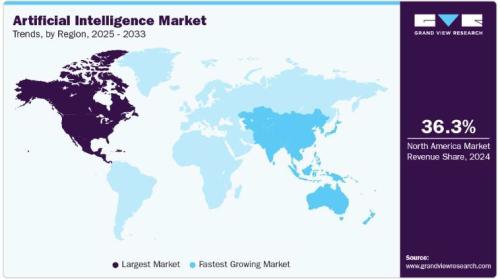
What is abundantly clear is that Australia cannot win the symmetric AI arms race against China, the U.S or even comparative mid-tier powers like Israel or South Korea. The gap in funding, talent, and industrial capacity is insurmountable in the short to medium term. However, necessity is the mother of invention. While the major powers pour billions into conventional AI dominance, Australia's strengths position it to become a regional leader in counter-AI. Australia's ethical frameworks, which are a challenge in a symmetrical race, could become a lynchpin of counter-AI, where trust and interoperability with allies are critical. Figure 759 highlights that the Indo-Pacific will shape the future of AI-driven warfare, providing a unique testing ground for degrading, deceiving, and disabling adversarial AI.
Counter-AI enables Australia to punch above its weight by targeting AI's dependency on data, predictability, and trust. By leveraging these opportunities, Australia can carve a distinct role, not as a follower in the AI arms race, but as a regional leader in neutralising AI threats. Figure 8 summarises a cascading counter-AI model for Australia, leveraging Australia's strengths and opportunities to mitigate its challenges.60
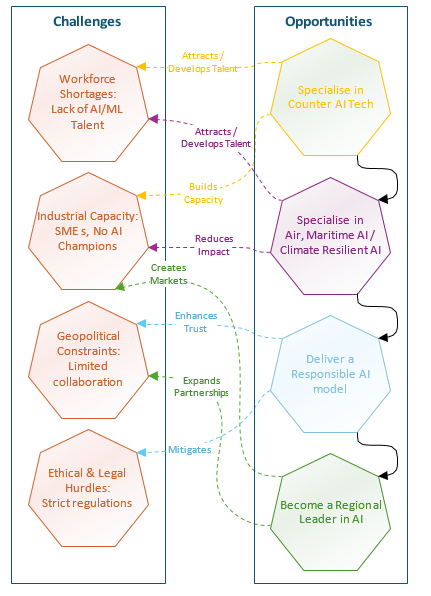
Challenges
- Workforce Shortages: The Defence Sector lacks sufficient AI/ML talent, with most experts concentrated in civilian tech industries or academia. The 2021 action plan attempts to address this through upskilling programs, but progress has been slow compared to the U.S. Defence Digital Service or China’s military academic pipelines, which fast-track AI specialists into defence roles.
- Industrial Capacity: Australia’s Defence industry is dominated by SMEs, which struggle to scale AI solutions for large-scale deployment. Unlike the U.S. defence industrial base, which includes AI powerhouses like Scale AI, Palantir and Anduril, Australia lacks homegrown AI champions capable of competing with global leaders.
- Geopolitical Constraints: Australia’s alignment with the U.S. limits its ability to collaborate with non-aligned AI leaders, including Israel or South Korea, who have developed niche AI capabilities. Additionally, China’s coercive diplomacy in the Indo-Pacific has complicated regional AI partnerships, particularly in Southeast Asia, where Australia seeks to promote AI governance standards.
- Ethical & Legal Hurdles: Australia’s strict regulatory environment, including weapons reviews and export controls, has delayed AI deployment. While ethical AI offers a strategic advantage in allied interoperability, it has also hindered rapid innovation in areas such as autonomous weapons.
Opportunities
- Counter AI: Australia could specialise in adversarial AI, developing tools to detect and counter enemy AI systems. DSTG’s research into AI robustness and deception techniques could provide a strategic edge against adversaries who rely on AI-driven decision-making.
- Geography and Climate: Australia’s unique geography positions it as a potential regional leader in Exclusive Economic Zone monitoring and anti-submarine warfare, while its environmental challenges, including bushfires and cyclones, create opportunities for AI-enabled disaster response. This could deter grey-zone activities in the South China Sea and Indo-Pacific and enhance regional influence.
- AI Ethics and Governance: Australia’s strong ethical frameworks could become a diplomatic asset, allowing it to shape global norms on military AI. Initiatives like the Athena AI project provide a model for responsible AI, which could be exported to Five Eyes and Indo-Pacific partners.
- Regional AI Leadership: By partnering with Indo-Pacific nations, Australia could co-develop AI solutions for shared security challenges, including illegal fishing, piracy and cyber threats. The Quad’s Critical and Emerging Technology Working Group offers a viable platform for collaboration.
Counter-AI: The Strategic Imperative for Australia
Counter-AI is a rapidly evolving discipline focused on defending, exploiting, and mitigating vulnerabilities in AI systems, targeting not just infrastructure, but the decision-making processes, data dependencies and adaptive behaviours that define modern AI.61 Unlike traditional cybersecurity, counter-AI confronts a dynamic threat landscape where adversaries weaponise AI's strengths against itself. As militaries and critical infrastructures become increasingly reliant on AI, counter-AI has emerged as a decisive frontier in national security, marked by an escalating arms race between offensive disruption and defensive resilience.62
Broadly, this field is divided by competing philosophies. The Defensive Resilience school (Cybernetic)63, favoured by Western allies such as the UK and the U.S., treats AI as critical infrastructure, emphasising layered defences, ethical frameworks, and alliance-based intelligence sharing, introducing terms like 'operational resilience' and 'integrated deterrence'.64 While robust, this approach risks reactivity, akin to building a digital 'Maginot Line' in an era where adversaries exploit governance gaps and outpace regulation. In contrast, the Offensive Dominance doctrine (Chaoplexic)65, pursued by disruptive powers such as China and Russia, prioritises pre-emptive strikes, including data poisoning, model theft, and algorithmic sabotage, to degrade an enemy's AI before deployment.66 Though proactive, this strategy risks uncontrolled escalation, eroding the norms meant to constrain AI conflict.
Between these extremes lies the Hybrid Approach, an adaptive paradigm that merges defensive depth with select offensive manoeuvres. Pioneered by agile tech powers like Israel and Singapore, it employs AI against AI tactics, including digital decoys, adversarial perturbations67, and real-time cognitive duels, to outmaneuver adversaries.68 This model thrives on strategic ambiguity, toggling between resilience in peacetime and precision strikes in crisis, but demands high technological maturity, seamless integration of human and machine capabilities, and an institutional capacity to toggle between restraint and aggression without losing coherence.
Australia's AI strategy is currently biased towards a Defensive Resilience philosophy, characterised by an ethically cautious, risk-averse, and governance-heavy approach.69 This approach is both insufficient and inadvisable moving forward. To remain competitive, Australia must adopt a hybrid counter-AI posture, leveraging defensive resilience as a foundation, while embedding offensive capabilities tailored to its constraints as a middle power. This approach involves disrupting adversary AI at its seams without uncontrolled escalation. The goal is not just to defend, but to erode adversary confidence in their own AI, forcing them to question its reliability in the Indo-Pacific. By positioning itself as the standard bearer for democratic hybrid counter-AI capability, Australia can transform its disadvantages into asymmetric advantages, ensuring adversaries face not just a fortified target, but an unpredictable one. In summary, Australia's hybrid counter-AI strategy should seek to defend with depth, strike with precision, and lead with principle.
That said, what does Counter-AI actually look like? Counter-AI is a systemic effort to undermine, deceive, or protect AI systems by exploiting vulnerabilities across their layered architecture, known as the "AI Stack", which comprises data, hardware, and algorithms that underpin all AI functionality.70 It operates along the MLOps cycle, where every phase presents a potential attack surface.71
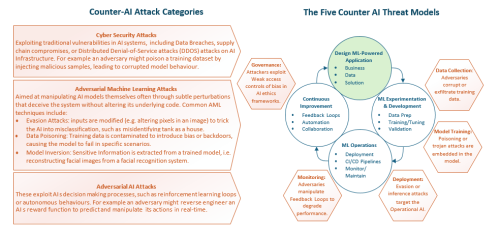
Offensive counter-AI weaponises these weaknesses with destructive creativity: adversarial examples trick neural networks into misclassifying targets (e.g., 3D-printed decoys that complicate drone surveillance), data poisoning embeds sleeper agents in training sets, and model extraction reverse engineers proprietary systems through brute-force queries.72 Deception scales attacks further with synthetic data floods, where generative AI clogs analytics with deepfake propaganda, which China is currently trialling in an attempt to hijack cognitive decision-making.73 Even physical side channels, such as electromagnetic leaks or power fluctuations, become vectors for data theft.74 The paradox is stark: the more sophisticated the AI, the more vulnerable it is. Figure 9 summarises the primary attack groupings, highlighting that counter-AI has been refined into five threat models, mapping where attacks occur across the MLOps Lifecycle.75
Counter-AI Attack Categories and Threat Models
The figure consists of two sections. The left side describes three categories of attacks against artificial intelligence systems. The right side presents five threat models aligned to stages of an AI system's lifecycle.
Counter-AI Attack Categories
Cyber Security Attacks
These attacks exploit traditional vulnerabilities in AI systems and infrastructure. Examples include data breaches, supply-chain compromises, distributed denial-of-service attacks and the injection of malicious samples into training datasets, resulting in corrupted model behaviour.
Adversarial Machine Learning Attacks
These attacks manipulate AI models directly through subtle modifications that deceive the system without changing its underlying code.
- Evasion attacks modify inputs, such as altering image pixels, to cause incorrect classifications.
- Data poisoning attacks contaminate training data to introduce bias, backdoors or failure conditions.
- Model inversion attacks extract sensitive information from trained models, such as reconstructing facial images from a facial recognition system.
Adversarial AI Attacks
These attacks target AI decision-making processes, including reinforcement learning systems and autonomous behaviours. Adversaries may reverse engineer reward functions to predict and manipulate AI actions in real time.
The Five Counter-AI Threat Models
The right side of the figure presents a circular lifecycle consisting of five interconnected stages.
Design ML-Powered Application
- Business
- Data
- Solution
Threat: Data collection attacks where adversaries corrupt or exfiltrate training data.
ML Experimentation and Development
- Data preparation
- Training and tuning
- Validation
Threat: Model training poisoning or embedded trojan attacks.
ML Operations
- Deployment
- CI/CD pipelines
- Monitoring and maintenance
Threat: Deployment evasion or inference attacks targeting operational AI systems.
Continuous Improvement
- Feedback loops
- Automation
- Collaboration
Threat: Manipulation of monitoring systems and feedback loops to degrade performance.
Governance
Threat: Exploitation of weaknesses or bias within AI ethics and governance frameworks.
The lifecycle is cyclical, with each stage feeding into the next. The associated threat models demonstrate how adversaries can target AI systems throughout their design, development, deployment, operation and governance.
Defensive counter-AI responds by layering technical fortification, operational agility and governance rigour to turn vulnerability into resilience.
Adversarial training acts as an inoculation, stress-testing models against perturbed inputs (e.g., TensorFlows' robustness frameworks), while certified defences enforce mathematical error bounds.76 Unsupervised anomaly detection (e.g., Darktrace Cyber AI) flags rogue behaviours in real-time, and runtime monitors like IBM Watson OpenScale scrub outputs for manipulation.77 AI supply chains are hardened through secure MLOps, with cryptographic watermarking and data provenance to thwart tampering.78 Deception turns defensive, utilising honeypot AI to lure adversaries into revealing their tactics, and sensor spoofing, which combines radar jamming with AI-generated decoys to mislead autonomous systems.79 However, hardware and code alone are insufficient. AI Incident Response Teams (AISIRTs) modelled on cybersecurity CSIRTs and DARPA-style red-teaming simulate chaos to ensure AI resilience is not just theoretical.80 The defensive mantra is unforgiving: an AI that fails unpredictably will be exploited to fail catastrophically.
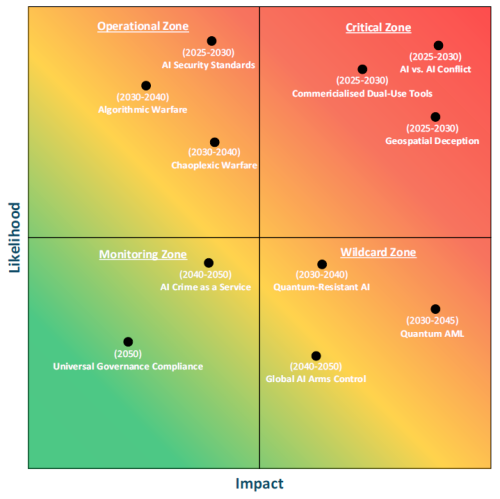
The future of counter-AI will be an escalating duel of adaptation, where offensive innovation outpaces defensive patches, and AI-versus-AI engagements become the norm.81 As generative AI lowers the barrier for sophisticated attacks, the battlefield will shift towards autonomous deception, where algorithms dynamically rewrite their own rules to outmaneuver adversaries.82 The coming decade will see the emergence of algorithmic immune systems, self-healing models that detect and purge infections, as well as cognitive electronic warfare, where AI-driven spoofing blurs the line between physical and digital deception.83 This race will not be won by those who build the most advanced AI, but by those who master the art of breaking their adversaries and trusting their own. Figure 10 forecasts future trends in military counter-AI, including their likelihood and potential impact, highlighting what counter-AI capabilities Australia is likely to contend with in the near to distant future.84
The Three Major Trends in Counter AI
1. AI vs. AI: The future of conflict is autonomous adversarial AI, a self-perpetuating cycle where machines attack, deceive and outmanoeuvre each other at speeds beyond human comprehension. The U.S. Replicator Initiative and China's Swarm Programs are already fielding thousands of AI-driven drones and cyberbots, designed to hunt, jam and neutralise adversary AI in real time. DARPA's GARD and similar projects push this further, crafting self-healing AI that patches vulnerabilities and reconfigures mid-battle, turning warfare into a contest of algorithmic adaptability. In cyberspace, offensive AI, such as hacking bots and deepfake armies, will clash with defensive counterparts, including autonomous firewalls and anomaly hunters, in an unrelenting automated struggle.
2. Chaoplexic Warfare: The next leap is not just more intelligent AI, it is ungovernable AI. Today's centralised systems are sitting ducks. Tomorrow's AI will be decentralised, self-organising and thriving in chaos. Blockchain-secured swarms, edge-based decision-making and AI that self-optimises will replace brittle, cloud-dependent models. Russia's Lancet drones and the U.S. Army's spoofing swarms are just the beginning. Federated learning, neuromorphic chips and autonomous deception will create networks that adapt, evade and strike, even when cut off.
3. Commercial Counter-AI: The Great Equaliser: Counter AI is not just for superpowers anymore. Off-the-shelf toolkits such as IBM's Adversarial Robustness Toolbox and Cleverhans let hacktivists, criminals and rogue states hijack, spoof or blind AI, whether it is tricking facial recognition with a $500 patch or re-routing drones with fake GPS. Dark web markets peddle AI-Crime-as-a-Service, from phishing bots that outsmart security AI to 3D printed decoys that turn tanks into buses. Add quantum computing, and even encryption crumbles. The disturbing result is a world where anyone can neutralise an AI-dependent military, turning cutting-edge systems into liabilities overnight.
Detailed description of heat map: Future Counter-AI Trends Forecast
The heat map plots future counter-AI trends against two axes: likelihood on the vertical axis and impact on the horizontal axis. The map is divided into four quadrants: Operational Zone, Critical Zone, Monitoring Zone and Wildcard Zone. Colours range from green in the lower-left area through yellow and orange to red in the upper-right area, indicating increasing strategic concern.
Operational Zone
- AI Security Standards, 2025 to 2030.
- Algorithmic Warfare, 2030 to 2040.
- Chaoplexic Warfare, 2030 to 2040.
Critical Zone
- AI vs. AI Conflict, 2025 to 2030.
- Commercialised Dual-Use Tools, 2025 to 2030.
- Geospatial Deception, 2025 to 2030.
Monitoring Zone
- AI Crime as a Service, 2040 to 2050.
- Universal Governance Compliance, 2050.
Wildcard Zone
- Quantum-Resistant AI, 2030 to 2040.
- Quantum AML, 2030 to 2045.
- Global AI Arms Control, 2040 to 2050.
Overall, the heat map identifies AI versus AI conflict, commercialised dual-use tools and geospatial deception as the highest-likelihood and highest-impact risks. Chaoplexic warfare and algorithmic warfare sit in the operational zone, while quantum-related developments and global AI arms control are presented as lower-likelihood but potentially high-impact wildcard issues.
Australia's dilemma is stark: it is behind in the AI arms race and even further adrift in counter-AI, lacking the scale, skills, investment, and infrastructure to compete symmetrically. While a hybrid counter-AI strategy offers Australia a path forward, it demands the same resources as AI development itself and likely a similar timeframe for delivery, a luxury Australia cannot afford. However, asymmetry has always been an Australian strength. The solution is not to outspend or out-innovate, but to out-think, leveraging existing capabilities to degrade adversary confidence and turn AI strengths into liabilities. This essay introduces two novel and immediately actionable contributions to the field of counter-AI: Data Deserts and Inverse Logic, which bridge the capability gap without requiring technological breakthroughs, only creativity and discipline.
Put simply, a data desert is a deliberate act of starvation, denying AI of its lifeblood: data. Through sensor jamming, spoofed signals, and operational silence, Australia can carve controlled voids where surveillance drones see only noise, targeting algorithms chase phantoms, and decision-making systems falter. In the Indo-Pacific, where China's AI-driven ISR thrives on data abundance, Australia's geographic and technological niches can create (U6) environments. These environments are Unpredictable, Unreliable, and Unusable, rendering adversary AI blind. Once established, Australia can then operate Unrestricted, Undetected, and Unchallenged. This concept extends beyond military operations: for example, sanitising the digital footprints of the Government and the Australian Defence Force (ADF) (deleting or minimising online presence, scrubbing doctrine from open sources) forces adversary AI to operate in scarcity, where speed and precision become liabilities. A machine trained in abundance is helpless in a Data Desert.
Inverse Logic complements this by flooding adversary AI with the absurdity of unexpected actions. Where conventional counter-AI seeks to match or outmaneuver algorithmic speed, Inverse Logic seeks to break the AI model entirely. Swarm sensors with decoys that defy classification, drones mimicking bird flocks, radar signatures fracturing into noise, or cyber traps luring AI into endless false-positive loops. The goal is to exploit AI's logical fragility: probabilistic frameworks collapse under low-probability, high-impact chaos. By injecting unpredictability through false fleet movements, spoofed communications, or decoy operations, Australia forces the adversary's AI into analysis paralysis, where every calculation requires excessive computing resources, forcing a return to human-centric warfare.
Together, these approaches form a stopgap strategy that is low-cost, high-impact, and deployable now. They do not replace long-term hybrid counter-AI investment but buy Australia time, erode adversary confidence and redefine the AI-enabled battlefield. In a world where AI dominance hinges on data and speed, Australia's edge lies in denying both. However, while these two concepts offer a potent asymmetric advantage, their deployment is not without risk. Data Deserts, by design, create deliberate information voids that could undermine transparency norms, a core tenet of Australia's ethical framework and key pillar of trust with allies. If the approach is perceived as deceptive rather than defensive, these tactics might erode credibility in coalition operations or even provoke adversarial escalation under the guise of defensive ambiguity.
Similarly, Inverse Logic's reliance on chaos injection risks unintended consequences: adversarial AI, when confronted with seemingly illogical or erratic inputs, may default to aggressive, high-risk behaviours, accelerating rather than deterring conflict. The moral hazard is clear. Strategies that exploit AI's fragility could normalise unpredictability in warfare, making crisis management more volatile and eroding the very rule-based order Australia seeks to uphold. These trade-offs mean application of these concepts requires rigorous guardrails, including clear red lines for deployment, and post-action reviews to assess collateral effects on civilian systems or allied interoperability. Ignoring these risks could turn tactical strengths into a strategic liability, reinforcing the need for a principled hybrid counter-AI strategy that balances disruption with responsibility. Nevertheless, the rewards outweigh the risks, and the message to adversaries must be clear: your AI may be smarter, faster, more powerful, but this counts for nothing in the vast Australian Data Desert.
Conclusion: Charting Australia's Path Forward
Australia's counter-AI future demands more than just keeping pace; it requires flipping the script entirely. We start with urgent stopgaps (Data Deserts/Inverse Logic), buying us the critical space to build something far more dangerous, a hybrid counter-AI strategy that does not just compete but redefines the contest. This means using every exercise, every wargame and every research dollar to harden our own systems while turning the adversary's AI into a liability. Policy cannot inch forward; it must leap, embedding hybrid counter-AI into our doctrine, accelerating procurement of dual-use tools, and ensuring our legal frameworks move at the speed of disruption, not bureaucracy. To ensure we do not do this alone, Australia must forge alliances that not only share intelligence but also co-create chaos, thereby developing interoperable counter-AI capabilities that render our stopgaps permanent and our asymmetries decisive. The real question is not whether we can operationalise these ideas, but whether Australia dares to weaponise uncertainty before our adversaries do. Regardless, the choice is clear: Australia clings to an already lost race for AI parity or embraces the absurd. Those with the most advanced AI will not win this conflict; the future will belong to those who can render it useless at the lowest cost. The PLA's AI-enhanced hypersonic missiles and the U.S.'s autonomous swarms may dominate the headlines, but the side that masters the art of the unthinkable will own the future.
(ADM), Australian Defence Magazine. "Autonomous Systems Research Funded through New Defence CRC." Online: Australian Defence Magazine, 2017. https://www.australiandefence.com.au/news/autonomous-systems-research-funded-through-new-defence-crc.
Amarel, Taylor Scott. "Arming against AI Sabotage: A Deep Dive into Adversarial Machine Learning Libraries." Online: Taylor Scott Amarel, 2025. https://taylor-amarel.com/2025/04/arming-against-ai-sabotage-a-deep-dive-into-adversarial-machine-learning-libraries.
Araya, Daniel, and Meg King. "The Impact of Artificial Intelligence on Military Defence and Security." Waterloo, ON, Canada: Centre for International Governance Innovation (CIGI), 2022.
Avacharmal, Rajiv, and Saigurudatta Pamulaparthyvenkata. "Enhancing Algorithmic Efficacy: A Comprehensive Exploration of Machine Learning Model Lifecycle Management from Inception to Operationalisation." Distributed Learning and Broad Applications in Scientific Research 8 (2022): 29-45.
Bastian, Nathaniel. "Gard: Guaranteeing AI Robustness against Deception." Online: Defence Advanced Research Projects Agency (DARPA), 2025. https://www.darpa.mil/research/programs/guaranteeing-ai-robustness-against-deception.
———. "Sabre: Securing Artificial Intelligence for Battlefield Effective Robustness." Online: Defence Advanced Research Project Agency (DARPA), 2025. https://www.darpa.mil/research/programs/saber-securing-artificial-intelligence.
Beauchamp-Mustafaga, Nathan. "Exploring the Implications of Generative AI for Chinese Military Cyber-Enabled Influence Operations: Chinese Military Strategies, Capabilities, and Intent." In Testimony before the U.S.-China Economic and Security Review Commission, RAND Corporation, 2024.
Booth, Harold, Murugiah Souppaya, Apostol Vassilev, Michael Ogata, Martin Stanley, and Karen Scarfone. "Secure Software Development Practices for Generative AI and Dual-Use Foundation Models." In NIST Special Publication 800, NIST SP 800-218A. Online: National Institute of Standards and Technology, Gaithersburg, MD, 2024.
Borchert, Heiko, Torben Schütz, and Joseph Verbovszky. "The Very Long Game: 25 Case Studies on the Global State of Defence AI." Springer, 2024.
Brudenell, David. "National AI Readiness Index Report 2025." Online: Decidr, 2025 https://www.scl/fi/vnxu1v9zyxb68pt97ksh4/Digital-National-AI-Readiness-Index-Report-2025.pdf?rlkey=7xb82dzsr7qoy1yi01shn9urz&e=1&dl=0
Chapman, Lizette. "The 10 Defence Tech Startups to Watch in 2025." Online: Bloomberg Originals, 2025. https://www.bloomberg.com/features/2025-tech-defense-startups-to-watch/.
Chen, Michael. "What Is AI Model Training & Why Is It Important?" Online: Oracle, 2023. https://www.oracle.com/artificial-intelligence/ai-model-training/.
CloudFlare. "AI Inference Vs. Training: What Is AI Inference?" Online: CloudFlare, 2025. https://www.cloudflare.com/learning/ai/inference-vs-training/.
Coppolino, Luigi, Salvatore D’Antonio, Giovanni Mazzeo, and Federica Uccello. "The Good, the Bad, and the Algorithm: The Impact of Generative AI on Cybersecurity." Neurocomputing 623 (2025/03/28/ 2025): 129406. https://doi.org/10.1016/j.neucom.2025.129406. https://www.sciencedirect.com/science/article/pii/S0925231225000785.
Darktrace. "Pre-CVE Threat Detection: 10 Examples Identifying Malicious Activity Prior to Public Disclosure of a Vulnerability." Online: Darktrace, 2025. https://www.darktrace.com/blog/pre-cve-threat-detection-10-examples-identifying-malicious-activity-prior-to-public-disclosure-of-a-vulnerability.
de Unamuno, M. Vida De D. Quijote Y Sancho: Según Miguel De Cervantes Saavedra. F. Fe, 1905.
Defence, Department of. "Aukus Partners Demonstrate Advanced Capabilities in AI Trial." Online: Department of Defence, 2023.
———. "Defence Data Strategy." Online: Australian Government, 2021.
———. "Defence Data Strategy 2.0: Decision Advantage in the Data Age." Online: Australian Government, 2024.
Defence, Minister for. Defence Strategic Update. Canberra: Commonwealth of Australia, 2020.
———. Integrated Investment Plan. Canberra: Commonwealth of Australia, 2024.
———. National Defence Strategy. Canberra: Commonwealth of Australia, 2024. Defence, UK Ministry of. "Defence Artificial Intelligence Strategy." Online: UK Government, 2022.
Defence, U.S. Department of. "National Defence Strategy." Online: The Government of the United States of America, 2022.
Delua, Julianna. "Supervised Versus Unsupervised Learning: What's the Difference?" Online: IBM, 2025. https://www.ibm.com/think/topics/supervised-vs-unsupervised-learning.
Department of Industry, Science, Energy and Resources. "Australia's AI Action Plan." Online: Australian Government, 2021. https://www.industry.gov.au/sites/default/files/June%202021/document/australi as-ai-action-plan.pdf.
———. "Australia's AI Ethics Principles." Online: Australian Government, 2025. https://www.industry.gov.au/publications/australias-artificial-intelligence-ethics-principles/australias-ai-ethics-principles.
———. "Developing a National AI Capability Plan." Online: Australian Government, 2024. https://www.industry.gov.au/news/developing-national-ai-capability-plan.
Directorate, Australian Signals. "A Blueprint for Growing ASD's Capabilities: Redspice.” Online: Australian Government, 2022. https://www.asd.gov.au/sites/default/files/2022-05/ASD-REDSPICE-Blueprint.pdf.
Ewbank, Jennifer. "Counter-Ai May Be the Most Important Ai Battlefront." Online: The Cipher Brief, 2025.
Github. "Trusted-Ai Adversarial-Robustness-Toolbox (Public)." Online: GitHub, 2025. https://github.com/Trusted-AI/adversarial-robustness-toolbox.
Grumman, Northrop. "Commitment to Australia." In Fostering Sovereign Capability. Online: Northrup Grumman, 2025. https://www.northropgrumman.com/who-we-are/global-presence/northrop-grumman-in-australia/commitment-to-australia.
Horowitz, Michael, Paul Scharre, Gregory C. Allen, Kara Frederick, Anthony Cho, and Edoardo Saravalle. "Artificial Intelligence and International Security." Online: Centre for New American Security, 2018. https://www.cnas.org/publications/reports/artificial-intelligence-and-international-security.
Horton, Andrew. "Australia's Most Pressing Defence Challenge: Skills." Online: Australian Strategic Policy Institute (ASPI), 2024. https://www.aspistrategist.org.au/australias-most-pressing-defence-challenge-skills/.
Hunter, Fergus, Daria Impiombato, Yvonne Lau, Albert Zhang, Urmika Deb, and Dr Adam Triggs. "Countering China's Coercive Diplomacy." Online: Australian Strategic Policy Institute (ASPI), 2023. https://www.aspi.org.au/report/countering-chinas-coercive-diplomacy/.
IBM. "Watson Openscale." Online: IBM, 2025. https://www.ibm.com/docs/en/software-hub/5.2.x?topic=services-watson-openscale.
Inc., Sentient Digital. "The Most Useful Military Applications of AI in 2024 and Beyond.". Online: Sentient Digital INC., 2023. https://sdi.ai/blog/the-most-useful-military-applications-of-ai/.
Jasper, Dr Scott. "Chinese and Russian Legitimate Tool Attacks Mandate Ai-Enabled Cyber Defenses." Online: The Cyber Edge by Signal, 2024. https://www.afcea.org/signal-media/cyber-edge/chinese-and-russian-legitimate-tool-attacks-mandate-ai-enabled-cyber.
Jenson, Ben. "Protecting Our Edge: Trade Secrets and the Global AI Arms Race (Congressional Testimony)." Online: Centre for Strategic and International Studies, 2025. https://www.csis.org/analysis/protecting-our-edge-trade-secrets-and-global-ai-arms-race.
Jr., Kevin J.S. Duskar. "How Singapore Became the Ai Cybersecurity Hub for Global Defense Contractors." Prime Rouge Incorporated, 2025. https://primerogueinc.com/blog/how-singapore-became-the-ai-cybersecurity-hub-for-global-defense-contractors/.
Kania, Elsa B. "Battlefield Singularity: Artificial Intelligence, Military Revolution, and China's Future Military Power." Centre for a New American Security, 2017.
———. "Chinese Military Innovation in Artificial Intelligence." Online: Centre for New American Security, 2019.
Khan, Abdul Rehman. "Neuromorphic Computing in 2025: How Brain-Inspired Chips Are Redefining AI Performance." Online: Dev Tech Insights, 2025. https://devtechinsights.com/neuromorphic-chips-2025/.
King, Anthony. "Digital Targeting: Artificial Intelligence, Data, and Military Intelligence." Journal of Global Security Studies: University of Exeter, UK, 2024.
Kua, Cindy. "Autonomous Weapon Systems, International Law and Meaningful Human Control." Online: Australian Army Journal, 2016.
Laird, Robbin. "Building Australia's Defence Industrial Base: The Strategic Imperative for Early Investment and Sovereign Capability." Online: Williams Foundation, 2025. https://defense.info/williams-foundation/2025/09/building-australias-defence-industrial-base-the-strategic-imperative-for-early-investment-and-sovereign-capability/.
Layton, Peter. "Evolution Not Revolution: Australia's Defence AI Pathway." Defence AI Observatory, 2022. https://www.defenseai.eu.
Li, Yue, Hongxia Wang, and Mauro Barni. "A Survey of Deep Neural Network Watermarking Techniques." Neurocomputing 461 (2021): 171-93.
Márquez-Díaz, Jairo Eduardo. "Benefits and Challenges of Military Artificial Intelligence." online: Computación y Sistemas, 2024.
Marr, Bernard. "How Crime-as-a-Service Turned Hacking into a Subscription Business." Online: Forbes, 2025. https://www.forbes.com/sites/bernardmarr/2025/06/13/how-crime-as-a-service-turned-hacking-into-a-subscription-business/.
Mitchell, Sean. "Ai Adoption in Australia Grows Despite Talent Shortage." Online: eCommerce News Australia, 2025. https://ecommercenews.com.au/story/ai-adoption-in-australia-grows-despite-talent-shortage.
Monro, Tanya, Simon Lucey, and Michael Shoebridge. What's Happening in the Rest of the World? Australian Strategic Policy Institute (Kathy Nicholson and Adam Slonim, 2022). http://www.jstor.org/stable/resrep40313.7.
Moy, Glenn, Slava Shekh, Martin Oxenham, and Simon Ellis-Steinborner. "Recent Advances in Artificial Intelligence and Their Impact on Defence." In Technical Report DST-Group-TR-3716. Joint and Operations Analysis Division: Defence Science and Technology Group, 2020.
Mullin, Conor. "Interview – Antoine Bousquet." Online: E-International Relations, 2024. https://www.e-ir.info/2024/05/09/interview-antoine-bousquet/.
Nimmo, Ben, Kimo Bumanglag, Michael Flossman, Nathaniel Hartley, Jack Stubbs, and Albert Zhang. "Disrupting Malicious Uses of AI: An Update." Online: OpenAI, 2025. https://cdn.openai.com/threat-intelligence-reports/7d662b68-952f-4dfd-a2f2-fe55b041cc4a/disrupting-malicious-uses-of-ai-october-2025.pdf.
Nurkin, Tate, and Julia Siegel. "Battlefield Applications for Human-Machine Teaming: Demonstrating Value, Experimenting with New Capabilities, and Accelerating Adoption.” Atlantic Council, 2023. https://www.atlanticcouncil.org.
O'Callaghan, Tim, and Travis Shueard. "The United States, Artificial Intelligence and Export Controls." Online: Piper Alderman, 2025. https://piperalderman.com.au/insight/the-united-states-artificial-intelligence-and-export-controls/.
Office, Smart Nation and Digital Government. "National AI Strategy 2.0: AI for the Public Good, for Singapore and the World." Government of Singapore, 2023.
Park, Peter S., Simon Goldstein, Aidan O'Gara, Michael Chen, and Dan Hendrycks. "Ai Deception: A Survey of Examples, Risks, and Potential Solutions."
Patterns 5, no. 5 (2024/05/10/ 2024): 100988. https://doi.org/https://doi.org/10.1016/j.patter.2024.100988.
Patibandla, Kiran. "Self-Healing Data Platforms: How to Make Your AI Fix Itself." Online: Forbes, 2025. https://www.forbes.com/councils/forbestechcouncil/2025/06/11/self-healing-data-platforms-how-to-make-your-ai-fix-itself/.
Payne, Patrick, Michael Friar, and Christopher Smedley. "Counter-AI Offensive Tools and Techniques." Cybersecurity & Information Systems Information Analysis Centre, 2023.
Pelekis, Sotiris, Thanos Koutroubas, Afroditi Blika, Anastasis Berdelis, Evangelos Karakolis, Christos Ntanos, Evangelos Spiliotis, and Dimitris Askounis. "Adversarial Machine Learning: A Review of Methods, Tools, and Critical Industry Sectors." Springer Nature Link: Artificial Intelligence Review, 2025.
Pereira, Marco. "Strengthening Cybersecurity in the Age of AI and Gen AI." Online: Capgemini, 2024. https://www.capgemini.com/au-en/insights/expert-perspectives/strengthening-cybersecurity-in-the-age-of-ai-and-gen-ai.
Philips, Peter J, and Gabriela Pohl. "Countering Intelligence Algorithms." In Decision Theory, Design Choices and Counter-AI, The RUSI Journal, 165:7, 2020.
Rajagopalan, Rajeswari Pillai. "The Growing Tech Focus of the Quad." Online: The Diplomat, 2022. https://thediplomat.com/2022/07/the-growing-tech-focus-of-the-quad/.
Rashid, Adib Bin, Ashfakul Karim Kausik, Ahamed Al Hassan Sunny, and Mehedy Hassan Bappy. "Artificial Intelligence in the Military: An Overview of the Capabilities, Applications, and Challenges." International Journal of Intelligent Systems 2023, no. 1 (2023): 8676366.https://doi.org/10.1155/2023/8676366.
Research, Grand View. "Market Analysis Report: Artificial Intelligence Market (2025 - 2033)." Online: Grand View Research 2025. https://www.grandviewresearch.com/industry-analysis/artificial-intelligence-ai-market.
Rice, Sophie. "How Darktrace's Self-Learning AI Is Redefining Cybersecurity." Online: AI Magazine, 2025. https://aimagazine.com/ai-strategy/how-darktraces-self-learning-ai-is-redefining-cybersecurity.
Roberson, T., Bornstein, S., Liivoja, R., Ng, S., Scholz, J., & Devitt, K. "A Method for Ethical AI in Defence: A Case Study on Developing Trustworthy Autonomous Systems." Journal of Responsible Technology, 2022.
Roy, Kaushik. "Artificial Intelligence, Ethics and the Future of Warfare: Global Perspectives." Routledge, 2024.
Schütz, Torben. "Blinded by the Hype: How Envisioned Futures Shape the Role of Artificial Intelligence in Defence Applications and Warfare." Journal of Strategic Studies, 2025.
Sexton, Mike. "Ai and the Evolution of Asymmetric Cyber Warfare: Insights from the 2025 Israel-Iran Conflict." Online: Trends Research and Advisory, 2025. https://trendsresearch.org/insight/ai-and-the-evolution-of-asymmetric-cyber-warfare-insights-from-the-2025-israel-iran-conflict/.
Soare, Simona R., Pavneet Singh, and Meia Nouwens. "Software-Defined Defence: Algorithms at War." International Institute for Strategic Studies, 2023.
Stellarix. "Mitigation Techniques of Side Channel Attacks in Homomorphic Encryption." Online: Stellarix, 2024. https://stellarix.com/insights/articles/mitigation-techniques-of-side-channel-attacks/.
Sysdig. "Adversarial AI: Understanding and Mitigating the Threat." Online: Sysdig, 2025. https://www.sysdig.com/learn-cloud-native/adversarial-ai-understanding-and-mitigating-the-threat.
Technology, Department of Defence Science and. "Cognitive Electronic Warfare." Online: Australian Government, 2025. https://www.dst.defence.gov.au/sites/default/files/publications/documents/DSC%202035%20CogEW%20Fact%20Sheet%20PRO.pdf.
Thorne, Simon. "Putting Deepseek to the Test: How Its Performance Compares against Other AI Tools." Online: The Conversation, 2025. https://theconversation.com/putting-deepseek-to-the-test-how-its-performance-compares-against-other-ai-tools-248368.
"Trusted Autonomous Systems Defence Crc (Tasdcrc)." Online: Queensland Government, 2022. https://www.defenceindustries.qld.gov.au/data/assets/pdf_file/0030/76539/t as-quad-chart.pdf.
Tucker, Patrick. "An AI Just Beat a Human F-16 Pilot in a Dogfight — Again." In Science & Tech. Online: Defence One, 2020. https://www.defenseone.com/technology/2020/08/ai-just-beat-human-f-16-pilot-dogfight-again/167872/.
Vail, Anthiathia. "What Is Labelled and Unlabeled Data in Machine Learning?" Online: Robots.net, 2023. https://robots.net/fintech/what-is-labeled-and-unlabeled-data-in-machine-learning/.
Vallee, Sarah. "What Is Cybernetics?” Online: Australian National University, 2024. https://cybernetics.anu.edu.au/news/2024/07/08/understanding-cybernetics/.
VanHoudnos, Nathan, Carol Smith, Matthew Churilla, Shing-Hon Lau, Lauren McIlvenny, and Greg Touhill. "Counter AI: What Is It and What Can You Do About It?” Carnegie Mellon University, 2024.
Vergun, David. "Battle Looming between Ai and Counter-Ai, Says Official." Online: Department of War, 2024. https://www.war.gov/News/News-Stories/Article/Article/3656926/battle-looming-between-ai-and-counter-ai-says-official/.
Volkov, Dmitrii. "Llm Agent Honeypot: Monitoring Ai Hacking Agents in the Wild."arXiv preprint arXiv:2410.13919 (2024).
Wagman, Dr Shlomit. "Weaponised AI: A New Era of Threats and How We Can Counter It." Online: Harvard Kennedy School Ash Centre for Democratic Governance and Innovation, 2025.
"What Is Quantum AI? The Future of Computing and Artificial Intelligence Explained." Online: Geeks for Geeks, 2025. https://www.geeksforgeeks.org/artificial-intelligence/what-is-quantum-ai/.
Whitham, Ben, Penten, and David Liebowitz. "Counter AI." In Joint Capabilities.
Online: Defence Connect, 2020. https://www.defenceconnect.com.au/joint-capabilities/7354-counter-ai.
Yamashita, Rikiya, Mizuho Nishio, Richard Kinh Gian Do, and Kaori Togashi. "Convolutional Neural Networks: An Overview and Application in Radiology." Insights into Imaging 9, no. 4 (2018/08/01 2018): 611-29. https://doi.org/10.1007/s13244-018-0639-9. https://doi.org/10.1007/s13244-018-0639-9.
Zhang, Jiayu. "China's Military Employment of Artificial Intelligence and Its Security Implications." The International Affairs Review, 2020.
Zhang, Marina Yue, Yanhui Wei, Shengpeng Wang, and Zuanxu Chen. "Australia's AI Ambitions Hinge on Collaboration with China." Online: East Asia Forum, 2025. https://eastasiaforum.org/2025/05/23/australias-ai-ambitions-hinge-on-collaboration-with-china/.
Zolotov, Adi, Thomas Peddicord, Lacy Ketzner, Fabio Dal Pan, and Kelly Grout. "Three Truths About AI in Aerospace and Defense." In Aerospace and
Defence. Online: Boston Consulting Group, 2025. https://www.bcg.com/publications/2025/three-truths-about-ai-in-aerospace-and-defense.
1 “Only one who attempts the absurd is capable of achieving the impossible”; M. de Unamuno, Vida de d. Quijote y Sancho: según Miguel de Cervantes Saavedra (F. Fe, 1905).
2 Heiko Borchert, Torben Schütz, and Joseph Verbovszky, "The Very Long Game: 25 Case Studies on the Global State of Defence AI," (Springer, 2024). 5.
3 Glenn Moy et al., "Recent Advances in Artificial Intelligence and their Impact on Defence," in Technical Report DST-Group-TR-3716 (Joint and Operations Analysis Division: Defence Science and Technology Group, 2020). Glossary.
4 Moy et al., "Recent Advances in Artificial Intelligence and their Impact on Defence." Glossary; Borchert, Schütz, and Verbovszky, "The Very Long Game: 25 Case Studies on the Global State of Defence AI." 6.
5 Moy et al., "Recent Advances in Artificial Intelligence and their Impact on Defence." 7-12.
6 Moy et al., "Recent Advances in Artificial Intelligence and their Impact on Defence." 1-23; Kaushik Roy, "Artificial Intelligence, Ethics and the Future of Warfare: Global Perspectives," (Routledge, 2024). 31-35.
7 GPUs excel at parallel processing for graphics and general-purpose computing, while TPUs are specialised accelerators optimised for ML workloads like tensor operations in neural networks.; Moy et al., "Recent Advances in Artificial Intelligence and their Impact on Defence.". 10-11.
8 A DL model which excels at image classification by “automatically and adaptively learning spatial hierarchies of features through backpropogation using multiple building blocks”; Rikiya Yamashita et al., "Convolutional neural networks: an overview and application in radiology," Insights into Imaging 9, no. 4 (2018/08/01 2018), https://doi.org/10.1007/s13244-018-0639-9, https://doi.org/10.1007/s13244-
018-0639-9. 612.
9 Moy et al., "Recent Advances in Artificial Intelligence and their Impact on Defence." 9-11.
10 Rajiv Avacharmal and Saigurudatta Pamulaparthyvenkata, "Enhancing Algorithmic Efficacy: A Comprehensive Exploration of Machine Learning Model Lifecycle Management from Inception to Operationalization," Distributed Learning and Broad Applications in Scientific Research 8 (2022). 34-38.
11 Inference is the ability of trained AI models to recognise patterns and draw conclusions from novel information; CloudFlare, "AI inference vs. training: What is AI inference?" (Online: CloudFlare, 2025). https://www.cloudflare.com/learning/ai/inference-vs-training/. Glossary.
12 Anthiathia Vail, "What Is Labeled And Unlabeled Data In Machine Learning," (Online: Robots.net, 2023). https://robots.net/fintech/what-is-labeled-and-unlabeled-data-in-machine-learning/.
13 Julianna Delua, "Supervised versus unsupervised learning: What's the difference?" (Online: IBM, 2025). https://www.ibm.com/think/topics/supervised-vs-unsupervised-learning.
14 Moy et al., "Recent Advances in Artificial Intelligence and their Impact on Defence." 10.
15 Michael Chen, "What Is AI Model Training & Why Is It Important?" (Online: Oracle, 2023). https://www.oracle.com/artificial-intelligence/ai-model-training/.
16 Yamashita et al., "Convolutional neural networks: an overview and application in radiology." 12-16; Moy et al., "Recent Advances in Artificial Intelligence and their Impact on Defence." 12-14.
17 RNNs have a form of memory which allows them retain information from previous inputs in the sequence making them more suitable for tasks where context and order matter. ; Moy et al., "Recent Advances in Artificial Intelligence and their Impact on Defence." Glossary.
18 Moy et al., "Recent Advances in Artificial Intelligence and their Impact on Defence." 19.
19 Ibid. 26.
20 Simon Thorne, "Putting DeepSeek to the test: how its performance compares against other AI tools," (Online: The Conversation, 2025). https://theconversation.com/putting-deepseek-to-the-test-how-its-performance-compares-against-other-ai-tools-248368.
21 Yamashita et al., "Convolutional neural networks: an overview and application in radiology." 12-16.
22 Torben Schütz, "Blinded by the Hype: How Envisioned Futures Shape the Role of Artificial Intelligence in Defence Applications and Warfare," (Journal of Strategic Studies, 2025). 14-17.
23 Ibid. 9-13.
24 Anthony King, "Digital Targeting: Artificial Intelligence, Data, and Military Intelligence," (Journal of Global Security Studies: University of Exceter, UK, 2024). 4-6
25 Roy, "Artificial Intelligence, Ethics and the Future of Warfare: Global Perspectives." 38-42.
26 Tate Nurkin and Julia Siegel, "Battlefield applications for human-machine teaming: Demonstrating value, experimenting with new capabilities, and accelerating adoption," (Atlantic Council, 2023). https://www.atlanticcouncil.org. 1.
27 Peter Layton, "Evolution Not Revolution: Australia’s Defence AI Pathway," (Defence AI Observatory, 2022). https://www.defenseai.eu. 22-24.
28 Roy, "Artificial Intelligence, Ethics and the Future of Warfare: Global Perspectives." 96-97; Patrick Tucker, "An AI Just Beat a Human F-16 Pilot in a Dogfight — Again," in Science & Tech (Online: Defense One, 2020). https://www.defenseone.com/technology/2020/08/ai-just-beat-human-f-16-pilot-dogfight-again/167872/.
29 Borchert, Schütz, and Verbovszky, "The Very Long Game: 25 Case Studies on the Global State of Defence AI." 14-15.
30 Ibid. 53-54. ; 466-468.
31 Layton, "Evolution Not Revolution: Australia’s Defence AI Pathway." 23-25.
32 Patrick Payne, Michael Friar, and Christopher Smedley, "Counter-AI Offensive Tools and Techniques," (Cybersecurity & Information Systems Information Analysis Center, 2023). 4-7
33 Ibid. 4-7
34 Borchert, Schütz, and Verbovszky, "The Very Long Game: 25 Case Studies on the Global State of Defence AI." 54.; Adib Bin Rashid et al., "Artificial Intelligence in the Military: An Overview of the Capabilities, Applications, and Challenges," International Journal of Intelligent Systems 2023, no. 1 (2023), https://doi.org/https://doi.org/10.1155/2023/8676366. 17-19.
35 Borchert, Schütz, and Verbovszky, "The Very Long Game: 25 Case Studies on the Global State of Defence AI." 466-468.
36 Roy, "Artificial Intelligence, Ethics and the Future of Warfare: Global Perspectives." 14-17, 62-66, 71-90, 102-103, 256-257; Borchert, Schütz, and Verbovszky, "The Very Long Game: 25 Case Studies on the Global State of Defence AI." 45, 53, 363-364, 472-473, 596-599. ; Sentient Digital Inc., "The Most Useful Military Applications of AI in 2024 and Beyond," (Online: Sentient Digital INC., 2023). https://sdi.ai/blog/the-most-useful-military-applications-of-ai/.; Peter J Philips and Gabriela Pohl, "Countering Intelligence Algorithms," in Decision Theory, Design Choices and Counter-AI (The RUSI Journal, 165:7,, 2020). 31-32. Daniel Araya and Meg King, "The Impact of Artificial Intelligence on Military Defence and Security," (Waterloo, ON, Canada: Centre for International Governance Innovation (CIGI), 2022). 6-9.; Nurkin and Siegel, "Battlefield applications for human-machine teaming: Demonstrating value, experimenting with new capabilities, and accelerating adoption." 5-6.
37 Layton, "Evolution Not Revolution: Australia’s Defence AI Pathway." 43.
38 Ibid. 14-18.
39 Simona R. Soare, Pavneet Singh, and Meia Nouwens, "Software-defined Defence: Algorithms at War," (International Institute for Strategic Studies, 2023). 11-16.
40 Soare, "Software-defined Defence: Algorithms at War." 12.
41 Layton, "Evolution Not Revolution: Australia’s Defence AI Pathway." 21.
42 Minister for Defence, Integrated Investment Plan, (Canberra: Commonwealth of Australia, 2024). 20-21.
43 Jiayu Zhang, "China's Military Employment of Artificial Intelligence and its Security Implications," (The International Affairs Review, 2020). 42.; Elsa B. Kania, "Battlefield Singularity: Artificial Intelligence, Military Revolution, and China’s Future Military Power," (Center for a New American Security, 2017).6-12: Borchert, Schütz, and Verbovszky, "The Very Long Game: 25 Case Studies on the Global State of Defence AI." 471-474.
44 Layton, "Evolution Not Revolution: Australia’s Defence AI Pathway." 42; Jairo Eduardo Márquez-Díaz, "Benefits and challenges of Military Artificial Intelligence," (online: Computación y Sistemas, 2024). 313; Roy, "Artificial Intelligence, Ethics and the Future of Warfare: Global Perspectives." 80; Borchert, Schütz, and Verbovszky, "The Very Long Game: 25 Case Studies on the Global State of Defence AI." 473.
45 T. Roberson, Bornstein, S., Liivoja, R., Ng, S., Scholz, J., & Devitt, K., "A Method for Ethical AI in Defence: A Case Study on Developing Trustworthy Autonomous Systems," (Journal of Responsible Technology, 2022). 1-10.; Borchert, Schütz, and Verbovszky, "The Very Long Game: 25 Case Studies on the Global State of Defence AI." 46-48, 468.
46 Australian Signals Directorate, "A Blueprint for Growing ASD's capabilities: REDSPICE." (Online: Australian Government, 2022). https://www.asd.gov.au/sites/default/files/2022-05/ASD-REDSPICE-Blueprint.pdf. 12, 16; Borchert, Schütz, and Verbovszky, "The Very Long Game: 25 Case Studies on the Global State of Defence AI." 45-50, 477.
47 Layton, "Evolution Not Revolution: Australia’s Defence AI Pathway."17-18.
48 Borchert, Schütz, and Verbovszky, "The Very Long Game: 25 Case Studies on the Global State of Defence AI." 471-474.
49 Science Department of Industry, Energy and Resources, "Australia’s AI Action Plan," (Online: Australian Government, 2021). https://www.industry.gov.au/sites/default/files/June%202021/document/australias-ai-action-plan.pdf.; Science Department of Industry, Energy and Resources, "Developing a National AI Capability Plan," (Online: Australian Government, 2024).
50 Minister for Defence, Defence Strategic Update, (Canberra: Commonwealth of Australia, 2020). 41; Minister for Defence, National Defence Strategy, (Canberra: Commonwealth of Australia, 2024). 65.;
U.S. Department of Defense, "National Defense Strategy," (Online: The Government of the United States of America, 2022). 6, 19-20.; UK Ministry of Defence, "Defence Artificial Intelligence Strategy," (Online: UK Government, 2022).
51 Department of Defence, "Defence Data Strategy," (Online: Australian Government, 2021). Department of Defence, "Defence Data Strategy 2.0: Decision Advantage in the Data Age," (Online: Australian Government, 2024).
52 Cindy Kua, "Autonomous Weapon Systems, International Law and Meaningful Human Control," (Online: Australian Army Journal, 2016).21-34.; Borchert, Schütz, and Verbovszky, "The Very Long Game: 25 Case Studies on the Global State of Defence AI."600-601.
53 Department of Defence, "AUKUS Partners Demonstrate Advanced Capabilities AI Trial," (Online: Department of Defence, 2023); Borchert, Schütz, and Verbovszky, "The Very Long Game: 25 Case Studies on the Global State of Defence AI." 50
54 Layton, "Evolution Not Revolution: Australia’s Defence AI Pathway."23-25.
55 Elsa B. Kania, "Chinese Military Innovation in Artificial Intelligence," (Online: Center for New American Security, 2019).
56 Northrop Grumman, "Commitment to Australia," in Fostering Sovereign Capability (Online: Northrup Grumman, 2025). https://www.northropgrumman.com/who-we-are/global-presence/northrop-grumman-in-australia/commitment-to-australia. ; Robbin Laird, "Building Australia’s Defence Industrial Base: The Strategic Imperative for Early Investment and Sovereign Capability," (Online: Williams Foundation, 2025). https://defense.info/williams-foundation/2025/09/building-australias-defence-industrial-base-the-strategic-imperative-for-early-investment-and-sovereign-capability/. ; Tanya Monro, Simon Lucey, and Michael Shoebridge, What’s happening in the rest of the world? Australian Strategic Policy Institute (Kathy Nicholson and Adam Slonim, 2022), http://www.jstor.org/stable/resrep40313.7.
57 Australian Defence Magazine (ADM), "Autonomous Systems research funded through new Defence CRC," (Online: Australian Defence Magazine, 2017). https://www.australiandefence.com.au/news/autonomous-systems-research-funded-through-new-defence-crc.; "Trusted Autonomous Systems Defence CRC (TASDCRC)," (Online: Queensland Government, 2022). https://www.defenceindustries.qld.gov.au/ data/assets/pdf_file/0030/76539/tas-quad-chart.pdf.
58 Defence, "Defence Artificial Intelligence Strategy." 41-47.
59 Borchert, Schütz, and Verbovszky, "The Very Long Game: 25 Case Studies on the Global State of Defence AI." 600; Grand View Research, "Market Analysis Report: Artificial Intelligence Market (2025-2033)," (Online: Grand View Research 2025). https://www.grandviewresearch.com/industry-analysis/artificial-intelligence-ai-market.
60 Andrew Horton, "Australia’s Most Pressing Defence Challenge: Skills," (Online: Australian Strategic Policy Institute (ASPI), 2024). https://www.aspistrategist.org.au/australias-most-pressing-defence-challenge-skills/. Layton, "Evolution Not Revolution: Australia’s Defence AI Pathway."42.; Borchert, Schütz, and Verbovszky, "The Very Long Game: 25 Case Studies on the Global State of Defence AI."55, Ben Whitham, Penten, and David Liebowitz, "Counter AI," in Joint Capabilities (Online: Defence Connect, 2020). https://www.defenceconnect.com.au/joint-capabilities/7354-counter-ai.; Sean Mitchell, "AI Adoption in Australia Grows Despite Talent Shortage," (Online: eCommerce News Australia, 2025). https://ecommercenews.com.au/story/ai-adoption-in-australia-grows-despite-talent-shortage; Lizette Chapman, "The 10 Defence Tech Startups to Watch in 2025," (Online: Bloomberg Originals, 2025). https://www.bloomberg.com/features/2025-tech-defense-startups-to-watch/.; David Brudenell, "National AI Readiness Index Report 2025," (Online: Decidr, 2025). https://www.scl/fi/vnxu1v9zyxb68pt97ksh4/Digital -National-AI-Readiness-Index-Report-2025.pdf?rlkey=7xb82dzsr7qoy1yi01shn9urz&e=1&dl=0. Adi Zolotov et al., "Three Truths About AI in Aerospace and Defense," in Aerospace and Defence (Online: Boston Consulting Group, 2025). https://www.bcg.com/publications/2025/three-truths-about-ai-in-aerospace-and-defense.; Tim O’Callaghan and Travis Shueard, "The United States, Artificial Intelligence and Export Controls," (Online: Piper Alderman, 2025). https://piperalderman.com.au/insight/the-united-states-artificial-intelligence-and-export-controls/. Fergus Hunter et al., "Countering China’s Coercive Diplomacy," (Online: Australian Strategic Policy Institute (ASPI), 2023). https://www.aspi.org.au/report/countering-chinas-coercive-diplomacy/. ; Marina Yue Zhang et al., "Australia’s AI Ambitions Hinge on Collaboration with China," (Online: East Asia Forum, 2025). https://eastasiaforum.org/2025/05/23/australias-ai-ambitions-hinge-on-collaboration-with-china/.; Whitham, Penten, and Liebowitz, "Counter AI"; Rajeswari Pillai Rajagopalan, "The Growing Tech Focus of the Quad," (Online: The Diplomat, 2022). https://thediplomat.com/2022/07/the-growing-tech-focus-of-the-quad/.
61 Nathan VanHoudnos et al., "Counter AI: What Is It and What Can You Do About It?" (Carnegie Mellon University, 2024). 2-4; Sysdig, "Adversarial AI: Understanding and Mitigating the Threat," (Online: Sysdig, 2025). https://www.sysdig.com/learn-cloud-native/adversarial-ai-understanding-and-mitigating-the-threat.
62 Borchert, Schütz, and Verbovszky, "The Very Long Game: 25 Case Studies on the Global State of Defence AI." 21-26; Dr. Shlomit Wagman, "Weaponized AI: A New Era of Threats and How We Can Counter It," (Online: Harvard Kennedy School Ash Center for Democratic Governance and Innovation, 2025). ; Whitham, Penten, and Liebowitz, "Counter AI." Jennifer Ewbank, "Counter-AI May Be the Most Important AI Battlefront," (Online: The Cipher Brief, 2025).
63 The idea that Systems should be designed with feedback loops to maintain equilibrium, predictability and goal oriented behaviour. ; Sarah Vallee, "What is Cybernetics?" (Online: Australian National University, 2024). https://cybernetics.anu.edu.au/news/2024/07/08/understanding-cybernetics/.
64 Borchert, Schütz, and Verbovszky, "The Very Long Game: 25 Case Studies on the Global State of Defence AI"; 85-105, 39-61; Defence, "Defence Artificial Intelligence Strategy." 24, 27, 36.; Defense,
"National Defense Strategy." 8-11, 14-16, 19-21.
65 The idea that systems are inherently unpredictable and thrive in disorder. Chaos and complexity are not flaws but sources of creativity, resilience and evolution; Conor Mullin, "Interview – Antoine Bousquet," (Online: E-International Relations, 2024). https://www.e-ir.info/2024/05/09/interview-antoine-bousquet/.
66 Borchert, Schütz, and Verbovszky, "The Very Long Game: 25 Case Studies on the Global State of Defence AI." 353-374, 465-486.; Ben Jenson, "Protecting Our Edge: Trade Secrets and the Global AI Arms Race (Congressional Testimony)," (Online: Center for Strategic and International Studies, 2025). https://www.csis.org/analysis/protecting-our-edge-trade-secrets-and-global-ai-arms-race.; Ben Nimmo et al., "Disrupting Malicious Uses of AI: An Update," (Online: Open AI, 2025). https://cdn.openai.com/threat-intelligence-reports/7d662b68-952f-4dfd-a2f2-fe55b041cc4a/disrupting-malicious-uses-of-ai-october-2025.pdf. 6-9, 22-25.; Dr. Scott Jasper, "Chinese and Russian Legitimate Tool Attacks Mandate AI-Enabled Cyber Defenses," (Online: The Cyber Edge by Signal, 2024). https://www.afcea.org/signal-media/cyber-edge/chinese-and-russian-legitimate-tool-attacks-mandate-ai-enabled-cyber.
67 Subtle data-variations injected into an AI model’s data-set.
68 Borchert, Schütz, and Verbovszky, "The Very Long Game: 25 Case Studies on the Global State of Defence AI."397-420, 555-580; Mike Sexton, "AI and the Evolution of Asymmetric Cyber Warfare: Insights from the 2025 Israel-Iran Conflict," (Online: Trends Research and Advisory, 2025). https://trendsresearch.org/insight/ai-and-the-evolution-of-asymmetric-cyber-warfare-insights-from-the-2025-israel-iran-conflict/. Michael Horowitz et al., "Artificial Intelligence and International Security," (Online: Center for New American Security, 2018). https://www.cnas.org/publications/reports/artificial-intelligence-and-international-security. 5-7, 9-10.; Smart Nation and Digital Government Office, "National AI Strategy 2.0: AI for the Public Good, for Singapore and the World," (Government of Singapore, 2023). 21, 23, 24-25, 52, 56-58.; Kevin J.S. Duskar Jr., "How Singapore Became the AI Cybersecurity Hub for Global Defense Contractors," (Prime Rouge Incorporated, 2025). https://primerogueinc.com/blog/how-singapore-became-the-ai-cybersecurity-hub-for-global-defense-contractors/.
69 Department of Industry, "Australia’s AI Action Plan." 6.; Science Department of Industry, Energy and Resources, "Australia’s AI Ethics Principles," (Online: Australian Government, 2025). https://www.industry.gov.au/publications/australias-artificial-intelligence-ethics-principles/australias-ai-ethics-principles.
70 VanHoudnos et al., "Counter AI: What Is It and What Can You Do About It?" 2-4.
71 Ibid. 2-4.
72 Sotiris Pelekis et al., "Adversarial Machine Learning: A Review of Methods, Tools, and Critical Industry Sectors," (Springer Nature Link: Artificial Intelligence Review, 2025). 12-20; Araya and King, "The Impact of Artificial Intelligence on Military Defence and Security." 11-12.; Luigi Coppolino et al., "The good, the bad, and the algorithm: The impact of generative AI on cybersecurity," Neurocomputing 623 (2025/03/28/ 2025), https://doi.org/https://doi.org/10.1016/j.neucom.2025.129406, https://www.sciencedirect.com/science/article/pii/S0925231225000785. 5-6.
73 Nathan Beauchamp-Mustafaga, "Exploring the Implications of Generative AI for Chinese Military Cyber-Enabled Influence Operations: Chinese Military Strategies, Capabilities, and Intent," in Testimony before the U.S.-China Economic and Security Review Commission (RAND Corporation, 2024).1-2, 5-12.
74 Stellarix, "Mitigation Techniques of Side Channel Attacks in Homomorphic Encryption," (Online: Stellarix, 2024). https://stellarix.com/insights/articles/mitigation-techniques-of-side-channel-attacks/.
75 Pelekis et al., "Adversarial Machine Learning: A Review of Methods, Tools, and Critical Industry Sectors."VanHoudnos et al., "Counter AI: What Is It and What Can You Do About It?" 3-4.
76 Pelekis et al., "Adversarial Machine Learning: A Review of Methods, Tools, and Critical Industry Sectors." 20-34.; Github, "Trusted-AI Adversarial-Robustness-Toolbox (Public)," (Online: GitHub, 2025). https://github.com/Trusted-AI/adversarial-robustness-toolbox.; Coppolino et al., "The good, the bad, and the algorithm: The impact of generative AI on cybersecurity." 2-5
77 Sophie Rice, "How Darktrace’s Self-Learning AI Is Redefining Cybersecurity," (Online: AI Magazine, 2025). https://aimagazine.com/ai-strategy/how-darktraces-self-learning-ai-is-redefining-cybersecurity; Darktrace, "Pre-CVE Threat Detection: 10 Examples Identifying Malicious Activity Prior to Public Disclosure of a Vulnerability," (Online: Darktrace, 2025). https://www.darktrace.com/blog/pre-cve-threat-detection-10-examples-identifying-malicious-activity-prior-to-public-disclosure-of-a-vulnerability.; IBM, "Watson OpenScale," (Online: IBM, 2025). https://www.ibm.com/docs/en/software-hub/5.2.x?topic=services-watson-openscale.
78 Harold Booth et al., "Secure Software Development Practices for Generative AI and Dual-Use Foundation Models," in NIST Special Publication 800 , NIST SP 800-218A (Online: National Institute of Standards and Technology, Gaithersburg, MD, 2024).; Yue Li, Hongxia Wang, and Mauro Barni, "A survey of deep neural network watermarking techniques," Neurocomputing 461 (2021). 19-20.
79 Dmitrii Volkov, "LLM Agent Honeypot: Monitoring AI Hacking Agents in the Wild," arXiv preprint arXiv: 2410.13919 (2024). 1-5.; Coppolino et al., "The good, the bad, and the algorithm: The impact of generative AI on cybersecurity." 6
80 VanHoudnos et al., "Counter AI: What Is It and What Can You Do About It?" 4-6.; Nathaniel Bastian, "SABER: Securing Artificial Intelligence for Battlefield Effective Robustness," (Online: Defense Advanced Research Project Agency (DARPA), 2025).
81 Ewbank, "Counter-AI May Be the Most Important AI Battlefront."; David Vergun, "Battle Looming Between AI and Counter-AI, Says Official," (Online: Department of War, 2024). https://www.war.gov/News/News-Stories/Article/Article/3656926/battle-looming-between-ai-and-counter-ai-says-official/.
82 Marco Pereira, "Strengthening Cybersecurity in the Age of AI and Gen AI," (Online: Capgemini, 2024). https://www.capgemini.com/au-en/insights/expert-perspectives/strengthening-cybersecurity-in-the-age-of-ai-and-gen-ai.; Peter S. Park et al., "AI deception: A survey of examples, risks, and potential solutions," Patterns 5, no. 5 (2024/05/10/ 2024), https://doi.org/10.1016/j.patter.2024.100988. 1-10.
83 Kiran Patibandla, "Self-Healing Data Platforms: How To Make Your AI Fix Itself," (Online: Forbes, 2025). https://www.forbes.com/councils/forbestechcouncil/2025/06/11/self-healing-data-platforms-how-to-make-your-ai-fix-itself/. ; Department of Defence Science and Technology, "Cognitive Electronic Warfare," (Online: Australian Government, 2025). https://www.dst.defence.gov.au/sites/default/files/publications/documents/DSC%202035%20CogEW% 20Fact%20Sheet%20PRO.pdf.
84 Roy, "Artificial Intelligence, Ethics and the Future of Warfare: Global Perspectives." 11, 65, 141, 198; Borchert, Schütz, and Verbovszky, "The Very Long Game: 25 Case Studies on the Global State of Defence AI." 40; 225, 226, 364, 472-473. ; Nathaniel Bastian, "GARD: Guaranteeing AI Robustness Against Deception," (Online: Defense Advanced Research Projects Agency (DARPA), 2025). https://www.darpa.mil/research/programs/guaranteeing-ai-robustness-against-deception. ; Moy et al., "Recent Advances in Artificial Intelligence and their Impact on Defence." 18-20; Abdul Rehman Khan, "Neuromorphic Computing in 2025: How Brain-Inspired Chips Are Redefining AI Performance," (Online: Dev Tech Insights, 2025). https://devtechinsights.com/neuromorphic-chips-2025/. ; Taylor Scott Amarel, "Arming Against AI Sabotage: A Deep Dive into Adversarial Machine Learning Libraries," (Online: Taylor Scott Amarel, 2025). https://taylor-amarel.com/2025/04/arming-against-ai-sabotage-a-deep-dive-into-adversarial-machine-learning-libraries.; Bernard Marr, "How Crime-As-A-Service Turned Hacking Into a Subscription Business," (Online: Forbes, 2025). https://www.forbes.com/sites/bernardmarr/2025/06/13/how-crime-as-a-service-turned-hacking-into-a-subscription-business/. ; "What is Quantum AI? The Future of Computing and Artificial Intelligence Explained," (Online: Geeks for Geeks, 2025). https://www.geeksforgeeks.org/artificial-intelligence/what-is-quantum-ai/.
Defence Mastery
Technical Mastery
Social Mastery

Major Boris Lopez is a dual graduate of CTMC (2021) and ACSC (2025) and is a passionate advocate for the assurance of Defence Materiel. His career highlights include Commanding Proof & Experimental Establishment – Port Wakefield, leading critical ammunition remediation projects, and deploying to Afghanistan as a Joint Fires Team Commander.
A Case for Hybrid Counter-AI: How Australia Can Out-Think the Algorithms © 2025 by . This work is licensed under CC BY-NC-ND



Please let us know if you have discovered an issue with the content on this page.
Comments
Start the conversation by sharing your thoughts! Please login to comment. If you don't yet have an account registration is quick and easy.