Strategic Triggers for a Nuclearised Republic of Korea and Australian Policy Options to Keep It Non-Nuclear
Introduction
The question of a nuclearised Republic of Korea (ROK) is not purely hypothetical but presents a real-time policy problem with direct consequences for Australia’s security and Indo-Pacific stability. A nuclear-armed ROK would weaken an increasingly contentious non-proliferation fabric, tempt parallel nuclearisation, Japan (JPN) foremost, and increase the potential consequences of any peninsula crisis. For Australia, that translates into harder deterrence tasks, compressed escalation timelines, and less room for coalition decision-making. This paper seeks to describe the key strategic triggers for the nuclearisation (the proliferation of an indigenous nuclear weapons capability) of the ROK and provide policy options to the Australian government and shows how the convergence of these triggers underpins the paper’s thesis.
ROK’s restraint is strategic, not technical. Restraint holds so long as three triggers do not converge: erosion, real or perceived, in the United States (US) extended deterrence credibility; escalatory Democratic People’s Republic of Korea (DPRK) behaviour, including the drift towards tactical-nuclear doctrine and first-use ambiguity; and domestic political and popular pressures. No single trigger is likely to tip the balance of decision-making within Seoul. Convergence does. That is the calculus Australia must seek to shape.
This paper seeks to fill a framing gap. The literature often approaches the issue of ROK nuclearisation through focused lenses of US signaling or DPRK nuclear and antagonistic actions, while technical studies reduce it to timelines and capabilities. This approach often misses where pressure accumulates, inside the ROK. The paper’s lens is deliberately ROK-focused for Australian action. It centres on contemporary ROK perspectives and the divergence between a popular majority that favours an indigenous capability and strategic elites who weigh the diplomatic and economic costs. The research is anchored in the last five years, covering two presidential administrations in both the ROK and the US, providing bipartisan views from both nations. The paper draws on evidence from official channels, polling and surveys, on which it places the most weight, alongside policy documents and open-source assessments. It does not use classified or controlled information. The focus is not on whether the ROK can build, but when, why, and under what convergent pressures it would choose to.
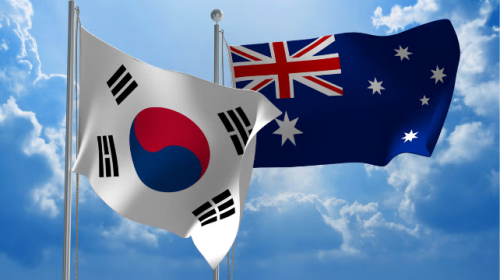
The paper is set out to provide the logic thread. Part 1 demonstrates that restraint has historically hinged on reassurance and pressure, not capability. Part 2 describes three triggers and, more importantly, their interaction to create a pathway to decision-making for ROK policymakers. Part 3 provides options that Australia can pursue to lower the probability of nuclearisation while strengthening deterrence: reinforce and clarify reassurance, deepen spoke-to-spoke ties with JPN and the ROK, and build capability pathways that strengthen confidence. ROK nuclear restraint is strategic and contingent; the triggers are interconnected; and Australia has agency to shape the calculus away from nuclearisation.
Part 1: Republic of Korea and Nuclear Weapons
Historically, the ROK’s indigenous nuclear ambitions are not new; today’s debates echo earlier episodes when Seoul sought to hedge against perceived alliance fragility. In the early 1970s, President Park Chung Hee authorised a clandestine nuclear weapons development program.1 This decision was driven by an apparent weakening of the US–ROK security relationship, symbolised most clearly by Washington’s unilateral withdrawal of the US 7th Infantry Division from the peninsula in 1971.2 That decision came against a backdrop of strained trust: a secret US–DPRK dialogue in 1969–70 over the USS Pueblo incident and a decade of North Korean infiltration and provocation, including the 1968 Blue House raid, had already fuelled Seoul’s anxieties about US commitment.3
At that time, South Korea lacked the current civilian nuclear industrial base to rapidly produce fissile material, but Park’s administration actively sought external supply contracts from Canada and France to accelerate its program.4 These procurements, if successful, would have provided the means for both production and potential weaponisation within a projected six- to ten-year horizon.5 Ultimately, the initiative was curtailed under sustained US diplomatic and economic pressure, including threats to restrict Bank financing6 and to suspend military assistance,7 coupled with the assurance of US extended deterrence under the nuclear umbrella.8 This section highlights a pattern: South Korea’s nuclear restraint was not simply a matter of capability, but of alliance reassurance and international pressure.
Since the 1970s, the credibility of US extended deterrence has remained the cornerstone of Seoul’s nuclear restraint.9 In 1958, Washington deployed tactical nuclear weapons to the peninsula, both to modernise allied warfighting options and to offset South Korea’s resource constraints during its reconstruction.10 These weapons remained stationed in Korea until 1991,11 when the George H.W. Bush administration unilaterally withdrew them as part of a broader post–Cold War initiative to reduce tactical nuclear stockpiles.12
Although the physical presence of nuclear weapons ended, successive US administrations have maintained assurances under the “nuclear umbrella”.13 These commitments have been reaffirmed through mechanisms such as the Extended Deterrence Strategy and Consultation Group (EDSCG) and, in 2023, the Nuclear Consultative Group (NCG)14 in response to heightened DPRK nuclear testing.15 Nevertheless, the robustness of these guarantees has not been immune to strain. Periodic shifts in US strategic focus, towards Europe during NATO crises or towards the Taiwan Strait in countering China, have stoked abandonment concerns in Seoul.16 Despite these doubts, extended deterrence has consistently served as the institutional anchor through which the ROK has maintained its obligations under the Nuclear Non-Proliferation Treaty (NPT), underscoring that restraint remains dependent on reassurance.
As a result of US security and nuclear industry assurances and the failure of Seoul’s foray into indigenous nuclear weapons development, the ROK ratified the Non-Proliferation Treaty (NPT) in 1975,17 aligning itself with international norms. Its compliance and acceptance of full-scope IAEA safeguards were not, however, purely normative; they were essential prerequisites for ROK civil nuclear cooperation, guaranteeing access to US civilian nuclear technology, financing, and reactor supply so long as compliance was maintained,18 highlighting that restraint was driven by leverage, not technical limitations.
The NPT commitment remains a cornerstone of Seoul’s nuclear restraint.19 As the ROK became one of the world’s largest nuclear energy producers, the benefits of compliance provided strong incentives to uphold its non-nuclear status. Nevertheless, the NPT itself contains an exit clause. Under Article X, any signatory may withdraw with three months’ notice if “extraordinary events”20 jeopardise its supreme national interests.21 The DPRK invoked this clause in 2003 to justify its departure from the treaty,22 setting a precedent that Seoul could conceivably mirror under extreme security duress. Whilst such a move would be highly controversial and carry severe costs, its legal availability and the ROK’s modern enhanced nuclear and industrial technology represent a path to proliferation, reinforcing that modern restraint remains contingent rather than technical.
Unlike in the 1970s, today South Korea possesses the industrial and technological foundations to rapidly develop nuclear weapons if it chose to do so. Its world-leading civilian nuclear power sector provides extensive expertise in reactor design, fuel-cycle management, and nuclear materials handling. Coupled with a highly advanced defence industry, particularly in ballistic missiles and precision guidance, Seoul has a robust technological base for weaponisation.23 Past research efforts further contribute to this latent knowledge base. Collectively, these attributes constitute a capability of nuclear latency (or threshold capability):24 the possession of technical expertise, materiel, and equipment, but the combination of such is short of an actual weapon.
Historically, constraints on access to fissile material limited South Korea’s ability to move quickly towards weaponisation.25 Yet the maturity of its nuclear industry and accumulated technical expertise significantly reduces these barriers today. While estimates vary, some analysts suggest that Seoul could produce a deliverable nuclear device in less than two years, provided the political decision was made and investment in enrichment or reprocessing infrastructure was accelerated.26 Whilst an initial device might be feasible within such a timeframe, operationalising a reliable and survivable nuclear force would take longer.27 Nonetheless, the essential point remains that South Korea’s restraint is not technical, but strategic, conditioned by external triggers such as alliance pressures and domestic politics. This is the foundation for how this paper assesses how the triggers; the erosion of US reassurance, DPRK escalation, and domestic pressures can converge to tip Seoul’s nuclear calculus.
Part 2: Strategic Triggers for Nuclearisation
A decision to acquire or pursue indigenous nuclear weapons development would not derive from historical actions and threat perceptions alone and would not be made by accident or afterthought. For the ROK contemplating such a consequential step, the ultimate judgement would be shaped by convergence of political and security calculations and, perhaps most fundamentally, by the meaning and strategic value that leaders attach to the possession of such capabilities.
Erosion of US Deterrence Credibility
The primary trigger that would see Seoul abandon its strong non-proliferation position and actively pursue the development of an indigenous nuclear weapons capability is the weakening of US security guarantees, perceived or real. US extended deterrence has functioned as a safety net, enabling the ROK’s strategic restraint,28 anchoring its decision to remain within the NPT framework despite possessing a credible and unquestionable latent capability to pursue nuclear weapons. Yet this assurance is contingent. If the credibility of US guarantees were seriously undermined or called into question, the rationale for continued restraint could quickly evaporate.29
The most indisputable and visible representation of erosion would be a reduction in US force presence on the peninsula, a repetition of the action taken by the Nixon and Carter administrations of the 1970s. The heavy forward-deployed US presence has long served as both a physical deterrent against DPRK action and a symbol of commitment.30 The withdrawal of the US 7th Infantry Division in 1971, the US announcement of tactical nuclear weapon removal and troop reduction in the late 1970s, which never eventuated,31 followed by the complete removal of US nuclear weapons in 1991,32 have left scars in South Korea’s strategic memory. More recently, debates within Washington about troop reductions, cost-sharing, and whether Seoul is paying its fair share echo these earlier anxieties. From an ROK perspective, signals from Washington that the alliance is transactional, such as continuous calls for dramatic increases in ROK payments in the Special Measures Agreement33, with President Trump previously calling for a 400% increase,34 along with warnings of troop withdrawal if the fiscal burden of defence is not shared,35 imply conditionality. Meanwhile, signals of solidarity, including the projection of nuclear-armed platforms to the peninsula36 or the 2023 “Commitment to Consult” trilateral (ROK-US-JPN) joint statement,37 seek to highlight an unconditional guarantee by normalising presence and formalise dialogue. This rhetoric, particularly under the current US administration that prioritises transactional agreements over solidarity, sends strong signals to ROK policymakers and the public that current US guarantees may be conditional rather than absolute.38
A second dimension of erosion lies in political dialogue about alliance priorities, specifically those that cast doubt on the readiness and reliability of conventional deterrence through US force posture. Statements that suggest US Forces Korea (USFK) could be redeployed to meet contingencies elsewhere feed into long-standing South Korean fears of abandonment.39 The current commander of USFK has spoken of the need for flexibility in force employment and force posture, indicating that forces may be used for crisis across the Indo-Pacific and not wholly dedicated to the defence of the peninsula.40 A view supported by Elbridge Colby, who has stated that U.S force should not be “held hostage” to a DPRK threat on the Peninsula and should be focused solely on China.41 This rhetoric reinforces concerns that Korea could be sacrificed if Washington were to judge other theatres to be higher priorities, as clearly expressed by a former chairman of the ROK Joint Chiefs of Staff “Seoul must prepare for contingencies where US support may be limited”.42 The last time USFK was substantially refocused was during the Bush administration’s Global Posture Review in support of the Global War on Terror, with troops withdrawn to support operations in Iraq.43 With the current US focus on countering China causing speculation that troop reductions on the peninsula to bolster US first-island-chain defences,44 or the redeployment of key defence systems, such as Patriot batteries, away from the peninsula to other global theatres,45 when combined with the lowest number of active duty US personnel on the peninsula since the cessation of hostilities,46 the ROK may see growing doubt in the commitment and strength of US force posture. In the calculus of deterrence, even the suggestion that US commitments may be diverted, coupled with the historical precedent of distraction, undermines the credibility.
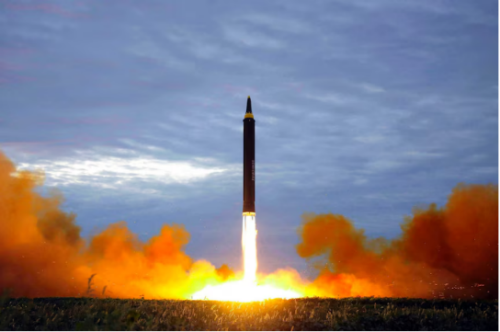
Third, the failure of US deterrence, conventional or nuclear, in support of another alliance or agreement would have profound effects on Korean trust in the alliance. This could occur in two modes: deterrence collapse, which manifests as a failure to prevent aggression, and deterrence- credibility collapse, a hesitation or failure to respond at all to aggression. Seoul can see this playing out globally. In Ukraine, in which deterrence has already failed, deterrence credibility hinges on sustained resolve and support.47 Whilst deterrence is yet to be tested in the Indo-Pacific, the increasing ambiguity in US signaling and apparent transactional nature of US alliances48 mean the credibility of US guarantees may be questioned. This logic is simple and follows de Gaulle’s “trade New York for Paris” or, as South Korean politicians, academics and journalists have put it, “trade San Francisco for Seoul”.49 If the US proves unwilling to defend others in a conflict that is overtly not in its interests, why would it accept the risk of escalation to defend the ROK in a conflict with the DPRK? This directly reinforces the convergence risk.
Whilst global cases shape Seoul’s read on US resolve, the ultimate test occurs on the peninsula itself. From this perspective, two themes matter. First, deterrence of aggression, which has largely held, no large-scale, conventional DPRK military actions have occurred since the Armistice and recurrent low-level incidents sit outside what US deterrence has sought to dissuade.50 Second, deterrence of nuclear advancement, which has not held: DPRK’s nuclear and missile programs have expanded despite sanctions and pressure, and many in the ROK judge that this trajectory increases the requirement for stronger reassurance mechanisms. Whilst the strong history of deterring action sustains faith in the alliance, a significant conventional action, or unchecked build-up, that exposes failings in the deterrent would raise existential questions about the sustainability of reliance on US support, likely creating the “extraordinary events” 51 justification to exit the NPT.
When taken together, these circumstances highlight that erosion of US extended deterrence is not a hypothetical scenario but a tangible, measurable, interconnected process. From reductions in physical presence and hardening rhetoric to competing priorities and regional and global alliance failures, each element chips away at the ROK’s confidence in the alliance. If these pressures converge, the result could be decisive: the ROK may view an indigenous nuclear capability not as a choice, but as the only viable guarantor of national survival against DPRK efforts at aggressive reunification.
Escalatory DPRK Actions
The second, but not subordinate, trigger that could compel Seoul to abandon nuclear restraint is the trajectory of increasingly bold and hostile DPRK behaviour. While doubts over US extended deterrence create the permissive strategic environment for escalation to flourish,52 as at the start of the Korean War, it is the DPRK’s actions, provocative, asymmetric and increasingly belligerent, that create the obvious and immediate pressure on ROK policymakers.53 Every escalation, be it conventional, nuclear, or rhetorical, gradually undermines the public and political confidence in existing security arrangements and amplifies the logic of nuclearisation to achieve security self-reliance.
The first dimension of this escalation lies in the DPRK’s pattern of low-level provocations. Pyongyang has long employed calibrated harassment, albeit sometimes retaliatory,54 such as artillery fire into ROK or disputed territories, the emplacement of anti-personnel land mines in the Demilitarised Zone, cyber intrusions, and, more recently, balloon launches carrying propaganda and refuse across the border.55 Between 2022 and 2024, such actions escalated56 to the point of collapsing the historic 2018 Comprehensive Military Agreement57, demonstrating the tenuousness of any negotiated stability and restraint. These activities may not represent existential threats in isolation, but the cumulative effect is certainly destabilising. This normalisation of provocation, in turn, reinforces and inflames domestic opinion, fostering a belief that ROK restraint presents a targetable vulnerability for a nuclear-armed neighbour. In this security environment, arguments for independent nuclear capabilities gain traction as the only credible safeguard against perpetual intimidation. Whilst conventional threats, be they clandestine or overt, will slowly erode the stability of the peninsula, combined with the nuclear imbalance in favour of the North all represents an existential threat, and a path to proliferation.
The second dimension is the modernisation and expansion of the DPRK nuclear program. The DPRK’s pursuit of nuclear weapons is not new, long justified as a defensive measure to deter invasion or regime change. 58 Pyongyang’s focus on the development of strategic nuclear weapons and ICBMs was often interpreted as primarily retaliatory, a tool to address the asymmetry of the conventional military power on the peninsula. This logic was reinforced by Kim Jong Un claiming that the DPRK had “perfected the national nuclear forces”59 after the successful launch of an ICBM in 2017. Yet this accomplishment did not slow the nuclear weapons development of the DPRK; concerningly for the ROK, the program evolved to focus on warhead miniaturisation and diversified delivery systems, and by 2021, in another of Kim’s addresses, at the Eighth Party Congress, the prioritisation had shifted to developing tactical-nuclear weapons60 and leaning towards a more offensive nuclear posture.61
This doctrinal shift towards tactical nuclear weapons alters the threat calculus for Seoul. Whilst previous strategic capabilities, combined with rhetoric, indicated that the program was designed to target US territories, tactical warheads are optimised for short-range ballistic missiles to strike across the peninsula. This emerging rhetoric and testing have been accompanied by ‘leaked’ images from the DPRK that demonstrate the intended locations of tactical-nuclear weapons employment.62 The September 2022 shift in nuclear policy authorised nuclear weapons use not only in retaliation for hostile actions but when it “is judged that they are imminent”.63 This marks a significant change from the previous policy, implemented in 2013, which approximated a no-first-use policy.64 This apparent loosening of nuclear restraint by the DPRK only increases the immediacy and unpredictability of the threat to the ROK and signals that nuclear weapons are no longer confined to deterring US actions but could be used first in a peninsula conflict to strike the ROK.
For Seoul, this evolution transforms the DPRK’s arsenal into both a deterrent and a credible first-strike capability, creating immediate pressure and intensifying debate over whether the ROK requires its own nuclear deterrent. Whilst nuclear development and testing are actively deterred through military posturing and diplomacy, this often produces a spiral of escalatory behaviour that does not dissuade DPRK nuclear testing, but rather emboldens it,65 creating a near-impossible calculus for the ROK. A test explicitly framed as a strike simulation could serve as a catalytic event, removing the option for nuclear restraint.
 Third, North Korea’s strengthening ties with Russia and China represent a critical external enabler, providing combat experience, technological transfers, and political legitimacy that amplify its threat to Seoul. The strategic partnership between Moscow and Pyongyang has always been cordial and cooperative, bordering on apathetic,66 however, the Russo-Ukrainian war has elevated the partnership and with it the threat that a new alliance, under the auspices of a “comprehensive strategic partnership”,67 poses to Seoul. Whilst the supply of as many as 5.2 million rounds of cannon and rocket artillery68 and up to 150 ballistic missiles69 demonstrates solidarity with Russia and reduces the DPRK’s magazine depth, it provides a far more valuable return, that of a feedback loop.70 With DPRK troops, combat systems, and doctrine being employed, assessed and evaluated in combat conditions that replicate a near-peer conflict supported by Western allies, s the peninsula.71 This combat-proving experience, coupled with the deliberate and incidental transfer of Russian military technologies, doctrine, and training, bolsters DPRK conventional military modernisation and support the growth of the DPRK military-industrial complex to meet the growing demand for expanded arms exports.72
China’s role in the modernisation and emboldening of DPRK has not taken a back seat and remains complementary. Beijing continues to walk the diplomatic knife-edge in providing political support for Pyongyang in international forums, harking back to the origins of the relationship, as China still needs the DPRK to provide a buffer against US forces on the Asian continent, as Mao described with the idiom “without the lips the teeth are cold”.73 Symbolically, China has taken steps to cement a new ‘axis’ alliance between the three states, with a demonstration on the world stage with the military parade commemorating the 80th anniversary of the Chinese victory in the Second Sino-Japanese War and the end of the Second World War in which Xi Jinping, Vladimir Putin, and Kim Jong-un, stood shoulder to shoulder and projected a consolidated anti-Western bloc, underscoring Beijing’s willingness to grant the DPRK legitimacy as part of a wider strategic front74 and potentially to support in a peninsula conflict.
The combined effect of these bilateral partnerships and the collective alliance is twofold. First, they accelerate DPRK’s modernisation, through both the combat experience provided to its troops and testing of its combat systems, making its forces more capable. Second, they anchor DPRK within a strengthening China-Russia-DPRK axis that stands in contrast to perceptions of US-ROK alliance fragility. For Seoul, this heightens the imbalance and exacerbates doubts about the US’ capacity or willingness to offset it, strengthening calls for an independent nuclear deterrent as the self-assured deterrence it seeks.
Taken together, the above factors highlight the rising instability and the ROK perception of the DPRK threat is well-founded. Persistent conventional provocations, advances in nuclear technologies and doctrine, conventional modernisation through external partnerships, and the increasingly strong alliances with DPRK’s aligned neighbours all converge to raise existential questions about continued reliance on external nuclear deterrence. Should these pressures reach boiling point, Seoul may be left with no viable alternatives. ROK may conclude that restraint is no longer viable and that an indigenous nuclear capability represents the only effective guarantor of its survival. Together, these dynamics elevate the risk that, if paired with weaker US reassurance, convergence could tip Seoul’s calculus.
Domestic Political and Popular Pressures
The third trigger is the result of the cumulative effects of the previous two triggers. Whilst the nuclear rhetoric has periodically surfaced in political conversations throughout the history of the ROK, since the end of military Junta rule,75 it has been no more prevalent than in the last decade. Specifically, over the past five years, under a previous administration, ROK nuclear restraint has shifted from a globally assumed reliable constant to a domestically and internationally contested policy position. The shifting security situation, outspoken political leadership, and shifts in public opinion have shaped a domestic environment that questions the strategic patience and restraint of Seoul. The debate on a nuclear ROK is once again not hypothetical; the emergence of rhetoric, apparent popular support and nuclear latency have created a credible scenario that Seoul may seek an indigenous capability if alliance guarantees are assessed as failing. This constitutes the third trigger.
Politically, the re-emergence of the nuclear question has been brought to bear through presidential signaling and domestic political support for the conversation to be had. President Yoon Suk Yeol’s remarks in January 2023, in which he conceded that “It’s possible that the problem gets worse and our country will introduce tactical nuclear weapons or build them on our own”,76 whilst this stopped short of an actual plan it normalised and legitimised a conversation that had previously been taboo both domestically and internationally. The Yoon administration later walked back these comments,77 but the rhetorical floodgates had been opened and the theme has continued to re-emerge.78 The administration then moved to translate rhetorical risk into procedural reassurance through the reinstated EDSCG and the creation of the NCG, complemented by the Washington Declaration’s measures.79 Whilst the reassurance of the US nuclear umbrella stymied the conversation, the issues which bore the sentiment remain active, such as the questions of escalation and the decision rights over nuclear use. Under the current Lee administration, advocacy for nuclear armament is unlikely, as his commitment to non-proliferation and a nuclear-free peninsula remains paramount in his policy.80 But the proverbial nuclear genie has been let out of the bottle, combined with Lee’s loosening stance on nuclear power,81 questions over the alliance, sub-surface bipartisan support,82 and a popular majority view, this means that nuclearisation is not off the table.
Whilst political discourse may bring the issue to bear, domestic popular support provides the momentum and backing. The Korean Institute for National Unification (KINU) Unification Survey series traces a robust, bipartisan majority for an indigenous nuclear weapons capability, which obviously ebbs and flows with provocations and peninsula incidents but remains persistently stable across administrations. Whilst the peak in support over the past five years came, predictably so, in 2021 due to DPRK provocations to 71%, it began to ease over the following two years, from 69% in 2022 to a low of 60.2% in 202383. Although in 2024 support once again rose to 66% in the face of DPRK provocation, in parallel, and worryingly so, the trust in the US nuclear umbrella fell from 72.1% to 66.9%.84 Similar polls from the Chicago Council on Global Affairs in 2022 showed 71% of the surveyed population support an indigenous nuclear weapons program, and when definitively asked to choose between a US deployment or an independent capability, the majority supported the latter (67% vs 9%).85 A similar question was posed in 2024 by the KINU survey and a comparable trend emerged: South Koreans would prefer a ROK nuclear capability over the presence of USFK, a first in the KINU surveys.86
Whilst the voice for popular public support is the loudest, a dissenting position persists, and its powerful base is non-trivial. A Center for Strategic and International Studies (CSIS) study from 2024 provides the most empirical data to support the dissenting view that has existed in Seoul for many years. The study engaged a less-surveyed demographic, described as “the strategic elite”87 in this case referring to a “sample [including] academics, think tank experts, business elites, legislators, and officials (current and former)”88 who are far less supportive of nuclearisation. When posed with the same question of an independent nuclear capability, in contrast, only 34% supported and 53% opposed, with 13% neutral.89 This significant deviation in support is likely due to the sample being far more acutely aware of the substantial economic, human and diplomatic costs of nuclearisation and that these, at least in the current security climate, far outweigh the benefits. They likely understand that the impacts of nuclearisation on the regional security dynamics and the significant risks to current alliances. They additionally understand that associated sanctions and withdrawals would likely decrease, not increase, the net security of the ROK.90 It is evident, in current restraint, that this view holds significant weight in the decisions of Seoul and has shaped official policy under both conservative and progressive governments alike. Whilst this powerful group remains influential, it is increasingly pressing against a popular domestic sentiment conditioned by DPRK escalation and an alliance whose reassurance, though substantial, is perceived as on shaky ground. Domestic pressures interact with erosion and escalation, tightening Seoul’s calculus.
PART 3: Australian Policy Recommendations to Reduce the Likelihood of ROK Nuclearisation
Australia’s interests in a non-nuclear ROK align directly with Australia’s interests in a stable Indo-Pacific. A nuclear-armed ROK would drag the region in the opposite direction by weakening a strong regional non-proliferation regime, opening the door to nuclear debate among other regional neighbours (namely JPN)91 and irreversibly complicating reunification or peace on the peninsula.92 Part 2 addressed why ROK may cross the nuclear threshold: doubts about US extended deterrence, a worsening DPRK threat, and domestic pressures that crest in moments of fear. Australia has little power to remove these drivers, but it can work to change Seoul’s calculus for nuclearisation.
Advocacy to strengthen the US-backed extended nuclear deterrence. Australia should advocate, both publicly and privately, for reassurance that is both clearer in language and heavier in capability. Australia should encourage Washington to move away from ambiguous policies on US nuclear weapons and provide tangible conditions for their employment. These policies should seek to enhance the ‘collective’ security narrative across the Indo-Pacific, to reassure the ROK and other regional allies.93 This is not to create an escalatory posture, but to create predictable and tangible thresholds. These assurances do not need to constitute a commitment for nuclear use but should include ROK decision-makers and decision-making pathways to go beyond the current consultative and response mechanisms.94
In concert with unambiguous commitments, Canberra should advocate for bringing the ROK into AUKUS. Initial efforts should be focused on bringing the ROK into Pillar II,95 in a similar manner to Japan’s consideration for entry,96 and this should seek to deliver near-term technological and information advantages to counter the DPRK threat. In parallel, Australia should support a path toward a future nuclear-powered submarine option for the ROK. Whilst this track would require strict guardrails to ensure that NPT/IAEA principles are maintained and a renegotiation of the current “123 Agreement”,97 this would ultimately enhance the strength of ROK organic deterrence and signal to Seoul the US enduring commitment to defence. This clearly messages that Australia backs stronger US extended-deterrence commitments and AUKUS-enabled capability, offering a framework that is institutionalised in commitment and credible.
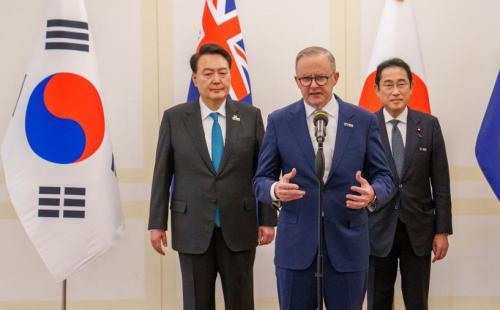
Image: United States Studies Centre
Formalise an AUS–JPN–ROK trilateral to reinforce extended deterrence. To complement US nuclear assurance without seeking to replace it, Australia should establish AUS–JPN–ROK security trilateral focused on conventional deterrence and crisis management. This agreement seeks to support US guarantees by establishing routine security cooperation that provides Seoul with predictable, visible, and stable alliance frameworks that present options in a time of crisis. Australia is well placed to convene such an agreement. Track-1.5 foundations already exist: in June 2024, the United States Studies Centre hosted the inaugural “Australia–Japan–Korea Trilateral Dialogue”,98 aimed at advancing trilateral approaches that complement existing alliance architectures rather than replacing them.99 The framework emphasises ‘spoke-to-spoke’ cooperation and coordination across security and national resilience agendas.
Additionally, Australia is well placed to act as a bridge towards a deeper and more meaningful ROK-JPN relationship that overcomes historical frictions.100 Whilst historically the US has acted in this role, Australia’s involvement would likely garner less international and domestic political attention and allow for the dialogue to avoid inflaming opinion.101 This cooperation would likely need to leverage the existing mechanisms through dialogue and Track-1.5 initiatives that exist to start with informal cooperation to pave the way for institutionalised collaboration, guarantees and joint security outcomes.102 A trilateral security partnership would seek to ease ROK abandonment concerns by offering alternatives to US extended deterrence considering concerns for failing assurances.
Conclusion
South Korea’s restraint is not technological; it is held by reassurance, risk, and diplomacy. If US extended deterrence appears conditional, if DPRK nuclear first-use becomes apparent, and if domestic pressure peaks, Seoul’s calculus will tighten. No single trigger tips the balance. Convergence does. That is the decision space that matters for Australia.
Australia cannot remove those triggers, but it can slow their convergence. The policy approach is credible, visible, non-escalatory reassurance: press the US to clarify thresholds and decision-making; normalise institutionalised presence and consultations; and build spoke-to-spoke alliances with JPN and the ROK that reduce the likelihood of abandonment narratives. AUKUS provides a useful frame for integration of technology and information flows, and carefully guard-railed pathways that strengthen ROK capabilities without realising weapon proliferation or breaching NPT guardrails.
To avoid nuclearisation, keep alliance reassurance strong, threats manageable, and diplomatic and domestic political space open in Seoul. Achieving that will likely keep the status quo in which a non-nuclear ROK prevails, even faced with nuclear latency and a worsening strategic threat environment.
Arkin, Dan. “US and South Korea Agree to Deploy Patriot Missiles to Middle East Amid Rising Tensions with Iran | Israel Defense.” Israel Defense, April 6, 2025. https://www.israeldefense.co.il/en/node/64818.
BBC News (London). “North Korea Tests New Weapon ‘to Improve Tactical Nukes.’” April 17, 2022. https://www.bbc.com/news/world-asia-61133225.
Bell, Corey Lee. “AUKUS Dampens South Korea’s Nuclear Submarine Hopes - Australian Defence Magazine.” https://www.australiandefence.com.au/defence/sea/aukus-dampens-south-korea-s-nuclear-submarine-hopes.
Biden, Joseph, and Seuk yul Yoon. “Joint Statement by President Biden and President Yoon on US-ROK Guidelines for Nuclear Deterrence and Nuclear Operations on the Korean Peninsula.”
US Embassy & Consulate in the Republic of Korea, July 12, 2024. https://kr.usembassy.gov/071224-joint-statement-by-president-biden-and-president-yoon-on-u-s-rok-guidelines-for-nuclear-deterrence-and-nuclear-operations-on-the-korean-peninsula/.
Bureau of International Security and Nonproliferation. US-Republic of Korea (R.O.K.) Agreement for Peaceful Nuclear Cooperation. US Department of State, 2025. https://www.state.gov/bureau-of-international-security-and-nonproliferation/releases/2025/01/u-s-republic-of-korea-r-o-k-agreement-for-peaceful-nuclear-cooperation/.
Campbell, Kurt M., Robert J. Einhorn, and Mitchell B. Reiss. The Nuclear Tipping Point: Why States Reconsider Their Nuclear Choices. Bloomsbury Publishing USA, 2004. http://ebookcentral.proquest.com/lib/deakin/detail.action?docID=273542.
Carlin, Maya. “Patriot Missile Batteries Are Headed to the Middle East - The National Interest.” The National Interest – The Buzz, April 7, 2025. https://nationalinterest.org/blog/buzz/patriot-missile-batteries-are-headed-to-the-middle-east.
Cha, Victor. South Korea’s Nuclear Option. Center for Strategic and International Studies, 2024. https://www.csis.org/analysis/breaking-bad-south-koreas-nuclear-option.
Cha, Victor. The Meaning of US Troop Withdrawals from Korea. Center for Strategic and International Studies (CSIS), 2025. https://www.csis.org/analysis/meaning-us-troop-withdrawals-korea.
Channer, Hayley. Manufacturing Partners: Japan-South Korea Security Cooperation and Australia’s Potential Role. No. 69. Strategic Insights. Australian Strategic Policy Institute, 2014.
Cheon, Seoung-whun. “Changing Dynamics of US Extended Nuclear Deterrence on the Korean Peninsula | Nautilus Institute for Security and Sustainability.” NAPSnet Special Reports, November 10, 2010. https://nautilus.org/napsnet/napsnet-special-reports/changing-dynamics-of-u-s-extended-nuclear-deterrence-on-the-korean-peninsula/.
Cheong, Wook-Sik. “The DPRK’s Changed Nuclear Doctrine: Factors and Implications.” Journal for Peace and Nuclear Disarmament 6, no. 1 (2023): 136–47. https://doi.org/10.1080/25751654.2023.2188859.
Choe, Sang-Hun. “In a First, South Korea Declares Nuclear Weapons a Policy Option.” The New York Times (New York), January 12, 2023. https://www.nytimes.com/2023/01/12/world/asia/south-korea-nuclear-weapons.html.
Choi, Jung Hoon. “North Korea’s Advanced Nuclear Weapons and US Extended Deterrence for South Korea: An Assessment Based on Nuclear Deterrence Theory.” Journal of the Asia-Japan Research Institute of Ritsumeikan University 3 (October 2021): 82-102.
Choi, Kyungwon. The Formation of Japan-ROK Security Relations: Meeting the Evolving Cold War Challenge. Edited by Kyungwon Choi. Springer Nature, 2025.
Choi, Yoon-Hee. “Shifting US Security Priorities Put Korea-US Alliance under Strain.” Korea JoongAng Daily, July 11, 2025. https://koreajoongangdaily.joins.com/news/2025-07-11/opinion/columns/Shifting-US-security-priorities-put-KoreaUS-alliance-under-strain/2350070.
Clay Moltz, James. “Future Nuclear Proliferation Scenarios in Northeast Asia.” The Nonproliferation Review 13, no. 3 (2006): 591–604. https://doi.org/10.1080/10736700601071769.
Collins, Liam, and Frank Sobchak. “Why the United States Failed to Deter Russia in Ukraine.” Foreign Policy, October 2, 2025. https://foreignpolicy.com/2023/02/20/ukraine-deterrence-failed-putin-invasion/.
Corben, Tom. “ROK-Australia-Japan Cooperation: A Perspective from Australia.” United States Studies Centre (USSC) - (Originally Published in The Asan Forum.). https://www.ussc.edu.au/rok-australia-japan-cooperation-a-perspective-from-australia.
Cranny-Evans, Sam. “Brothers in Arms: Assessing North Korea’s Contribution to Russia’s War in Ukraine.” September 16, 2025. https://www.rusi.org/explore-our-research/publications/commentary/brothers-arms-assessing-north-koreas-contribution-russias-war-ukraine.
Da-gyum, Ji. “Allies Face Test with Return of Trump’s Transactional Diplomacy.” The Korea Herald, November 7, 2024. https://www.koreaherald.com/article/3849431.
Dalton, Toby, Karl Friedhoff, and Lami Kim. Thinking Nuclear: South Korean Attitudes on Nuclear Weapons. Public-Opinion Survey Report. Chicago Council on Global Affairs, 2022. https://globalaffairs.org/research/public-opinion-survey/thinking-nuclear-south-korean-attitudes-nuclear-weapons.
Davenport, Kelsey. “North Korea Ends Inter-Korean Military Agreement.” Arms Control Today, February 2024. https://www.armscontrol.org/act/2024-02/news/north-korea-ends-inter-korean-military-agreement.
Davenport, Kelsey. “South Korea Walks Back Nuclear Weapons Comments.” Arms Control Today, March 2023. https://www.armscontrol.org/act/2023-03/news/south-korea-walks-back-nuclear-weapons-comments.
Earl, Jessica. “South Korea’s Lingering Nuclear Debate Comes into Focus.” Parley Policy Initiative, July 29, 2025. https://www.parleypolicy.com/post/south-korea-s-lingering-nuclear-debate-comes-into-focus.
Engelhardt, Michael J. “Rewarding Nonproliferation: The South and North Korean Cases.” The Nonproliferation Review 3, no. 3 (Spring-Summer) (1996): 31–37. https://doi.org/10.1080/10736709608436635.
Farrington, Keegan. “How Continued US Aid to Ukraine Enhances America’s Credibility.” American Security Project, March 10, 2023. https://www.americansecurityproject.org/how-continued-u-s-aid-to-ukraine-enhances-americas-credibility/.
Fitzpatrick, Mark. Asia’s Latent Nuclear Powers: Japan, South Korea and Taiwan. Taylor & Francis Group, 2016. http://ebookcentral.proquest.com/lib/deakin/detail.action?docID=5088270.
Frassineti, Francesca. “Signals in the Noise: North Korea’s Participation in the Russian Invasion of Ukraine as a Catalyst for Europe-South Korea Cooperation.” The Asan Institute for Policy Studies - Issue Brief No. 2025-05 (July 2025). https://www.asaninst.org/data/file/s1_1/53a22aed2117838f4539133b88902f5a_ECsmqX x8_8ce595730ea024394d3b7bf6bc1e9ca193409417.pdf.
Furukawa, Katsuhisa. The 8th Congress of the Workers’ Party of Korea (1): 5–12 January 2021. Open Nuclear Network, 2021. https://opennuclear.org/open-nuclear-network/publication/8th-congress-workers-party-korea-1.
Gallo, William, and Lee Juhyun. “Under Yoon, Calls for South Korean Nukes ‘Normalized.’” Voice of America, September 9, 2024. https://www.voanews.com/a/under-yoon-calls-for-south-korean-nukes-normalized/7777068.html.
Han, Yong-Sup. South Korea and Nuclear Weapons: Retrospect and Prospects. No. 56. APLN Policy Brief. Asia-Pacific Leadership Network, 2018. https://apln.network/analysis/policy-briefs/policy-brief-no-56-south-korea-and-nuclear-weapons-retrospect-and-prospects.
Hawkins, Amy, and Helen Davidson. “North Korea’s Involvement in Ukraine Draws China into a Delicate Balancing Act.” World News. The Guardian, November 6, 2024. https://www.theguardian.com/world/2024/nov/06/north-korea-troops-russia-ukraine-war-china-relationship.
Hill, Alannah. “How US Forces Korea Is Changing Its Tune on Mission to Counter North Korea | NK News.” NK News - North Korea News, June 12, 2025. https://www.nknews.org/2025/06/how-us-forces-korea-is-changing-its-tune-on-mission-to-counter-north-korea/.
House, The White. “Commitment to Consult.” The White House, August 18, 2023. https://bidenwhitehouse.archives.gov/briefing-room/statements-releases/2023/08/18/commitment-to-consult/.
Howell, Edward. North Korea and Russia’s Dangerous Partnership: The Threat to Global Security from the Kim–Putin Axis and How to Respond. Royal Institute of International Affairs, 2024. https://doi.org/10.55317/9781784136321.
Hrytsenko, Alina. “North Korea Is Using Russia’s Ukraine Invasion to Upgrade Its Army.” Atlantic Council - UkraineAlert, January 23, 2025. https://www.atlanticcouncil.org/blogs/ukrainealert/north-korea-is-using-russias-ukraine-invasion-to-upgrade-its-army/.
International Atomic Energy Agency (IAEA). Report by the Director General on the Implementation of the Resolution Adopted by the Board on 6 January 2003 and of the Agreement between the IAEA and the Democratic People’s Republic Of Korea for the Application of Safeguards in Connection with the Treaty on the Non-Proliferation of Nuclear Weapons. GOV/2003/4. International Atomic Energy Agency: Board of Governers, 2003.
International Campaign to Abolish Nuclear Weapons (ICAN). “Nuclear Tensions Keep Rising on Korean Peninsula.” International Campaign to Abolish Nuclear Weapons (ICAN). https://www.icanw.org/nuclear_tensions_rise_on_korean_peninsula.
Jeong, Jae-hwon, and Su-hyeon Park. “US Official Calls South Korea a ‘Model’ for Defense Burden Sharing.” National. The Chosun Daily, August 6, 2025. https://www.chosun.com/english/national-en/2025/08/06/OZLISZKRFVHJZCYGIWIVXEEIPQ/.
Jeongmin. “Trump Implies US Could Withdraw Troops If ‘Wealthy’ South Korea Doesn’t Pay More.” NK News - North Korea News (via Yonhap), May 1, 2024. https://www.nknews.org/2024/05/trump-implies-us-could-withdraw-troops-if-wealthy-south-korea-doesnt-pay-more/.
Jo, Bee Yun. Strategic Flexibility of USFK and the Future of the ROK-US Alliance. Policy Brief Nos.2025–19. Sejong Policy Brief. Sejong Institute, 2025. https://sejong.org/web/boad/1/egoread.php?bd=24&seq=12333&utm.
Kanishkh, Kanadia. “US Indo-Pacific Allies Are Unhappy about Trump’s Defence Demands. But They Have to Comply.” Chatham House, July 14, 2025. https://www.chathamhouse.org/2025/07/us-indo-pacific-allies-are-unhappy-about-trumps-defence-demands-they-have-comply.
Kelly, Robert E., and Min-Hyung Kim. “Why South Korea Should Go Nuclear: The Bomb Is the Best Way to Contain the Threat From the North.” Foreign Affairs 104, no. 1 (2025): 113–26. International Security & Counter Terrorism Reference Center (182028927).
Kim, In Chul. “Statement by H.E. Ambassador KIM In-Chul Deputy Permanent Representative Permanent Mission of the Republic of Korea to the UN Secretariat and International Organizations in Geneva: General Debate Second Session of the Preparatory Committee for the 2020 Review Conference of the Parties to the Treaty on the Non-Proliferation of Nuclear Weapon.” April 23, 2018. https://unrcpd.org/wp-content/uploads/2014/04/South-Korea.pdf.
Kim, Jong Un, and Transcribed at North Korea Leadership Watch. “2018 New Year’s Address.” North Korean Leadership Watch: Research and Analysis on the DPRK Leadership, January 1, 2018. https://www.nkleadershipwatch.org/2018/01/01/new-years-address/.
Kim, Min-hyung. “Under What Conditions Would South Korea Go Nuclear? Seoul’s Strategic Choice on Nuclear Weapons.” Pacific Focus 38, no. 3 (2023): 409–31. https://doi.org/10.1111/pafo.12238.
Klingner, Bruce. “Crisis of Credibility: The Need to Strengthen US Extended Deterrence in Asia.” The Heritage Foundation: Backgrounder, no. No. 3751 (February 2023).
Korea.Net: The Official Website of the Republic of Korea. “President Lee to ‘open New Horizon for Practical Alliance’ with US.” August 26, 2025. https://www.korea.net/NewsFocus/policies/view?articleId=277781.
Kristensen, Hans M. “The Withdrawal of US Nuclear Weapons from South Korea.” Nukestrat (FAS), September 28, 2005. https://www.nukestrat.com/korea/withdrawal.html.
Kristensen, Hans M., and Robert S. Norris. “A History of US Nuclear Weapons in South Korea.” Bulletin of the Atomic Scientists 73, no. 6 (2017): 349–57. https://doi.org/10.1080/00963402.2017.1388656.
Lee, Daeyeon. “Direction, Implications, and Challenges of Lee Jae-Myung’s Nuclear Energy Policy.” The National Interest, August 25, 2025. https://nationalinterest.org/blog/energy-world/direction-implications-and-challenges-of-lee-jae-myungs-nuclear-energy-policy.
Lee, Hyo-Jin. “USFK Commander Stresses Expanded Role for US Troops in Korea against Broader Regional Threats.” South Korea. The Korea Times, August 10, 2025. https://www.koreatimes.co.kr/southkorea/defense/20250810/usfk-commander-stresses-expanded-role-for-us-troops-in-korea-against-broader-regional-threats.
Lee, Sang Sin, Taeu-uen Min, Juhwa Park, Chul Lee Moo, Kwang-Il Yoon, and Bon-Sang Koo. KINU Unification Survey 2024 — Executive Summary: North Korea’s Two-State Claim / US Presidential Election Outlook and ROK-US Relations. Korea Institute for National Unification, 2024. https://www.kinu.or.kr/eng/board/view.do?nav_code=eng1678858138&code=78h7R6uc KsuM&idx=24481.
Lee, Sang Sin, Taeu-uen Min, Kwang-Il Yoon, and Bon-Sang Koo. Executive Summary - KINU Unification Survey 2023 - Public Opinion on South Korea’s Nuclear Armament. Korea Institute for National Unification, 2023.
Lee, Seong-Hyon. “The China-Russia-North Korea Alliance That Needs No Name.” The Interpreter (Lowy Institute), September 2025. https://www.lowyinstitute.org/the-interpreter/china-russia-north-korea-alliance-needs-no-name.
Lee, Shin-ae. Russia-DPRK Strategic Partnership and Prospects for NATO-Indo-Pacific Cooperation. Wilson Center, 2024. https://www.wilsoncenter.org/sites/default/files/media/uploads/documents/2024-11_Lee.pdf.
Longo, Daniel J, and Karen Sokol. US-South Korea Special Measures Agreements (SMAs): Legal and Policy Issues for Congress. Legislation No. IF13050. CRS in Focus. Congressional Research Service, 2025. https://www.congress.gov/crs-product/IF13050.
Malyshev, Michael. “Nuclear Latency and the Future Strategic Environment.” The Strategist (Australian Strategic Policy Institute), March 10, 2015. https://www.aspistrategist.org.au/nuclear-latency-and-the-future-strategic-environment/.
Marles, Richard, Penny Wong, Tae-Yul Cho, and Wok-sik Shin. “Australia-Republic of Korea 2+2 Joint Statement.” Defence Ministers, May 1, 2024. https://www.minister.defence.gov.au/statements/2024-05-01/australia-republic-korea-22-joint-statement.
Marles, Richard, Penny Wong, Iwaya Takeshi, and Nakatani Gen. “Joint Statement on the Twelfth Japan–Australia 2+2 Foreign and Defence Ministerial Consultations.” Defence Ministers, September 6, 2025. https://www.minister.defence.gov.au/statements/2025-09-06/joint-statement-twelfth-japan-australia-22-foreign-defence-ministerial-consultations.
Martin, Nancy A. Youssef, Alexander Ward and Timothy W. “Exclusive | US Considers Withdrawing Thousands of Troops From South Korea.” The Wall Street Journal, May 22, 2025. https://www.wsj.com/world/asia/u-s-considers-withdrawing-thousands-of-troops-from-south-korea-725a6514.
McCurry, Justin. “From Ammunition to Ballistic Missiles: How North Korea Arms Russia in the Ukraine War.” World News. The Guardian, April 25, 2025. https://www.theguardian.com/world/2025/apr/25/how-north-korea-arms-russia-in-ukraine-war.
Meisel, Collin. “Failures in the ‘Deterrence Failure’ Dialogue.” War on the Rocks, May 8, 2023. https://warontherocks.com/2023/05/failures-in-the-deterrence-failure-dialogue/.
Melissa Conley Tyler. “A Possible Australia-Japan-Korea Trilateral Is Gathering Momentum.” Australian Institute of International Affairs, n.d. https://www.internationalaffairs.org.au/australianoutlook/a-possible-australia-japan-korea-trilateral-is-gathering-momentum/.
“Memorandum of Conversations: James R. Schlesinger and Park Chung Hee and Suh Jyong-Chul.” Gerald R. Ford Presidential Library, National Security Adviser—Presidential Country Files for East Asia and the Pacific, Box 9, “Korea (11). August 26, 1975. Wilson Center Digital Archive.
Ministry of Foreign Affairs of the DPRK, Institute for Disarmament and Peace. “날로 불안정해지는 지역안보환경으로부터 국가의 안전리익을 담보하기 위한 자위적노력을 더욱 가속화하는것은 우리의 필연적선택이다” [“It Is Our Inevitable Choice to Accelerate Self-Defensive Efforts to Safeguard National Security Interests amid an Increasingly Unstable Regional Security Environment”]. Ministry of Foreign Affairs of the DPRK, 2025. http://mfa.gov.kp/view/article/22041.
Moon, Chung-In, and Sue Jeoung. “Is a Nuclear Domino Effect in Northeast Asia A Real Possibility?” Global Asia 16, no. No.2 (2021): 40–47.
Oswald, Rachel. “If It Wanted To, South Korea Could Build Its Own Bomb.” Pulitzer Center, April 11, 2018. https://pulitzercenter.org/stories/if-it-wanted-south-korea-could-build-its-own-bomb.
Panda, Ankit. “Seoul’s Nuclear Temptations and the US-South Korean Alliance.” War on the Rocks, February 3, 2023. https://warontherocks.com/2023/02/seouls-nuclear-temptations-and-the-u-s-south-korea-alliance/.
Panda, Jagannath. “South Korea as a Nuclear State • Stimson Center.” Stimson Center, October 30, 2023. https://www.stimson.org/2023/south-korea-as-a-nuclear-state/.
Parallel, Beyond. “Database: North Korean Provocations.” Beyond Parallel, May 28, 2025. https://beyondparallel.csis.org/database-north-korean-provocations/.
Park, James. “From Punishment to Denial: Stabilizing Deterrence on the Korean Peninsula.” Quincy Institute for Responsible Statecraft, no. Quincy Brief no.74 (May 2025). https://quincyinst.org/research/from-punishment-to-denial-stabilizing-deterrence-on-the-korean-peninsula/.
Park, Ju-min. “Military Agreement Fractures as Tensions Rise with North Korea.” Asia Pacific. Reuters, November 23, 2023. https://www.reuters.com/world/asia-pacific/military-agreement-fractures-tensions-rise-with-north-korea-2023-11-22/.
Renz, Bettina. “Was the Russian Invasion of Ukraine a Failure of Western Deterrence?” The US Army War College Quarterly: Parameters 53, no. 4 (2023). https://doi.org/10.55540/0031-1723.3251.
Roehrig, Terence. “The US Nuclear Umbrella over South Korea: Nuclear Weapons and Extended Deterrence.” Political Science Quarterly 132, no. 4 (2017): 651–84. https://doi.org/10.1002/polq.12702.
Sang-ho, Song. “(Yonhap Interview) Ex-Pentagon Official Stresses Need for War Plan Rethink, Swift OPCON Transfer, USFK Overhaul.” Yonhap News Agency, May 8, 2024. https://en.yna.co.kr/view/AEN20240508000300315.
Saunders, Elizabeth N. “Elites in the Making and Breaking of Foreign Policy.” Annual Review of Political Science 25, no. Volume 25, 2022 (2022): 219–40. https://doi.org/10.1146/annurev-polisci-041719-103330.
Seiler, Sydney. “DPRK Aggression: Near-Term Concerns, Longer-Term Challenges.” Enter for Strategic and International Studies (CSIS), October 21, 2024. https://www.csis.org/analysis/dprk-aggression-near-term-concerns-longer-term-challenges.
Shaheen, Salma. “North Korea’s Nuclear Use Doctrine.” Asia-Pacific Leadership Network, February 8, 2023. https://www.apln.network/analysis/commentaries/north-koreas-nuclear-use-doctrine.
Smith, Josh. “North Korea Could ‘Go Small’ with Tactical Nukes.” Aerospace & Defense. Reuters, April 22, 2022. https://www.reuters.com/business/aerospace-defense/nkorea-could-go-small-with-tactical-nukes-if-it-resumes-testing-2022-04-22/.
Smith, Josh, and Reuters. “‘New North Korea Law Outlines Nuclear Arms Use, Including Preemptive Strikes.’North Korea Passes New Law on Nuclear ‘first Strikes’ Posted on ABC as "Kim Jong Un Says North Korea’s New Law Allowing Pre-Emptive Nuclear Strikes Is ‘Irreversible’.”.” ABC News, September 9, 2022. https://www.abc.net.au/news/2022-09-09/new-north-korea-law-outlines-nuclear-weapons-use-including-preem/101425072.
Stover, Dawn. “Nuclear Weapons Gaffe in South Korea Is a Warning to Leaders Everywhere.” Bulletin of the Atomic Scientists, March 15, 2023. https://thebulletin.org/2023/03/nuclear-weapons-gaffe-in-south-korea-is-a-warning-to-leaders-everywhere/.
Strating, Bec. “Understanding Doubts over US Extended Nuclear Deterrence in Asia.” The Interpreter (Lowy Institute), April 15, 2025. https://www.lowyinstitute.org/the-interpreter/understanding-doubts-over-us-extended-nuclear-deterrence-asia.
The White House. Remarks by President Trump and NATO Secretary General Stoltenberg After 1:1 Meeting. (London), December 3, 2019. https://trumpwhitehouse.archives.gov/briefings-statements/remarks-president-trump-nato-secretary-general-stoltenberg-11-meeting-london-united-kingdom/.
United Nations Office for Disarmament Affairs (UNODA). “Treaty on the Non-Proliferation of Nuclear Weapons (NPT) – UNODA.” United Nations Office for Disarmament Affairs (UNODA), n.d. https://disarmament.unoda.org/wmd/nuclear/npt/text/.
United States Forces Korea. USS Kentucky Arrives in the Republic of Korea. Press Release PA-001-23. United States Forces Korea, 2023. http://www.usfk.mil/Media/Press-Products/Press-Releases/Article/3461511/uss-kentucky-arrives-in-the-republic-of-korea/.
United States Studies Centre [@USSC]. “ Yesterday three of the Indo-Pacific’s most capable and important actors came together to enhance coordination on shared strategic objectives. We were delighted to host the first Track-1.5 Dialogue with Australia (@TimWattsMP), Japan and the Republic of Korea. https://t.co/uftdjxyJ1W.” Tweet. Twitter, June 14, 2024. https://x.com/USSC/status/1801575397512859905.
US Department of State. “US Department of State Cable, ROK Plans to Develop Nuclear Weapons and Missiles.” US Department of State, March 4, 1975. Wilson Center Digital Archive. https://digitalarchive.wilsoncenter.org/document/us-department-state-cable-rok-plans-develop-nuclear-weapons-and-missiles-0.
US Department of War. 2022 Nuclear Posture Review of the United States of America. 2022 National Defence Strategy of the United States of America. United States of America Department of War, 2022.
US Department of War. “United States of America–Republic of Korea Extended Deterrence Strategy and Consultation Group.” US Department of War, September 4, 2024. https://www.war.gov/News/Releases/Release/Article/3894971/united-states-of- america-republic-of-korea-extended-deterrence-strategy-and-con/.
US Embassy & Consulate in the Republic of Korea. Washington Declaration. US Embassy & Consulate in the Republic of Korea, 2023. https://kr.usembassy.gov/042723-washington-declaration/.
Watterson, Christopher J. Seizing the Moment: Outcomes of the Inaugural Australia-Japan-South Korea Trilateral Dialogue. United States Studies Centre, 2024. https://www.ussc.edu.au/outcomes-of-the-inaugural-australia-japan-south-korea-trilateral-dialogue.
Yonhap. “Trump Suggests US Could Withdraw Its Troops If S.Korea Does Not Contribute More to Support USFK.” The Korea Times, May 1, 2024. https://www.koreatimes.co.kr/southkorea/defense/20240501/trump-suggests-us-could-withdraw-its-troops-if-skorea-does-not-contribute-more-to-support-usfk-time.
Yonhap. “Trump Suggests Withdrawing Troops If Korea Does Not Pay More for USFK.” Korea JoongAng Daily, May 1, 2024. https://koreajoongangdaily.joins.com/news/2024-05-01/national/defense/Trump-suggests-withdrawing-troops-if-Korea-does-not-pay-more-for-USFK/2037567.
Yonhap. “US Military Expert Calls for Expanding Role of USFK to Include Taiwan Contingencies.” Korea JoongAng Daily, July 11, 2025. https://koreajoongangdaily.joins.com/news/2025-07-11/national/defense/US-military-expert-calls-for-expanding-role-of-USFK-to-include-Taiwan-contingencies/2350998.
1Fitzpatrick, Asia’s Latent Nuclear Powers, 21–22.
2Han, South Korea and Nuclear Weapons: Retrospect and Prospects, 2.
3Choi, The Formation of Japan-ROK Security Relations, 19; Campbell et al., The Nuclear Tipping Point, 261.
4Han, South Korea and Nuclear Weapons: Retrospect and Prospects, 3.
5Campbell et al., The Nuclear Tipping Point, 262; Fitzpatrick, Asia’s Latent Nuclear Powers, 22–23.
6US Department of State, “US Department of State Cable, ROK Plans to Develop Nuclear Weapons and Missiles.”
7Engelhardt, “Rewarding Nonproliferation,” 31.
8Han, South Korea and Nuclear Weapons: Retrospect and Prospects, 3–4; “Memorandum of Conversations: James R. Schlesinger and Park Chung Hee and Suh Jyong-Chul,” 3
9Han, South Korea and Nuclear Weapons: Retrospect and Prospects, 3.
10Roehrig, “The US Nuclear Umbrella over South Korea,” 663.
11Kristensen, Hans M., “The Withdrawal of US Nuclear Weapons from South Korea.”
12Roehrig, “The US Nuclear Umbrella over South Korea,” 667.
13US Embassy & Consulate in the Republic of Korea, Washington Declaration; Roehrig, “The US Nuclear Umbrella over South Korea.” US Department of War, 2022 Nuclear Posture Review of the United States of America, 12.
14Biden and Yoon, “Joint Statement by President Biden and President Yoon on US-ROK Guidelines for Nuclear Deterrence and Nuclear Operations on the Korean Peninsula.”
15Klingner, “Crisis of Credibility: The Need to Strengthen US Extended Deterrence in Asia,” 2; US Department of War, “United States of America–Republic of Korea Extended Deterrence Strategy and Consultation Group.”
16Strating, “Understanding Doubts over US Extended Nuclear Deterrence in Asia.”
17United Nations Officer for Disarmament Affairs, “Republic of Korea,” Fact Sheet https://www.unrcpd.org/region/republic-korea/.
18Engelhardt, “Rewarding Nonproliferation.”
19Kim, “Statement by H.E. Ambassador KIM In-Chul Deputy Permanent Representative Permanent Mission of the Republic of Korea to the UN Secretariat and International Organizations in Geneva: General Debate Second Session of the Preparatory Committee for the 2020 Review Conference of the Parties to the Treaty on the Non-Proliferation of Nuclear Weapon,” 1.
20United Nations Office for Disarmament Affairs (UNODA), “Treaty on the Non-Proliferation of Nuclear Weapons (NPT) – UNODA.”
21United Nations Office for Disarmament Affairs (UNODA), “Treaty on the Non-Proliferation of Nuclear Weapons (NPT) – UNODA.”
22International Atomic Energy Agency (IAEA), Report by the Director General on the Implementation of the Resolution Adopted by the Board on 6 January 2003 and of the Agreement between the IAEA and the Democratic People’s Republic Of Korea for the Application of Safeguards in Connection with the Treaty on the Non-Proliferation of Nuclear Weapons, 2.
23Fitzpatrick, Asia’s Latent Nuclear Powers, 26–33.
24Malyshev, “Nuclear Latency and the Future Strategic Environment.”
25Fitzpatrick, Asia’s Latent Nuclear Powers, 26–33.
26Oswald, “If It Wanted To, South Korea Could Build Its Own Bomb”; Clay Moltz, “Future Nuclear Proliferation Scenarios in Northeast Asia”; Fitzpatrick, Asia’s Latent Nuclear Powers, 34–36.
27Oswald, “If It Wanted To, South Korea Could Build Its Own Bomb.”
28Cheon, “Changing Dynamics of US Extended Nuclear Deterrence on the Korean Peninsula | Nautilus Institute for Security and Sustainability”; Clay Moltz, “Future Nuclear Proliferation Scenarios in Northeast Asia,” 601
29Roehrig, “The US Nuclear Umbrella over South Korea,” 651–52.
30Roehrig, “The US Nuclear Umbrella over South Korea,” 651.
31Han, South Korea and Nuclear Weapons: Retrospect and Prospects, 1–4.
32Kristensen and Norris, “A History of US Nuclear Weapons in South Korea,” 351.
33The White House, Remarks by President Trump and NATO Secretary General Stoltenberg After 1:1 Meeting; Longo and Sokol, US-South Korea Special Measures Agreements (SMAs).
34Longo and Sokol, US-South Korea Special Measures Agreements (SMAs).
35Yonhap, “Trump Suggests Withdrawing Troops If Korea Does Not Pay More for USFK”; Jeongmin, “Trump Implies US Could Withdraw Troops If ‘Wealthy’ South Korea Doesn’t Pay More”; Yonhap, “Trump Suggests US Could Withdraw Its Troops If S.Korea Does Not Contribute More to Support USFK.”
36United States Forces Korea, USS Kentucky Arrives in the Republic of Korea.
37House, “Commitment to Consult.”
38Jeong and Park, “US Official Calls South Korea a ‘Model’ for Defense Burden Sharing”; Da-gyum, “Allies Face Test with Return of Trump’s Transactional Diplomacy.”
39Jo, Strategic Flexibility of USFK and the Future of the ROK-US Alliance, 2–8.
40Yonhap, “US Military Expert Calls for Expanding Role of USFK to Include Taiwan Contingencies”; Lee, “USFK Commander Stresses Expanded Role for US Troops in Korea against Broader Regional Threats”; Hill, “How US Forces Korea Is Changing Its Tune on Mission to Counter North Korea | NK News.”
41Sang-ho, “(Yonhap Interview) Ex-Pentagon Official Stresses Need for War Plan Rethink, Swift OPCON Transfer, USFK Overhaul.”
42Choi, “Shifting US Security Priorities Put Korea-US Alliance under Strain.”
43Jo, Strategic Flexibility of USFK and the Future of the ROK-US Alliance, 2.
44Martin, “Exclusive | US Considers Withdrawing Thousands of Troops From South Korea.”
45Arkin, “US and South Korea Agree to Deploy Patriot Missiles to Middle East Amid Rising Tensions with Iran | Israel Defense”; Carlin, “Patriot Missile Batteries Are Headed to the Middle East - The National Interest.”
46Cha, The Meaning of US Troop Withdrawals from Korea.
47Farrington, “How Continued US Aid to Ukraine Enhances America’s Credibility”; Renz, “Was the Russian Invasion of Ukraine a Failure of Western Deterrence?” 8–12; Collins and Sobchak, “Why the United States Failed to Deter Russia in Ukraine”; Meisel, “Failures in the ‘Deterrence Failure’ Dialogue.”
48Kanishkh, “US Indo-Pacific Allies Are Unhappy about Trump’s Defence Demands. But They Have to Comply.”
49Kelly and Kim, “Why South Korea Should Go Nuclear: The Bomb Is the Best Way to Contain the Threat From the North.” Panda, “Seoul’s Nuclear Temptations and the US-South Korean Alliance.”
50Park, “From Punishment to Denial.”
51United Nations Office for Disarmament Affairs (UNODA), “Treaty on the Non-Proliferation of Nuclear Weapons (NPT) – UNODA.”
52Kelly and Kim, “Why South Korea Should Go Nuclear: The Bomb Is the Best Way to Contain the Threat From the North.”
53Seiler, “DPRK Aggression”; Park, “From Punishment to Denial.”
54Ministry of Foreign Affairs of the DPRK, Institute for Disarmament and Peace., “날로 불안정해지는 지역안보환경으로부터 국가의 안전리익을 담보하기 위한 자위적노력을 더욱 가속화하는것은 우리의 필연적선택이다” [“It Is Our Inevitable Choice to Accelerate Self-Defensive Efforts to Safeguard National Security Interests amid an Increasingly Unstable Regional Security Environment”]; Park, “From Punishment to Denial.”
55Parallel, “Database.”
56Parallel, “Database.”
57Davenport, “North Korea Ends Inter-Korean Military Agreement”; Park, “Military Agreement Fractures as Tensions Rise with North Korea.”
58International Atomic Energy Agency (IAEA), Report by the Director General on the Implementation of the Resolution Adopted by the Board on 6 January 2003 and of the Agreement between the IAEA and the Democratic People’s Republic Of Korea for the Application of Safeguards in Connection with the Treaty on the Non-Proliferation of Nuclear Weapons.
59Kim and Transcribed at North Korea Leadership Watch, “2018 New Year’s Address.”
60Smith, “North Korea Could ‘Go Small’ with Tactical Nukes”; BBC News, “North Korea Tests New Weapon ‘to Improve Tactical Nukes.’”
61Furukawa, The 8th Congress of the Workers’ Party of Korea (1): 5–12 January 2021; Kim, “Under What Conditions Would South Korea Go Nuclear?”
62Choi, “North Korea’s Advanced Nuclear Weapons and US Extended Deterrence for South Korea: An Assessment Based on Nuclear Deterrence Theory,” 95–96.
63Smith and Reuters, “‘New North Korea Law Outlines Nuclear Arms Use, Including Preemptive Strikes.’North Korea Passes New Law on Nuclear ‘first Strikes’ Posted on ABC as "Kim Jong Un Says North Korea’s New Law Allowing Pre-Emptive Nuclear Strikes Is ‘Irreversible’.””; Cheong, “The DPRK’s Changed Nuclear Doctrine.”
64Cheong, “The DPRK’s Changed Nuclear Doctrine”; Shaheen, “North Korea’s Nuclear Use Doctrine.”
65International Campaign to Abolish Nuclear Weapons (ICAN), “Nuclear Tensions Keep Rising on Korean Peninsula.”
66Lee, Russia-DPRK Strategic Partnership and Prospects for NATO-Indo-Pacific Cooperation.
67Howell, North Korea and Russia’s Dangerous Partnership, 4–10.
68Cranny-Evans, “Brothers in Arms.”
69McCurry, “From Ammunition to Ballistic Missiles.”
70Frassineti, “Signals in the Noise: North Korea’s Participation in the Russian Invasion of Ukraine as a Catalyst for Europe-South Korea Cooperation,” 3.
71Frassineti, “Signals in the Noise: North Korea’s Participation in the Russian Invasion of Ukraine as a Catalyst for Europe-South Korea Cooperation,” 3.
72Frassineti, “Signals in the Noise: North Korea’s Participation in the Russian Invasion of Ukraine as a Catalyst for Europe-South Korea Cooperation”; Hrytsenko, “North Korea Is Using Russia’s Ukraine Invasion to Upgrade Its Army.”
73Hawkins and Davidson, “North Korea’s Involvement in Ukraine Draws China into a Delicate Balancing Act.”
74Lee, “The China-Russia-North Korea Alliance That Needs No Name.”
75Han, South Korea and Nuclear Weapons: Retrospect and Prospects, 4–5.
76Choe, “In a First, South Korea Declares Nuclear Weapons a Policy Option.”
77Davenport, “South Korea Walks Back Nuclear Weapons Comments.”
78Gallo and Juhyun, “Under Yoon, Calls for South Korean Nukes ‘Normalized.”
79Biden and Yoon, “Joint Statement by President Biden and President Yoon on US-ROK Guidelines for Nuclear Deterrence and Nuclear Operations on the Korean Peninsula.”
80Korea.Net: The Official Website of the Republic of Korea, “President Lee to ‘open New Horizon for Practical Alliance’ with US.”
81Lee, “Direction, Implications, and Challenges of Lee Jae-Myung’s Nuclear Energy Policy.”
82Earl, “South Korea’s Lingering Nuclear Debate Comes into Focus.”
83Lee et al., Executive Summary - KINU Unification Survey 2023 - Public Opinion on South Korea’s Nuclear Armament.
84Lee et al., KINU Unification Survey 2024 — Executive Summary: North Korea’s Two-State Claim / US Presidential Election Outlook and ROK-US Relations.
85Dalton et al., Thinking Nuclear: South Korean Attitudes on Nuclear Weapons.
86Lee et al., KINU Unification Survey 2024 — Executive Summary: North Korea’s Two-State Claim / US Presidential Election Outlook and ROK-US Relations.
87Saunders, “Elites in the Making and Breaking of Foreign Policy.”
88Cha, South Korea’s Nuclear Option.
89Cha, South Korea’s Nuclear Option, 8.
90Cha, South Korea’s Nuclear Option, 9.
91Stover, “Nuclear Weapons Gaffe in South Korea Is a Warning to Leaders Everywhere”; Moon and Jeoung, “Is a Nuclear Domino Effect in Northeast Asia A Real Possibility?”
92Panda, “South Korea as a Nuclear State • Stimson Center.”
93Clay Moltz, “Future Nuclear Proliferation Scenarios in Northeast Asia,” 602.
94House, “Commitment to Consult”; US Department of War, “United States of America–Republic of Korea Extended Deterrence Strategy and Consultation Group.”
95Marles et al., “Australia-Republic of Korea 2+2 Joint Statement.”
96Marles et al., “Joint Statement on the Twelfth Japan–Australia 2+2 Foreign and Defence Ministerial Consultations.”
97Bureau of International Security and Nonproliferation, US-Republic of Korea (R.O.K.) Agreement for Peaceful Nuclear Cooperation; Bell, “AUKUS Dampens South Korea’s Nuclear Submarine Hopes - Australian Defence Magazine.”
98Watterson, Seizing the Moment; United States Studies Centre [@USSC], “Yesterday three of the Indo-Pacific’s most capable and important actors came together to enhance coordination on shared strategic objectives. We were delighted to host the first Track-1.5 Dialogue with Australia (@TimWattsMP), Japan and the Republic of Korea. https://t.co/uftdjxyJ1W”; “A Possible Australia-Japan-Korea Trilateral Is Gathering Momentum.”
99Corben, “ROK-Australia-Japan Cooperation.”
100Channer, Manufacturing Partners: Japan-South Korea Security Cooperation and Australia’s Potential Role, 1–3.
101Channer, Manufacturing Partners: Japan-South Korea Security Cooperation and Australia’s Potential Role, 3–4.
102Watterson, Seizing the Moment.
Defence Mastery
Social Mastery

Biography
Joshua Vogel CSM
Explosive Ordnance Disposal Officer, Headquarters of the United States Army Pacific
Major
Major Joshua Vogel, CSM, is an Explosive Ordnance Disposal Officer who has spent his career focused on, and deployed throughout, the Indo-Pacific Region. He is currently posted to the Headquarters of the United States Army Pacific (USARPAC) in Hawaii, USA as an exchange officer.
Balancing on the Nuclear Knife-Edge © 2026 by . This work is licensed under CC BY-NC-ND



Please let us know if you have discovered an issue with the content on this page.
Comments
Start the conversation by sharing your thoughts! Please login to comment. If you don't yet have an account registration is quick and easy.