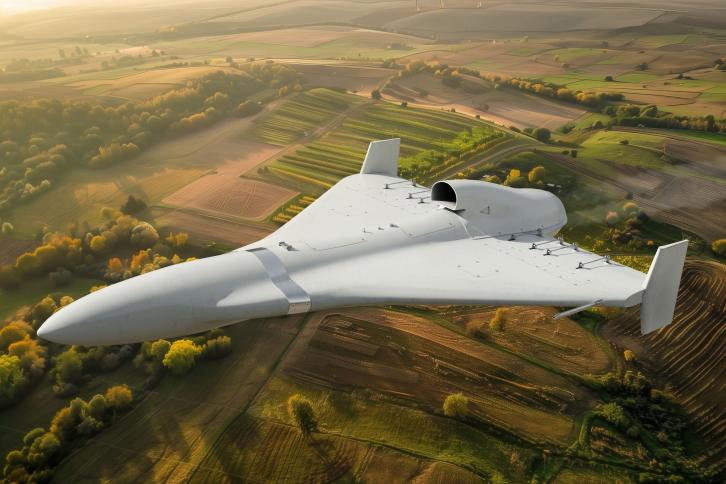
A laser does not have to miss to fail. It can hit the target, damage it, and still lose the engagement if the drone survives long enough to force the defender back onto missiles. The same is true of high-power microwave (HPM). A laser-and-microwave stack can hit a drone, hurt it, and still concede the engagement — because the success condition for the attacker is not destroying the ship, but forcing the defender to spend missiles.
Surviving a High-Power Laser
The author works in building physics — how surfaces absorb and reflect heat, how structures resist fire, and how materials move heat away from vulnerable areas. From that professional background, laser hardening is a familiar problem: it is, in physical terms, protecting a moving structure the same way an architectural scientist protects a roof and its load-bearing frame from fire and solar gain.
None of the materials needed are exotic. They are in common use in commercial construction across Australia right now.
Energy-efficient cool roofs rely on high-reflectance surface coatings to reduce solar heat gain. The defence equivalent is a ceramic paint applied to the drone's outer skin — the same chemistry used on energy-efficient commercial roofing — formulated to reflect much of the laser's energy before it can enter the airframe. Unlike aluminium foil, which achieves higher reflectance but creates a strong radar return, ceramic paint is mostly radar-transparent.
The dominant protection layer sits inside the wing, not on its surface. In factories where industrial lasers are used, the walls are lined with open-cell aluminium foam. The foam's first job is to conduct heat laterally away from the beam's point of impact, preventing the laser from dwelling on a single spot long enough to burn through. If the beam persists and local temperatures reach 660°C, the aluminium cells melt, and molten aluminium is highly reflective, turning a structural failure into a second line of defence. The same foam fills the drone's wing cavities, moulded to serve as structural filler and laser absorber simultaneously.
Fire engineers protect steel structures in two ways that translate directly. The first is plasterboard: its gypsum core contains chemically bound water that is released as steam when heated, absorbing large amounts of energy in the process. This is why a sheet of plasterboard on the front face of the wing spar buys the kind of time a fire engineer would recognise as structural fire rating. The second is intumescent coating — paint applied to structural steel that expands under heat into a dense insulating char. Applied to the drone's leading edge as a wax-plug bladder of expandable epoxy, it weeps when punctured to provide a self-healing layer that regenerates under continued attack: as each section chars and is ablated, the next layer weeps, expands, and seals the wound.
Together, the full stack adds 12–19 kg and costs between A$343 and A$1,005 per drone. Against a 60 kW shipboard laser, it pushes the time needed to achieve structural failure into the hundreds of seconds. A jet drone at 800 km/h crosses the laser's entire engagement envelope in roughly 36 seconds. The drone does not need to be laser-proof. It only needs to last longer than the engagement allows the laser to dwell.
The Microwave Was Meant to Catch What the Laser Could Not
Modern naval directed-energy stacks pair a laser with HPM precisely because each covers the other's gap. The laser handles drones at range. The microwave catches anything that gets close, by damaging electronics — autopilot, GPS, datalink, servo controllers. Together they are meant to keep the destroyer's missile magazine intact, because once a ship starts firing interceptors, it cannot reload at sea, and every missile spent is capacity the fleet cannot recover until it withdraws from station.
This logic carries a quiet geometric assumption. The microwave is strongest across the face of its phased array. It degrades sharply overhead. The manoeuvre to exploit that has a long history. Tanks were built around frontal armour because the fight was expected to be frontal. Stuka dive-bombers in 1941, and later top-attack missiles like Javelin and NLAW, turned the tank's strongest aspect into a fixed irrelevance by attacking the axis it was not designed to defend.
A shipboard phased array has the same geometry. The hardened jet drone declines to arrive head-on. It climbs above the ship's defensive envelope and attacks from near the zenith, the part of the sky where a shipboard array has its least useful geometry. Effective microwave power at that angle falls to a fraction of the broadside figure, and the engagement range collapses with it. The system has less time, from a worse angle, against a target that has already survived the laser layer.
The Dead-Man Release
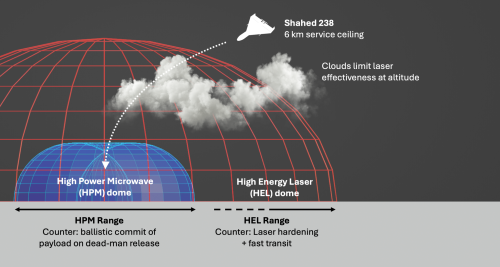
There is a further architectural point. The drone commits to its terminal dive outside the HPM engagement envelope. Shipboard phased-array microwaves have a useful range of roughly 1–2 km against electronic targets; the bomber begins its zenith dive from 6–9 km altitude and several kilometres of slant range, well beyond that envelope. By the time the drone enters HPM range, it is already on a ballistic trajectory the microwave can no longer redirect.
A late HPM kill of the carrier therefore does not prevent the drop. Loss of control triggers a dead-man switch. The dispensers open, the drone's nose lifts on a small pyrotechnic charge, and a few hundred 40 mm fragmentation grenades continue on a ballistic path — fused to burst a few metres above the ship, spreading effect across a wide footprint of exposed equipment.
The defender sees a kill. The ship still receives the payload.
(Original graphic created by the author)
The Forced Missile Shot
This is where the procurement argument changes. The drone does not need to sink the ship. It does not even need to destroy the directed-energy system. It only needs to force the defender to use missiles. Once the laser cannot kill fast enough and the microwave cannot reliably neutralise the weapon load, the destroyer must return to its conventional layers. It must fire interceptors. It must spend the missile magazine that directed energy was meant to preserve.
That is the success condition. Not a sunk destroyer. A forced kinetic response. In an attrition campaign, a destroyer that withdraws to reload has been removed from station. The attacker has bought time, space, and operational disruption. That can be a win even if every attacking drone is eventually shot down.
What This Means for the Directed Energy Weapon Procurement
Australia should keep investing in counter-drone defence. Directed energy may have a real role against slow, lightly built, thermally simple targets. But directed energy must be tested against the next target, not the last one.
The test article should be fast. It should be hardened with ordinary heat-management materials available from any commercial roofing or fire-protection supplier. It should attack from the geometric blind spot of the phased microwave array. It should carry simple munitions designed to give the microwave nothing useful to attack. It should arrive in numbers.
If the laser-and-microwave stack can handle that, it has earned its place. If it cannot, then the stack is not a magazine substitute. It is another expensive system that must itself be protected by missiles — and the magazine-depth crisis in current allied operations indicates that those missiles cannot be assumed.
Australia's directed-energy procurement is being specified now, against a threat profile that may already be two years out of date. Test before buying.
Defence Mastery
Technical Mastery
Social Mastery

Tim Law is a PhD architectural scientist and principal of ArchSciences, Melbourne. A former commissioned officer, he is a technical committee member of the Australian Building Codes Board on condensation, and works in radiant-heat engineering, fire-safety design, and bushfire-zone passive protection. His professional interest in cross-domain risk analysis produced this paper.
The Missile the Laser–Microwave Duo Were Meant to Save © 2026 by . This work is licensed under CC BY-NC-ND



Please let us know if you have discovered an issue with the content on this page.
Comments
Start the conversation by sharing your thoughts! Please login to comment. If you don't yet have an account registration is quick and easy.