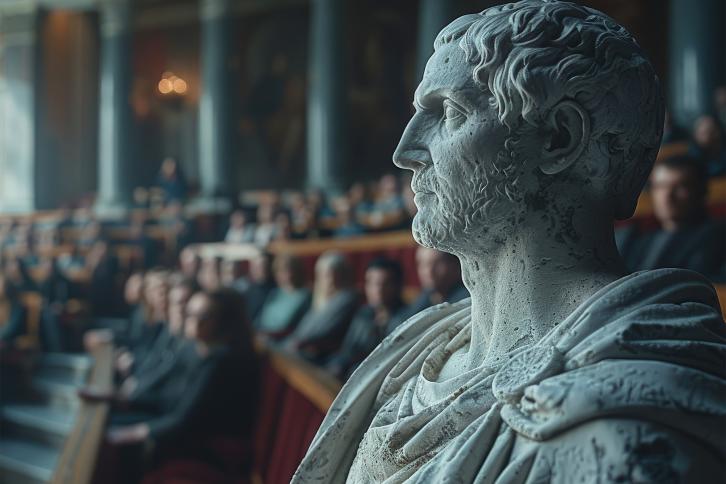
On Friday 24 October, the Centre for Defence Leadership and Ethics (CDLE) hosted the inaugural Military Ethics Workshop at the Australian Defence College. The event brought together academics and Defence researchers for a day of discussion on some of the most pressing ethical issues facing modern militaries—from the moral challenges of artificial intelligence to the meaning of unlimited liability and the cultural narratives that shape our understanding of war crimes.
The workshop formed part of CDLE’s broader effort to strengthen Defence’s network of scholars and practitioners working in military ethics and to position the Centre as the focal point for ethical research in Australia. Participants from Defence, ANU, Charles Sturt University, and UNSW Canberra shared their current projects and engaged in wide-ranging discussion about how their findings can inform policy, education, and doctrine.
The day began with Christine Boshuijzen-van Burken and colleagues from the Military Ethics Research Lab and Innovation Network (MERLIN) presenting their empirical work on AI-enabled decision-support systems. Their research examined whether “vision AI” technologies—designed to detect and label objects on a screen—improve ethical decision-making on the battlefield. Using simulated scenarios where participants decided whether to “shoot or not to shoot,” their findings suggest that AI tools have little effect, positive or negative, in straightforward situations where human judgment is already confident. This challenges both the optimism and the concern often associated with AI in combat, offering a more nuanced view of its ethical implications.
Next, Nicholas Carroll presented a paper on unlimited liability, a concept often described as central to the military profession but rarely defined. He proposed a rights-based interpretation of unlimited liability as the voluntary alienation of certain rights through informed consent—an act that makes military orders morally binding. His analysis raised important questions about the moral and institutional conditions under which such consent is genuine, and whether current Defence practices adequately reflect this ethical foundation.
Following lunch, Zena Assaad explored the intersection of technology, tactics, and the resort to force. Her presentation examined how the growing reliance on AI-driven decision-support systems introduces new layers of complexity into the decision to use force—ranging from software dependencies to unpredictable system interactions. Dr Assaad’s work emphasised that while such systems may enhance situational awareness, they also carry novel risks that require careful policy consideration and design oversight.
The final session, by Neil Renic and Jessica Wolfendale, turned to the moral language surrounding war crimes. Their paper categorised common forms of “war crimes apologia”—from justifying atrocities as “tragic necessities” to portraying perpetrators as exceptional “bad apples.” These narratives, they argued, distort our understanding of responsibility in war and risk undermining both moral accountability and public trust in military institutions. Their taxonomy offers a powerful framework for identifying and countering the subtle ways in which moral norms erode in conflict settings.
Across all sessions, the workshop underscored the value of sustained collaboration between Defence and academia in confronting complex ethical questions. Discussion was lively, open, and reflective, with participants highlighting the importance of connecting philosophical theory with practical military contexts.
By bringing together leading thinkers from across Canberra and beyond, the workshop demonstrated both the strength and diversity of Australia’s military ethics community. It also reaffirmed the CDLE’s role as a convenor of ideas and facilitator of thoughtful discourse, committed to ensuring that ethical reflection remains central to Defence’s professional identity. The success of the event, and the enthusiasm it generated, have set a strong foundation for future workshops.
To register your interest in attending or presenting your work at future military ethics workshops, please contact CDLE.events@defence.gov.au
Defence Mastery
Social Mastery

Military Ethics Workshop Brings Researchers Together to Tackle Emerging Ethical Challenges © 2026 by . This work is licensed under CC BY-NC-ND



Please let us know if you have discovered an issue with the content on this page.
Comments
Start the conversation by sharing your thoughts! Please login to comment. If you don't yet have an account registration is quick and easy.