This thesis is submitted in partial fulfilment of the requirements for the
Master of National Security and Strategy
Acknowledgements
Thank you to the many disrupters, change agents, and teammates who have been part of my journey and inspired this work. James, Bec, Paul, Roger, Judd, Alex, JJ, Robbo, Macca, Gabe, Adam, Stephen, and many others, every day you tirelessly and thanklessly help this organisation strive to reach its potential. I see you and appreciate you.
To the key members of the Army War College team, who were instrumental in turning my frustrating and painful experiences of change into a positive exploration seeking to help the Australian Defence Organisation to it better: Pichamon, Michael (x2), and Nick, thank you for your time, consideration, and willingness to explore - invaluable.
To Stephen, you inspire me daily to fight the good fight, tackle the challenging roles and pursue excellence. Thank you for your tireless patience, frank advice, and unwavering support. I could not have done it without you!
Dedication
To the dinosaurs, the change leaders, and everyone in between, surf’s up, let’s catch the wave!
Abstract
This thesis explores military organisational change, specifically whether the Australian Defence Organisation (ADO) is postured to evolve to meet the challenge directed by the 2023 Defence Strategic Review (DSR) and the 2024 National Defence Strategy (NDS). It must evolve warfighting capability whilst simultaneously overhauling the machine delivering that capability, the business of Defence. This challenge is further compounded by today’s strategic environment, characterised by multiple megatrends occurring simultaneously at pace.
Motivated by the author's experience and enabled by an exploration of theory and academic inquiry, it highlights the perpetual challenge of organisational change. It recognises that despite a reputation for change resistance, there is no universally applied model of military organisational change to validate this claim.
This exploratory thesis seeks to merge perspectives from organisational change and intersecting disciplines, including balancing military conservatism, to assemble a model of military organisational change. Using Dooley’s Complex Adaptive System (CAS) as the foundation, it brings together an enhanced assemblage capable of capturing the complexity of contemporary militaries with the explanatory power to understand and optimise organisational change outcomes.
This thesis takes the initial step toward advancing knowledge of military organisational change, proposing a model for future PhD research that incorporates primary-source engagement to examine whether ADO resists change and how this can be overcome.
List of Acronyms
ADF
Australian Defence Force
ADO
Australian Defence Organisation
AI
Artificial Intelligence
AUKUS
Australia, United Kingdom, United States
CAS
Complex Adaptive System
eCAS
Enhanced Complex Adaptive System
DSR
Defence Strategic Review
ERP
Enterprise Reform Program
HR
Human Resource
ICT
Information and Communication Technology
ISR
Intelligence, Surveillance, and Reconnaisance
NDS
National Defence Strategy
PPBS
Planning Programming Budgeting System
RMA
Revolution of Military Affairs
Chapter 1 Introduction
The 2023 Defence Strategic Review (DSR), endorsed by the Government, is direction from the top, demanding pan-organisation transformation. This translated into the inaugural 2024 National Defence Strategy (NDS), and is not confined to evolving warfighting capability. It requires simultaneous and far-reaching changes to the business of Defence, the machine delivering warfighting capability.1 This comes amid Australia’s contemplation of a dynamic strategic environment and a digital future, with all Sectors pursuing similar transformative change. As the waves of change rise, is the Australian Defence Organisation (ADO)2 ready to surf?
Organisational change is a perpetual challenge, and modern militaries are no exception. McKinsey’s recent study highlights ‘60 percent of senior military leaders surveyed see organisational change efforts as unsuccessful or at best achieving sub-optimal outcomes.’3 This underscores the tough road ahead of the ADO, emphasising the need to assess whether it is effectively postured to tackle this challenge.
Exploring the research on military transformation reveals a recurring theme: resistance to change. B.H. Liddell Hart’s perspective on military change captures this well, ‘two thousand years of experience tells us the only thing harder than getting a new idea into the military mind is getting an old idea out.’4 This reluctance isn’t exclusive to the military; studies on organisational development and change management contain similar findings. Yet, as Schuyler points out, despite substantial investments in these fields, it is perplexing to understand why organisational change remains such a challenge.5 Understanding how the ADO navigates change, whether resistance is present, and how it can be diminished is critical to achieving the NDS vision. Crucially, this work will contribute to the body of knowledge on organisational change, empowering contemporary militaries to thrive into the future.
The current strategic environment is characterised by a dynamic, mutually reinforcing set of circumstances confronting all Sectors. Dobbs et al. describe the multiple forces, or megatrends, driving change simultaneously, at pace, and all reinforcing each other.6 This is often referred to as the emerging Fourth Industrial Revolution.7 Unlike previous revolutions characterised by a singular trend, the world currently faces multiple megatrends, all reinforcing each other.8 These compounding factors drive an urgent narrative where transformation, innovation, change, and adaption are essential for organisational survival.
This exploratory thesis seeks to merge perspectives from organisational change and intersecting disciplines to formulate a model of military organisational change. In doing so, it aims to provide a foundation for future research, establishing a framework to evaluate ADO organisational change efforts and determine how resistant the ADO is to change. Applying this model of military organisational change can illuminate strategies to optimise future transformation outcomes.
Section 1.1 My Experience - Motivation
Those currently working with the ADO would agree the only constant is change,9 perhaps nostalgically yearning for a bygone simple era of stability. This perspective does not accord with the author’s experience. Graduating from the Royal Military College in 1999, over 50 percent of the positions and half the units were closed to women. Fast forward to 2017, she would command one of these units. She has consistently navigated change throughout her career, surfing the wave. Yet many have dropped off the back of the wave, and at times, the waves themselves felt weak, breaking violently against underground reefs.
The author has keenly felt the adverse effects of organisational change efforts. When General Morrison’s words resonated globally in 2013, ‘the standard you walk past is the standard you accept.’10 Many hoped it heralded the realisation of an organisation where all could reach their potential. Instead, as a woman, this author felt isolated, a pariah, the symbol of a change effort, many viewed, would result in the degradation of warfighting capability. General Morrison was clear and determined in his approach; he could not afford to take the organisation on a long, arduous incremental journey. Instead, he chose to rip the Band-Aid off, exposing the wound, forcing change at speed. His approach created a significant challenge for serving women, including the author. Many suffered at the hands of those resisting the change, and despite early promise, hegemonic masculinity still endures.11 There had to be a better way.
Transitioning from experiencing change to leading transformation ignited her fascination with how teams navigate organisational change and continual improvement. Leading a 'skunkworks' team tackling recruitment and retention issues in the ADO, she faced unexpected resistance from the Army's Human Resources (HR) experts.12 This experience introduced her to change management theory and the diverse individual responses to change. Far from being malicious, Army’s HR experts were stabilising, reluctant to pursue untested innovation, and fearful of the impact of change on the existing systems.13 Developing knowledge to assist individuals, teams, and the ADO in becoming more adept at navigating change sparked a curiosity to delve deeper.
Most recently, navigating the Land Capability System through post-DSR change illuminated challenges unique to digital transformation. The Land Domain Digital Twin, co-designed by Army and an Industry Partner, faced significant organisational resistance. The system connected the desk officer to the senior decision-maker in an aggregated live environment. Three unique behaviours emerged. First, was a misconception analytical environments are just another tool, leading to superficial innovation, integrating new tools into old ways of doing things, rather than revolutionising how work is done to enable decision-making by design.14 Second, a prevailing black-box approach to analytical tools similar to platform procurement. Adoption is premised on perfection and proven results rather than on iterative development approaches that integrate users, which are essential to success in the digital environment.15 Finally, an unfocused approach to data, where instead of starting with specific questions, connecting data and iterating, the emphasis was on accumulating all data into a swamp, hoping insights would emerge. The author has learned how these behaviours add complexity to the organisational change challenge. A model of military organisational change must be agile, accommodating the realities of the strategic environment, including a digital future.
This section explored the motivation for this thesis. The author's frustration and thus enthusiasm to connect deeply to the theory to do change better. Recognising that change is constant, it is critical to acknowledge that the change process is not an outcome and is not always beneficial. Many military leaders frequently avoid terms like evolution and transformation in this dynamic strategic environment to avoid disrupting their teams. They sense an exhausted organisation, change fatigued, needing instead to concentrate on its warfighting mission. This thesis proposes a model for military organisational change, incorporating a logic of military conservatism, balancing the prevailing narrative depicting anyone opposing innovation or change as a dinosaur – obsolete. Through this research, there lies an opportunity to delve deeper into the theory, assembling a model for military organisational change that tackles complexity, accommodates uniqueness, and enhances future transformation outcomes.
Section 1.2 The Gap
The extensive and continually evolving body of research on organisational change underscores the challenge ahead of the ADO. Change of military organisations is comprehensively studied, yet there is a noticeable lack of a universally accepted model designed explicitly for this context. It is crucial to understand whether militaries exhibit unique responses to change, and to identify any distinctive characteristics making resistance more likely than other organisations. This includes examining the military's unique role and understanding whether a peacetime versus wartime context is determinative.
This thesis contributes to the organisational change body of knowledge, using assemblage theory to build a model for military organisational change. In addition to exploring organisational change theory in Chapter Two, it explores intersecting fields of study in Chapter Three, enhancing the accuracy and explanatory capacity of the model. This approach contributes to scholarly research and adapts applications primarily developed in the private sector to incorporate better the unique challenges of pursuing change in a military context.
Furthermore, whilst interwar periods have been studied extensively in the United States, United Kingdom, Germany, and France, little speaks to the Australian experience. Exploring studies of Western military organisational change in Chapter Four provides initial validation and further model enhancement. To understand if the ADO resists change, deliberate analysis is required. However, lack of learning, analysis, or deliberate review of past organisational change efforts challenges the application of the model to the ADO in this thesis. Instead, this thesis sets a foundation for future PhD research, incorporating primary source engagement, to understand if the ADO resists change and how this can be overcome.
This thesis explores organisational change and intersecting theory from a position where change is necessary. However, as Zegart highlights, not all reforms or evolutions are required.16 Ensuring a balanced and pragmatic exploration of military organisational change, this thesis explores the logic of military conservatism in Chapter Five, balancing the narrative that the mere presence of change and innovation equates to positive organisational outcomes.
Chapter Six takes the initial step of advancing the knowledge of military organisational change and building a foundation model to take forward into primary source engagement to more effectively understand the ADO and its approach to change. It aims to contribute to the future study and practice of organisational change by enhancing models focusing on public organisations, specifically militaries. Assembling a model of military organisational change and enhancing understanding will surface opportunities to ensure more successful transformation outcomes.
Section 1.3 Definitions
The terminology across the theoretical fields exploring organisational change is inconsistent. This section defines key terms to enable clarity and consistency, supporting the assembly of a model of military organisational change. An organisation is a structured group of individuals working collaboratively towards common goals. The character or type of organisation shapes its response to change. Galvin characterises three types: businesses, enterprises, and firms. Militaries most closely resemble an enterprise conducting economic and purposeful activities yet behave similarly to a firm of professionals.17 This research focuses on contemporary Western militaries, defined by Kilcullen as those subscribing to a warfighting approach ‘emphasising battlefield dominance achieved through high-tech precision engagement, networked communications, and pervasive intelligence, surveillance, and reconnaissance (ISR).’18
Change is the action or process of becoming different.19 In an organisational context, it involves transitioning from a current to a desired future state. Zegart highlights the shift must improve the fit with the external environment.20 The term transformation and organisational change are used interchangeably, emphasising scale and organisational-wide change, as described by Murray and Farrell, encompassing social and organisational structures, doctrinal and technological aspects.21 Murray’s distinction between peace and wartime is used extensively when examining military transformation.22 Murray defines transformation in peacetime as innovation, where the environment is fundamentally different, resources may be constrained, but there is time to think, experiment and evaluate ideas and concepts. The adversary is indeterminate, and multiple futures drive action.23 In contrast, processes during wartime are known as adaption. Whilst there may be an abundance of resources, time is limited. There is the immediate feedback loop of combat results and the added complexity of an adversary adapting, necessitating constant, ongoing change.24
Resistance to change involves actions or behaviours deliberately hindering or preventing change from occurring. This differs from inefficiency or indifference, which neither support nor contest change.25 It is also separate from military conservatism, which aims for a pragmatic balance focused on assuring an improved desired end state, not simply the presence of change.
Organisational change theory encompasses change management processes and organisational development strategies that inform the foundation of this thesis.26 Organisational development is a broad field of study originating in the social sciences, focused on improving organisational effectiveness. As Szabla describes, it assists organisations fulfil their purpose and simultaneously offers greater dignity and meaning to the people within them or who are impacted by their existence.27 Change management focuses on a structured approach to transitioning individuals, teams, and organisations from a current to a future state.28
This chapter has introduced and outlined motivations for this exploratory thesis, which aims to advance the knowledge of organisational change by developing a model tailored for use in militaries. The definitions provide a common language to build a model that draws on multiple intersecting fields of study. The next chapter will lay the foundation for the model, exploring organisational change theory.
Chapter 2 The Theory
This chapter interrogates the dynamic field of organisational change theory, building the foundation of a model of military organisational change. Exploring the field’s development from the 1940s illuminates potential models capable of capturing the complexity of contemporary militaries with the explanatory power to understand and optimise change.
Section 2.1 Organisational Change
Kurt Lewin's contribution is foundational to the study of organisational change. As Burnes explains, Lewin’s Planned Approach visualises organisational change as a three-step process. Developed in the 1940s, it endures today, influencing contemporary approaches.29 Lewin challenged Frederick Taylor’s Scientific Management, which focused on efficiency and productivity. Instead, Lewin prioritised democratic participation through action research theory. 30 As Adleman explains, action research reveals participants are not simply impacted by change; they are simultaneously active in shaping change.31 A concept that endures in both academic inquiry and practical application today.
Lewin’s Planned Approach laid the field's groundwork, highlighting that top-down direction and autocratic influence are insufficient to assure organisational change outcomes. This is a critical insight for a highly hierarchical organisation like the military. As Dooley highlights, control, organisational structure and bureaucratic process are essential to effective operation, but relying solely on these for change outcomes is insufficient.32 Although Lewin’s model offers a solid starting point, its straightforward nature and origin in the private sector challenge its ability to account for the complexities of change in public institutions, including militaries, necessitating additional understanding.
Evolving theories challenge Lewin’s model and better represent the complexity of modern organisations and how they navigate change. As Burnes, Cummings et al. note, critics argue the planned approach is too linear and fails to consider the interdependency of the individuals, teams, organisation, and their social contexts.33 For militaries, two factors challenge Lewin’s model: its simplicity fails to account for the influence of external factors and complex networks crossing organisational boundaries, and its linear nature implies a stable start and end state. As highlighted in Chapter One and reinforced by the NDS and DSR, a state of constant change is more reflective of the ADO navigating the current strategic environment.
Proceduralists like Andrew Pettigrew emphasise change as continuous and open-ended. According to Burnes and Sminia, Pettigrew focused on better understanding internal organisational dynamics and influences of external context.34 His triangle framework and complementary tools focus on understanding an organisation’s acumen for change, illuminating organisational indicators assuring change outcomes.35 Pettigrew’s approach complements rather than contests Lewin’s model, providing insights into change resistance in organisations and the influence of external factors.
Whilst Pettigrew emphasised the importance of understanding an organisation's acumen for change, John Galbraith and Malcolm Baldridge focused on organisational design to enhance performance and development. Galbraith emphasises effective information processing to support decision-making, advocating for holistic design to maintain agility and flexibility. 36 His Star Model has endured through adaptations and is used by consultancies such as McKinsey.37 The greater fidelity provided by Pettigrew, Galbraith and Baldridge enhances understanding of the modern organisation’s complexity and external factor influences. They also share a resistance to universally applied frameworks.38 Instead, their tools incorporate tailorable aspects to appreciate the unique nature of the organisation in question. Curiously, in the author's experience, this adaptability is not evidenced in the approaches employed by many managerial consultants working with the ADO today. An enhanced understanding of models informed by practical application may offer greater insight into organisational change in militaries.
Translating theory into practice, the realm of managerial consultants has contributed significantly to organisational change. As Clay discusses, John Kotter’s Eight-Step Process exemplifies practitioner-informed contributions. 39 As an educator of managers at the Harvard Business School, Kotter’s focus on management and leadership provided insight into the challenges of achieving organisational change. Kotter coalesced the eight critical mistakes organisations make when implementing change into an eight-step model to overcome them. Many scholars argue Kotter’s model lacked formal academic research and validation. However, there was little evidence presented against the model and support for one or more of the ‘steps’ is evident across the broader literature.40 It resonated with practitioners who saw themselves in the challenges underpinning the model. His later work expanded this approach, focusing beyond management to multifaceted action across all levels of organisations. He challenged linear step-by-step models and instead approached change more expansively and organically. This highlights the complexity of modelling organisational change. While individual models have limitations in understanding the complete organisation within its eternal context, considering them collectively enhances their explanatory power.
Section 2.2 Complex Adaptive Systems
Modern organisational change theory increasingly highlights the crucial role of humans and the complexity they cultivate in the system. Glenda Eoyang delves into Kevin Dooley's contribution, using complexity theory to understand and influence change in the complex human system of the modern organisation.41 Dooley’s Complex Adaptive System (CAS) model of organisational change aggregates insights from models described earlier in this chapter, enhancing understanding of contemporary organisations. As Eoyong describes, Dooley, influenced by Lewin, rejected command-and-control approaches and clinical views of information processing, instead incorporating a deeper exploration of influence.42 Dooley’s CAS appreciates the organisation as an entity but simultaneously looks deeper to understand its behaviour as an organism, and the humans central to the system.
Dooley draws on the physical sciences, chaos theory and self-organisation to enable a more holistic view of the modern organisation. The CAS integrates three views of organisational change: ‘organic (systems theory), organismic (population ecology), and cognitive (information processing and organisational learning).’43 Leveraging complexity paradigms and exploring chaotic dynamics of system behaviours, he contests Newtonian views, where equilibrium is considered the natural state of the system. 44 This Newtonian view influenced early concepts of planned organisational change, framing its commencement and conclusion from a stable state. In the complexity paradigm, equilibrium is just one of several possible states.
The CAS comprises semi-autonomous organisational agents, interacting at many levels of cognition and action, whose interactions produce system-wide patterns.45 It is self-organising and self-creating through continual learning.46 Agents form the critical building blocks of the CAS; they scan their local environment, including other agents, and develop schema, mental models, to interpret information (values, symbols, myths, norms, assumptions). 47 When observations are incongruent with an agent’s schema, they can adapt the observation to fit or alter their schema through learning.48 Patterns can be identified from the interdependent interaction of agents, describing potential system evolution. These patterns can be viewed from the organic (whole of entity), the organismic (internal system), and the cognitive (agent) level.
Early systems thinking developed alongside organisational theory, influencing the view of organisations as organic entities. Contingency theory describes how the entity adjusted to environmental fluctuations, particularly market forces, in the private sector.49 As systems theory evolved, more organismic perspectives emerged, exploring how internal organisational structures and processes could be optimised to perform in stable versus unstable markets.
The organismic view influenced by population ecology studies illuminated how changes in the system could be random (internally generated) or planned (externally driven).50 Dooley describes Van de Ven and Guard’s use of hereditary aspects of ecology to explain how cultural traits such as biases could be transmitted between system agents.51 This transmission enables diffusion and adoption of innovation. Adoption occurs when diffusion of ideas reaches a critical mass of agents, and innovation displaces old ways of doing things. This enables exploration of the socio-technology view of how the organisation and technology coevolve, influencing each other over time.52 This view is powerful in exploring how the technology acceleration trend, a critical factor in the current strategic environment, motivates organisational change.
At the organism level, punctuated equilibrium provides insight into the paradigm of continuous change. Rather than stability, the CAS visualises organisations moving through periods of relative equilibrium punctuated by revolutionary change.53 Revolutionary change may be motivated externally or triggered internally by inducing a far-from-equilibrium state, a crisis within the system. The recovery from this far-from-equilibrium state drives change. Dooley uses Jack Welch and General Electric Company to describe this approach,54 which resonates with Morrison’s approach, described in Chapter One. While effective in accelerating change, in the author's experience, it was not without significant collateral damage.
The final component of the CAS focuses on the cognitive level and agent decision-making. Dooley draws on Galbraith’s insights on information processing and how optimising acquiring, storing, retrieving, and analysing information improves decision-making superiority.55 The CAS cognitive level focuses on how agents adjust schema through learning and the translation of this into collective organisation patterns.56 Dooley heavily references the work of Argyris and Schön to develop this cognitive level, which will be further explored in the next section.
Within the holistic model of the CAS, Dooley’s examination of ontogeny through the lens of autopoiesis illustrates its explanatory potential. 57 Ontogeny refers to the history of structural change within an entity, which occurs without compromising its organisational integrity. Despite changes motivated by internal dynamics or external interactions, the fundamental structure defining the entity remains constant. While earlier theories of organisational change viewed the interaction between an organisation and its environment as open, the CAS suggests its future configuration is already coded within the system when change is triggered.58 By comprehending the organisation at the CAS’s organic, organismic and cognitive level, it becomes possible to visualise potential futures, identify vectors of resistance and implement adaptive strategies to overcome them.
Section 2.3 The Agents - People
A recurring theme in organisational change research is the centrality of people, specifically, how humans can be cultivated to initiate, facilitate, and manage change effectively. Understanding resistance to change necessitates examining this human factor. This aligns closely with the CAS cognitive level, which focuses on agents and their schema. This section explores people-centric theories of organisational change to enhance the CAS, particularly considering distinct characteristics of military organisations like the ADO.
William Bridges pioneered the Bridges Transition Model, which, like Lewin, visualised an entity ‘moving through’ phases of change to achieve new, improved stability. He differentiated the external functional change of the organisation from the inner psychological process people move through as they internalise the resultant new situation.59 His three phases, Ending, Neutral Zone and New Beginning, are designed to clarify the emotional journey of people inside the organisation, with proposed strategies to support each phase.60 Whilst still a linear process, it appreciated these phases could overlap and co-exist within one organisation, highlighting challenges for those experiencing and managing change.61 The modern organisation's multifaceted web of agents navigating these intertwined phases, sometimes concurrently at different paces, whilst simultaneously influencing one another, reveals the Bridges Transition Model's practical limitations.
An alternate and potentially more comprehensive model incorporating how people trigger and navigate change is Margaret Wheatley and Deborah Frieze’s (Berkana) Two Loops Model. This model, illustrated in Figure 1, explains the evolution of social systems and leverages the same theoretical basis as the CAS.62 According to Wheatley and Frieze, two systems cannot exist in parallel; people respond to and influence both the decline of the old system and the emergence of the new system simultaneously.63 Their focus on people within changing social systems has strong application in organisational change settings.64
Dooley, Wheatley, and Frieze challenge notions of change occurring solely due to ‘top-down’ strategies or directives from an individual.65 Instead, they argue change begins through localised innovations, Pioneers, which, if coalesced into networks, ultimately create a new system, supplanting the old dominant System.66
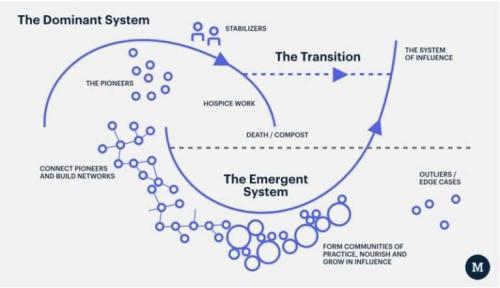
The Stabilisers, often misinterpreted as Resistors or Dinosaurs, focus on maintaining the function of the old system.68 Their motivations are varied and complex. It is crucial to understand this nuance. Primarily, the current system must continue to operate, as no organisation, particularly the ADO, can afford to halt operations until a new system emerges. Whilst Stabilisers provide the necessary support for this, they can be constrained by their existing schema, potentially hindering the emergence of the new system. Ultimately, deliberate effort is required to transition them to the new emergent system and compost the old.69 These roles or change responses resonate with Spencer Johnson’s parable, ‘Who Moved My Cheese.’70 Understanding these responses and the roles agents play enables individuals and leaders to contribute to, and navigate change, more effectively.
This model was revolutionary in addressing the author’s frustration when navigating the visceral resistance to developing a new ‘Future Ready’ Army HR System. The Future Ready Workforce Program was focused on the Pioneers and coalescing them into the emergent system; what was missing was the holistic view of the CAS encompassing the other agents, the Stabilisers, in the Army HR System, wider Army and the ADO. An enhanced understanding of the model provided insight into cultivating organisational change more effectively. It also exposed a phenomenon in the ADO, a layer of resistance beyond the stabilising function, requiring further exploration.
This layer, the Iron Colonels, is an individual or group representing barriers to organisational change in the ADO.71 Whilst they can be mistaken for Stabilisers, their enduring allegiance to the old system (under which they had thrived) results in behaviours resisting change and, at worst, undermining the emergence of the new system. Chris Argyris and David Schön potentially provide insight into this phenomenon and how it might be mitigated.
Integral to the CAS cognitive level Argyris’ insight into learning and mental models is key to understanding how agent schema are shaped. With his colleague Schön, his Single and Double-loop learning concept provided indicators to assess the learning ability of organisations, translating into solid change acumen. These signposts include enhanced learning, identifying errors and ensuring they are corrected, competence to solve problems so they remain solved, and justice through universally agreed-upon values and rules.72
This enhanced learning is key to ensuring accepted norms, goals, values, and frameworks are explicit, not taken for granted, and significantly, do not contribute to resistance or perverse behaviours. Single-loop learning is focused on solving the problem presented and correcting mistakes without questioning the underlying values or assumptions. It does not focus on why the problem exists; the focus is on doing things right.73 This is the space where iron colonels reside, adhering to process and accepted assumptions. Double-loop learning goes deeper by questioning the assumptions and values that guide actions; the underlying cause can be exposed. This focused on doing the right things.74 As Smith reinforces, Argyris and Schön’s research focuses on increasing the organisation's capacity for Double-loop learning, especially at the leadership/executive level.75 This is essential to making informed decisions in a rapidly changing and uncertain context.
This thinking has been developed further to include the most profound level of Triple-loop Learning. Mathews highlights Argyris and Schön, building on Baston’s work, do not directly explore, but it is present in their model, focusing on the fundamental values and beliefs shaping decision-making processes, ‘where one stands and their way of being, drives their thinking.’76 Ben Zweilbelson explores Triple-loop learning in the military context as a means of challenging mental models and better enabling people to navigate and cultivate positive organisational change. He emphasises Single and Double-loop learning constrain agents within the assumptions the organisation has established and rationally employed.77 This results in adherence to rules contained within the linear, mechanistic decision-making methodologies perpetuated in military doctrine.78 The challenge, particularly in organisational change, is complexity violates this precept. Concepts of what is rational differ between agents and conflict with the organisational norms.79 Zweibelson draws on the ideas of reflective practice and reflexivity to describe how Triple-loop learning enables agents to think paradoxically, exploring the tensions between how different agents interpret reality in strikingly different ways yet do so whilst systematically acting within the same dynamic complex and emergent system.80 Argyris and Schön’s learning concepts, enhanced by Zweibelson, are critical to understanding the CAS cognitive level.
An intersecting body of work speaks to the ability to shape agent behaviour and schema without changing core beliefs. Elizabeth Paluk’s work in post-genocide Rwanda potentially enhances the CAS intersecting at the organism and cognitive levels. Paluck’s work using influence mediums demonstrates how collective interactions can be shaped by shifting collective culture and schema without shifting an individual's beliefs.81 This provides a vector to understand how resistant groups like Iron Colonels could be simultaneously influenced through deepened individual learning and collective behaviour-shaping initiatives.
This chapter explored organisational change theory, illuminating the CAS as a robust foundation for a model of military organisational change. The deeper exploration of people-centric organisational change underscores the CAS cognitive level, providing enhanced insights into change resistance groups, such as Iron Colonels. The Berkana model and Paluk’s behaviour-shaping work offer further insight into agent behaviour and how schema evolves, enhancing the CAS further. This illuminates the opportunity to build the CAS beyond Dooley’s original conception, enhancing ADO applicability. The next chapter explores enhancements focusing on CAS organic and organismic levels, better accounting for external context and internal system dynamics unique to contemporary public institutions.
Chapter 3 Intersecting Theories
Intersecting fields of study provide insights that can enhance the CAS’ explanatory power, including accommodating unique aspects of militaries. Exploring organisational change literature in public organisations, there is substantial use of assemblages of theories, hybrid models seeking to account for this unique context. This chapter explores intersecting theories and, leveraging the concept of assemblage, focuses on how CAS could be improved to understand military organisational change better.
Section 3.1 Agency Design and Bureaucracy
The study of public agencies and bureaucracies helps understand change resistance in the ADO and potential interventions. Unlike private companies driven by market forces, public institutions lack this external motivation for change, highlighted in Chapter Two. Amy Zegart combines organisational change theory and rational choice or new institutionalism to explore change failure in American bureaucracies. This assemblage addresses inadequacies in organisational theory and institutionalism when applied singularly.
Zegart presents a cyclic ‘Groundhog Day’ of failure, reform, and resistance.82 Whilst acknowledging not all reforms are good ideas, this cyclic failure warrants enhanced understanding. 83 She notes studies of public institutions have overly focused on initial design rather than evolution or transformation failures.84 This resonates with the author’s motivation to understand the ADO’s organisational change record and the importance of enhancing knowledge of how public institutions evolve. Whilst her model could provide insights into private organisations, public institutions' unique challenges illuminate enhancements to the CAS, specifically applicable to militaries.
The unique external context militaries operate in is a weakness at the CAS organic level. In a private company, market forces and the threat of unemployment and bankruptcy create strong incentives to adapt. Unlike private companies who die if they fail to adapt, public institutions endure regardless of how costly.85 In the peacetime military context absence of external, existential motivation (an adversary) has the potential to retard military organisational change.
The CAS’ networks incorporate external agents whose influence and motivation towards successful adaptation must be considered. As Zegart highlights, in a private setting, agents (creators and employees) are invested in successful organisational change; this is not always the case in the public sector.86 Government agencies are co-created. In politics, machinery of government is forced by winning political coalitions, who impose their will. However, wins are never complete; the opposition influences the agency's initial organisational design, and they possess the interests and capabilities to constrain longitudinal agency evolution.87 Robert Durant reinforces this analysis by highlighting the significant influence of senior bureaucrats external to the organisation, such as the National Security Council.88 Whilst a US analysis, this resonates with the DSR and NDS, representing a significant change in direction imposed by the Labour Government after securing power in 2022.
Internally, public institutions face unique constraints compared to their private sector counterparts. Wilson highlights the constrained ability of leaders to influence the system.89 Setting the mission, evolving the workforce, building and restructuring teams, and instituting new procedures, policies, and customs all require external agent (for the ADO, Government-level) oversight and involvement. Drawing from organisational theory, Zegart reinforces the CAS cognitive level further constrain organisational change. She illuminates how agents in public organisations become wedded to their schema, noting the constraining impact of doctrine or standard operating procedures (SOP). The process becomes so accepted it assumes moral/political importance, entrenching schema and constraining organisational change efforts.90 This reinforces how Single-loop learning constrains change at the CAS cognitive level.
Durant and Zegart explore the limits of theories such as rational choice institutionalism and offer adaptations and assemblages to better account for the unique nature of public institutions and bureaucracies.91 Their insights reinforce all three levels of the CAS, providing unique insight into challenges specific to public institutions, enhancing the CAS’ explanatory power as a model of military organisational change. The following section seeks to improve the CAS further, exploring the intersection between the ADO and today’s strategic environment.
Section 3.2 Innovation
The relentless pursuit of innovation is a pervasive narrative as all sectors confront today’s strategic environment. The exponential rate of technology change simultaneously offering enticing opportunities, unfathomable unknowns, and potential threats.92 Exploring innovation theory provides insights to enhance the CAS’ explanatory power, accommodating intersections between the ADO and today’s strategic environment.
This exploration of innovation theory goes beyond Murray’s military definition in Chapter One, a broader view defining innovation as introducing novelties, new ideas, methods or inventions altering what is established. 93
Traditionally, innovation occurred within the boundaries of an organisation with integral research and development resources. In contrast, Ron Adner’s insights on Innovation Ecosystems embrace open innovation, collaborating across organisational boundaries and mobilising a diverse network to harness collective intelligence. This recognises ground breaking ideas emerge internally and externally.94 Adner describes equally compelling examples of failed innovation ecosystems, emphasising the importance of understanding risk, dependencies and influence beyond the organisation's boundaries.95 The DSR and NDS encourage ADO to embrace open innovation.96 In light of this direction, Adner’s model provides insights for the CAS organism level, enhancing understanding of external agents, intersecting networks, their schema and how their influence might accelerate or constrain innovation and, ultimately, organisational change.
Adner and Dan Levinthal’s concept of creative destruction provides insight into system emergence triggered by innovation, explaining how technology invades new market niches.97 There is military precedence, adopting wireless communication despite the high cost and poorer sound quality to gain mobility and flexibility not offered by traditional wire systems. The military and police represented an initial niche where the benefits outweighed costs.98 As the ADO contemplates a digital future, embracing creative destruction to challenge mental models and consider technology beyond its original application is essential. This intersects with the CAS cognitive level and offers opportunities to overcome the unhelpful behaviours associated with ADO digital transformation discussed in Chapter One.
Clayton Christensen explores an alternate but complementary view of creative destruction, known as disruptive innovation. The process where a new technology (product or service) emerges in a simple application at the bottom of the market and, over time, moves upward, displacing competitor technologies. He differentiates this from sustaining innovation, which focuses on incremental improvement in the current context.99 Creative destruction focuses on the displacing effect of new technology; Christensen’s analysis focuses on the technology, tracking its trajectory compared with the market. He notes many technologies never surpassed the old dominant technology.100 Like Adner, Christensen highlights emerging new markets as the strongest signal of potential opportunity; however, these new markets are unknowable, requiring the organisation to focus on learning and discovery rather than executing a plan.101 Importantly, these technologies require cultivation and protection from processes and incentives designed to optimise current markets and serving mainstream customers.102 This resonates with leaders' role in protecting the pioneers in the Berkana model discussed in Chapter Two.
Christensen visualises emerging markets and disruption as waves requiring organisations to cultivate technology and be positioned to catch the wave of change. Adner and Christensen’s approaches stress the benefit of cultivating Double and Triple-loop learning in the CAS cognitive level. For the ADO to navigate today’s strategic environment, incorporating these concepts ensures agile thinking and adaptable mental models. It also offers insights at the CAS organism level, examining if the ADO is structured to enable this type of exploration and, once identified, how it cultivates adoption, ensuring the dinosaurs catch the wave.
When considering the current strategic environment, technologies such as Artificial Intelligence (AI), Robotics, and Automation are rapidly changing. Peter Singer’s exploration of the ethical consideration of robots, especially if they become sentient, the terminator conundrum described also by Campbell, challenges the mental models shaping how humans interact with technology.103 This philosophical intersection will challenge moral and ethical frameworks, particularly for the military. What constitutes agents in the system, how are their schema influenced, and how do they interact and connect as networks? Singer’s approach requires a deeper exploration of CAS cognitive level, challenging mental models framing current approaches to technology. This could be key in cultivating organisations to pursue disruptive innovation and shifting mental models to overcome resistance to change.
Section 3.3 Assemblage
Chapter Two explored organisational change theory, identifying the CAS as a foundational model. This chapter investigates intersecting theories, improving the explanatory power of the CAS for militaries. The emerging theme, described by Marshall Poole and Andre Van de Ven, is no single theory has the explanatory power to understand modern organisations. Organisational change and innovation transpire in complex ways across multiple levels of the organisation, interfacing across boundaries with agents drawing on diverse dynamic (and some not-so) schema to process information and drive action.104 Poole and Van der Ven’s visualise the concept of assemblage through an early renaissance image from L'atmosphère: météorologie Populaire, pictured at figure 2 105 The Monk claims to have found the point where the earth and heaven touch. Peering through, hoping to see a glorious order behind the complex movement of the stars and the planets, only to find more complexity, with pockets of interconnected order.
Figure 2 - Un missionnaire du moyen Age raconte qu’il avait trouvé le point où le ciel et la Terre se touchent.
The organisational change literature is rich and diverse. Chapters Two and Three illuminated the evolution and potential intersecting fields of study, yet Schuyler’s reflection from Chapter One reinforces the perplexing challenge that still confronts those pursuing organisational change. The challenge of any theory is to be ‘accurate enough to explain the complexity, yet simple enough to understand and guide behaviour.’106 This Chapter drew on Poole and Van de Van’s concept of assemblage. From the foundation of Dooley’s CAS, intersecting models are assembled to enhance understanding of military organisational change and explore vectors of change resistance. The next chapter seeks to further develop the CAS, examining the application of many theories and assemblages to military transformation. It aims to finalise an applied model to explore if the ADO is resistant to change and opportunities to overcome resistance, optimising future organisational change outcomes.
Chapter 4 Military Organisational Change
This chapter leverages the literature analysing military transformation to test and further refine the CAS assemblage. There is no universally applied model for military organisational change, with any scholars using assemblages to support their exploration. It commences with accounts of Western military organisational change before exploring the literature available on discrete components of the ADO and tactical innovation.
Section 4.1 Other Militaries
The Revolution of Military Affairs (RMA) in the second inter-war period provides case studies to explore military organisational change in peacetime. Harvey Sapolsky et al. explore the US military response, exposing an unexpected lack of organisational change.107 They consider Wilson’s insights into innovation within bureaucracies, which highlights small, decentralised institutions are more likely to cultivate pioneers who generate ideas; however, this diversity leads to ‘choice jurisdiction’ hindering longer-term adoption. In contrast, organisations with more rigid hierarchies can often drive implementation.108 As Sapolsky et al. notes, the US military, contained both and it was not clear how this hybridity behaved or could be optimised.109
Instead, Sapolsky et al. assembled a composite theory leveraging the combined explanatory power of Stephen Rosen and Barry Posen’s work, contributing that inter-service rivalry for status and budget can also motivate organisational change.110 Rosen outlines a gradual innovation model in militaries that requires a generational timescale, with change resulting only as proponents are promoted to positions of power.111 This requires them to find protectors, experiment, and slowly climb the ladder until they can drive change. This resonates with the Berkana model, which requires pockets of innovation to coalesce into networks, an emergent system. To do so, pioneers must be protected, connected, and, in Rosen’s view, promoted to achieve organisational change.
Posen emphasises the importance of senior civilian intervention driving significant doctrinal change to overcome military organisational resistance.112 This perspective aligns with Zegart and Durant’s analysis. J.P Clarke further expands this idea, highlighting the simultaneous influence of a maverick internal reformer crucial to assuring success.113 Posen’s approach provides greater fidelity across the CAS organic and organism levels. The DSR and NDS represent this external intervention. The CAS offers a framework to assess its enduring impact and the existence and cultivation of Clarke’s cross-boundary network of agents to drive organisational change.
Sapolsky et al. observe interservice rivalry can be a powerful motivator or barrier to change, highlighting through their case study the promise of Joint Operations enhancing cross-boundary interoperability and efficiency was only realised when it did not come at the cost of a single Service.114 This resonates with the Australian experience and is an ominous predicament for the ADF’s pursuit of an integrated force. It illustrates the strength of tribes within militaries and the importance of understanding these networks at the CAS organism level.
Williamson Murray explores military organisational change in peace and wartime, highlighting the connection between the two; he argues innovation skills developed in peacetime, based on empirical evidence, enabled militaries to recognise actual wartime conditions, which was crucial to adaption.115 He examines organism level military architecture and processes challenging innovation and adaption, highlighting, ‘(t)he demand of discipline and rigid respect for one’s superiors—on which cohesion in battle depends—are antithetical to the processes of adaptation, which require the willingness of subordinates to question revealed wisdom of their superiors.’116 Through his study of the interwar periods, he identifies trends across militaries to cultivate innovation.
Emphasising culture and learning, his trends enhance the CAS cognitive level, providing practical examples for cultivating Double and Triple-loop learning. He focuses on using empirical evidence to challenge mental models, cultivating critical examination across doctrine and concepts, and pragmatic, respectful analysis of adversaries to promote enhanced learning.117 John Nagl reinforces the importance of building an organisational learning culture and change acumen in peacetime to ensure adaptability in wartime.118 Murray also cautions against misusing history, re-writing, or selectively remembering the past to fit existing schema and resist change.119 Whilst not a comprehensive model, his examination of historical examples reveals trends helpful to understanding agents and the evolution of their schema. These insights provide key prompts to enhance the CAS through tangible military examples.
Whilst Murray takes an expansive view of the inter-war period, Andrew Krepinevich focuses on the US Army in Vietnam, examining its learning and innovation within the broader political environment. To explore the causes of the US Army’s failure in Vietnam, Krepinevich examines their innovation in the 1950-60s. This period reinforced a foundation of resistance contributing to adaption failure during the war. 120 The richness of this case study lies in its parallels to the ADO’s current situation. The ‘Army Concept’ was entrenched when President Kennedy came to power and remained so, despite his efforts to shift Eisenhower’s Massive Retaliation doctrine to a Flexible Response focus.121 Concurrently, Secretary of Defence Robert McNamara sought to institute the Planning Programming Budgeting System (PPBS) to enhance procurement efficiency with a strong focus on technical and managerial aspects.122 Krepinevich explores where attempts to drive change were avoided, overcome or ignored, highlighting the importance of agent schema, the CAS cognitive level and how they become impenetrable. The dual nature of innovation meant the Secretary of Defence’s focus on the acquisition system diverted attention from the President’s challenge, leaving the Army autonomous, and undermining the external direction Posen emphasises as critical.
Krepinevich builds on this analysis to explore his latest work on how disruptive innovation influences the trajectories of nations. He suggests to maintain the competitive edge, military organisations should prepare to respond effectively to an emerging military revolution.123 By examining Christensen’s concept of disruptive innovation, he draws parallels to the RMA. Unlike the private sector, he emphasises RMAs are characterised by multiple technologies; the combination of the machine gun, aeroplane, submarine and battleship transformed warfare at the end of the 19th Century.124 Moreover, implementing this combination of technologies with new operational concepts - a change in thinking - proved most successful.125 Integrating this analysis into the CAS refines Christensen and Adner's innovation concepts for the military context. Krepinevich reinforces the challenges and resistance identified by other scholars, including cultivating leaders who can navigate bureaucracy, foster deep learning, and provide a compelling vision and rationale for change.
While many scholars distinguish between military innovation and adaption, Theo Farrell, like Murray, highlights the interdependency, taking a longitudinal view. His widely referenced work focuses on three elements of change: adjustment, adaption, and innovation.126 With Rynning and Terriff, he takes a longitudinal view of Army organisational change, which does not conclude at the boundary of war. Instead, operations enable testing, refinement, adaption and enhanced understanding of the evolving character of war.127 Farrell et al. do not propose a single theory; instead, they assemble several, including Rosen, Posen, and Sapolsky, to examine transformation of the United States, France, and British Armies since the Cold War.128 They draw four factors from these models: service interests (Sapolsky), senior leadership ideas (Posen), individuals (Rosen) and the impact of operations. Whilst no single factor has primacy, all influence military organisational change, reinforcing their value to an enhanced CAS. A common theme across case studies is the risk of technological fetishism, explored further in Chapter Five.129
Additionally, Farrell et al. explore emulation and how militaries influence each other.130 They found military cooperation and alliances significantly influence organisational change, though they were not decisive over the other factors in the countries studied.131 For the ADO, AUKUS and sub-imperial notions described by Clinton Fernandez may warrant further exploration as both a trigger for organisational change and how schema are shaped through this cultural phenomenon.132
Mick Ryan exemplifies contemporary discussions of military transformation, positioning his work in today’s strategic environment. Whilst rooted in the megatrends described by Dobbs et al., he emphasises humans continue to compete and fight with available tools. Warfare will use old and new technologies, some ancient and others highly sophisticated.133 His analysis leverages models of open and disruptive innovation described in Chapter Three. A significant theme is the ‘knowledge explosion,’ an acceleration of the CAS cognitive level requiring exploitation. Humans’ insatiable capacity to learn and share has expanded tremendously and, through technology, is on an exponential trajectory.134 Notably, technology is not the complete solution. It is how people combine it with new ideas and organisations to cultivate ‘Decision Advantage.’135 His work reinforces the importance of a non-linear appreciation of organisational change, best modelled by the CAS, and the importance of deep learning enabling dynamic schema and system cultures celebrating creativity, encouraging debate, continually challenging mental models.
Examining the application of organisational change and intersecting theories to other military transformations reinforces the importance of a model that can appreciate complexity whilst providing explanatory power. There is a strong focus on cognitive elements, learning, leadership, and empowerment and how CAS organism elements like doctrine, SOPs, and structure enable or constrain organisational change. Any model should keep curiosity and a thirst for understanding central. As Ryan emphasises, quoting Strachan ‘On War’s strength, its very essence and the reason for its longevity is it remains a work in progress. Its author never stopped asking questions – not simply of his conclusions but also of the methods by which he reached them.’136
Section 4.2 Australian Military
Literature on the ADO is limited, focusing on cultivating innovative individuals and teams. Chris Field, James Brown, and Alex Neads et al. highlight individuals as key drivers of innovation, pinpointing organisational culture and intrinsic motivation as core barriers.137
Brown discusses Army’s innovation ability, highlighting culture and talent management as barriers.138 While acknowledging the Adaptive Army initiative, he notes a lack of tangible action, incentivisation or fostering of learning, new ideas, and critical thinking.139 Field also stresses the importance of the CAS cognitive level, encouraging Double and Triple-loop learning to foster innovation. He further emphasises creating an ‘organisational climate that enables creativity and innovation’.140 This aligns with Argyris’ informed CAS cognitive level and Zweibelson's Triple-loop learning enhancement.
Brown discusses improved talent management, seeking to accelerate timeframes outlined by Rosen to position key agents in influential roles to drive change.141 Field reinforces this premise by discussing Clarke’s concept of diffusion, describing a process akin to the Berkana model, were pioneers form networks and emergent systems. While his focus is on the pioneers, he acknowledges the need to cultivate the conditions for points of innovation to coalesce into organisational change.142
Field further focuses on providing space for imagination, experimentation, and robust testing.143 Scott Holmes explores this idea further, proposing a dual structure balancing preparedness with room for innovation and experimentation.144 This provides organism level insight to enhance the CAS, structuring to enable innovation.
Brown and Field's analysis, while focused on tactical innovation, reinforces CAS cognitive aspects and complementary organism elements. However, their view is incomplete, focused only on early innovation and pioneer cultivation stages. While reinforcing enhancements to the CAS by other scholars, neither offers a holistic view of military organisational change.
Neads et al. take a broader perspective, examining the Army’s digital future. They reinforce Dooley’s punctuated equilibrium concept, highlighting how innovation causes the rupture needed for rapid organisational change and capability enhancement.145 Their work centres on ‘officer perceptions of the strengths and weaknesses of potential military innovations, and how these collectively shape professional understandings of the desirability of change’.146 This resonates with the Iron Colonel phenomenon and provides ADO-specific enhancement to the CAS.
Leveraging Institutionalism, Neads et al. examine how institutions influence member attitudes and behaviours, either facilitating or resisting change. Past organisational experiences influence individual schema evolution, as does the collective behaviour of a broad field of similar agents.147 Their work finds Australian military officers' attitudes towards Human-Machine Teaming and AI integration into command, control and decision-making are heavily influenced by their past digitisation experiences. Supporters and opponents base their arguments on this experience, resulting in a consensus favouring gradual sustaining innovations over revolutionary change.148 Neads et al. underscore the importance of understanding how past organisational change can enhance or constrain future efforts by influencing agent schema. Reinforcing the requirement for a longitudinal understanding beyond the current change being pursued.
They also explain how coalition partnerships can influence organisational change. Although Farrell et al. suggested this was not determinative, in this instance, it impacted the Australian approach to AI integration by reinforcing interoperability and cultural similarities.149 Emphasising the CAS organism level should comprehensively explore cross-organisational networks, including external agents, capturing all potential influences on agent schema.
Michael Evan’s exploration of the ADO’s unique diarchal structure, its history and evolution provide crucial structural insights into the CAS organism level. The Diarchy is the joint administrative authority of the Secretary and the Chief of the Defence Force.150 Evans’ exploration of the ADO’s civil-military context highlights the Diarchy’s dysfunction - ‘Broken Backbone,’ risking the ADO and Australia’s ability to navigate the current strategic environment.151 Based on the Huntington philosophy, the civil-military compact ensures subjective control of armed forces by elected civilian authorities but professional autonomy or objective control of military affairs by senior officers over members of the profession of arms. He notes many consider this rigid separation outdated, with most Western militaries favouring ‘an equilibrium model based on integration, partnership and liberal democratic values.’152
Evans argues this foundation persists, weakened by reviews that have diminished the Defence Minister’s power, compared to the Secretary’s, strengthening a powerful public service at the expense of the uniformed officials.153 This imbalance focuses too heavily on civilian managerial solutions, with neither side genuinely understanding the other.
Further, as reinforced by Albert Palazzo, a strategic culture persists in investing too much independence and power in the Service Chiefs at the cost of the Joint Force.154 This compounds a lack of integrated partnerships, compromising institutional unity and significantly impacting organisational change efforts. Evans and Palazzo highlight structural aspects and interservice primacy within the ADO, aligning with Sapolsky, Posen and Zegart's analysis of key barriers to organisational change in militaries. Evans and Palazzo’s analysis provides nuanced ADO-specific structural insight into the CAS organism levels.
The literature on military transformation reinforces the CAS assemblage as a rich model to grasp the nuances of change in military organisations. Viewing military transformation studies through the lens of the CAS assemblage enables further refinement, incorporating specific military insights enhancing all three levels. This chapter reinforces that no universally applied model for military organisational change exists, with scholars relying on assemblages to support their investigations. This reinforces the importance of a tailorable assemblage to account for the unique nature of the ADO. The exploration across Chapters One through Four is situated on the premise change is necessary. The next chapter explores the logic of military conservatism, balancing the narrative that the mere presence of change and innovation equates to positive organisational outcomes.
Chapter 5 The Logic of Military Conservatism
The premise of this thesis is how military organisational change can be improved. In today’s strategic environment, H.G. Wells' sentiment continues to resonate: ‘Adapt or perish, now as ever, is nature’s inexorable imperative.’155 However, there is a quiet voice of caution, a logic of military conservatism, often drowned out by the populist hype requiring exploration as part of any model of military organisational change. Few authors examine risks of military innovation, and the absence of such exploration implies a lack of innovation is detrimental to military capability. Kendrick Kuo’s account of the British Army’s innovation in armoured warfare during the interwar period and subsequent performance in the Desert War exemplifies not only his theory of harmful innovation but also a prevailing theme in the study of military innovation and organisational change - the presence of innovation and the pursuit of change equals effectiveness, rather than an objective focus on the outcome.
Kuo’s exploration offers the opportunity to ensure the CAS incorporates mechanisms to identify where organic, organism, and cognitive elements designed to cultivate positive organisational change outcomes are in danger of producing perverse results. Kuo emphasises self-defeating innovation occurs when growing security commitments outweigh resourcing, thus incentivising gambling behaviour.156 The NDS potentially drives this nexus, an ADO facing resource constraints and growing requirements, potentially resulting in harmful outcomes. This chapter will explore three pathologies: gambling, glorification of mavericks, and superficiality.
Elizabeth Kier exemplifies the popular narrative surrounding the British Army’s inadequate innovation during the Battle of France and the subsequent Desert War. Conversely, Germany’s victory in the Battle of France, enabled by the Blitzkrieg concept, is a celebrated exemplar of military innovation. She points to the barrier posed by ‘conservative Army leaders suppressing a small group of prophetic tank enthusiasts.’157 However, Kuo draws on historical revisions of Blitzkrieg to offer an alternate view - far from failing to innovate, British poor performance was a story of innovation gone too far.158
Kuo and others contend Britain’s interwar Army relied too heavily on the promise of armour. Influenced by radicalism and wishful thinking in a resourced-constrained environment. A new armoured manoeuvre concept resolved the workforce and funding challenges of the time. Liddell Hart and Fuller’s new Army abandoned the combined arms concept, arguing that incorporating infantry would be ‘tantamount to yoking a tractor to a draft horse’.159 The British experience illuminates the compounding impact of resource constraints, wishful thinking, and despite experimental evidence, abandoning proven concepts in the hope of a radical new way of war.160 After significant losses in the Desert War, undeniable evidence, the British were forced to adapt unlearning armoured-only manoeuvre in favour of combined-arms approaches.161 The British gambled on an alternative, exhibiting behaviour inherent to Kuo’s theory of harmful innovation. Exploring the CAS cognitive level reinforces the requirement for deeper Double and Triple-loop learning. Significantly, whilst doctrine and SOPs can constrain change, their abonnement must be supported by empirical evidence.
Kier’s account of Liddell Hart and Fuller exemplifies the dangers of glorifying mavericks, change agents, a component of the CAS organism level. The CAS cognitive level emphasises requirements enabling innovative thought, disruptive thinking, and experimentation. However, it does not suggest militaries abandon assured preparedness. As Rumsfeld described: ‘You go to war with the Army, you have,’ and innovation should enable, not undermine combat effectiveness.162 The popular narrative on military innovation dismisses logical military conservativism as simply a component of the inherent resistance Murray describes in Chapter Four.163 Most literature addresses resistance or caution as a negative barrier; anyone opposing the mavericks as stifling necessary creativity, as Zweibelson describes, ‘inhibitors who cannot open their minds to the future.’164 Military history is a powerful vehicle for shaping mental models enabling the current force; an unbalanced narrative obscures risk and can potentially drive a new generation towards harm.
Evans, who subscribes to the popular theory of failed British innovation in the face of the Blitzkrieg concept, shares Kuo’s concern about mythology surrounding mavericks and radicals. In his view, too much faith was placed in Liddell Hart and Fuller as change agents, and they were ill-equipped to influence broader organisational dynamics necessary to assure practical innovation.165 This resulting mythology sets an alarming precedent for future generations. It continues the theme of focusing on the presence of innovation or change as the end state and obscures potential risks of catastrophic failure. Rather than demonise conservatives, as Holmes describes, the CAS must balance the conservation of military preparedness while simultaneously cultivating new ideas and thinking.166
The explosive acceleration of technology risks a superficial fascination with technology, a fetish, with genuine innovation giving way to a narrow focus on technology integration.167 Perhaps the starkest example of technology fetish is the Israeli Defence Force. Lebanon in 2006 and, most recently, the Hamas-led action in October 2023 exposed weakness in their technology-led approach.168 This is not unique to small armies; Farrell et al explores superficial innovation in the US Army, where a focus on technology risks comprehensive warfighting capability. The highly technical conventional force-on-force operations in the 1991 Gulf War yielded impressive results; however, the transition to a war among the Balkans people exposed significant gaps.169 The lack of focus on human-centric counter-insurgency operations similarly required rapid adaption in the Middle East, fundamentally challenging the promise of network-centric warfare.170 Murray’s organisational resistance presents a contributing factor potentially reinforcing harmful superficial innovation. As Zweibelson reinforces, the architecture, driving order and control, and challenges of predicting the changing character of war can lead to a ‘fixation on the tactical and the technical, a search for new ways or means of achieving old things.’171 Pursuing comprehensive innovation whilst balancing risk against preparedness requires an environment that challenges the convergent order described by Murray but can equally balance preparedness. The CAS cognitive level, the ability to challenge and evolve entrenched mental models, is where the balance between innovation and conservatism is best achieved.
The narrative driving organisational change to keep pace with the strategic environment compounds a perspective that innovation dramatically enhances military effectiveness. The presence of innovation or pursuit of change has become synonymous with improved military effectiveness; any voice of caution is drowned out. When efficiency drives innovation without considering the consequences, outcomes can be compromised. As Galvin discusses, people naturally presume very large organisations are inherently too large, and efficiency can be achieved by becoming smaller. In an environment of performance driven by numbers, lowering them is always attractive, especially if there is potential for savings to reinvest in other priorities.172 Centralisation of assets and establishment of shared services are examples of saving of people, but consequently, time and priority are compromised; most have experienced this in the ICT or HR help desk construct.173
This chapter exposes pathologies and contexts driving harmful innovation and organisational change. The ADO must be cautious of an emerging environment where security commitments outstrip military resources, potentially cultivating harmful behaviours. How militaries approach the future, the mental models, and the schema used to process information are well-informed by history. This requires a pragmatic and balanced account, which is not currently represented in military innovation and transformation studies. The Glorification of mavericks and their pre-eminence in organisational change obscures risk, reinforcing incomplete and unhelpful mental models for the next generation. The CAS organism and cognitive levels must incorporate military conservatism. Indeed, the CAS assemblage offers a means for deep understanding to identify best the change required.
Chapter 6 Enhanced CAS and Next Steps
This ADO has been directed to change, simultaneously evolving warfighting capability whilst overhauling the machinery delivering capability. This is occurring in a dynamic strategic environment, cultivating a narrative that pursuing change and innovation are critical to success. To determine if ADO is postured to meet this challenge, this thesis has explored organisational change theories and intersecting academic inquiry to create a model of military organisation change. This is but the first step, setting a foundation for future research to answer the question, is the ADO resistant to change?
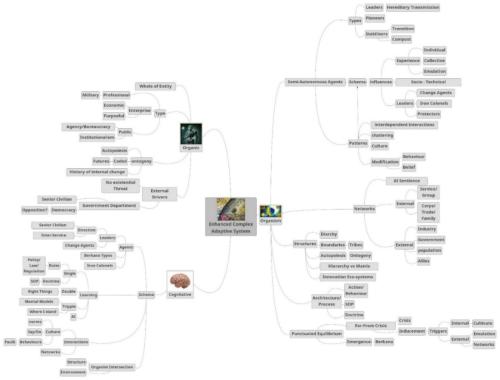
This final chapter will present the Enhanced Complex Adaptive System (eCAS), as illustrated in Figure 3. Structured in CAS’ three levels, it outlines the assemblage of theories and studies, enhancing its explanatory power and applicability to the ADO.
Section 6.1 Organic
At the whole of entity level, the eCAS is considered homogenous, responding to external fluctuations. This level of the model enables evaluation as a unified entity, maintaining its holistic identity whilst containing all possible futures in its internal coding. This creates a practical boundary and a mental model of the entire ADO entity. A shared understanding of this boundary enables unbounded exploration of multiple internal coded futures, including challenging traditional internal boundaries, such as the diarchy, Service and Group tribes, potentially unlocking the promise of the integrated force.
The ADO uniquely responds to change as an enterprise and a professional firm. This hybrid type influences both individual schema and collective culture from the bottom up and top down. Understanding Grissom’s organisational type at the organic level distinguishes it from the private sector. Zegart and Durrant's analysis of public institutions provides insight into the unique nature of the military entity. As a public organisation, it will survive regardless of effective evolution. Identifying similar hybrids enables the exploration of historical precedents and their responses to organisational change.
The lack of existential threat (adversary) or market forces can lead to ambivalence or resistance to external environmental fluctuations in peacetime or interwar periods. The current strategic environment, marked by the fourth industrial revolution, is unprecedented, but is it sufficient to mobilise whole of ADO organisational change? Durant and Zegart highlight the need for external senior civilian intervention to overcome institutional bureaucratic resistance, a view supported by Posen, which is widely referenced in military transformation studies. Noting not all senior civilians are invested in the successful continual improvement of public entities, particularly the democratic opposition. Although the DSR and NDS represent such intervention, Palazzo notes this has previously proved inadequate.174 Evans points out the challenge of the ADO Diarchy and the immaturity of Australian civil-military relations as compounding challenges.
Whilst external triggers can initiate change, artificially generating crises internally can drive change through recovery, impacting all levels of the CAS. While motivated to achieve positive outcomes, Morrison’s approach to Army organisational change exemplifies crisis in a military context. A holistic view considering second and third-order impacts and enduring outcomes is essential; short-term gain may not realise the intended vision. The organic level assists in framing the military organisational change model, but as shown in Chapter Four, it is insufficient. The complexity of contemporary military organisation requires a deeper level of analysis.
Section 6.2 Organism
The CAS's organism level explores this complexity, the organisation's internal dynamics. The ecological influences at this level differentiate it from mechanistic planned approaches characterising early organisational change models. At the core of Dooley’s CAS is the network of semi-autonomous agents, each with their schema interacting, producing pattern across the system. These interactions form cultures impacting individual and collective behaviour. Two key intersecting structural factors in the ADO must be considered at this level: the interservice tribes and the diarchy. Evans' consideration of the weakness in the Australian civilian-military relationship intersects with Sapolsky’s consideration of interservice rivalry, providing a unique context enhancing the application of the eCAS to the ADO.
Sapolsky and Farrell et al. explore military structures, noting they are both hierarchical and matrixed networks. This provides opportunities to challenge structural barriers Murray et al. suggest constrain organisational change. Understanding the hybrid nature of the military organism uncovers vectors of resistance to be overcome. Holmes, Field, Christensen, Adner, and Levinthal suggest structuring to enable the Berkana pioneers to innovate in cross-boundary ecosystems may unlock disruptive thought and creativity, often constrained in traditional hierarchical structures.
The eCAS is a network of interacting agents adapting based on experiences and system influences, characterised by non-linearity, self-organisation, and creation. Small changes at the right place and time can have exponential impact. The co-evolution of systems and technology is crucial, emphasising the interplay between networks (social structures), communication and collaboration (social process) and technological systems, illustrating their co-evolution in dynamic environments. For the ADO, this integrates Farrell and Evans' observations on the technology fetish paradigm, illuminating unhelpful behaviours unique to digital transformation and how the socio-technology concept can be leveraged to overcome them.
At the organism level, intersecting with networks and the socio-technology component, Singer’s work interfaces with the strategic environment. Understanding AI and emerging sentience expands the network of agents construct. Immediately, machine learning can enhance decision-making and shape mental models in the cognitive space. Singer’s insights further challenge the current mental model of what constitutes a network of semi-autonomous agents. The eCAS incorporating his work provides opportunities to explore how this intersects at all levels, potentially accelerating or constraining organisational change.
Understanding agent schema and how it can be evolved is fundamental to the eCAS cognitive level. However, as Murray and Zegart highlight, military architecture and processes can cultivate resistance to change. SOPs and doctrine, designed to enable cohesion and ordered, controlled military action in battle, can have a perverse effect in peacetime. When architecture and process assume moral/political importance instead of the outcome they were designed to achieve, resistance to change can result. Conversely, leveraging this phenomenon can ensure a balanced approach to change. Paluk’s exploration of behaviour modification, without changing individual belief systems, further illustrates how collective influence can shift schema at the network level.
Not surprisingly, a consistent theme across military transformation studies is the crucial role of leaders as proponents of change. Posen’s focus on senior civilian intervention, coupled with Clarke’s internal mavericks, emphasises the importance of internal and external change leaders. Rosen’s generational model highlights the importance of these critical agents achieving the correct position with power and influence to drive organisational change. However, in contrast, Wilson’s analysis of public intuitions emphasises that, unlike private entities, leaders are constrained by their ability to independently change the system, challenging their ability to achieve change. Understanding the leadership landscape at the eCAS organism level enables cultivation and empowerment to ensure change outcomes.
The eCAS contains significant organism-level enhancement, improving its applicability to the military context. Ontogeny suggests all possible future change outcomes are already coded into the organisational entity. Understanding the current state enables predictive approaches to planning, strategy development, simulation, and testing and ultimately implementation. The inherent eCAS non-linearity challenges rigid approaches and checklists. Instead, it encourages multi-future analysis to track evolution, outcomes, and emerging resistance. It motivates strategies and plans enabling dynamic adjustment, focusing on outcomes rather than rigid adherence to a plan.
Section 6.3 Cognitive
The CAS cognitive level has significant synergies with the theory and models used to examine military transformation. Integrating military-specific exemplars enhances the eCAS' explanatory power, especially considering the nature of agents within military organisations. This level emphasises agents and their schema, the rules, knowledge, and experience used to navigate their environment. Schema are fundamental to processing information and decision-making, helping agents navigate novel scenarios. Agents adapt and evolve schema based on interactions with other agents, the environment and learning. Importantly, agent interaction guided by schemas coalesces into emergent patterns at the organism and organic level, which cannot be predicted by individual components. The cognitive level incorporates Argryis and Schön’s learning models, with Zweibelson's work in the military context further enhancing.
Learning is critical to the evolution of agent schema. Cultivating learning and encouraging agents to challenge foundational mental models enables paradoxical thinking, prompting them to explore tensions between how others interpret the environmental reality rather than simply conform to linear decision-making. Paluk, Singer, Zegart, Nagl and Murray’s exploration of how architecture and process at the organism level influence schema evolution intersect into this cognitive level. Their impact on learning can both cultivate and constrain change efforts. While Zegart’s exploration of agency and bureaucracy intersects most heavily at the organic level of the CAS, her core questions to frame change help drive deeper learning, ‘Are you doing enough different today to meet the challenges of the future?’175 This type of learning encourages creative exploration and disruptive innovation.
The Berkana model identifies agent types. Whilst all possess unique individual schema, these agents' consistent response to organisational change can be leveraged. This baseline understanding, coupled with Johnson’s parable, enables leaders to support individuals and teams more effectively. This may go as far as identifying pioneers, connecting them into networks and tailoring their management to accelerate change outcomes. Conversely, as Kalm highlights, the Iron Colonels represents a group cultivating organisational resistance and must be considered in the military context, requiring equally nuanced management.
Change leaders are detailed at the organism level, but all leaders influence schema, specifically learning. Brown and Field highlight leaders provide environments that constrain or cultivate the deep learning essential to schema evolution. They are vital to balancing military conservatism and innovation, nurturing creativity whilst maintaining warfighting capability. Leadership alone cannot assure or retard change but is a key contributor to eCAS requiring exploration across all levels.
The eCAS offers a model of military organisational change leveraging Dooley’s CAS foundation. It leverages assemblage theory to enhance its explanatory power and brings together intersecting theories and studies of military transformation to support its application to the military environment. Whilst this thesis uses literature exploring change and innovation in discrete parts of the ADO, it cannot be extrapolated to assess change resistance. Instead, it offers a model to take forward into primary source engagement to more effectively understand the ADO and its approach to change.
Section 6.4 Next Steps
This exploratory thesis aimed to develop a model for military organisational change, enabling the ADO to ascertain whether it is genuinely resistant to change and thereby optimise future transformation efforts. In examining organisational change and intersecting theories, Dooley’s CAS provided a robust foundation for understanding the intricate complexity of the contemporary military organisation. It offered tangible explanatory power to identify resistance and optimise organisational change outcomes. Integrating intersecting theories and studies of military transformation through the application of assemblage theory, the eCAS model was developed, enhancing both explanatory power and applicability to the ADO context.
Whilst literature specifically addressing ADO organisational change is limited, this thesis has drawn from studies of discrete components and tactical innovation to enhance the CAS across the cognitive and organism levels. However, simply extrapolating these findings is insufficient to assess the ADO’s resistance to change.
This thesis lays the groundwork for examining contemporary ADO transformation programs through the eCAS model. Insight from comprehensive primary sources across the organisation is necessary to validate its explanatory power and ability to identify change resistance, ultimately providing a means to optimise future transformation efforts.
The author intends to apply this model to a contemporary organisational change initiative to validate its explanatory power and effectiveness in analysing and optimising organisational change. The Enterprise Reform Program (ERP) is realising the ADO’s digital future, affecting the entire organisation. Its impact across all parts of the organisation and its problematic implementation makes it an excellent candidate for exploration.176 The potential for comparative analysis of other militaries also exists, noting number of nations are undergoing simultaneous transformation using the same digital platform.177 This represents an ideal nexus for further contribution to the study of contemporary military organisational change and providing tangible benefits to the continual improvement of the ADO.
The ADO faces a significant challenge ahead. As Kurt Lewin aptly said, ‘If you want to truly understand something, try to change it.’178 The eCAS model provides a means to truly understand how the ADO can meet the challenges ahead and if dinosaurs can be taught to surf?
(78) Accelerate - YouTube. Accessed 24 August 2024. https://www.youtube.com/watch?v=o9SxvladTCg.
2017 Good Practice. ‘John Kotter on Transformational Change’, 2017.
Adelman, Clem. ‘Kurt Lewin and the Origins of Action Research’. Educational Action Research 1, no. 1 (January 1993): 7–24. https://doi.org/10.1080/0965079930010102.
Adner, Ron. ‘Match Your Innovation Strategy to Your Innovation Ecosystem’. Harvard Business Review, 2006.
Adner, Ron, and Daniel A. Levinthal. ‘The Emergence of Emerging Technologies’. California Management Review 45, no. 1 (1 October 2002): 50–66. https://doi.org/10.2307/41166153.
Agile Change Leadership Institute. ‘70% of Change Fails: Bollocks!’ Agile Change Leadership Institute
(blog). Accessed 5 May 2024. https://aclinstitute.com/newsroom/70-change-fail/.
Ahronheim, Anna. ‘Bringing the IDF into the Digital World. The Military’s Digital Transformation Is Not Only Focused on War, but Also on the Individual Soldier’. Jerusalem Post, 18 April 2022. 2652604698. Global Newsstream.
Ahronheim, Anna. ‘Bringing the IDF into the Digital World. The Military’s Digital Transformation Is Not Only Focused on War, but Also on the Individual Soldier’. Jerusalem Post, 18 April 2022. 2652604698. Global Newsstream.
Alam, Moinul. ‘What Is Open Innovation? Definition, Types, Model and Best Practices’. IdeaScale
(blog), 14 July 2023. https://ideascale.com/blog/what-is-open-innovation/.
Alecsoiu, Olivia. ‘Resistance to Organisational Change; Literature Review Politics, Administration and Social Development’. Annals of the Constantin Brancusi University of Targu Jiu, Letters and Social Sciences Series 2017, no. 4 (2017): 16–20.
Allan R. Millett and Williamson Murray. Military Effectiveness: Volume 3, The Second World War. 2nd ed. Vol. 00003. Military Effectiveness. Cambridge: Cambridge University Press, 2010. https://research.ebsco.com/linkprocessor/plink?id=43aa69b2-94a2-3635-915f-c1c3a905d432.
Alvinius, Aida, Arita Holmberg, and Eva Johansson. ‘Do Military Leaders Resist Organizational Challenges?’ 5, no. 1 (2019).
Andrew F. Krepinevich. The Origins of Victory : How Disruptive Military Innovation Determines the Fates of Great Powers. New Haven, Ct: Yale University Press, 2023. https://research.ebsco.com/linkprocessor/plink?id=d97009d2-8f3b-3925-9e30-71252da8d489.
Argenti, Paul A., Jenifer Berman, Ryan Calsbeek, and Andrew Whitehouse. ‘The Secret Behind Successful Corporate Transformations’. Harvard Business Review, 14 September 2021. https://hbr.org/2021/09/the-secret-behind-successful-corporate-transformations.Argyris, Chris. Overcoming Organizational Defenses: Facilitating Organizational Learning. Boston: Allyn and Bacon, 1990.
———. ‘Skilled Incompetence’. Harvard Business Review, 1 September 1986. https://hbr.org/1986/09/skilled-incompetence.
———. ‘The Executive Mind and Double-Loop Learning.’ Organizational Dynamics 11, no. 2 (1 September 1982): 5–22. https://doi.org/10.1016/0090-2616(82)90002-X.
Arnoldi, Jakob. ‘Autopoiesis.’ Theory, Culture & Society 23, no. 2/3 (1 March 2006): 116–17. https://doi.org/10.1177/026327640602300220.
Augier, Mie, and Jerry Guo. Technology and Leadership and International Perspective. Chapter 7 The Evolutionary Nature of Innovation And Disruptive Change: The Interrelatedness of Technology, Leadership And Organizations, n.d.
Augier, Mie, and Wayne Hughes. ‘Leading Military Innovation, Past and Present | Center for International Maritime Security’, 14 August 2018. https://cimsec.org/leading-military-innovation-past-and-present/.
Australian Chief of Army to Sexist Soldiers: Respect Women or GET OUT, 2013. https://www.youtube.com/watch?v=dRQBtDtZTGA.
Avadikyan, Arman, Patrick Cohendet, and Olivier Dupouët. ‘A Study of Military Innovation Diffusion Based on Two Case Studies’. In Innovation Policy in a Knowledge-Based Economy: Theory and Practice, edited by Patrick Llerena and Mireille Matt, 161–89. Berlin, Heidelberg: Springer Berlin Heidelberg, 2005. https://doi.org/10.1007/3-540-26452-3_7.
Ball, Desmond, and Robert Ayson, eds. Strategy and Security in the Asia-Pacific: Global and Regional Dynamics. London: Routledge, 2020. https://doi.org/10.4324/9781003117506.
Barno, David, and Nora Bensahel. Adaptation under Fire : How Militaries Change in Wartime. Oxford, UNITED STATES: Oxford University Press, Incorporated, 2020. http://ebookcentral.proquest.com/lib/dlsau-ebooks/detail.action?docID=6268800.
———. ‘The Role of Leadership’. In Adaptation under Fire: How Militaries Change in Wartime, edited by David Barno and Nora Bensahel, 0. Oxford University Press, 2020. https://doi.org/10.1093/oso/9780190672058.003.0005.
BCG Consulting. ‘Six Priorities for Leaders When Transforming Defense Agencies’. BCG Global, 14 November 2023. https://www.bcg.com/publications/2023/six-priorities-for-leaders-launching-a- defense-transformation.
Berry, Matt. ‘The Berkana Institute’s “Two Loops”’. Innovation Unit (blog), 11 November 2022. https://www.innovationunit.org/thoughts/the-berkana-institutes-two-loops/.
Beverley Patwell. Leading Meaningful Change : Capturing the Hearts, Minds, and Souls of the People You Lead, Work With, and Serve. Vancouver: Figure 1 Publishing, 2020. https://search.ebscohost.com/login.aspx?direct=true&AuthType=ip,sso&db=e020mww&AN=2362350&site=eds-live&custid=s3330841.
Blomme, Robert. ‘Leadership, Complex Adaptive Systems, and Equivocality: The Role of Managers in Emergent Change’. Organization Management Journal 9 (1 April 2012). https://doi.org/10.1080/15416518.2012.666946.
Bob Breen. Struggling for Self Reliance : Four Case Studies of Australian Regional Force Projection in the Late 1980s and the 1990s. Canberra Papers on Strategy and Defence. Canberra: ANU Press, 2008. https://search.ebscohost.com/login.aspx?direct=true&AuthType=ip,sso&db=nlebk&AN=3093257&site=eds-live&custid=s3330841.
Bolman, Lee. ‘Argyris, Chris: The Iconoclast’. In The Palgrave Handbook of Organizational Change Thinkers, edited by David B. Szabla, 71–90. Cham: Springer International Publishing, 2021. https://doi.org/10.1007/978-3-030-38324-4_29.
Bousquet, Antoine. ‘Chaoplexic Warfare or the Future of Military Organization.’ International Affairs 84, no. 5 (1 September 2008): 915–29. https://doi.org/10.1111/j.1468-2346.2008.00746.x.
Bousquet, Antoine. The Scientific Way of Warfare: Order and Chaos on the Battlefields of Modernity. 2nd edition. London: Hurst & Company, 2022.
Bower, Joseph L., and Clayton M. Christensen. ‘Disruptive Technologies: Catching the Wave’. Harvard Business Review, 1 January 1995. https://hbr.org/1995/01/disruptive-technologies-catching-the-wave.
Brandon, Ian. ‘MASTER OF MILITARY ART AND SCIENCE Art of War Scholars’, n.d. Breen, Bob. ‘Preparing the Australian Army for Joint Employment’, n.d.
Bridges, Williams. ‘William Bridges Associates : Transition Management Leaders’. William Bridges Associates. Accessed 24 August 2024. https://wmbridges.com/about/william-bridges-bio/.
Brose, Christian. ‘The New Revolution in Military Affairs: War’s Sci-Fi Future’. Foreign Affairs 98, no. Issue 3 (1 May 2019): 122–34.
Brown, James. ‘The Challenge of Innovation in the Australian Army’. Security Challenges 7, no. 2 (2011): 13–18.
Bruce J. Avolio. Organizational Transformation : How to Achieve It, One Person at a Time. Stanford, California: Stanford Business Books, 2018. https://eds.p.ebscohost.com/eds/ebookviewer/ebook/ZTAyMG13d19fMTc5OTI4MF9fQU41?sid=3c55bd98-3c0e-4699-885d-5ff1fc021f32@redis&vid=15&format=EB&rid=11.
Burke, W. Warner, and George H. Litwin. ‘A Causal Model of Organizational Performance and Change.’ Journal of Management 18, no. 3 (September 1992): 523.
Burnes, Bernard. ‘Kurt Lewin and the Planned Approach to Change: A Re-Appraisal’. Journal of Management Studies 41, no. 6 (2004): 977–1002. https://doi.org/10.1111/j.1467-6486.2004.00463.x.
Cameron, Esther, and Mike Green. Making Sense of Change Management : A Complete Guide to the Models, Tools and Techniques of Organizational Change. Fourth edition. Kogan Page, 2015. https://search.ebscohost.com/login.aspx?direct=true&AuthType=ip,sso&db=cat08417a&AN=dod.963632&site=eds-live&custid=s3330841.
Campbell, Tom. ‘Terminator Conundrum: Perhaps a Middle Ground?’, 10 August 2018. https://www.futuregrasp.com/terminator-conundrum.
Cardus, Mike. ‘Change Management or Organization Development’. Mikecardus.Com (blog), 5 March 2023. https://mikecardus.com/change-management-organization-development/.
Can Robots Suffer? | Peter Singer and Lex Fridman, 2020. https://www.youtube.com/watch?v=8RKbnjlOV8I.
Carter, Cate. ‘Being One of the Boys in the Military | Lowy Institute’, 20 February 2020. https://www.lowyinstitute.org/the-interpreter/being-one-boys-military.
CASPS, RAF. ‘Basil H. Liddell Hart: His Applicability to Modern War’. RAF CASPS (blog), 18 May 2018. https://medium.com/raf-caps/basil-h-liddell-hart-his-applicability-to-modern-war-bf4e4c9145e3.
Cheeseman, Graeme. ‘Structuring the Australian Defence Force for United Nations Operations: Change and Resistance’. In Peacekeeping and Peacemaking: Towards Effective Intervention in Post- Cold War Conflicts, edited by Tom Woodhouse, Robert Bruce, and Malcolm Dando, 231–52. London: Palgrave Macmillan UK, 1998. https://doi.org/10.1007/978-1-349-26213-7_12.
Chesbrough, Henry, Wim Vanhaverbeke, and Joel West. Open Innovation : Researching a New Paradigm. Oxford: OUP Oxford, 2006. https://research.ebsco.com/linkprocessor/plink?id=3e31353b-0f93-363c-835d-2560edb1e1f0. Chief of the Australian Defence Force. ‘ADF Leadership’. ADF, 2021. https://theforge.defence.gov.au/sites/default/files/2021-06/adf-philosophical-doctrine-adf-leadership.pdf.
Chinn, David, and John Dowdy. ‘Five Principles to Manage Change in the Military’, n.d.
Chizek, Judy G. ‘Military Transformation: Intelligence, Surveillance and Reconnaissance: RL31425.’
Congressional Research Service: Report, 17 January 2003, 1.
Christensen, Clayton M. The Innovator’s Dilemma: The Revolutionary Book That Will Change the Way You Do Business ; [with a New Preface]. 1. Harper Business paperback publ. New York, NY: Harper Business, 2011.
———. The Innovator’s Dilemma: When New Technologies Cause Great Firms to Fail. Paperback. The Management of Innovation and Change Series. Boston, Massachusetts: Harvard Business Review Press, 2016.
———. ‘The Innovator’s Dilemma : When New Technologies Cause Great Firms to Fail / Clayton M. Christensen.’, 1 January 1997. https://research.ebsco.com/linkprocessor/plink?id=7d58d6ab-bc0b-3488-8e01-e00950ad96e3.
Christensen, Clayton M., Jeff Dyer, Hal B. Gregersen, and Michael E. Raynor. [Disruptive Innovation : The Christensen Collection]. Boston, Massachusetts: Harvard Business Review Press, 2011. https://research.ebsco.com/linkprocessor/plink?id=1cffc029-8b1b-351b-976f-357b56c6ad26.
Chubb, Danielle, and Ian McAllister. Australian Public Opinion, Defence and Foreign Policy: Attitudes and Trends Since 1945. Singapore: Springer, 2021. https://doi.org/10.1007/978-981-15-7397-2.
CIO Magazine. ‘Why Adaptability Is the New Digital Transformation’. CIO, 30 October 2023. https://www.proquest.com/trade-journals/why-adaptability-is-new-digital-transformation/docview/2884075843/se-2?accountid=10479.
Clark, JP. ‘Organizational Change and Adaptation in the US Army.Pdf’. US Army War College: Parameters, no. 46 (1 September 2016).
Clay, Brett. ‘Kotter, John: A Pragmatic Observer of Managers’ Life Worlds’. In The Palgrave Handbook of Organizational Change Thinkers, edited by David B. Szabla, 875–89. Cham: Springer International Publishing, 2021. https://doi.org/10.1007/978-3-030-38324-4_47.
Cohen, Eliot A. ‘A Revolution in Warfare’. Foreign Affairs 75, no. 2 (1996): 37–54. https://doi.org/10.2307/20047487.
Cohen, Eliot, and John Gooch. Military Misfortunes; The Anatomy of Failure in War. The Free Press Collier Macmillian, 1990.
Cronin, Audrey Kurth. ‘Technology and Strategic Surprise: Adapting to an Era of Open Innovation’, n.d.
Cronshaw, Darren. ‘Book Review – The Fifth Discipline: The Art and Practice of the Learning Organization, by Peter Senge - Grounded Curiosity’, 20 April 2024. https://groundedcuriosity.com/book-review-the-fifth-discipline-the-art-and-practice-of-the-learning-organization-by-peter-senge/.
Cummings, Stephen, Todd Bridgman, and Kenneth G Brown. ‘Unfreezing Change as Three Steps: Rethinking Kurt Lewin’s Legacy for Change Management’. Human Relations 69, no. 1 (1 January 2016): 33–60. https://doi.org/10.1177/0018726715577707.
Davidson, Janine. ‘Military Learning and Competing Theories of Change’. Lifting the Fog of Peace: How Americans Learn to Fight Modern War, 2010.
———. ‘The Contemporary Presidency: Civil-Military Friction and Presidential Decision Making: Explaining the Broken Dialogue’. Presidential Studies Quarterly 43, no. 1 (1 March 2013): 129–45. https://doi.org/10.1111/psq.12006.
Davis, Paul K. ‘Military Transformation? Which Transformation, and What Lies Ahead?’ Potomac Books, 4 June 2010. https://www.rand.org/pubs/reprints/RP1413.html.Debra Orr Ph.D. Team for Change : A Practitioner’s Guide to Implementing Change in the Modern Workplace. Emerald Points Ser. Bingley: Emerald Publishing Limited, 2021. https://search.ebscohost.com/login.aspx?direct=true&AuthType=ip,sso&db=e020mww&AN=2730969&site=eds-live&custid=s3330841.
Defence Act, Cth § 10 (1903). https://www8.austlii.edu.au/cgi-bin/viewdoc/au/legis/cth/consol_act/da190356/s10.html .
Defense XXI : Shaping a Way Ahead for the United States and Its Allies. [publisher not identified], 2022. https://search.ebscohost.com/login.aspx?direct=true&AuthType=ip,sso&db=cat08417a&AN=dod.1071130&site=eds-live&custid=s3330841.
Department of Defence. ‘Lead the Way: Defence Transformation Strategy | About | Defence’. Website. scheme=AGLSTERMS.AglsAgent; corporateName=Commonwealth of Australia, Department of Defence; address=Russell Offices, Russell, ACT, 2600; contact=1300 333 362. Accessed 2 April 2024. https://www.defence.gov.au/about/strategic-planning/lead-way-defence-transformation-strategy.
Dept of Def. ‘Australia’s 2023 Defence Strategic Review’. IISS. Accessed 6 May 2024. https://www.iiss.org/en/publications/strategic-comments/2023/australias-2023-defence-strategic-review/.
Diamond, Michael A. ‘Resistance to Change: A Psychoanalytic Critique of Argyris and Schön ’s Contributions to Organization Theory and Intervention’. Journal of Management Studies 23, no. 5 (September 1986): 543–62. https://doi.org/10.1111/j.1467-6486.1986.tb00436.x.
Dickinson, Eleanor. ‘Defence to Migrate 100,000 ADF Personnel to New HR Tool’. iTnews. Accessed 3 October 2024. https://www.itnews.com.au/news/defence-to-migrate-100000-adf-personnel-to-new-hr-tool-611771.
Disgruntled Soldier Complains to Rumsfeld, 2015. https://www.youtube.com/watch?v=t5uBgLtY6ec. Dobbs, Richard, James Manyika, and Jonathan Woetzel. ‘How Do You Govern a Disrupted World?’ n.d.
———. No Ordinary Disruption: The Four Global Forces Breaking All the Trends. New York, UNITED STATES: PublicAffairs, 2015. http://ebookcentral.proquest.com/lib/deakin/detail.action?docID=1948759.
———. ‘The Four Global Forces Breaking All the Trends’, n.d.
Dooley, Kevin. ‘A Complex Adaptive Systems Model of Organization Change’. Nonlinear Dynamics Psychology and Life Sciences 1 (1 January 1997): 69–97. https://doi.org/10.1023/A:1022375910940.
———. ‘A Nominal Definition of Complex Adaptive Systems’. Chaos Network 8 (1 January 1996): 2–3.
Dougherty, George. ‘Promoting Disruptive Military Innovation: Best Practices for DoD Experimentation and Prototyping Programs’. Defense Acquisition Research Journal 25, no. 1 (2 January 2018): 2–29. https://doi.org/10.22594/dau.17-782.25.01.
Doughty, Robert A. ‘Military Misfortunes: Pitfalls in Understanding’. The US Army War College Quarterly: Parameters 20, no. 1 (4 July 1990). https://doi.org/10.55540/0031-1723.1552.
Douwen, Nina van, Marieke van den Brink, and Yvonne Benschop. ‘Badass Marines: Resistance Practices against the Introduction of Women in the Dutch Military.’ Gender, Work & Organization 29, no. 5 (1 September 2022): 1443–62. https://doi.org/10.1111/gwao.12835.
Dunford, Richard, and Deborah Jones. ‘Narritive in Strategic Change’. Human Relations 53, no. 9 (September 2000): 1207–26.
Durant, Robert F. ‘Herbert Hoover’s Revenge: Politics, Policy, and Administrative Reform Movements’. In The Oxford Handbook of American Bureaucracy, edited by Robert F. Durant, 0. Oxford University Press, 2010. https://doi.org/10.1093/oxfordhb/9780199238958.003.0007.
———. ‘Agency Evolution, New Institutionalism, and “Hybrid” Policy Domains: Lessons from the “Greening” of the U.S. Military’. Policy Studies Journal 34, no. 4 (November 2006): 469–90. https://doi.org/10.1111/j.1541-0072.2006.00187.x.
———, ed. The Oxford Handbook of American Bureaucracy. Oxford University Press, 2010. https://doi.org/10.1093/oxfordhb/9780199238958.001.0001.
Elizabeth Kier. Imagining War : French and British Military Doctrine Between the Wars. [N.p.]: Princeton University Press, 2017.
Hall, Aaron. ‘Overcoming Resistance to Change: Strategies for Successful Transformation’. Aaron Hall, 1 October 2023. https://aaronhall.com/insights/overcoming-resistance-to-change-strategies-for- successful-transformation/.
Eoyang, Glenda H. ‘Dooley, Kevin J: Complexity – Simple and Useful’. In The Palgrave Handbook of Organizational Change Thinkers, edited by David B. Szabla, 541–56. Cham: Springer International Publishing, 2021. https://doi.org/10.1007/978-3-030-38324-4_75.
Ergas, Henry. ‘Australia’s Defence: A Review of the “Reviews”’. Agenda: A Journal of Policy Analysis and Reform 19, no. 1 (2012): 63–71.
Evans, Jake. ‘Australia’s Military Has Begun One of Its Greatest Shifts since WWII. Here’s How It Will Change’. ABC News, 24 April 2023. https://www.abc.net.au/news/2023-04-24/defence-strategic-review-key-takeaways/102260364.
Evans, MichaeI. ‘Fabrizio’s Choice: Organisational Change and the Revolution in Military Affairs Debate’, n.d.
Evans, Michael. ‘Australia and Defence Transformation 1’. Defence Studies 6, no. 2 (1 June 2006): 133–49. https://doi.org/10.1080/14702430601056055.
———. ‘Diagnosing Dysfunction in Defence Management’. Quadrant 66, no. 10 (1 October 2022): 20–29.
Farrell, Theo, Sten Rynning, and Terry Terriff. Transforming Military Power since the Cold War: Britain, France, and the United States, 1991-2012. New York: Cambridge University Press, 2013.
Farrell, Theo, and Terry Terriff. The Sources of Military Change : Culture, Politics, Technology. Making Sense of Global Security. Boulder, Colo: Lynne Rienner Publishers, 2002. https://search.ebscohost.com/login.aspx?direct=true&AuthType=ip,sso&db=nlebk&AN=149697&site=eds-live&custid=s3330841.
Field, Chris. ‘Enabling Army Innovation’. Australian Army Journal 13, no. 1 (1 June 2016): 68–80.
Field, Chris, and Peter Layton. ‘Australian Journal of Defence and Strategic Studies, Volume 4 Number 2 : Review of Mars Adapting: Military Change During War by Frank G Hoffman and War Transformed by Mick Ryan’ 4, no. 2 (2022).
Flaherty, Christopher. ‘The Relevance of the US Transformation Paradigm for the Australian Defense Forces’. Defense & Security Analysis 19, no. 3 (September 2003): 219–40. https://doi.org/10.1080/1475179032000118803.
Flammarion, Camille. L’atmosphère métérologie populaire : ouvrage contenant quinze planches tirées en chromotypographie, deux cartes en couleur et trois cent sept figures insérées dans le texte. Paris : Librairie Hachette et cie., 1888. http://archive.org/details/McGillLibrary-125043-2586.
Francis Hoffman. Mars Adapting : Military Change During War. Transforming War. Annapolis, MD: Naval Institute Press, 2021. https://search.ebscohost.com/login.aspx?direct=true&AuthType=ip,sso&db=e000xww&AN=2708134&site=eds-live&custid=s3330841.
French, David. Raising Churchill’s Army : The British Army and the War against Germany, 1919-1945., 2000. https://search.ebscohost.com/login.aspx?direct=true&AuthType=ip,sso&db=cat08417a&AN=dod.a485562&site=eds-live&custid=s3330841.
Friedman. ‘Thank You for Being Late: An Optimist’s Guide to Thriving in the Age of Accelerations’. Accessed 1 September 2024. https://www.carnegiecouncil.org/media/series/39/20170111-thank-you-for-being-late-an-optimists-guide-to-thriving-in-the-age-of-accelerations.
Frieser, Karl-Heinz. The Blitzkrieg Legend. The Blitzkrieg Legend. Annapolis, Annapolis: Naval Institute Press, Naval Institute Press, 2013. https://www.proquest.com/books/blitzkrieg-legend/docview/2131360826/se-2?accountid=10479 .
Gady, Franz-Stefan. ‘Israel’s Military Tech Fetish Is a Failed Strategy’. Foreign Policy (blog), 5 September 2024. https://foreignpolicy.com/2023/10/26/israel-hamas-gaza-military-idf-technology-surveillance-fence-strategy-ground-war/.
———. ‘“The Fog of Peace”: Why We Are Not Able to Predict Military Power’. Accessed 4 August 2024. https://thediplomat.com/2015/02/the-fog-of-peace-why-we-are-not-able-to-predict-military-power/.
Galbraith, Sasha. ‘Galbraith, Jay R.: Master of Organization Design – Recognizing Patterns from Living, Breathing Organizations’. In The Palgrave Handbook of Organizational Change Thinkers, edited by David B. Szabla, 631–50. Cham: Springer International Publishing, 2021. https://doi.org/10.1007/978-3-030-38324-4_39.
Galvin, Thomas P., and Lance D. Clark. ‘Beyond Kotters Leading Change: A Broad Perspective on Organizational Change for Senior U.S. Military Leaders’: Fort Belvoir, VA: Defense Technical Information Center, 16 June 2015. https://doi.org/10.21236/AD1001714.
Galvin, Tom. ‘Leading Change in Military Organizations: Primer for Senior Leaders’. US Army War College, n.d.
Gat, Azar. ‘British Influence and the Evolution of the Panzer Arm: Myth or Reality? Part I’. War in History 4, no. 2 (1997): 150–73.
Gilchrist, Mark. ‘Emergent Technology, Military Advantage, and the Character of Future War’. The Strategy Bridge (blog), 26 July 2018. https://thestrategybridge.org/the-bridge/2018/7/26/emergent-technology-military-advantage-and-the-character-of-future-war.
———. ‘You Can’t Write an Algorithm for Uncertainty: Why Advanced Analytics May Not Be the Solution to the Military “Big Data” Challenge’. The Strategist (blog), 23 August 2017. https://www.aspistrategist.org.au/cant-write-algorithm-uncertainty-advanced-analytics-may-not-solution-military-big-data-challenge/ .
Goldman Schuyler, Kathryn. ‘Senge, Peter: “Everything That We Do Is About Shifting the Capability for Collective Action...”’ In The Palgrave Handbook of Organizational Change Thinkers, edited by David B. Szabla, 1569–86. Cham: Springer International Publishing, 2021. https://doi.org/10.1007/978-3-030-38324-4_100.
Gormley, Bill. ‘James Q. Wilson, Bureaucracy: What Government Agencies Do and Why They Do It’. In The Oxford Handbook of Classics in Public Policy and Administration, edited by Martin Lodge, Edward C. Page, and Steven J. Balla, 0. Oxford University Press, 2015. https://doi.org/10.1093/oxfordhb/9780199646135.013.2.
Grissom, Adam. ‘The Future of Military Innovation Studies’. Journal of Strategic Studies 29, no. 5 (1 October 2006): 905–34. https://doi.org/10.1080/01402390600901067.
Hain, Raymond F. ‘The Use and Abuse of Technology: In Insurgent Warfare’, n.d.
Hall, Peter A., and Rosemary C. R. Taylor. ‘Political Science and the Three New Institutionalisms’. Political Studies 44, no. 5 (December 1996): 936–57. https://doi.org/10.1111/j.1467-9248.1996.tb00343.x.
Harris, J. P. Men, Ideas and Tanks: British Military Thought and Armoured Forces; 1903 - 1939. 1. publ. War, Armed Forces and Society. Manchester: Manchester University Press, 1995.
Harris, J.P. ‘The Myth of Blitzkrieg’. War in History 2, no. 3 (1995): 335–52.
Hart, Russell A. Guderian : Panzer Pioneer or Myth Maker? Vol. 1st ed. Military Profiles. Washington, D.C.: University of Nebraska Press, 2006. https://search.ebscohost.com/login.aspx?direct=true&AuthType=sso&db=nlebk&AN=388656&site=ehost-live&custid=s3330841.
Hill, Andrew. ‘Military Innovation and Military Culture’. The US Army War College Quarterly: Parameters 45, no. 1 (1 March 2015). https://doi.org/10.55540/0031-1723.2809.
———. ‘Military Innovation Through “Brilliant Mistakes”’, n.d.
Hill, Andrew, and Stephen Gerras. ‘Systems of Denial: Strategic Resistance to Military Innovation’, 2016.
Hirschhorn, Larry. ‘The Primary Risk’. Human Relations 52, no. 1 (1 January 1999): 5–23. https://doi.org/10.1177/001872679905200102.
Holmes, Scott. ‘Military Revolution: Preparing the Australian Army for the Fourth Industrial Revolution’. Thesis, UNSW Sydney, 2021. https://doi.org/10.26190/unsworks/2358.
‘How I Became a Localist: The Two Loops’. TEDxJamaicaPlain. Accessed 24 August 2024. https://www.youtube.com/watch?v=2jTdZSPBRRE.
Howk, Jason Criss. ‘Risk-Taking Leaders: Mavericks and Innovators Change the World’. ClearanceJobs, 10 December 2020. https://news.clearancejobs.com/2020/12/10/risk-taking-leaders-mavericks-and-innovators-change-the-world/.
Kurzweilai.net. ‘Understanding the Accelerating Rate of Change « the Kurzweil Library + Collections’. Accessed 12 August 2024. https://www.thekurzweillibrary.com/understanding-the-accelerating-rate-of-change.
Hughes, Mark. ‘Do 70 Per Cent of All Organizational Change Initiatives Really Fail?’ Journal of Change Management 11, no. 4 (1 December 2011): 451–64. https://doi.org/10.1080/14697017.2011.630506.
Human Systems Dynamics Institute. ‘Complex Adaptive System’. Accessed 11 September 2024. https://www.hsdinstitute.org/resources/complex-adaptive-system.html.
Immink, Ron. Building the In-Company Change Muscle : Intrapreneurship, Innovation, Transformation & Strategy. Business Book Series. Cork, Ireland: Oak Tree Press, 2021. https://search.ebscohost.com/login.aspx?direct=true&AuthType=ip,sso&db=e020mww&AN=3036847&site=eds-live&custid=s3330841.
J Rogers, Clifford. The Military Revolution Debate: Readings on the Military Transformation of Early Modern Europe. Oxford, UNITED KINGDOM: Taylor & Francis Group, 1995. http://ebookcentral.proquest.com/lib/deakin/detail.action?docID=5438843.
Jaclyn Lee. Accelerating Organisation Culture Change : Innovation Through Digital Tools. Vol. First edition. Emerald Points Ser. Bingley, UK: Emerald Publishing Limited, 2020. https://search.ebscohost.com/login.aspx?direct=true&AuthType=ip,sso&db=e020mww&AN=2289449&site=eds-live&custid=s3330841.
James, Neil. ‘The Bureaucracy’s Control over the Australian Defence Force’. National Observer - Australia and World Affairs, 2001. Gale In Context: Global Issues.
Jans, Brigadier Nick. ‘Rich Organisation, Poor Organisation: Defence Performance and Military Leadership’, n.d.
Jarvis, Lee, and Nick Robinson. ‘Oh Help! Oh No! The International Politics of The Gruffalo: Children’s Picturebooks and World Politics’. Review of International Studies 50, no. 1 (2024): 58–78. https://doi.org/10.1017/S0260210523000098.
Jelenjev, Lana. ‘Finding Each Other in the Emergence’. Lana Jelenjev, 29 January 2022. https://www.lanajelenjev.com/post/finding-each-other-in-the-emergence.
Jensen, S. Henning. ‘Taylor, Frederick Winslow: The First Change Agent, from Rule of Thumb to Scientific Management’. In The Palgrave Handbook of Organizational Change Thinkers, edited byDavid B. Szabla, 1673–89. Cham: Springer International Publishing, 2021. https://doi.org/10.1007/978-3-030-38324-4_24.
Johnson, David. ‘An Army Trying to Shake Itself from Intellectual Slumber, Part II: From 9/11 to Great Power Competition’. War on the Rocks (blog), 6 February 2018. https://warontherocks.com/2018/02/army-trying-shake-intellectual-slumber-part-ii-9-11-great-power-competition/.
Johnson, Derek B. ‘Why the Pentagon Remains Both the Best and Worst Customer for Tech Innovators’. SC Media, 22 August 2022. https://www.scmagazine.com/feature/why-the-pentagon-remains-both-the-best-and-worst-customer-for-tech-innovators.
Johnson, Spencer. Who Moved My Cheese? An Amazing Way to Deal with Change in Your Work and in Your Life. Reissued. Personal Development. London: Vermilion, 2002.
Jungdahl, Adam M., and Julia M. Macdonald. ‘Innovation Inhibitors in War: Overcoming Obstacles in the Pursuit of Military Effectiveness’. Journal of Strategic Studies 38, no. 4 (2014): 467.
Kalms, Mike. ‘Cultural Reform in Middle Army – Melting Iron Colonels | The Cove’. Accessed 10 September 2024. https://cove.army.gov.au/article/cultural-reform-middle-army-melting-iron-colonels.
Kamara, Hassan M. ‘Military Transformation: Applying the Kotter Eight-Step Methodology for Change in the U.S.’ National Defense University Press. Accessed 24 August 2024. https://ndupress.ndu.edu/Media/News/News-Article-View/Article/1681876/military-transformation- applying-the-kotter-eight-step-methodology-for-change-i/
———. ‘The Influence of U.S. Strategic Culture on Innovation and Adaptation in the U.S. Army.’
Journal of Strategic Security 8, no. 4 (1 December 2015): 79–91. https://doi.org/10.5038/1944-0472.8.4.1453.
Kartchner, Kerry M., Briana D. Bowen, and Jeannie L. Johnson, eds. Routledge Handbook of Strategic Culture. London: Routledge, 2023. https://doi.org/10.4324/9781003010302.
Kegan, Robert, and Lisa Laskow Lahey. Immunity to Change : How to Overcome It and Unlock Potential in Yourself and Your Organization. Leadership for the Common Good, 2009. https://search.ebscohost.com/login.aspx?direct=true&AuthType=ip,sso&db=cat08417a&AN=dod.667649&site=eds-live&custid=s3330841.
Kelly, J. ‘Resistance to Organizational Cultural Change in the Military - A JFO Case Study’, n.d.
Kidson, Renee Louise. ‘Army in the 21st Century and Restructuring the Army: A Retrospective Appraisal of Australian Military Change Management in the 1990s’. PQDT - Global. M.A., The Australian National University (Australia), 2017. ProQuest One Academic (2220864459). http://ezproxy.deakin.edu.au/login?url=https://www.proquest.com/dissertations-theses/army-21st-century-restructuring-retrospective/docview/2220864459/se-2?accountid=10445.
Kilcullen, David. The Dragons and the Snakes : How the Rest Learned to Fight the West. Brunswick, Victoria, AUSTRALIA: Scribe Publications, 2020. http://ebookcentral.proquest.com/lib/dlsau->ebooks/detail.action?docID=6151462
Knott, Matthew. ‘Can a “placeholder” Reform Australian Defence Force?: Analysis’. The Age, 10 April 2024. 3034683799. Global Newsstream.
Kober, Avi. ‘The Israel Defense Forces in the Second Lebanon War: Why the Poor Performance?’ Journal of Strategic Studies 31, no. 1 (1 February 2008): 3–40. https://doi.org/10.1080/01402390701785211.
Krepinevich, Andrew F. ‘Cavalry to Computer: The Pattern of Military Revolutions’. The National Interest, no. 37 (1994): 30–42.
———. The Army and Vietnam. Paperback ed., 1988. https://search.ebscohost.com/login.aspx?direct=true&AuthType=ip,sso&db=cat08417a&AN=dod.798654&site=eds-live&custid=s3330841. Krepinevich, Andrew F. ‘The Military-Technical Revolution: A Preliminary Assessment’. Center for Strategic and Budgetary Assessments, 2002. https://csbaonline.org/uploads/documents/2002.10.02-Military-Technical-Revolution.pdf.
Krepinevich, Andrew F. Jr. ‘The Big One: Preparing for a Long War with China’. Foreign Affairs 103, no. Issue 1 (1 January 2024): 104–19.
Kuo, Kendrick. ‘Dangerous Changes: When Military Innovation Harms Combat Effectiveness’.
International Security 47, no. 2 (1 October 2022): 48–87. https://doi.org/10.1162/isec_a_00446.
———. ‘How to Think About Risks in US Military Innovation’. Survival 66, no. 1 (2 January 2024): 85–
98. https://doi.org/10.1080/00396338.2024.2309077.
———. ‘Military Magic: The Promise and Peril of Military Innovation’, 31 August 2021.
Kuronen, Tuomas, and Aki-Mauri Huhtinen. ‘Leadership in the Contemporary Military: Mavericks in the Bureaucracy?’ Journal on Baltic Security 1, no. 2 (1 June 2015): 158–82. https://doi.org/10.1515/jobs-2016-0024.
Lamarre, Eric, Kate Smaje, and Rodney Zemmel. Rewired: The McKinsey Guide to Outcompeting in the Age of Digital and AI. Hoboken, New Jersey: Wiley, 2023.
Lewin, Kurt, and Terri Gullickson. ‘Resolving Social Conflicts: Field Theory in Social Science’.
PsycCRITIQUES 42, no. 8 (1 August 1997): 756–756. https://doi.org/10.1037/005017.
Liddell Hart, B.H. Thoughts on War. Loddon Fadden. 1944.
Loo, Bernard Fook Weng. Military Transformation and Strategy : Revolutions in Military Affairs and Small States. Contemporary Security Studies, 2009. https://search.ebscohost.com/login.aspx?direct=true&AuthType=ip,sso&db=cat08417a&AN=dod.655589&site=eds-live&custid=s3330841.
Marles, Richard. ‘2024 National Defence Strategy’. 17 April 2024. https://www.minister.defence.gov.au/media-releases/2024-04-17/2024-national-defence-strategy.
Massie, Morgan. ‘Council Post: Unlocking Organizational Theory: A Practical Guide For Small Businesses’. Forbes. Accessed 15 August 2024. https://www.forbes.com/councils/forbescoachescouncil/2023/10/05/unlocking-organizational-theory-a-practical-guide-for-small-businesses/.
Mathews, Sheril. ‘How Double-Loop Learning Improves Performance’. Leading Sapiens, 10 March 2023. https://www.leadingsapiens.com/double-loop-learning-leadership-performance/.
Mattila, Juha Kai. ‘Governance of Digital Transformation: As Observed in Two Cases of Military Transformations.’ Proceedings of the European Conference on Management, Leadership & Governance, November 2022, 300–309.
Mattila, Juha, and Simon Parkinson. ‘Enterprise Architecture as a Tool in Military Change Management’, n.d.
Maturana, Humberto R., and Francisco J. Varela. The Tree of Knowledge: The Biological Roots of Human Understanding. The Tree of Knowledge: The Biological Roots of Human Understanding. Boston, MA, US: New Science Library/Shambhala Publications, 1987.
McCarthy, Daniel R., ed. Technology and World Politics: An Introduction. Abingdon, Oxon ; New York, NY: Routledge, 2018.
McKinsey Digital. ‘Managing the Fallout from Technical Transformations’, February 2020.
Mick Ryan. War Transformed : The Future of Twenty-First-Century Great Power Competition and Conflict. Annapolis, Maryland: Naval Institute Press, 2022. https://research.ebsco.com/linkprocessor/plink?id=9c2ac6e9-24d2-38ce-a122-421565fb6d75.
Murray, Williamson. Military Adaptation in War: With Fear of Change. 1st ed. Cambridge University Press, 2011. https://doi.org/10.1017/CBO9781139005241.
Murray, Williamson, MacGregor Knox, and Alvin H. Bernstein, eds. The Making of Strategy : Rulers, States, and War. Cambridge University Press, 1994. https://search.ebscohost.com/login.aspx?direct=true&AuthType=ip,sso&db=cat08417a&AN=dod.167155&site=eds-live&custid=s3330841.
Murray, Williamson, and Thomas O’Leary. ‘Military Transformation and Legacy Forces’: Fort Belvoir, VA: Defense Technical Information Center, 1 April 2002. https://doi.org/10.21236/ADA411749.
———. ‘Military Transformation and Legacy Forces.’ JFQ: Joint Force Quarterly, no. 30 (1 April 2002): 20.
Murray, Williamson R., and Allan R. Millett, eds. Military Innovation in the Interwar Period. Cambridge: Cambridge University Press, 1996. https://doi.org/10.1017/CBO9780511601019.
Nagl, John A. ‘Learning to Eat Soup with a Knife: British and American Army Counterinsurgency Learning during the Malayan Emergency and the Vietnam War’. World Affairs 161, no. Issue 4 (15 March 1999): 193–99.
Neads, Alex, Theo Farrell, and David J. Galbreath. ‘Evolving towards Military Innovation: AI and the Australian Army’. Journal of Strategic Studies, n.d., 1–30. https://doi.org/10.1080/01402390.2023.2200588.
Neal, Derrick. Capability Development in Support of Comprehensive Approaches: Transforming International Civil-Military Interactions. Center for Technology and National Security Policy, Institute for National Strategic Studies, National Defense University, 2011.
Neal, Derrick J. ‘Do We Really Understand What Is Meant by Transformational Change for Defence?’
Defence Studies 6, no. 1 (1 March 2006): 73–96. https://doi.org/10.1080/14702430600838537.
Nelson, Amy J. ‘National Models of Military Innovation and the Dual-Use Conundrum’, n.d.
Nelson, Lindsay. ‘A Case Study in Organisational Change: Implications for Theory’. The Learning Organization 10, no. 1 (2003): 18–30. https://doi.org/10.1108/09696470310457478.
Nicol, Adelheid A. M., and Amélie Mayrand Nicol. ‘Attitudes towards Women in the Military and Their Relation to Both Quantity and Quality Contact with Female Leaders.’ Frontiers in Psychology, 27 March 2024, 1–17.
Nolan, Cathal J. The Allure of Battle: A History of How Wars Have Been Won and Lost. Oxford, GB New York: Oxford University Press, 2017.
O’Hanlon, Michael. ‘A Retrospective on the So-Called Revolution in Military Affairs, 2000-2020’.
Foreign Policy Brookings, n.d.
‘Organizational Theory - an Overview | ScienceDirect Topics’. Accessed 15 August 2024. https://www.sciencedirect.com/topics/social-sciences/organizational-theory.
Oxford English Dictionary. ‘Change, n.’ Oxford University Press, September 2024. Oxford English Dictionary. https://doi.org/10.1093/OED/5725214838.
———. ‘Innovation, n.’ Oxford University Press, June 2024. Oxford English Dictionary. https://doi.org/10.1093/OED/3967393416.
Palazzo, Dr Albert. ‘Precision and the Consequences for the Modern Battlefield’. Small Wars Journal (blog), 19 August 2016. https://smallwarsjournal.com/jrnl/art/precision-and-the-consequences-for-the-modern-battlefield.
———. ‘Resetting the Australian Army: Negotiating the 2023 Defence Strategic Review’, n.d.
Paluck, Elizabeth Levy. ‘What’s in a Norm? Sources and Processes of Norm Change’. Journal of Personality and Social Psychology 96, no. 3 (1 March 2009): 594.
Paluk, Elizabeth, and Donald Green. ‘Deference, Dissent, and Dispute Resolution: An Experimental Intervention Using Mass Media to Change Norms and Behaviour in Rwanda’. The American Political Science Review 103, no. 4 (2009): 622–44.
Panel, Expert. ‘Council Post: 13 Industry Experts Share Reasons Companies Fail At Digital Transformation’. Forbes. Accessed 4 April 2024. https://www.forbes.com/sites/forbestechcouncil/2021/06/15/13-industry-experts-share-reasons-companies-fail-at-digital-transformation/ .
Pasmore, William, Stu Winby, Susan Albers Mohrman, and Rick Vanasse. ‘Reflections: Sociotechnical Systems Design and Organization Change’. Journal of Change Management 19, no. 2 (3 April 2019): 67–85. https://doi.org/10.1080/14697017.2018.1553761.
Pettigrew, Andrew M. (Andrew Marshall), 1944-. ‘The Awakening Giant : Continuity and Change in Imperial Chemical Industries / Andrew M. Pettigrew.’, 1 January 2011. https://research.ebsco.com/linkprocessor/plink?id=84a18b0c-da8d-342c-a0eb-d76f50b2e7ea.
Pettigrew, Andrew M., Richard W. Woodman, and Kim S. Cameron. ‘STUDYING ORGANIZATIONAL CHANGE AND DEVELOPMENT: CHALLENGES FOR FUTURE RESEARCH.’ Academy of
Management Journal 44, no. 4 (1 August 2001): 697–713. https://doi.org/10.5465/3069411.
Philippa Kelly. ‘’Why Would We Employ People?’ Experts on Five Ways AI Will Change Work; From Farming and Education to Healthcare and the Military, Artificial Intelligence Is Poised to Make Sweeping Changes to the Workplace. But Can It Have a Positive Impact -- or Are We in for a Darker Future?’ The Guardian (London, England), 12 May 2023. Gale In Context: Global Issues. https://search.ebscohost.com/login.aspx?direct=true&AuthType=ip,sso&db=edsgit&AN=edsgit.A749061942&site=eds-live&custid=s3330841.
Poole, Marshall Scott, and Andrew H. Van de Ven. ‘Theories of Organizational Change as Assemblages’. In The Oxford Handbook of Organizational Change and Innovation, edited by Marshall Scott Poole and Andrew H. Van de Ven, 0. Oxford University Press, 2021. https://doi.org/10.1093/oxfordhb/9780198845973.013.31.
Posen, Barry. The Sources of Military Doctrine : France, Britain, and Germany Between the World Wars. Cornell Studies in Security Affairs. Ithaca: Cornell University Press, 1984. https://search.ebscohost.com/login.aspx?direct=true&AuthType=ip,sso&db=e000xww&AN=843731&site=eds-live&custid=s3330841.
Raphael D. Marcus. Israel’s Long War with Hezbollah : Military Innovation and Adaptation Under Fire. Washington, DC: Georgetown University Press, 2018. https://search.ebscohost.com/login.aspx?direct=true&AuthType=ip,sso&db=nlebk&AN=1922282&site=eds-live&custid=s3330841.
Raska, Michael. Military Innovation in Small States: Creating a Reverse Asymmetry. London: Routledge, 2015. https://doi.org/10.4324/9781315766720.
Relations, E.-International. ‘Interview – Antoine Bousquet’. E-International Relations (blog), 9 May 2024. https://www.e-ir.info/2024/05/09/interview-antoine-bousquet/.
Research, Centre for Rural Health, and Rural Health Services Research Network of Bc. ‘Two-Loop Model’, 29 March 2023. https://pressbooks.bccampus.ca/ccedarrproject/chapter/two-loop-model/. Resistance to Change. Henry Stewart Talks, 2022. https://hstalks.com/bm/4830/.
Reynolds, Jefferson D. ‘Collateral Damage on the 21st Century Battlefield: Enemy Exploitation of the Law of Armed Conflict, and the Struggle for A Moral High Ground.’ Air Force Law Review 56 (1 January 2005): 1–108.
Richbourg, Robert. ‘“It’s Either a Panda or a Gibbon”: AI Winters and the Limits of Deep Learning’. War on the Rocks (blog), 10 May 2018. https://warontherocks.com/2018/05/its-either-a-panda-or-a-gibbon-ai-winters-and-the-limits-of-deep-learning/.
Robertson, David Brian. ‘Historical Institutionalism, Political Development, and the Study of American Bureaucracy’. In The Oxford Handbook of American Bureaucracy, edited by Robert F. Durant, 0. Oxford University Press, 2010. https://doi.org/10.1093/oxfordhb/9780199238958.003.0002. Robinson, Harry. ‘Why Do Most Transformations Fail? A Conversation with Harry Robinson’, Perspectives on Transformation, n.d.
Rosen, Stephen Peter. Winning the Next War: Innovation and the Modern Military. Cornell University Press, 1991. http://www.jstor.org.ezproxy-f.deakin.edu.au/stable/10.7591/j.ctv2n7k6j.
Rosenhead, Jonathan, L. Franco, Keith Grint, and Barton Friedland. ‘Complexity Theory and Leadership Practice: A Review, a Critique, and Some Recommendations’. The Leadership Quarterly 30 (1 August 2019): 101304. https://doi.org/10.1016/j.leaqua.2019.07.002.
Rouleau, Linda. ‘Micro-Practices of Strategic Sensemaking and Sensegiving: How Middle Managers Interpret and Sell Change Every Day’. The Journal of Management Studies 42, no. 7 (November 2005): 1413–41.
Roy, Raj. ‘What Is Innovation? Definition, Types, Examples and Process. IdeaScale (blog), 15 July 2023. https://ideascale.com/blog/what-is-innovation/.
Rumsfeld, Donald. ‘Lessons Learned.’ Presidents & Prime Ministers 12, no. 2 (1 March 2003): 24–36.
Sapolsky, Edited Harvey M, Benjamin H Friedman, and Brendan Rittenhouse Green. US Military Innovation since the Cold War. Strategy and History, n.d.
Sapolsky, Harvey, Benjamin Friedman, and Brendan Green. US Military Innovation Since the Cold War: Creation Without Destruction. Routledge, 2009. https://www-taylorfrancis-com.ezproxy-b.deakin.edu.au/books/edit/10.4324/9780203878651/us-military-innovation-since-cold-war-harvey-sapolsky-benjamin-friedman-brendan-green.
Sapolsky, Harvey, Brendan Green, and Benjamin Friedman. ‘The Missing Transformation’. In US Military Innovation Since the Cold War: Creation without Destruction. Routledge, 2009.
Sapolsky, Harvey M. ‘Organizational Structure and Innovation’. The Journal of Business 40, no. 4 (1967): 497–510.
Satell, Greg. ‘The 4 Types of Innovation and the Problems They Solve’. Harvard Business Review, 21 June 2017. https://hbr.org/2017/06/the-4-types-of-innovation-and-the-problems-they-solve.
Schein, Edgar H. ‘Culture: The Missing Concept in Organization Studies’. Administrative Science Quarterly 41, no. 2 (1996): 229–40. https://doi.org/10.2307/2393715.
Schein, Edgar H. ‘Three Cultures of Management: The Key to Organizational Learning’. Sloan Management Review 38, no. 1 (Fall 1996): 9.
Schrager, Allison. ‘The Four Fallacies of Warfare, According to Donald Trump’s New National Security Advisor’. Quartz, 21 February 2017. https://qz.com/915438/the-four-fallacies-of-warfare-according-to-national-security-advisor-hr-mcmaster.
Scott, Michael. ‘Military Strategy a Casualty of Successive Restructures | Future Forge’. The Forge, 26 April 2022. https://theforge.defence.gov.au/article/military-strategy-casualty-successive-restructures.
Selfridge, Peter. ‘Modernizing Defense for the Digital Age’. SAP News Center, 23 February 2024. https://news.sap.com/2024/02/modernizing-defense-for-digital/.
Selznick, Philip, 1919-2010. ‘Leadership in Administration : A Sociological Interpretation.’, 1 January 1957. https://research.ebsco.com/linkprocessor/plink?id=042cb263-082b-3022-90f8-63303cbc3ac7. Senge, Peter. The Fifth Discipline. Random House, 1995.
Shactman, Noah. ‘Brain, Damaged: Army Says Its Software Mind Is “Not Survivable” | WIRED’, 8 August 2012. https://www.wired.com/2012/08/software-brain-not-survivable/.
Shaw, David. ‘Plato’s “Noble Lie” and the Management of Corporate Culture’. Philosophy of Management 20, no. 4 (1 December 2021): 457–70. https://doi.org/10.1007/s40926-021-00168-y.
Shoebridge, Michael. ‘As Defence’s Core Functions Fail, What’s the Plan for Change?’ Strategic Analysis Australia, 30 November 2023. https://strategicanalysis.org/as-defences-core-functions-fail-whats-the-plan-for-change/.
———. ‘Reforming Defence Is about the Mission and Urgency—Not Lengthy Corporate Documents’. The Strategist, 28 July 2021. https://www.aspistrategist.org.au/reforming-defence-is-about-the-mission-and-urgency-not-lengthy-corporate-documents/.
Siegl, Michael B. ‘Military Culture and Transformation’, n.d.
Singer, Peter, and Yip Fai Tse. ‘AI Ethics: The Case for Including Animals’. AI and Ethics 3, no. 2 (1 May 2023): 539–51. https://doi.org/10.1007/s43681-022-00187-z.
Sminia, Harry. ‘Pettigrew, Andrew M.: A Groundbreaking Process Scholar’. In The Palgrave Handbook of Organizational Change Thinkers, edited by David B. Szabla, 1341–57. Cham: Springer International Publishing, 2021. https://doi.org/10.1007/978-3-030-38324-4_53.
Smith, Mark. K. ‘Chris Argyris: Theories of Action, Double-Loop Learning and Organizational Learning – Infed.Org’. The encyclopaedia of pedagogy and informal education. infed.org, 2013 2001. https://infed.org/mobi/chris-argyris-theories-of-action-double-loop-learning-and-organizational-learning/.
Starry, Donn A. ‘To Change an Army’. Military Review 102, no. 1 (1 January 2022): 95–101.
Strachan, Hew. ‘5 The Elusive Meaning and Enduring Relevance of Clausewitz’. In 5 The Elusive Meaning and Enduring Relevance of Clausewitz, 116–44. Princeton University Press, 2023. https://doi.org/10.1515/9780691226729-008.
———. ‘Clausewitz’s On War : A Biography / Hew Strachan.’, 1 January 2007. https://research.ebsco.com/linkprocessor/plink?id=059f393d-2404-31b3-90cf-2397c0566b96.
———. ‘Strategy & Democracy’. Gresham College, 29 October 2018.
Strachan, Hew and Strategic & Combat Studies Institute, eds. Big Wars and Small Wars: The British Army and the Lessons of War in the 20th Century ; [in March 2003, the Stategic and Combat Studies Institute Organised a Conference in Oxford]. 1. publ. Cass Series: Military History and Policy 23. London: Routledge, 2006.
Studies (IISS), The International Institute for Strategic, ed. Survival: Global Politics and Strategy (April- May 2020): State Power and Climate Change. London: Routledge, 2023.
Stulberg, Adam N., and Michael D. Salomone. Managing Defense Transformation: Agency, Culture and Service Change. London: Routledge, 2016. https://doi.org/10.4324/9781315593524.
Stulberg, Adam. ‘Managing Military Transformations: Agency, Culture, and the U.S. Carrier Revolution.’ Security Studies 14, no. 3 (1 July 2005): 489–528. https://doi.org/10.1080/09636410500323211.
Sweijs, Tim, Saskia Can Genugten, and Frans Osinga. ‘Defence Planning for Small and Middle Powers : Rethinking Force Development in an Age of Disruption.’, 1 January 2024. https://research.ebsco.com/linkprocessor/plink?id=75d0a1ca-1caf-3bea-abf8-d352b317f1e7.
Szabla, David B., ed. The Palgrave Handbook of Organizational Change Thinkers. Cham: Springer International Publishing, 2021. https://doi.org/10.1007/978-3-030-38324-4.
Talmadge, Caitlin. The Dictator’s Army: Battlefield Effectiveness in Authoritarian Regimes. Cornell University Press, 2015. http://www.jstor.org/stable/10.7591/j.ctt20d89pv.
Tamarack Institute. ‘TOOL | Single, Double and Triple Loop Learning’. Accessed 24 August 2024. https://www.tamarackcommunity.ca/hubfs/Events/Multi-Day%20Events/Community%20Change%20Institute%20-%20CCI/2017%20CCI%20Vancouver/Resources/Tool%20-%20Single%20Double%20Triple%20Loop%20Learning.pdf.
The AI Revolution - Prof Genevieve Bell, 2018. https://www.youtube.com/watch?v=_zAUkh0ruk8.
The Cove. ‘The Cove’s Defence Strategic Review Report Digest | The Cove’. Accessed 6 May 2024. https://cove.army.gov.au/article/coves-defence-strategic-review-report-digest.
The Strategy Institute. ‘The McKinsey 7-S Model for Organizational Alignment and Success’. Accessed 30 August 2024. https://www.thestrategyinstitute.org/insights/the-mckinsey-7-s-model-for-organizational-alignment-and-success.
Theo Farrell, Terriff Terry, and Osinga Frans. A Transformation Gap? : American Innovations and European Military Change. Stanford, Calif: Stanford Security Studies, 2010. https://search.ebscohost.com/login.aspx?direct=true&AuthType=ip,sso&db=nlebk&AN=713304&site=eds-live&custid=s3330841.
Tolam, Charles, Frances Cherry, Rene van Hezewick, and Ian Lubek. Problems of Theoretical Psychology. Captus Press, 1996.
Tolero Solutions. ‘What Is Change Management & Why Is It Important’. Tolero Solutions (blog), 4 August 2019. https://tolerosolutions.com/what-is-change-management-why-is-it-important-to-your-organization/.
Tuck, Dr Chris, and Steve. ‘MDI Revisited: Evolving Towards a Revolution?’ Wavell Room (blog), 20 January 2023. https://wavellroom.com/2023/01/20/mdi-revisited-evolving-towards-a-revolution/.
Venable, Heather. ‘Accelerate Change and Still Lose? Limits of Adaptation and Innovation. Æther: A Journal of Strategic Airpower & Spacepower 1, no. 1 (2022): 57–70.
Wadham, Ben, Donna Bridges, Anuradha Mundkur, and James Connor. ‘“War-Fighting and Left-Wing Feminist Agendas”: Gender and Change in the Australian Defence Force’. Critical Military Studies 4, no. 3 (2 September 2018): 264–80. https://doi.org/10.1080/23337486.2016.1268371.
Weber, David. ‘Philosopher Peter Singer Weighs in on AI, Robot Rights and Being Kinder to Animals’. ABC News (blog), 7 May 2023. https://www.abc.net.au/news/2023-05-08/peter-singer-on-ai-robot-rights/102303010.
Wells, H. G. Mind at the End of Its Tether. San Francisco: Millet Books, 1974.
Wheatley, Margaret, and Deborah Frieze. ‘Using Emergence to Take Social Innovation to Scale’, n.d. Will Robots Have Rights in the Future? | Peter Singer | Big Think, 2019. https://www.youtube.com/watch?v=y_aK_njciZc.
Williams, Paul D., and Matt McDonald. Security Studies : An Introduction. Milton, United Kingdom: Taylor & Francis Group, 2018. http://ebookcentral.proquest.com/lib/deakin/detail.action?docID=5295090.
Wilson, James Q. Bureaucracy: What Government Agencies Do and Why They Do It. Hachette UK, 2019.
———. ‘Reinventing Public Administration’. PS: Political Science and Politics 27, no. 4 (1994): 667–73. https://doi.org/10.2307/420364.
Wood, B. Dan. ‘Agency Theory and the Bureaucracy’. In The Oxford Handbook of American Bureaucracy, edited by Robert F. Durant, 0. Oxford University Press, 2010. https://doi.org/10.1093/oxfordhb/9780199238958.003.0008.
Yasin, Mahmoud M., Ronald F. Green, and Tom Zimmerer. ‘Executive Courage Across Cultures: An Organizational Perspective’. International Journal of Commerce and Management 2, no. 1/2 (1 January 1992): 75–87. https://doi.org/10.1108/eb060306.
Zegart, Amy B. ‘Agency Design and Evolution’. In The Oxford Handbook of American Bureaucracy, edited by Robert F. Durant, 0. Oxford University Press, 2010. https://doi.org/10.1093/oxfordhb/9780199238958.003.0009.Zweibelson, Ben. ‘Beyond the Pale : Designing Military Decision-Making Anew / Ben Zweibelson.’, 1 January 2023. https://research.ebsco.com/linkprocessor/plink?id=5d5ae84c-902b-30cb-98fe-61e9c3348d17.
———. ‘Why Do Militaries Stifle New Ideas?’ Contemporary Issues in Air and Space Power 2, no. 1 (19 February 2024): bp38138320. https://doi.org/1
1The Cove, ‘The Cove’s Defence Strategic Review Report Digest | The Cove’, accessed 6 May 2024, https://cove.army.gov.au/article/coves-defence-strategic-review-report-digest; Commonwealth of Australia, ‘National Defence Strategy 2024’ (Defence, 17 April 2024), https://www.defence.gov.au/about/strategic-planning/2024-national-defence-strategy-2024-integrated-investment-program.
2The ADO is an integrated organisation consisting of the Australian Defence Force and the Department of Defence. This integrated nature is a unique context necessitating investigation. Change cannot be investigated in one component without considering the other.
3David Chinn and John Dowdy, ‘Five Principles to Manage Change in the Military’, n.d., 41.
4B.H. Liddell Hart, Thoughts on War, Loddon Fadden, 1944, 115.
5Kathryn Goldman Schuyler, ‘Senge, Peter: “Everything That We Do Is About Shifting the Capability for Collective Action...”’, in The Palgrave Handbook of Organizational Change Thinkers, ed. David B. Szabla (Cham: Springer International Publishing, 2021), 1582, https://doi.org/10.1007/978-3-030-38324-4_100.
6The four trends urbanisation, accelerating technological change, aging population, and increased global connection (economic). Richard Dobbs, James Manyika, and Jonathan Woetzel, No Ordinary Disruption: The Four Global Forces Breaking All the Trends (New York, UNITED STATES: PublicAffairs, 2015), http://ebookcentral.proquest.com/lib/deakin/detail.action?docID=1948759; Scott Holmes, ‘Military Revolution: Preparing the Australian Army for the Fourth Industrial Revolution’ (Thesis, UNSW Sydney, 2021), https://doi.org/10.26190/unsworks/2358.
7Holmes, ‘Military Revolution’.
8Holmes; Dobbs, Manyika, and Woetzel, No Ordinary Disruption.
9Commonwealth of Australia, ‘National Defence Strategy 2024’, 11.
10Australian Chief of Army to Sexist Soldiers: Respect Women or GET OUT, 2013, https://www.youtube.com/watch?v=dRQBtDtZTGA.
11Ben Wadham et al., ‘“War-Fighting and Left-Wing Feminist Agendas”: Gender and Change in the Australian Defence Force’, Critical Military Studies 4, no. 3 (2 September 2018): 264–80, https://doi.org/10.1080/23337486.2016.1268371; Cate Carter, ‘Being One of the Boys in the Military | Lowy Institute’, 20 February 2020, https://www.lowyinstitute.org/the-interpreter/being-one-boys-military.
12Future Ready Workforce was an Army People System initiative to trial new initiatives to enhance recruitment and retention. Skunkworks refers to the concept of trailing various initiatives in a fail-fast construct to challenge mental models and biases and find new ways of doing things.
13Stabilisers, as discussed in the Berkana Two Loops Model Sect 2.2, seek to protect a declining system until a new, improved emerging system is formed.
14Discussed in the context of creative destruction and disruptive innovation in Section 3.2. It is also referred to as a tech fetish, a focus on technology rather than the pan-system changes required.
15Eric Lamarre, Kate Smaje, and Rodney Zemmel, Rewired: The McKinsey Guide to Outcompeting in the Age of Digital and AI (Hoboken, New Jersey: Wiley, 2023), 335–39.
16Amy B. Zegart, ‘Agency Design and Evolution’, in The Oxford Handbook of American Bureaucracy, ed. Robert F. Durant (Oxford University Press, 2010), 208, https://doi.org/10.1093/oxfordhb/9780199238958.003.0009.
17Tom Galvin, ‘Leading Change in Military Organizations: Primer for Senior Leaders’ (US Army War College, n.d.), 4.
18David Kilcullen, The Dragons and the Snakes : How the Rest Learned to Fight the West (Brunswick, Victoria, AUSTRALIA: Scribe Publications, 2020), 13, http://ebookcentral.proquest.com/lib/dlsau-ebooks/detail.action?docID=6151462.
19Oxford English Dictionary, ‘Change, n.’ (Oxford University Press, September 2024), Oxford English Dictionary, https://doi.org/10.1093/OED/5725214838.
20Amy B Zegart, ‘Agency Design and Evolution’, in The Oxford Handbook of American Beuracracy (Oxford University Press, 2010), 217.
21Theo Farrell, Sten Rynning, and Terry Terriff, Transforming Military Power since the Cold War: Britain, France, and the United States, 1991-2012 (New York: Cambridge University Press, 2013), 2; Williamson Murray and Thomas O’Leary, ‘Military Transformation and Legacy Forces’: (Fort Belvoir, VA: Defense Technical Information Center, 1 April 2002), 21, https://doi.org/10.21236/ADA411749.
22David Barno and Nora Bensahel, Adaptation under Fire : How Militaries Change in Wartime (Oxford, UNITED STATES: Oxford University Press, Incorporated, 2020), 18, http://ebookcentral.proquest.com/lib/dlsau-ebooks/detail.action?docID=6268800.
23Williamson Murray, Military Adaptation in War: With Fear of Change, 1st ed. (Cambridge University Press, 2011), 309–10, https://doi.org/10.1017/CBO9781139005241.
24Murray, 309–10.
25Chris Argyris, ‘Skilled Incompetence’, Harvard Business Review, 1 September 1986, https://hbr.org/1986/09/skilled-incompetence.
26Introduction David B. Szabla, ed., The Palgrave Handbook of Organizational Change Thinkers (Cham: Springer International Publishing, 2021), https://doi.org/10.1007/978-3-030-38324-4.
27Introduction Szabla.
28Introduction Szabla.
29Including change as a three-step process, Unfreezing – Moving Forward – Freezing, Bernard Burnes, ‘Kurt Lewin and the Planned Approach to Change: A Re-Appraisal’, Journal of Management Studies 41, no. 6 (2004): 977, https://doi.org/10.1111/j.1467-6486.2004.00463.x.
30Kevin Dooley, ‘A Complex Adaptive Systems Model of Organization Change’, Nonlinear Dynamics Psychology and Life Sciences 1 (1 January 1997): 69–97, https://doi.org/10.1023/A:1022375910940.
31Clem Adelman, ‘Kurt Lewin and the Origins of Action Research’, Educational Action Research 1, no. 1 (January 1993): 7, https://doi.org/10.1080/0965079930010102.
32Dooley, ‘A Complex Adaptive Systems Model of Organization Change’, 70.
33Burnes, ‘Kurt Lewin and the Planned Approach to Change’, 99; Stephen Cummings, Todd Bridgman, and Kenneth G Brown, ‘Unfreezing Change as Three Steps: Rethinking Kurt Lewin’s Legacy for Change Management’, Human Relations 69, no. 1 (1 January 2016): 34–35, https://doi.org/10.1177/0018726715577707.
34Harry Sminia, ‘Pettigrew, Andrew M.: A Groundbreaking Process Scholar’, in The Palgrave Handbook of Organizational Change Thinkers, ed. David B. Szabla (Cham: Springer International Publishing, 2021), 1346, https://doi.org/10.1007/978-3-030-38324-4_53.
35Whilst primarily focused on comprehensive organisational research models, Pettigrew’s complimentary tools include five factors for assessing an organisation’s strategic change acumen, and his nine mutually reinforcing indictors of innovative organisations. Sminia, 1347–51.
36Sasha Galbraith, ‘Galbraith, Jay R.: Master of Organization Design – Recognizing Patterns from Living, Breathing Organizations’, in The Palgrave Handbook of Organizational Change Thinkers, ed. David B. Szabla (Cham: Springer International Publishing, 2021), 640–41, https://doi.org/10.1007/978-3-030-38324-4_39.
37Galbraith, 640–41.
38Sminia, ‘Pettigrew, Andrew M.: A Groundbreaking Process Scholar’, 1347.
39Brett Clay, ‘Kotter, John: A Pragmatic Observer of Managers’ Life Worlds’, in The Palgrave Handbook of Organizational Change Thinkers, ed. David B. Szabla (Cham: Springer International Publishing, 2021), 52, https://doi.org/10.1007/978-3-030-38324-4_47.
40Clay, 881.
41Glenda H. Eoyang, ‘Dooley, Kevin J: Complexity – Simple and Useful’, in The Palgrave Handbook of Organizational Change Thinkers, ed. David B. Szabla (Cham: Springer International Publishing, 2021), 541–56, https://doi.org/10.1007/978-3-030-38324-4_75.
42Eoyang, 543.
43Dooley, ‘A Complex Adaptive Systems Model of Organization Change’, 76.
44Dooley, 76.
45Eoyang, ‘Dooley, Kevin J: Complexity – Simple and Useful’, 69; Kevin Dooley, ‘A Nominal Definition of Complex Adaptive Systems’, Chaos Network 8 (1 January 1996): 2–3.
46Similar systems include ecologies, cultures, politics and weather. Dooley, ‘A Complex Adaptive Systems Model of Organization Change’, 77.
47Dooley, 80.
48Dooley, ‘A Nominal Definition of Complex Adaptive Systems’.
49Dooley, ‘A Complex Adaptive Systems Model of Organization Change’, 71–72.
50Dooley, 71–72.
51Dooley, 73.
52Dooley, 73; William Pasmore et al., ‘Reflections: Sociotechnical Systems Design and Organization Change’, Journal of Change Management 19, no. 2 (3 April 2019): 67–85, https://doi.org/10.1080/14697017.2018.1553761.
53Dooley, ‘A Complex Adaptive Systems Model of Organization Change’, 74.
54Jack Welch is an example of a leader who generated crisis to drive change, however there are also leaders who have capitalised on crisis, such as Churchill in WW2 ‘Never let a good crisis go to waste’ Dooley, 78.
55Dooley, 75.
56Dooley, 75–76.
57Autopoiesis comes from the Greek self-creation, it offers a framework for understanding both living systems and social structures as self-sustaining entities that continuously produce and reproduce their own components and boundaries Jakob Arnoldi, ‘Autopoiesis.’, Theory, Culture & Society 23, no. 2/3 (1 March 2006): 116–17, https://doi.org/10.1177/026327640602300220.
58Structure denotes the specific network at a specific time (which can change) differentiated from the general organisation form of the entity. Humberto R. Maturana and Francisco J. Varela, The Tree of Knowledge: The Biological Roots of Human Understanding., The Tree of Knowledge: The Biological Roots of Human Understanding. (Boston, MA, US: New Science Library/Shambhala Publications, 1987).
59Esther Cameron and Mike Green, Making Sense of Change Management : A Complete Guide to the Models, Tools and Techniques of Organizational Change., Fourth edition. (Kogan Page, 2015), 118, https://search.ebscohost.com/login.aspx?direct=true&AuthType=ip,sso&db=cat08417a&AN=dod.963632&site=eds-live&custid=s3330841.
60Cameron and Green, 119–20.
61Cameron and Green, 121.
62Margaret Wheatley and Deborah Frieze, ‘Using Emergence to Take Social Innovation to Scale’, n.d., 2.
63Wheatley and Frieze, 2.
64This model was revolutionary in understanding the resistance to the future ready workforce initiatives. Matt Berry, ‘The Berkana Institute’s “Two Loops”’, Innovation Unit (blog), 11 November 2022, https://www.innovationunit.org/thoughts/the-berkana-institutes-two-loops/.
65Wheatley and Frieze, ‘Using Emergence to Take Social Innovation to Scale’, 3.
66This is the concept of system emergence Wheatley and Frieze, 3–4.
67Berry, ‘The Berkana Institute’s “Two Loops”’.
68Berry.
69Berry.
70In Johnson’s parable, Hem and Haw represent the Stabilisers and, importantly, Hem, those who can cultivate transition. Sniff and Scurry represent the innovators and the network of adopters that ultimately form the emergent system. Spencer Johnson, Who Moved My Cheese? An Amazing Way to Deal with Change in Your Work and in Your Life, reissued, Personal Development (London: Vermilion, 2002).
71Mike Kalms, ‘Cultural Reform in Middle Army – Melting Iron Colonels | The Cove’, accessed 10 September 2024, https://cove.army.gov.au/article/cultural-reform-middle-army-melting-iron-colonels.
72Chris Argyris, Overcoming Organizational Defenses: Facilitating Organizational Learning (Boston: Allyn and Bacon, 1990).xi
73Argyris, 92.
74Argyris, 94.
75Mark. K Smith, ‘Chris Argyris: Theories of Action, Double-Loop Learning and Organizational Learning – Infed.Org’, the encyclopaedia of pedagogy and informal education, infed.org, 2013 2001, https://infed.org/mobi/chris-argyris-theories-of-action-double-loop-learning-and-organizational-learning/.
76Sheril Mathews, ‘How Double-Loop Learning Improves Performance’, Leading Sapiens, 10 March 2023, https://www.leadingsapiens.com/double-loop-learning-leadership-performance/.
77Ben Zweibelson, ‘Beyond the Pale : Designing Military Decision-Making Anew / Ben Zweibelson.’, 1 January 2023, 32, https://research.ebsco.com/linkprocessor/plink?id=5d5ae84c-902b-30cb-98fe-61e9c3348d17.
78Zweibelson, 32–33.
79Zweibelson, 33.
80Zweibelson, 34–35.
81Mediums such as soap operas were used to model behaviour, without changing beliefs. Elizabeth Paluk and Donald Green, ‘Deference, Dissent, and Dispute Resolution: An Experimental Intervention Using Mass Media to Change Norms and Behaviour in Rwanda’, The American Political Science Review 103, no. 4 (2009): 622–44.
82Groundhog Day referring to the 1993 movie where the same day repeats. Zegart, ‘Agency Design and Evolution’, 2010, 208.
83Zegart, 208.
84Zegart, 213.
85Zegart highlights the costly failed IT transformation of the FBI that cost $170M. Zegart, 218.
86Zegart, 219.
87Zegart, 218.
88Robert F. Durant, ‘Agency Evolution, New Institutionalism, and “Hybrid” Policy Domains: Lessons from the “Greening” of the U.S. Military’, Policy Studies Journal 34, no. 4 (November 2006): 470, https://doi.org/10.1111/j.1541-0072.2006.00187.x.
89Bill Gormley, ‘James Q. Wilson, Bureaucracy: What Government Agencies Do and Why They Do It’, in The Oxford Handbook of Classics in Public Policy and Administration, ed. Martin Lodge, Edward C. Page, and Steven J. Balla (Oxford University Press, 2015), 522, https://doi.org/10.1093/oxfordhb/9780199646135.013.2.
90Zegart, ‘Agency Design and Evolution’, 2010, 219.
91Zegart, 220.
92Dobbs, Manyika, and Woetzel, No Ordinary Disruption.
93Oxford English Dictionary, ‘Innovation, n.’ (Oxford University Press, June 2024), Oxford English Dictionary, https://doi.org/10.1093/OED/3967393416.
94Moinul Alam, ‘What Is Open Innovation? Definition, Types, Model and Best Practices’, IdeaScale (blog), 14 July 2023, https://ideascale.com/blog/what-is-open-innovation/.
95Ron Adner, ‘Match Your Innovation Strategy to Your Innovation Ecosystem’, Harvard Business Review, 2006, 3.
96Commonwealth of Australia, ‘National Defence Strategy 2024’, 63.
97Speciation comes from biology, the evolutionary process were a population emerges to become its own species. Ron Adner and Daniel A. Levinthal, ‘The Emergence of Emerging Technologies’, California Management Review 45, no. 1 (1 October 2002): 54, https://doi.org/10.2307/41166153.
98Adner and Levinthal, 56–57.
99Clayton M. Christensen, ‘The Innovator’s Dilemma : When New Technologies Cause Great Firms to Fail / Clayton M. Christensen.’, 1 January 1997, 138, https://research.ebsco.com/linkprocessor/plink?id=7d58d6ab-bc0b-3488-8e01-e00950ad96e3.
100Joseph L. Bower and Clayton M. Christensen, ‘Disruptive Technologies: Catching the Wave’, Harvard Business Review, 1 January 1995, 43–45, https://hbr.org/1995/01/disruptive-technologies-catching-the-wave.
101Christensen, ‘The Innovator’s Dilemma : When New Technologies Cause Great Firms to Fail / Clayton M. Christensen.’, 138.
102Bower and Christensen, ‘Disruptive Technologies’.
103Peter Singer and Yip Fai Tse, ‘AI Ethics: The Case for Including Animals’, AI and Ethics 3, no. 2 (1 May 2023): 539–51, https://doi.org/10.1007/s43681-022-00187-z; Tom Campbell, ‘Terminator Conundrum: Perhaps a Middle Ground?’, 10 August 2018, https://www.futuregrasp.com/terminator-conundrum.
104Marshall Scott Poole and Andrew H. Van de Ven, ‘Theories of Organizational Change as Assemblages’, in The Oxford Handbook of Organizational Change and Innovation, ed. Marshall Scott Poole and Andrew H. Van de Ven (Oxford University Press, 2021), 817, https://doi.org/10.1093/oxfordhb/9780198845973.013.31.
105Camille Flammarion, L’atmosphère métérologie populaire : ouvrage contenant quinze planches tirées en chromotypographie, deux cartes en couleur et trois cent sept figures insérées dans le texte (Paris : Librairie Hachette et cie., 1888), 163, http://archive.org/details/McGillLibrary-125043-2586.
106Poole and Van de Ven, ‘Theories of Organizational Change as Assemblages’, 818.
107RMA during this period focused on the significant technological advancement in sensors, communication Networks, precision weapons and stealth. Harvey Sapolsky, Benjamin Friedman, and Brendan Green, US Military Innovation Since the Cold War: Creation Without Destruction (Routledge, 2009), 9, https://www-taylorfrancis-com.ezproxy-b.deakin.edu.au/books/edit/10.4324/9780203878651/us-military-innovation-since-cold-war-harvey-sapolsky-benjamin-friedman-brendan-green.
108James Q. Wilson, Bureaucracy: What Government Agencies Do and Why They Do It (Hachette UK, 2019).
109Sapolsky, Friedman, and Green, US Military Innovation Since the Cold War, 7.
110Sapolsky, Friedman, and Green, 9.
111Stephen Peter Rosen, Winning the Next War: Innovation and the Modern Military (Cornell University Press, 1991), 251, http://www.jstor.org.ezproxy-f.deakin.edu.au/stable/10.7591/j.ctv2n7k6j.
112Barry Posen, The Sources of Military Doctrine : France, Britain, and Germany Between the World Wars, Cornell Studies in Security Affairs (Ithaca: Cornell University Press, 1984), 223, https://search.ebscohost.com/login.aspx?direct=true&AuthType=ip,sso&db=e000xww&AN=843731&site=eds-live&custid=s3330841.
113JP Clark, ‘Organizational Change and Adaptation in the US Army.Pdf’, US Army War College: Parameters, no. 46 (1 September 2016): 24.
114Sapolsky, Friedman, and Green, US Military Innovation Since the Cold War, 9.
115As per section 1.3 adaption occurs in wartime and innovation in peacetime Murray, Military Adaptation in War, 5.
116Murray, 3.
117Williamson R. Murray and Allan R. Millett, eds., Military Innovation in the Interwar Period (Cambridge: Cambridge University Press, 1996), 312–22, https://doi.org/10.1017/CBO9780511601019.
118John A. Nagl, ‘Learning to Eat Soup with a Knife: British and American Army Counterinsurgency Learning during the Malayan Emergency and the Vietnam War’, World Affairs 161, no. Issue 4 (15 March 1999): 193–98.
119Murray and Millett, Military Innovation in the Interwar Period, 310–28.
120Andrew F. Krepinevich, The Army and Vietnam., Paperback ed., 1988, 260–63, https://search.ebscohost.com/login.aspx?direct=true&AuthType=ip,sso&db=cat08417a&AN=dod.798654&site=eds-live&custid=s3330841; Krepinevich, 35. and 260-3
121Krepinevich, The Army and Vietnam., 27–28.
122Krepinevich, 35.
123Andrew F. Krepinevich, The Origins of Victory : How Disruptive Military Innovation Determines the Fates of Great Powers (New Haven, Ct: Yale University Press, 2023), https://research.ebsco.com/linkprocessor/plink?id=d97009d2-8f3b-3925-9e30-71252da8d489.
124Andrew F. Krepinevich, 132.
125Andrew F. Krepinevich, 132.
126Francis Hoffman, Mars Adapting: Military Change During War, Transforming War (Annapolis, MD: Naval Institute Press, 2021), https://search.ebscohost.com/login.aspx?direct=true&AuthType=ip,sso&db=e000xww&AN=2708134&site=eds-live&custid=s3330841.
127Farrell, Rynning, and Terriff, Transforming Military Power since the Cold War, 12–13.
128Farrell, Rynning, and Terriff, 248–92.
129Farrell, Rynning, and Terriff, 295.
130Farrell, Rynning, and Terriff, 292–93.
131Farrell, Rynning, and Terriff, 294.
132AUKUS stands for Australia, United Kingdom and the United States as described by the NDS. Sub-Imperial refers a model where Australia’s strategic culture is that of a sub-imperial component of the US. Clinton Fernandes, Sub-Imperial Power : Australia in the International Arena. (Melbourne University Press, 2022), https://search.ebscohost.com/login.aspx?direct=true&AuthType=ip,sso&db=cat08417a&AN=dod.1069338&site=eds-live&custid=s3330841.
133Mick Ryan, War Transformed : The Future of Twenty-First-Century Great Power Competition and Conflict (Annapolis, Maryland: Naval Institute Press, 2022), 12, https://research.ebsco.com/linkprocessor/plink?id=9c2ac6e9-24d2-38ce-a122-421565fb6d75.
134Mick Ryan, 23.
135Mick Ryan, 29.
136Hew Strachan, ‘Clausewitz’s On War : A Biography / Hew Strachan.’, 1 January 2007, 193, https://research.ebsco.com/linkprocessor/plink?id=059f393d-2404-31b3-90cf-2397c0566b96.
137James Brown, ‘The Challenge of Innovation in the Australian Army’, Security Challenges 7, no. 2 (2011): 16–17; Alex Neads, Theo Farrell, and David J. Galbreath, ‘Evolving towards Military Innovation: AI and the Australian Army’, Journal of Strategic Studies, n.d., 23–24, https://doi.org/10.1080/01402390.2023.2200588; Chris Field, ‘Enabling Army Innovation’, Australian Army Journal 13, no. 1 (1 June 2016): 68–69.
138Brown, ‘The Challenge of Innovation in the Australian Army’, 14.
139Brown, 15.
140Field, ‘Enabling Army Innovation’, 70.
141Brown, ‘The Challenge of Innovation in the Australian Army’, 15–16.
142Field, ‘Enabling Army Innovation’, 71.
143Field, 73–74.
144Holmes, ‘Military Revolution’.
145The authors leverage Murrays definition of innovation s1.3. Neads, Farrell, and Galbreath, ‘Evolving towards Military Innovation: AI and the Australian Army’, 3.
146Neads, Farrell, and Galbreath, 5.
147Neads, Farrell, and Galbreath, 6.
148Neads, Farrell, and Galbreath, 23.
149Neads, Farrell, and Galbreath, 23; Farrell, Rynning, and Terriff, Transforming Military Power since the Cold War, 292–93.
150Section 10, ‘Defence Act’, Cth § 10 (1903), https://www8.austlii.edu.au/cgi-bin/viewdoc/au/legis/cth/consol_act/da190356/s10.html.
151Michael Evans, ‘Diagnosing Dysfunction in Defence Management’, Quadrant 66, no. 10 (1 October 2022): 21.
152Evans, 22.
153Evans, 22–23.
154Evans, 22–23; Dr Albert Palazzo, ‘Resetting the Australian Army: Negotiating the 2023 Defence Strategic Review’, n.d.
155H. G. Wells, Mind at the End of Its Tether (San Francisco: Millet Books, 1974).
156Kendrick Kuo, ‘Military Magic: The Promise and Peril of Military Innovation’, 31 August 2021, 642.
157Elizabeth Kier, Imagining War : French and British Military Doctrine Between the Wars ([N.p.]: Princeton University Press, 2017), 120–21.
158This revisionist line of inquiry is known as the Blitzkrieg Myth. Kendrick Kuo, ‘Dangerous Changes: When Military Innovation Harms Combat Effectiveness’, International Security 47, no. 2 (1 October 2022): 62, https://doi.org/10.1162/isec_a_00446; Kuo, ‘Military Magic: The Promise and Peril of Military Innovation’, 68–70.
159Kuo, ‘Dangerous Changes: When Military Innovation Harms Combat Effectiveness’, 68–70.
160Kuo, 71–72.
161Kuo, 74–79.
162Disgruntled Soldier Complains to Rumsfeld, 2015, https://www.youtube.com/watch?v=t5uBgLtY6ec.
163Elizabeth Kier, Imagining War : French and British Military Doctrine Between the Wars, 120; Murray, Military Adaptation in War, 3–5.
164Ben Zweibelson, ‘Why Do Militaries Stifle New Ideas?’, Contemporary Issues in Air and Space Power 2, no. 1 (19 February 2024): bp38138320, https://doi.org/10.58930/bp38138320.
165MichaeI Evans, ‘Fabrizio’s Choice: Organisational Change and the Revolution in Military Affairs Debate’, n.d., 80.
166Holmes, ‘Military Revolution’.
167The acceleration of technology is one of the four megatrends defining the strategic environment. Dobbs, Manyika, and Woetzel, No Ordinary Disruption.
168Franz-Stefan Gady, ‘Israel’s Military Tech Fetish Is a Failed Strategy’, Foreign Policy (blog), 5 September 2024, https://foreignpolicy.com/2023/10/26/israel-hamas-gaza-military-idf-technology-surveillance-fence-strategy-ground-war/; Avi Kober, ‘The Israel Defense Forces in the Second Lebanon War: Why the Poor Performance?’, Journal of Strategic Studies 31, no. 1 (1 February 2008): 3–40, https://doi.org/10.1080/01402390701785211.
169Farrell, Rynning, and Terriff, Transforming Military Power since the Cold War, 294–95.
170Farrell, Rynning, and Terriff, 294–95.
171Zweibelson, ‘Why Do Militaries Stifle New Ideas?’, 2–4.
172Galvin, ‘Leading Change in Military Organizations: Primer for Senior Leaders’, 7.
173Galvin, 7.
174Palazzo, ‘Resetting the Australian Army: Negotiating the 2023 Defence Strategic Review’.
175Zegart, ‘Agency Design and Evolution’, 2010, 217.
176Eleanor Dickinson, ‘Defence to Migrate 100,000 ADF Personnel to New HR Tool’, iTnews, accessed 3 October 2024, https://www.itnews.com.au/news/defence-to-migrate-100000-adf-personnel-to-new-hr-tool-611771.
177Peter Selfridge, ‘Modernizing Defense for the Digital Age’, SAP News Center, 23 February 2024, https://news.sap.com/2024/02/modernizing-defense-for-digital/.
178Charles Tolam et al., Problems of Theoretical Psychology (Captus Press, 1996), 31.
Defence Mastery
Social Mastery
Drawing on almost 30 years in the Australian Army, building and leading great teams, in 2025 Brigadier Jen Harris has lead Defence’s flagship regional engagement program Indo-Pacific Endeavour, and she will assume command of the 7th Brigade in December. Her Army service has included combat and peacekeeping experience in Iraq, Afghanistan, Lebanon and Syria and through a wide range of command, leadership and operational roles around Australia.
Dinosaurs Can’t Surf: Is the Australian Defence Organisation Change Resistant? © 2026 by . This work is licensed under CC BY-NC-ND



Please let us know if you have discovered an issue with the content on this page.
Comments
Start the conversation by sharing your thoughts! Please login to comment. If you don't yet have an account registration is quick and easy.