Introduction: Planning for the Multi-Domain Battlespace
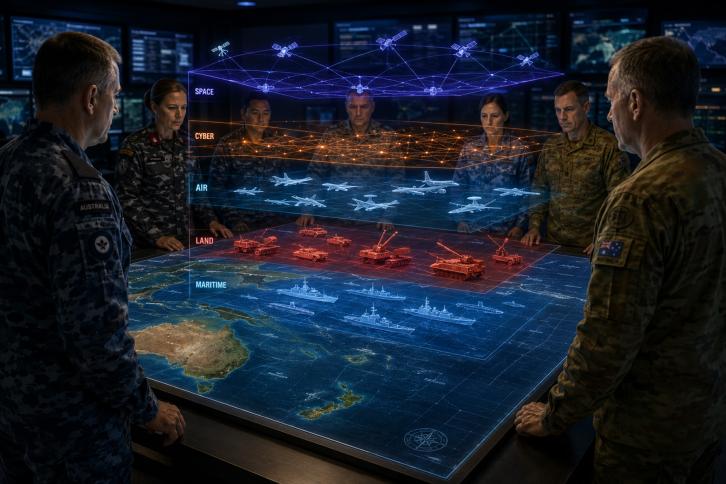
Contemporary military operations are increasingly characterised by the deliberate integration of effects across all warfighting domains - land, maritime, air, space, cyber, and the information environment. Multi-Domain Operations (MDO) aim to orchestrate and synchronise these effects to achieve operational and strategic objectives with greater speed, precision, and adaptability than single domain efforts approaches. Modern conflicts, such as the ongoing war in Ukraine, demonstrate the necessity and effectiveness of this approach, with Ukrainian forces utilising space-based ISR, cyber disruption, and precision fires to offset conventional methods disadvantages. The NATO 2022 Strategic Concept1 asserts that integrated capabilities across space, cyber, air, maritime, and land are vital in high-intensity warfighting against peer adversaries, with Ukraine demonstrating the operational impact of coordinated cross-domain effects.2 This imperative aligns with Clausewitz’s principle that the unpredictability and non-linearity of war demand adaptability, as no amount of planning can anticipate all enemy actions or emerging opportunities.3 In this context, seamless and integrated planning is not a luxury but a doctrinal and operational prerequisite for mission success.
Traditionally, the Australian Defence Force (ADF) used the Joint Military Appreciation Process (JMAP) for campaign and operational planning. Although JMAP offered a well-organised and reliable problem-solving framework, it was progressively regarded as too linear, aligned with specific services, and lacking the flexibility needed to address the speed, scope, and complexity of today's multi-domain operations.4 As Jackson (2020) observes, such technically rationalist planning frameworks often falter when confronted with the ‘wicked problem’ of contemporary conflict, where ambiguity and rapid change are the norm.5 In response, the ADF introduced the Defence Military Planning Process (DMPP), an integrated, commander-centric planning framework that unifies single-service and joint planning into a single doctrine.6 The DMPP seeks to overcome earlier processes’ rigidity by empowering commanders to tailor planning to operational tempo, incorporate emerging capabilities from the outset, and encourage adaptive thinking across all domains.7 In doing so, it aims to address JMAP’s limitations, accelerating planning cycles, strengthening cross-domain integration, and fostering agility across all operational levels.8
This essay argues that the DMPP marks a significant doctrinal step towards achieving integrated, multi-domain planning within the ADF. It offers structural unification, early domain integration, and a commander-centric approach that can improve operational tempo and joint force cohesion. However, it suggests that the DMPP’s success still depends on its consistent application throughout the force and the development of cross-domain expertise, and the ability to adapt planning to degraded, high-tempo, and contested environments. Drawing lessons from conflicts, exercises, and operations, the analysis assesses how the DMPP facilitates joint force synchronisation while highlighting ongoing challenges—such as cognitive overload, reliance on centralised command-and-control, and institutional inertia—that must be addressed. Ultimately, the discussion presents the DMPP as an essential but not sufficient factor in achieving lasting multi-domain advantage, with its success hinging on aligning doctrinal ambitions with the cultural, technological, and procedural enablers necessary for effective operationalisation pressure.
From JMAP to DMPP: Reforming for Joint Effect
While the JMAP provided a solid and well-understood foundation for planning, it exhibited significant shortcomings in complex, fast-evolving operations. Its linear, sequential nature often encouraged a reductionist, prescriptive aapproach that was ill-suited to environments requiring rapid adaptation.9 Planners frequently applied JMAP as a rigid checklist; a ‘clunky process-driven procedure’- which could stifle creative thinking and delay responses to emerging problems.10 Moreover, information flow in JMAP was largely top-down, with limited feedback loops, fostering siloed efforts between different staff and levels of command. Historically, the ADF compounded this challenge by maintaining separate planning processes at joint and single-service levels (JMAP for joint, with staff/individual planning variants for each service), further fragmenting planning and slowing the integration of efforts. This fragmentation, combined with JMAP’s step-by-step rigidity, meant that incorporating new technologies or multi-domain concepts was often reactive rather than proactive. For example, as warfare expanded into cyber and other domains, planners found that JMAP’s one-dimensional focus struggled to account for the volatile, ambiguous environment of grey-zone conflict.11 These limitations were reinforced by operational experiences in irregular and hybrid warfare, where strictly linear planning proved unable to anticipate or outpace the adaptive tactics of adversaries. This analysis of JMAP’s shortcomings establishes the benchmark against which the DMPP’s enhancements will be measured, highlighting the doctrinal shift required to achieve multi-domain integration.
The ADF responded by overhauling its planning doctrine, introducing the DMPP as a comprehensive, integrated, and flexible framework. The DMPP now serves as the single, standardised planning doctrine for the ADF, replacing the previous JMAP and Service-specific MAPs.12 This reform significantly reduced the procedural and cultural silos of the old system, with one process now guiding both joint and single-Service planning across all domains. Crucially, the DMPP elevates the active role of the commander throughout the planning cycle, a role that earlier doctrine had not sufficiently emphasised.13 Decision-making is reaffirmed as a commander’s responsibility, with commanders expected to provide continuous guidance, make timely decisions, and shape planning tempo at key points.14 By enabling commanders to steer planning iteratively - rather than waiting for staff to complete sequential steps - the DMPP increases responsiveness to dynamic conditions. The doctrine is deliberately less prescriptive about specific techniques for each staff function, allowing planners to integrate emerging capabilities earlier, adopt best practices from coalitions, and tailor the process to operational realities.15 In essence, the DMPP addresses JMAP’s limitations by fostering a more integrated, agile, and commander-centric approach to planning.16 These reforms mark a deliberate move toward a more adaptive planning culture, which is central to the essay’s contention that structural change must be matched by institutional and cognitive change to achieve sustained MDO effectiveness.
Integrating Domains: How the DMPP Enables Joint Operations
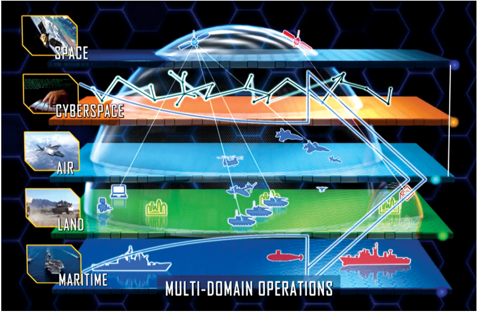
Building on its integrative foundation, the DMPP’s commander-centric architecture directly enables joint force integration by aligning planning tempo, decision-making, and cross-domain synchronisation across land, maritime, air, cyber, and space.17 Unlike earlier linear, staff-driven models such as JMAP, the DMPP repositions the commander as the primary architect of operational design, providing continuous guidance, iterative decision points, and early integration of emerging capabilities throughout the planning process.18 This approach aligns with mission command principles, decentralising authority and empowering subordinate initiative while ensuring that actions in all domains remain coherently aligned with strategic objectives.19 By embedding the commander’s role across all phases, the DMPP fosters rapid adaptation to changing conditions - particularly in fluid environments such as cyber and space, where operational windows are often measured in minutes rather than days.20 From a joint integration perspective, this adaptability shortens the OODA loop, enabling synchronised maritime and air manoeuvres, supported by space-enabled ISR and cyber disruption, to be coordinated in near real-time.21 Comparative experience from NATO’s COPD shows similar benefits when commander’s guidance is embedded early, accelerating cross-domain decision cycles in exercises such as Trident Juncture.22 ADF operational experiences reinforce this enabling function: during Operation Bushfire Assist (2019–2020) and Operation COVID-19 Assist, as well as Operation OKRA, the ADF’s ability to integrate joint capabilities and coordinate with civilian agencies hinged on timely, commander-led direction that unified land logistics, maritime lift, air mobility, and information support. These cases illustrate how the DMPP’s decision-focused design sustains unity of effort and strategic coherence under high operational tempo, validating research that adaptive, decision-centric planning frameworks consistently outperform rigid processes in contested, coalition, or complex environments.23
Complementing these domain and command advantages is the DMPP’s unification of previously fragmented Service-level planning frameworks into a single, cohesive doctrine.24 Historically, the ADF operated under a dual structure, using JMAP for joint planning and Service-specific methodologies such as the Army’s Military Appreciation Process (MAP) for single-Service efforts. This bifurcation led to inconsistent planning outputs, communication breakdowns, and doctrinal friction in joint or coalition environments.25 By replacing these legacy systems with a single, standardised process, the DMPP establishes a shared planning language and common procedural architecture applicable across all Services and levels of command. This mirrors coalition lessons from NATO and combined operations in Iraq and Afghanistan, where unified planning constructs not only accelerated interoperability but also improved shared situational awareness among partners. Although only formally released in late 2024 the DMPP is built upon lessons from earlier planning experiences under JMAP and related processes. For example, during Australia’s COVID-19 response and Operation OKRA, joint planners successfully integrated effects across land, maritime, air, and information domains despite doctrinal fragmentation and varied Service planning cultures. These cases demonstrate the type of interoperability, interagency coordination, and cross-domain awareness that the DMPP now seeks to institutionalise from the outset.26 In effect, these earlier operations serve as a proof of concept for the integrative outcomes that DMPP aims to deliver more consistently. Moreover, this unified approach strengthens Australia’s Integrated Campaigning concept, aligning military, diplomatic, economic, and informational instruments toward strategic objectives.27 By drawing on these operational lessons, the DMPP has the structural foundations to function as a fully enabling tool, one capable of integrating effects across domains, empowering command, and harmonising planning at all levels of war. By addressing previous structural fragmentation, the DMPP has laid the foundation for consistent cross-domain coordination. However, its ultimate success will depend on how these principles perform under contested, high-tempo conditions.
Enduring Challenges: Constraints in Applying the DMPP
While the DMPP delivers important doctrinal and structural improvements, its integration of all warfighting domains introduces a level of complexity that creates both cognitive and procedural challenges. Modern multi-domain operations require the orchestration of kinetic and non-kinetic effects across distributed geographies, timeframes, and domains - including cyber, space, electromagnetic warfare, and the information environment. This scope significantly increases the information-processing demands on commanders and planning teams. As Sălăvăstru and Rațiu (2024) argue, the MDO construct creates a span-of-control dilemma in which human planners struggle to process the sheer volume of cross-domain intelligence, risk assessments, and planning variables within compressed timelines.28 ADF-P-5 (2021) acknowledges this tension, noting that operational planning must strike a balance between conceptual creativity and procedural discipline.29 The ADF’s Integrated Planning framework similarly warns that expanding situational awareness across multiple domains inevitably increases the volume, velocity, and variety of information that must be processed.30 While the DMPP’s design embeds cross-domain considerations early in mission analysis, this breadth of scope risks overloading planning staff when decision windows are measured in hours or minutes rather than days. Without advanced decision-support tools, collaborative planning technologies, and targeted professional development to enhance cognitive agility and prioritisation skills, the integrated framework intended to accelerate tempo may instead slow it. This constraint is particularly evident in scenarios where cross-domain data fusion is partial, degraded, or contested - a challenge observed in complex coalition exercises and multinational operations even under earlier systems.31 The DMPP’s success in such environments will depend on whether doctrinal intent is matched by enabling capabilities that allow planners to filter, prioritise, and act decisively. This highlights the central tension of the DMPP: the same integrative breadth that promises operational advantage can, without the right enablers, become a source of friction that slows tempo.
A second critical limitation of the DMPP lies in its implicit dependence on centralised, protected command-and-control (C2) environments - an assumption increasingly untenable in peer or near-peer conflict. The doctrine presumes access to stable planning cycles, continuous communications, and secure headquarters infrastructure, all of which are now highly vulnerable in contemporary threat environments. The Ukraine conflict has demonstrated how persistent ISR, precision fires, and electronic warfare have rendered traditional, static C2 nodes high-payoff targets vulnerable to rapid detection and strike.32 The ADF’s Concept for Command and Control of the Future Force (2023) acknowledges that survivability, mobility, and decentralisation must become defining features of future C2 postures.33 Yet the DMPP’s planning model still privileges a structured, centralised sequence from mission analysis to COA development - highlighting a doctrinal gap between planning methodology and operational necessity. Wille (2019) emphasises that effective MDO requires not just convergence of effects, but resilient, distributed, and reconfigurable C2 networks capable of functioning under disruption.34 If adversaries can deny or degrade access to key planning hubs, the DMPP may struggle to support responsive decision-making or adaptive re-planning. NATO’s experience during Exercise Steadfast Cobalt has shown that distributed C2 architectures, coupled with pre-delegated authorities, can sustain operational tempo in degraded communications environments.35 In this area, DMPP’s procedural guidance remains underdeveloped. Similarly, during combined training in Exercise Indo-Pacific Endeavour, ADF planners faced constraints when rehearsing operations under communications-denied conditions, exposing the need for planning frameworks more attuned to dispersed and mobile command and control (C2) realities. While the doctrine acknowledges contingency planning, it provides limited procedural detail for operating under persistent disruption. These lessons underscore that without procedural depth for degraded environments, doctrinal intent alone will not guarantee resilience in coalition or contested operations.
Despite the DMPP’s strengths as a unified doctrine, its ability to deliver fully integrated multi-domain operations is constrained by uneven adoption across the ADF and the limited maturity of integration mechanisms in specific domains. While the DMPP formally replaced JMAP and service-specific models, many units remain more familiar with legacy frameworks, resulting in inconsistent implementation, partial compliance, and institutional inertia. Jackson (2020) notes that resistance to doctrinal transition often stems from misaligned PME curricula, unclear change-management pathways, and entrenched Service-centric cultures. These factors are particularly problematic in joint, multinational, or interagency contexts where shared mental models and standard planning lexicons are essential for synchronising effects across land, maritime, air, cyber, and space. Moreover, although the DMPP explicitly incorporates newer domains such as cyber, space, and the information environment, much of the supporting TTPs and domain-specific expertise remain immature compared to the well-established doctrine of traditional domains. As Jackson (2020) observes, doctrinal intent alone cannot guarantee cross-domain convergence; planners must have the requisite literacy, technical fluency, and integration mechanisms to translate emerging capabilities into coherent operational effects.36 NATO’s experience in Exercise Trident Juncture shows the importance of joint experimentation, wargaming, and shared doctrine to achieve true convergence. Without investing in PME, experimentation, tools, and cross-domain education, integration risks becoming superficial, reducing the DMPP’s effectiveness as an enabler of multi-domain advantage. The essay's key point is that doctrinal, cultural, and technical convergence are essential for real MDO implementation.
Bridging Theory and Practice: Where the DMPP Must Improve
Taken together, the constraints outlined above highlight that while the DMPP marks a significant and necessary evolution in joint planning doctrine, its utility in contemporary multi-domain operations is tempered by persistent operational frictions. The cognitive burden placed on planners, the vulnerability of traditional command-and-control assumptions, and the inconsistent uptake across the ADF reveal systemic gaps that must be addressed for the doctrine’s promise to be fully realised. These challenges do not undermine the DMPP’s foundational value; rather, they underscore the need for iterative refinement, institutional embedding, and deliberate change management. The complexity of modern warfare and MDO; characterised by compressed decision timelines, contested information environments, and dispersed C2 structures, demands that planning frameworks be both conceptually robust and procedurally agile. In other words, bridging the gap between doctrinal ambition and operational delivery will require not only refinement of process, but sustained investment in the people, systems, and partnerships that make integration possible.
Both international and domestic exercises, operations, and conflicts provide insight into the utility and limitations of the ADF’s application of the DMPP, offering concrete lessons for its evolution. These activities demonstrate the potential for cross-domain integration (e.g., space-enabled ISR fused with maritime and air fires) but also expose recurring friction points — incomplete data fusion, contested communications, variable coalition interoperability, and slow decision cycles — that must be addressed through campaign-level experimentation, rigorous after-action review cycles, and doctrine-to-PME feedback loops. As the ADF adapts to an operating environment increasingly defined by compressed timelines, persistent ambiguity, and adversary disruption, the DMPP must remain a living doctrine — with explicit guidance for degraded/denied C2, distributed planning teams, pre-delegated authorities, and decision-support tooling — capable of adapting to strategic shocks while guiding coherent operational design and execution. These observations confirm the essay’s core contention: that the DMPP’s success will hinge less on the elegance of its design and more on how quickly and consistently its principles can be operationalised under pressure.
Conclusion: Planning for the Multi-Domain Battlespace
This essay critically assesses the utility of the Defence Military Planning Process (DMPP) in planning contemporary multi-domain operations, with a specific focus on how it enables or constrains joint force integration across land, maritime, air, cyber, and space domains. The analysis demonstrates that the DMPP is a strategically significant, doctrinally coherent, and forward-leaning planning framework, offering a structured yet adaptable approach to the complex demands of modern warfare. Through its emphasis on commander-driven decision-making, early incorporation of emerging domains, and an institutional push for jointness, the DMPP enables more cohesive, synchronised, and operationally integrated planning outcomes.
At the same time, the DMPP’s utility is conditional and context-dependent. The process imposes cognitive and procedural challenges that must be mitigated if it is to succeed in high-tempo, contested environments. Its reliance on traditional command-and-control assumptions, coupled with inconsistent adoption across the ADF, constrains its ability to serve as a fully effective enabler of joint force integration. These are not flaws in doctrinal design but signals of where implementation, training, and supporting systems must mature. In conclusion, the DMPP is both a strategically important and operationally necessary evolution in ADF planning doctrine. Its core strengths, integrated domain inclusion, joint force alignment, and doctrinal coherence, make it well suited to the realities of multi-domain operations. However, to fulfil its potential, conceptual ambition must be matched by sustained investment in PME, coalition interoperability initiatives, and the enablers required for distributed, resilient C2. If fully institutionalised, the DMPP will not only support joint planning; it will also shape how the ADF, alongside allies and partners, anticipates, integrates, and prevails in the contested, multi-domain battlespace of the future. This will thus meet Clausewitz’s enduring call for adaptability in the face of war’s unpredictability.
Australian Defence Force. ‘ADF Capstone Concept APEX_ Integrated Campaigning for Deterrence, Edition 2’. Joint Concepts, 11 January 2024.
Australian Defence Force. ‘ADF Concept for Command and Control of the Future Force’. Force Exploration Branch, 13 May 2019.
Australian Defence Force. ‘ADF-I-5 Decision-Making and Planning Processes (1)’. Directorate of Communication, Change and Corporate Graphics, 21 October 2024.
Australian Defence Force. ‘ADFP 5.0.1 Joint Military Planning Process (JMAP) Ed 2, AL3’. Joint Doctrine Directorate, 15 August 2019.
Australian Defence Force. ‘ADF-P-5 - Philosophical - Planning’. Directorate of Communication, Change and Corporate Graphics, 1 February 2022.
Australian Defence Force. ‘Concept COHERE - ADF Cyber Domain Concept’. Joint Concepts, 2024.
Australian Defence Force. ‘Concept SELENE - ADF Space Concept’. Joint Concepts, 2024.
Beyerchen, Alan. ‘Clausewitz, Nonlinearity, and the Unpredictability of War’. International Security 17, no. 3 (1992): 59. https://doi.org/10.2307/2539130.
Chiriac, Cătălin. ‘COPD V3.0 AND IMPLICATIONS ON THE JOINT LEVEL’. BULLETIN OF ‘CAROL I’ NATIONAL DEFENCE UNIVERSITY 11, no. 2 (2022): 7–13. https://doi.org/10.53477/2284-9378-22-68.
Dennis Willie. ‘Lead a Renaissance in Great Power Competition Doctrine; The Army and Multi Domain Operations’. New America, 2019.
Fazekas, Ferenc. ‘Military Command In Multi-Domain Environment’. Land Forces Academy Review 29, no. 3 (2024): 312–21. https://doi.org/10.2478/raft-2024-0034.
Friis, Karsten, and Rolf Tamnes. ‘The Defence of Northern Europe: New Opportunities, Significant Challenges’. International Affairs 100, no. 2 (2024): 813–24. https://doi.org/10.1093/ia/iiae019.
Hindmarsh, David. ‘JMAP: Fit for Purpose’. War College Papers 2023, 2024. https://theforge.defence.gov.au/war-college-papers-2023/jmap-fit-purpose#:~:text=The%20ADF%20is%20not%20exempt,still%20follow%20divergent%20and%20convergent.
Jackson, Aaron. ‘Military Design Thinking; Contrasting Civilian and Military Innovation Methodologies’. Air University Press, 2020, 29–47.
Jackson, Aaron. ‘Military Design Thinking; Contrasting Civilian and Military Innovation Methodologies’. Air University Press, 2020, 29–47.
Janne, Tähtinen. ‘Principles of Multi-Domain Operations; Concepts and Doctrine Division’. Finnish Defence Research Agency 10 (June 2025).
Jeffery Harrigan. ‘Shaping the Future Multi-Domain C2’. JAPCC Journal 29 (2020): 6.
Krause, Major General. ‘Cove Talk- 5 Brigade: Decision Making and Planning Process’. Holsworthy Barracks Officers Mess, 25 February 2025. https://cove.army.gov.au/article/covetalk-5-brigade-decision-making-and-planning-process-0#:~:text=The%20DMPP%20aims%20to%20emphasise,4.
Krause, Major General. ‘Decision Making and Planning Processes’. ACSC, Australian War College, 5 June 2025. https://docs.google.com/presentation/d/1s6NbZxJ2MVCi4qGqV1j145OI8SudEG7i/edit?slide=id.p2#slide=id.p2.
NATO. ‘NATO Strategic Concept’. 2022. https://www.nato.int/nato_static_fl2014/assets/pdf/2022/6/pdf/290622-strategic-concept.pdf.
Post, Ryan CMDR. ‘The Joint Military Appreciation Process: The Good, The Bad and Some Alternatives’. War College Papers 2022, n.d. https://theforge.defence.gov.au/war-college-papers-2022/joint-military-appreciation-process-good-bad-and-some-alternatives#:~:text=of%20the%20key%20weaknesses%20of,or%20continue%20to%20use%20the.
Sălăvăstru, Claudiu-Marius, and Aurelian Raţiu. ‘Mission Command in Multi-Domain Operations’. International Conference KNOWLEDGE-BASED ORGANIZATION 30, no. 1 (2024): 161–65. https://doi.org/10.2478/kbo-2024-0022.
Sălăvăstru, Claudiu-Marius, and Aurelian Raţiu. ‘Mission Command in Multi-Domain Operations’. International Conference KNOWLEDGE-BASED ORGANIZATION 30, no. 1 (2024): 161–65. https://doi.org/10.2478/kbo-2024-0022.
Takabatake, Futoshi. ‘NATO’s Approach to Multi-Domain Operations: From the Perspective of the Economics of Alliances’. Defence and Peace Economics 35, no. 3 (2024): 281–94. https://doi.org/10.1080/10242694.2023.2235502.
Wallin, Mathias. Rethinking Military Planning for Modern Warfare. 2024.
Watts, Sam Maj. ‘JMAP: Too Long, Too Linear and Lacking Tools’. War College Papers 2023, n.d. https://theforge.defence.gov.au/war-college-papers-2023/jmap-too-long-too-linear-and-lacking-tools#:~:text=No%20revolutionary%20differences%20can%20be,NATO%20Planning%20are%20Initiation%2C%20Mission.
William Gregor. ‘Military Planning Systems and Stability Operations’. Institute for National Strategic Security (PRISM) 1, no. 2 (n.d.): 99–114.
176 The Australian War College – Geddes Papers
1 NATO, ‘NATO Strategic Concept’, 2022, 6, https://www.nato.int/nato_static_fl2014/assets/pdf/2022/6/pdf/290622-strategic-concept.pdf.
2 Futoshi Takabatake, ‘NATO’s Approach to Multi-Domain Operations: From the Perspective of the Economics of Alliances’, Defence and Peace Economics 35, no. 3 (2024): 283, https://doi.org/10.1080/10242694.2023.2235502.
3 Alan Beyerchen, ‘Clausewitz, Nonlinearity, and the Unpredictability of War’, International Security 17, no. 3 (1992): 60, https://doi.org/10.2307/2539130.
4 Australian Defence Force, ‘ADFP 5.0.1 Joint Military Planning Process (JMAP) Ed 2, AL3’, Joint Doctrine Directorate, 15 August 2019, 2–16.
5 Aaron Jackson, ‘Military Design Thinking; Contrasting Civilian and Military Innovation Methodologies’, Air University Press, 2020, 38.
6 Australian Defence Force, ‘ADF-I-5 Decision-Making and Planning Processes (1)’, Directorate of Communication, Change and Corporate Graphics, 21 October 2024, iv.
7 Major General Krause, ‘Decision Making and Planning Processes’, ACSC, Australian War College, 5 June 2025, https://docs.google.com/presentation/d/1s6NbZxJ2MVCi4qGqV1j145OI8SudEG7i/edit?slide=id.p2#slide=id.p2.
8 Australian Defence Force, ‘ADFP 5.0.1 Joint Military Planning Process (JMAP) Ed 2, AL3’.
9 Ryan CMDR Post, ‘The Joint Military Appreciation Process: The Good, The Bad and Some Alternatives’, War College Papers 2022, n.d., https://theforge.defence.gov.au/war-college-papers-2022/joint-military-appreciation-process-good-bad-and-some-alternatives#:~:text=of%20the%20key%20weaknesses%20of,or%20continue%20to%20use%20the.
10 David Hindmarsh, ‘JMAP: Fit for Purpose’, War College Papers 2023, 2024, https://theforge.defence.gov.au/war-college-papers-2023/jmap-fit-purpose#:~:text=The%20ADF%20is%20not%20exempt,still%20follow%20divergent%20and%20convergent.
11 Post, ‘The Joint Military Appreciation Process: The Good, The Bad and Some Alternatives’.
12 Major General Krause, ‘Cove Talk- 5 Brigade: Decision Making and Planning Process’, Holsworthy Barracks Officers Mess, 25 February 2025, https://cove.army.gov.au/article/covetalk-5-brigade-decision-making-and-planning-process-0#:~:text=The%20DMPP%20aims%20to%20emphasise,4.
13 Australian Defence Force, ‘ADF-I-5 Decision-Making and Planning Processes (1)’, 7.
14 Australian Defence Force, ‘ADF-I-5 Decision-Making and Planning Processes (1)’, 15.
15 ‘PDF’, n.d.
16 Australian Defence Force, ‘ADF-I-5 Decision-Making and Planning Processes (1)’, 49.
17 Australian Defence Force, ‘ADF-I-5 Decision-Making and Planning Processes (1)’, 7.
18 Krause, ‘Decision Making and Planning Processes’, 10.
19 Claudiu-Marius Sălăvăstru and Aurelian Raţiu, ‘Mission Command in Multi-Domain Operations’, International Conference KNOWLEDGE-BASED ORGANIZATION 30, no. 1 (2024): 161–65, https://doi.org/10.2478/kbo-2024-0022.
20 Jeffery Harrigan, ‘Shaping the Future Multi-Domain C2’, 10.
21 Ferenc Fazekas, ‘Military Command in Multi-Domain Environment’, Land Forces Academy Review 29, no. 3 (2024): 312–21, https://doi.org/10.2478/raft-2024-0034.
22 Karsten Friis and Rolf Tamnes, ‘The Defence of Northern Europe: New Opportunities, Significant Challenges’, International Affairs 100, no. 2 (2024): 822, https://doi.org/10.1093/ia/iiae019.
23 Jackson, ‘Military Design Thinking; Contrasting Civilian and Military Innovation Methodologies’; William Gregor, ‘Military Planning Systems and Stability Operations’, Institute for National Strategic Security (PRISM) 1, no. 2 (n.d.): 99–114.
24 Krause, ‘Decision Making and Planning Processes’, 2.
25 Sam Maj Watts, ‘JMAP: Too Long, Too Linear and Lacking Tools’, War College Papers 2023, n.d., https://theforge.defence.gov.au/war-college-papers-2023/jmap-too-long-too-linear-and-lacking-tools#:~:text=No%20revolutionary%20differences%20can%20be,NATO%20Planning%20are%20Initiation%2C%20Mission.
26 Krause, ‘Decision Making and Planning Processes’, 7.
27 Australian Defence Force, ‘ADF Capstone Concept APEX_ Integrated Campaigning for Deterrence, Edition 2’.
28 Claudiu-Marius Sălăvăstru and Aurelian Raţiu, ‘Mission Command in Multi-Domain Operations’, International Conference KNOWLEDGE-BASED ORGANIZATION 30, no. 1 (2024): 161–65, https://doi.org/10.2478/kbo-2024-0022.
29 Australian Defence Force, ‘ADF-P-5 - Philosophical - Planning’, Directorate of Communication, Change and Corporate Graphics, 1 February 2022, 8.
30 Australian Defence Force, ‘ADF Capstone Concept APEX_ Integrated Campaigning for Deterrence, Edition 2’.
31 Allied Command Transformation and NATO’s Strategic Warfare Development Command, ‘Multi-Domain Operations and Digital Transformation: Enabling Converged Effects in the Modern Battlespace’, 2 May 2025, https://www.act.nato.int/article/mdo-dt-enabling-converging-effects/?utm_source=chatgpt.com.
32 Sălăvăstru and Raţiu, ‘Mission Command in Multi-Domain Operations’, 2024, 164.
33 Australian Defence Force, ‘ADF Concept for Command and Control of the Future Force’, Force Exploration Branch, 13 May 2019.
34 Jackson, ‘Military Design Thinking; Contrasting Civilian and Military Innovation Methodologies’.
35 Friis and Tamnes, ‘The Defence of Northern Europe’.
36 Aaron Jackson, ‘Military Design Thinking; Contrasting Civilian and Military Innovation Methodologies’, Air University Press, 2020, 29–47.

Squadron Leader Dani Phelps is a Logistic Officer and graduate of the ACSC(MA) class of 2025. She is currently posted as the Staff Officer to the Head of Air Capability.
Critically assess the utility of the DMPP in planning contemporary MDOs © 2026 by . This work is licensed under CC BY-NC-ND



Please let us know if you have discovered an issue with the content on this page.
Comments
Start the conversation by sharing your thoughts! Please login to comment. If you don't yet have an account registration is quick and easy.