Executive Summary
Australia’s 2024 National Defence Strategy (NDS) establishes a fundamental shift in military posture toward a doctrine of National Defence, anchored in deterrence by denial across the Indo-Pacific (Department of Defence, 2024). To meet this requirement, the Australian Defence Force (ADF) must generate an amphibious land combat capability, optimising the Army for littoral manoeuvre, controlling strategic land positions in a contested, archipelagic environment (Department of Defence, 2024, pp. 36-38). However, the current force design lacks an amphibious armoured solution for Ship-to-Objective Manoeuvre (STOM), creating a reliance on dismounted landings or vulnerable landing craft (Navy, 2011). Without an amphibious vehicle fleet, Australia cannot project power credibly across its northern approaches or contribute to Indo-Pacific security with confidence (O’Neill, 2025).
This business case recommends approval for the Littoral Combat Vehicle (LCV) program - a sovereign, Australian-led initiative to design, develop, and deliver 200 modular, amphibious light-armoured vehicles optimised for littoral warfare. The LCV directly responds to the NDS directive for an ‘amphibious-capable combined-arms land system’, including supporting force projection, terrain control, and industry partnership tasks outlined in the Integrated Investment Program (IIP) (Department of Defence, 2024). The capability will fill a critical shortfall left by the retirement of the M113AS4 and ASLAV fleets, and deliver a sovereign solution suited for Indo-Pacific terrain and infrastructure (Palazzo, 2022).
The LCV fleet will consist of a common amphibious hull architecture supporting interchangeable mission modules: 154 APC variants (four dismounts), 24 command, 16 mortar, and 6 medical variants. Vehicles will be distributed to 2RAR and 5/7RAR (84 vehicles each), with 32 hulls allocated to training and sustainment, and supported by an Integrated Product Support (IPS) framework. The fleet enables light-armoured amphibious mobility, rapid deployment, and sustained inland operations (Haver, 2024).
The program is phased across three years of R&D and six years of production, with Minimum Viable Capability (MVC) delivered by the end of Year 5 (70 hulls), Initial Operational Capability (IOC) achieved with 140 vehicles, and Final Operational Capability (FOC) at full delivery, including air/sea certification. Project sponsorship commences under the Advanced Strategic Capabilities Accelerator (ASCA), with specialist expertise from the Defence Science and Technology Group (DSTG), UNSW, and the Australian Maritime College (AMC). The program then transitions to the Land Capability Division (LC Div)1 and the Capability Acquisition and Sustainment Group (CASG)2 for acquisition and delivery.
At an estimated A$2.2 billion (outturned), the program is costed across R&D (A$300M), production (A$1.75B), and IPS (A$150M). Sovereign manufacturing, Australian Industry Content (AIC), and export potential are fundamental to delivery, and aligned with the Defence Industry Development Strategy (DIDS) (Department of Defence, 2024). By closing the amphibious capability gap and securing industrial resilience, the LCV program ensures the ADF is equipped to meet strategic demands in the Indo-Pacific (Department of Defence, 2024).
Introduction
Australia’s strategic environment is undergoing rapid transformation, shaped by accelerating regional militarisation, intensifying great power competition, and an increasingly contested Indo-Pacific maritime domain (Department of Defence, 2024). In response, the 2024 NDS establishes a new Defence posture, National Defence, focused on deterrence by denial and the defence of Australia’s northern approaches and immediate region (Department of Defence, 2024). A central pillar of this posture is the ability to conduct integrated operations across littoral and archipelagic terrain, supported by an ‘amphibious-capable combined-arms land system’ capable of force projection, manoeuvre, and sustainment in contested environments (Department of Defence, 2024).
However, the Australian Army currently lacks such a capability. The absence of a protected amphibious combat vehicle leaves littoral manoeuvre forces dependent on small craft and heavy vehicles unsuited for ship-to-objective manoeuvre (STOM), creating a critical capability shortfall (McMillan, 2019). This business case responds to that gap by proposing the Littoral Combat Vehicle (LCV) program, an Australian-led initiative to design, develop, and acquire 200 modular, amphibious armoured vehicles optimised for the operational conditions of Australia and Southeast Asia.
This business case first outlines the capability background and strategic context underpinning the requirement for the LCV. It then presents a detailed problem definition, followed by a comparative analysis of three options: the status quo, FMS acquisition, and the recommended sovereign development model. A Detailed Business Case development and Recommendation are also provided, and the cost model and delivery schedule used to support these, are described in the later sections. In line with the DIDS, the business case also assesses industry and economic benefits, such as export potential, workforce development, and sovereign industrial growth (Department of Defence, 2024).
Ultimately, the business case demonstrates that the sovereign LCV program provides the best cost-benefit solution, delivering both operational capability and national industry growth. It concludes with a recommendation for Defence to proceed with First Pass approval and immediate R&D commencement under the Advanced Strategic Capabilities Accelerator (ASCA).
Capability Background
Since World War II, amphibious operations have shaped outcomes in the Indo-Pacific theatre (James, 2021). The Allies’ island-hopping campaign, from Guadalcanal to the Philippines, was made possible by purpose-built, amphibious platforms capable of projecting combat power across sea-land interfaces (Currey, 2023) (D. R. Leece). Yet despite this legacy, the Australian Defence Force (ADF) currently lacks a modern protected amphibious combat capability suited to the archipelagic battlespace of the contemporary Indo-Pacific (D. R. Leece).
Australia’s 2024 NDS identifies the Indo-Pacific as the primary focus for deterrence and strategic response, emphasising contested littoral terrain and the need for integrated, deployable land-sea combat formations (Department of Defence, 2024). However, the Army’s current vehicle fleet, including Boxer CRVs and Redback IFV, is too heavy and lacks amphibious mobility, while legacy platforms like the ASLAV and M113AS4 are obsolete; the Army cannot achieve its directed transformation into one focused on littoral manoeuvre (Department of Defence, 2024). Neither CRV nor Redback provides independent, protected, Ship-to-Objective Manoeuvre (STOM) capability, leaving the ADF reliant on vulnerable landing craft/ships and creating a dangerous gap in sovereign force projection (McMillan, 2019).
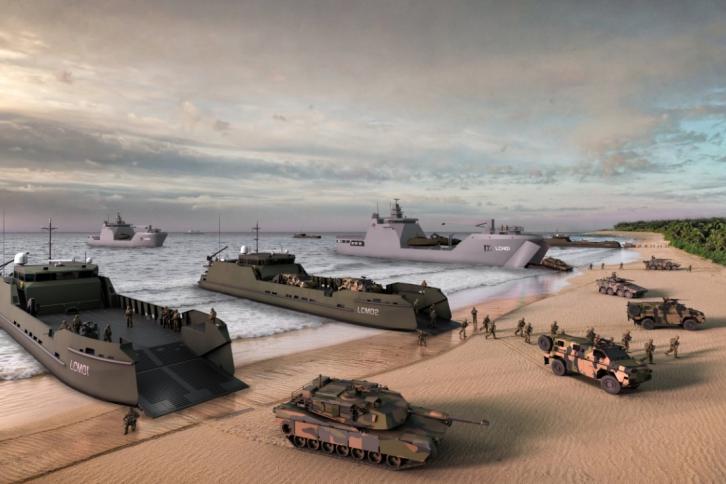
The LCV seeks to fill this gap by providing a protected, modular tracked and/or wheeled amphibious armoured platform capable of operating independently from ship to shore and beyond (Haver, 2024). Designed around a common base hull with mission-specific modules, including APC, mortar carrier, command post, and medical variants, with potential for others, the LCV enables combined-arms manoeuvre in terrain inaccessible to current conventional platforms. Its amphibious capability allows it to swim from a ship's well-deck or future littoral vessels, and transition directly into land operations, crossing riverine terrain once ashore, without relying on port infrastructure, beachhead reconfiguration or mobility support forces (Dr. John Burrow, 2013).
Proposed LCV armaments seek fielded, high TRL options, such as the GAU-19B .50 cal Gatling gun for high-volume, stabilised fire, mounted FGM-148 Javelin or Spike LR2 anti-tank guided missile system for precision long-range anti-armour lethality, and/or a vehicle-mounted 84mm Carl-Gustaf recoilless system to deliver organic, versatile anti-structure and anti-armour effects at the platoon level. These weapon systems would be integrated with a high TRL, modern, ISTAR suite. Local options include a sovereign EOS suite3, or foreign choices such as a variant of IAI ELTA’s ELI-3312 Multi-Mission Multi-Sensor System (M3S2)4, either mounted on a telescoping ‘giraffe’ mast. This provides enhanced situational awareness, targeting from cover, and overwatch, tailored to variant roles such as APC, command, and reconnaissance, ensuring an optimal balance of sensors and shooters (Elta, 2025) (George Salazar, 2021).
Globally, peer militaries are fielding comparable capabilities, for example, China’s People’s Liberation Army deploys fast amphibious vehicles like the ZBD-05 and ZTL-11 for archipelagic assault, while Poland’s Borsuk IFV reflects Europe’s push for lightweight, amphibious infantry mobility (Haver, 2024) (Army Technology - Projects, 2021). The U.S. Marine Corps’ Amphibious Combat Vehicle (ACV) demonstrates the value of modular, protected amphibious systems for contested littoral manoeuvre; each has informed the LCV project and proposed Functional Performance Specifications (Bernard Kempinski, 2012) (Alicia Gray, 2019).
Within this strategic context, the LCV will be distributed across two primary Army units, 2RAR, as the current Amphibious Task Group pre-landing force unit, and 5/7RAR, the Army’s littoral battalion. The LCV’s mission profile reflects decades of lessons from amphibious campaigns: to exploit littoral gaps, manoeuvre at pace across island and riverine terrain, and offer credible deterrence without reliance on contested infrastructure (McMillan, 2019). The platform will integrate future-focused technologies, including hybrid diesel-electric or gas turbine-electric propulsion for stealth and range, and advanced low TRL tri-layer armour to balance protection and buoyancy (Xiaojun Sun, 2024).
By closing the amphibious capability gap, the LCV program will align the Australian Army’s force structure with the NDS and support a credible, sovereign amphibious combat presence and resilient domestic industry. It enables protected entry into contested zones, distributed lethality, and greater resilience in peer high-intensity conflict operations, and lower spectrums, making it not just a vehicle, but a strategic enabler for the ADF’s evolving role in the Indo-Pacific (Sr, 2024).
Strategic Context and Problem Statement
Australia’s evolving strategic environment and Defence posture demand the urgent development of a sovereign amphibious land combat capability (O’Neill, 2025). The 2024 NDS introduces a shift toward ‘National Defence,’ focusing on deterrence by denial across Australia’s northern approaches and immediate region, and among its five core tasks are directives to ‘defend Australia and our immediate region,” ‘deter through denial any potential adversary’s attempts to project power,’ and ‘contribute with partners to collective Indo-Pacific security’ (Department of Defence, 2024). These missions require an integrated joint force able to dominate the littoral domain, not only at sea, but across archipelagic, riverine and near-shore land environments where Australia must project and sustain combat power.
While Defence strategy outlines a clear ambition to generate littoral combat power, Australia lacks the platforms to credibly deter or defeat a peer adversary operating in the Indo-Pacific’s fragmented maritime geography (Laird, 2025). It is observed that the PLA has invested heavily in amphibious armoured vehicles and combined-arms landing capabilities tailored to contested island chains and coastal operations (Haver, 2024), and without a comparable capability, the ADF cannot deny key maritime terrain, nor credibly land and sustain forces on forward positions (McMillan, 2019). Protected ship-to-objective manoeuvre is essential to seize and hold decisive ground, whether for launching long-range maritime strike, interdicting adversary movement, or enabling ISR operations from austere island outposts (Salo, 2024). The current force structure, which relies on unarmoured connectors and slow deployment of heavy vehicles, is misaligned with the operational tempo and threat environment of the region. A credible littoral force must be able to manoeuvre across islands, riverine systems, and degraded ports independently from mobility forces, with speed and protection, tasks that cannot be met without amphibious armoured mobility.
Meanwhile, regional competitors and allied militaries are accelerating the development of amphibious capabilities in direct response to the contested maritime terrain (Joel Wuthnow, 2022). The US Marine Corps is fielding the Amphibious Combat Vehicle (ACV) as part of its island-hopping Expeditionary Advanced Base Operations (EABO) strategy (Marine Corps Warfighting Lab, 2018). The PLA’s suite of high-speed amphibious platforms, including the ZBD-05, is optimised for seizure of island chains in the Western Pacific, and even non-maritime actors, such as Poland, are prioritising modular and amphibious infantry vehicles suited to contested riverine and littoral terrain (Army Technology - Projects, 2021) (Haver, 2024). It is assessed that Australia risks strategic obsolescence in this environment, because without a protected mobile amphibious platform, the ADF cannot credibly project force or deny key terrain in a region increasingly shaped by armoured littoral manoeuvre (D. R. Leece) (McMillan, 2019).
In addition to strategic alignment, the LCV program directly advances the goals of the 2024 Defence Industry Development Strategy (DIDS), where DIDS prioritises building a resilient, sovereign Defence industrial base capable of delivering critical capabilities (Department of Defence, 2024). The LCV is to be designed, developed, and manufactured in Australia using a Prime Systems Integrator model5, maximising Australian Industry Content (AIC) in key technology areas such as advanced composites, vehicle systems, electronics, and sustainment. It is assessed that this approach supports supply chain resilience, protects sovereign capability, and anchors critical skills and intellectual property within the domestic workforce (Department of Defence, 2024). By involving local firms in early design, prototyping, and phased production, the LCV program also supports DIDS’s goals of transparent acquisition pipelines, industry-readiness, and export competitiveness (Department of Defence, 2024) (Department of Defence, 2024).
Without a modern amphibious armoured platform, the ADF cannot effectively utilise its amphibious fleet, nor fulfil its role in a littoral coalition (D. R. Leece) (Laird, 2025). The Littoral Combat Vehicle offers a credible, scalable solution to this gap. The following sections detail how the program delivers on these strategic and industrial imperatives.
Options Analysis
To address Australia’s amphibious combat capability gap, three primary options have been considered. These differ in strategic alignment, cost, sovereign industry potential, and operational utility, with the analysis below outlining the trade-offs, risks, and benefits of each.
Option 1: Status Quo - No Dedicated Amphibious Combat Vehicle.
Under this approach, the ADF would continue relying on the two Canberra-class LHDs, HMAS Choules, and landing craft acquired under Land 8710. Troops would deploy from ship to shore using unprotected connectors and non-amphibious vehicles. No dedicated amphibious armoured capability would be delivered.
While this option avoids new acquisition costs and preserves current models, it exposes ADF forces to significant operational and strategic risk (McMillan, 2019). Without a protected STOM platform, forces are vulnerable during lodgement, limited to permissive environments, and constrained in mobility (D. R. Leece) (Dr. John Burrow, 2013). It also fails to meet the 2024 NDS directive to project force in contested littoral terrain (Department of Defence, 2024). The absence of a vehicle platform for sovereign development means it contributes nothing toward AIC or DIDS objectives (Department of Defence, 2024). This is the least preferred option.
Option 2: LCV Program (Preferred Option)
This option develops the LCV domestically via ASCA, DSTG, UNSW Canberra, AMC, and the Army’s Land Capability Division, with CASG leading procurement. A competitive tender to the Australian industry maximises AIC.
It delivers 200 modular amphibious vehicles on a common hull architecture with mission-specific ‘pod’ variants. This option offers sovereign capability, long-term industry resilience, and strong alignment with DIDS (Department of Defence, 2024). Though risks exist (e.g low-TRL hull/armour/propulsion), these are mitigated through structured R&D and phased prototyping (Bernard Kempinski, 2012) (George Salazar, 2021). It provides the best balance of strategic alignment, capability, and sovereign industry uplift, making it the preferred option.
Option 3: Foreign Military Sales (FMS) or Direct Commercial Sale (DCS) of BAE ACV (Second Preferred)
This option acquires the BAE Amphibious Combat Vehicle through an FMS with the U.S. or a DCS model incorporating local assembly and IPS. It benefits from a proven, operational platform now fielded by the U.S. Marine Corps, reducing technical risk and enhancing interoperability (Alicia Gray, 2019) (Hudson, 2016).
However, an FMS path limits Australia’s control over configuration, delivery, and sustainment. A DCS model could offer improved AIC, but still lacks sovereign design control (Dunk, 2016). While preferable to doing nothing, it falls short of Option 2 in meeting DIDS aims and tailored operational requirements.
Options Matrix
| Criteria | Option 1: Status Quo | Option 2: LCV Program (Preferred) | Option 3: BAE ACV (FMS/DCS) |
|---|---|---|---|
| Strategic Alignment | Poor | Excellent | Good |
| Armoured Amphibious Combat Capability | None | Full - light | Full - medium |
| AIC Development | None | High | Low - Medium |
| Sovereign Capability | None | High | Low - Medium |
| Technical Risk | Low | Medium - High (mitigated via R&D, integrated by design) | Low-Medium (integration after fact) |
| Operational Suitability | Poor | Excellent | Good |
| Schedule | N/A | Medium (phased development) | Shorter lead time |
| Cost | Low | Medium-High (est A$2.2B – more variables) | Medium-High (less variables) |
| Recommendation | Not recommended | Preferred | Second Preferred |
Capability Delivery and Program Schedule
The Littoral Combat Vehicle (LCV) program is structured over nine years - three years of research and development (R&D) followed by a six-year phased production schedule, delivering Final Operational Capability (FOC) by Year 9. The approach balances urgency, risk mitigation, and industry readiness, enabling early MVC by the end of year 4, while scaling to full fleet delivery.
Phase 1: Research and Development (Years 1 - 3)
Led by the Advanced Strategic Capabilities Accelerator (ASCA), with support from DSTG, UNSW Canberra, and AMC, R&D focuses on hull hydrodynamics, lightweight armour, and hybrid propulsion. Year 1 finalises system architecture and subcomponent selection. Year 2 delivers a mobility test rig and a complete amphibious prototype. By Year 3, a fully integrated, combat systems-ready prototype is tested across all spectrums, and design specifications are frozen. Milestone: Initial Design Freeze and Prototype Completion (end - Year 3). Budget: A$300 million (systems engineering, test facilities, advanced materials, and personnel).
Phase 2: Low-Rate Initial Production (Years 4 - 5)
Responsibility transitions to LC Div - AHQ, and CASG. Production of Batch 1 (70 hulls) begins in Year 4, delivering MVC: 58 APCs, 10 Command variants, and 2 Medical. These are fielded to 2RAR and 5/7RAR (27 each), with 16 vehicles at the School of Armour. IPS activities – crew and maintainer training, repair parts stores, operator manuals, and maintenance planning - begin in parallel. Milestones: Initial Materiel Release (IMR) in Year 5 and IOC by the end of Year 5. Cost: A$650 million.
Phase 3: Full Rate Production (Years 6 - 9)
Production ramps to 45 vehicles annually across Batches 2 - 4 (130 hulls). Variant integration expands: mortar carriers (Batch 2), additional medical and command variants (Batch 3), and consideration given to recovery or direct fire prototypes (Batch 4). Milestone: Final Materiel Release (FMR) and FOC by Year 9, with 200 hulls delivered and certifications for air/sea lift complete.
IPS and Cost Profile (also see Annex A – Cost modelling and spend spread).
The costing profile is derived from comparative analysis of similar platforms (e.g Boxer, Redback, ACV), adjusted for production scale and inflation assumptions. Training, warehousing, configuration management, and obsolescence planning ramp alongside production from FY2027. Total program cost is A$2.2 billion (out turned): A$300 million for R&D, A$1.9 billion for production, IPS, and infrastructure. Unit cost: A$8.75 million (base), or approx. A$9.5 million, including inflation and contingency (2.5% annually). This aligns with comparable AFV benchmarks (e.g Boxer, IFV and US ACV), the IIP requirements, and the DIDS (Defence Connect, 2019) (Department of Defence, 2023) (Alicia Gray, 2019). This approach ensures readiness, sovereign industry development, and operational capability across Australia’s amphibious forces. See Annex A for full cost modelling.
Detailed Business Case Development and Recommendation
The proposed LCV program has been refined through cost modelling, risk analysis, and strategic alignment review, in doing so, three viable options were considered: (1) maintaining the status quo, relying on current amphibious assets and accepting key limitations; (2) a sovereign Australian LCV program; and (3) acquiring the US Amphibious Combat Vehicle (ACV) via Foreign Military Sales (FMS) or Direct Commercial Sales (DCS).
This section details the cost, benefits, delivery feasibility, and risk exposure of each.
The preferred option, Australia’s own LCV program, is both a military capability and an industrial investment. It provides the essential armoured amphibious combat vehicle and meets sovereign capability goals under the Defence policy (D. R. Leece). The estimated capital cost of A$2.2 billion (outturned) includes A$300 million for R&D, prototyping, and testing; approximately A$1.75 billion for full-rate production of 200 vehicles and variants; and A$150 million for Integrated Product Support (IPS), facilities, training systems, and establishing the Repair Parts Store (RPS) (Defence Connect, 2019) (Alicia Gray, 2019). Unit cost assumptions, benchmarked against IFV, US ACV, Boxer, and Redback programs, yield a competitive A$8.75 million per vehicle, or A$9.5 million (outturned + contingency).
Benefits extend well beyond force projection; the LCV also stimulates the domestic Defence industry through high AIC, aligned with the DIDS (Department of Defence, 2024). This includes technology transfer, IP retention, workforce growth, and a resilient local supply chain, with commensurate export potential for trusted partners, particularly Pacific and NATO-aligned states seeking a versatile amphibious vehicle (Deperatment of Defence, 2024). These non-monetised benefits - strategic deterrence, alliance cohesion, and industrial uplift - are significant national security gains.
Risks span five domains: technical, schedule, cost, industry capacity, and operational fit (Bernard Kempinski, 2012) (D. R. Leece) (George Salazar, 2021). Mitigations include fixed R&D timelines (three years), a phased production strategy, early and sustained industry engagement, and embedded user input from 2RAR and 5/7RAR. Long-term operating costs are expected to be moderate, thanks to platform commonality and IPS design, simplifying training, maintenance, and spares.
By contrast, acquiring the ACV via FMS/DCS offers lower development risk and potentially faster delivery, especially with support from the US DOD (Defense Security Cooperation Agency, n.d.). However, it diminishes Australian industry involvement and foregoes sovereign control over R&D, IP, and innovation, undermining DIDS priorities (Department of Defence, 2024). While a credible fallback option, it should only be pursued if domestic industry capacity proves insufficient or timelines become untenable.
Recommendation
Defence should proceed with Option 2: the sovereign LCV program. It delivers the required amphibious combat capability while advancing the DIDS, through Australian design, build and sustainment. The program fills a critical operational gap, supports the Army’s littoral transformation, and aligns with the strategic guidance of the NDS 2024 and IIP.
If insurmountable technical or schedule constraints arise, Defence should prepare to activate Option 3, an FMS arrangement for the US Amphibious Combat Vehicle (ACV). While this sacrifices AIC, it offers a viable fallback to deliver capability at speed and maintain interoperability with a key ally.
Conclusion
The Littoral Combat Vehicle (LCV) program offers a strategically aligned, operationally relevant, and economically sound solution to address Australia’s growing amphibious capability shortfall. As the Indo-Pacific becomes an increasingly contested, archipelagic battlespace, the ADF must project protected, joint-enabled land power across sea-land terrain. Without a credible STOM platform, the Army remains reliant on vulnerable, unarmoured landing systems that limit both operational effectiveness and deterrence posture.
This business case has evaluated three pathways, status quo, foreign acquisition, and sovereign development, and recommends the LCV as the preferred solution. Designed and built in Australia, the LCV combines modularity, protection, and amphibious performance tailored to regional conditions, supported by a nine-year schedule and a total capital cost of A$2.2 billion. Beyond battlefield utility, the program is a national investment: it delivers on the DIDS by building domestic manufacturing capability, retaining sovereign intellectual property, and laying the foundation for long-term export opportunities to ABCANZ, NATO, and Five Eyes partners.
Importantly, the LCV’s cost structure has been benchmarked against global peers and incorporates conservative inflation and contingency buffers. Risks - technical, schedule, cost, industrial, and operational - are addressed through phased delivery, a rigorous R&D program, embedded Army user involvement, and IPS-aligned sustainment from the outset.
Should unforeseen barriers emerge, such as delays in R&D or shortfalls in local industrial readiness, the fallback Option 3, an FMS or DCS acquisition of the U.S. ACV, remains viable. However, this would sacrifice sovereign development benefits and diminish AIC.
The LCV program enables the Army to operate with confidence in the littoral domain, delivering a mobile, protected, and future-ready force. For capability, deterrence, and industrial resilience, Defence should proceed with the Littoral Combat Vehicle as a top strategic priority.
Annex A – Cost Modelling and Spend Spread
Annex A provides a detailed cost model and year-by-year expenditure profile for the Littoral Combat Vehicle (LCV) program, outlining the allocation of the estimated A$2.2 billion outturned budget across research and development, production, Integrated Product Support (IPS), and contingency provisions over the program’s nine-year timeline.
The cost modelling was developed using comparative analysis against similar armoured vehicle programs, including the Boxer CRV, Redback IFV, and USMC Amphibious Combat Vehicle (ACV), to benchmark unit costs, R&D investment, and production scaling, adjusted for Australian inflation and local industry factors.
| Program Year | Annual Spend (A$M) | Major Activities / Deliverables | Cumulative Spend (A$M) |
|---|---|---|---|
| Year 1 - R&D Initiation | 80 | Concept development, TRL research, industry engagement | 80 |
| Year 2 - Prototype Development | 100 | Prototype build, test rig trials, component testing | 180 |
| Year 3 - Final Prototype & Transition | 120 | Full system prototype, live trials, design freeze, CASG transition | 300 |
| Year 4 - Low Rate Initial Production (LRIP) | 320 | Start of production (Batch 1), support system planning | 620 |
| Year 5 - IOC Delivery & IPS Establishment | 330 | IOC, 70+ vehicles delivered, IPS rollout and training start | 950 |
| Year 6 - Full Rate Production (Batch 2) | 360 | Batch 2 production (45 hulls), Mortar & Medical variants start | 1310 |
| Year 7 - Full Rate Production (Batch 3) | 370 | Batch 3 production (45 hulls), Command variant integration | 1680 |
| Year 8 - Full Rate Production (Batch 4) | 330 | Batch 4 production (40 hulls), completion of fleet | 2010 |
| Year 9 - Final Delivery & Capability Certification | 190 | FMR, final IPS, certification (air/sea mobility), program closure | 2200 |
Per Vehicle Cost Benchmarking - Per-unit cost (including mission module):
A$1,750M ÷ 200 = A$8.75 million per vehicle (including weapons, sensors, module, integration, testing, and margin).
Inflated (out turned) and Risk-Buffered Unit Cost: When including annual inflation and contingency margin, the average cost per vehicle rises to approximately. $9.5 million. This is consistent with Defence outturn costing practices over long production runs.
Confidence & Validation of Figures - The cost modelling was developed using comparative analysis against similar armoured vehicle programs—including the Boxer CRV, Redback IFV, and USMC Amphibious Combat Vehicle (ACV)—to benchmark unit costs, R&D investment, and production scaling, adjusted for Australian inflation and local industry factors. Benchmarking Against Past Programs:
- LAND 400 Ph 2: Boxer IFVs, A$5.2B for 211 vehicles - A$24.6M per vehicle (incl. sustainment) (Defence Connect, 2019).
- LAND 400 Ph 3: Redback IFV, A$7B for 129 vehicles - A$54M per vehicle (includes sustainment) (Department of Defence, 2023).
- US ACV: US$13B for 2,100 ACVs = AUD$9 – $10m per vehicle (Alicia Gray, 2019).
The LCV’s estimated unit cost of A$8.75 million is comparatively modest due to its lighter weapon systems, modular hull design reuse, early domestic tooling already scoped within R&D, and cost efficiencies gained through a common platform and streamlined sustainment model.
Contingency Buffers: A$50M should be set aside as contingency (2.3%), following Defence Cost Estimation Handbook standards ( First Assistant Secretary Procurement and Contracting, 2024).
Total Project Cost (Out turned): A$2.2 Billion. This figure includes:
- R&D, prototyping, and test & evaluation
- Full-rate production of 200 vehicles
- Integrated Product Support (IPS), including training, facilities, and a Repair Parts Store (RPS)
- Inflation (2.5% annually, over 9 years)
- Risk contingency (approx. 2.3%, in line with Defence estimation guidance)
Breakdown of Major Cost Categories
| Cost Category | Amount (AUD, out turned) | Notes |
|---|---|---|
| Research & Development | $300 million | Years 1 - 3: ASCA-led prototyping, DSTG engagement, hydrodynamic trials, armour dev |
| Vehicle Production (200 units) | $1.75 billion | Base cost including mission modules, sensors, weapons, and integration |
| Integrated Product Support (IPS) | $150 million | Training systems, Level of Repair Analysis, spare parts, supply chain, RPS setup. |
| Total Program Estimate | $2.2 billion | Inclusive of inflation and contingency |
Per-Unit Cost Explanation
- Base Unit Cost:
- $1.75 billion / 200 = $8.75 million per vehicle.
- This includes the hull, mission module, RWS or weapon, ISTAR and battle management systems and electronics, integration, and margin.
Inflated and Risk-Buffered Unit Cost:
- When including annual inflation and contingency margin, the average cost per vehicle rises to approximately $9.5 million
- This is consistent with Defence outturn costing practices over long production runs.
Contingency and Cost Management
- A $50 million contingency is embedded (approx. 2.3%).
- Additional unprogrammed risk buffer (up to 5%) can be drawn if R&D or production costs escalate beyond projections.
- Benchmarked against the Boxer CRV, USMC ACV and Redback IFV.
Year-By-Year Spending Considerations
- R&D is time-boxed to 3 years with capped investment.
- Production spending ramps over 6 years:
- Years 4–5: Low-Rate Initial Production (LRIP), MVC 70 vehicles total
- Years 6–9: Full-rate production, 40–50 vehicles/year
- Year 10: Final systems integration, IOC/FOC certifications, air lift and sea lift/trials, worthiness, 200 hulls delivered +mission pods.
- IPS scales with delivery milestones to ensure support infrastructure keeps pace
Conclusion
Both cost figures are valid depending on context:
- $8.75M = baseline unit cost used for benchmarking
- $9.5M = real-world cost once inflation and contingency are included
Together, they support a robust, transparent, and credible cost estimate for a strategically aligned, sovereign amphibious capability.
Annex B - Work Breakdown Structure (WBS)
Littoral Combat Vehicle (LCV) Program
The following Work Breakdown Structure (WBS) outlines the phased tasks, timelines, and associated costs required to deliver the Littoral Combat Vehicle (LCV) program over nine years, providing a detailed roadmap that validates the project’s schedule feasibility and budget realism.
Phase 1: Research and Development (Years 1 - 3) - A$300 Million Total
| Work Package | Duration | Estimated Cost (A$M) | Cumulative Cost (A$M) |
|---|---|---|---|
| System Requirements Definition and Architecture Finalisation | 6 months | 20 | 20 |
| TRL Assessments and Risk Reviews | 6 months (overlap) | 10 | 30 |
| Design of Hull, Hydrodynamics and Buoyancy Systems | 12 months | 40 | 70 |
| Development of Lightweight Armour Concepts | 12 months | 35 | 105 |
| Development of Hybrid Propulsion Technologies | 12 months | 35 | 140 |
| Weapons and ISTAR Integration Modelling | 9 months | 25 | 165 |
| Construction of Mobility Test Rig and Amphibious Swim Testbed | 12 months | 40 | 205 |
| Construction and Integration of Full Prototype Vehicle | 9 months | 55 | 260 |
| Validation Testing, Compliance and Evaluation | 6 months | 40 | 300 |
Phase 2: Low-Rate Initial Production (Years 4 - 5) - A$650 Million Total
| Work Package | Duration | Estimated Cost (A$M) | Cumulative Cost (A$M) |
|---|---|---|---|
| Establishment of Production Line (Tooling, QA, Facilities) | 12 months | 100 | 400 |
| Production of 70 LCVs (Batch 1) | 18 months | 400 | 800 |
| IPS Stand-Up: Training Systems, Manuals, Spares, RPS | 12 months | 100 | 900 |
| Initial Materiel Release (IMR) and Validation Trials | 6 months | 50 | 950 |
Phase 3: Full-Rate Production (Years 6 - 9) - A$1.25 Billion Total
| Work Package | Duration | Estimated Cost (A$M) | Cumulative Cost (A$M) |
|---|---|---|---|
| Batch 2 Production - 45 Vehicles incl. Mortar Variants | 12 months | 420 | 1,370 |
| Batch 3 Production - 45 Vehicles incl. Command & Medical Variants | 12 months | 420 | 1,790 |
| Batch 4 Production - 40 Vehicles incl. Recovery/Direct Fire Variant | 12 months | 375 | 2,165 |
| Full IPS Deployment and Sustainment Setup | 36 months (overlap) | 35 | 2,200 |
| Task | Start Date | End Date | Duration (months) |
|---|---|---|---|
| Program Initiation and Governance Setup | 1-Jul-25 | 1-Jan-26 | 6 |
| Concept Development and System Requirements | 1-Jul-25 | 1-Jul-26 | 12 |
| Technology Development and R&D Prototyping | 1-Jan-26 | 1-Jul-28 | 30 |
| Initial Design Freeze and Prototype Completion | 1-Dec-27 | 1-Jan-28 | 1 |
| Transition to LC Div / CASG for Acquisition | 1-Jan-28 | 1-Apr-28 | 3 |
| Low-Rate Initial Production (LRIP) – Batch 1 | 1-Apr-28 | 1-Apr-30 | 24 |
| MVC Testing and Evaluation | 1-Jan-29 | 1-Jan-30 | 12 |
| IPS Setup: Training, RPS, Manuals | 1-Jul-28 | 1-Jul-30 | 24 |
| Initial Operational Capability (IOC) | 1-Mar-30 | 1-Apr-30 | 1 |
| Full-Rate Production – Batches 2–4 | 1-Jan-30 | 1-Jan-33 | 36 |
| Variant Integration (Mortar, Med, Cmd) | 1-Jan-30 | 1-Jan-33 | 36 |
| Final Testing and Evaluation | 1-Jan-33 | 1-Jan-34 | 12 |
| Final Operational Capability (FOC) | 1-Jan-34 | 1-Feb-34 | 1 |
First Assistant Secretary Procurement and Contracting. (2024). Defence Cost Principles. Department of Defence. Capability Acquisition and Sustainment Group. From https://www.defence.gov.au/sites/default/files/2024-09/DefenceCostPrinciples.pdf
Alicia Gray. (2019, June). U.S. Marine Corps awards BAE Systems team a contract to develop ACV family of vehicles. From BAE Systems - Our news: https://www.baesystems.com/en/article/us-marine-corps-awards-bae-systems-team-a-contract-to-develop-acv-family-of-vehicles
Army Technology - Projects. (2021). Borsuk (Badger) Amphibious Infantry Fighting Vehicle, Poland. From Army Technology: https://www.army-technology.com/projects/borsuk-badger/
Bernard Kempinski, C. M. (2012). Technical Challenges of the U.S. Army’s Ground Combat Vehicle Program. Washington DC: Congressional Budget Office. From https://apps.dtic.mil/sti/pdfs/ADA591460.pdf
Currey, B. C. (2023). Amphibious Doctrine’s Evolution in the Pacific. Proceedings, 149(6). From https://www.usni.org/magazines/proceedings/2023/june/amphibious-doctrines-evolution pacific#:~:text=The%20World%20War%20II%20island,by%20today's%20near%2Dpeer%20rivals.
D. R. Leece, I. E. (n.d.). 2022-23 Defence Strategic Review - Royal United Services Institute for Defence and Security Studies – Australia. 2023, 1-3. From https://rusi.org.au/documents/DSR20223.pdf
Defence Connect. (2019, Nov). Two for the price of one: Why is Australia being charged double for Boxer MIVs? From defenceconnect.com.au: https://www.defenceconnect.com.au/land-amphibious/5108-two-for-the-price-of-one-why-is-australia-being-charged-double-for-boxer-mivs
Defense Security Cooperation Agency. (n.d.). FOREIGN MILITARY SALES FAQ. From dsca.mil: https://www.dsca.mil/Resources/Foreign-Military-Sales-FAQ
Department of Defence. (2023, July). Redback to bring Army some bite. From defence.gov.au/news: https://www.defence.gov.au/news-events/news/2023-07-27/redback-bring-army-some-bite
Department of Defence. (2024). Defence Industry Development Strategy. Department of Defence. Canberra: Commonwealth of Australia. From https://www.defence.gov.au/about/strategic-planning/defence-industry-development-strategy
Department of Defence. (2024). Integrated Investment Program. Department of Defence. Canberra: Commonwealth of Australia.
Department of Defence. (2024). National Defence Strategy 2024. Department of Defence. Canberra: Commonwealth of Australia. From https://www.defence.gov.au/about/strategic-planning/2024-national-defence-strategy-2024-integrated-investment-program
Department of Defence. (2024). National Defence Strategy 2024. Department of Defence. Commonwealth of Australia. From https://www.defence.gov.au/about/strategic-planning/2024-national-defence-strategy-2024-integrated-investment-program
Department of Defence. (2024). National Defence Strategy 2024. Department of Defence. Canberra: Commonwealth of Australia. From https://www.defence.gov.au/about/strategic-planning/2024-national-defence-strategy-2024-integrated-investment-program
Deperatment of Defence. (2024, April). Landmark production contract signed for Boxer Heavy Weapon Carrier vehicle export to Germany. From defence.gov.au/news: https://www.defence.gov.au/news-events/releases/2024-04-10/landmark-production-contract-signed-boxer-heavy-weapon-carrier-vehicle-export-germany#:~:text=This%20contract%2C%20worth%20more%20than,delivery%20of%20military%20vehicle%20capabilities.%22
Dr. John Burrow, D. N. (2013). Concept Exploration of the Amphibious Combat Vehicle. Quantico: United States Marine Corps (USMC).
Dunk, G. (2016, Aug). Australia’s continuing love affair with the US Foreign Military Sales office. From aspistrategist.org.au: https://www.aspistrategist.org.au/australias-continuing-love-affair-us-foreign-military-sales-office/#:~:text=Commitment%20to%20sustainment%20through%20FMS%20does%20little,range%20from%2012%25%E2%80%9356%25%20of%20the%20total%20value.
Elta, I. (2025, Oct). Multi Mission Multi Sensor Suite (M3S2). From IAI Aerospace & Defense Land Multi-Mission Situational Awareness ELI-3312 Multi Mission Multi Sensor Suite (M3S2): https://www.iai.co.il/p/eli-3312
George Salazar, M. N.-V. (2021). Technology Readiness Level (TRL)as the foundation of Human Readiness Level (HRL). From EID Abstract Summary 092920_Technology Readiness Level (TRL) as the fou: https://ntrs.nasa.gov/api/citations/20210000183/downloads/EID%20Abstract%20Summary%20092920_Technology%20Readiness%20Level%20(TRL)%20as%20the%20foundation%20of%20Human%20Readiness%20Level%20(HRL).docx.pdf
Haver, Z. (2024). Speeding Toward Taiwan: China’s Amphibious Armored Vehicle Development. Insikt Group.
Hudson, L. (2016). BAE Systems awarded FMS contract to provide Japan with two AAVs. From insidedefense.com: https://insidedefense.com/insider/bae-systems-awarded-fms-contract-provide-japan-two-aavs#:~:text=BAE%20Systems%20awarded%20FMS%20contract,with%20two%20AAVs%20%7C%20InsideDefense.com
James, D. K. (2021). South-West Pacific: amphibious operations, 1942–45. Royal Australian Navy - Sea Power Soundings(30). From https://seapower.navy.gov.au/sites/default/files/2023-02/Soundings_No_30.pdf
Joel Wuthnow, D. G. (2022). CROSSING THE STRAIT - China’s Military Prepares for War with Taiwan. Washington DC: National Defense University Press.
Laird, R. (2025, September 21). The Australian Army’s Evolving Role in Deterrence Strategy: Rethinking Land Power in the Indo-Pacific. From Williams Foundation: https://defense.info/williams-foundation/2025/09/the-australian-armys-evolving-role-in-deterrence-strategy-rethinking-land-power-in-the-indo-pacific/#:~:text=Perhaps%20the%20most%20significant%20finding,more%20realistic%20prospects%20for%20success.
Marine Corps Warfighting Lab. (2018). Expeditionary Advanced Base Operations (EABO) Handbook - Considerations for Force Development and Employment. Quantico: Concepts & Plans Division. From https://www.marines.mil/News/News-Display/Article/2708120/expeditionary-advanced-base-operations-eabo/
McMillan, P. (2019). Army Capability Issues: As CLEAR as Daylight. Australian Army Journal, 15(2), 1-3. From https://researchcentre.army.gov.au/library/australian-army-journal-aaj/volume-15-number-2-spring-edition/army-capability-issues-clear-daylight#:~:text=The%20threat%20of%20land%2Dbased%20anti%2Daccess%2C%20area%20denial,to%20provide%20its%20logistics%20and
Navy, D. o. (2011). Ship to Objective Maneuver. Quantico: Marine Corps Combat Development Command.
O’Neill, D. M. (2025). Conceptually Adrift in the Littoral. Australian Army Journal. doi:10.61451/210202
O’Neill, D. M. (2025). Conceptually Adrift in the Littoral. Australian Army Journal. doi:10.61451/210202
Palazzo, D. A. (2022). Deciding the future - The Australian Army and the infantry fighting vehicle. Canberra: ASPI. From https://ad-aspi.s3.ap-southeast-2.amazonaws.com/2022-10/SR190%20Deciding%20the%20future_0.pdf?VersionId=PHISU6Y5VKQ1x4LR3kEOJ4wCNKK1Sv4L
Salo, E. (2024). Not a Carbon Copy of the U.S. Marine Corps. In W. D. B. A. Friedman, ON CONTESTED SHORES, Vol 2 (pp. 327-331). Quantico: Marine Corps University Press. From https://www.usmcu.edu/Portals/218/OnContestedShores%20vol%202_web.pdf
Sr, D. E. (2024). On Contested Shores vol 2. Quantico: Marine Corps University Press. From https://www.usmcu.edu/Portals/218/OnContestedShores%20vol%202_web.pdf
Xiaojun Sun, Y. G. (2024, June). Design and Research of a Hybrid Propulsion System Testbed for Amphibious Vehicles. The Institution of Engineers, 507–521. From Design and Research of a Hybrid Propulsion System Testbed
1 https://www.army.gov.au/sites/default/files/2023-11/Land-Capability-Division.pdf - The Land Capability Division (LCD) leads the development of a modernised, agile, and adaptive Land Capability System capable of enabling the Joint Force to meet the challenges of today and tomorrow
2 https://www.defence.gov.au/about/who-we-are/organisation-structure/capability-acquisition-sustainment-group - Capability Acquisition and Sustainment Group (CASG) exists to meet the Australian Defence Force's (ADF) military equipment and supply requirements as identified by Defence and approved by government.
3 https://eos-aus.com/defence/ - specialise in advanced technologies that enable the integration of weapon systems onto a diverse range of platforms used in both land and maritime domains.
4 https://www.iai.co.il/p/eli-3312 - The ELI-3312 M3S2 enhances any weapon system with its advanced situational awareness and target acquisition capabilities. This system comprises compact tactical sensors, including staring radars, muzzle flash detectors, electro-optical, and acoustic sensors, all integrated through a central signal processing unit (CU).
5 A Prime Systems Integrator (PSI) model delivers capability by assigning a lead contractor responsibility for managing the integration of all subsystems, suppliers, and support elements into a cohesive, functioning platform. The PSI ensures technical coherence, oversees design and production coordination, manages risk across the supply chain, and is accountable for end-to-end capability outcomes, often in partnership with Defence through shared governance and performance-based milestones.
Defence Mastery
Technical Mastery
Social Mastery

Major Isaac Williams is a Combat Engineer and Explosive Ordnance Disposal Officer and graduate of the ACSC-CM class of 2025. He is currently posted into a Defence capability futures role at the forefront of emerging tech delivering capability to operators at the leading edge of the ADF.
Capability Business Case: Littoral Combat Vehicle (LCV) Program © 2026 by . This work is licensed under CC BY-NC-ND



Please let us know if you have discovered an issue with the content on this page.
Comments
Start the conversation by sharing your thoughts! Please login to comment. If you don't yet have an account registration is quick and easy.