What can military leaders learn from best practices in the nonprofit sector? And how can Defence best work with nonprofits when their objectives are aligned?
It is easy to acknowledge the importance of civil society and social entrepreneurship and why it is a growing sector. Alongside government and business, our world and communities today need the best efforts of nonprofit organisations to respond to today’s challenges.
It is admirable that progress is being made across different spheres, thanks to the actions of both civil society and large agencies such as the UN. Nevertheless, the scale and complexity of the problems of the world today are only increasing – not least of which include extreme poverty, climate change, health care, archaic education systems, terrorist violence by non-state-based actors, unjust economical and judicial systems, COVID-19, and who knows what other epidemic challenges are around the corner, all of which have potential to catalyse local or potentially global conflict.
What are the best practices for nonprofits seeking to respond? Jim Collins has written business books like Good to Great: Why Some Companies Make the Leap…and Others Don’t and, with Jerry Porras, Built to Last: Successful Habits of Visionary Companies. But what is it that make nonprofits ‘great’ and lasting in what they attempt to do to make their communities and their world a better place?
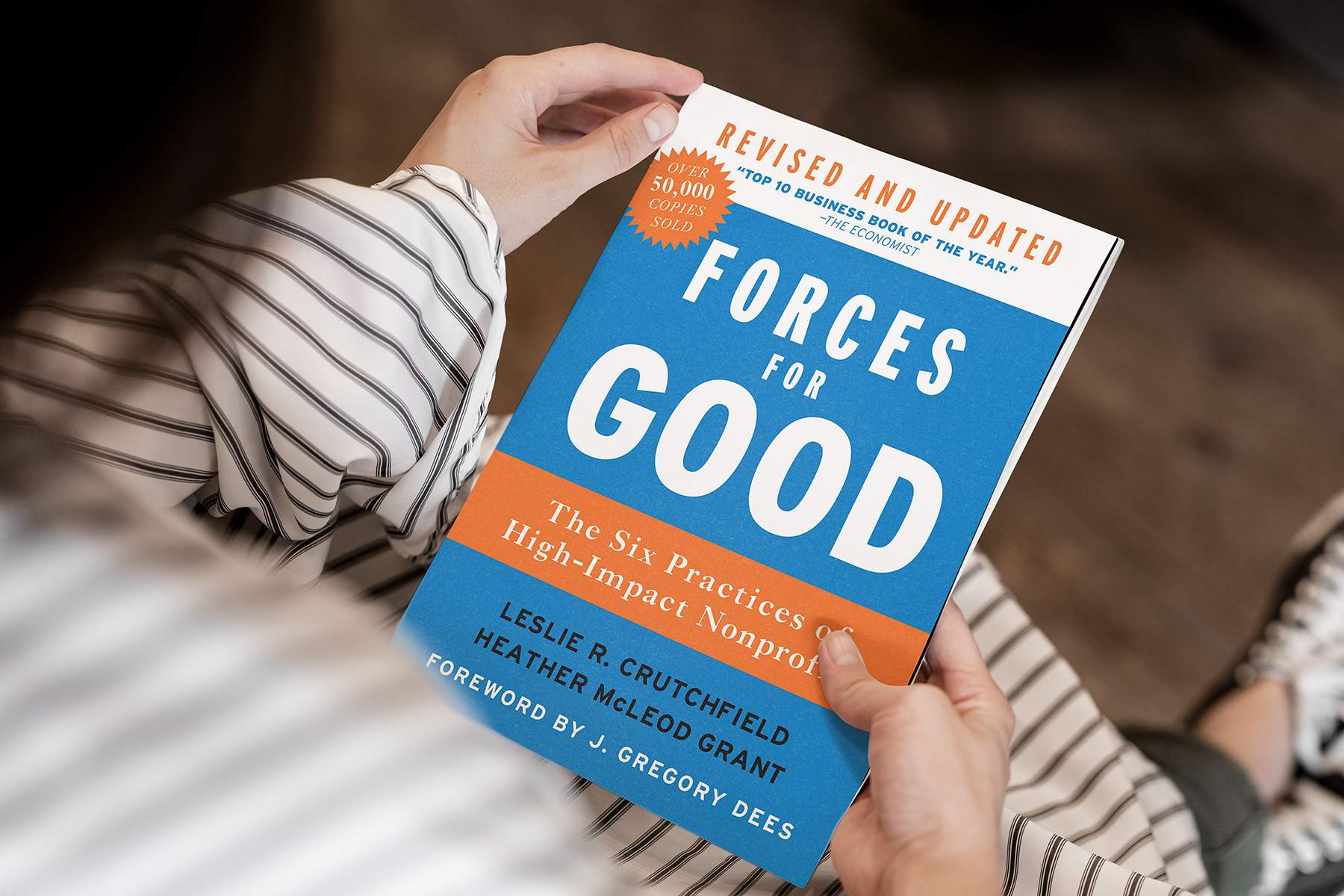
These are the questions that grabbed the imagination of Leslie R. Crutchfield and Heather McLeod Grant. Crutchfield wrote as a senior advisor with Foundation Strategy Group and a respected authority on scaling social innovation and high-impact philanthropy. Grant wrote as a senior consultant with Monitor Institute, focusing on networking, transforming legacy organisations, and scaling social innovations. Both have MBAs, serve as board members, and contribute to the field through writing and speaking. What they have done uniquely in this volume is an extensive and rigorous research project investigating: ‘what makes great nonprofits great?’
The research approach was to identify and learn from twelve national-scale nonprofits that demonstrate extraordinary impact – from the Environment Defense Fund to Habitat for Humanity, Exploratorium to Teach for America. Borrowing from Collins’ research methods for businesses, they surveyed nonprofit executives to nominate nonprofits with significant impact. They followed up the survey with selected expert interviews (2004), and then case study analysis over two years (2005-2006) and pattern identification (2006). Originally publishing their findings in 2007, the authors have now substantially revised the book, including evaluating how the organisations have weathered the financial crisis and expanded the sample to include case studies of thirteen smaller local organisations.
Basically, they tell the stories of a number of extraordinary nonprofits and discuss the six practices they use to change their world in extraordinary ways:
- Advocate and Serve. The best organisations integrate grassroots programs with policy advocacy. For example, Self-Help provided loans to low-income clients, but felt drawn to leverage its expertise to advocate politically against unscrupulous lending practices.
- Make Markets Work. Nonprofits can invite businesses to ‘do well while doing good’ through better business practices, corporate partnerships and earned income. For example, Environmental Defense Fund helped McDonalds reduce its waste and use more recyclable wrapping, It is important to find the right partner and not sell out, but business brings valuable assets to the table.
- Inspire Evangelists. The more mentoring, community building and social networking nonprofits can put into their volunteer base, the better motivated they will be to recruit for the cause. For example, Habitat for Humanity gets people involved in physically building houses but also mobilising their communities to solve housing problems. Founder Millard Fuller explained: “I was more interested in building a movement than an organisation. The key ingredient of a movement is abandon – you can’t hold back. It takes passion, commitment, dedication. But you can only have a movement if you attract a lot of people. That’s what Habitat did – it attracted a huge following of hundreds of thousands of people” (p.103).
- Nurture Nonprofit Networks. Other nonprofits are not competitors. It helps the cause to share expertise, wealth and talent and give away leaders and ideas. For example, Frank Oppenheimer dreamed up Exploratorium as a museum that can be interactive and mind-expanding. Instead of hoarding or franchising their ideas, they have generously shared to the point of giving away their genius and catalysing a worldwide hands-on science education movement.
- Master the Art of Adaptation. In a changing world, nonprofits need to be able to listen, learn and adapt (and decide what not to do so they can focus on their sweet spot). For example, Share Our Strength sought to fight hunger, but instead of mailing the usual donors, they enlisted the help of a target group who cared about food – chefs and restaurateurs – to share their time and resources.
- Share Leadership. The best leaders distribute leadership through their organisation and networks, with good team building, succession planning, board engagement and utilising a strong complementary second-in-command. For example, smaller nonprofits often share leadership beyond their organisation, such as MEND in California, which focuses on holistic care for the homeless, delivered by volunteers and other organisations who decide together the best strategy for service delivery.
The updated edition explained how the twelve original nonprofits continued to exercise the practices through and beyond the recession, and how the practices work for local and smaller organisations as well as large nonprofits.
The book is full of practical wisdom on how to practice the principles, to plan and utilise the best experts and accessible funding, and navigate the political minefields. It argues organisations cannot achieve broad and lasting change just through internal management, but acknowledges that cannot be ignored either and so offers counsel on staffing, capital and infrastructure management.
Underlining the practical advice, the research argued greatness is achieved not from the lowest overheads or the largest reach or the highest growth, but from those who have the greatest impact on the world. The best way to make global impact is not by importing the latest business management tools, crafting the neatest mission statement or adding more charity to ever-increasing need. The most effective way to bring change is not for any one nonprofit to build its own organization, but to collaborate with government, business, individuals and other nonprofits for broad and lasting change, undergirded by adaptation and shared leadership: “Greatness is about working with and through others…It’s about leveraging every sector of society to become a force for good” (p.320).
Great nonprofit CEOs take Level 5 leadership beyond putting organisational interest ahead of their own, to putting the overall cause ahead of their organisation! Great nonprofits do not just deliver services but foster movements for lasting change and thus function as ‘catalytic agents of change’. For example, Teach for America is not just about recruiting teachers but shaking up the education establishment.
This is an excellent resource for understanding yourself and others as leader(s), and particularly when working with or alongside nonprofits in order to help equip them and their organization be a catalytic force for good.
Notes:
The book was published by Jossey-Bass in 2012.
Earlier versions of this review were originally published in Journal of Religious Leadership 13:1 (Spring 2014), and then in The Cove “Understanding Yourself and Others as a leader” (2021).











Comments
Start the conversation by sharing your thoughts! Please login to comment. If you don't yet have an account registration is quick and easy.