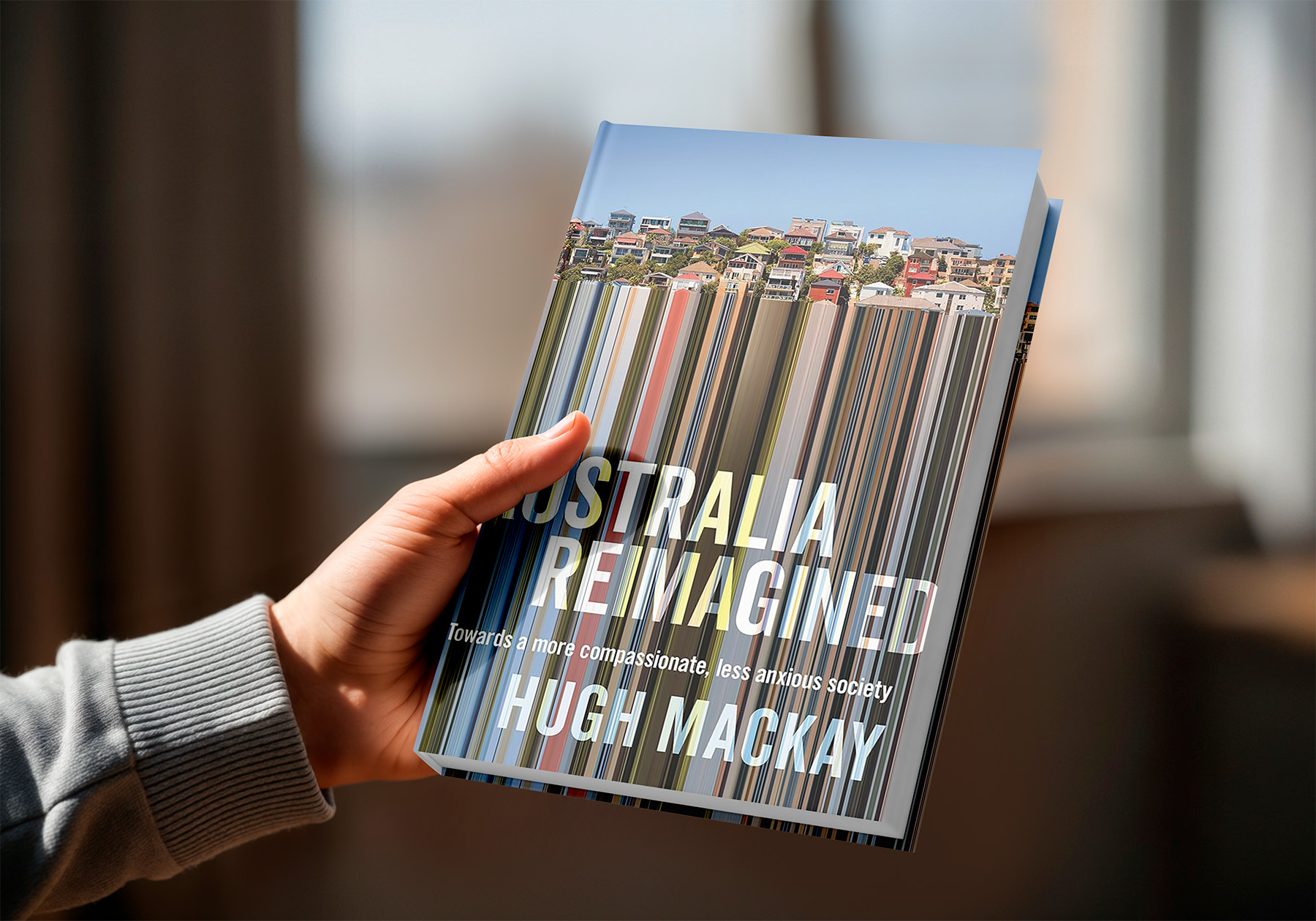
Hugh Mackay is Australia’s best-known social researcher and author, 3 decades ago, of Reinventing Australia. In Australia Reimagined, he shows he continues to have his finger on the pulse of a range of pressing social issues and points in some bold and radical directions for change.
Mackay’s portrayal of what is going wrong is especially concerning for me as I look towards the future of Australia through the eyes of my children. He identifies challenges of relationship breakdown, fragmented neighbourhoods, economic inequality, housing affordability, underemployment, neglect of First peoples, rampant gambling, 100,000 homeless Australians, and 65,000 attempted suicides annually. He describes Australia’s heartless treatment of asylum seekers (despite a majority of Australians advocating a more welcoming approach), excessive reliance on digital technology, degrading school system and increasingly commercialised university system, and distrust of institutions including parliament, churches and banks. As a reader, I was aware of many of these issues, but Mackay’s analysis gave me stark insights into their extent and implications.
Moreover, Mackay opened my eyes to realities I was unaware. For example, lagging behind the pressing social issues our nation faces is a lack of philanthropy; e.g., almost 40% of Australians earning over a million dollars do not claim a single dollar of tax-deductible charity donations! And people report concerning levels of distrust in their neighbours, not because neighbours are universally untrustworthy, but because we do not know our neighbours enough. The biggest challenge Mackay identifies, however, is the heightened and widespread anxiety epidemic. We are an overbusy, hyperconnected, financially overstretched, overweight, overmedicated and overanxious society.
Thankfully, Mackay does not simply identify problems but points in alternative directions. Often these are bold and radical suggestions, especially in the four ‘fault lines’ of gender, religion, politics and education. Mackay suggests the gender revolution has stalled and urges a new level of partnership between women and men. As a necessary kick-start, he appeals for quotas of women on boards and in leadership positions. Regarding religion, Mackay observes that despite the decline of church attendance, there is an increasingly pervasive understanding of God being with and in us and an increase in those who self-identify as ‘spiritual but not religious’. If anxiety is the most pressing social issue in Australia, then compassion and mutual respect that religion or any spirituality at its best can foster are the biggest need and solution. The main problem with politics, Mackay suggests, is our adversarial system, and he proposes parliamentary reform, perhaps even nominating representatives by ballot or, at least, directly recruiting experts as ministers. In the meantime, he urges expecting better service from our parliamentarians (and not calling them politicians). Finally, he challenges the rhetoric of ‘choice’ in education and urges phasing out public money for private schools in the interests of a more egalitarian system offering quality education for all.
One area I would like to read more about from Mackay is more compassionate relationships with Indigenous peoples. Mackay notes Australia’s moral blindness led to one of the worst records of treatment of her First Peoples:
He bemoans how we continue to fail as a nation to act in constructive ways. For example, in 2017, we debated whether to include a reference to the Aborigines in the Constitution's preamble. The Aboriginal and Torres Strait Islander Constitutional Convention of May 2017 issued the ‘Uluru Statement’ that appealed instead for a more serious constitutionally enshrined voice to Parliament, with an Indigenous body outside the Parliamentary structure that advises on issues and legislation related to Indigenous people. It was dismissed and not even discussed by Malcolm Turnbull and his cabinet. Since the book was published, history has shown Australia voted against the 2023 Referendum for an Indigenous Australian Voice to Parliament. Another recent contentious issue is Indigenous youth detention and advocacy to increase the age of criminal responsibility from 10 to 14 years old across all states and territories. Reconciliation with indigenous peoples and closing the gap of inequality of detention, healthcare, education and political representation desperately needs more reimagining and compassionate action along the lines of Mackay’s social vision.
Mackay’s writing suggests many implications for leadership, whether in public life, churches or the military. We need a spirituality for our times, and I appreciate Mackay’s comments on the power of faith and faith community. We need to model alternatives to materialistic consumerism and develop new ethics in the context of the digital revolution. Locally, we need to proactively foster neighbourly connections. Among my favourite stories Mackay narrated were the neighbourhood Facebook groups and associated street parties that connected neighbours. Given the declining trust in institutions, we need to reclaim (and re-earn) trust as leaders across different spheres, including the military and the church. Ultimately, we need to come together to think innovatively about our most pressing social issues. Mackay celebrates the Aussie innovativeness and resourcefulness that he inspired me to draw on in my research and leadership:
The challenge of Australia’s loneliness epidemic is only heightened with the social isolation related to COVID-19 pandemic restrictions and the pressing need to foster healthy community relationships and support structures. With whatever challenges we are facing or will face in years to come, Australia Reimagined is an antidote for complacency and a manifesto for compassion that calls for courage, wisdom and imagination towards a less anxious society. It is essential reading for community leaders and anyone interested in understanding our pressing social issues and proposing alternative solutions.









Comments
Start the conversation by sharing your thoughts! Please login to comment. If you don't yet have an account registration is quick and easy.