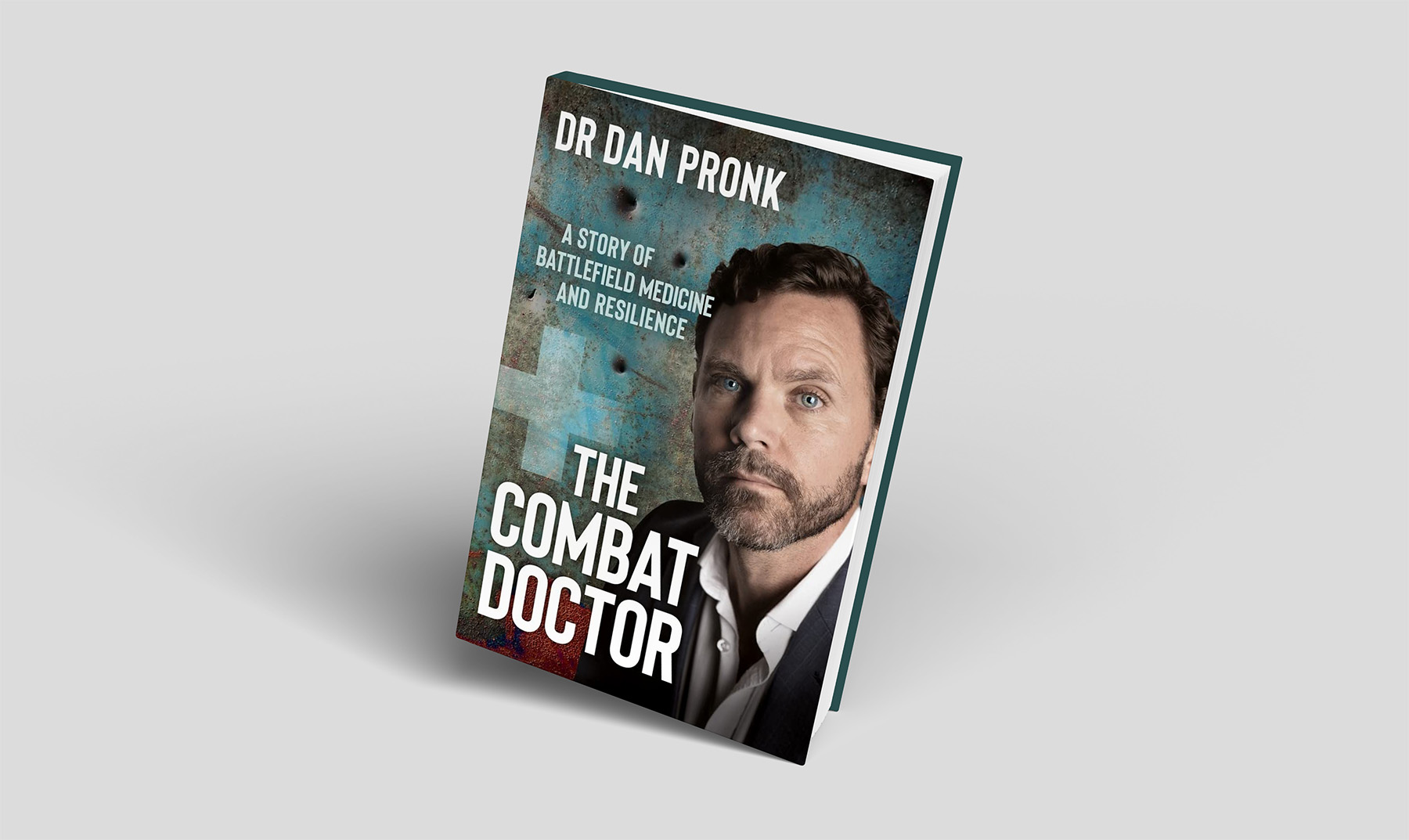
Note: Content within this review and book regarding trauma and mental health challenges may be distressing to some people. Support is available through your Chain of Command, Chaplaincy or Health Centre, Lifeline 13 1144 or Open Arms 1800 011 046.
The Combat Doctor is a first-hand, riveting account by Dr Dan Pronk of the resilience required to join, integrate with, serve in, and transition from Special Forces and Battlefield Medicine.
One of Pronk’s early teenage ambitions was to become a pro triathlete. He channelled that energy into a self-directed regime of training for selection for Special Air Service Regiment (SASR). While studying medicine on an Army scholarship and then serving at 5RAR in Darwin, he regularly did 150 kilometres of pack-marching a week, 1000 push-ups a day, practised night navigation, and, just prior to exercise, carefully dosing up on vitamins.
Lessons from selection were significant, for example, framing testing not as competition with other candidates but as challenges with teammates to rely on support. The paradigm change was not to ask “Did I beat them?” but “Would I want this person on my team at war?” (p.52) Testing was as much about character, resilience, and perseverance as it was about skills and confidence. Selection processes have changed somewhat since, but these principles remain centrally important. Pronk passed selection and uniquely became a Combat Doctor, qualified and equipped to join the fight – as he described it – to either take life or save it.
This does raise an ethical question for me as a chaplain reading the book. My role, like that of a medic or doctor, is as a non-combatant and protected person under the Geneva Convention (Protocol I, 8 June 1977, Art 43.2). I am allowed to carry weapons, and if necessary, use weapons for self-defence or defence of those in my care. I take seriously my need to understand and be trained in weapons I may carry. But medical and religious personnel do not have the right to participate in hostilities, or if we do participate directly in combat, we lose our protected status. Thus, I am cautious about any inference that I could ever be an active shooter as well as a chaplain, and medics may have the same hesitancy.
The book describes how Pronk integrated with and served alongside Special Forces (SF) operators. He didn’t have the opportunity to complete the Reinforcement Cycle of training (REO) to qualify as an operator. Yet he served as a Combat Doctor at 2nd Commando Regiment (2 CDO) and SASR for 5 years, including 4 tours of Afghanistan. This exposed him to teams for whom he grew a great respect. He narrates the transport in and, sometimes, the evacuation out of battles, some of the taskings, some of the saved lives, and some lives he was unable to save. In one episode, Pronk performed a chest-opening cut in an airborne helicopter with a combat knife, doing what was necessary rather than what was protocol, but saved the digger’s life. Yet he transparently explains the moral injury of not being able to save a civilian child, and the grief of losing colleagues and mates who were in his medical care. It is only natural that grief and mourning go on for years.
Pronk insightfully explains battlefield medicine, including the development of tactical combat casualty care (TCCC) as a life-saving intervention. He discusses the role of the teams of ‘Voodoo Medics’ as SF medics and doctors on standby for medical evacuation (MEDIVAC) became known. Towards the end of his last deployment, Pronk realised a well-trained medic or operator could deal with the majority of life-threatening wounds as well as he could. Pronk realised on his last deployment that his best role was focusing on improving medical capability across the team, commenting: “I realise now that one’s contribution to an organisation is more accurately measured by what they have left behind rather than what they achieved while they were there.” (p.302) This is also focused on the work of medics in training others in TCCC and more advanced training for Combat First Aiders. By extension, it is also encouraging for Chaplain colleagues and me to not seek to be the point of contact for welfare and wellbeing, but to upskill the chain of command and colleagues across a unit to offer an umbrella of care to one another and their teams.
The Combat Doctor’s story of transition to civilian life and his family experience is also insightful. Pronk details some career and family challenges other members will empathise with: navigating posting hick-ups, returning from deployment, restlessness and desiring another deployment fix, being demoted back because of lack of promotion courses, DHA housing, wife saying “It’s time”, transition to civilian life, PTSD diagnosis, drinking more, the revenge cycle trap. He was determined not to lose any more time with family – he said he invests in relationships as the dead cannot. He had asked his wife Kristy what she did in Adelaide during his second deployment, when his children were 3 and newborn, and she replied: “I cried.” (p.158). In transition, he explained:
Pronk reframed his challenges as an opportunity for post-traumatic growth. He sought out new skills in meditation and identified sources of resilience for himself and others that he and colleagues wrote about in The Resilience Shield. Some psychological “demons” still surfaced but he realised that it was not that part of him died on battlefield of Afghan, but part had been born, awakened, learning much about himself. He has built a successful post-Army career in medical leadership and entrepreneurship. He was also “Dr Dan” on the TV show SAS Australia.
The Combat Doctor is highly recommended reading for those interested in resilience, mental health, battlefield medicine and special forces, including those who Command and support SF in various ways. It is a tribute to the stoicism and resilience of SF operators and their partnering “Voodoo Medics”.
Notes:
An earlier version of this review was originally published in Journal of Military and Veterans’ Health.
Publisher details: Dan Pronk, The Combat Doctor: A Story of Battlefield Medicine and Resilience (Sydney: Pan Macmillan, 2022). He also wrote Average 70kg D**khead: Motivational Lessons from an Ex-Army Special Forces Doctor (reviewed in JMVH) and with SASR colleagues Ben Pronk and Tim Curtis wrote The Resilience Shield: SAS Resilience Techniques to Master Your Mindset and Overcome Adversity (previously reviewed in Grounded Curiosity by Chris Booth.






Comments
Start the conversation by sharing your thoughts! Please login to comment. If you don't yet have an account registration is quick and easy.