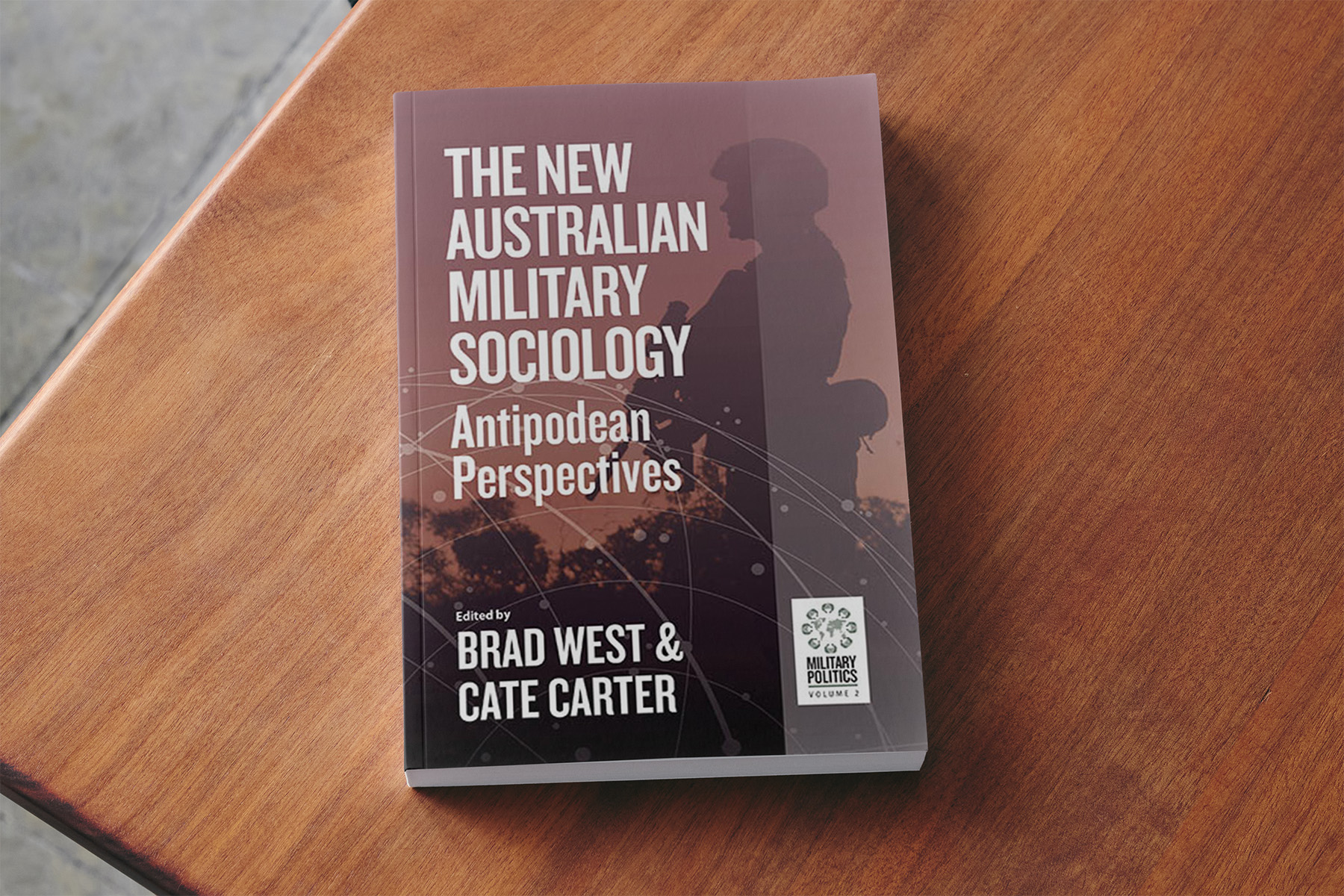
This edited volume marks a welcome and timely contribution to Australian military studies. In The New Australian Military Sociology, Brad West and Cate Carter bring together a set of essays that seek not only to analyse aspects of Australian civil-military life but also to establish the grounds for a more sustained sociological conversation about them. The book is presented as the opening statement of a broader intellectual project, and it is best read in that spirit. It does not offer a single unified argument so much as a set of connected inquiries into the institutional, cultural, and social forms through which military life in Australia is organised, experienced, and understood.
The introduction by West and Carter gives the reader a strong sense of the volume’s central questions. They argue that Australian civil-military relations are not well captured by models developed in the Global North, especially in the United States, particularly those that assume overt rivalry between military elites and civilian political elites or that read civilian-military proximity chiefly through the lens of militarisation. In the Australian case, they suggest, the relationship is marked less by overt contestation than by silence, ambiguity, and limited opportunities for substantive public discussion. The Australian Defence Force (ADF) seeks public support, but public discussion of what it actually does is often constrained or thinly developed. This is a productive place for the volume to begin because it identifies the civil–military gap as the central problem the collection wants to explore: a relationship in which public support for the ADF is cultivated, but opportunities for fuller public discussion of its role and meaning remain limited.
To develop this argument, the editors draw on Jeffrey Alexander’s Civil Sphere Theory, proposing that it offers a more nuanced account of the ‘civil’ in civil-military relations than some of the more familiar approaches in the field. This framing signals the editors’ wish not merely to describe Australian cases but to use them to intervene in wider theoretical debates. The volume as a whole reads as an initial exploration of that possibility rather than its final formulation, but that is no bad thing. One of the strengths of the collection is precisely that it opens lines of inquiry that future work can deepen. If anything, the persuasiveness of the introduction leaves the reader wanting to see this framework carried even more fully into the substantive analysis of particular cases across the collection.
Phillip Hoglin’s chapter examines demographic change in the ADF using Defence administrative data, Defence Census material, and Australian population data. Focusing on gender, marital status, age, birth country, Indigenous representation, and religious affiliation across 2002, 2012 and 2022, he asks how far the contemporary ADF reflects the broader Australian population and what this means for representation and social legitimacy. Particularly striking is the observation that ADF personnel are now less religious than the Australian population as a whole, a finding that complicates familiar assumptions about the social conservatism of military institutions. Hoglin’s discussion of social legitimacy brings into view a larger issue at stake in the chapter, namely the relationship between demographic resemblance and the legitimacy of a volunteer military in contemporary Australia.
Cate Carter’s chapter offers a different kind of contribution through autoethnographic reflection on movement across service categories and military identities. Her account of the distinctions between Reserve and Regular service, and of the claims to authenticity attached to them, is one of the more illuminating parts of the volume. It shows that categories such as Reserve and Regular are lived not simply as administrative distinctions, but as differences of identity, status, and belonging. The chapter is also useful in methodological terms, since it makes a case for forms of military research that are attentive to lived experience and institutional texture rather than only external observation.
The chapter on student veterans by Wadham and colleagues turns to the experience of former ADF members in Australian higher education, an area that has not received much sustained attention in Australian scholarship. Using Lizzio’s “Five Senses of Student Success” model, the authors show that universities are often not well equipped to understand the distinctive experiences and needs of student veterans. The chapter is largely descriptive, but productively so. It identifies higher education as an important part of the transition landscape and shows that veteran transition is shaped not only by questions of employment or health, but also by the institutions veterans enter after service and by the assumptions through which those institutions recognise, or fail to recognise, military experience.
Woodside and Connor’s chapter explores ADF values statements and wider processes of cultural change. Their discussion of the gap between espoused values and lived practice is especially useful in showing how values reform can be understood not only as an internal matter of organisational adjustment but also as one way in which civilian expectations are brought to bear on military institutions. In this respect, values appear less as settled moral commitments than as instruments through which reform is articulated and pursued. The chapter therefore opens a broader question about the relation between formal cultural reform and the less orderly process by which change does or does not take hold in everyday military life.
Bridges and Wulff’s chapter on gender neutrality in the ADF engages a significant theme in contemporary feminist military studies. Their argument is that gender-neutral discourse can leave masculine norms intact while presenting itself as inclusive, thereby placing the burden of adjustment elsewhere. This thoughtful chapter, and its emphasis on the continuing tension between formal equality and lived institutional norms makes it a valuable contribution to understanding what is involved in understanding de-identification of gender identity in the ADF. In particular, the chapter is concerned with the limits of a reform language that treats neutrality as the answer to inequality. What it brings out is the difficulty of treating neutrality as if it were free of history. Standards that appear universal may still bear the imprint of older masculine norms, even when presented as equally applicable to all.
McComas and West’s discussion of interoperability during the 2019–20 Black Summer bushfires shows that interoperability is not simply a technical or procedural matter. It is also shaped by organisational culture, role perception, and differing institutional assumptions. In the context of domestic disaster response, these issues become especially clear. The chapter is valuable in drawing attention to the social and cultural dimensions of coordination across agencies. It also shows that friction between organisations cannot be reduced to failures of planning or communication alone, since different agencies may arrive with different assumptions about authority, competence, and appropriate roles. In that respect, the chapter usefully widens the discussion of interoperability beyond systems and command arrangements to the question of how institutions understand one another in practice.
The final chapter, by Taino-Spick and Shore, turns to military transition and the performative dimensions of veteran subjectivity. It is the most conceptually ambitious chapter in the volume and asks how official documents and transition practices help shape the identities available to those leaving service. The argument is at points more suggestive than fully developed, but it raises worthwhile questions about the relation between military service, separation, and the enduring symbolic presence of Anzac in Australian public life. In doing so, it treats transition not simply as an administrative process or personal adjustment, but as a moment in which military identity is reworked under institutional and cultural pressures. The chapter therefore adds a different register to the volume by asking how forms of military belonging persist, alter, or lose their force once service has formally ended.
As with many edited collections, the chapters vary in emphasis and approach, and not all are equally developed. Some are more empirical, others more conceptual. Yet this variation also reflects the fact that the book is trying to do more than one thing at once. It introduces a field, gathers a community of researchers, and offers a range of case studies through which the sociological study of the Australian military might be pursued. Read in that spirit, the collection succeeds in showing that the Australian military is an important and underexamined object of sociological inquiry.
One of the notable features of the volume is the collaborative relationship it represents between university-based scholars and those with experience inside Defence. That gives the collection a distinctive texture and, in several chapters, a level of institutional sensitivity that is not always easy to achieve. It also suggests one of the more promising aspects of the wider project the editors are advancing: the possibility of scholarship that is analytically serious, empirically grounded, and attentive to the particularities of Australian military life. At the same time, the collection’s framing points toward larger changes in Australia’s strategic environment than most of the chapters take up directly, and this in turn suggests one important direction in which the project might develop further.
The New Australian Military Sociology therefore deserves to be welcomed as a significant contribution. Its greatest strength lies in making a case for the importance of the field itself. The volume shows that questions of military organisation, professional identity, transition, gender, legitimacy, and civil-military relations in Australia can sustain serious sociological treatment. It is to be hoped that this collection will be followed by further work of the same kind, because it has opened a conversation worth continuing.










Comments
Start the conversation by sharing your thoughts! Please login to comment. If you don't yet have an account registration is quick and easy.