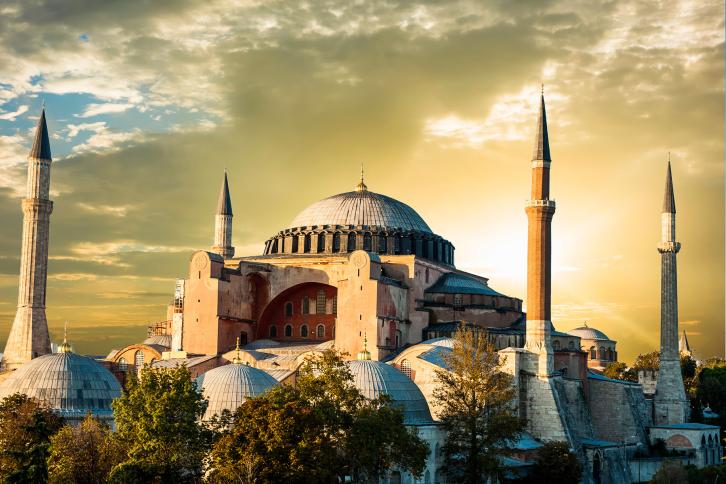
The rise and fall of empires reveal crucial lessons in strategic brilliance and failure, offering insights that help shape our present and future. The Byzantine Empire's enduring history offers a valuable case study for students of strategy. Centred on Constantinople, the Byzantine capital’s strategic location on the Bosporus Strait made it a crucial economic hub linking Europe, Africa, and Asia.1 Its central location also made it a crucial centre of religion, particularly Christianity. Spanning the eastern Mediterranean, North Africa and the Middle East, the Empire's immense territory presented numerous strategic opportunities and threats, necessitating a grand strategy that was “lean, adaptive and innovative.”2 Throughout its history, successive Byzantine Emperors were forced to employ nuanced and dynamic approaches to meet ever-changing strategic circumstances. While intended to ensure survival, strategic missteps were made that also destabilised the Empire.
Drawing on the seminal works of Edward Luttwak3 and Peter Frankopan,4 this essay argues that the most important lessons from the Byzantine experience are the crucial roles of economy-building and nation-building as foundations of national power. This essay will identify the Byzantine Empire’s grand strategy, assess the critical roles of economy-building and nation-building, and analyse their enduring relevance for contemporary strategic thinking. These insights into the Byzantine Empire's strategic resilience will offer profound lessons for modern students of strategy, emphasising the enduring relevance of
economy-building and nation-building in navigating complex and challenging strategic environments.
Byzantine Grand Strategy
Grand strategy is a comprehensive framework that guides a state’s use of its resources—its levers5—to achieve long-term objectives and priorities across all spheres of national power.6 The Byzantine Empire’s grand strategy focused on the strategic levers of warfare, diplomacy, and statecraft. Notable Byzantine leaders, including Emperor Justinian I, skilfully integrated these elements to maintain the Empire’s stability and safeguard its territorial integrity.7 In the strategic context, these levers fundamentally provided the 'ways'8 for the Byzantine Empire to implement foreign policy. Critically, these levers were derived from and underwritten by two distinct strategic ‘means’: the economy and societal cohesion. The grand strategy of the Byzantine Empire enabled it to endure for over a millennium, sustained primarily through effective economic management and religious patronage. These elements served as the bedrock of Byzantine national power, fortifying their resilience, and enabling them to survive during an era marked by volatility and dynamic social and political change. These strategic strengths; however, were also its weakness: the core economic and societal pillars would also play a key role in the Byzantine Empire’s downfall.
The eventual collapse of the Byzantine Empire was a complex process influenced by numerous factors, including leadership dynamics, external threats, and internal religious friction that affected the consistency and effectiveness of its grand strategy. Bereft critical strategic outcomes, the Byzantines could not leverage their former strategic strength, with the once mighty empire sliding into decline from the 11th century. Central to the decline were the once robust pillars of economic management and religious patronage, the deterioration of which undermined the Empire’s ability to sustain itself, adapt to emerging challenges, and maintain cohesion in the face of persistent threats. The grand strategy of the Byzantine Empire is a testament to how enduring national power can be maintained through effective strategic planning, and how it can be eroded by strategic miscalculations.
Grand Strategy and National Power
National power, the ability of a state to influence others, is central to grand strategy.9 Put simply, “the transmission of power in all its forms, in order to maintain policy, is the aim of grand strategy.”10 Hans Morgenthau maintains that "international politics, like all politics, is a struggle for power,"11 underscoring power's central role in state interactions. In the context of international relations, power dictates interactions between states, where the primary goal is to ensure national security and achieve dominance in an anarchic international system.12 As a result, maximising power becomes a crucial objective in the ever-present shadow of
state-on-state violence: nations ignore this at their peril.
The Byzantine experience underscores that economy-building and nation-building are crucial elements in developing and leveraging national power. Given this, the development and continuous refinement of grand strategy is essential in the pursuit and application of national power. Andrew Phillips argues that states develop and leverage national power through:
- State-building: Managing political discourse and power transitions.
- Economy-building: Leveraging economic potential.
- Nation-building: Inculcating societal identity and cohesion.13
Fundamentally, these elements are cyclic: enhancing one strengthens the others. Conversely, decline in any element weakens them all. This inter-connected nature highlights the need for balanced national power. Paul Kennedy posits that a state able to leverage an advanced economy benefits greatly over its rivals.14 Equally, Michael Mazarr argues that it is the qualities of a state’s society, its ability to generate social cohesion, that underpins national advantage.15 Together, economic and societal factors are the foundations from which all other elements of national power, such as military strength, are dependent on. By balancing economic resources and political environments, a state can navigate power dynamics and better position itself globally.
The rise and fall of the Byzantine Empire
The Byzantine Empire's history underscores how critical economic management is to national success and stability, illustrating the intricate link between economic health and state resilience. Likewise, the rise and fall of the Byzantine Empire was intrinsically linked to social cohesion: “To foster the people’s willing spirit is often as important as to possess the more concrete forms of power.”16 The Byzantine Empire's strong societal environment contributed to its early successes, but internal power struggles and religious friction played a role in its decline. Examining these factors reveals valuable lessons on how economic and societal stability can enhance a state’s capacity to wield power effectively.
Economic Management and National Stability
The 4th century saw Constantinople emerge as the crucible between the East and West—a vital economic hub controlling key trade routes.17 At its peak, the Byzantine Empire benefited from vast commercial networks, productive lands, and taxpaying societies. However, it was these same networks, lands, and taxpayers that, at its lowest point, were lost and with them their economic contributions, all of which fuelled internal unrest. Economic wealth is a fundamental element of a state’s ability to generate and sustain strategic courses of action such as warfare, diplomacy, and statecraft; therefore, it is of utmost importance that economic stability is a focal point for both internal and external policies.
Military conflict endured as a constant thread throughout Byzantine’s history, be it through strategic choice or enemy invasion.18 Continuous cycles of conquest and defeat imposed significant economic costs on the Empire: “friction between great powers is almost always injurious to core interests.”19 Regardless of involvement, war amongst states directly affects international trade, and hence the economic stability of not just protagonists, but also states linked to them through trade. By the 7th century, decades of conflict had reduced Byzantine territory to just Constantinople and its hinterland, with once-bustling international commerce in the Eastern Mediterranean effectively ceasing. As an outcome, trade within vibrant cities such as Athens ground to a halt: their economic centres all but abandoned.20 In direct contrast, once-Roman lands such as Egypt—now in the hands of the emerging Islamic caliphate—were bustling, their cities “coursed with ideas, goods and money.”21 Throughout Byzantine history, trade and market control were crucial to the Empire's economic power and its ability to conquer or defend territory. Absent these economic lifelines, however, the Byzantine Empire struggled to sustain its military, finance diplomacy, and maintain internal cohesion.
At its peak, the key to Byzantine economic power centred on Constantinople’s strategic location, which enabled the establishment and control of a vast agricultural and trade network encompassing Europe, Africa and Asia.22 The 7th Century loss of Egypt to the Islamic Caliphate had profound economic and societal consequences for the Byzantine Empire given the critical importance of Egyptian agriculture in providing essential food supplies, tax revenues, and trade opportunities.23 Equally as damaging, the loss of strategic control over lucrative Mediterranean trade to Italian city-states such as Venice and Genoa in the 13th century severely eroded Constantinople’s economic stability.24 The fall of the Byzantine Empire was directly attributable to the loss of these valuable economic resources—something the Empire could not recover from. The Byzantine Empire's history clearly demonstrates that strategic financial structures, trade networks and economic resources are indispensable for a nation's resilience, and their loss can lead to downfall.
The robust economic foundation laid by the Byzantine Empire played a crucial role in their nation-building efforts. By fostering a stable economy, the Empire could invest in infrastructure, maintain the military, and support a thriving society. This economic stability allowed for effective governance and social cohesion, which were essential for the Empire's long-term stability and growth. Conversely, conflict and the cost of defending large borders disrupted trade and taxation, creating a vicious cycle of economic and societal instability. In this context, the interconnectedness of economy-building and nation-building becomes evident, as each component reinforces the other to create a resilient and prosperous state. Without a stable economic foundation, even the most sophisticated military or diplomatic efforts cannot sustain a state in the long term. This lesson remains relevant today, as modern nations address the complexities of economic security.
Social Cohesion and National Stability
The Silk Roads25 of Eurasia facilitated not just trade but also the spread of religions, highlighting how faith and commerce intertwined to influence societal and political dynamics in the Byzantine Empire.26 The societies of antiquity were highly receptive to divine guidance, where faith offered both explanations and solutions to every conceivable problem.27 Across Eurasia, religions fought each other for audiences, wealth, and—above all—moral and political authority. For those in power, the desire to harness faith “was as simple as it was powerful: a society protected and favoured by the right god, or gods, thrived; those promising false idols and empty promises suffered.”28 Emperor Constantine’s adoption of Christianity in 312 CE unified Byzantine society, fostering cohesion under a common religion. However, it also introduced enduring divisions within the Church, which remained unresolved and plagued the Empire throughout its existence, despite the efforts of multiple emperors, including Constantine. By integrating Christianity into the Empire, Constantine's conversion enhanced internal stability and bolstered political authority.29 Frankopan views this as “shrewd politics,”30 with John Norwich also positing that Constantine’s conversion was influenced by political considerations.31 Regardless of his motivations for conversion, Constantine’s decision had a profound influence for both his empire and that of the Christian faith. In this aspect, Robert Joustra argues that Byzantine Orthodox Christianity stood as the real power behind Byzantine foreign policy.32
Leveraging cultural links and religious beliefs were fundamental aspects driving Byzantine societal cohesion—and in tearing it apart. Throughout its history, differing Christian factions fought for hegemony both within the Byzantine Empire and across the Christian world. These religious disputes often led to significant political, economic, and social upheaval, impacting the stability of the Empire. Constantine, along with many Byzantine emperors, saw themselves as the custodians of Christianity, often portraying themselves as both political and religious leaders.33 This dual role played a central part in the Empire’s religious and political identity. Constantinople became a beacon of scholarship and religious devotion—second only to Jerusalem as the Empire’s spiritual heart34—influencing both Eastern Europe and the Middle East. For successive emperors, Christianity was not only a domestic political instrument in Byzantine society; it was also a source of influence over foreign empires and rulers. As Frankopan noted, “to strengthen the Empire was therefore to advance Christian salvation.”35 This not only worked for the ruling emperors, but also the Church, whose interests were the most salient.
Byzantine emperors saw the Orthodox Church as a crucial ally in maintaining political, economic, and social stability, and they often sought to use the church’s authority to legitimise their rule and enforce policies. For some, however, this lesson was lost and cost them their reign. Emperor Basiliscus acceded the throne in 475 CE, whereby he immediately drew the wrath of his subjects by imposing vicious taxation, and—critically— the wrath of the Church by “his ham-fisted attempts to impose Monophysitism throughout the Empire.”36 Having angered both the people and the Church, it was only a matter of time before they moved against him, with Basiliscus forcibly deposed and exiled in 477 CE. As Basiliscus’ experience demonstrates, the intertwining of religious and political power could result in the suppression and persecution of those holding differing beliefs—including emperors—thus destabilising the Empire.
The Byzantine Empire's strategic use of religion and cultural integration underscores the importance of fostering societal and cultural identity. Christopher Berg succinctly expresses this point, arguing that:
In the context of imperial conquest and engendering control over vanquished populations, Berg’s point is highlighted by the Byzantine maxim: “When a populous city is taken, it is important to leave the gates open, so that the inhabitants may escape and not be driven to utter desperation.”38 Psychology, whether it be collective or individual, plays a key role in influencing societies and underpinning societal cohesion—particularly those newly conquered who need to be integrated into society, not alienated from it.39 Leaders of modern nations can learn much from Byzantine history, particularly in how their approach to leadership directly affects their ability to build cohesive and stable communities within diverse, multi-cultural societies.
Lessons for students of strategy
The Byzantine Empire’s achievements and missteps in economy-building and nation-building present enduring lessons for generating and maintaining national power. In this context, a compelling comparison can be drawn between the Persian Empire and Byzantine Emperor Maurice. Fuelled by a strong economy ironically sustained by regular Byzantine subsidy payments—a legacy of foreign policy failure—and a softer, tolerance-based approach to practicing religion, Persian rulers oversaw a period of relative peace that went hand in glove with economic prosperity within the Empire.40 Across Persia, numerous new cities sprang from this success, each resplendent with infrastructure and monuments built for the people.41 Tied to this was an increase in long-distance trade, particularly in luxury goods, with the resulting societal prosperity driving a vibrant commercial boom. The Persian experience underscores the importance of managing both economic and social factors for sustained prosperity. The link between economic growth and social cohesion is clear, as demonstrated by the Persian Empire's success in fostering a vibrant and prosperous society through economic development and religious tolerance.
In stark contrast, the Byzantine Empire under Emperor Maurice illustrates the consequences of neglecting these factors. For Maurice, his fundamental constraint was a lack of finances. His predecessors had left the Empire near-bankrupt, with ongoing subsidy payments to rivals such as Persia and conflict across his large frontiers leaving him unable to reconstitute the Byzantine treasury. The result of this Norwich describes as a “parsimoniousness which gradually became an obsession.”42 His reduction of military rations by a quarter led to mutiny in 588; his refusal to ransom twelve thousand Byzantian prisoners in 599 led to their deaths; and, the final straw for the military, his insistence on leaving troops in inhospitable winter conditions in 602 ignited riots in Constantinople which forced Maurice to flee. Eventually captured, Maurice was witness to the deaths of his four sons, before he himself was executed.
History presents Maurice as a wise Emperor: “[he] left the Empire immeasurably stronger than he found it.”43 Regardless, the lesson of his reign remains clear, the direct link between the economy and prosperity is keenly felt by the people: If you make them paupers, they will make you pay. “Had [Maurice] allowed his soldiers only a little more bread, or his people just a few more circuses, he would have escaped his fate.”44 Where periods of Byzantine affluence heralded the “large-scale building of Churches … and the founding of institutions such as law schools”45—all for the benefit of the Empire and its people—depressing economic prosperity led to dire consequences, with the fate of Emperor Maurice being just one example.
As a modern case study drawing on lessons from the Byzantine Empire, particularly under Emperor Maurice, contemporary Russia faces challenges that highlight the strategic interplay of economic and social dynamics. In both cases, Orthodox Christianity remains a core pillar of national identity.46 Despite this clear societal strength, under economic strain even the most robust societies can falter. Russia’s conflict in Ukraine mirrors Maurice’s costly military campaigns, compounding fiscal burdens through sanctions, inflation, and economic stagnation.47 Maurice’s parsimoniousness alienated his people, sparking rebellion and his eventual downfall—a cautionary tale for Russia, where poverty and unemployment threaten to destabilise the traditionally resilient Russian community. These historical and modern parallels underscore a vital lesson for Russia: sustained fiscal stress undermines societal cohesion and stability. The cracks appearing in the Russian Orthodox community mirror the tensions that surfaced in the Byzantine Empire during times of fiscal and social strain, illustrating how unchecked economic hardships can undermine even the strongest societal institutions.
Throughout Byzantine history, the interdependence of economic stability and social cohesion played a pivotal role in the Empire’s fortunes: harmonising these elements was crucial for maintaining national power. In the anarchic realm of international politics, the ability of leaders to leverage economic and societal strengths directly influences state success. As the lessons from the Byzantine Empire underscore—and Russia’s current domestic situation indicates—integrating robust economy-building and inclusive nation-building initiatives is imperative for generating and projecting national power, offering timeless insights for contemporary students of strategy.
Conclusion
The Byzantine Empire's longevity highlights the critical importance of robust
economy-building and inclusive nation-building as pillars of national power. Its economic success stemmed from financial stability, effective resource management, and adaptable trade networks. Similarly, its societal cohesion—anchored in religious integration—ensured internal stability and sustained influence abroad. However, its decline reveals that neglecting these foundations renders states vulnerable to decay.
The interplay of economic and social stability has defined the trajectory of states throughout history. Prosperity accompanies those who align these factors, while instability and conflict await those who fail: the decay of civilisations is often precipitated by overextension of resources and the accumulation of political and social tensions.48 The Byzantine Empire does not stand alone as a case study where economic and social factors coalesce. The rise of Islam and its caliphates from the 7th century highlights the success of harmonising economic and social policies. By uniting diverse regions under a cohesive administration, currency, and language, these caliphates fostered stability and innovation.49 Conversely, the British Empire's post-World War II decline illustrates the failure to adapt to shifting economic and societal dynamics, as decolonisation and economic strain eroded its global dominance.50 For those willing to learn, history consistently shows that alignment—or lack thereof—between economic and social systems is a defining factor in determining the trajectory of empires and states.
This paper has clearly articulated the critical strategic roles of economy-building and nation-building. Further, it has provided stark evidence as to why these elements serve as key lessons for students of strategy. For modern strategists, understanding the interconnectedness of economic and societal factors across all aspects of governance is essential. Effective economic management akin to the Byzantine’s can provide financial stability that supports strong social programs and institutions. Additionally, the Byzantine integration of religion and statecraft exemplifies how shared cultural and ideological frameworks can unify diverse populations. Drawing from such lessons, contemporary planners and policymakers can develop nuanced strategies that integrate these elements to strengthen long-term stability and prosperity.
Baldwin, David A. “Realism.” In Power and International Relations, 123–38. A Conceptual Approach. Princeton University Press, 2016.
Berg, Christopher. “Book Review: The Grand Strategy of the Byzantine Empire.” De Re Militari, 2011. https://www.deremilitari.org/REVIEWS/Luttwak_GrandStrategyByzEmp.htm.
Bosio, Nick. On Strategic Art - A Guide to Strategic Thinking & the Australian Strategy Formulation Framework. Canberra: Australian Department of Defence, 2024.
Frankopan, Peter. Silk Roads: A New History of the World. Paperback edition. Bloomsbury, 2016.
Hart, Basil. Strategy. 2nd ed. Faber and Faber, 1967.
Joustra, Robert. “The (Not so) Grand Strategy of the Byzantine Empire.” Review of Faith and International Affairs 8, no. 3 (January 1, 2010): 69–70.
Kennedy, Paul. The Rise and Fall of the Great Powers: Economic Change and Military Conflict from 1500 to 2000. Petite Bibliothèque Payot: Documents. Random House, 1987.
Krindatch, Alexey D. “Changing Relationships between Religion, the State, and Society in Russia.” GeoJournal 67, no. 4 (2006): 267–82.
Luttwak, Edward. The Grand Strategy of the Byzantine Empire. Cambridge, Mass: Belknap Press, 2009.
Malpas, Rowena. The Fall of Civilizations: Lessons from History’s Declines. Richards Education, n.d.
———. The History of Empires: Rise and Fall of Great Powers. Richards Education, n.d.
Mazarr, Michael J. “What Makes a Power Great: The Real Drivers of Rise and Fall.” Foreign Affairs 101, no. 4 (July 1, 2022): 52–63.
Mead, Walter Russell. “Thucydides, Polybius, and the Legacies of the Ancient World.” In The New Makers of Modern Strategy, edited by Hal Brands, 41–66. From the Ancient World to the Digital Age. Princeton University Press, 2023.
Morgenthau, Hans. Politics Among Nations: The Struggle For Power And Peace. New York: Alfred A. Knopf, 1949.
Narizny, Kevin. The Political Economy of Grand Strategy. Cornell University Press, 2007.
Nelson, Rebecca. “The Economic Impact of Russia Sanctions.” Congressional Research Service. Washington, February 20, 2025.
Norwich, John Julius. A Short History of Byzantium. Penguin, 2013.
———. Byzantium: The Early Centuries, 1990.
Silove, Nina. “Beyond the Buzzword: The Three Meanings of ‘Grand Strategy’.” Security Studies 27, no. 1 (January 1, 2018): 27–57.
Skedros, James C. “‘You Cannot Have a Church Without an Empire’: Political Orthodoxy in Byzantium.” In Christianity, Democracy, and the Shadow of Constantine, edited by George E. Demacopoulos and Aristotle Papanikolaou, 219–31. Fordham University Press, 2017.
Slack, Keith. “The Information Lever of Power.” Freeman Papers, August 21, 2024.
Teall, John L. “The Grain Supply of the Byzantine Empire, 330-1025.” Dumbarton Oaks Papers 13 (1959): 87–139.
1Rowena Malpas, The History of Empires: Rise and Fall of Great Powers (Richards Education, n.d.), p. 80.
2Robert Joustra, “The (Not so) Grand Strategy of the Byzantine Empire,” Review of Faith and International Affairs 8, no. 3 (January 1, 2010): 69–70, p. 69.
3Edward Luttwak, The Grand Strategy of the Byzantine Empire (Cambridge, Mass: Belknap Press, 2009).
4Peter Frankopan, Silk Roads: A New History of the World, Paperback edition. (Bloomsbury, 2016).
5Levers of power are those resources available to states to achieve political or strategic outcomes. These are typically categorised as diplomatic, information, military, and economic. Keith Slack, “The Information Lever of Power,” Freeman Papers, August 21, 2024, p. 3.
6Nina Silove, “Beyond the Buzzword: The Three Meanings of ‘Grand Strategy’, p. 27.
7John Julius Norwich, A Short History of Byzantium (Penguin, 2013).
8This paper defines strategy as: ‘ends’ (objectives toward which one strives) plus ‘ways’ (courses of action) plus ‘means’ (instruments by which some end can be achieved). COL Arthur Lykke cited by Lawrence Freedman, Hal Brands, ed., The New Makers of Modern Strategy: From the Ancient World to the Digital Age (Princeton University Press, 2023). p. 33.
9Nick Bosio, On Strategic Art - A Guide to Strategic Thinking & the Australian Strategy Formulation Framework (Canberra: Australian Department of Defence, 2024). p. 38.
10Citing J. F. C. Fuller, David Gethin Morgan-Owen, “History and the Perils of Grand Strategy,” The Journal of Modern History 92, no. 2 (June 1, 2020): 351–85, p. 356.
11Hans Morgenthau, Politics Among Nations: The Struggle for Power And Peace (New York: Alfred A. Knopf, 1949), p. 13.
12David A. Baldwin, “Realism,” in Power and International Relations, A Conceptual Approach (Princeton University Press, 2016), 123–138.
13Andrew Phillips cited by Bosio, On Strategic Art - A Guide to Strategic Thinking & the Australian Strategy Formulation Framework. p. 43.
14Paul Kennedy, The Rise and Fall of the Great Powers: Economic Change and Military Conflict from 1500 to 2000, Petite Bibliothèque Payot: Documents (Random House, 1987), p. xvii.
15Michael J. Mazarr, “What Makes a Power Great: The Real Drivers of Rise and Fall,” Foreign Affairs 101, no. 4 (July 1, 2022): 52–63. p. 52.
16Basil Hart, Strategy, 2nd ed. (Faber and Faber, 1967), p. 322.
17Peter Frankopan, Silk Roads: A New History of the World, Paperback edition. (Bloomsbury, 2016), p. 24.
18John Julius Norwich, A Short History of Byzantium (Penguin, 2013).
19Kevin Narizny, The Political Economy of Grand Strategy (Cornell University Press, 2007). p. 13, 19.
20Frankopan, Silk Roads: A New History of the World. p. 90.
21Frankopan. p. 91.
22Rowena Malpas, The Fall of Civilizations: Lessons from History’s Declines (Richards Education, n.d.). p. 59.
23John L. Teall, “The Grain Supply of the Byzantine Empire, 330-1025,” Dumbarton Oaks Papers 13 (1959): 87–139.
24Frankopan, Silk Roads: A New History of the World. p. 156.
25The Silk Roads of antiquity were a vast network of trade routes that connected the East and West, facilitating the exchange of goods, culture, and ideas across Eurasia. Frankopan.
26Frankopan.
27Frankopan. p. 28.
28Frankopan. p. 28.
29John Julius Norwich, Byzantium: The Early Centuries, 1990, p. 42.
30Frankopan, Silk Roads: A New History of the World. p. 41.
31Norwich, Byzantium: The Early Centuries. p. 42.
32Joustra, “The (Not so) Grand Strategy of the Byzantine Empire.” p. 70.
33James C. Skedros, “‘You Cannot Have a Church Without an Empire’: Political Orthodoxy in Byzantium,” in Christianity, Democracy, and the Shadow of Constantine, ed. George E. Demacopoulos and Aristotle Papanikolaou (Fordham University Press, 2017), 219–31, http://www.jstor.org.ezproxy-b.deakin.edu.au/stable/j.ctt1gn6b41.14. p. 220.
34Frankopan, Silk Roads: A New History of the World. p. 42.
35Edward Luttwak, The Grand Strategy of the Byzantine Empire (Cambridge, Mass: Belknap Press, 2009), p. 113.
36John Julius Norwich, A Short History of Byzantium (Penguin, 2013), p. 53.
37Christopher Berg, “Book Review: The Grand Strategy of the Byzantine Empire,” De Re Militari, 2011. Accessed 05 March 2025 from https://www.deremilitari.org/REVIEWS/Luttwak_GrandStrategyByzEmp.htm.
38Luttwak, The Grand Strategy of the Byzantine Empire. p. 286.
39Walter Russell Mead, “Thucydides, Polybius, and the Legacies of the Ancient World,” in The New Makers of Modern Strategy, ed. Hal Brands, From the Ancient World to the Digital Age (Princeton University Press, 2023), 41–66, p. 46.
40Frankopan, Silk Roads: A New History of the World. p. 56.
41Frankopan. p. 56.
42Norwich, A Short History of Byzantium. p. 87.
43Norwich. p. 88.
44Norwich. p. 88.
45Frankopan, Silk Roads: A New History of the World. p. 127.
46Alexey D. Krindatch, “Changing Relationships between Religion, the State, and Society in Russia,” GeoJournal 67, no. 4 (2006): 267–82, p. 280.
47Rebecca Nelson, “The Economic Impact of Russia Sanctions,” Congressional Research Service (Washington, February 20, 2025).
48Malpas, The Fall of Civilizations: Lessons from History’s Declines. p. 3.
49Frankopan, Silk Roads: A New History of the World, p. 73-75.
50Malpas, p. 119.
Defence Mastery
Social Mastery

Why Byzantium Still Matters for Strategy © 2026 by . This work is licensed under CC BY-NC-ND



Please let us know if you have discovered an issue with the content on this page.
Comments
Start the conversation by sharing your thoughts! Please login to comment. If you don't yet have an account registration is quick and easy.