Acknowledgements
I wish to begin by acknowledging the Ngunnawal people as traditional custodians of the land from which I have had the privilege to live and study for the year and recognise other people or families with connection to the lands of the Australian Captial Territory and region. I acknowledge and respect their continuing culture and the contribution they make to the life of Canberra and this region.
Ehara taku toa i te toa takitahi, engari kē he toa takitini
This proverb, or whakatauki from my own country, serves to acknowledge team efforts, reflecting that one’s success is due to the support and contribution of many. With this in mind, I thank my supervisor, Dr Liam Kane, for his guidance throughout the research process and Dr Andrew Phillips and Dr Pichamon Yeophantong for helping formulate and frame my project.
I also want to acknowledge my work colleagues for engaging in discussion on the subject matter, sharing their thoughts and taking the time to review and offer feedback on my research findings. I offer special thanks to Captain Andy Watts RNZNR ONZM, who has given considerable thought to the future challenges of delivering maritime military capabilities, and Captain John Sellwood RNZN, who is faced with the challenges of managing the RNZN’s current and emerging capability sets. I further thank Commander Mike Collinson RNZN for his engaging discussion on the challenges and opportunities arising through his political insights into the Australian and New Zealand Naval relationship.
Ko te manu e kai ana i te miro nōnā te ngahere, ko te manu e kai ana i te mātauranga nōnā te ao.
This final whakatauki is an appropriate reflection on the value of the educational and research journey I have undertaken, which translates as, ‘the forest belongs to the bird who feasts on the miro berry, but the world belongs to the bird who feasts on knowledge.’
Summary
The Royal New Zealand Navy has frequently demonstrated it is responsive to local and regional emergencies, yet it is suffering high levels of staff attrition that has forced the sale of ships, missions to conclude early, and seen other ships tied up indefinitely. As the New Zealand Government embarks on its first major Defence Policy review since the Defence Strategic Policy Statement 2018, this paper seeks to understand the extent to which the Royal New Zealand Navy is structured to meet Government policy objectives. It identifies New Zealand’s national interests before examining how these interests have influenced defence policy and force structure.
The performance and availability of RNZN capabilities are critically analysed through the navy’s annual reports to the government before implications for the future are considered. This thesis reveals that the adoption of a liberal internationalist approach to foreign policy has seen national security interests viewed as a product of multilateralism and economic interdependence rather than derived from military power. A balanced force structure has generated a fleet suitable for a wide range of operations in the low-threat Pacific environment where non-traditional security challenges dominate. However, the utility of the resulting broad yet shallow suite of capabilities is challenged by the government’s desire to retain the pretence of a high-end combat capability. The benefits of maintaining this capability are not worth the attendant drain on limited resources. This thesis suggests that a longer-term and more innovative view is required in approaching force design. This approach must build resilience into the RNZN, beginning by reimagining how the navy, as an instrument of national power, contributes to regional security.
Chapter 1: Framing the Problem
On 15 January 2022, in the small Pacific Kingdom of Tonga, without warning, the Hunga Tonga-Ha’apai undersea volcano erupted with a 15-megaton blast sending debris nearly 60 kilometres into the atmosphere. The blast disrupted satellite communications and generated tsunamis across the Pacific.1 Within hours of the eruption, the New Zealand Government responded through diplomatic networks and mobilised its Defence Force (NZDF) for this critical disaster relief mission. Aerial surveillance and Air transport assets were first over the scene, followed days later by a third of the Royal New Zealand Navy’s (RNZN) fleet with specialist Army Engineers, utility and surveillance helicopters, hydrographic survey and undersea construction capabilities, and the all-important relief supplies embarked for the local population. After days on station producing and distributing fresh water across the Tongan island group and resupplying the growing multi-national naval flotilla from the United States of America (US), Australia, and the United Kingdom (UK), the refuelling ship HMNZS Aotearoa detached and sailed for Antarctica to resupply McMurdo Station ahead of the coming winter.2 In this instance, the NZDF delivered a critical component of the Government’s national instruments to support Tonga, principally enabled through RNZN capabilities. It demonstrated significant agility by responding quickly to a complex and uncertain environment, operating as part of a combined joint force, before seamlessly pivoting towards other tasks in equal but different, extreme and remote locations.
In contrast to this dynamic military response, the NZDF has also attracted negative media attention regarding high staff attrition, raising concerns that it could be unable to respond to a simultaneous range of contingencies in the region.3 Reinforcing these concerns in response to reports that a third of the Navy’s fleet was tied up indefinitely due to staff shortages, the Chief of Navy confirmed he had only 90% of his ideal staffing levels.4 This statement suggests an underlying fragility in the Navy system, especially since this situation is not new. In 2013 media reports showed that RNZN ships were also unable to operate due to high staff attrition, with the RNZN having to rely on Royal Australian Navy sailors to help crew the fleet.5 This dichotomy between agility in times of crisis and periods of force inaction forces us to examine the extent to which the RNZN, as an instrument of national power, is structured to meet the Government’s policy objectives.
The structure and roles of naval forces among Western nations have been subject to much debate since the demise of the Soviet Navy. Standing military forces are typically expensive to acquire and maintain, with costs escalating rapidly as complexity and capabilities increase. However, governments can rarely justify high military expenditure against competing domestic priorities without a specific military threat. This scenario played out in 1991, resulting in the term ‘peace dividend’ being coined to describe the reallocation of Cold War military funding in many Western nations. In the case of naval forces, the notion of ‘sea blindness’ often compounds the reluctance of governments to invest in maritime capabilities through their inability to recognise or understand maritime security issues, which is brought about by either ignorance or a lack of resources to address the issues.6 These two factors (the peace dividend and sea blindness) quickly challenge the premise of any investment decision: the ability to fuse an organisation’s purpose with a problem that needs solving. Designing and investing in solutions becomes less precise in the absence of either of these factors, hence the apt cliche, ‘a solution looking for a problem.’7 New Zealand’s former Prime Minister Helen Clark has often been cited for her comments in 2001, describing the Pacific region as an ‘incredibly benign strategic environment’,8 and although this language has moderated over time, a theme that remains common across strategic assessments still recognises that New Zealand faces no direct military threat.9
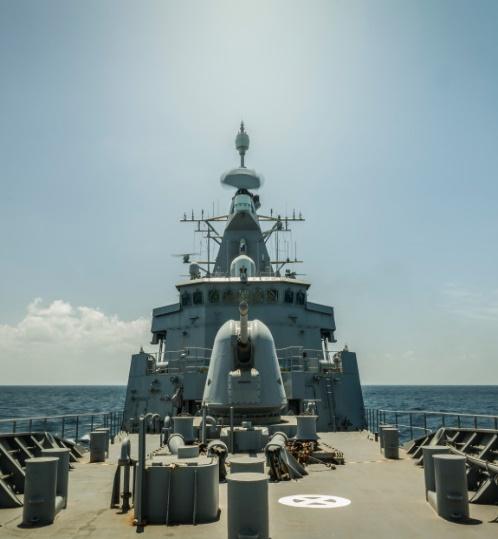
In this thesis, I will demonstrate that shifts in successive New Zealand government foreign and defence policies, along with corresponding changes to military doctrine, have fundamentally impacted the requirements for and design of the RNZN’s fleet. The lack of a concrete threat has resulted in a broad but shallow suite of military maritime capabilities, with the resulting navy organisation being highly vulnerable to shocks. I will frame this argument by exploring the evolution of Western naval forces since the early 1990s and identify themes that help explain the RNZN’s developmental pathway. I will then examine New Zealand’s history and geography to contextualise how successive Governments view the nation’s interests and explain how these have shaped foreign and security policies before exploring how these policies have been translated into the military eco-system to produce the naval force structure of today. Finally, I will examine the extent to which the RNZN is structured to meet the Government’s policy objectives before identifying areas of further potential research.
Two research methods aid in developing these arguments, discourse and empirical analysis. Primary and secondary sources of publicly available information form the basis of this research, underpinned by three focus areas. These focus areas include examining what the Government’s national interests are, understanding the expected role of the Navy in achieving those interests and, finally, the crux of this research, assessing the extent to which the Navy is structured to meet those interests.
Discourse analysis is the primary method for examining New Zealand’s national interests and the expected roles of the Navy. This method analyses text and the spoken word to derive meaning. While several approaches exist within the discipline, common principles exist across all approaches. These include the premise that communication is fundamental to human relationships, social action, or the construct of realities, is performed through discourse; and the interpretation of discourse is contextual to historical, social and cultural norms. The result of discourse analysis is groups of themes or illustrative points about a subject that presents a version of reality to the reader.10 Sources relevant to this research include policy statements, official speeches, strategic assessments, departmental strategic plans, doctrine, and relevant academic literature. A combination of discourse and empirical analysis methods form the basis for considering the final focus area, the extent to which the Navy is structured to meet the national interests. In contrast to discourse analysis which includes elements of subjectivity, empirical analysis focuses on the observation and measurement of actual events. Annual Departmental performance reports to the Government will provide the primary source for empirical research, supported by the discourse of professional journal articles, media releases, and relevant academic literature.
Chapter 2: Evolving Maritime Strategies post-Cold War
The evolution of maritime strategy offered by Buddy Suseto et al. provides an important point of reference in their observation of a turning point in modern naval forces with the demise of the Soviet threat at the end of the Cold War. Suseto et al. observe, in the case of the US, that policymakers almost immediately reduced the size of the US fleet but ‘...without a corresponding reduction of the nation’s overseas obligation’.11 This change was similarly observed by Jeremy Stöhs when analysing the impact of geostrategic events on European naval power. He observes that changing threat perceptions arising from several events, including the end of the Cold War, changed the balance of military investment away from the costly naval forces required for sea control towards less expensive patrol and force projection capabilities.12 Stöhs argues that this geostrategic shift also changed the narrow focus of many navies from direct conflict to engaging in a broader range of activities, including non-traditional security matters, diplomacy, humanitarian aid, and disaster relief.13 Two themes quickly emerge — the desire for US and European countries to capitalise on the post-Cold War peace dividend and the reshaping of naval forces to find purpose, including pivoting towards new and non-traditional security threats. Stöhs goes on to argue that since the decline in investment, many navies have performed well in low-end operations in mostly permissive environments but with great power competition reemerging, many European powers have lost the ability to maintain order at sea through traditional concepts of deterrence and sea control.14
The decisions of US and European policymakers were similarly observed in New Zealand, as Derek Quigley demonstrated in his examination of New Zealand’s Defence Policy Framework Statement of June 2000. Due to the changing strategic environment, the policy framework envisaged the need for a land force supported by naval and air forces working as part of a collective security arrangement for peace support rather than peace enforcement. As a result, small countries, such as New Zealand, would not be expected to maintain a full range of military capabilities. He further reflected that it would not be in New Zealand’s interests to invest in capabilities that could not maintain operational standards.15 This assessment is an important observation in policy development. The NZDF’s Future Joint Operating Concept 2040, issued 20 years later, draws similar conclusions, albeit for different reasons. The Concept recognises that in the absence of a direct military threat, military forces are involved in a broader range of non-traditional security roles and argues that without a unifying military problem, it risks expending effort, ‘...too thin to achieve good outcomes, and force design may be mismatched to what needs doing.’16 João Correia reinforces this argument while examining capability-based planning systems, warning that the more ambiguous the concept, the more subjective the solutions derived from the capability planning process become, and suggests there is a greater likelihood that militaries will be ill-prepared for the future.17 In practical terms, Correia identifies that military planners are more likely to bias their plans and advice towards capabilities they are familiar with when presented with vague concepts or scenarios. Furthermore, and of particular relevance to New Zealand, Correia observes a fundamental difference in capability planning imperatives between great and small powers. He observes that small powers who regularly interact with great powers, primarily through alliances or collective security arrangements, often fall into the trap of viewing the world through a great power lens and act as great powers themselves. Small nations then struggle to deliver capabilities and have a tendency, at least at the political level, to communicate capabilities that do not exist.18
The RNZN’s Maritime Doctrine provides valuable insights for considering the link between current Government policy objectives and the expectations of its Navy. The doctrine prescribes three tenets underpinning the delivery of maritime capabilities, of which combined, joint and integrated approaches to warfighting are deemed critical to operational success within all-of-government responses to security events.19 Conventional wisdom dictates that high-end warfighting capabilities are the foundation for enabling joint and multi-agency operations, regardless of the demand or likelihood of using these skills. It infers that a wide range of capabilities must be maintained as the demand for maritime capabilities grows across the many branches of Government. This is reflected in Steven Paget’s analysis of the RNZN soon after the release of the Defence White Paper 2016.20 In his assessment of the size and capability of the fleet against its suitability to undertake expected tasks and its ability to integrate with close partners, Paget concluded that the RNZN is effective in filling a wide range of tasks. However, it is stretched, and expectations of the Navy are misaligned with the shape of the fleet. This conclusion is similar to that reached by Stöhs regarding European navies and illustrates the risks reflected in the NZDF’s Future Joint Operating Concept 2040 and the work undertaken by Correia. Andrew Watts has considered the RNZN's challenges in maintaining naval capability into the future. While the purpose of his article is to discuss strategies for addressing the future needs of the Navy, his opening remarks imply some criticism of the current shape of the fleet. He claims,‘...many would argue it [the fleet] is already diverse beyond the point of sustainability’,21 which reinforces Correia’s observations regarding small nations' capability development traps. Media reports of staff shortages impacting fleet availability also support this view.22
Reviewing policy documents, assessments, and academic analysis reveals common themes concerning the challenges of maintaining naval forces relevant to this argument. With the desire to capitalise on the post-Cold War peace dividend and no unified peer or near-peer naval threat, many Western nations needed to reevaluate the requirement to invest in capital-intensive naval capabilities. The search for new problems saw an orientation towards low-level, out-of-area operations, mainly in permissive environments and bent towards a wide range of non-traditional security issues. The appropriate capabilities required to respond to the range of possible traditional and non-traditional security contingencies have grown to meet the increasingly complex joint and inter-agency operating concepts and the growing demands of successive governments. Despite the NZDF recognising force design and capability planning risks, great power biases influence military thinking, especially role conception, which can create an environment where government policy objectives do not translate well to force design.
Chapter 3: What is in the National Interest?
Geographically, New Zealand is a large remote Polynesian island nation in the South West Pacific, with its nearest neighbour over 1,000km away. It has a small economy when compared to other developed nations, which is largely fuelled by agricultural exports.23 As a constitutional monarchy with a parliamentary government, elections in New Zealand are held every three years through a mixed-member proportional (MMP) electoral system. This system makes it unlikely that a single Party will govern alone.24 David McCraw’s analysis of the two dominant parties’ policies demonstrates that historically the National Party has tended towards a more realist approach to foreign policy, emphasising the need to maintain relationships with great power allies for security and economic well-being, while the Labour Party has been reformist and demonstrates a strong commitment to internationalist ideas.25 Since 1976 major Parties have governed in six to nine-year cycles, each supported by one or more minor Parties since the introduction of MMP.26
When considering New Zealand in its South Pacific neighbourhood, it is reasonable to see it as a middle power, second only in national power to Australia when assessed against Lowy Institute’s Asia Power Index.27 However, in the context of the wider Indo-Pacific Region, it is appropriate to consider New Zealand’s foreign policy from the perspective of a small state. Characteristics generally inherent in foreign policy among such states include limited policy objectives and low engagement in world affairs, but with a strong focus on trade and a heavy reliance on international institutions, and policy issues tend to have a strong moral or ethical basis.28 In 1980 New Zealand’s prime minister, Robert Muldoon, perhaps overplayed these characteristics when he famously quipped, ‘Our foreign policy is trade. We are not interested in other foreign policy matters to any great extent…’.29 However, by the early 2000s, New Zealand’s foreign policy was heavily influenced by Helen Clark’s Labour Government. Her nine-year tenure as Prime Minister provided the opportunity to significantly reorient New Zealand’s foreign policy towards the Party’s liberal internationalist ideology.30 Despite a return to a conservative government in 2008, New Zealand’s foreign policy settings remained arguably largely unchanged.31
Government officials frequently use the term national interest to convey the importance of an issue. But, their statements are often vague and lack a causal explanation between the issue and the ‘national interest’. It, therefore, becomes difficult to define what interests are. Donald Nuechterlein offers a simple definition of the national interest as ‘…the perceived needs and desires of one sovereign state in relation to other foreign states comprising the external environment.’32 He argues that four basic national interests form the foundation of a State’s foreign policy.
These concern the security of the State and its people, enhancing the economic well-being of the State in relation to others, the importance of maintaining international order in political and economic systems, and an ideological component reflecting the values of the State.33 This argument bares out in New Zealand’s case, where the briefing to the incoming Minister of Foreign Affairs and Trade, Nanaia Mahuta, in 2020 describes the role of the Minister and her department as ‘...protect enduring national interests…’, before describing these as the international rules-based order, a security environment that keeps New Zealanders safe, international connections that enables prosperity, and global action in sustainability issues.34 The Foreign Minister’s inaugural speech to the Diplomatic Corp in February 2021 reinforced these interests with two important additions, the first being to include ...promoting regional stability…’ to the security interest.35 The second was to include references to indigenous peoples in the concept of New Zealand's national interests. In the 20-minute speech, the Minister referred to trade and prosperity 28 times and indigenous populations 10 times, ahead of climate change, which she mentioned seven times. This is an interesting observation in that the Prime Minister at the time campaigned on climate change action in her 2017 election victory,36 and is illustrative of Nuechterlein’s argument that, although there are foundational interests, the priority afforded to these are influenced by leaders’ ‘intensity of interest’.37 Security, as a national interest, was mentioned but four times during Mahuta’s address, and only regarding the importance of maintaining relationships with Australia and the US, but most significantly, partnerships and relationships were mentioned 48 times.
The tone and emphasis of Mahuta’s discourse support the assertions made by Small State Theorists that small-state foreign policy will strongly emphasise trade and place a heavy reliance on institutions and multilateralism. The low intensity of interest in security reflects New Zealand’s Defence Policy, where successive White Papers have largely dismissed the threat of direct military attack,38 and Strategic Assessments have placed greater emphasis on risks arising from the cyber-domain and non-traditional security challenges.39 Still, it is worthy of analysing Mahuta’s speech in June 2023 concerning ‘...New Zealand’s Place in a Troubled World…’, where the focus of this discourse is firmly on the risks of geostrategic competition.40 In a similar length speech to that previously cited, keywords carry a similar weighting with matters concerning relationships, partnerships, and multilateralism dominating the narrative. These are followed by economic, trade and prosperity keywords, with issues of human rights, climate change, and security rating less than a dozen mentions each. However, Mahuta's emphasis on maintaining an independent foreign policy differs greatly from her previous speech. She emphasises that the current environment does not require binary choices — perhaps a veiled rejection of George W. Bush’s ‘either you are with us, or you are with the terrorists’ ultimatum41 — and claims that a shared value system is not a prerequisite for constructive engagement. The Prime Minister’s foreign policy speech to the New Zealand Institute of International Affairs on 7 July 2023 reinforces the importance of maintaining principled independence, and in keeping with his National Party predecessor 43 years earlier, Prime Minster Chris Hipkins fell back on the importance of trade, stating, ‘In foreign policy terms, it means making sure that we have greater economic resilience across our trade markets…’. Hipkins continued to stress the importance of relationships, arguing that ‘...relationships [are] key to our economic prosperity, [and] enhancing our national security…’,42 a logic that is in keeping with the long-held internationalist view that a country cannot become more secure by making others less secure — the antithesis of the security dilemma.43
The term ‘national interest’ can be an overused cliche amongst government officials and is rarely explicitly defined in policy. Yet national interests and values are critical in shaping foreign policy. New Zealand’s national interests are communicated through political discourse. A closer analysis of recent speeches by senior politicians demonstrates that matters concerning international relationships, multilateralism, and economic prosperity are of high importance to New Zealand’s national interest. Issues concerning climate change and security remain relevant but of lesser importance. New Zealand’s sovereignty is not addressed directly as a national interest; however, it may be inferred by emphasising the importance of principled independence in international engagements and decision-making. The breadth of national interests is rapidly growing, and Hipkins acknowledges New Zealand cannot be passive, stating, ‘...we may be small, but we are not bystanders…New Zealand has a role to play, and a contribution to make in shaping the international environment…’,44 while Mahuta’s balancing statement warns, ‘...our capacity to engage can, at times, face real constraints…’.45 The division of responsibility across Government agencies for protecting these national interests is defined in policies and departmental objectives. For example, the Ministry of Foreign Affairs and Trade has seven goals, including leading New Zealand’s international action to protect the security and safety of New Zealanders,46 while NZDF’s objectives encompass community environmental well-being and resilience, securing the national lines of communication, contributing to maintaining the rules-based order and promoting strong international networks.47 The scope of these expectations grows when paired with ten all-encompassing roles, including defending, protecting, contributing and supporting New Zealand, its allies and partners geographically ranging from Antarctica across the Pacific to Asia and, more broadly, internationally. Finally, there is an enduring need to be prepared to respond.48 These expectations present challenges for all Government agencies. Changing levels in the ‘intensity of interest’ of political leaders on matters of national interest will likely increase in a world characterised by increasing complexity and uncertainty. Government agencies that enable and deliver the effects of national power must be agile, capable, and equipped to respond to changing demand signals. However, reinforcing Mahuta’s warning that ‘...Aotearoa cannot be "Everything Everywhere All At Once"...’49 will require political leaders to compromise and accept trade-offs, sometimes at the expense of other national interests.
Chapter 4: The Changing Shape of the Navy
Having established that security is one of four basic and enduring national interests, the previous Chapter showed how security strategies can vary greatly between political parties, as does the intensity of political leaders' interests when prioritising resources towards promoting and protecting national interests. This Chapter examines how Government security policies have been translated into the military eco-system, focusing on two defining periods in New Zealand's history: the 1985 Nuclear Free legislation and the 2000 institutional reforms of the NZDF. These political decisions have fundamentally impacted New Zealand's long-standing approach toward assuring its security interests and are instrumental in producing the naval force structure of today. It is useful to start this examination with Peter Mayall’s analysis of New Zealand geopolitics. Mayall uses Halford Mackinder’s influential framework to examine New Zealand’s security relationships, which he defines in three distinct phases: dependence, collective security and independent security. While this Chapter focuses mostly on the independent security phase, it is helpful to briefly examine the previous two phases as sources of influence on contemporary security thinking.
As a fledging British colony, New Zealand’s early security dependence was never in doubt. Through the 19th and much of the 20th centuries, New Zealand was part of the imperial defence network, a series of commercial and strategic relationships between Britain and its colonies, which assured both parties' security and economic interests.50 To demonstrate its commitment to Britain, New Zealand raised 6,500 volunteers to fight in the Boer War 1899-1902, a pattern repeated during the successive World Wars.51 Underpinning this arrangement was an assumption that both Britain and New Zealand's security interests were aligned and an expectation that Britain was a committed partner in the relationship.52
In the immediate aftermath of World War II, New Zealand’s engagement in the Asian region continued to be guided by British foreign policies, with New Zealand forming part of the British Commonwealth Occupation Force of Japan from 1946-1949,53 and the Malaya Emergency 1949-1960.54 It soon became evident that the security interests of New Zealand and Britain were less aligned than previously imagined, and Britain’s ability to act as a security guarantor, especially after the fall of Singapore during World War II, was in doubt.55 The Korean War allowed New Zealand to pursue a more reliable security partner. As a founding member of the United Nations, New Zealand entered the Korean War deploying six of the RNZN’s Loch Class frigates over three years to this conflict.56 This early commitment to the Korean War was rewarded in gaining the US as a security guarantor with the ANZUS Alliance Treaty being signed in 1951.57 Yet despite New Zealand shifting its great power alliance, New Zealand Prime Ministers continued to espouse the strong parent-child relationship with Britain, firstly during the Suez Crisis in 1956 when Sydney Holland said, ‘New Zealand goes and stands where the mother country goes and stands’, and reaffirmed as late as 1984 when Robert Muldoon claimed‘...in times of trouble we stand with our mother country’ concerning the Falklands War.58
This new dependency on the US would soon become a politically contentious matter among the New Zealand public. The security relationship was a major factor in New Zealand supporting the unpopular Vietnam War, along with the desire to develop closer economic relations with Australia as Britain sought membership in the European Economic Community,59 and at a similar time, the Government was becoming increasingly aware of the risks of atmospheric contamination from nuclear testing in the Pacific.60 Public opposition to this testing grew throughout the 1970s, driven by community-based campaigning and education initiatives raising the awareness of risks surrounding nuclear technology.61 In 1984 the New Zealand public voted for a Labour Government, which paved the way for New Zealand to become a nuclear-free State, and in February 1985, the USS Buchanan was denied entry to New Zealand based on the US Government’s refusal to confirm whether the conventional destroyer was carrying nuclear weapons.62 In response, the US cut all military ties, essentially expelling New Zealand from the ANZUS Alliance. For many across Australia and New Zealand, the Anzacs and Gallipoli are significant national memories that are credited with both countries' developing sense of national identity.63 I would, however, argue that the outcome of the USS Buchanan affair, although less glamorous, was the defining political event in New Zealand’s history where the country truly demonstrated principled independence in its foreign policy,64 and marked the transition away from nearly 200 years of security dependence on Great Powers.
For New Zealand’s navy, this transition to independence began earlier, at least on paper, with the formal establishment of the Royal New Zealand Navy in October 1941. While this signalled greater autonomy for the Navy and relations with the US strengthened in the post-war years, the RNZN was still very much influenced by the Royal Navy, with Britain remaining the source of supply for major combatants until the 1980s, providing officers and sailors to crew the fleet when necessary, and training New Zealand officers.65 After World War II, the fleet comprised a core of two cruisers and six frigates.66 It would retain this surface combatant focus, modernizing towards an anti-submarine warfare (ASW) fleet of frigates from the 1960s to meet the demands of the Cold War.67 By 1990 the RNZN comprised 15 ships, including a squadron of four Leander Class frigates, an underway replenishment ship, a hydrographic and research flotilla of four ships, two dive tenders, one of which primarily acted in a training capacity, and a four-ship patrol force crewed by Volunteer Reserve operating from New Zealand’s main port centres. The fleet was primarily designed for maritime interdiction and sea control operations supporting the Cold War deterrence strategy.68 The frigate squadron, supported by a replenishment ship, had the endurance to meet national and collective security obligations across the Pacific and Southeast Asia. The survey flotilla fulfilled national requirements for domestic and regional hydrographic cartography and oceanographic research, while the Volunteer Reserve controlled shipping, harbour defence, and mine countermeasures. From this point, a slow evolution in force structure began.
New Zealand’s exile from the ANZUS Alliance and newfound independence forced the Government to adopt a more independent, self-reliant defence policy in the 1987 Defence White Paper. The first test of the Government’s new independent policy stance arose immediately with the need to replace the Navy’s ageing Leander Class frigates. Australia presented a proposal to build future combatants, and in 1988 the Government agreed to purchase two ships, later designated the Anzac Class. The debate over whether New Zealand should purchase up to four ships to provide a direct replacement for the existing fleet continued for the next decade before a newly elected Labour Government would confirm only two ships would be purchased.69 Seeking to capitalise on the peace dividend, successive National Governments sought to curb spending on defence. The 1991 Defence Review assessed the shape of the NZDF was broadly appropriate for the tasks expected; however, over the next seven years, Defence experienced a 19% reduction in funding.70 The 1997 Defence White Paper similarly confirmed Defence capabilities but argued the number of ships comprising the combat force was discretionary. It reduced the frigate fleet from four to three ships to balance the tension between desirability and affordability.71 This period of fiscal austerity shaped the fleet’s ageing hydrographic flotilla. The principal survey ship Monowai, two inshore survey craft Takapu and Tarapunga, and the research ship Tui were decommissioned and replaced by a single ex-US Navy ship, Resolution. Contributing to this decision was restructuring the Department of Survey and Land Information in 1996 to form Land Information New Zealand, which saw accountability for delivering hydrographic services transferred to this new entity. The RNZN remained a contracted survey data provider until 2012, but when the memorandum of understanding expired, the remaining hydrographic vessel, Resolution, retired from service.72
The next major shift in New Zealand’s Defence policy came with Helen Clark’s Labour Government election in 1999. The Defence Beyond 2000 inquiry was particularly influential in generating reform and strongly guided by the liberal internationalist ideals espoused by the Party. The report concluded there was no plausible threat to New Zealand’s sea lines of communication, and the NZDF should prioritise land forces supported by sea and air transport and patrol forces.73 The report successfully argued against the logic of further investing in maritime combat capabilities in the absence of a specific threat, and land forces would represent ‘a more conspicuous assertion of our identity…because of their closer involvement with the populations than naval or air combat units…’.74 The Review advocated for incorporating the NZDF into the wider government strategic planning apparatus, recognising that a whole-of-government approach led by preventive diplomacy better reflected the nation's means.75 This report initiated the Maritime Patrol Review, which further promoted multi-agency engagement and led to Project Protector, which would deliver a new suite of capabilities for the RNZN, including a sea lift ship, two long-range patrol vessels and a fleet of four smaller inshore patrol vessels.76 In 2001 the Prime Minister announced a restructure of the NZDF, including a joint approach to operations to improve coordination between the three Services.77 These significant reforms signalled a shift to a more integrated whole-of-government approach to national security and codified the links between policy, priorities and funding.
The National Party’s return to Government in 2009 resulted in the first Defence White Paper in over a decade, which espoused the continued importance of national security, the international rules-based order, strong networks and a strong global economy.78 The Paper predicted the tasks for the NZDF would remain largely unchanged from the previous 25 years; however, it did signal a likely increase in demand for the NZDF, pointing to rising fragility in the Pacific as a source.79 The White Paper was a status-quo paper focused more on the affordability of maintaining capabilities in the shadow of the global financial crisis (2007-2009). It asserted that the cost of maintaining high-end combat capabilities was beyond New Zealand’s means,80 and expected $100M to be freed up through organisational reform, with a further $250M-$300M to be realised annually from ‘value for money’ initiatives for front-line forces.81 In keeping with the previous Government’s approach to Defence, the Paper emphasised the need for mutually reinforcing capabilities delivered through joint operations that were responsive to whole-of-government needs.82 The only change signalled for the RNZN in this paper was the replacement of the survey ship and dive tender by a single vessel.83 But more importantly, in the wake of this White Paper, the NZDF embraced joint operations by releasing the NZDF’s Future Joint Operating Concept 2035. This concept envisaged the development of a joint task force based on an amphibious capability.84 It did not require significant capital investment. Rather the concept used amphibious operations as a means of forcing the single Services to operate in a more integrated way. The Defence White Paper 2016 introduced only one new element for the RNZN to consider (Antarctica), which some frustrated Australian commentators described as New Zealand’s ‘Look South’ policy.85 The White Paper emphasised the growing importance of Antarctica and signalled the replacement of the aging fleet replenishment ship Endeavour, with a new ice-capable logistic support ship, along with a long-range southern ocean patrol vessel.86
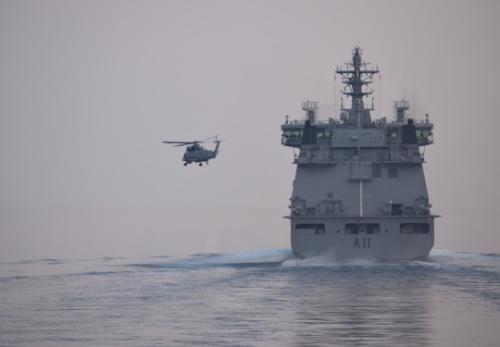
Today, the RNZN maintains a fleet of nine surface ships, augmented by small watercraft and shore-based operational units. Two Anzac Class frigates, Te Kaha and Te Mana deliver the Navy’s combat capability, each fitted with modern weapons and sensor systems and augmented with the RNZAF’s Kaman Super Seaprite SH-2G(I) helicopter. Patrol capabilities are delivered through Otago and Wellington Protector Class long-range offshore patrol vessels (capable of embarking helicopters), and two Lake Class patrol vessels, Taupo and Hawea, for domestic and inter-Agency tasks. Canterbury provides specialist sealift capability, which can deliver logistics over the shore in austere environments using the ship’s landing craft or embarked helicopters, including the NH-90 medium-lift utility helicopters. Aotearoa provides at-sea replenishment and is capable of operating in Antarctic waters. The shore-based Unit Matataua provides diving, salvage, and hydrographic survey capabilities delivered most effectively through the specialist ship Manawanui, although not exclusively.87 This fleet is balanced to meet the range of tasks the Government requires, ranging from Antarctica to the equator and responding to low-threat non-traditional security events, through to operating with coalition forces engaged in higher-intensity operations. The component capabilities deliver a versatile amphibious capability appropriate for the Pacific.
The release of New Zealand’s first comprehensive maritime security strategy in 2020 illustrates how successive Governments have responded to the more demanding geopolitical environment and increased frequency of non-traditional security events.88 The strategy assigns roles and responsibilities to departments across a matrix spanning three delivery functions of policy/strategy, intelligence and operations, against 20 areas of interest or threats. The NZDF is assigned a lead role in only three of the 60 potential areas of responsibility and supports a further 33 areas.89 Consistent with military approaches to operations, the strategy is structured to deliver effects comprising understanding, engaging, preventing and responding to threats — collectively, emphasising deterrence.90 Comparing this concept to Australia’s Defence Security Review, which emphasises a hard military approach to deterrence by denial,91 it is clear both countries focus on different threats. New Zealand’s approach emphasises gathering evidence of illegal activity to seek prosecution through international legal mechanisms or diplomatic solutions. The Strategy highlights that Agencies need the right tools to deliver the required effects. Capabilities need to be available at short notice for tasking, be able to cope with the maritime environment and carry out enforcement operations, but also balanced so the proper response is engaged appropriately for the situation.92 Most notably, the NZDF is not the lead agency in delivering New Zealand’s maritime security strategy but is an essential operational enabler.
New Zealand’s national interests have mostly remained unchanged, and similarly, since the end of the Cold War, New Zealand’s strategic appreciation has varied little. However, the method in which New Zealand approaches its security requirements has evolved from a realist-centred dependence on a Great Power security guarantor to a liberal-internationalist view of self-reliance in partnership. New Zealand’s newfound independence in 1985 provided greater autonomy to shape and scale its Defence Force to meet the nation’s interests. It offered greater licence to pursue its own security agenda, resulting in a force that meets New Zealand’s national security interests while being mindful of the need to contribute to collective security arrangements meaningfully. New Zealand’s geographic location means the RNZN has always been a blue water expeditionary war-fighting service,93 but affordability has been a key driver in shaping security capabilities. The more balanced approach to security from the 2000s, emphasising joint and inter-agency cooperation, has seen the RNZN’s core capabilities shift from a single Service emphasis on sea control to joint force projection based on an amphibious core. The challenge for the RNZN is that, despite reducing the number of platforms, the range of capabilities required to deliver this effect increases. At the same time, the emphasis on inter-agency cooperation has seen the demands from those Agencies increase significantly.
Chapter 5: Perfectly Formed or a Hot Mess?
The previous Chapter demonstrated how New Zealand’s defence strategy has evolved from great power dependency towards self-reliance in partnership, emphasising a whole-of-government approach to maritime security. With this change, the RNZN’s parallel journey has gone from a sea control force towards a more balanced Navy with blue-water force projection capabilities, following the pattern of many European nations that Stöhs observed after the Cold War. This Chapter examines the extent to which the RNZN, as an instrument of national power, is structured to meet the Government’s policy objectives. The roles the Navy is expected to perform are defined more fully, and examined from two perspectives — that of force structure (the ships it possesses) and the NZDF’s operating model (how the force is used). The NZDF’s formal reporting to the Government provides the evidence for this analysis. I acknowledge these reports tend to accentuate the positive, as does community engagement literature produced by the organisation.
This bias is balanced through media reporting and think-thank assessments, which tend to be more critical, emphasising vulnerabilities or system failures. These sources do have a tendency to be issues-focused, or limited in scope such as assessing the qualities of particular systems and platforms, without considering the integrated capabilities across the NZDF that generate military effects. However, together, these sources provide a balanced evidential basis from which to conduct the assessment.
Government objectives and expectations are defined at the NZDF level and broadly grouped into roles associated with community, national, and global environments. These roles and objectives are wide-ranging, beginning with defending New Zealand’s sovereignty and territory and protecting critical lines of communication. These broaden to encompass peace and security objectives across the South Pacific (including leading initiatives when and where necessary), making a credible contribution to the Asia-Pacific region and contributing to international peace and security and the international rules-based order. Added to these significant obligations is the need to contribute to national and community well-being, support other Agencies in the Southern Ocean and Antarctica, and work with other Agencies to understand New Zealand’s strategic environment. Finally, there is the need to be prepared to respond to sudden shifts in the strategic environment.94 These expansive requirements are translated in the RNZN’s Maritime Doctrine through interrelated and interdependent roles encompassing safety and assistance, constabulary, diplomacy, and combat both at and from the sea.95 All of this is underpinned by 16 functional capabilities necessary to undertake and deliver these roles.96 Annual reporting to the Government describes how the RNZN has fulfilled these roles.
The following examples illustrate the range of activities undertaken by the navy, beginning with the newest maritime capability in Antarctica. The RNZN’s newest ship Aotearoa supported the Antarctic mission resupplying fuel in 2022,97 and a year prior hydrographic surveyors from Matataua deployed to support the Scott Base redevelopment project.98 At the other end of the spectrum, supporting international peace and security, the RNZN commanded maritime security operations in the Arabian Gulf during 2021.99 The navy engaged with partners to enhance interoperability, with Te Kaha and Matataua attending Exercise RIMPAC 2019,100 and Manawanui participating in 2021 during the height of the COVID-19 pandemic.101 Regionally, the Lake Class inshore patrol vessel Hawea deployed for six months to support Fiji’s maritime and fisheries security during 2017.102 Support to the Pacific continues with Taupo conducting a similar mission to Samoa in 2023.103 The RNZN responded as part of a joint task force to significant national and regional emergencies, including the Hunga Tonga-Ha’apai volcanic eruption described in the introduction and the Kaikoura Earthquake 2017. In the latter case, Te Kaha commanded an international maritime response, comprising US, Canadian and Australian ships working alongside Canterbury and Wellington.104 Articles in the RNZN’s official magazine attest to the wide range of missions the RNZN fulfils, including supporting Agency tasks at Raoul Island and the sub-Antarctic Islands, Pacific fisheries patrols and cultural exchanges with both Fijian and US military partners.105
These individual stories demonstrate the breadth of RNZN activities that meet wider national interests. However, these ‘snapshots’ are merely feel-good public relations stories, rather than being robust critical assessments of the Navy’s operational capabilities or capacity. Scholarly assessments are more sobering. Steven Paget’s analysis of the RNZN in 2016 concluded that while it was effective in filling a wide range of tasks, it was over-stretched, and expectations were misaligned with the shape of the fleet.106
Similarly, the NZDF’s Concepts warn that as militaries become involved in a broader range of non-traditional security roles, they risk expending effort, ‘...too thin to achieve good outcomes, and force design may be mismatched to what needs doing.’107 Between 1990-2023, the fleet shrank from 15 ships required to perform a limited range of naval tasks to nine ships, while still being required to operate across a wide spectrum of joint and inter-Agency operations. In other words, the RNZN of 2023 represents a trade-off in capability depth for breadth. The impact of this is evident when analysed across Annual Reports, with Table 1 demonstrating significant capability gaps over time, that are generally linked to platform replacement programmes or major capability upgrades.
Reporting Period | Naval Combat | Projection & Sustainment | Shipping | Patrol | |||
|---|---|---|---|---|---|---|---|
Warfare | Security | Sea Lift | Replenish | Littoral | |||
2010 | ✓ | ✓ | ● | ✓ | ● | No reporting | ● |
2011 | ✓ | ✓ | ● | ● | ✓ | ✓ | |
2012 | ✓ | ✓ | ✓ | ✓ | ✓ | ● | |
2013 | ✓ | ✓ | ● | ✓ | ✓ | ● | |
2014 | ● | ● | ✓ | ✖ | ✓ | ● | |
2015 | ✓ | ✓ | ✓ | ✖ | ✓ | ✓ | No reporting |
2016 | ✓ | ✓ | ✓ | ✓ | ✓ | ✓ | |
2017 | ✓ | ✓ | ✓ | ✓ | ● | ✓ | |
2018 | ● | ● | ✓ | ✖ | ● | ✓ | ✓ |
2019 | ● | ● | ✓ | ✖ | ● | ✓ | ● |
2020 | ✖ | ✖ | ✓ | ✖ | ● | ✓ | ✓ |
2021 | ✖ | ✖ | ✓ | ✓ | ✓ | ✓ | ● |
2022 | ● | ● | ✓ | ✓ | ✓ | ✓ | ● |
✓ Fully met (>90%)
● Partially met (<90%)
✖ No capability (0%)
Table 1: RNZN Output Delivery 2010-2022108
The most evident is the lack of combat force for two years (2020-2021) due to the frigate system upgrades,109 while patrol capabilities frequently suffer due to shortages of skilled staff who are prioritised towards operating higher-value platforms. It must be noted that a reported result of ‘fully met’ does not mean a capability is available for the full reporting period, in this case, a financial year.
Rather it indicates that the capability was available for the period planned. While all ships possess common capabilities, each Class has unique attributes or specialist functions. The naval combat and patrol outputs (domestic and regional) benefit from having two platforms that offer some redundancy. The specialist capabilities inherent in the remaining ships are unique to single platforms. Thus, if Canterbury is undergoing major maintenance, whether planned or not, the RNZN has no practical sea lift or amphibious capability of scale.
This is further illustrated by the availability of each ship. Until 2014, RNZN outputs were reported to the Government by the number of days ships were available for tasks (mission available) and the days ships spent at sea. This ceased being reported publicly in 2015, but data between 2010-2014 provides a useful insight into the fleet’s actual availability, as illustrated in Table 2.
| Ships in Class | Availability | Sea Days | Days Deployed |
|---|---|---|---|
| One | ≈50% | ≈30% | 94–123 days deployed |
| Two | ≈100% | ≈60% | 200–230 days deployed |
| Four | ≈200% | ≈100% | 361 days deployed |
While individual ship utilisation can be highly variable and the source data is dated, it is representative of the normal operating tempo of the RNZN over five years. The data demonstrates a single ship will typically be mission available for six months of the annual cycle and, although available, will only be tasked for four months of the year, spending between 94-123 days at sea. Where two ships exist within a Class, the Government is more assured the capabilities derived from the platforms are available all year, while planned tasking between the two platforms will amount to seven months of operations. Against the total Fleet however, this would suggest that three ships are available for tasking or re-tasking if already employed, at any one time, and therefore it is plausible that media reporting of ‘A third of the fleet tied up’, although true, may simply be remarking upon the Fleet’s normal operating availability.111
The core issue is the erosion of fleet size in general, as financial efficiencies have been sought by successive Governments. Indeed, the NZDF has reported sustainability issues to the Government stating, ‘...the two frigate paradigm does not provide enough reliable training capacity to sustain critical training capabilities. Significant deficiencies in trained and experienced personnel exist across the Naval Combat Force and wider Naval System...’112 A practical example of this deficiency was highlighted in Ben Felton’s blog in Naval News where he reported the anticipation surrounding Te Mana’s scheduled surface-to-air missile firing in Australia in late 2023. Notably, it is the first missile firing to be conducted in 11 years.113
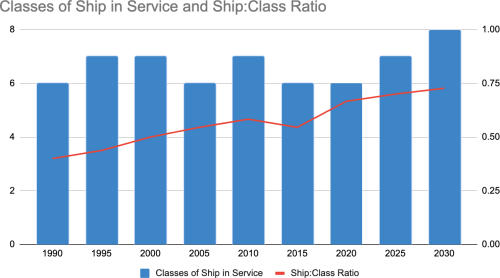
The current Fleet comprises six Classes across the nine ships, and with plans to acquire a Southern Ocean Patrol Vessel and an additional logistics ship with a docking capability, this issue compounds further.114 Efficiencies can be gained through commonality across a fleet of vessels or even a Class of ship used by a number of countries. These efficiencies are often couched in terms of lower costs delivered through construction, reduced training overheads, and improved material costs through achieving better economies of scale.115 Indeed, this was the concept underpinning the Anzac Class, and some equipment commonality across Project Protector (Canterbury, Wellington, Otago, Taupo and Hawea). However, New Zealand’s frigate systems upgrade adopted a different through-life development path to Australia, so the commonality between national variants is minimal. This pattern of growing diversification remains evident in the more recent acquisition of a dive and hydrographic vessel. A key risk highlighted to the Ministers of Finance and Defence concerned challenges around acquiring and maintaining qualified people to operate the ship’s unique dynamic positioning system.116 Figure 4 illustrates the ratio between the number of ships comprising the RNZN fleet and the number of Classes, projected against current acquisition plans to 2030.
A higher ratio represents less commonality, which is arguably less efficient and less resilient. This observation lends credibility to Andrew Watts reflecting criticism of the current shape of the fleet when he stated, ‘...many would argue it is already diverse beyond the point of sustainability’.117
Diversity across the fleet is relevant when considering staffing, often cited as a critical vulnerability and the subject of more intense media reporting. This phenomenon is not new with the Chief of Navy reporting a 20% shortfall in technical staff in 1973 when recruiting challenges resulted in dissatisfaction among more experienced engineers who were required to stay at sea longer.118 In 1978, the frigate Taranaki was tied up due to these critical staff shortages.119 A decade later, the RNZN was trying to recruit retired officers and sailors from Australia and Britain in the face of strong commercial sector competition for skilled staff that drove attrition up to 23%.120 Soon after, two patrol craft were tied up due to a shortage of skilled bridge staff.121 This pattern repeated in 2012 in the aftermath of the Defence Transformation Programme, resulting in two Lake Class inshore patrol vessels being tied before eventually being sold.122 And in 2022, the Chief of Defence Force reaffirmed challenges with staffing, citing a 16.5% attrition rate contributed to a third of the Navy’s fleet being tied up indefinitely.123 At the same time, Wellington returned from Pacific fisheries patrols a month early to help manage this attrition.124 People are a critical component in delivering Navy capabilities. Still, issues in training new staff may be compounded by the high overhead associated with the diverse range of ships and roles the Navy is expected to undertake, resulting in a longer recovery time.
Some of these challenges are mitigated by changes to how the NZDF operates. With the Government’s restructuring of the NZDF to operate in a more integrated way, the funding and activity reporting system also changed, being formally codified into the NZDF’s output framework in 2015.125 This change resulted in the Chief of Navy no longer having responsibility for executing naval operations but only retaining accountability for preparing naval capabilities for joint operations within prescribed periods of notice. The logistic ship Canterbury, for example, has particular utility during the Pacific’s high-risk weather season, so the navy focuses on Canterbury’s mission readiness for this period. Operational execution is vested in the Commander Joint Forces New Zealand, with mission-ready forces assigned from the Services.126 This is explained in the Report by the Expert Review Group, which highlights the ‘Could we? Should we? Will we?’ process.127 The Commander Joint Forces New Zealand has considerable flexibility in developing a range of options with the force elements available (what could we do?). A more politically nuanced view considers and advises on wider implications of each option (what should we do?), before the Government provides direction on and authorises using military forces (what we will do?). Designing military responses is seldom contingent on organic NZDF capabilities alone.128 Options may range from delaying action as specialist force elements become mission-ready, seeking support from other government agencies, allies and partner nations, or seeking commercial solutions for specific capabilities or additional capacity. While operational domains such as ‘the maritime domain’ mostly remain the purview of the Navy,129 the increased emphasis on joint operations has resulted in an increasing number of joint functions being realised, such as intelligence and information. Commanders can combine similar functions from across the Services to achieve the mission, with this matrix approach spanning domains and functions, offering greater flexibility in accessing and applying specific capabilities.130 There remains a suite of conventional solutions for domain-specific problems recorded in doctrine. However, this joint approach allows more innovative solutions to be explored than may otherwise be derived from traditional single-Service models. As a result, Government objectives are less likely to fail based on the availability of a single asset. The effectiveness of this approach at an NZDF-wide level is reflected in annual agency satisfaction ratings, which have been reported annually since 2014. Notably, since data was collected in a comprehensive form, the number of agencies has risen from just seven to 22, reflecting the increased demands being placed on the NZDF, yet with annual satisfaction ratings generally 80% or greater.
As an instrument of national power, it is evident that the Navy is structured to meet Government objectives, as reflected in the annual agency feedback. The range of operations conducted is diverse and often planned far in advance. Still, the RNZN has also demonstrated agility in responding to crises as part of a joint task force when necessary. It is equipped to deliver against expectations, but this versatility is only paper-thin. The concentration of capabilities — such as sea lift, underway replenishment, and to a lesser extent, littoral operations — into single assets means that the navy’s ability to perform such core duties is too exposed to the vagaries of maintenance and training schedules, equipment reliability and an increasingly transient and diverse workforce. The fact that the RNZN has had only partial or no combat capability for the last five years and no underway replenishment capability for a similar period illustrates these vulnerabilities. While current capability plans intend to increase the depth of sea lift and Southern Ocean patrol, this will likely generate greater demands on an already stretched workforce. A considerable portion of the RNZN activities support other government agencies. This is evident both in the Maritime Security Strategy, where the NZDF supports 33 of the 60 work areas and the increase in agencies the NZDF sees as key customers. The Defence Annual Report 2012 introduces the NZDF as, ‘…the only agency that maintains disciplined forces available at short notice and that operates largescale and integrated fleets of vehicles, ships, and aircraft.’.131 With the Government’s stated desire to incorporate the NZDF into the wider strategic security architecture in 2000 and the more deliberate emphasis on joint and inter-agency operations from 2010, this demand is unsurprising in the absence of a direct military threat.
Chapter 6: Investing in Resilience
In 2013, the NZDF formally engaged with industry seeking information to support the replacement of the Navy’s ageing diver tender vessel. Despite eventually acquiring and modifying an existing commercial vessel, the operational release of the new ship was not planned until 2022, nine years after the programme was initiated.132 This example illustrates a challenge in delivering maritime capability: a relatively simple of-the-shelf asset procurement spanned three different Governments. Procurement is a lengthy process, spanning multiple political cycles and with limited ability to adapt to evolving geopolitical environments. This challenge is succinctly described by the Chief of Defence Force, arguing that ‘successive governments have had “too short a timeframe” on defence issues, focusing on wins they can score within three-year terms….we’ve got to look 10, 20, 30 years ahead’.133
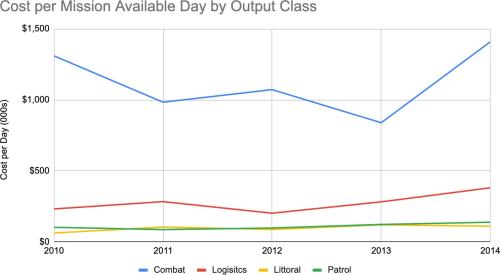
In addition to this short-term focus, there is also a need to critically challenge long-standing assumptions about the force structure, for example, the need to operate at the high end of the maritime warfare spectrum. It is worth considering the opportunity cost of maintaining the ability to respond at this level and, more fundamentally, asking whether this capability aligns with the Government’s security philosophy. Pre-2015 Defence Reporting to Government offers insight into the cost of each maritime function. Output Expense 2 Naval Combat Force is described as ‘The provision of HMNZ Ships Te Kaha and Te Mana prepared to conduct maritime operations…’134 The RNZN’s Maritime Doctrine provides a fuller description of what the naval combat force functions include.135 And the cost of maintaining this capability is expensive. Figure 5 shows the per diem cost is notably higher for the naval combat force than for other functions, averaging $1.1M per mission available day over five years, as opposed to the Patrol force, which was less than 10% of that cost. Similarly, if every ship in Service in 2023 were put to sea with a full crew, the combat force would account for over 50% of the demand on people. This analysis is conducted purely to illustrate the resource burden of different capabilities, and, albeit in a superficial sense, this suggests the opportunity cost of an additional frigate may be as high as the sum of all other naval capabilities combined.
Given the evidence of significant capability gaps, the training challenges identified in sustaining a two-frigate combat force, and the relative costs against other naval capabilities, the current investment or approach to maintaining a combat force is questionable. Even the expectations of naval practitioners in doctrine writing differ from what Government officials use. The capability of the Anzac Class frigate, for example, is described in the Navy’s Doctrine as ‘...allow[ing] them to operate in medium to high threat situations…’,137 whereas the Ministry of Defence describes the frigate systems upgrade as offering ‘...confidence in low to medium-threat environments…’.138 On paper, this appears a minor difference - at best a typographical error or an oversight in preparing a business case. Depending on the threat definitions in use, this difference could be significant, or even a subtle erosion of capability, and the manifestation of the Government’s reluctance to invest in maintaining a high-end maritime warfighting capability. The fragility of the combat force described in this analysis supports João Correia’s observation that small powers that interact with great powers fall into the trap of viewing the world through a great power lens and struggle to deliver capabilities. Further justification for reinstating the combat capability of the Anzac Class rests in ‘providing a physical demonstration of New Zealand’s commitment to regional and global security.’139 This raises the question of whether a nation’s interest in preserving global security translates to a need for global military reach.
Since New Zealand adopted an independent foreign policy, a pattern has emerged of successive governments reforming and then refining the force structures that enable the NZDF to meet its objectives. These have included investment decisions regarding capabilities, how the organisation operates internally, and how well it integrates with the wider government security architecture. Underlying national interests have not changed. However, the Nation has developed its unique security philosophy, arguably influenced by geographic isolation and the absence of direct military threats. This philosophy embraces the liberal internationalist view that security is a product of maintaining positive international relationships and economic interdependence rather than derived from protectionist policies and strong military forces. This is borne out in the discourse of senior political leaders who focus on multilateralism, and economic prosperity, underscored by New Zealand retaining its principled independence. This evolution has seen New Zealand's approach to conflict shift from needing to prove its allegiance to a great power security guarantor by committing troops to war to an approach that focuses on conflict management and post-conflict reconstruction legitimised through the United Nations.140 These factors have strongly influenced the shape of New Zealand’s military, but the lower priority that successive Governments have placed on military power as a tool for assuring traditional national security has seen these forces atrophy over time. The RNZN is designed to deliver a wide range of capabilities appropriate for the region — a blue continent with low military threat and an increasing frequency of non-traditional security issues or, in other words, the most likely scenario. It is not designed for the most dangerous scenario. From a capability perspective, the RNZN has the makings of an agile force through its balanced force structure, but from a resource perspective, it is unduly weighted towards a modern combat capability offering little more than a pretence at delivering the high-end warfighting capability expected by great powers. This has resulted in a fragile navy with too few ships that would have difficulty in managing multiple concurrent challenges.141 Even the Chief of Defence Force has conceded the NZDF would struggle to maintain a peacekeeping presence in the Pacific Region.142
The NZDF is not new to organisational reforms that challenge underlying military traditions and assumptions. Indeed, one of the tenets that guide the employment of the Navy rests with encouraging ‘commanders to seize the initiative and gain an advantage by adopting unorthodox or imaginative courses of action as opportunities arise.’143 How could the RNZN reimagine New Zealand’s contribution to regional security, beginning with the premise of New Zealand’s role in maintaining the international rules-based order? China’s destabilising behaviours in the Region have been the subject of significant scrutiny in recent times. The influence of China has been recognised in New Zealand’s Defence Policy and Strategy Statement 2023,144 although not in the same alarmist terms described by many media and think-tank commentators. New Zealand’s relationship with China is significant, and future cooperation will be essential in addressing future challenges, yet there is no denying increasing strategic competition across the Indo-Pacific Region. During the release of New Zealand’s first National Security Strategy, Minister of Defence Hon Andrew Little stated, ‘...we do not live in a benign strategic environment’.145 The environment described in the strategy is complex, but strategic competition is only one of the dozen threat vectors identified. Transboundary challenges of violent extremism, terrorism, malicious cyber and disinformation, alongside a range of non-traditional security threats permeate the region. However, along with previous strategic assessments, a direct military attack on New Zealand is not one of them, and the impact of climate change is considered the greatest threat to the livelihoods and security of the Pacific people.146 With New Zealand’s dominant European heritage and membership of the Five Eyes community, it is easy for the small nation to interpret the world through the lens adopted by its traditional security partners. But this is also changing, especially with Hon Nanaia Mahuta’s attempt to introduce more of an indigenous worldview to New Zealand’s diplomatic toolkit and declare the Pacific region as central to New Zealand’s national interests.147 This does not mean New Zealand is blind to the challenges and implications of greater Chinese assertiveness in the region. Still, New Zealand’s response to these challenges can be the point of difference, arguably led by New Zealand’s soft power in the region.
Do these changing circumstances test or confirm the underlying assumptions for maintaining New Zealand’s naval combat capability? Defence planners could mount a sound argument for continuing to invest in high-end maritime combat capabilities with global, or at least wider Indo-Pacific reach if overt Chinese military aggressiveness tops the list of security concerns. A return to a Cold War ‘focused force’, tailored to address a specific threat may enhance the effectiveness of a small nation’s maritime capabilities in a particular mission area while offering much-needed depth to a coalition force, such as during the Cold War. However, it may also limit versatility in other types of operations. This is not the case. New Zealand’s prime area of interest is the Pacific, and non-traditional security threats persist as the ever-present danger.
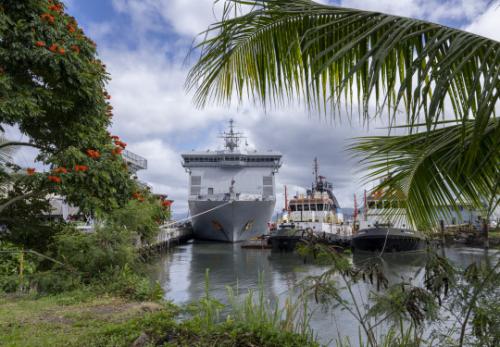
New Zealand’s current approach to force design combines different types of ships that provide different capabilities to achieve a range of operational objectives. It is essential for preserving versatility and responding to various threats. However, as demonstrated, small navies face challenges maintaining a critical mass when specialist capabilities are vested in single ships. Lessons from the current force offer some factors to consider, with the first question being the degree to which New Zealand can afford to maintain a balanced force through its traditional ship replacement programme. Replacing the Anzac Class with like-for-like platforms will cost between $2.4bn-$3.2bn for two European FREMM148 or UK Type 26149 platforms. Either of these options will anchor the challenges of resourcing the Navy’s existing combat capability until the 2060s. The Royal Navy’s Maritime Modularity Concept may offer alternative approaches that maximise the benefits of common low-cost platforms, with a suite of plug-and-play modules offering a range of mission profiles suited to the region and avoid the long-term capability gaps experienced with the Anzac Class systems upgrade.150
For the RNZN to be an effective instrument of national power, it needs to address its vulnerabilities. This is not just people; rather, it lacks the depth of capability across the force to be resilient in the face of shocks, whether from global supply chain collapse or attractive market conditions that lure trained sailors away. Andrew Watts argues that emerging concepts and technologies offer new ways of operating, including leveraging remote and autonomous solutions, embracing open computing architecture, and the concepts of modularity across common platforms. He further argues that the design of the future fleet must be based on a unified view of operational requirements and how these can best be delivered in the contemporary environment rather than just replacing ships.151 But, attitudes towards the RNZN’s role in maintaining peace and stability beyond New Zealand’s region may also need to be re-examined. In 2013 the Centre for International Maritime Security posed a simple question on their bulletin board, ‘What advice would you give to a smaller nation on the maritime investments it should pursue, and why?’. Responses were wide and varied from junior Naval Officers to academics. Professor John Homles of the US Navy War College offered, ‘There’s a premium on thinking and acting strategically when you have only meagre resources to tap …[small nations] have to think and invest smart…[and] design their fleets as creatively as possible’.152 New Zealand is a developed and innovative nation with an entrepreneurial spirit that has access to a wide range of commercial and defence concepts and technology solutions. The underlying question is whether traditionally conservative naval practitioners when advising the Government, can deviate from the conceptions of the past to deliver effects in a way that does not include the multi-billion-dollar investment of high-end surface combatants. New Zealand’s current foreign policy and national security environment may suggest divesting naval combat capability in favour of building depth to the low-threat force projection capabilities suitable for responding to regional non-traditional security threats is the most prudent course of action.
“2023 Briefing to Incoming Minister of Defence.” Wellington, New Zealand: Ministry of Defence, February 2023. https://www.beehive.govt.nz/sites/default/files/2023-03/BIM%20-%20Minister%20of%20Defence.pdf.
Bridgeman, Andrew. “Major Projects Report 2021.” Wellington, New Zealand: New Zealand Ministry of Defence, December 9, 2021. https://www.defence.govt.nz/assets/publication/file/Defence-Major-Projects-Report-2021.pdf.
Buchanan, Paul G. “Lilliputian in Fluid Times: New Zealand Foreign Policy After the Cold War.” Political Science Quarterly 125, no. 2 (June 1, 2010): 255–79. https://doi.org/10.1002/j.1538-165X.2010.tb00675.x.
Burns, Stephanie. “Solution Looking For A Problem.” Forbes, May 28, 2019. https://www.forbes.com/sites/stephanieburns/2019/05/28/solution-looking-for-a-problem/.
Bush, George W. “President Declares ‘Freedom at War with Fear,’” September 20, 2001. https://georgewbush-whitehouse.archives.gov/news/releases/2001/09/2001092.
Catalinac, Amy L. “Why New Zealand Took Itself out of ANZUS: Observing ‘Opposition for Autonomy’ in Asymmetric Alliances.” Foreign Policy Analysis 6, no. 4 (September 22, 2010): 317–38. https://doi.org/10.1111/j.1743-8594.2010.00115.x.0-8.html.
Cavanaugh, M. L. “New Zealand’s Dangerous Strategic Apathy in an Uncertain Age.” The Strategist, February 11, 2020.https://www.aspistrategist.org.au/new-zealands-dangerous-strategic-apathy-in-an-uncertain-age.
Choi, Charles. “1st Mega-Tsunami on Record since Antiquity Was Triggered by Tonga Volcanic Eruption.” livescience.com, April 28, 2023. https://www.livescience.com/planet-earth/tsunami/1st-mega-tsunami-on-record-since-antiquity-was-triggered-by-tonga-volcanic-eruption.
Combined Maritime Forces (CMF). “CTF 150: Maritime Security,” September 17, 2010. https://combinedmaritimeforces.com/ctf-150-maritime-security/.
Corl, Michael J, Michael Kokkolaras, and Michael G Parsons. “Platform-Based Design of a Family of Ships Considering Both Performance and Savings,” August 28, 2007.
Correia, João. “Military Capabilities and the Strategic Planning Conundrum.” Security and Defence Quarterly 24, no. 2 (June 28, 2019): 21–50. https://doi.org/10.35467/sdq/108667.
Craymer, Lucy. “New Zealand Navy Idles Ships as Labour Crisis Hits,” 7 Dec 22. https://www.reuters.com/world/asia-pacific/new-zealand-navy-idles-ships-labour-crisis-hits-2022-12-07-crisis-hits-2022-12-07/.
“Defence Assessment.” Wellington, New Zealand: Ministry of Defence, December 2021. https://www.defence.govt.nz/assets/publication/file/Defence-Assessment-2021.pdf.
“Defence Policy and Strategy Statement.” Wellington, New Zealand: New Zealand Government, 2023. https://www.defence.govt.nz/assets/publication/file/23-0195-Defence-Policy-and-Strategy-Statement-WEB.PDF#page=14.
Defence Strategic Policy Statement. Wellington, New Zealand: Ministry of Defence, 2018.
Defence White Paper 2010. Wellington, N.Z.: Ministry of Defence, 2010.
Defence White Paper, 2016. Wellington, New Zealand: Ministry of Defence, 2016.
Dickens, Dr David. “Inquiry into Defence Deyond 2000: An Independent Review of the Foreign Affairs, Defence & Trade Parliamentary Select Committee’s Interim Report.” Working Paper, n.d.
Dodd, Norman L. “New Zealand’s Defence Problems.” The RUSI Journal 123, no. 2 (June 1978): 49–56. https://doi.org/10.1080/03071847809422896.
Felton, Ben. “New Zealand Frigate Arrives in Australia for Rare Missile Firing.” Naval News (blog), July 28, 2023. https://www.navalnews.com/naval-news/2023/07/new-zealand-frigate-arrives-in-australia-for-rare-missile-firing.
“FREMM Multipurpose Frigate.” In Wikipedia, September 27, 2023. https://en.wikipedia.org/w/index.php?title=FREMM_multipurpose_frigate&oldid=1177378489 .
“Governments in New Zealand since 1856 - New Zealand Parliament,” July 18, 2023. https://www.parliament.nz/en/visit-and-learn/mps-and-parliaments-1854-onwards/governments-in-new-zealand-since-1856.
Hall, Sarah. “Defence Force Funding.” North & South Magazine (blog), February 11, 2023. https://northandsouth.co.nz/2023/02/11/new-zealand-defence-force/.
Hipkins, Chris. “Prime Minister’s Foreign Policy Speech to NZIIA.” The Beehive, July 7, 2023. https://www.beehive.govt.nz/speech/prime-ministers-foreign-policy-speech-nziia.
Huntley, Wade. “The Kiwi That Roared: Nuclear-free New Zealand in a Nuclear-armed World.” The Nonproliferation Review 4, no. 1 (December 1996): 1–16. https://doi.org/10.1080/10736709608436649.
Institute, Lowy. “New Zealand - Lowy Institute Asia Power Index.” Lowy Institute Asia Power Index 2023. Accessed September 18, 2023. https://power.lowyinstitute.org/countries/new-zealand/. Jennings, Peter. “New Zealand’s Defence White Paper: Look South.” The Strategist, June 9, 2016. https://www.aspistrategist.org.au/new-zealands-defence-white-paper-look-south/.
Jones, Nicholas. “Govt Likely to Sell Idle Navy Ships.” NZ Herald, April 15, 2016. https://www.nzherald.co.nz/nz/govt-likely-to-sell-idle-navy-ships/IDEBSMOKRVSCBEQDHN6MAOOI2E.
Jones, Rhys. “Annual Report 2012.” Wellington, New Zealand: New Zealand Defence Force, August 15, 2012.
———. “Annual Report 2013.” Wellington, New Zealand: New Zealand Defence Force, August 28, 2013.
———. Future Joint Operating Concept 2035. Wellington, New Zealand: New Zealand Defence Force, 2012.
Keating, Tim. “Annual Report 2015.” Wellington, New Zealand: New Zealand Defence Force, June 30, 2015.
———. “Annual Report 2017.” Wellington, New Zealand: New Zealand Defence Force, June 30, 2017.
Ken Ross. “John Key’s Global Diplomacy.” New Zealand International Review 42, no.3 (June 2017): 22–25.
Killingray, David. “Imperial Defence.” In The Oxford History of the British Empire: Volume V: Historiography, edited by Robin Winks and Wm.Roger Louis, 0. Oxford University Press, 1999. https://doi.org/10.1093/acprof:oso/9780198205661.003.0022.
Lee-Frampton, Nick. “A Third of New Zealand’s Navy Ships Are Docked over Lack of Crew.” Defense News, December 9, 2022. https://www.defensenews.com/naval/2022/12/09/a-third-of-new-zealands-navy-ships-are-docked-over-lack-of-crew/ .
Little, Andrew. “Speech to Announcement of Roadmap for Future of Defence and National Security Released.” The Beehive, August 4, 2023. https://www.beehive.govt.nz/release/speech-roadmap-for-future-of-defence-and-national-security-released.
Mahuta, Nanaia. “Aotearoa New Zealand’s Place in a Troubled World: Partnership and Partnering to Deliver International Solutions.” The Beehive, June 6, 2023. https://www.beehive.govt.nz/speech/aotearoa-new-zealands-place-troubled-world-partnership-and-partnering-deliver-international.
———. “Inaugural Foreign Policy Speech to Diplomatic Corps.” The Beehive, February 4, 2021. https://www.beehive.govt.nz/speech/inaugural-foreign-policy-speech-diplomatic-corps.
———. “Why the Pacific Way Matters for Regional Security.” The Beehive, May 3, 2023. https://www.beehive.govt.nz/speech/why-pacific-way-matters-regional-security.
“Main Body of Jayforce Lands in Japan.” Accessed July 31, 2023. https://nzhistory.govt.nz/jayforce-arrives-in-japan.
“Maritime Modularity Concept.” London: Ministry of Defence, February 2, 2023. https://www.gov.uk/government/publications/maritime-operating-concept-maropc/introduction-to-the-royal-navys-maritime-modularity-concept.
“Maritime Patrol Review.” Wellington, New Zealand: Department of Prime Minister and Cabinet, February 2001.
Maritime Security Forum. “Sea Blindness,” February 5, 2023. https://www.forumulsecuritatiimaritime.ro/sea-blindness/.
“Maritime Security Strategy.” National Maritime Coordination Centre (New Zealand), December 2020. https://www.transport.govt.nz//assets/Uploads/Report/MSS_V6_U.pdf. Martin, John. Maritime Doctrine. First Edition. Auckland, New Zealand: New Zealand Defence Force, Te Ope Kaatua o Aotearoa, 2019.
Mayell, Peter. “Beyond the ‘Outer Crescent’: The Mackinder Century in New Zealand Geopolitics.” The Geographical Journal 170, no. 4 (December 2004): 368–76. https://doi.org/10.1111/j.0016-7398.2004.00138.x.
McCraw, David. “New Zealand Foreign Policy under the Clark Government: High Tide of Liberal Internationalism?” Pacific Affairs 78, no. 2 (July 1, 2005):217–35. https://doi.org/10.5509/2005782217.
———. “New Zealand’s Foreign Policy Under National and Labour Governments: Variations on the ‘Small State’ Theme?” Pacific Affairs 67, no. 1 (1994): 7. https://doi.org/10.2307/2760117.
———. “Reluctant Ally: New Zealand’s Entry into the Vietnam War.” New Zealand Journal of History 15, no. 1 (April 1981): 49–60.
“MFAT Strategic Intentions 2021-2025.” Wellington, New Zealand: Ministry of Foreign Affairs and Trade, 2021.
“MFP 8: The Future of Small-Nation Maritime Forces | Center for International Maritime Security,” January 22, 2013. https://cimsec.org/mfp-8-the-future-of-small-nation-maritime-forces/.
Morey, Kelly Ana. Service from the Sea: New Zealand Naval History Told through the Collections of the Royal New Zealand Navy Museum = Ngā Mahi Nō Te Moana. Auckland, N.Z: Viking, 2008.
“National Defence - Defence Strategic Review.” Canberra, Australia: Australian Government, 2023. https://www.defence.gov.au/about/reviews-inquiries/defence-strategic-review.
Navy Today. 242. Wellington, New Zealand: Defence Public Affairs, 2020.
“New Zealand | Britannica,” June 30, 2023. https://www.britannica.com/place/New-Zealand. New Zealand Government. “How Government Works,” May 17, 2023. https://www.govt.nz/browse/engaging-with-government/government-in-new-zealand/.
“New Zealand Government Defence Capability Plan 2019.” Wellington, New Zealand: Ministry of Defence, June 2019. https://www.defence.govt.nz/assets/Uploads/03acb8c6aa/Defence-Capability-Plan-2019.pdf.
“New Zealand in the Korean War.” Accessed July 9, 2023. https://nzhistory.govt.nz/war/korean-war.
Nuechterlein, Donald E. “National Interests and Foreign Policy: A Conceptual Framework for Analysis and Decision-Making.” British Journal of International Studies 2, no. 3 (October 1976): 246–66. https://doi.org/10.1017/S0260210500116729.
“NZ and the Malayan Emergency.” Accessed July 9, 2023. https://nzhistory.govt.nz/war/the-malayan-emergency.
NZ Herald. “Cobbers Keep Navy Afloat - New Zealand News,” 2013. https://www.nzherald.co.nz/nz/cobbers-keep-navy-afloat/SNWYJOBYHE4UUUWS4GNS76FVNI/.
“NZ Navy Ship Completes Maritime Patrol in Samoa to Help Protect Fisheries.” Accessed July 13, 2023. https://www.nzdf.mil.nz/media-centre/news/nz-navy-ship-completes-maritime-patrol-in-samoa-to-help-protect-fisheries/.
Office of the Auditor-General New Zealand. “Multi-Role Vessel and Patrol Vessels (Project Protector).” Accessed May 24, 2023. https://oag.parliament.nz/2008/defence/appendix/appendix2.htm.
Our Nuclear Free Moment, 2017. https://www.youtube.com/watch?v=gQW2MB3XiXI.
Paget, Steven. “The ‘Best Small Nation Navy in the World’? The Twenty-First Century Royal New Zealand Navy.” Australian Journal of Maritime & Ocean Affairs 8, no. 3 (July 2, 2016): 230–56. https://doi.org/10.1080/18366503.2016.1217385.
Press. “Naval Staff Shortages Tie up Patrol Craft.” April 13, 1988. Press. “Navy Critically Short of Men.” September 4, 1973, CXIII edition.
Priestley, Rebecca. “Ernest Marsden’s Nuclear New Zealand: From Nuclear Reactors to Nuclear Disarmament.” Journal & Proceedings of the Royal Society of New South Wales 139 (2006): 23–38.
Provost, Lyn. “Report of the Expert Review Group.” Wellington, New Zealand, November 2021.
Quigley, Hon Derek. “The Evolution of New Zealand Defence Policy” 2, no. 3 (2006).
Quilter, Helene, and Kevin Short. “Report to the Ministers of Finance and Defence: New Zealand Defence Force: Approval to Commit to Contractor for the Dive and Hydrogrpahic Vessel.” Ministry of Defence, December 2018. https://www.defence.govt.nz/assets/Uploads/5e0a78f961/2018-Dive-and-Hydrographic-Vessel.pdf.
RNZ. “New Zealand Navy Frigate to Leave Canada Years after Upgrade Began,” May 17, 2022. https://www.rnz.co.nz/news/national/467270/new-zealand-navy-frigate-to-leave-canada-years-after-upgrade-began.
RNZ. “Third of NZ Navy Ships Idle as Defence Force Staff Leave,” December 8, 2022. https://www.rnz.co.nz/news/national/480354/third-of-nz-navy-ships-idle-as-defence-force-staff-leave.
“Sale of Former Royal New Zealand Navy Vessels Provides $26 Million Boost to Local Economy,” April 6, 2023. https://www.nzdf.mil.nz/media-centre/news/sale-of-former-royal-new-zealand-navy-vessels-provides-26-million-boost-to-local-economy/.
“Secure Together: New Zealand’s National Security Strategy 2023-2028.” Wellington, New Zealand: New Zealand Government, August 2023. https://www.dpmc.govt.nz/sites/default/files/2023-08/New%20Zealand%27s%20National%20Security%20Strategy_Secure%20Together_FINAL_0.pdf#page=12.
“Ships & Watercraft.” Accessed July 10, 2023. https://www.nzdf.mil.nz/navy/our-equipment/ships-and-watercraft/.
Short, Kevin. “Annual Report 2018.” Wellington, New Zealand: New Zealand Defence Force, June 30, 2018.
———. “Annual Report 2019.” Wellington, New Zealand: New Zealand Defence Force, June 30, 2019.
———. “Annual Report 2021.” Wellington, New Zealand: New Zealand Defence Force, June 30, 2021.
———. “Annual Report 2022.” Wellington, New Zealand: New Zealand Defence Force, June 30, 2022. https://www.nzdf.mil.nz/assets/Uploads/DocumentLibrary/22-0341-NZDF-Annual-Report-2022-WEB.PDF.
———. Campagins and Operations. 3rd ed. Vol. 3.0. NZDDP. Wellington, New Zealand: New Zealand Defence Force, 2022.
———. Command and Control. 3rd ed. Vol. 00.1. NZDDP. Wellington, New Zealand: New Zealand Defence Force, 2022.
“South African War 1899-1902.” Accessed July 9, 2023. https://nzhistory.govt.nz/war/south-african-boer-war/introduction.
Stöhs, Jeremy. “Into the Abyss?: European Naval Power in the Post–Cold War Era,” 2018.
Suseto, Buddy, Zarina Othman, and Farizal Mohd Razalli. “Assessing the Evolution of Maritime Strategy in the Asia Pacific.” Jurnal Ilmu Sosial Dan Ilmu Politik 23, no. 2 (December 26, 2019): 87. https://doi.org/10.22146/jsp.41709.
Temocin, Pinar. “From Protest to Politics: The Effectiveness of Civil Society in Shaping the Nuclear-Free Policy in Aotearoa New Zealand” 13 (2021).
“The Significance of the Gallipoli Peninsula.” Text. Australia. Accessed July 10, 2023. https://www.aph.gov.au/parliamentary_business/committees/senate/finance_and_public_administration/Completed inquiries/2004-07/gallipoli/report/d01b.
“Type 26 Frigate.” In Wikipedia, August 16, 2023. https://en.wikipedia.org/w/index.php?title=Type_26_frigate&oldid=1170650207.
Watts, Andrew. “Designing the Next Fleet.” The Professional Journal of the Royal New Zealand Navy 1, no. 1 (December 2020): 22–47.
Wiggins, Sally. An Introduction to Discourse Analysis. SAGE Publications Ltd., 2017. https://doi.org/10.4135/9781473964709.
Wilson, Dave. “Navy Woos Back Retired Officers.” Press, March 27, 1988.
Wynd, Michael. “Small Steps from Empire to Independence: The Royal New Zealand Navy, 1910-2010.” The Northern Mariner / Le Marin Du Nord 24, no. 3 & 4 (October 31, 2014): 104–23. https://doi.org/10.25071/2561-5467.276.
Young, Audrey. “NZ Navy Sends Hawea to Fiji for Six Months.” NZ Herald, April 6, 2017. https://www.nzherald.co.nz/nz/nz-navy-to-send-hawea-patrol-vessel-to-fiji-for-six-months-to-help-patrol-fisheries/OCM6U3ONB2Y5LCELFYJO6WA3KA/.
1 Charles Choi, “1st Mega-Tsunami on Record since Antiquity Was Triggered by Tonga Volcanic Eruption,” livescience.com, April 28, 2023, https://www.livescience.com/planet-earth/tsunami/1st-mega-tsunami-on-record-since-antiquity-was-triggered-by-tonga-volcanic-eruption.
2 “2023 Briefing to Incoming Minister of Defence” (Wellington, New Zealand: Ministry of Defence, February 2023), 17,https://www.beehive.govt.nz/sites/default/files/2023-03/BIM%20-%20Minister%20of%20Defence.pdf.
3 Sarah Hall, “Defence Force Funding,” North & South Magazine (blog), February 11, 2023, https://northandsouth.co.nz/2023/02/11/new-zealand-defence-force/.
4 Nick Lee-Frampton, “A Third of New Zealand’s Navy Ships Are Docked over Lack of Crew,” Defense News, December 9, 2022,https://www.defensenews.com/naval/2022/12/09/a-third-of-new-zealands-navy-ships-are-docked-over-lack-of-crew/.
5 “Cobbers Keep Navy Afloat - New Zealand News,” NZ Herald, 2013, https://www.nzherald.co.nz/nz/cobbers-keep-navy-afloat/SNWYJOBYHE4UUUWS4GNS76FVNI/.
6 “Sea Blindness,” Maritime Security Forum, February 5, 2023, https://www.forumulsecuritatiimaritime.ro/sea-blindness/.
7 Stephanie Burns, “Solution Looking For A Problem,” Forbes, May 28, 2019, https://www.forbes.com/sites/stephanieburns/2019/05/28/solution-looking-for-a-problem/.
8 M. L. Cavanaugh, “New Zealand’s Dangerous Strategic Apathy in an Uncertain Age,” The Strategist, February 11, 2020,https://www.aspistrategist.org.au/new-zealands-dangerous-strategic-apathy-in-an-uncertain-age/.
9 “Defence Assessment” (Wellington, New Zealand: Ministry of Defence, December 2021), 22, https://www.defence.govt.nz/assets/publication/file/Defence-Assessment-2021.pdf.
10 Sally Wiggins, An Introduction to Discourse Analysis (SAGE Publications Ltd., 2017), https://doi.org/10.4135/9781473964709.
11 Buddy Suseto, Zarina Othman, and Farizal Mohd Razalli, “Assessing the Evolution of Maritime Strategy in the Asia Pacific,” Jurnal Ilmu Sosial Dan Ilmu Politik 23, no. 2 (December 26, 2019): 90, https://doi.org/10.22146/jsp.41709.
12 Jeremy Stöhs, “Into the Abyss?: European Naval Power in the Post–Cold War Era,” 2018, 16, 18, 21.
13 Stöhs, 10.
14 Stöhs, “Into the Abyss?: European Naval Power in the Post–Cold War Era.”
15 Hon Derek Quigley, “The Evolution of New Zealand Defence Policy” 2, no. 3 (2006): 55–56.
16 Rhys Jones, Future Joint Operating Concept 2035 (Wellington, New Zealand: New Zealand Defence Force, 2012), 24–26.
17 João Correia, “Military Capabilities and the Strategic Planning Conundrum,” Security and Defence Quarterly 24, no. 2 (June 28, 2019): 2, https://doi.org/10.35467/sdq/108667.
18 Correia, 38–39.
19 Correia, 26.
20 Steven Paget, “The ‘Best Small Nation Navy in the World’? The Twenty-First Century Royal New Zealand Navy,” Australian Journal of Maritime & Ocean Affairs 8, no. 3 (July 2, 2016): 230–56, https://doi.org/10.1080/18366503.2016.1217385.
21 Andrew Watts, “Designing the Next Fleet,” The Professional Journal of the Royal New Zealand Navy 1, no. 1 (December 2020): 25.
22 “Cobbers Keep Navy Afloat - New Zealand News”; Lee-Frampton, “A Third of New Zealand’s Navy Ships Are Docked over Lack of Crew.”
23 “New Zealand | Britannica,” June 30, 2023, https://www.britannica.com/place/New-Zealand.
24 “How Government Works,” New Zealand Government, May 17, 2023, https://www.govt.nz/browse/engaging-with-government/government-in-new-zealand/.
25 David McCraw, “New Zealand’s Foreign Policy Under National and Labour Governments: Variations on the ‘Small State’ Theme?,” Pacific Affairs 67, no. 1 (1994): 24–25, https://doi.org/10.2307/2760117.
26 “Governments in New Zealand since 1856 - New Zealand Parliament,” July 18, 2023, https://www.parliament.nz/en/visit-and-learn/mps-and-parliaments-1854-onwards/governments-in-new-zealand-since-1856/.
27 Lowy Institute, “New Zealand - Lowy Institute Asia Power Index,” Lowy Institute Asia Power Index 2023, accessed September 18, 2023, https://power.lowyinstitute.org/countries/new-zealand/.
28 McCraw, “New Zealand’s Foreign Policy Under National and Labour Governments,” 7–8.
29 McCraw, 14.
30 David McCraw, “New Zealand Foreign Policy under the Clark Government: High Tide of Liberal Internationalism?,” Pacific Affairs 78, no. 2 (July 1, 2005): 234, https://doi.org/10.5509/2005782217.
31 Ken Ross, “John Key’s Global Diplomacy,” New Zealand International Review 42, no. 3 (June 2017): 23.Donald E. Nuechterlein, “National Interests and Foreign Policy: A Conceptual Framework for Analysis and Decision-Making,” British Journal of International Studies 2, no. 3 (October 1976): 246–47, https://doi.org/10.1017/S0260210500116729.
32 Donald E. Nuechterlein, “National Interests and Foreign Policy: A Conceptual Framework for Analysis and Decision-Making,” British Journal of International Studies 2, no. 3 (October 1976): 246–47, https://doi.org/10.1017/S0260210500116729.
33 Nuechterlein, 248.
34 “2023 Briefing to Incoming Minister of Defence,” 33.
35 Nanaia Mahuta, “Inaugural Foreign Policy Speech to Diplomatic Corps,” The Beehive, February 4, 2021, https://www.beehive.govt.nz/speech/inaugural-foreign-policy-speech-diplomatic-corps.
36 Our Nuclear Free Moment, 2017, https://www.youtube.com/watch?v=gQW2MB3XiXI.
37 Nuechterlein, “National Interests and Foreign Policy,” 248–49.
38 Defence White Paper, 2016 (Wellington, New Zealand: Ministry of Defence, 2016), 19.
39 Defence Strategic Policy Statement (Wellington, New Zealand: Ministry of Defence, 2018), 26.
40 Nanaia Mahuta, “Aotearoa New Zealand’s Place in a Troubled World: Partnership and Partnering to Deliver International Solutions,” The Beehive, June 6, 2023, https://www.beehive.govt.nz/speech/aotearoa-new-zealands-place-troubled-world-partnership-and-par tnering-deliver-international.
41 George W Bush, “President Declares ‘Freedom at War with Fear,’” September 20, 2001, https://georgewbush-whitehouse.archives.gov/news/releases/2001/09/20010920-8.html.
42 Chris Hipkins, “Prime Minister’s Foreign Policy Speech to NZIIA,” The Beehive, July 7, 2023, https://www.beehive.govt.nz/speech/prime-ministers-foreign-policy-speech-nziia.
43 McCraw, “New Zealand Foreign Policy under the Clark Government,” 228.
44 Hipkins, “Prime Minister’s Foreign Policy Speech to NZIIA.”
45 Mahuta, “Aotearoa New Zealand’s Place in a Troubled World.”
46 “MFAT Strategic Intentions 2021-2025” (Wellington, New Zealand: Ministry of Foreign Affairs and Trade, 2021), 15.
47 Defence Strategic Policy Statement, 6.
48 “Defence Assessment,” 29.
49 Mahuta, “Aotearoa New Zealand’s Place in a Troubled World.”
50 David Killingray, “Imperial Defence,” in The Oxford History of the British Empire: Volume V: Historiography, ed. Robin Winks and Wm.Roger Louis (Oxford University Press, 1999), 342, https://doi.org/10.1093/acprof:oso/9780198205661.003.0022.
51 “South African War 1899-1902,” accessed July 9, 2023, https://nzhistory.govt.nz/war/south-african-boer-war/introduction.
52 Peter Mayell, “Beyond the ‘Outer Crescent’: The Mackinder Century in New Zealand Geopolitics,”The Geographical Journal 170, no. 4 (December 2004): 371, https://doi.org/10.1111/j.0016-7398.2004.00138.x.
53 “Main Body of Jayforce Lands in Japan,” accessed July 31, 2023, https://nzhistory.govt.nz/jayforce-arrives-in-japan.
54 “NZ and the Malayan Emergency,” accessed July 9, 2023, https://nzhistory.govt.nz/war/the-malayan-emergency.
55 Mayell, “Beyond the ‘Outer Crescent,’” 371.
56 “New Zealand in the Korean War,” accessed July 9, 2023, https://nzhistory.govt.nz/war/korean-war.
57 Mayell, “Beyond the ‘Outer Crescent,’” 371.
58 Mayell, 371.
59 David McCraw, “Reluctant Ally: New Zealand’s Entry into the Vietnam War,” New Zealand Journal of History 15, no. 1 (April 1981): 49–50.
60 Rebecca Priestley, “Ernest Marsden’s Nuclear New Zealand: From Nuclear Reactors to Nuclear Disarmament,” Journal & Proceedings of the Royal Society of New South Wales 139 (2006): 32.
61 Pinar Temocin, “From Protest to Politics: The Effectiveness of Civil Society in Shaping the Nuclear-Free Policy in Aotearoa New Zealand” 13 (2021): 185–86.
62 Wade Huntley, “The Kiwi That Roared: Nuclear-free New Zealand in a Nuclear-armed World,” The Nonproliferation Review 4, no. 1 (December 1996): 1, https://doi.org/10.1080/10736709608436649.
63 “The Significance of the Gallipoli Peninsula,” text, Australia, accessed July 10, 2023,https://www.aph.gov.au/parliamentary_business/committees/senate/finance_and_public_administratio n/Completed inquiries/2004-07/gallipoli/report/d01b.
64 Amy L. Catalinac, “Why New Zealand Took Itself out of ANZUS: Observing ‘Opposition for Autonomy’ in Asymmetric Alliances,” Foreign Policy Analysis 6, no. 4 (September 22, 2010): 330–31, https://doi.org/10.1111/j.1743-8594.2010.00115.x; Quigley, “The Evolution of New Zealand Defence Policy,” 42.
65 Kelly Ana Morey, Service from the Sea: New Zealand Naval History Told through the Collections of the Royal New Zealand Navy Museum = Ngā Mahi Nō Te Moana (Auckland, N.Z: Viking, 2008), 166–203.
66 John Martin, Maritime Doctrine, First Edition (Auckland, New Zealand: New Zealand Defence Force, Te Ope Kaatua o Aotearoa, 2019), 14.
67 Michael Wynd, “Small Steps from Empire to Independence: The Royal New Zealand Navy, 1910-2010,” The Northern Mariner / Le Marin Du Nord 24, no. 3 & 4 (October 31, 2014): 119, https://doi.org/10.25071/2561-5467.276.
68 Paul G. Buchanan, “Lilliputian in Fluid Times: New Zealand Foreign Policy After the Cold War,”Political Science Quarterly 125, no. 2 (June 1, 2010): 269, https://doi.org/10.1002/j.1538-165X.2010.tb00675.x.
69 Wynd, “Small Steps from Empire to Independence,” 119–20.
70 Quigley, “The Evolution of New Zealand Defence Policy,” 48–49.
71 Quigley, 50.
72 Rhys Jones, “Annual Report 2012” (Wellington, New Zealand: New Zealand Defence Force, August 15, 2012), 48.
73 Dr David Dickens, “Inquiry into Defence Deyond 2000: An Independent Review of the Foreign Affairs, Defence & Trade Parliamentary Select Committee’s Interim Report,” Working Paper, n.d., 6.
74 Dickens, 8.
75 Quigley, “The Evolution of New Zealand Defence Policy,” 51.
76 “Multi-Role Vessel and Patrol Vessels (Project Protector),” Office of the Auditor-General New Zealand, accessed May 24, 2023, https://oag.parliament.nz/2008/defence/appendix/appendix2.htm;Quigley, “The Evolution of New Zealand Defence Policy,” 56.
77 “Maritime Patrol Review” (Wellington, New Zealand: Department of Prime Minister and Cabinet, February 2001), 41.
78 Defence White Paper 2010 (Wellington, N.Z.: Ministry of Defence, 2010), 9.
79 Defence White Paper 2010, 11.
80 Defence White Paper 2010, 42.
81 Defence White Paper 2010, 13.
82 Defence White Paper 2010, 46.
83 Defence White Paper 2010, 50.
84 Jones, Future Joint Operating Concept 2035, 47–51.
85 Peter Jennings, “New Zealand’s Defence White Paper: Look South,” The Strategist, June 9, 2016, https://www.aspistrategist.org.au/new-zealands-defence-white-paper-look-south/.
86 Defence White Paper 2010, 52.
87 “Ships & Watercraft,” accessed July 10, 2023, https://www.nzdf.mil.nz/navy/our-equipment/ships-and-watercraft/.
88 “Maritime Security Strategy” (National Maritime Coordination Centre (New Zealand), December 2020), 1–3, https://www.transport.govt.nz//assets/Uploads/Report/MSS_V6_U.pdf.
89 “Maritime Security Strategy,” 39.
90 “Maritime Security Strategy,” 23.
91 “National Defence - Defence Strategic Review” (Canberra, Australia: Australian Government, 2023), 19, https://www.defence.gov.au/about/reviews-inquiries/defence-strategic-review.
92 “Maritime Security Strategy,” 24.
93 Martin, Maritime Doctrine, 27.
94 Defence Strategic Policy Statement, 8.
95 Martin, Maritime Doctrine, 83.
96 Martin, 85–104.
97 Kevin Short, “Annual Report 2022” (Wellington, New Zealand: New Zealand Defence Force, June 30, 2022), 50,https://www.nzdf.mil.nz/assets/Uploads/DocumentLibrary/22-0341-NZDF-Annual-Report-2022-WEB.P DF.
98 Kevin Short, “Annual Report 2021” (Wellington, New Zealand: New Zealand Defence Force, June 30, 2021), 56.
99 “CTF 150: Maritime Security,” Combined Maritime Forces (CMF) (blog), September 17, 2010, https://combinedmaritimeforces.com/ctf-150-maritime-security/.
100 Kevin Short, “Annual Report 2019” (Wellington, New Zealand: New Zealand Defence Force, June 30, 2019), 74–75.
101 Short, “Annual Report 2021,” 64.
102 Audrey Young, “NZ Navy Sends Hawea to Fiji for Six Months,” NZ Herald, April 6, 2017, https://www.nzherald.co.nz/nz/nz-navy-to-send-hawea-patrol-vessel-to-fiji-for-six-months-to-help-patro l-fisheries/OCM6U3ONB2Y5LCELFYJO6WA3KA/.
103 “NZ Navy Ship Completes Maritime Patrol in Samoa to Help Protect Fisheries,” accessed July 13, 2023, https://www.nzdf.mil.nz/media-centre/news/nz-navy-ship-completes-maritime-patrol-in-samoa-to-help-protect-fisheries/.
104 Tim Keating, “Annual Report 2017” (Wellington, New Zealand: New Zealand Defence Force, June 30, 2017), 12, 35.
105 Navy Today, 242 (Wellington, New Zealand: Defence Public Affairs, 2020).
106 Paget, “The ‘Best Small Nation Navy in the World’?,” 249–50.
107 Jones, Future Joint Operating Concept 2035, 24–26.
108 Data extracted from Defence Annual Reports (GR.55) 2010-2022.
109 “New Zealand Navy Frigate to Leave Canada Years after Upgrade Began,” RNZ, May 17, 2022, https://www.rnz.co.nz/news/national/467270/new-zealand-navy-frigate-to-leave-canada-years-after-up grade-began.
110 Data extracted from Defence Annual Reports (GR.55) 2010-2014.
111 Lee-Frampton, “A Third of New Zealand’s Navy Ships Are Docked over Lack of Crew.”
112 Kevin Short, “Annual Report 2018” (Wellington, New Zealand: New Zealand Defence Force, June 30, 2018), 59.
113 Ben Felton, “New Zealand Frigate Arrives in Australia for Rare Missile Firing,” Naval News (blog), July 28, 2023,https://www.navalnews.com/naval-news/2023/07/new-zealand-frigate-arrives-in-australia-for-rare-missile-firing/.
114 “New Zealand Government Defence Capability Plan 2019” (Wellington, New Zealand: Ministry of Defence, June 2019), 13–14,https://www.defence.govt.nz/assets/Uploads/03acb8c6aa/Defence-Capability-Plan-2019.pdf.
115 Michael J Corl, Michael Kokkolaras, and Michael G Parsons, “Platform-Based Design of a Family of Ships Considering Both Performance and Savings,” August 28, 2007, 4, 11.
116 Helene Quilter and Kevin Short, “Report to the Ministers of Finance and Defence: New Zealand Defence Force: Approval to Commit to Contractor for the Dive and Hydrogrpahic Vessel” (Ministry of Defence, December 2018), 4,https://www.defence.govt.nz/assets/Uploads/5e0a78f961/2018-Dive-and-Hydrographic-Vessel.pdf.
117 Watts, “Designing the Next Fleet,” 25.
118 “Navy Critically Short of Men,” Press, September 4, 1973, CXIII edition.
119 Norman L. Dodd, “New Zealand’s Defence Problems,” The RUSI Journal 123, no. 2 (June 1978): 52, https://doi.org/10.1080/03071847809422896.
120 Dave Wilson, “Navy Woos Back Retired Officers,” Press, March 27, 1988.
121 “Naval Staff Shortages Tie up Patrol Craft,” Press, April 13, 1988.
122 Nicholas Jones, “Govt Likely to Sell Idle Navy Ships,” NZ Herald, April 15, 2016, https://www.nzherald.co.nz/nz/govt-likely-to-sell-idle-navy-ships/IDEBSMOKRVSCBEQDHN6MAOOI2 E/; “Sale of Former Royal New Zealand Navy Vessels Provides $26 Million Boost to Local Economy,” April 6, 2023,https://www.nzdf.mil.nz/media-centre/news/sale-of-former-royal-new-zealand-navy-vessels-provides-2 6-million-boost-to-local-economy/.
123 Lee-Frampton, “A Third of New Zealand’s Navy Ships Are Docked over Lack of Crew.”
124 “Third of NZ Navy Ships Idle as Defence Force Staff Leave,” RNZ, December 8, 2022, https://www.rnz.co.nz/news/national/480354/third-of-nz-navy-ships-idle-as-defence-force-staff-leave.
125 Tim Keating, “Annual Report 2015” (Wellington, New Zealand: New Zealand Defence Force, June 30, 2015), 45.
126 Kevin Short, Command and Control, 3rd ed., vol. 00.1, NZDDP (Wellington, New Zealand: New Zealand Defence Force, 2022), 16.
127 Lyn Provost, “Report of the Expert Review Group” (Wellington, New Zealand, November 2021), 28–30.
128 Kevin Short, Campagins and Operations, 3rd ed., vol. 3.0, NZDDP (Wellington, New Zealand: New Zealand Defence Force, 2022), 23.
129 Short, 3.0:26.
130 Short, 3.0:29.
131 Jones, “Annual Report 2012,” 9.
132 Andrew Bridgeman, “Major Projects Report 2021” (Wellington, New Zealand: New Zealand Ministry of Defence, December 9, 2021), 37–43,https://www.defence.govt.nz/assets/publication/file/Defence-Major-Projects-Report-2021.pdf.
133 Hall, “Defence Force Funding.”
134 Rhys Jones, “Annual Report 2013” (Wellington, New Zealand: New Zealand Defence Force, August 28, 2013), 57.
135 Martin, Maritime Doctrine, 106.
136 Data extracted from Defence Annual Reports (GR.55) 2010-2014.
137 Martin, Maritime Doctrine, 106.
138 Bridgeman, “Major Projects Report 2021,” 25.
139 Bridgeman, 25.
140 Mayell, “Beyond the ‘Outer Crescent,’” 375.
141 Lucy Craymer, “New Zealand Navy Idles Ships as Labour Crisis Hits,” 7 Dec 22, https://www.reuters.com/world/asia-pacific/new-zealand-navy-idles-ships-labour-crisis-hits-2022-12-07/.
142 Hall, “Defence Force Funding.”
143 Martin, Maritime Doctrine, 29.
144 “Defence Policy and Strategy Statement” (Wellington, New Zealand: New Zealand Government, 2023), 14,https://www.defence.govt.nz/assets/publication/file/23-0195-Defence-Policy-and-Strategy-Statement-WEB.PDF#page=14.
145 Andrew Little, “Speech to Announcement of Roadmap for Future of Defence and National Security Released,” The Beehive, August 4, 2023,https://www.beehive.govt.nz/release/speech-roadmap-for-future-of-defence-and-national-security-rele ased.
146 “Secure Together: New Zealand’s National Security Strategy 2023-2028” (Wellington, New Zealand: New Zealand Government, August 2023), 12, https://www.dpmc.govt.nz/sites/default/files/2023-08/New%20Zealand%27s%20National%20Security%20Strategy_Secure%20Together_FINAL_0.pdf#page=12.
147 Nanaia Mahuta, “Why the Pacific Way Matters for Regional Security,” The Beehive, May 3, 2023, https://www.beehive.govt.nz/speech/why-pacific-way-matters-regional-security.
148 “FREMM Multipurpose Frigate,” in Wikipedia, September 27, 2023, https://en.wikipedia.org/w/index.php?title=FREMM_multipurpose_frigate&oldid=1177378489.
149 “Type 26 Frigate,” in Wikipedia, August 16, 2023, https://en.wikipedia.org/w/index.php?title=Type_26_frigate&oldid=1170650207.
150 “Maritime Modularity Concept” (London: Ministry of Defence, February 2, 2023), https://www.gov.uk/government/publications/maritime-operating-concept-maropc/introduction-to-the-ro yal-navys-maritime-modularity-concept.
151 Watts, “Designing the Next Fleet,” 24.
152 “MFP 8: The Future of Small-Nation Maritime Forces | Center for International Maritime Security,” January 22, 2013, https://cimsec.org/mfp-8-the-future-of-small-nation-maritime-forces/.
Defence Mastery
Social Mastery
Captain Quentin Randall, RNZN is a graduate of the NZDF’s inaugural Advanced Command and Staff Course (2002), and a more recent graduate of the Defence Strategic Studies Centre at the Australian War College. Captain Randall holds Master degrees in Philosophy (Massey University, 2006) and National Security and Strategy (Deakin University, 2023). His early career postings included warfare and logistics appointments in both auxiliary and combat ships deployed across the Pacific and Asian regions.
The Royal New Zealand Navy: An Agile or Fragile Navy for a Large Maritime Nation © 2026 by . This work is licensed under CC BY-NC-ND



Please let us know if you have discovered an issue with the content on this page.
Comments
Start the conversation by sharing your thoughts! Please login to comment. If you don't yet have an account registration is quick and easy.