Introduction – Everyone has a plan until they get punched in the face
The aphorism that everyone has a plan until they get punched in the face appears to originate as misquote of the pugilist Mike Tyson’s comment that, “everyone has a plan until they get hit for the first time”.[1] Like Clausewitz observation that war is, “always the collision of two living forces”, it is a reminder that the enemy always gets a vote.[2] However Tyson also provides an incisive reminder that combatants, whether boxers or military forces, need to be able to take a hit and stay in the fight. Stretching the boxing analogy a little further, air power can be likened to a boxer with long reach, a devastating punch and a glass jaw. In the air, aircraft are fast, agile and can deliver a devasting blow; a single fighter bomber can deliver a greater weight of ordnance onto a target simultaneously than an entire brigade of artillery. However, on the ground aircraft are fragile, immobile and utterly dependent on complex support systems. An adversary who can get inside the reach and deliver an effective blow against aircraft basing can achieve disproportionate results.
The Australian Government has recognised the importance of bases, including air bases. The National Defence Strategy 2024 directs the delivery of, “a logistically networked and resilient set of bases, predominantly across the north of Australia, to enhance force projection and improve Defence’s ability to recover from an attack”.[3] This direction has been supported by the allocation of approximately $6bn in the Integrated Investment Program 2024 for northern airbase infrastructure.[4] However, the challenge confronting Defence is vast. The distance between RAAF Learmonth on the west coast of northern Australia and RAAF Townsville on the east coast of northern Australia is more than 3,400km, approximately the distance from London to Beirut.[5] The Air Force has only six air bases within this area, including RAAF Learmonth and RAAF Townsville.[6] With a tiny number of bases to cover a huge area, the ability of the Air Force to take the hit and stay in the fight is open to question.
Construction in northern Australia is an expensive undertaking. Building additional airbases in northern Australia to improve the resilience and survivability of air operations in northern Australia would put substantial pressure on an already stretched budget and involve significant opportunity costs. However, the concept of National Defence articulated in the National Defence Strategy 2024 provides some guidance to an approach that could be taken to mitigate the problem. The National Defence Strategy 2024 defines National Defence as, “a coordinated, whole-of-government and whole-of-nation approach to meet the strategic challenges Australia faces” that, “harnesses all arms of Australia’s national power”.[7] Utilising suitable civilian airfields to support military air operations could potentially reduce the dependence of air operations on a handful of military air bases, reducing the vulnerability of the force to attacks on those bases and improving the resilience and survivability of air operations in northern Australia.
Research Question and Analytical Method
The research question that this paper aims to address is, what is the potential to utilise civilian airfields to improve the resilience and survivability of air operations in northern Australia? In assessing potential this paper seeks to investigate whether the use of civilian airfields for military air operations is a promising avenue for further investigation, as opposed to a detailed analysis of the feasibility of military air operations at particular airfields. This is necessary because this paper is limited to information available to the public, while a detailed analysis of feasibility would require access to classified information. For this paper, northern Australia is defined as the portion of mainland Australia north of latitude 260S. This aligns with the southern border of the Northern Territory and approximately aligns with the definition used by the Commonwealth Government’s Office of Northern Australia.[8] This definition is also use by the Australian Strategic Policy Institute for their series on security of northern Australia.[9]
This paper will start by reviewing some fundamental principles of operating, attacking and defending airbases. It will then examine the historical pattern of attacks against air power on the ground. This will be followed by an analysis of the contemporary environment, including the impact of technologies as well as current concepts and doctrine. Lessons and observation from the current conflict in Ukraine are particularly relevant as a major conflict where control of the air remains contested. Finally, this paper will examine airfield requirements for Royal Australian Air Force crewed fast jet, surveillance and tanker aircraft. These will be compared to available airfield infrastructure in northern Australia to draw conclusions about the potential to utilise civilian airfields for military purposes. This will form the basis of recommendations for future research and policy actions. This paper has excluded uncrewed, training and transport aircraft from consideration to simplify analysis. Uncrewed aircraft have the potential to introduce additional airfield requirements that may not be available in the public domain. Training aircraft are generally not used directly in contested military operations, while transport aircraft form part of a broader transportation network that requires considerations such as access to land and sea transport terminals that are beyond the scope of this study.
An airfield site selection methodology for US Air Force agile combat employment developed by Moer, Chini, Feng and Schuldt was considered, but not used. This technique was developed for a theatre level overview in the context of US Indo-Pacific basing requirements in a war against China and lacked the detail other methods could provide in a northern Australia context.[10] Instead, airfield suitability was assessed by comparing runway length and strength against aircraft requirements. Runway length and strength data was usually taken from Airservices Australia flight planning information published in the En Route Supplement Australia (ERSA).[11] The only exception to the use of ERSA data was for military airfields undergoing upgrade projects, in these cases the publicly declared capability of the airfield post upgrade was used. Aircraft runway requirements are dependent on aircraft type and weight, airfield attitude and atmospheric conditions. Requirements for fast jet airfields were based on the F-35A Lightning II, because any airfield capable of supporting the F-35A will also be able to support the F/A-18F Super Hornet and E/A-18G Growler.[12] Runway suitability was also assessed for the E-7A Wedgetail Airborne Early Warning and Control, P-8A Poseidon Maritime Patrol Aircraft and the KC-30A Multi-Role Tanker Transport. All analysis assumed aircraft operating at Maximum Take Off Weight (MTOW). Runway length requirements were based on hot conditions at airfields up to 2000ft above sea level. Runway strength requirements were based on the Aircraft Classification Number (ACN) / Pavement Classification Number (PCN) system where an aircraft with ACN lower than the runway PCN can operate without restriction on the runway.[13]
It should be noted that this approach is conservative and limits the selection of airfields to runways able to support the full capability of the aircraft at peacetime levels of risk to the aircraft and the runway. Decisions to accept operational limitations, higher rates of wear to the runway or higher levels of risk would enable a larger number of airfields to be utilised. However, in the absence of an actual situation driving decision making, many assumptions would be required, rendering the value of any such analysis dubious.
Fundamental Principles of Airbase Operation, Attack and Defence.
By convention, operating times in aviation are measured in hours. This gives an indication of the comparatively short endurance of aircraft and the fundamental importance of airbase operations on the ground to support military aviation operations. The most basic airbase can consist of a runway where the aircraft can land and take off, and an area with stores and limited ground crew where the aircraft can be replenished. This is commonly referred to as a Forward Arming and Refuelling Point (FARP). If aircraft are operating from an airbase for a period, the base will usually have crew briefing and planning facilities and at least limited maintenance capability, with communications and personnel support capabilities to support these activities. The largest airbases can resemble small cities, with thousands of personnel and heavy industrial maintenance, test and calibration facilities. The loss of different capabilities on an airbase will have different impacts on air operations. For example the loss of movement surfaces such as runways and taxiways may immediately prevent operations from that airbase temporarily, while loss of sophisticated calibration facilities may lead to a long-term degradation of aircraft availability.
The functions a force needs to perform to attack an airbase have remained consistent, while the tools available to execute the functions have been subject to considerable evolution. An effective attack on airbase requires both targeting information and a means of prosecuting the attack on the target. Effective targeting information allows effort to be focused on valuable targets and can be gained through a range of means including espionage, ground-based reconnaissance, aerial reconnaissance, satellite observation and electronic intelligence. An attack can be prosecuted through sabotage, penetrating assault or stand-off attack. A stand-off attack can utilise weapons ranging from man-portable mortars, rockets or small drones through air attack to cruise and ballistic missiles.
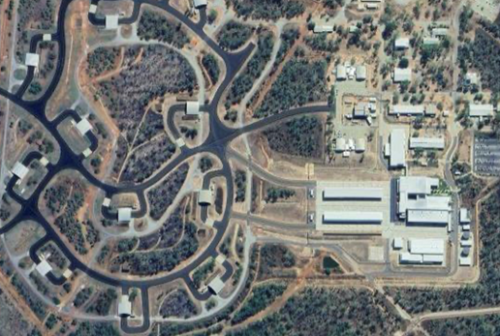
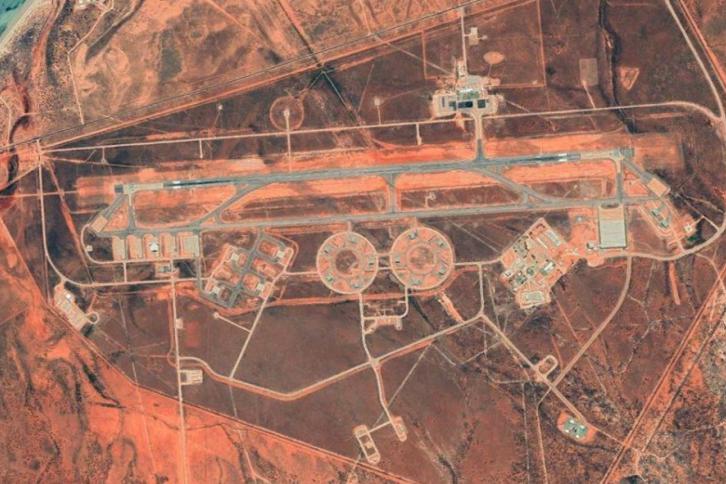
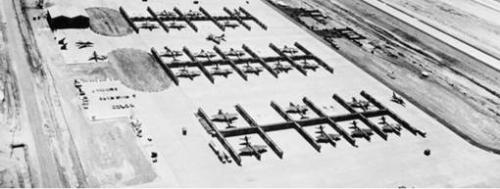
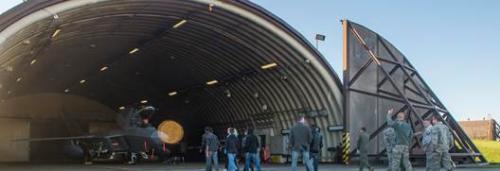
The design of an airbase for defence against attack is a compromise that requires consideration of factors including current and future threats to the airbase, redundancy, dispersal vs consolidation, hardening and opportunity cost. Meeting current threats and hedging against future threats is a key consideration because airbase infrastructure projects can take years to complete and be in service for decades. It possible that the threat will change between when the project is conceived and when it is completed, and almost certain that the threat will change before the project is retired. Redundancy of critical infrastructure enables the airbase to continue to function if it is damaged or destroyed, but comes at considerable cost. As illustrated in Figure 2, dispersal on an airbase or between airbases makes it more difficult for an adversary to cause widespread destruction with a stand-off attack, while consolidation makes it easier to secure against espionage, sabotage and penetrating assault as well as improving operational efficiency. Hardening protects aircraft or critical infrastructure against attack and usually takes the form of revetments (Figure 3), hardened aircraft shelters (Figure 4), or occasionally underground hangars (Figure 5). Constructing defensive features for an airbase imposes significant opportunity cost because it requires considerable resources and funding that cannot be used for other purposes, with the risk that those resources and funds are wasted if conflict occurs in a different location.

Historical Patterns of Airfield Attacks
Airpower arguably came of age during the Second World War, with battle to control the air and destroy adversaries’ air forces being a key consideration for all major combatants. Following the fall of France, Hitler ordered, “the Luftwaffe to overpower the English air force with all the forces at its command, in the shortest time possible”.[19] To defend against this attack the RAF had an Integrated Air Defence System (IADS) with aircraft operating from a collection of major sector airfields and dispersed satellite airfields.[20] The Luftwaffe struggled to gain targeting information on RAF airfields, losing 50 aircraft on reconnaissance missions prior to the battle.[21] The Luftwaffe proved unable to overwhelm the RAF IADS and network of dispersed bases, switching to attacks on London in the hope of victory through air to air combat before dwindling to defeat.[22] In contrast to the massed air attack of the Luftwaffe, the British were able to achieve considerable destruction of German aircraft in North Africa with penetrating ground raids undertaken by special forces.[23]
If the Battle of Britain was history’s first large scale counter air campaign, the opening air strikes of the Six Day War were arguably the most spectacular. In less than 12 hours the Israelis flew almost 700 sorties with less than 200 aircraft, attacking 26 airfields and destroying more than 400 aircraft for the loss of only 24.[24] Arab aircraft were dispersed on airbases, but the only hardening was a limited number of revetments.[25] The Israeli’s developed tactics that enabled them to disable the runway rendering the airbase inoperative then immediately attack aircraft stranded on the ground.[26] In the same era, the US in South Vietnam was contending with ground attacks that overwhelmingly used stand-off weapons to destroy more aircraft than air to air combat during that war.[27]
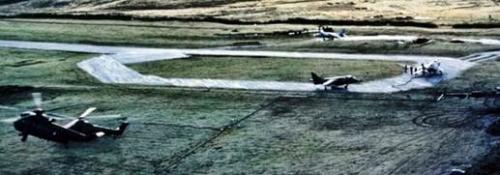
The 1982 Falklands War saw two militaries with advanced air forces contest air control in a remote corner of the South Atlantic. Once again availability of airfields became a significant issue. The British devoted considerable resources to the ‘Blackbuck’ air raid from Ascension Island, which successfully cratered the only sealed runway on the islands at Stanley Airport, precluding any possibility of the airfield being used for fighter aircraft while creating difficulties for transport flights.[28] Prior to landing on the islands, the British conducted a penetrating special forces raid to destroy the light attack aircraft based at Pebble Island and remove the threat they posed to the landings.[29] Once ashore on the islands, the British took advantage of the unique Vertical / Short Take Off and Landing (V/STOL) capabilities of the Harrier aircraft to construct a FARP at San Carlos, extending the range and endurance of the carrier based aircraft (Figure 6).[30]
The last decade of the 20th century would see the most devastating counter air campaign in history. Iraq started the 1991 Gulf War 636 operational combat aircraft, protected by 594 hardened aircraft shelters spread across 17 airbases, with a further 7 airbases and 34 dispersal bases available if needed, all forming part of an IADS that included dozens of radars, hundreds of Surface to Air Missiles (SAMs) and thousands of Anti-Aircraft Artillery (AAA) guns.[32] Against this, the US led coalition amassed more than 2600 aircraft, including more than 1850 fighter / attack aircraft, which would fly almost 120,00 sorties during the six week war, achieving air supremacy in less than two weeks.[33] The coalition destroyed 375 Hardened Aircraft Shelters and 245 aircraft for the loss of 38 aircraft during the course of the war.[34]
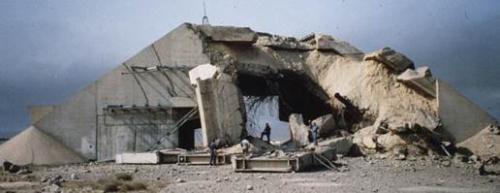
The experience of the Six Day War and Gulf War showed that air forces could be devastated on the ground when an adversary gained freedom of action in the air through either surprise or overwhelming force. In the Gulf War even extensive hardening of airbases provided minimal protection. However, in a contested air environment an adversary could struggle to mount effective attacks against a network of dispersed bases. The Falklands War showed that in remote environments with sparse infrastructure, the ability to utilise, deny or create airbases could significantly affect the ability to prosecute an air war. British efforts in North Africa and the Falklands and Communist efforts in Vietnam demonstrated that where air power could not be brought to bear against airbases, infiltration by ground forces for assault or stand off attack could still be used to degrade an adversary’s air capability. This all shows the need to hedge the basing of air operations against a range of possible threats that could emerge in different circumstances.
Contemporary Threats, Concepts and Lessons.
The Gulf War also marked the end of the Cold War and the beginning of quarter century of focus on peacekeeping, counter terrorism and counter insurgency for western militaries. During this period western air supremacy was unchallenged, although ground attacks were still occasionally mounted against airbases, most notably in Afghanistan where one attack killed two personnel, wounded seventeen and destroyed six aircraft.[36] From the mid-2010s this outlook began to change driven by concern amongst the US and allies (including Australia) about the emergence of the People’s Republic of China as peer military threat. In the US Quadrennial Defence Review 2014, China is not mentioned in the executive summary and there is one sentence in the Future Security Environment chapter about, “the rapid pace and comprehensive scope of China’s military modernisation”, and the, “relative lack of transparency and openness from China’s leaders”.[37] In the most recent US National Defence Strategy 2022, China is explicitly identified as the, “pacing challenge”, for the US and first section of the Security Environment chapter is about, “Strategic Competition with the People’s Republic of China”.[38] Since the 2022 Russian invasion of Ukraine, there has also been the example of a high intensity war between modern European military forces where neither has been able to gain control of the air. These factors have combined to create a focus on new threats from evolving technology, new concepts for generating airpower in a contested environment and lessons from current conflict.
Technology has evolved considerably since the end of the Cold War. The most significant technologies that affect the threat to airbases are satellite surveillance, the integration of surveillance with stand-off weapons into Anti-Access / Area Denial systems (A2AD) and uncrewed aircraft, or drones, used for both surveillance and attack. The ongoing improvement in electronics has dramatically decreased the size of satellites while providing equally dramatic increases in performance. What was previously the domain of nation states is now available commercially. For example, one company offers 0.5m resolution visual satellite imagery within three hours of the satellite pass, with multiple passes per day.[39] Another company offers all weather, high resolution synthetic aperture radar imagery daily.[40] This means that high quality surveillance and targeting information is now rapidly available to almost anyone commercially, and that the classified capabilities of major space powers are likely to be even more effective. The integration of dramatically improved surveillance and targeting with equally dramatic improvements in the precision of cruise and ballistic missiles has enabled the created of A2AD systems that reach far beyond the borders of major powers. Simultaneously, drones have changed the dynamics of prosecuting an attack. Used as weapons, drones provide a stand-off capability that is generally less effective than cruise or ballistic missiles, but orders of magnitude cheaper than either the offensive missiles they replace, or the defensive missiles used to intercept them.[41] They enable high volume precision attack, allowing the attacker to engage a wide large number of dispersed targets or use numbers to soak up defensive weapons before following up with more capable weapons.
In response to the threat posed by A2AD systems in particular, the USAF has developed the concept of Adaptive Basing. Adaptive Basing, “calls for forces to disaggregate capabilities from a single base and disperse forces and capabilities to many locations for operational maneuvre(sic)”.[42] Research to support Adaptive Basing has developed ideas such as “stay and fight” bases and “dispersal” bases to support air operations in contested areas, ideas that bear significant similarity to those used by the RAF during the Battle of Britain.[43] The concept of disaggregating capabilities is being explored beyond bases airbases for physical aircraft to include the command and control system. This looks beyond a single, large, easily targetable Combined Air Operations Centre in a theatre to an, “agile and dispersible set of processes and command and control structures”.[44] The concept of Adaptive Basing is support by an organisational concept of Agile Combat Employment, where the USAF is seeking, “both new technology and a culture shift”, so that in a highly contested environment it is possible, “to create many small locations from which the Air Force can quickly operate, creating too many targets for prospective enemies to successfully attack”.[45] Research has identified that this method of operating may increase risk in some aspects of air operations, but will reduce risk overall in a contested A2/AD environment.[46] Observers of the Chinese PLAAF have noted that China appears to have identified similar vulnerabilities in its air power basing and has started to conduct tentative exercises to test dispersed airbase operational concepts.[47] For Taiwan the problem is even more acute. Taiwan has extensive hardening of aircraft facilities, including potentially underground hangars, but has relatively small landmass with only a limited number of runways which are vulnerable to destruction.[48]
While theorists attempt to discern the shape of a future war in the western Pacific, the largest war in Europe since the Second World War is providing practical lessons. However, the fact that the war is ongoing with both sides seeking to maintain operational security and maximise propaganda value, means that lessons must be treated with some caution. Despite expectations prior to the war Russia, “failed to achieve air superiority, failed at suppression of enemy air defence and failed to deny the use of airpower to its adversary”.[49] Available information from the conflict has highlighted the criticality of mobility, dispersal and deception for survival when fighting a more capable adversary. The Russians were able to hit around 75% of stationary Ukrainian Air Defence sites within the first 48hrs, but only 10% of mobile sites.[50] Ukraine was able to use its strategic depth to disperse it aircraft to positions deeper inside Ukraine to save them from effective Russian attack.[51] The Ukrainians have also proved effective at using deception to mitigate Russian attacks, notably using aircraft shelters with images of battle damage over repaired sites to confuse satellite battle damage assessments.[52] One challenge that has proved difficult for Ukraine to effectively counter is the mass of Iranian Shahed-136 long range attack drones. The Shahed is relatively simple, low-cost, long-range weapon. Individual Shahed drones are not difficult for Ukrainian air defence to engage, however their simplicity means that they can be produced much more rapidly and easily than most of the missiles used to shoot them down, meaning that mass attacks result in significant depletion of air defence magazines.[53]
Most of the underlying principles of many of the contemporary threats, concepts and lessons would be recognisable to air power practitioners of the Second World War and Cold War. While the technology has evolved almost beyond recognition since then, the biggest conceptual shift is arguably the reversion to a contested air domain after the anomaly of the post-Cold War period. Even the mass precision attack by drones has similarities to mass attacks by crewed aircraft or kamikazes during the Second World War.
Airfield Infrastructure to Support Survivable Air Operations in Northern Australia
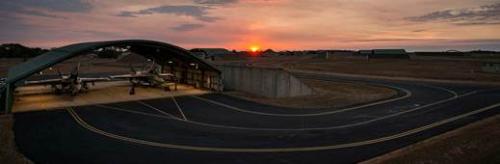
Australia faces significant challenges in applying contemporary thinking to the defence of northern Australia. The six military airbases across northern Australia cover a vast area and, except for RAAF Darwin and RAAF Tindal, have large distances between them. This limits the ability to disperse aircraft between bases to defend any particular area of northern Australia. All of the bases have some level of hardening, with Ordnance Loading Areas (OLAs) for fighter aircraft that have revetments and a roof that provides protection from weather and satellite observation, but not from attack (Figure 8). However, the number of these OLAs is limited, with only 5 at RAAF Curtin, 10 at RAAF Townsville and RAAF Scherger, 12 at RAAF Darwin and RAAF Learmonth and 22 at RAAF Tindal.[54] This means that for Darwin region there are 34 targetable locations where fighters could be operating shielded from satellite surveillance, for the Coral Sea there are 20 and for the Pilbara there are 15. The bases also have several movement surfaces for larger aircraft, some with revetments but none with overhead shelter, making them vulnerable to satellite observation.
In the current environment of frequent satellite observation and the potential for massed long range precision attack, military aircraft operating out of northern Australia are vulnerable to either being destroyed on the ground or having their base rendered inoperable. Constructing hardened aircraft shelters to improve protection would be expensive and, as the Iraqi experience in the Gulf War demonstrated, not necessarily effective. A more cost-effective solution could be to utilise civilian airfields to enable dispersal of military aircraft, with redundancy and mutual support of airbase options. The requirements for unrestricted operation of Australian combat aircraft are shown in Table 1, the airfields in northern Australia with runways that can support these aircraft are shown in Table 2 and the location of these airfields is mapped in Figure 9.
| Aircraft Type | MTOW (kg) | ACN [56] | Runway Length (m) | |||||||
|---|---|---|---|---|---|---|---|---|---|---|
| Flexible | Rigid | |||||||||
| A | B | C | D | A | B | C | D | |||
| F-35A | 29900 [57] | 29.4 | 28.5 | 27.8 | 27.3 | 31.3 | 31.2 | 30.8 | 30.1 | 2438 [58] |
| E-7A [59] | 77564 [60] | 36.2 | 38.0 | 41.8 | 46.9 | 41.1 | 43.9 | 46.0 | 47.2 | 2500 [61] |
| P-8A | 85820 [62] | 48.1 | 51.3 | 56.2 | 61.1 | 55.6 | 58.9 | 61.3 | 62.5 | 2844 [63] |
| KC-30A | 233000 [64] | 56.4 | 61.6 | 71.3 | 95.0 | 52.8 | 61.2 | 72.6 | 83.6 | 3000 [65] |
| Airport | Code | Latitude | Longitude | Altitude (ft) | Type | Aircraft |
|---|---|---|---|---|---|---|
| Alice Springs | YBAS | 23°48′30″S | 133°54′03″E | 1789 | Public | F-35A |
| Ayers Rock | YAYE | 25°01′19″S | 130°58′32″E | 1626 | Public | F-35A / E-7A |
| Cairns Intl | YBCS | 16°03′09″S | 145°04′19″E | 10 | Public | All |
| Christmas Creek | YCHK | 22°21′21″S | 119°38′33″E | 1454 | Private | F-35A / E-7A |
| Curtin | YCIN | 17°03′45″S | 123°49′42″E | 300 | Military | F-35A / E-7A |
| Darwin | YPDN | 12°24′53″S | 130°05′36″E | 103 | Public | All |
| Eliwana | YEWA | 22°25′44″S | 116°53′41″E | 1576 | Private | F-35A / E-7A |
| Ginbata | YGIA | 22°34′52″S | 120°02′08″E | 1409 | Private | F-35A |
| Iron Bridge | YIBO | 21°07′12″S | 118°52′59″E | 666 | Private | F-35A / E-7A |
| Learmonth | YPLM | 22°04′08″S | 114°05′19″E | 19 | Military | All |
| McArthur River | YMHU | 16°26′36″S | 136°04′36″E | 136 | Private | F-35A |
| Mount Isa | YBMA | 20°09′50″S | 139°29′19″E | 1121 | Public | F-35A |
| Port Hedland | YPPD | 20°22′40″S | 118°37′35″E | 33 | Public | F-35A / E-7A |
| Rockhampton | YBRK | 23°22′55″S | 150°28′31″E | 36 | Public | F-35A / E-7A |
| Scherger | YBSG | 12°03′26″S | 142°05′14″E | 145 | Military | F-35A |
| Tindal | YPTN | 14°03′16″S | 132°22′40″E | 443 | Military | All |
| Townsville | YBTL | 19°15′09″S | 146°45′55″E | 18 | Military / Public | F-35A / E-7A / P-8A |
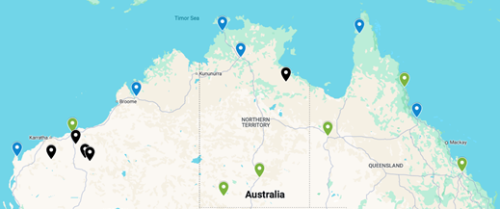
This shows that there are a limited number of civilian airfields in northern Australia with runways suitable to support unrestricted operations by Australian combat aircraft. The KC-30A tanker aircraft is particularly restricted, with only RAAF Learmonth on the west coast, RAAF Darwin and Tindal in the centre and Cairns International on the east coast able to support unrestricted operations. Some of the airfields, such as Alice Springs and Ayers Rock are too remote to be useful in most circumstances. However, there is a cluster of 7 airfields around the Pilbara, including RAAF Learmonth and RAAF Curtin, that could potentially be used to support dispersed, agile combat operations in this strategically vital area. There is also the potential to increase the number of airfields available by restricting aircraft take off weights and accepting operational limitations, or by accepting increased risk through pavement concessions or operational waivers.
A suitable runway alone is not sufficient for air combat operations. As identified earlier, fuel, other consumables and suitable parking for aircraft replenishment are also required. Some form of communications and personnel sustainment is essential, while consideration also needs to be given to appropriate levels of protection.
Figure 9 is a satellite photo of a typical Pilbara mining airfield at Christmas Creek Mine, showing the limited aircraft parking available. The airfield has a typical mining airfield fuel capacity of just over 100,000l.[67] For context, an F-35A has a fuel capacity of approximately 10,000l.[68] During the 2003 Gulf War, Australian F/A-18A Hornets achieved just under 1 sortie per aircraft per day.[69] Therefore, a half squadron deployment of six F-35A aircraft would need at least six OLAs and approximately 60,000l of fuel per day, with double those numbers for full squadron.
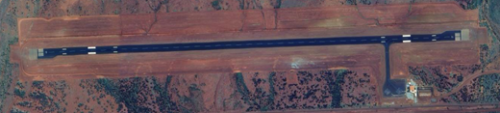
To turn an airfield like Christmas Creek into functioning dispersal base requires rapid establishment of aircraft parking, taxiways, fuel storage, communications, personnel support and ideally protection. Fortunately, much of the equipment required to achieve this is in existence, if not necessarily in use with the Australian Defence Force (ADF). The ADF already has deployable communications and facilities to sustain personnel. As the British demonstrated during the Falklands War, temporary movement surfaces capable of supporting aircraft taxiing have existed for some time. Many of these systems are in use on Australian mine sites and could support fighter movements, although larger aircraft such as the E-7A will probably have to use the existing movement surfaces.[71] Deployable revetments have been in widespread use since the Gulf War.[72] Containerised shelters able to protect fighter sized aircraft protection from the weather and more importantly satellite observation are also readily commercially available.[73] The ready availability of relatively cheap commercial solutions opens the possibility of establishing deployable infrastructure at every suitable airfield in the Pilbara, confronting an adversary with a much more complicated surveillance and targeting problem. Deployable infrastructure could also be used outside Australia if required, unlike fixed infrastructure on airbases. The biggest challenge is likely to be fuel. The fuel supply at many of these airfields is insufficient for even two days of half squadron operations, making deployable fuel infrastructure essential. However, fuel bladders required to support dispersed air operations are large, soft targets, easily visible by satellite. They still require fuel transport to resupply and move the fuel if a new dispersal location is used. The use of road trains for trains for storage and transport may provide an alternative. A four-trailer road train can hold over 140,000l of fuel, enabling fuel storage to be camouflaged out of satellite view and easily relocated to new base if required.[74]
Conclusions, Further Research and Policy Implications
The return of great power competition, dramatic increase in space surveillance capabilities and development of A2/AD systems has removed the security enjoyed by airbases during the post-Cold War period. Contemporary concepts such as Adaptive Basing and Agile Combat Employment have more in common with doctrine of the Second World War and Cold War than recent practice. The sparsity of military airbase infrastructure in northern Australia renders it extremely challenging to implement contemporary concepts using military infrastructure alone. However, as this research as established, there is potential to utilise civilian airfields to improve the resilience and survivability of air operations in northern Australia, particularly in the strategically important economic region of the Pilbara. However, this currently exists as potential only. To realise this potential will require further research and investment in materiel, personnel and organisational structures.
The most pressing research to realise this potential is field research and trials. Ultimately it is necessary to survey the airfields and associated infrastructure and build relationships with the relevant stakeholders to understand what is possible and practical. Trials are necessary to understand what materiel works and what doesn’t, what personnel skills are required and what organisational structures are most effective. It is also necessary to play the enemy during these trials, in particular turning space-based surveillance systems against the trials to understand how vulnerable these activities are to detection.
The key policy implication of this research is that civil airfields are a potentially vital component of national defence infrastructure. Cairns International Airport is particularly significant as the only airfield on the east coast of northern Australia where the KC-30A tanker aircraft can operate to full capability. This would be especially important in the event of air operations over the Coral Sea or Papua New Guinea. As such, Defence should build a relationship with the Airport owner as a key stakeholder to ensure that this strategic capability is not compromised. Defence should also maintain a watching brief on substantial public and private airfields in northern Australia and be ready to engage if advantageous. An arrangement where Defence pays the marginal cost of lengthening or strengthening the runway of a suitably located new mining airfield is much cheaper than building a new military airfield from scratch. Developing a deployable military capability to turn a civilian airfield into a functioning airbase reduces the risk of wasted investment because these capabilities can be used in Australia, the region, or globally if required. In the coordinated, whole-of-nation approach to National Defence envisaged by the government, utilisation of civilian airfields offers the potential for more effective, survivable and resilient air operations that are less costly than what Defence could achieve alone. They offer the best opportunity for Australian Air Power to survive the punch in the face.
3 Seas Europe. “The Underground Airbase That Could Launch Planes.” Accessed October 13, 2024. https://3seaseurope.com/zeljava-yugoslavia-underground-airbase-croatia/
Airbus. A330: Aircraft Characteristics Airport and Maintenance Planning: Rev Jul 01/23. Airbus S.A.S, 2023. https://aircraft.airbus.com/sites/g/files/jlcbta126/files/2023-08/ac_a330_jul2023_0.pdf
Airservices Australia. ERSA effective 21 Mar 2024. Airservices Australia, 2024.
Allshelter. “Container Mounted Dome Shelters.” Accessed October 13, 2024. https://www.allshelter.com.au/product/container-mounted-shelters/
Aloni, Shlomo. Six-Day War 1967: Operation Focus and the 12 hours that changed the Middle East. Osprey Publishing, 2019.
Altman, Howard. “What Does A Shahed-136 Really Cost.” The War Zone, February 8, 2024. https://www.twz.com/news-features/what-does-a-shahed-136-really-cost
Australian Strategic Policy Institute. “ASPI Strategist: North of 26o South.” Accessed October 13, 2024. https://www.aspistrategist.org.au/dinkus/north-of-26-south/
Australian War Memorial. Phan Rang, Vietnam. 1967-07. Aerial view of the aircraft revetments at the airbase. 1967. Australian War Memorial, Accession no. P01978.002 https://www.awm.gov.au/collection/C287384
Badowski, Russell S. “Airpower Projection in the Antiaccess / Area-Denial Environment.” in Defending Air Bases in an Age of Insurgency, edited by COL Shannon W. Caudill, USAF, Retired. Air University Press, 2019. https://www.jstor.org/stable/resrep19551.15?seq=14
Boeing. “P-8A Poseidon Maritime Patrol Aircraft: Technical Specifications.” Accessed October 13, 2024. https://www.boeing.com/defense/p-8-poseidon#tech-spec
Boeing Commercial Airplanes. D6-58325-7 Rev A: Next-Generation 737 Airplane Characteristics for Airport Planning. Boeing, 2023. https://www.boeing.com/content/dam/boeing/boeingdotcom/commercial/airports/acaps/737NG_REVA.pdf
Bronk, Justin, Nick Reynolds and Jack Watling. The Russian Air War and Ukrainian Requirements for Air Defence. RUSI, 2022. https://rusi.org/explore-our-research/publications/special-resources/russian-air-war-and-ukrainian-requirements-air-defence
Brown, CQ Jr. “Ready to Meet the Moment.” AEther: A Journal of Strategic Airpower & Spacepower 1, no. 1 (2022): 8-12, https://www.jstor.org/stable/48651801?seq=4
Campbell, David. Ex Pitch Black. 2016. Department of Defence, ref. S20161660. https://images.defence.gov.au/assets/Home/Search?Query=20160818raaf8595531_009.jpg&Type=Filename
Capella Space. “SAR Data Products.” Accessed October 13, 2024. https://cdn.prod.website-files.com/66b32de523b6c4b17bad83f2/66fdca1efb612bc02ce5b444_Capella%20Space%20Data%20Product%20Guide.pdf
Civil Aviation Safety Authority Advisory Circular AC 139.C-07v 1.0: Strength Rating of Aerodrome Pavements. Civil Aviation Safety Authority, 2021. https://www.casa.gov.au/strength-rating-aerodrome-pavements
Clausewitz, Carl Von. On War. Translated by Michael Howard and Peter Paret. Princeton University Press, 1989.
Collier, Paul, Alastair Finlan, Mark J. Grove et al. The Second World War: A World in Flames. Osprey Publishing, 2004.
Defence, Department of. Facilities Requirements for the New Air Combat Capability: Statement of Evidence to the Parliamentary Committee on Standing Works. Commonwealth of Australia, 2014. https://www.aph.gov.au/DocumentStore.ashx?id=b2b1ed75-dc16-447a-a878-b8670edb674d&subId=254100
Defence, Department of. Facilities Requirements for the Maritime Patrol Aircraft Replacement Capability: Statement of Evidence to the Parliamentary Committee on Standing Works. Commonwealth of Australia, 2014. https://www.aph.gov.au/DocumentStore.ashx?id=cbc05e6e-30a1-4658-8673-734072ae593b&subId=301132
Defence, Department of. Integrated Investment Program 2024. Commonwealth of Australia, 2024. https://www.defence.gov.au/about/strategic-planning/2024-national-defence-strategy-2024-integrated-investment-program
Defence, Department of. National Defence Strategy 2024. Commonwealth of Australia, 2024. https://www.defence.gov.au/about/strategic-planning/2024-national-defence-strategy-2024-integrated-investment-program
Deptula, David A. “A New Battle Command Architecture for Joint All-Domain Operations,” AEther: A Journal of Strategic Airpower & Spacepower 1, no. 1 (2022): 51-56, https://www.jstor.org/stable/48651807?seq=6
Dildy, Douglas C. Battle of Britain 1940: The Luftwaffe’s ‘Eagle Attack’. Osprey Publishing, 2018.
Hallion, Richard P. Desert Storm 1991: The most shattering air campaign in history, Osprey Publishing, 2022.
HESCO. “Mil Units.” Accessed October 13, 2024. https://www.hesco.com/products/mil-units/
Hupfeld, Air Vice-Marshal Mel. “The 2003 Gulf War – Australia.” In Proceedings of the 2014 RAAF Air Power Conference: A Century of Military Aviation 1914-2014, edited by Keith Brent. Air Power Development Centre, 2014.
Imperial War Memorial, The remains of an Iraqi Hardened Aircraft Shelter (HAS) destroyed by Coalition Laser Guided Bombs, Imperial War Memorial, Catalogue no. GLF 390, https://www.iwm.org.uk/collections/item/object/205018648
Infrastructure, Transport, Regional Development, Communication and the Arts, Department of. “Office of Northern Australia.” Accessed October 13, 2024. https://www.infrastructure.gov.au/territories-regions-cities/regional-australia/office-northern-australia
Middlebrook, Martin. The Argentine Fight for the Falklands. Pen & Sword, 2003.
Mills, Patrick, James A. Leftwich, Kristen Van Abel and Jason Mastbaum. Estimating Air Force Deployment Requirements for Lean Force Packages: A Methodology and Decision Support Tool Prototype. RAND Corporation, 2017. https://www.rand.org/pubs/research_reports/RR1855.html
Mills, Patrick, James A. Leftwich, John G. Drew et al., Building Agile Combat Support Competencies to Enable Evolving Adaptive Basing Concepts. RAND Corporation, 2020. https://www.rand.org/pubs/research_reports/RR4200.html
Mischie, Colonel Ioan. “Causes of the Failure of Russian Aviation Achieving Air Supremacy in the Ukraine Conflict and Subsequent Influences on its Evolution,” Romanian Military Thinking 1 (2023): 30-47. https://research.ebsco.com/c/2jmkxr/viewer/pdf/nvfd3c6jiz
Moer, Zachary T., Christopher M. Chini, Peter P. Feng and Steven J. Schuldt. “Contested Agile Combat Employment: A Site Selection Methodology.” Air & Space Operations Review 1, no. 3 (2022): 62-77. https://research.ebsco.com/c/2jmkxr/viewer/pdf/datbfjupdn
Murray, William S. “Revisiting Taiwan’s Defense Strategy.” Naval War College Review 61, Iss. 3 (2008): 12-39 https://www.proquest.com/docview/205937062/fulltextPDF/8E7E4EBA74A44BD1PQ/1?accountid=10479&sourcetype=Scholarly%20Journals
Parliament of Australia. “4. RAAF Base Tindal Stage 6 Redevelopment and United States Force Posture Initiative Airfield Works.” Accessed October 13, 2024. https://www.aph.gov.au/Parliamentary_Business/Committees/Senate/Rural_and_Regional_Affairs_and_Transport/OffshorePetroleumBills/Report/Section?id=committees%2Freportjnt%2F024459%2F73081
Parliament of Australia. “Department of Defence – RAAF Base Learmonth Redevelopment Enabling KC-30A Operations, Exmouth, Western Australia.” Accessed October 13, 2024. https://www.aph.gov.au/Parliamentary_Business/Committees/Joint/Public_Works/DoDRAAFLearmonth
Planet Labs. “High Resolution Satellite Imagery with Planet Satellite Tasking.” Accessed October 13, 2024. https://www.planet.com/products/high-resolution-satellite-imagery/
Quote Investigator. “Everybody Has Plans Until They Get Hit for the First Time.” Accessed October 13, 2024. https://quoteinvestigator.com/2021/08/25/plans-hit/
Royal Australian Air Force. “About Us: Bases.” Accessed October 13, 2024. https://www.airforce.gov.au/about-us/bases
Royal Australian Air Force. “Aircraft: F-35A Lightning II.” Accessed October 13, 2024. https://www.airforce.gov.au/aircraft/f-35a-lightning-ii
Royal Australian Air Force. “Aircraft: KC-30A Multi-Role Tanker Transport.” Accessed October 13, 2024. https://www.airforce.gov.au/aircraft/kc-30a-mrtt
Sidoti, Sal. Airbase Operability: A Study in Airbase Survivability and Post-Attack Recovery. Aerospace Centre, 2001.
Solen, Derek. “The PLA Air Force’s Efforts Towards Agile Combat Employment.” China Brief 21, no.17 (2021): 18-22, https://jamestown.org/program/the-pla-air-forces-efforts-toward-agile-combat-employment/
Soloco LLC. Dura-Base Composite Mat System: Application Evaluation and Design Rev 0.0. Soloco LLC, 2002.
Tri-Service Transportation: Pavements-Transportation – Community of Practice. “ACN and ACR Calculator.” Accessed October 13, 2024. https://transportation.erdc.dren.mil/acnacr/
Think Defence. “The San Carlos FOB (Forward Operating Base).” Accessed October 13, 2024. https://www.thinkdefence.co.uk/2024/06/the-san-carlos-fob-forward-operating-base/
UK Parliament. “Camp Bastion Attack report published.” accessed October 13, 2024. https://committees.parliament.uk/work/2225/afghanistan-camp-bastion-attack/news/183159/camp-bastion-attack-report-published/#:~:text=The%20ensuing%20engagement%20lasted%20into,of%20six%20US%20Harrier%20jets.
U.S. Air Forces in Europe. “Raptor pilots visit future generation.” Accessed October 13, 2024. https://www.usafe.af.mil/News/Article-Display/Article/748112/raptor-pilots-visit-future-generation
U.S. Department of Defense. 2022 National Defense Strategy of the United States of America including the 2022 Nuclear Posture Review and the 2022 Missile Defense Review. U.S. Department of Defense, 2022. https://media.defense.gov/2022/Oct/27/2003103845/-1/-1/1/2022-NATIONAL-DEFENSE-STRATEGY-NPR-MDR.pdf
U.S. Department of Defense, Quadrennial Defense Review 2014. U.S. Department of Defense, 2014. https://history.defense.gov/Portals/70/Documents/quadrennial/QDR2014.pdf?ver=tXH94SVvSQLVw-ENZ-a2pQ%3d%3d
Wiswesser, Sean M. “Potemkin on the Dnieper: the Failure of Russian Airpower in the Ukraine War.” Small Wars & Insurgencies 34, no. 7 (2023): 1205-1234. https://www.tandfonline.com/doi/pdf/10.1080/09592318.2023.2187201
Woodward, Admiral Sandy with Patrick Robinson One Hundred Days: The Memoirs of the Falklands Battle Group Commander. Harper Collins, 2003.
Zabrodskyi, Mykhaylo, Jack Watling, Oleksander V Danylyuk and Nick Reynolds. Preliminary Lessons in Conventional Warfighting from Russia’s Invasion of Ukraine: February-July 2022. RUSI, 2022. https://rusi.org/explore-our-research/publications/special-resources/preliminary-lessons-conventional-warfighting-russias-invasion-ukraine-february-july-2022
1 “Everybody Has Plans Until They Get Hit for the First Time,” Quote Investigator, accessed October 13, 2024, https://quoteinvestigator.com/2021/08/25/plans-hit/
2 Carl Von Clausewitz, On War, trans. Michael Howard and Peter Paret (Princeton University Press, 1989), 77.
3 Department of Defence, National Defence Strategy 2024 (Commonwealth of Australia, 2024), 29, https://www.defence.gov.au/about/strategic-planning/2024-national-defence-strategy-2024-integrated-investment-program.
4 Department of Defence, Integrated Investment Program 2024 (Commonwealth of Australia, 2024), 87, https://www.defence.gov.au/about/strategic-planning/2024-national-defence-strategy-2024-integrated-investment-program.
5 Distances measured using Google Earth App October 13, 2024.
6 “About Us: Bases,” Royal Australian Air Force, accessed October 13, 2024, https://www.airforce.gov.au/about-us/bases
7 Defence, National Defence Strategy, 17.
8 “Office of Northern Australia,” Department of Infrastructure, Transport, Regional Development, Communication and the Arts, accessed October 13, 2024, https://www.infrastructure.gov.au/territories-regions-cities/regional-australia/office-northern-australia
9 “ASPI Strategist: North of 26o South,” Australian Strategic Policy Institute, accessed October 13, 2024, https://www.aspistrategist.org.au/dinkus/north-of-26-south/
10 Zachary T. Moer et al. , “Contested Agile Combat Employment: A Site Selection Methodology,” Air & Space Operations Review 1, no.3 (2022): 70-71 https://research.ebsco.com/c/2jmkxr/viewer/pdf/datbfjupdn
11 Airservices Australia, ERSA effective 21 Mar 2024 (Airservices Australia, 2024).
12 There was no official information available on F/A-18F and E/A-18G airfield length requirements. However, both aircraft are designed to operate from aircraft carriers and all publicly available information indicated that they require a significantly shorter runway than the F-35A
13 Civil Aviation Safety Authority, Advisory Circular AC 139.C-07v 1.0: Strength Rating of Aerodrome Pavements (Civil Aviation Safety Authority, 2021), 22, https://www.casa.gov.au/strength-rating-aerodrome-pavements
14 Satellite view of RAAF Tindal, Google Maps, accessed October 13, 2024 https://www.google.com/maps/@-14.5271258,132.3950147,1711m/data=!3m1!1e3?entry=ttu&g_ep=EgoyMDI0MTAwMi4xIKXMDSoASAFQAw%3D%3D
15 Department of Defence, Facilities Requirements for the New Air Combat Capability: Statement of Evidence to the Parliamentary Committee on Standing Works (Commonwealth of Australia, 2014), 15, https://www.aph.gov.au/DocumentStore.ashx?id=b2b1ed75-dc16-447a-a878-b8670edb674d&subId=254100
16 Australian War Memorial, Phan Rang, Vietnam. 1967-07. Aerial view of the aircraft revetments at the airbase, 1967, Australian War Memorial, Accession no. P01978.002, https://www.awm.gov.au/collection/C287384
17 “Raptor pilots visit future generation,” U.S. Air Forces in Europe, accessed October 13, 2024 https://www.usafe.af.mil/News/Article-Display/Article/748112/raptor-pilots-visit-future-generation
18 “The Underground Airbase That Could Launch Planes,” 3 Seas Europe, accessed October 13, 2024, https://3seaseurope.com/zeljava-yugoslavia-underground-airbase-croatia/
19 Douglas C. Dildy, Battle of Britain 1940: The Luftwaffe’s ‘Eagle Attack’ (Osprey Publishing, 2018), 40.
20 Dildy, Battle of Britain, 36.
21 Dildy, Battle of Britain, 42.
22 Dildy, Battle of Britain, 75.
23 Paul Collier et al., The Second World War: A World in Flames (Osprey Publishing, 2004), 181.
24 Shlomo Aloni, Six-Day War 1967: Operation Focus and the 12 hours that changed the Middle East (Osprey Publishing, 2019), 86.
25 Aloni, Six-Day War, 23-24.
26 Aloni, Six-Day War, 15-17.
27 Sal Sidoti, Airbase Operability: A Study in Airbase Survivability and Post-Attack Recovery, (Aerospace Centre, 2001), 38-44.
28 Martin Middlebrook, The Argentine Fight for the Falklands (Pen & Sword, 2003), 76-78.
29 Admiral Sandy Woodward with Patrick Robinson, One Hundred Days: The Memoirs of the Falklands Battle Group Commander (Harper Collins, 2003), 271-278.
30 “The San Carlos FOB (Forward Operating Base)”, Think Defence, accessed October 13, 2024, https://www.thinkdefence.co.uk/2024/06/the-san-carlos-fob-forward-operating-base/
31 Think Defence. “The San Carlos FOB.”
32 Richard P. Hallion, Desert Storm 1991: The most shattering air campaign in history, (Osprey Publishing, 2022), 20-28.
33 Hallion, Desert Storm, 8, 14, 89-90.
34 Hallion, Desert Storm 59-60, 91.
35 Imperial War Memorial, The remains of an Iraqi Hardened Aircraft Shelter (HAS) destroyed by Coalition Laser Guided Bombs, Imperial War Memorial, Catalogue no. GLF 390, https://www.iwm.org.uk/collections/item/object/205018648
36 “Camp Bastion Attack report published,” UK Parliament, accessed October 13, 2024, https://committees.parliament.uk/work/2225/afghanistan-camp-bastion-attack/news/183159/camp-bastion-attack-report-published/#:~:text=The%20ensuing%20engagement%20lasted%20into,of%20six%20US%20Harrier%20jets.
37 U.S. Department of Defense, Quadrennial Defense Review 2014 (U.S. Department of Defense, 2014), 4, https://history.defense.gov/Portals/70/Documents/quadrennial/QDR2014.pdf?ver=tXH94SVvSQLVw-ENZ-a2pQ%3d%3d
38 U.S. Department of Defense, 2022 National Defense Strategy of the United States of America including the 2022 Nuclear Posture Review and the 2022 Missile Defense Review (U.S. Department of Defense, 2022), 2, 4, https://media.defense.gov/2022/Oct/27/2003103845/-1/-1/1/2022-NATIONAL-DEFENSE-STRATEGY-NPR-MDR.pdf
39 “High Resolution Satellite Imagery with Planet Satellite Tasking,” Planet Labs, accessed October 13, 2024, https://www.planet.com/products/high-resolution-satellite-imagery/
40 “SAR Data Products,” Capella Space, accessed October 13, 2024, https://cdn.prod.website-files.com/66b32de523b6c4b17bad83f2/66fdca1efb612bc02ce5b444_Capella%20Space%20Data%20Product%20Guide.pdf
41 Howard Altman, “What Does A Shahed-136 Really Cost,” The War Zone, February 8, 2024, https://www.twz.com/news-features/what-does-a-shahed-136-really-cost
42 Patrick Mills et al., Estimating Air Force Deployment Requirements for Lean Force Packages: A Methodology and Decision Support Tool Prototype (RAND Corporation, 2017), 22, https://www.rand.org/pubs/research_reports/RR1855.html
43 Patrick Mills et al., Building Agile Combat Support Competencies to Enable Evolving Adaptive Basing Concepts (RAND Corporation, 2020), xiii, https://www.rand.org/pubs/research_reports/RR4200.html
44 David A. Deptula, “A New Battle Command Architecture for Joint All-Domain Operations,” AEther: A Journal of Strategic Airpower & Spacepower 1, no. 1 (2022): 56, https://www.jstor.org/stable/48651807?seq=6
45 CQ Brown Jr., “Ready to Meet the Moment,” AEther: A Journal of Strategic Airpower & Spacepower 1, no. 1 (2022): 11, https://www.jstor.org/stable/48651801?seq=4
46 Russell S. Badowski, “Airpower Projection in the Antiaccess / Area-Denial Environment,” in Defending Air Bases in an Age of Insurgency, ed. COL Shannon W. Caudill, USAF, Retired (Air University Press, 2019), 279-281 https://www.jstor.org/stable/resrep19551.15?seq=14
47 Derek Solen, “The PLA Air Force’s Efforts Towards Agile Combat Employment,” China Brief 21, no.17 (2021): 18-22, https://jamestown.org/program/the-pla-air-forces-efforts-toward-agile-combat-employment/
48 William S. Murray, “Revisiting Taiwan’s Defense Strategy,” Naval War College Review 61, no. 3 (2008): 21-24, https://www.proquest.com/docview/205937062/fulltextPDF/8E7E4EBA74A44BD1PQ/1?accountid="10479&sourcetype"=Scholarly%20Journals
49 Sean M. Wiswesser, “Potemkin on the Dnieper: the Failure of Russian Airpower in the Ukraine War,” Small Wars & Insurgencies 34, no. 7 (2023): 1205, https://www.tandfonline.com/doi/pdf/10.1080/09592318.2023.2187201
50 Mykhaylo Zabrodskyi et al., Preliminary Lessons in Conventional Warfighting from Russia’s Invasion of Ukraine: February-July 2022 (RUSI, 2022), 24, https://rusi.org/explore-our-research/publications/special-resources/preliminary-lessons-conventional-warfighting-russias-invasion-ukraine-february-july-2022
51 Colonel Ioan Mischie, “Causes of the Failure of Russian Aviation Achieving Air Supremacy in the Ukraine Conflict and Subsequent Influences on its Evolution,” Romanian Military Thinking 1 (2023): 35-36, https://research.ebsco.com/c/2jmkxr/viewer/pdf/nvfd3c6jiz
52 Zabrodskyi et al., Preliminary Lessons, 25-26.
53 Justin Bronk et al., The Russian Air War and Ukrainian Requirements for Air Defence (RUSI, 2022), 32-34, https://rusi.org/explore-our-research/publications/special-resources/russian-air-war-and-ukrainian-requirements-air-defence
54 Counted using Google Earth App October 13, 2024.
55 David Campbell, Ex Pitch Black, 2016, Department of Defence, ref. S20161660, https://images.defence.gov.au/assets/Home/Search?Query=20160818raaf8595531_009.jpg&Type=Filename
56 “ACN and ACR Calculator,” Tri-Service Transportation: Pavements-Transportation – Community of Practice, accessed October 13, 2024, https://transportation.erdc.dren.mil/acnacr/
57 “Aircraft: F-35A Lightning II,” Royal Australian Air Force, accessed October 13, 2024, https://www.airforce.gov.au/aircraft/f-35a-lightning-ii
58 Department of Defence, Facilities Requirements for the New Air Combat Capability, 7.
59 Official Data was unavailable for the E-7A. The E-7A is a derivative of the Boeing 737-700, so Boeing 737-700 data was used.
60 Boeing Commercial Airplanes, D6-58325-7 Rev A: Next-Generation 737 Airplane Characteristics for Airport Planning (Boeing, 2023), 3-29 https://www.boeing.com/content/dam/boeing/boeingdotcom/commercial/airports/acaps/737NG_REVA.pdf
61 Boeing Commercial Airplanes, Next-Generation 737 Airplane Characteristics, 3-29, 2000ft airfield at MTOW.
62 “P-8A Poseidon Maritime Patrol Aircraft: Technical Specifications,” Boeing, accessed October 13, 2024, https://www.boeing.com/defense/p-8-poseidon#tech-spec
63 Department of Defence, Facilities Requirements for the Maritime Patrol Aircraft Replacement Capability: Statement of Evidence to the Parliamentary Committee on Standing Works (Commonwealth of Australia, 2014), 19-20, https://www.aph.gov.au/DocumentStore.ashx?id=cbc05e6e-30a1-4658-8673-734072ae593b&subId=301132
64 “Aircraft: KC-30A Multi-Role Tanker Transport,” Royal Australian Air Force, accessed October 13, 2024, https://www.airforce.gov.au/aircraft/kc-30a-mrtt
65 Airbus, A330: Aircraft Characteristics Airport and Maintenance Planning: Rev Jul 01/23 (Airbus S.A.S, 2023), s3-3-2 p4, ~500ft airfield at MTOW, https://aircraft.airbus.com/sites/g/files/jlcbta126/files/2023-08/ac_a330_jul2023_0.pdf
66 Airservices Australia, ERSA, except as noted.
67 Christmas Creek Aerodrome Supervisor, email to author, October 7, 2024.
68 Royal Australian Air Force, “F-35A Lightning II.”
69 Air Vice-Marshal Mel Hupfeld, “The 2003 Gulf War – Australia,” in Proceedings of the 2014 RAAF Air Power Conference: A Century of Military Aviation 1914-2014, ed. Keith Brent (Air Power Development Centre, 2014), 220-221.
70 Satellite view of Christmas Creek Mine airport, Google Maps, accessed October 13, 2024 https://www.google.com/maps/@-22.3554942,119.6426159,1635m/data=!3m1!1e3?entry=ttu&g_ep=EgoyMDI0MTAwOS4wIKXMDSoASAFQAw%3D%3D
71 Soloco LLC, Dura-Base Composite Mat System: Application Evaluation and Design Rev 0.0 (Soloco LLC, 2002), 3.
72 “Mil Units,” HESCO, accessed October 13, 2024, https://www.hesco.com/products/mil-units/
73 “Container Mounted Dome Shelters,” Allshelter, accessed October 13, 2024, https://www.allshelter.com.au/product/container-mounted-shelters/
74 Aero Refuellers Port Headland, Telephone conversation with author, October 3, 2024.
Defence Mastery
Technical Mastery
Social Mastery

Squadron Leader Craig Reynolds is an Aeronautical Engineer and a graduate of the Australian Command and Staff Course (Military Art) class of 2024. He is currently posted to Air Force Headquarters, where he works on capability requirements for the MQ-28A Ghostbat.
Potential use of civilian airfields to improve resilience of air operations in Northern Australia © 2024 by . This work is licensed under CC BY-NC-ND



Please let us know if you have discovered an issue with the content on this page.
Comments
Start the conversation by sharing your thoughts! Please login to comment. If you don't yet have an account registration is quick and easy.