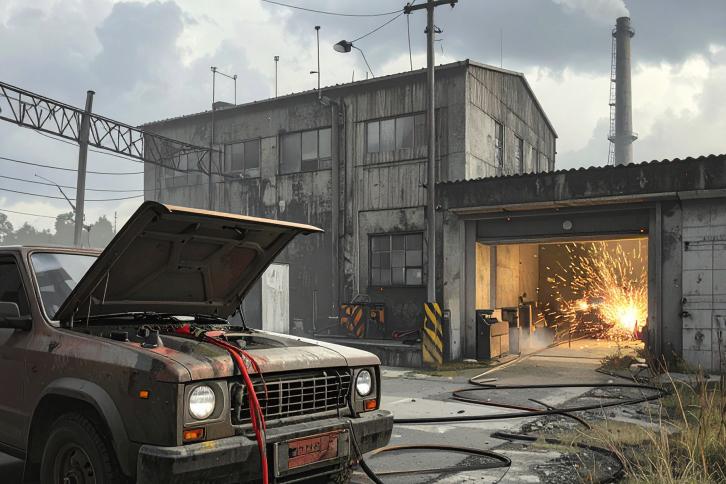
The start of a war is a strategic shock even for those who initiate it. The course of events is uncertain as many factors begin to impact. Decision-makers become confused by unexpected happenings, successes and reversals. Through it all, the pace can become unrelenting.
In a new paper, hopefully to be published later this year, I explore the start of the national industrial mobilisations of Australia, Canada and the US during World War Two. Australia and Canada were slow to get underway, for which their respective armed forces were partly responsible. The American mobilisation was much faster but chaotic with a massive over-ordering that actually slowed its outputs being delivered to the armed forces.
None of the three mobilisations provide faultless models in themselves. On the other hand, they each had common features. Combining these shared aspects suggests distinct actions that could be taken by a nation's military at the start of a future war to both expedite and improve a national industrial mobilisation.
To gain these advantages, preparation needs to be taken prewar to have processes in place and able to be quickly activated. Waiting until the start of a war will lead to the problems that Australia, Canada and the US encountered when each entered World War Two. The following sections derived from the three nations’ experiences set out actions that should be taken prewar.
Develop Doctrine
Doctrine should be developed to support how procurement branches prepare and place orders at the start of war. I was involved in writing the current high-level doctrine (so it’s superb) but is for a different purpose. It is not sufficient in itself.
In placing initial wartime procurement orders, a certain boldness is essential as there will be considerable uncertainties. Having an acquisition-focused doctrine will reassure organisational leaderships and their staff, and encourage them into taking audacious actions. This doctrine might stress that the initial orders the military makes at the start of a war can only be predictive and accordingly unlikely to be accurate. The doctrine might propose devising orders based on broad considerations, including the anticipated size and composition of the expanded force, generalisations about the character of equipment needs, and arbitrary assumed rates of attrition, usage and ammunition expenditure.
Know What to Order Immediately War Starts
At the start of a war, there will be considerable confusion. The impact of this on a mobilisation can be reduced by having prepared material and munition orders available to quickly place with defence industry with the minimum delay. The prewar preparation of these orders ensures careful consideration can be given to meshing the military strategy and the industrial mobilisation plan; whether industry has the capability and capacity to complete the orders; amalgamating orders across the defence enterprise; prioritising the orders; and the impact of the orders on the civilian sector of the economy.
Importantly, the planned orders should be devised to ensure they grow the national industrial base in the direction most useful to anticipated later parts of the war. Providing industry with a tentative future order plan will allow companies to factor this into their initial expansion. A significant issue is whether the orders placed are envisaged by the military as a one-off or as part of a continuing series. The aim should be to keep production lines flowing smoothly and thus avoid stop/start production problems.
All of these aspects apply to the domestic industrial base with some also to international defence companies. No country can run an autarkic mobilisation.
A fallback if an order plan related to the military strategy cannot be devised is to instead plan to place the maximum feasible orders for whatever might possibly be needed. Such an approach focuses on increasing manufacturing output irrespective of the character of the war. Optimising the manufacturing output can be undertaken when the war is better understood and defined. This approach will commence a broad expansion of the industrial base, although somewhat wastefully as scarce resources will inevitably be diverted to less important aspects.
Decide an Order Priority System
An order priority system should be established by the military to ensure the most urgently required material and munitions are given production priority. However, history highlights that such a system can be overused and become useless after a time. This period will depend on the scarcity of manufacturing resources: the greater the level of scarcity the sooner the order priority system will collapse.
With the failure of the military order priority system, the government supply department and/ or the manufacturing companies will adopt simple tactical-level expedients and prioritise anyway. For example, a company might fill the more profitable orders first. A department might action small, easy orders before large and complex ones.
A robust and enduring wartime order priority system was not devised by Australia, Canada or the US during World War Two. It’s worth addressing prewar before wartime pressures overwhelm thinking.
Decide on the Production Balance
From the military viewpoint, balance may be sought across the joint force. However, determining the balanced force for a war that has just started may be difficult, especially as in its early stages the conflict may be quickly evolving. The initial wartime orders may be determined by responding to an attack and calling for as large as possible a quantity of defensive-type supplies as quickly as possible. After some time, the war’s demands may be better understood and adequate stocks may have been built up of the type of material and munitions ordered initially.
The initial order types might then change to emphasise offensive-type supplies. However, the initial orders will have created a certain industrial base structure. In being rapidly expanded from a narrow base in the early stages of the war, this industry might have become optimised for some types of production but not all. Companies may have trouble switching production to new items.
The production balance across the course of the war needs determining. This will be more correct in the nearer term than in the war’s envisaged later stages. Nevertheless, comprehending the later stage possibilities will usefully inform the initial orders that set the development of the future industrial base.
Devise a Wartime Scheduling Process
In wartime, large defence programs require careful scheduling of constituent elements to ensure timely delivery. Scheduling determines when and in what order those tasks happen, including timelines, deadlines and durations. Historically, interference between the elements of the many individual projects underway has been an ongoing and significant issue. Active deconfliction is necessary.
This requires establishing a production executive committee focused on schedules and composed of both the military procurement agencies and the civilian departments controlling the civilian sector. In agreeing on program schedules, the committee also defines the constraints of the national industrial capacity and works with the procurement organisations to adjust the military orders to fit those constraints. The committee also provides a framework for senior procurement officers to agree on a whole-of-defence production program schedule.
Note ‘controlling the civilian sector. In a conceptual sense, the nation has a certain total amount of resources. That total amount can be split between that needed for the civil sector and that needed for the defence sector. In a wartime mobilisation, more is allocated to the defence sector and accordingly taken from the civil sector.1 In World War Two, Australia had several government departments controlling the civilian sector; Canada had only one while the US had countless overlapping departments and agencies.
Devise a Wartime Programming Process
In wartime, there is a crucial interrelationship between the military strategy and the production programming. Programming defines what needs to be done in terms of outcomes sought, tasks and resources.
Building and applying power needs to be synchronised to manufacture what is needed when it is needed by the armed forces. To ensure such coordination, a wartime programming process needs to be devised. This process will involve a flexible schedule of meetings involving the procurement agencies, the military planning staff within the strategic headquarters, and the civilian department controlling the civilian sector. The activities of all three are relevant to military production programming.
Reconcile the Can Do/Should Do Tension
At the start of a war there may be a tension between what industry can do and what the military believes industry should do. Companies may be able to swiftly manufacture equipment but which does not fit the military strategy. On the other hand, the military may call for equipment that can’t be built by industry until its capabilities are improved and its capacity increased. The two extremes need active reconciliation prewar.
The military needs to understand what industry could very quickly provide in extremis. While the military may not want the material or munitions that could be so manufactured, in a war that may be all that is available in the near term. The operational and strategic implications of this need to be thought out before such a dire situation occurs. Something may be better than nothing—or not.
Plan to Place Identified Business Professionals into Appropriate Departments
At the start of a war, the government departments, organisations and agencies associated with defence supply will need rapid expansion. A plan for this needs considering. An option to accelerate mobilisation, and one proven in World War Two, is to recruit business professionals with appropriate skills, including in industrial production, business management, accounting and legal matters. Bringing business professionals into the applicable government departments will give confidence to a government, media and general public often sceptical of military procurement prowess.
A plan to utilise business professionals should not be left to the start of the war to implement. A rolling set of individuals could be usefully identified and recruited years before, allowing them time to formally and informally develop their knowledge of the mobilisation challenges. Australia’s WW2 mobilisation ‘industrial dictator’, Essington Lewis, had effectively undergone some two decades of such an education before being appointed Director-General of the Department of Munitions. Lewis’s highly successful appointment was an obvious one at the time and still is, but it was 20 years in the making.2
Conclusion
National mobilisation can appear a daunting and perhaps bewildering topic. Military mobilisation planners, though, have faced such issues before. The successes and failures of the early days of World War Two can provide useful guideposts on the industrial mobilisation planning path.
1. Peter Layton, National Mobilisation During War: Past Insights, Future Possibilities, Canberra: National Security College, August 2020, pp. 48-52.
2. Geoffrey Blainey and Ann G. Smith, ’Essington Lewis (1881–1961)’, Australian Dictionary of Biography, Vol.10, 1986, https://adb.anu.edu.au/biography/lewis-essington-7185
Defence Mastery
Social Mastery

Dr Peter Layton is a Visiting Fellow at the Griffith Asia Institute and an Associate Fellow RUSI (UK). He has extensive aviation and defence experience, is the author of Grand Strategy and the co-author of Warfare in the Robotic Age.
Jump-Starting a Wartime National Industrial Mobilisation © 2026 by . This work is licensed under CC BY-NC-ND



Please let us know if you have discovered an issue with the content on this page.
Comments
The article captures the tension at the heart of US grand strategy: liberalism has always depended on hegemonic power, yet power increasingly pulls policy away from liberal ends, as we now see in plain sight.
The post‑Cold War moment was the anomaly; a period when US primacy was so overwhelming that values and interests could be rhetorically fused. As relative power erodes, that fusion breaks down and something approximating realpolitik appears to emerge, again, as we plainly see.
The question then, is not whether realpolitik has replaced liberalism, but whether the liberal order can survive without hegemony. Revival in its universal form seems unlikely but the article hints at an alternative future: a thinner, more selective liberalism grounded in coalitions of capability and principle, rather than universal norms. In this sense, the choice is not between principle and power, but between overextended moral ambition and a more modest, interest‑aligned liberalism that accepts pluralism and strategic restraint. And this is what Mark Carney alluded to only a few weeks ago when he addressed the Australian parliament on grounds of middle power commonality and cultural alignment.
If the liberal order is to endure - I doubt it will be restored—it will have to be renegotiated, with legitimacy flowing less from declarations of rhetorical values and more from consistent, limited actions that others believe liberal partnerships and alignments can actually sustain.
Continue the conversation by sharing your thoughts! Please login to comment. If you don't yet have an account registration is quick and easy.




A timely article in classic Layton style - direct and to the point. The historical reflections are particularly instructive; Australia’s sluggish and fragmented industrial response at the start of the Second World War is a stark reminder that mobilisation deferred is capability stifled.
The assumption that industry can rapidly expanded once conflict begins proved costly then, and it is riskier today. By grounding contemporary planning challenges in those historical lessons, this piece makes a case for treating industrial preparedness as a standing national imperative, not a problem to be solved after warning time arrives. And maybe it has arrived.