
This paper will argue that the Force Design outlined in the Defence Strategic Review (DSR) does not meet the demands of the next two decades, a period marked with significant and unpredictable strategic challenges.
The first section argues that the force design in the DSR is too narrowly focussed on denial, the planning carries significant risk due to the reliance on assumptions about the PRC, allies, and partners that history has shown these assumptions are often inaccurate. A broader force design is necessary to mitigate risks associated with these assumptions, emphasising that while a focused force provides clarity and direction, it also limits the military's ability to respond to unforeseen challenges. Australia needs a broad force structure to address a wide range of strategic outcomes and contingencies.
The second argument identifies that the A2AD force design is missing a survivable long-range strike capability until the SSNs capability in 2040. It examines the long-range strike capabilities proposed across the land, air, and sea domains, showing that the force design lacks credible long-range strike in a contested environment due to the survivability and limited ranges from the platforms and missiles being acquired. The argument recommends acquiring the B21 bomber, which could address a survivable long-range strike requirement by 2030, ten years sooner than the SSNs.
The third argument highlights the narrow force design focussing on A2AD in the land domain, arguing that this approach leaves Australia ill-prepared for other contingencies such as an engagement with PRC amphibious forces. It assesses the terrain and infrastructure within the archipelago to the north and provides a detailed comparison of force structures highlighting a capability mismatch between the two forces. It recommends Australia acquire the originally planned 450 IFVs to address the shortcoming.
The DSR terms of reference outlined that the authors were to “ensure that Defence has the right capabilities that are postured to meet the growing strategic challenges that Australia will face in the world in the coming years.”[1] These arguments clearly show that the DSR is based on risky assumptions, delivering a force design that lacks ability to address contingencies, that the key focus of A2AD lacks survivable long range strike and that the current land domain options and contingencies would be ineffective against the PRC.
DSR Force Structure is too narrowly focused on Denial
The DSR force structure has a narrow focus on denial. If assumptions about PRC, our allies’ and partners actions are incorrect, then there are too few alternative options for government.
Assessments over the last 20 years have continually misread the PRC, its growth, its economics, its ambition and significantly its strategic actions. President Xi has indicated that re-unification with Taiwan may come to conflict, in his statement of “taking all necessary measures” [2] which remains a policy of the Ministry of National Defence today.[3] How re-unification, and a conflict would be achieved is not well understood due to the differing cultures, values, and approach to competition.[4] Assumptions for how the PRC would conduct a major conflict must cater for an extremely broad set of questions:
- What would the conflict between the US and PRC look like and how would it evolve?
- What would be the military and strategic goals, and how would the economic and business factors impact a conflict?
- What is the US Plan?
- How would all this impact Australia and any military activities we would be required to do?[5]
- How will Space and Cyber impact the operational and strategic level?
The breadth and complexity of assumptions around PRC actions carry significant risk of incorrect assumptions, therefore a broad force design is required to mitigate the risk of incorrect assumptions.
The DSR moves Australia from a balanced force to a focussed force[6], with limited resources focusing the force on specific objectives, is prudent. However, the force is focussed on assumptions of potential PRC actions where the west has a poor track record of getting this right. Effective force design balances the tension between focussing on a specific strategy and retaining agility and flexibility of the force. A focussed force aligns the force with a clear objective, and it is an efficient use of resources providing more combat power at a specific point/objective.[7] The downside being most forces are aligned to a single objective limiting the options not aligned to that objective. Flexible and agile force design creates options and reduces the risk as situations evolve; it brings less force to bear pre-assessed objectives, however it has the benefit of bringing more force on unexpected or unplanned objectives.[8] Decision makers should be reminded that the Maginot Line in World War 2 was based on incorrect assumptions which lead to French capitulation in just over six weeks.[9] Ultimately force design cannot eliminate all uncertainties, and a focussed force provides clear unity and direction to the force, yet, additional agile and flexible force capabilities provide a broad agile and flexible force design, providing decision makers with more denial options.
The DSR focusses the force on a narrow strategy of denial, specifically A2AD, [10] it offers few options if this approach is unsuccessful or is not able to be implemented. A2AD relies on exquisite and expensive capabilities; a single strike containing 4 x F-35 ($400m) is 6% of Australia’s fighter force firing 10% ($24M)[11] of the long-range missiles. A task group containing 2 x Hobart Class Destroyers ($4 Billion)[12] is 66% of the capability and once fired would need weeks to re-arm and re-position. Due to the size of the PRC military, there is risk that their forces could overwhelm the missile stockpiles, delivery platforms or timelines for Australia to achieve effective A2AD in the northern archipelago. Similar to Russia’s reported firing of 2,154 missiles[13] in the first two months of the Ukraine war, draining their stockpiles and requiring conventional military forces to conduct the bulk of the fighting. The DSR does not provide a broad force structure that accounts for a failure, or defeat of our A2AD forces or for the PRC to conduct actions that mitigate or negate A2AD within the norther approaches.
Long-range strike before 2040
The DSR force structure is too narrow in long-range strike capability until SSN capability arrives in 2040. The DSR states long-range strike, undersea warfare, and surface to air missiles as enablers for A2AD.[14] Australia has a potent undersea warfare capability in the Collins class submarines and ANZAC frigates, surface to air missiles are being acquired with the short-range surface to air missiles in the form of NASAMs entering service, and the AIR6502 project to introduce medium and long-range air defence over the coming years.[15] Australia does not currently field a long-range strike capability to implement effective long-range strike. This paper will assess long-range strike using Marcus Hellyer and Andrew Nicholls definition:
Air domain long-range strike missiles are on order such in the form of the JASSM-ER, coupled with the F/A-18F Super Hornets and F-35 Lightnings which will provide an unrefuelled strike radius of 2,000 kilometres. The AGM 158C Long Range Anti-Ship Missile (LRASM) coupled with the F/A-18F Super Hornets, F-35 Lightnings and P-8A Poseidon, with the P-8A will provide a strike radius of 3,000 kilometres.[17] However, the survivability of these systems at the rages proposed in a competitive environment is highly questionable. The F/A-18F is not a stealth platform, the F-35 would be required to carry both missiles on external pylons due to the missile’s size negating the F-35 stealth characteristics and the P-8A is a large slow ISR Platform. In a contested environment, a strike at these ranges would require usage of jamming, refuelling and supporting assets in a narrow, small pool of air domain assets. The strike would require accepting significant risk of losing platforms in a contested environment due to the complexity and distances involved.
In the naval domain, Australia will acquire the Tomahawk missiles for use in the Hobart Class Air Warfare Destroyers (AWD) with a range of 1,500 kilometres.[18] The Tomahawk is a sophisticated and proven missile. However, with only three AWD platforms in total, Australia would be at a stretch to put two AWDs in a taskforce. This taskforce would then be required to close within 1,500 kilometres of a target in a contested environment without a full complement of air-defence missiles as several VLS cells would be occupied with Tomahawk missiles. In the land domain Australia is acquiring the High Mobility Artillery Rocket System (HIMARS) the range is currently 70 kilometres, and participating in the Precision Strike Missile (PrSM) with an expected range of 500 kilometres in the short term which does not qualify as long-range.
As announced in 2022 under pillar one of the AUKUS agreement, Australia will acquire SSN submarines.[19] These submarines see a significant increase in capability in ASuW, ASW, intelligence, and reconnaissance. They will also provide the most potent long-range strike capability the ADF has ever fielded. Australia will initially acquire three to five Virginia class submarines with 12 VLS capable of firing the Tomahawk cruise missile; submarines can move undetected through the archipelago to strike at very long range. While the AUKUS design submarine is still in development, it is not expected until the “early 2040s” more than two decades away.[20]
Australia has limited long-range strike options until the Virginia SSN submarines provide effective long-range strike capability in 2040. The optimal pathway report slates the first Virgina SSN acquisition in 2034, with likely an additional submarine every two or three years. Naval capability requires three platforms to provide one on station, with one in maintenance, one on training and working up, and one deployed to theatre. Australia’s proposed three Virgina class submarines will be able to provide one on station continuously by 2040 at the earliest. While contingency has not been disclosed publicly, there are many hurdles for US and Australian politicians to overcome and significant training and knowledge transfer required. Coupled with the history of Australia regularly failing acquisition timelines, the risk of achieving this 2040 timeline is significant with recent unconfirmed reports saying the plan is already two to three years late.[21]
The DSR outlines that Australia has lost its ten-year strategic warning time; it is adopting a strategy of denial through A2AD where long-range strike is critical. While the recommended force design provides some long-range strike capabilities in the near term, there would be significant survivability challenges from these platforms in a conflict with the PRC until the Virgina SSNs arrive at scale in 2040 or later.
This paper recommends for a broad force structure; Australia should acquire the B-21 Bomber to provide a survivable long-range strike capability from 2030, and to supplement the SSNs from 2040. Northrop Grumman was selected to build the B21 in 2015 to replace the B-1 Lancer and B-2 Spirit and eventually B-52 Stratofortress as they reach their end of life. They have recently commenced low-rate production[22] with the bomber taking its first flight in November 2023.[23] It is estimated to have similar capabilities to the B2 Bomber which has 11,000 kilometre range, and a payload of 12 anti-ship strike missiles or 50-60 250 Kilogram JDAMs. This is a similar payload as six F35 Lightnings at four or five times the combat radius. Australia can take an approach like the F-35 and acquire one platform from each of the initial low-rate production rounds, roughly expected to take one year each, providing Australia with six airframes by 2030, and 12 by 2034 once full production starts. Following the rule of three, this provides Australia with a broad force structure with a survivable long-range strike capability by 2030, ten years before the arrival of an SSN capability.
Land force flexibility
The DSR force design provides a Land force that has very little capability other than A2AD nodes, leaving no credible capability against a Chinese Amphibious Brigade. The DSR has identified that the land force must project into the archipelago to facilitate A2AD. Positioning forces in Australia will have limited ability to project into the archipelago due to the limited range of land-based systems. A2AD nodes forward deployed on islands to the north have unique characteristics of persistency, concealment and dispersion when compared to the Air and Naval Surface platforms achieving the same task.
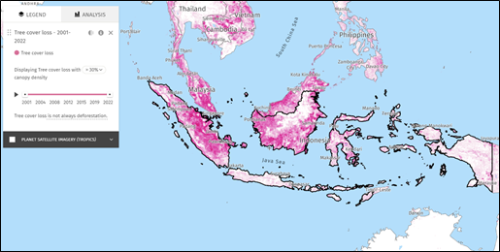
There are arguments that Infantry Fighting Vehicles (IFV) and Main Battle Tanks (MBT) are not suited to the terrain in the archipelago to the north. There has been significant development in the nations in the archipelago and southern islands of the South China sea. While there are still areas that are reached only by foot, there are over 500,000 Kilometres of road in Indonesia[24] which have also seen a reduction in jungle coverage, losing 18% of its tree cover
since 2001 (Figure 1)[25]. The Indonesian military themselves have over 100 MBTs and are currently adding more tanks to their military. In 1942 less than 50 light and medium tanks made a significant impact to the Japanese advance against a numerically superior force leading to the fall of Singapore.[26] While there would be challenges for heavy armour in the wet season and in areas of jungle, there remains a credible risk of PRC using its powerful amphibious force in the northern archipelago.
The PRC may decide to occupy a location in the archipelago to protect a flank in a conflict with the US, control global sea lines of communication through a key straight, or base forces to enable strike against Australia’s north. To achieve this, they would likely use one of their amphibious brigade which has the mass to dominate a local area. An amphibious brigade would be challenging to dislodge with Australia’s limited long-range strike options due to the number of targets an amphibious brigade presents. The PRC Peoples Liberation Army Land Force (PLALF) currently fields six amphibious Brigades and is rapidly expanding their Peoples Liberation Army Navy Marine Corps (PLANMC) brigade’s with the following force structure:
- Four combined arms battalions, each with two amphibious assault gun companies, two amphibious mechanized infantry companies, and a firepower company.
- One reconnaissance battalion with amphibious recon vehicles.
- One artillery battalion with amphibious 122mm howitzers, tracked 122mm rocket launchers, and anti-tank guided missile systems.
- One air defence battalion with tracked anti-aircraft gun systems, short-range surface-to-air missile systems, and MANPADs.[27]
If the limited Australian A2AD resources failed to dislodge a PRC amphibious brigade and the ADF was called to deploy its one mechanised brigade it would consist of:
- One armoured battalion with three companies of M1A2 SEP3 MBT
- Two Infantry Battalions – Three Companies mechanised infantry of redback infantry fighting Vehicles. Three companies mechanised infantry of Bushmaster PMV.
- One reconnaissance battalion with three companies of Boxer Combat Reconnaissance Vehicles
- One Artillery Battalion with companies of Huntsman 155 SPH and HIMARS Rockets
- One air defence battalion with three companies of NASAMS and other air defence capabilities.
- A combat aviation battalion comprising of AH-64 Apache Attack Helicopter, UH-60M Black Hawk and CH-47 Chinook Air Mobility Helicopters.[28]
The three PMV motorised companies cannot survive the 0-400m close fight and would be limited to rear area security for the Brigade combat service support.
From a quantitative comparison the most combined arms combat weight comes from mechanised infantry. Here the PRC would field eight mechanised infantry companies compared to Australia’s three. In total combined arms teams Australia would field two battalion sized combined arms teams where PRC would field four. While Australian platforms are equal or better than those from the PRC, this is an insurmountable challenge and means the Australian mechanised brigade would not be effective against a PRC amphibious brigade due to the lack of IFVs.
This paper recommends that Australia acquire the originally planned 450 vehicles. This would provide a broad force design enabling security and protection of A2AD nodes, four mechanised infantry battalions on the Redback IFV[29] assessed as equal or better than the PRC ZBD-05[30]. This would allow rotation of forces allowing Australia to maintain a brigade combat effective for longer. With the capability overmatch in other platforms in the brigade and the higher professionalism and training, Australia would have a broad land force structure to handle unforeseen contingencies.
Conclusion
The 2023 Defence Strategic Review (DSR) proposes a force design intended to navigate the complexities of the upcoming two decades, marked by unpredictable strategic challenges and potential conflict with the PRC. This paper argues that while the DSR attempts to align Australia's defence capabilities with perceived future threats, it does not provide a broad enough force design in several critical areas, thus not fully meeting the demands over the next twenty years.
Firstly, the DSR's emphasis on denial, focusing largely on Anti-Access/Area Denial (A2AD), is too narrow. This approach is heavily reliant on assumptions about the PRC, allies, and global partners that have historically been proven inaccurate. The DSR underestimates the necessity of a broad force design capable of mitigating risks associated with these uncertainties. While it aims to provide clarity and direction, the focused force design lacks the flexibility and agility needed to respond to unforeseen challenges.
Secondly, the A2AD strategy's is not viable due to the absence of a survivable long-range strike capability until the expected introduction of SSNs in 2040. Although efforts to enhance long-range strike capabilities through acquisitions such as the JASSM-ER and Tomahawk missiles are underway, these platforms face survivability challenges in contested environments. The acquisition of B-21 Bombers, recommended by this paper, would address this gap by providing a viable long-range strike option a decade prior to the SSNs, significantly enhancing Australia's strategic posture.
Thirdly, the DSR's narrow focus extends to the land domain, which is inadequately prepared for potential engagements with PRC amphibious forces. The limited A2AD capabilities and the proposed reduction in the acquisition of Infantry Fighting Vehicles (IFVs) leave Australia vulnerable to amphibious assaults. This paper suggests that adhering to the original plan of acquiring 450 IFVs would significantly bolster Australia's capability to protect A2AD nodes and offer a more resilient force structure if it was ever required to engage a PRC amphibious brigade.
In conclusion, while the DSR outlines a strategic vision for Australia's defence, it critically overlooks the importance of flexibility, agility, and broad force design in addressing the multifaceted challenges of the next two decades. To ensure Australia's defence force is adequately postured to meet growing strategic challenges, it must diversify its capabilities beyond a narrow focus on A2AD, incorporate survivable long-range strike options before 2040, and enhance its land domain strategies to counter a wider array of potential threats.
“Defence Strategic Review Terms of Reference for the Independent Leads of the Review.” https://www.pm.gov.au/media/defence-strategic-review
Tian, Yew Lun. “China Will Never Renounce Right to Use Force over Taiwan.” Reuters, October 16, 2022. China. https://www.reuters.com/world/china/xi-china-will-never-renounce-right-use-force-over-taiwan-2022-10-16/
“Defense Policy - Ministry of National Defense.” http://eng.mod.gov.cn/xb/DefensePolicy/index.html
Mitter, Rana, and Elsbeth Johnson. “What the West Gets Wrong About China.” Harvard Business Review, May 1, 2021. https://hbr.org/2021/05/what-the-west-gets-wrong-about-china
Babbage, Ross. The next Major War: Can the US and Its Allies Win against China? Amherst, New York: Cambria Press, 2023
“National Defence, Defence Strategic Review”
“The Importance Of Strategically Focused Force Design | Future Forge.” Accessed April 7, 2024. https://theforge.defence.gov.au/article/importance-strategically-focused-force-design.
Macgregor, Douglas. “Thoughts on Force Design in an Era of Shrinking Defence Budgets.” Joint Force Quarterly, no. 63 (Quarter 2011).
“Battle of France | History, Summary, Maps, & Combatants | Britannica,” March 9, 2024. https://www.britannica.com/event/Battle-of-France-World-War-II
“US Approves JASSM ER Sale to Australia - Australian Defence Magazine.” https://www.australiandefence.com.au/defence/joint/us-approves-jassm-er-sale-to-australia
Gloury, Darren. “Should Australia’s Navy Have More Hobart-Class Air Warfare Destroyers?” The Strategist, September 16, 2021. https://www.aspistrategist.org.au/should-australias-navy-have-more-hobart-class-air-warfare-destroyers/
Beardsworth, James. “Explainer: Is Russia Running Low on Missiles?” The Moscow Times, May 17, 2022. https://www.themoscowtimes.com/2022/05/17/explainer-is-russia-running-low-on-missiles-a77704
Department of Defence. “Medium Range Ground-Based Air Defence | Defence.” Website. Accessed April 3, 2024. https://www.defence.gov.au/defence-activities/projects/medium-range-ground-based-air-defence
Marcus Hellyer, and Andrew Nicholls. “Impactful Projection’: Long-Range Strike Options for Australia.” ASPI, December 2022. Page 11 https://www.aspi.org.au/report/impactful-projection-long-range-strike-options-australia.
Perrett, Bradley. “A Guide to Australia’s Planned Strike Missiles.” The Strategist, June 29, 2023. https://www.aspistrategist.org.au/a-guide-to-australias-planned-strike-missiles/
“Australia Invests in Powerful New High-Tech Missiles,” August 21, 2023. https://www.minister.defence.gov.au/media-releases/2023-08-21/australia-invests-powerful-new-high-tech-missiles
“Joint Media Statement: Australia to Pursue Nuclear-Powered Submarines through New Trilateral Enhanced Security Partnership,” September 16, 2021, https://www.minister.defence.gov.au/statements/2021-09-16/joint-media-statement-australia-pursue-nuclear-powered-submarines-through-new-trilateral-enhanced-security-partnership
“Optimal Pathway,” January 30, 2024, https://www.asa.gov.au/aukus/optimal-pathway
Creighton, Adam. “Construction of Virginia Class Submarines Is Running Two to Three Years Late.” The Australian, April 4, 2024. https://www.theaustralian.com.au/world/construction-of-virginia-class-submarines-is-running-two-to-three-years-late/news-story/7f38f57cfba4079709aa5fb2814fff7a
Marrow, Michael. “B-21 Raider Stealth Bomber in Production,.” Breaking Defense (blog), January 22, 2024. https://breakingdefense.sites.breakingmedia.com/2024/01/b-21-raider-stealth-bomber-in-production-pentagon-says/
Stone, Mike, and David Swanson. “US Air Force’s New B-21 Raider Takes First Flight.” Reuters, November 11, 2023, sec. Aerospace & Defense. https://www.reuters.com/business/aerospace-defense/us-air-forces-new-b-21-raider-flying-wing-bomber-takes-first-flight-reuters-2023-11-10/
Worlddata.info. “Transport and Infrastructure in Indonesia.” https://www.worlddata.info/asia/indonesia/transport.php
Vizzuality. “Indonesia Interactive Forest Map & Tree Cover Change Data | GFW.” https://www.globalforestwatch.org/map/country/IDN/
Bayly, Christopher Alan, and Timothy N. Harper. Forgotten Wars: Freedom and Revolution in Southeast Asia. First Harvard University Press paperback edition. Cambridge, Massachusetts: The @Belknap Press of Harvard University Press, 2010.
Blasko, Dennis J. “The PLA Army Amphibious Force.” China Maritime Report No 20. CMSI China Maritime Reports, 2022
Commonwealth of Australia, Department of Defence; “Major changes to Army announced | Defence.” https://www.defence.gov.au/news-events/news/2023-09-28/major-changes-army-announced
“ODIN - OE Data Integration Network.” https://odin.tradoc.army.mil/Search/WEG
1 “Defence Strategic Review Terms of Reference for the Independent Leads of the Review.” https://www.pm.gov.au/media/defence-strategic-review
2 Tian, Yew Lun. “China Will Never Renounce Right to Use Force over Taiwan.” Reuters, October 16, 2022. China. https://www.reuters.com/world/china/xi-china-will-never-renounce-right-use-force-over-taiwan-2022-10-16/
3 “Defense Policy - Ministry of National Defense.” http://eng.mod.gov.cn/xb/DefensePolicy/index.html
4 Mitter, Rana, and Elsbeth Johnson. “What the West Gets Wrong About China.” Harvard Business Review, May 1, 2021. https://hbr.org/2021/05/what-the-west-gets-wrong-about-china
5 Babbage, Ross. The next Major War: Can the US and Its Allies Win against China? Amherst, New York: Cambria Press, 2023.
6 “National Defence, Defence Strategic Review,” Page 53
7 “The Importance Of Strategically Focused Force Design | Future Forge.” Accessed April 7, 2024. https://theforge.defence.gov.au/article/importance-strategically-focused-force-design.
8 Macgregor, Douglas. “Thoughts on Force Design in an Era of Shrinking Defence Budgets.” Joint Force Quarterly, no. 63 (Quarter 2011).
9 “Battle of France | History, Summary, Maps, & Combatants | Britannica,” March 9, 2024. https://www.britannica.com/event/Battle-of-France-World-War-II
10 “National Defence, Defence Strategic Review,” Para 7.1
11 “US Approves JASSM ER Sale to Australia - Australian Defence Magazine.” Accessed April 5, 2024. https://www.australiandefence.com.au/defence/joint/us-approves-jassm-er-sale-to-australia
12 Gloury, Darren. “Should Australia’s Navy Have More Hobart-Class Air Warfare Destroyers?” The Strategist, September 16, 2021. https://www.aspistrategist.org.au/should-australias-navy-have-more-hobart-class-air-warfare-destroyers/
13 Beardsworth, James. “Explainer: Is Russia Running Low on Missiles?” The Moscow Times, May 17, 2022. https://www.themoscowtimes.com/2022/05/17/explainer-is-russia-running-low-on-missiles-a77704
14 “National Defence, Defence Strategic Review,” Page 49
15 Department of Defence. “Medium Range Ground-Based Air Defence | Defence.” Website. Accessed April 3, 2024. https://www.defence.gov.au/defence-activities/projects/medium-range-ground-based-air-defence
16 Marcus Hellyer, and Andrew Nicholls. “Impactful Projection’: Long-Range Strike Options for Australia.” ASPI, December 2022. Page 11 https://www.aspi.org.au/report/impactful-projection-long-range-strike-options-australia.
17 Perrett, Bradley. “A Guide to Australia’s Planned Strike Missiles.” The Strategist, June 29, 2023. https://www.aspistrategist.org.au/a-guide-to-australias-planned-strike-missiles/
18 “Australia Invests in Powerful New High-Tech Missiles,” August 21, 2023. https://www.minister.defence.gov.au/media-releases/2023-08-21/australia-invests-powerful-new-high-tech-missiles
19 “Joint Media Statement: Australia to Pursue Nuclear-Powered Submarines through New Trilateral Enhanced Security Partnership,” September 16, 2021, https://www.minister.defence.gov.au/statements/2021-09-16/joint-media-statement-australia-pursue-nuclear-powered-submarines-through-new-trilateral-enhanced-security-partnership
20 “Optimal Pathway,” January 30, 2024, https://www.asa.gov.au/aukus/optimal-pathway
21 Creighton, Adam. “Construction of Virginia Class Submarines Is Running Two to Three Years Late.” The Australian, April 4, 2024. https://www.theaustralian.com.au/world/construction-of-virginia-class-submarines-is-running-two-to-three-years-late/news-story/7f38f57cfba4079709aa5fb2814fff7a
22 Marrow, Michael. “B-21 Raider Stealth Bomber in Production,.” Breaking Defense (blog), January 22, 2024. https://breakingdefense.sites.breakingmedia.com/2024/01/b-21-raider-stealth-bomber-in-production-pentagon-says/
23 Stone, Mike, and David Swanson. “US Air Force’s New B-21 Raider Takes First Flight.” Reuters, November 11, 2023, sec. Aerospace & Defense. https://www.reuters.com/business/aerospace-defense/us-air-forces-new-b-21-raider-flying-wing-bomber-takes-first-flight-reuters-2023-11-10/
24 Worlddata.info. “Transport and Infrastructure in Indonesia.” https://www.worlddata.info/asia/indonesia/transport.php
25 Vizzuality. “Indonesia Interactive Forest Map & Tree Cover Change Data | GFW.” https://www.globalforestwatch.org/map/country/IDN/
26 Bayly, Christopher Alan, and Timothy N. Harper. Forgotten Wars: Freedom and Revolution in Southeast Asia. First Harvard University Press paperback edition. Cambridge, Massachusetts: The @Belknap Press of Harvard University Press, 2010.
27 Blasko, Dennis J. “The PLA Army Amphibious Force.” China Maritime Report No 20. CMSI China Maritime Reports, 2022
28 Commonwealth of Australia, Department of Defence; “Major changes to Army announced | | Defence.” Website. https://www.defence.gov.au/news-events/news/2023-09-28/major-changes-army-announced
29 “ODIN - OE Data Integration Network.” https://odin.tradoc.army.mil/Search/WEG/k21
30 “ODIN - OE Data Integration Network.” https://odin.tradoc.army.mil/WEG/Asset/ZBD-05_(ZBD-2000)_Chinese_Amphibious_Infantry_Fighting_Vehicle

Major Danny Roberts is an Infantry Officer and graduate of the Australian Command and Staff Course (Military Art)-Part Time (formally ACSC-Remote) class of 2024. He is currently posted to the Defence People Group, where he works in Reserve Officer Career Management – Army.
Perspectives – Case Study 3 © 2026 by . This work is licensed under CC BY-NC-ND



Please let us know if you have discovered an issue with the content on this page.
Comments
Start the conversation by sharing your thoughts! Please login to comment. If you don't yet have an account registration is quick and easy.